
The death of Marcus Aurelius in 180 and the subsequent 12-year rule of his violent and erratic son Commodus ended the era of Pax Romana (the “Peace of Rome”). With the assassination of Commodus on New Year’s Eve 192, many Romans no doubt hoped 193 would bring a restoration of peace and stability. That was not to be so. Indeed, the new year was so tumultuous that it would become known in Roman history as the Year of the Five Emperors.
The elite unit of imperial bodyguards known as the Praetorian Guard arranged for an army officer named Pertinax to succeed Commodus as Emperor. We know that money played a role; Pertinax offered a tidy sum of 12,000 sestertii each to the guardsmen, but it was done in the more typical way (quietly and behind the scenes). After 87 days in which Pertinax attempted to clean house of Praetorian corruption, the dissatisfied Guard stabbed and beheaded the would-be reformer. That set the stage for an act so brazen in its scope that the next emperor would be remembered primarily for that, and for not much more.
Knowing the Praetorian Guard could be bought, two men appeared at its headquarters and presented themselves as rival claimants for the Roman throne. One was Titus Flavius Sulpicianus, who was the father-in-law of the deceased Pertinax. The other was 60-year-old Didius Julianus, who had distinguished himself in both politics and the military. In his Chronicle of the Roman Emperors, historian Chris Scarre notes,
No attempt was made to hide the nature of the negotiations: the Praetorians stationed heralds on the walls to announce that the position of emperor was up for sale … The bidding went on for some time, but eventually the soldiers’ choice fell on Didius Julianus. He not only bid the higher price, but also warned them that if they elected Sulpicianus they might expect revenge at his hands for the murder of Pertinax.
This notorious “Auction of the Empire”, as Edward Gibbon would call it centuries later, was described by another historian who was alive and writing as it happened, Cassius Dio (155-235 A.D.). In his 80-volume history of Rome, he described the scandalous episode this way:
So when he [Didius Julianus] heard of the death of Pertinax, he hastily made his way to the imperial throne. Then ensued a most disgraceful business and one unworthy of Rome. For, just as if it had been in some market or auction-room, both the city and its entire empire were auctioned off. The sellers were the ones who had slain their previous emperor, and the would-be buyers were Sulpicianus and Didius Julianus, who vied to outbid each other … They gradually raised their bids up to 20,000 sestertii for each soldier. Some of the soldiers would carry word to Julianus, “Sulpicianus offers so much; how much more do you make it?” And to Sulpicianus in turn, “Julianus promises so much; how much more do you raise him?” Sulpicianus would have won the day, being prefect of the city and also the first to name the figure 20,000, had not Julianus raised his bid by a whole 5,000 at one time, shouting the sum out in a loud voice and indicating the amount with his fingers.
Sold! One gigantic empire and the top position in it — for a mere 25,000 sestertii per guardsman, or approximately the value at the time of ten horses.
Upon assuming the mantle of Emperor, Didius Julianus devalued the currency by reducing the precious metal content of Roman coinage. But not even that measure made the price he offered affordable to him. He never fully coughed up what he promised. After 66 days in power, he met the same fate as his predecessor — assassination at the hands of disgruntled Praetorians.
“But what evil have I done?” he is said to have cried with his last words. “Whom have I killed?”
Before the year was over, three other men would attempt to claim the title of Emperor until one man emerged as the unquestioned ruler — Severus.
The Year of the Five Emperors was drenched in power lust, scandal and blood. For the Empire, it was mostly downhill from there. When it fell to foreign invasion in 476, many Romans welcomed the invaders because they figured they couldn’t be worse than their own rulers.
And, sadly, they were probably right.
Lawrence W. Reed, “Didius Julianus: The Roman Emperor Who Bought the Imperial Throne – and Paid With His Life”, Foundation for Economic Education, 2021-08-11.
October 1, 2026
QotD: The “auction of the empire” – Didius Julianus buys the highest office for himself
September 13, 2026
QotD: Naming “Cathay”
You may think you’ve never heard of the Khitans (Chinese: 契丹 or “qidan“), but you probably have, albeit indirectly. “Khitan” is their ethnonym within their own proto-Mongolic branch of the Altaic languages. In the Turkic languages a little further West, the same people are called “Khitai“. A splinter group of the Khitans who settled in Dzhungaria and Transoxiana called themselves the “Kara-Khitai” (Black Khitans), a name that should be instantly recognizable to anybody who played Age of Empires II. If you prefer Paradox map-painting games to more traditional RTS, they do also show up in the Crusader Kings series, resulting in memes like this one. Oh dear, where was I? Right, the Khitans. The word “Khitai“, via a continent-wide game of Chinese whispers (get it?), became “Cathay”, which the confused Europeans took as the name of the Middle Kingdom itself, finally resulting in the birth of a wonderful airline.
Right, the Khitans. There they were, grazing their flocks on the Greater Khingan Mountains, just bein’ a horde, doing horde stuff. Suddenly, opportunity fell into their laps: the Tang empire was unravelling. The bustling cities and ports of Northeastern China were sitting right there, defenseless, full of gold, and skilled craftsmen, and all the soft and delicate sensuality of settled life. It was about to happen again, right? The nomadic horsemen riding in from the wild steppe, pillaging the effete townspeople and becoming their masters, only to succumb to pleasure and become effete in turn, the endless cycle of history? How could it be avoided? Here is how Mote (yes, we’ve finally gotten to the book) describes their Catch-22:
… the Khitans probably saw quite clearly that when a steppe people by degrees gave up its nomadic mobility in exchange for the more comfortable sedentary life, it ran great risks of having to compete with the Chinese on their ground. Losing in that way their comparative advantage inevitably cost the nomads their cultural integrity; they slowly became just “little Chinese” … no steppe people on China’s borders could become sinified and survive, except by migrating into China and being absorbed — another form of extinction … the warning to nomadic peoples was clear: they must master the art of drawing resources from China without sacrificing their steppe integrity … The wealth that could be wrung from it could give mastery over all Inner Asia.
The Khitan response to this pickle was unlike any I’ve ever heard. Roughly half of the Khitan aristocracy, including the royal clan, immediately adopted Chinese customs,1 moved to the city, and began building a bureaucracy. The other half, including the clan that Khitan kings traditionally picked their wives from, stayed in the steppe and had nothing to do with any of this. They then established two governments, two sets of laws,2 two taxation regimes, two writing systems, two of everything. One was civilized, the other was barbarian. Two completely incompatible social structures living side-by-side, passing through each other, but never interacting. Like dark matter, or like life-forms with mirror chirality. As a Khitan subject, you belonged to just one of these systems (if you were low class, you were sometimes allowed to pick!), and only that system had any authority over you.
The only point of official contact between the two worlds was at the top, where the Khitan king spent half the year reigning as a Chinese-style emperor, and half of it touring around his nomadic subjects as Great Khan in a mobile court. The Khitans recognized that although the king was theoretically 50-50, extended exposure to civilization would tend to Sinify him over time, and his descendants even more so. This is why they mandated that every empress was a pure-strain barbarian from a wild clan. They expected these formidable women to wield influence over their sons and to ensure that as the years rolled past and the royal clan grew more and more Chinese, they would be replenished each generation with the barbarian perspective of their mothers. This totally worked, but also resulted in no end of conflict between the empresses and their palace retainers, who exemplified different worlds.3
Sometimes you read about a social or legal system, and you are just certain that it could not be stable. I had this reaction reading about the Spartan diarchy as a kid, and I had it again reading about the Khitans last year. But their system not only endured, it flourished, and eventually turned into the Liao Dynasty which ruled China for centuries. And it functioned basically as it said it would on the tin — the civilized parts of their empire keeping things efficient and organized, supporting craftsmen and tradespeople; while the Strategic Nomad Reserve was always there ready to be called on in times of war, and prevented the administration from getting too soft and decadent.
John Psmith, “REVIEW: Imperial China, by F.W. Mote”, Mr. and Mrs. Psmith’s Bookshelf, 2025-02-24.
- The decisive thing they actually did was to adopt surnames, which as James C. Scott will tell you is about the most forceful possible way to reject your barbarian heritage.
- The differences in laws could be extreme. For instance, under Chinese law, as in most “civilized” places, treason was punished with ultimate severity and brutality. But in many “barbarian” cultures, treason isn’t actually a huge deal (almost akin to a playground fight) and defeated rebels are customarily forgiven. The Khitans, again, simply did both. Traitors were executed if they lived under city law, and received amnesty if they were under tribal law.
- One such an empress, upon the death of her husband, was asked by a Chinese courtier if she would follow ancient custom and be buried alongside him. She responded: “I of course do not refuse to join the Emperor underground, but my children are young and the country has no leader, so I am not free to do that”. Then she ordered that her right hand be severed at the wrist to represent her within her husband’s tomb.
September 5, 2026
QotD: The first (of many) near-death experiences of William Marshal, the greatest knight
He would have been far from the first child to die on Stephen’s account, because at this point England was fourteen years into a civil war so brutal that the Peterborough Chronicle recorded that men “said openly that Christ slept” (þa sæden openlice ðæt Crist slep. ⁊ his halechen),1 but this time was different. This time, the king had to order the boy’s death himself.
The medieval English royal succession was never as neat as Crusader Kings mechanics would have you believe, but even so Stephen I (and only) was an unlikely king. His mother Adela was the youngest child of William the Conqueror. She had four older brothers, three of whom survived their father, and Stephen himself was the third of her sons. But the Conqueror’s eldest son, Robert Curthose, mortgaged his duchy of Normandy to fund his participation in the First Crusade and would go on to spend the decades after his return in comfortable captivity. His second son, Richard, was killed as a teenager in a hunting accident in the New Forest in 1070, and his third son, William Rufus, succeeded him as king, never married, and was also killed in a hunting accident in the New Forest (this time in 1100). If this seems suspiciously convenient, it was: the youngest brother, Henry, was also on the fatal hunting trip. He immediately rode hard for Winchester, where he was crowned three days later.
Henry I promptly married Matilda, whose father was the king of Scotland and whose mother Margaret (later canonized by Innocent IV) was the sister of Edgar Ætheling: Henry and Matilda’s son William, born in 1103, united the blood of the Norman conquerors and the old Anglo-Saxon House of Wessex. Their daughter, another Matilda, was sent off to Germany at the age of eight to marry the twenty four-year-old Holy Roman Emperor Henry V. And that was it: Henry I also fathered at least twenty-two attested bastards, but William and Matilda were his only legitimate children. Which meant that when a drunken helmsman wrecked the ship carrying William and at least three hundred other flowers of the Anglo-Norman nobility across the Channel, Henry was in deep trouble. Luckily for him, his daughter soon returned from Germany a childless widow and once he had remarried her to Geoffrey of Anjou he was able to browbeat his barons into accepting her as his heir. Unluckily for him, they didn’t mean it: Empress Matilda was deeply unpopular even beyond the fact that she was a woman, and as soon as Henry died they were happy to crown his nephew Stephen instead.
The ensuing civil war, known to history as “the Anarchy,” was exciting and dramatic and featured such moments as a king captured on the battlefield, a queen climbing out the window of a besieged castle and escaping through a snowstorm, and a teenage boy invading England with a mercenary army he couldn’t afford to pay. For our purposes, though, all you really need to know is that in 1152 Stephen laid siege to a castle in Berkshire that John Marshal, a supporter of Matilda, had built without royal authorization. (These are apparently called “adulterine castles“, which I think is delightful.) Marshal asked for a truce to consult with his constable and organize the garrison’s surrender and offered his youngest son William as a hostage for his good behavior. Stephen accepted, took the boy into his camp, and withdrew to let Marshal enter with his men.
And then John Marshal stayed in the newly-reinforced castle instead.
Using your children as diplomatic hostages was standard practice in this era. Abandoning them to be executed as punishment for your bad faith was definitely not. But when Stephen’s men told John Marshal that his son’s life would be forfeit for his treachery, Marshal is said to have replied that he didn’t care, because he still had “the anvils and the hammers to forge even finer ones”. Stephen was not, in the end, able to bring himself to kill young William: the story has it that he lost his nerve when the boy asked on his way to the gallows whether he could play with a guard’s spear “afterwards”, and then again when William happily climbed into the catapult they planned to use to send him over the walls to his father (he thought it was a swing). He did, however, remain a hostage in Stephen’s camp until the end of the war a year later.2
Our only source for this story of William’s childhood, and for most of the truly excellent stories medievalist Thomas Asbridge recounts in The Greatest Knight, is a 19,215 line rhyming poem in medieval French. Probably composed a few years after William Marshal’s death at the behest of his friends or children, and pretty well corroborated by other sources where other sources exist, the poem is our only surviving example of a medieval biography of a “normal” person. (Relatively speaking; that little boy grew up to be an incredibly accomplished man but neither a king nor a saint, which is who usually got written about.) Moreover, it seems to have been compiled from stories told by people who actually knew him — which probably means that he was the one who told them about the child who thought the catapult was a swing. The poem exists in only one manuscript,3 discovered by Paul Meyer in the late 19th century and published with partial translations into modern French as L’histoire de Guillaume le Maréchal. (You can find Meyer’s version here or here.) More recently, Nigel Bryant published a full English translation, the text of which isn’t available online, though I’ll point out that even Claude Sonnet does a pretty decent job with screencaps of the original.4
Jane Psmith, “REVIEW: The Greatest Knight by Thomas Asbridge”, Mr. and Mrs. Psmith’s Bookshelf, 2026-04-27.
- As a measure of the degradation of the times, the chroniclers’ English no longer employed grammatical gender.
The ⁊ is a Tironian note for “and”, incidentally, and halechen is obviously cognate with “hallowed”. Like and subscribe for more Old English in the least expected places.
- Stephen’s son and heir Eustace having died by this point, it was agreed that he would keep the English throne but be succeeded by Matilda’s son, the future Henry II, who had already conquered Stephen’s duchy of Normandy.
- Yes, like Beowulf. It’s depressing to realize how many incredible medieval texts survive in only one manuscript. Thank a Benedictine today!
- Claim not verified by anyone who actually reads medieval French, but I didn’t see any obvious errors.
August 10, 2026
QotD: Cleopatra’s relationship with Egypt and her Egyptian subjects
The factors usually pointed at to demonstrate Cleopatra’s attachment to Egypt are that she learned the language, engaged with Egyptian religion and represented herself in Egyptian fashion in royal artwork and commemoration meant for consumption in Egypt. And that’s true, she did those things! But the context often missing from using that as a clear indicator of Cleopatra’s cultural “Egyptianness” is that, apart from learning the language, those were common things for Ptolemaic rulers to do, despite the fact that the dynasty maintained a pronounced ethnic hierarchy in Egypt and aren’t generally regarded as being particularly attached to its people or culture. Nevertheless, there’s not nothing here in the sense that Cleopatra showed – or at least wanted to show – more than the normal Ptolemaic attachment to Egypt as a place and the Egyptians as people, which is to say almost any at all.
Let’s start with languages, because I think this fact can be presented in a somewhat distorted way. The language of the Ptolemaic court was Greek, initially Macedonian Greek (the Macedonians had a pronounced accent), though Plutarch notes that some of the later Ptolemies had lost their Macedonian accent (Plut. Ant. 27.3-4). Cleopatra, by contrast, was the first of the Ptolemies to bother to learn Egyptian (which should tell you something about the character of Ptolemaic rule; imagine if King Charles was the first English king since George I and kings from the House of Hanover to bother to learn English). The problem with this fact is that it is incomplete, presenting Cleopatra as a Greek-speaker who learned the language of her people out of sincere devotion, but that’s not what Plutarch says. Plutarch says:
She could turn [her voice] easily to whichever language she wished and she conversed with few barbarians entirely through an interpreter, and she gave her decisions herself to most of them, including Ethiopians, Troglodytes, Hebrews, Arabians, Syrians, Medes and Parthians. She is said to have learned the languages of many others also, although the kings before her did not undertake to learn the Egyptian language, even though some of them had abandoned the Macedonian dialect.1
So let’s unpack that. This isn’t a native speaker of Greek who learned just the language of her subjects, but a spectacularly skilled linguist who learned a lot of different languages, quite regardless of if she ruled the people in question. Running through the list, she evidently learned Ethiopian, the language of the people on her southern border, the speech of the Troglodytae, the people who lived on the coast of the Red Sea (a hinterland of her kingdom). The “language of the Hebrews” here is probably Aramaic rather than Hebrew (which would also cover much of Syria), while the language of the Medes and Parthians might mean both Old Persian and the Parthian language. To which we must add Egyptian, implied by that last sentence; it also seems fairly clear Cleopatra knew at least some Latin.2 This is part of why I find arguments that use Cleopatra’s knowledge of Egyptian as strong proof either for her Egyptian ancestry or deep attachment to Egypt less than fully compelling; she was surely not Parthian and did not have a deep attachment to Parthia, but she learned their language too. Again, there’s not nothing here, but it’s not a slam dunk either.
What of Cleopatra’s role in Egyptian religion? The recent Netflix miniseries makes quite a fuss about how Cleopatra’s first action as queen – that we know of, because this is simply the first moment she is visible in the sources to us at all – is to partake in a religious festival installing a new sacred bull in a shrine at Hermonthis, close to Thebes in Upper Egypt and how this was indicative of a deep love of Egyptian religion. And it may well have been, but it’s also worth noting that Ptolemaic rulers had been taking part in Egyptian religion for a long time. Most of the massive temple complex at Philae, for instance – even farther from Alexandria than Hermonthis, I might add – was built in the Ptolemaic period, with major expansions by Ptolemy II and III. Even more relevantly to our subject, this was a [devotion] to Isis; Cleopatra was not the first Ptolemy by any means to claim that goddess for the dynasty.3
Nor had this even been a new practice for the Ptolemies. Alexander was presumably crowned pharaoh in Memphis in the traditional manner, visited the oracle of Amun at Siwa and dedicated a major set of construction works in the temple of Amun at Thebes. The Ptolemies followed this model. Ptolemy II went to Mendes to personally conduct the ritual of the process of the Ram of Mendes and then extended the temple, he presided over the inauguration of a temple at Pithom, and so on.4 And on it went with Ptolemy III and on down the line (indeed, becoming a bit more pronounced as we move into the later Ptolemies, beginning with Ptolemy V Epiphanes, potentially as a result of the increasing weakness of the Ptolemaic dynasty both internally and abroad). Ptolemaic kings were regularly in and out of Memphis, the religious capital of Egypt, building new Egyptian temples, attending Egyptian religious rituals and so on. The reason is that the job of Pharaoh was as much (if not more) a religious job as it was a political one and it was a job that only the Pharaoh could conduct. And the idea that a Ptolemaic pharaoh with a legitimacy problem might consecrate some temples to help fix that wasn’t new either; Ptolemy VIII Physcon is out doing that thing in the mid-second century. Consequently, involvement in Egyptian religion was a requirement of the position, quite apart from the question of how much the holder of that position cared.
Cleopatra, like any Ptolemaic ruler, engaged in this sort of building, though it seems striking how much of her building program was composed of Hellenistic structures in Alexandria, even as Duanne Roller admits, “the queen was not a major builder”.5 She restored the gymnasium of Alexandria, made major repairs to the Lighthouse, built a new precinct in honor of Julius Caesar called the Kaisareion, and apparently built a monumental tomb for herself, also in Alexandria. Examples of her building outside of Alexandria are fairly thin: the completion of a temple at Dendera begun by Ptolemy XII, extensions to the temple at Hermonthis (where she visited early in her reign), never entirely finished and a temple to Isis in Ptolemais Hermiou in Upper Egypt. Cleopatra could hardly be accounted the great renovator of Egyptian religion or religious sites.
Likewise the assertion that Cleopatra represented herself in Egyptian artwork in Egyptian style and dress; that too was true of all of the Ptolemaic rulers from the very beginning. Indeed, Cleopatra’s self-representation as Isis was very much not new, but in fact the normal way Ptolemaic queens were represented (to match Ptolemaic kings being represented as Osiris). Here, for instance, is Ptolemy II Philadelphos (r. 284-246) with his queen Arsinoe II represented in Egyptian style on a relief now in the British Museum.
Like all Ptolemaic rulers before her, Cleopatra presented herself in an Egyptian form, conforming to Egyptian style, in Egyptian contexts. And, like all of the Ptolemaic rulers before her, she presented herself in a Hellenistic form in Alexandria and on her coinage. While you will see people point to various busts and frescos as being images of Cleopatra, it is only her coins where we can say for certain that an effort was made to capture her likeness (her Egyptian portraiture, though labeled, follows Egyptian stylistics, not her actual likeness); we have no idea if, for instance, later Roman artists had any information about what she actually looked like or if the busts we suppose to be of her actually are. Be wary also of Greek and Roman frescos showing fair-skinned women reported to be Cleopatra; almost all women in Greek and Roman fresco are shown as fair-skinned; it’s a standard artistic convention. Coins, of course, record no skin color and neither do our sources for Cleopatra; anyone who thinks they can tell you what color her skin was is unduly certain.6
Now this isn’t to say Cleopatra is doing nothing new. She does seem to have been somewhat more involved in Egyptian religion than her predecessors, though the exact degree to which this is true is hard to see because we don’t have anything like a full accounting of their actions; if it is a difference it is a different in quantity, not kind. Certainly her building program wasn’t anywhere close to the scale of the early Ptolemies, but perhaps she took more direct personal involvement. Once again, the unknowns here are formidable. Dorothy J. Thompson in the the Cambridge Ancient History7 takes this, along with Cleopatra switching her regnal name from “philopator” (“loves-father”) to “philopatris” (“loves-homeland”8) to be indicative of a clear effort by Cleopatra to be, “indeed queen of Egypt”, particularly in the context of dynastic struggles with her brothers: outflanking them by getting the favor of the people.
The problem with this narrative is the timing: Cleopatra makes that switch in titles in 36/5 BC, which is to say in year 16 of her 21 year reign, eight or nine years after her last serious competition for the throne, her youngest brother, had died. Instead, Bingen9 argues that the homeland Cleopatra is professing love for is the greater Macedonian empire – the empire of Alexander – which she may have seemed in 36 on the verge of reclaiming.10 Antonius was just about to give her (through her children) sweeping portions of Roman Syria, Cilicia, Cyrenaica and Armenia; he would also give them titles to Medea and Parthia, which he didn’t control (though perhaps in 36 he hoped to) but would represent collectively the whole of the old Seleucid Empire near its height. Bingen notes the other change to Cleopatra’s titulature at this point was rather than just being “the goddess who loves her father” she becomes “the young goddess who loves her father and her country”; the added νεωτέρα (“young”) perhaps being intended as a link to Cleopatra Thea, Seleucid queen-consort of Syria from 150 to 126 BC and Cleopatra’s own great-grand-aunt. Cleopatra, after all, was about to achieve the long Ptolemaic dream of controlling all of Syria.
Strikingly the sources do not tell us that Cleopatra was seen as any more distinctively Egyptian than her father or that she had some groundswell of popular support in Egypt. Indeed, Cassius Dio implies the opposite (Cass. Dio 42.34-6) that the Egyptians favored Ptolemy XIII in the succession dispute and it was only the force of Caesar’s arms that turned the issue to Cleopatra. Of course we have to be somewhat skeptical of this account too: Dio is marinating in a literary tradition that is very hostile to Cleopatra and also makes no effort to distinguish between the Alexandrians and the rest of Egypt, two very distinct groups. In any case it is clear that Cleopatra achieved no groundswell of support in Egypt in those early years: she had to raise her army in Syria and in the event it wasn’t the stronger force as she and Caesar spent the winter of 48/7 besieged in Alexandria by Ptolemy XIII’s then larger army (Caesar had not brought his full field army), until the arrival of an army out of Roman Syria led by a collection of Caesar’s allies tipped the balance. Julius Caesar was never a particularly cautious commander, so if he looked at whatever force Cleopatra still had and said, “we need to wait for reinforcements”, it could not, at that point, have been very substantial. Afterwards, Caesar would leave four legions in Egypt to secure Cleopatra’s rule, which seems not to indicate her great popularity or any great faith in her ability to hold the kingdom. After 44, she’s able to rule without direct support, but of course after 44, she and her children are the only dynastic options left, her brothers and sisters all being dead (some at her hand). Finally, when Octavian comes for her, there is no major effort by anyone to stop him militarily. If Cleopatra had the love of the Egyptian people at that point, we sure don’t see it.
In my view then, it seems like an argument can be made that Cleopatra had a fairly modest propaganda effort towards presenting herself as more in touch with Egyptian religion, but the extent and quality was at most only a modest improvement over the previous Ptolemies and apart from keeping her on the throne (with Roman backing), it doesn’t seem to have achieved much.
Bret Devereaux, “Collections: On the Reign of Cleopatra”, A Collection of Unmitigated Pedantry, 2023-05-26.
- Trans. from Jones (2006).
- On this, see Roller (2010), 48-9.
- On this sanctuary and its inscriptions, see J. Bingen (2007), 31-43.
- On this, see Hölbl (2001), 77-90.
- op. cit. 108.
- Though, contra Netflix, we can say something about her hair. I was rather confused when one of their talking heads posited that he liked to imagine Cleopatra with hair like his – his hair was very tightly curly and indeed that is how the Netflix documentary opted to do Cleopatra’s hair. We can see her hair on her coins and it is wavy, pulled together into a bun in Hellenistic style with short draping curls (loose, not tight) and a Hellenistic diadem. I think it is pretty fair to suppose this is how Cleopatra actually wore her hair – or at least, how she wanted people to think she wore her hair.
- The second edition of the Cambridge Ancient History; in this case CAH2 IX, 320-1.
- Literally “loves her fatherland”. To save myself some audio pain in the future, I often hear “philopator” pronounced with the emphasis on the second syllable (phi-LOPE-a-tor), but the accent is on the alpha, phi-lo-PA-tor, because that o is an omega, a long-vowel, so the accent can fall no further back.
- op. cit., 58-62 and 76-79.
- Bingen argues that in an Egyptian context, it would have been clear that Cleopatra’s patris was, in fact, Makedon – the most prestigious and useful possible patris to have in Ptolemaic Egypt.
July 21, 2026
Frederick the Great’s 1741 book, The Anti-Machiavel
At SteynOnline, Tal Bachman continues his look at all things Machiavelli, including Prussian king Frederick the Great’s polemic against the author of The Prince:
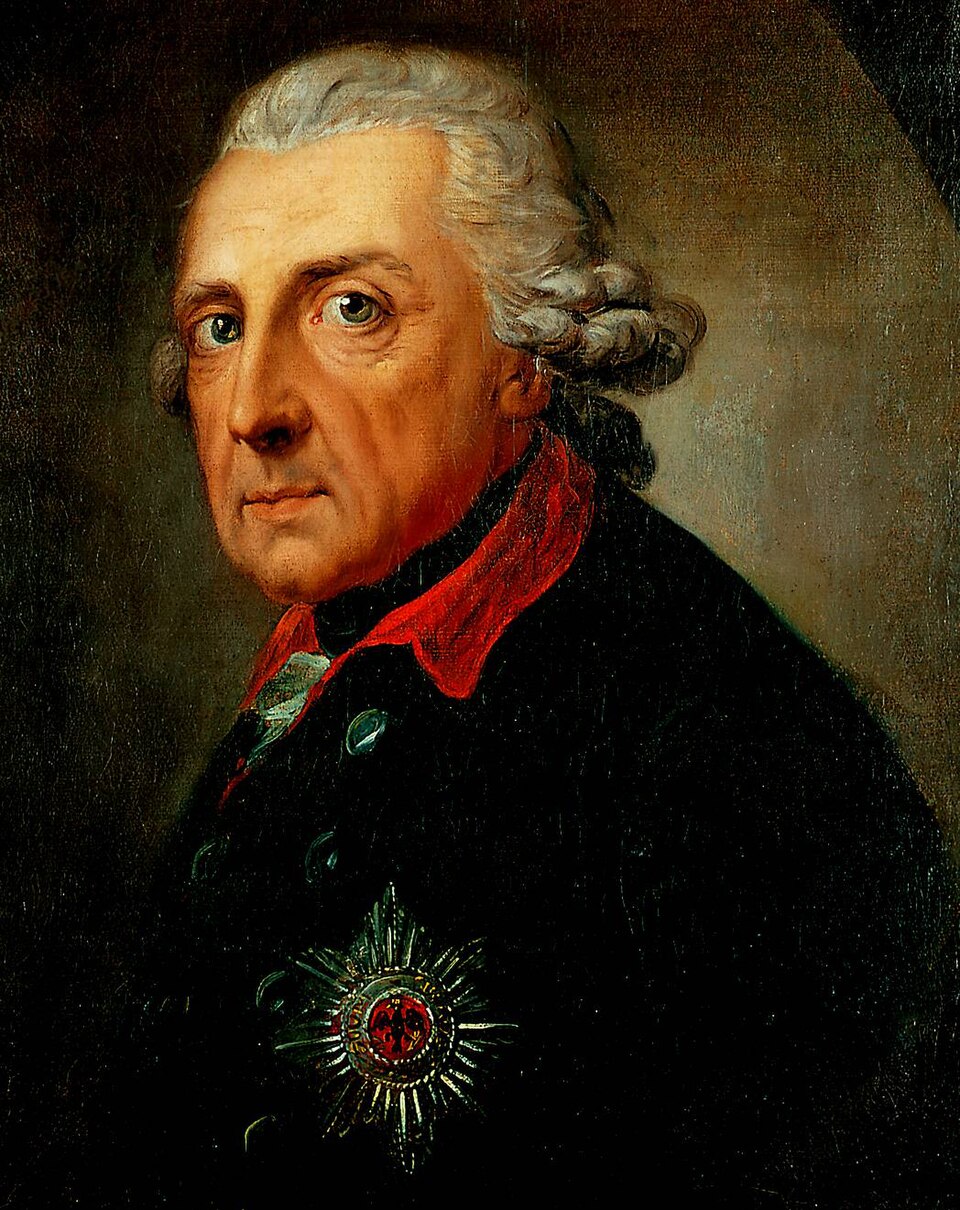
Frederick the Great, 1781
Oil portrait by Anton Graff (1736-1813) in the Sanssouci Palace collection via Wikimedia Commons.
Maybe Machiavelli’s teachings have no relevance in any remotely civilized political system. Maybe they’re far worse than irrelevant: maybe they’re all entirely evil (as they appear), and in addition, would prove the ruin of both the people and their ruler.
This was, as it happens, the view espoused by one important ruler: the Prussian king Frederick the Great. In his 1741 book, The Anti-Machiavel, he claims Machiavelli’s book is “one of the most dangerous that ever appeared in the world”, in that the political crimes it encourages would impose “a lasting misery upon whole nations”. Truly great rulers, says Frederick, aren’t the avaricious, amoral, self-serving, shape-shifting demons that Machiavelli describes. Rather, they are those “whose business it is to administer justice, and to set examples of justice to their subjects; and who, by their magnanimity, mercy, and goodness, ought to be the living images of Deity”. Thus, Frederick sees his rebuttal as “a defense of humanity against a monster who would destroy it”; it is “an antidote to poison”.
Frederick ruled Prussia for nearly 50 years. Most historians rate him a success. On the face of things, he seems like the kind of critic who knows what he’s talking about.
But Machiavelli would say, not so fast. What did Frederick do almost immediately after assuming power? Without any provocation, he launched a war to seize the large, prosperous, populous province of Silesia (now in southwestern Poland) from the Habsburg Monarchy. And he did so on a convoluted, centuries-old dynastic claim which sounded as unconvincing to his contemporaries as it does to us now. In the three Silesian wars which followed (the third turning into the Seven Years War), well over a million soldiers died fighting. Millions more wound up maimed, psychologically scarred, or otherwise ruined. Of course, millions of non-combatants also suffered: wives lost husbands, mothers and fathers lost sons, children lost fathers and uncles and brothers. Those non-combatants also suffered displacement, terror, deprivation, and injury. Over two decades, Frederick’s wars — particularly the Seven Years War — convulsed Europe. Frederick gained 30% more territory and 50% more citizens, but the cost was losing 10% of the Prussian population to combat or disease (the modern equivalent of 35 million Americans, 6 million English, or 3 million Australians). The point is: if his actions are anything to go by, Frederick didn’t oppose Machiavellian power moves as much as he professed, if at all. Machiavelli might even argue that in taking pains to proclaim his opposition to Machiavelli even as his wars of acquisition injured and killed millions, he was doing exactly what Machiavelli had advised: seeming to be good even as he was doing whatever the hell he wanted, for his own purposes. Most people will buy the act anyway, says Machiavelli, so why not?
This brings me back to Machiavelli’s claims about how rulers do in fact act, and how they must act to avoid ruin. And that in turn brings me back to the original wording of The Prince, and what real-world credibility Machiavelli might have as a political commentator.
As it happens, Machiavelli was no armchair quarterback. Even if he hadn’t spent nearly fifteen years at the highest levels of Florentine government (which he did), he might well have qualified as a political expert just by virtue of growing up in the tumultuous time and place he did. Between the jockeying Italian states, the myriad (and ever-changing) foreign alliances and enemies and designs, the political influence of the papacy, and Florence’s own internal politics, Machiavelli’s home city furnished more than enough lessons in how the political world could, and often did, operate.
July 16, 2026
QotD: The nostalgic British elements of Canadian nationalism
Britishness survives as civic nationalism. Old British Canada may be gone, but aspects of that Britishness live on. We should celebrate our history and our historic symbols, but this alternative shouldn’t set about restoring it all. A future oriented embrace of our history needs to be built around the active parts of this Britishness that have now become truly Canadian. For example, the Crown in Canada is not now just a British institution, it’s a Canadian institution. Same with our democratic institutions and parliamentary traditions, which we must work to strengthen and renew.
Embracing this enables us to thread the needle on our relationship with America. Part of what makes us different historically, culturally, ideationally, and in disposition from America, is this history. Just as Canadian Britishness has survived to the present day in unique ways, our desire not to become Americans is alive and well. A homegrown Canadian Britishness enables us to continue this without falling into crass anti-Americanism, and without requiring us to embrace the new Liberal nationalism to reject America. We should see America as an amicable cousin, but one that we are distinct and different from.
But most importantly, what this new kind of national identity needs to build around needs to be an evolution of the liberal nationalism that emphasizes and consciously builds around our regional pluralism. […] but the kind of rationalistic liberalism that our modern national identity is built around, while sold as a way of dealing with diversity, suffers from some serious internal tensions. Liberalism, especially the Canadian variant of it, implicitly depends upon and encourages a degree of homogenization that flattens hard cultural differences. We need to become more pluralistic, and less liberal.
Ben Woodfinden, “True North Patriotism and a Distinctly Canadian Conservatism”, The Dominion, 2020-10-20.
July 15, 2026
The Prince – “The only people who haven’t read it are the ones who keep losing”
I didn’t intend to turn this into Machiavelli week, but after the discussion of correctly translating “virtù“ for modern audiences, here’s Krzysztof Szczawinski with more about that famous/infamous book:
Niccolò Machiavelli wrote The Prince in 1513 as a practical manual for power. For five centuries, polite society has pretended to be shocked by it. Meanwhile, every successful political operator — on every side — has been quietly following it. The only people who haven’t read it are the ones who keep losing.
1. Machiavelli’s central insight is not that the ends justify the means. That is the misquote that lets comfortable people dismiss him. His actual insight is simpler and more disturbing: power has its own logic, independent of morality, and those who refuse to understand that logic will be defeated by those who do. The Prince is not a villain’s manual. It is a description of reality that makes virtuous people uncomfortable – because reality doesn’t care about their virtue.
2. The current progressive system applies Machiavelli more fluently than any of its opponents. His first rule: the appearance of virtue matters more than virtue itself. The DEI statement while systematically excluding dissent. The democracy rhetoric while suppressing opposition. The compassion branding while destroying careers. This is Machiavelli’s prince – not good, but performing goodness to maintain legitimacy. The performance is the power.
3. His second rule, which the current system also applies perfectly: cruelty, when necessary, should be delivered swiftly, completely, and early. Cancellation is Machiavellian – total, swift, exemplary. The point isn’t the individual being cancelled. The point is the ten thousand people watching who quietly adjust their behavior. One public destruction purchases a million private silences. Machiavelli would have recognized the mechanism immediately. He invented the theory.
4. Communism applied the fear side of Machiavelli with full conviction – Stalin made the explicit choice Machiavelli described: better to be feared than loved. The show trial is pure Machiavellian theater – a public demonstration of power functioning as a warning to everyone who isn’t on trial. But communism made his fatal mistake: it destroyed the people’s goodwill so completely that it generated not just fear but hatred. And Machiavelli is unambiguous – you can rule through fear, you cannot survive through hatred.
5. His most important democratic insight — the one nobody quotes — is that the prince who builds his power on the people is more secure than one who builds it on elites. Elites are few, demanding, and treacherous. The people are many, ask only not to be oppressed, and are a more stable foundation. The political movement that actually connects with ordinary people against the credentialed elite is applying Machiavelli more correctly than the elite relying on institutional capture alone.
6. What should we do? Stop bringing virtue to a knife fight. The chronic error of the opposition is the naive prince Machiavelli explicitly warns against – the leader who assumes truth wins automatically, who believes that being right is a strategy. It is not a strategy. It is a precondition. Being right gives you something worth fighting for. Machiavelli tells you how to fight: build your own power base, never rely entirely on others, control your narrative before your enemies do, and treat fortune as something to be seized, not waited for. Fortune favors the bold. Not the righteous. The bold.
7. Machiavelli is taught in universities as cynical amoralism – the thing decent people reject. This framing is itself Machiavellian – it keeps the manual out of the hands of the people who most need it. The current establishment didn’t reject Machiavelli. It institutionalized him, rebranded him in the language of social justice, and uses him daily. The opposition reads Augustine and loses. The system reads Machiavelli and wins. Until the side that is actually right decides that understanding power is not a betrayal of principle but a precondition for defending it – the result will be the same. Virtue without strategy is just a dignified way of losing.
Update, 16 July: Welcome, Instapundit readers! Have a look around at some of my other posts you may find of interest. I send out a daily summary of posts here through my Substack – https://substack.com/@nicholasrusson that you can subscribe to if you’d like to be informed of new posts in the future.
The Ancient Greeks 03 – Enter the Persians 3 – Darius, Ionia, and the Fragile Peace
seangabb
Published 16 Feb 2026Greece: A Brief History, c.700 BC – 500 AD
With Darius I, the Persian Empire reaches its greatest extent. This lecture explores how Darius reorganised the empire into satrapies, imposed taxation systems, and stabilised rule across vast territories. We examine Persian cultural policy, military discipline, and the integration of Greek communities within the imperial system.
But beneath the surface of order, tension grows. The Ionian Greek cities resent indirect rule through tyrants. Persian administrative logic collides with Greek political volatility. The peace is real — but unstable.
July 14, 2026
Translating “virtù” in Machiavelli’s The Prince
At SteynOnline, Tal Bachman ponders the use of the Italian word “virtù” and how best to translate it into English without losing the essence of what Machiavelli was trying to communicate:
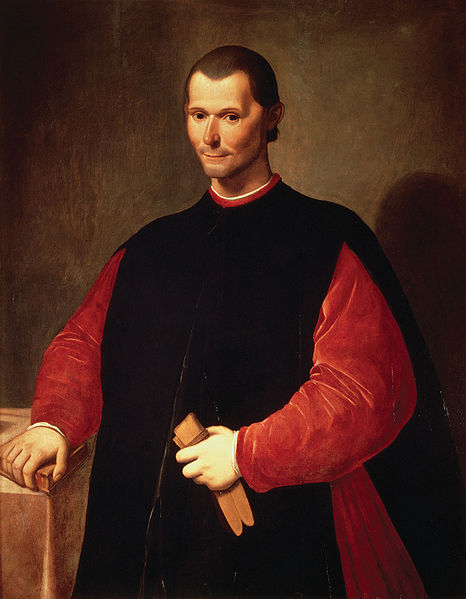
Portrait of Niccolò Machiavelli by Santi di Tito (1536-1603)
Via Wikimedia Commons.
I’d read Machiavelli’s The Prince many times. Pondered its fiendish teachings as I watched political events. Wondered how true, or at least universal, the suggestions really were. I’d even started translating the text myself a few months earlier, just for fun. Machiavelli’s Italian wasn’t all that different from Spanish, so I could get quite a bit of it. With a bit of study, I got the rest. Now, here I was, standing in the very room he’d written the book in, touching the very desk he might have used.
It was in that moment I remembered a letter Machiavelli had written once, to a friend, about writing in that very room:
When evening has come, I return to my house and go into my study. At the door I take off my clothes of the day, covered with mud and mire, and I put on my regal and courtly garments; and decently reclothed, I enter the ancient courts of ancient men, where, received by them lovingly, I feed on the food that alone is mine, and that I was born for. There, I am not ashamed to speak with them and to ask them the reason for their actions; and they in their humanity reply to me. And for the space of four hours I feel no boredom, I forget every pain, I do not fear poverty, death does not frighten me. I deliver myself entirely to them … I have composed a little work (The Prince), where I delve as deeply as I can into reflections on this subject.
The book itself opens with a quick description of the different types of states, and then concludes the first paragraph with an important sentence. New dominions, says Machiavelli, are acquired o con le armi di altri o con le proprie, o per fortuna o per virtù — that is, they’re acquired “either with the arms of others or with one’s own, either by fortune or by” — drum roll — “virtù“. That’s the word in Italian. The question is how to best translate virtù into English.
You might say, “virtue”. And you wouldn’t entirely be wrong: of course the Italian virtù and the English virtue are cognates. The problem is that in the Tuscan Italian of 1513, virtù carried important connotations which no longer exist in contemporary Italian, and don’t exist in English. “Virtue” these days, in either language, refers to an ethical attribute; it describes something good or moral. But in Renaissance Italian, it still retained an older meaning — one unaligned with anything specifically ethical. That older meaning merely described a certain kind of manly excellence, skill, power, prowess, or virtuosity: the Latin root of virtù is vir, meaning man; virility, like virtuosity, traces back to the same root. (The only remaining echo of this meaning in English or Italian, that I know of, lies in the idiom “by virtue of” — which attributes some authoritative force to something: “The agreement remained binding by virtue of state law”, or “Dan became captain by virtue of his experience”.)
To make matters even more challenging for the conscientious translator, Machiavelli pushes this older meaning to its extreme end throughout The Prince. In fact, his use — or as some might have it, his abuse — of the word virtù drives the main theme of the book.
In brief, what Machiavelli argues is that the political realm has its own rules — its own sort of morality, if it can even be called that. This morality is entirely unlike Christian morality, Aristotelian morality, or commonsense folk morality. Thus, the meaning of “virtue” and “vice” in the political realm differs from the meaning in other contexts. Failure to understand this and act accordingly will bring ruin to any aspiring ruler.
So, according to Machiavelli, a “virtuous” ruler isn’t necessarily a good man. In fact, he can’t be a good man by any normal definition; if he were, he’d inevitably fail as a ruler. After listing off some admirable moral qualities, Machiavelli says this:
It is not necessary, then, for a prince to have in fact all of the qualities written above, but it is indeed necessary to seem to have them … when these qualities are possessed and always observed, they are harmful; but when they seem to be possessed, they are useful. So it is useful to seem compassionate, faithful, kind, honest, religious … a prince cannot observe all of those things for which men are believed good, since to maintain his state he is often required to act against faith, against charity, against kindness, and against religion.
A virtuous ruler, in other words, is simply a political virtuoso: a ruler who knows what it takes to acquire and use power effectively, and has the guts to do it.
[…]
As you read through The Prince, you can almost hear Machiavelli saying, hey — I didn’t create this world. I’m just explaining how it actually works. If that’s anyone’s fault, it’s God’s — except there’s no reason to believe God even exists. And so, the aspiring ruler can and must do whatever it takes to succeed, without fear of divine disapproval.
This is Machiavelli’s conception of, or redefinition of, virtù. It is the main theme of the book. Yet as Harvey Mansfield notes in his book Machiavelli’s Virtue, often “Machiavelli’s translators have difficulty in rendering virtù“. Indeed they do, and where they don’t get it right, the reader has no chance to grasp just how radical or disturbing Machiavelli’s morality-inverting argument is. Where they do get it right, we get the chance to engage with one of history’s subtlest and most challenging political thinkers. This raises the question of whether there’s some specific set of principles which ought to guide the translation of great books, and if so, what they might be.
July 4, 2026
In the “early Victorian period … drinking whisky was the modern-day equivalent of licking hallucinogenic toads”
Scotland was terra incognita to the English for far longer than one might think, even though the two kingdoms shared a monarch as early as 1603. On his Substack, Ed West shows how modern day Scotland has long since emerged from the mysterious shadows of the past:

“Scotch whiskies” by Chris huh is licensed under CC BY-SA 4.0 

 .
.
In his highly entertaining history of alcohol and the British, Empire of Booze, Henry Jeffreys observed how one effect of the Napoleonic Wars was to make Scotland a popular destination for English holiday makers. What with the continent being isolated and everything, there weren’t many more exotic places for the richer, more adventurous traveller to visit.
The country was until then largely unknown to many people south of the border, something also true of its trademark drink. “Highland and lowland whisky in the early 19th century would have been a mystery to the majority of Englishmen”, Jeffreys writes: “In the literature of the Georgian and early Victorian period it’s apparent that drinking whisky while in Scotland was the modern-day equivalent of licking hallucinogenic toads while in the Amazon or eating rancid whale in Iceland”.
The conflict with revolutionary France proved to be a great boost to Brand Scotland, and not just because of the limits it placed on rival destinations, but also for the dash that the Scots cut on the field. This culminated with a momentous scene in which “the Highland regiments dazzled the French when the Allied armies marched into Paris”.
Here they wowed both friends and enemies alike, and Sergeant Thomas Campbell of the Grenadier Company recalled how the Tsar even personally “examined my hose, gaiters, legs, and pinched my skin, thinking I wore something under my kilt, and had the curiosity to lift my kilt up to my navel, so that he might not be deceived”. Thanks to the likes of the Black Watch and Gordon Highlanders, the Scots had arrived on the global stage, and no one would ever forget Die Damen aus der Hölle (Ladies from Hell) as German troops would later call Highlanders.
This period of upheaval and war – the birth pangs of true modernity — was marked by a growing craze for Highlandism, “a peculiar phenomenon where lowland Scotland, a predominantly settled mercantile society, took on the trappings of the Highlander as a way of differentiating themselves from Englishmen who they were now yoked to in the Union”.
Previously viewed as menacing, the Highlanders had been tamed by the defeat of the Jacobites and the Clearances that followed, making this once-feared Gaelic culture now safe for English speakers to adopt as their own. Much of this was driven by the romantic imagination of Edinburgh’s Walter Scott, who helped shape both Scottish national identity and the 19th century resurgence of medievalism. Perhaps more than literature, however, Highlandism was boosted by the region’s most famous export — whisky. As Jeffreys writes: “The growth of Scotch coincided with the birth of Highlandism”.
The development of Brand Scotland was also helped by a man widely regarded as Britain’s greatest buffoon and waste of space, the former Prince Regent. Historian John Plumb described a hugely influential visit by the now George IV in 1822, where: “He paraded Edinburgh in the kilt, resplendent in the Royal Stuart tartan and flesh-coloured tights, and yet managed to keep his dignity. The Scots loved it! Quaintly enough, George IV had struck the future note of the monarchy … Be kilted! Be sporans! Be tartans! Riding up Princess Street … To the roaring cheers of loyal Scots, he was showing the way that the monarchy would have to go if it were to survive an industrial and democratic society.”
It was the start of a beautifully symbiotic relationship, with the Royal Family immersing themselves in Highlandism ever since, spending much of their summer holidays there and helping to project an ideal of a region famed for its dramatic countryside, castles, distilleries and golf courses. They’re not alone: Donald Trump, whose mother hailed from the Isle of Lewis, has a noted fondness for the old country, even if this is not always reciprocated, and no doubt many more of his compatriots will be making the pilgrimage in the coming year thanks to the country’s newest brand ambassadors. These are, of course, another occupying force of Scots, the fans of the national football team who followed their country’s brief recent appearance at World Cup.
The Scots in Boston marched as proudly as their ancestors. Their bagpipers serenaded the opposition. Some even turned up at a wedding. They came to watch the Boston Red Sox, which one local described as “the best thing that’s happened in years”. They attracted many neutrals, including a duck. Folk songs were written about them. Everyone loved them, even if some struggled to understand them.
The Boston Globe published a full-page letter thanking them. One local reported how Scotland fans leaving Boston was “almost like a day of mourning for the Americans“. After they left, Massachusetts State Senator Paul Feeney made an emotional farewell, thanking them for visiting children’s hospitals and donating money to local charities: “You’ve been great, courteous guests, you’ve been polite and you’ve been fun and I don’t want that to end”. He invited them to return next year, by which time Glasgow will be twinned with Boston. Indeed, Scottish fans so impressed the Bostonians that the city changed its zoning laws, not an easy task in America. They may even have solved the fertility crisis. Indeed, the Tartan Army charm offensive in Boston has been so overwhelming that I half suspect it’s some sort of devious RICU operation.

June 29, 2026
King Charles disclaims the title “Defender of the Faith”
His Majesty has been hinting of his preference for Islam since at least his thirties … becoming formal head of the Church of England fits poorly with his likely personal beliefs. This isn’t really a surprise, as the Church of England has been drifting a long way from its roots for generations now, but symbolically it is quite important, as Donna-Louise Flowers writes on Substack Notes:
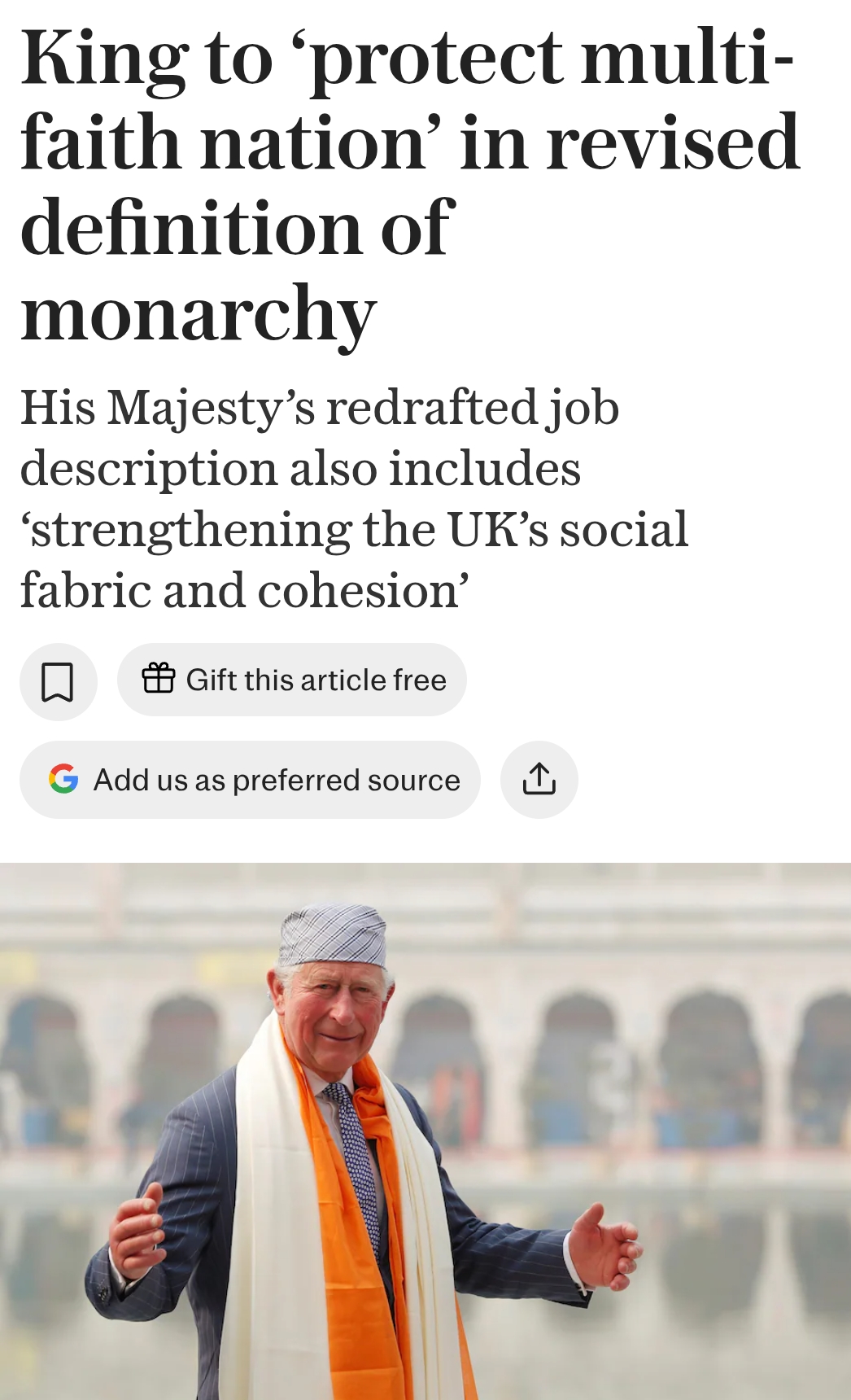
This Is the End of Britain: King Charles Just Formalised the Surrender
This is absolutely shocking. It is an absolute outrage. And it feels like the beginning of the end for Britain as we have known it.
In the latest Sovereign Grant report, Buckingham Palace has ditched the ancient title “Defender of the Faith”. No more defending the Christian foundation of this realm. Instead the King is now described as protecting “the space for Faith within the multi-faith nation”. What utter nonsense. Britain is a Christian country. That is not up for debate or negotiation. If the monarch abandons that core duty, then the institution itself has abandoned the British people.
Other faiths exist here, yes. But their presence does not require the Head of State and Supreme Governor of the Church of England to water down his role into some vague, multi-faith referee. His job is to defend the Christian faith of this nation. Full stop. Not to bend over backwards for every new arrival.
King Charles has spent decades signalling exactly this shift — praising interfaith dialogue, building ties across communities, and even calling Islam a religion of peace. Now it is baked into official Palace language. While we watch our Christian heritage eroded, churches close, and British identity dissolve, the monarchy chooses accommodation over duty.
This is more than infuriating. It is a profound betrayal. We see the reality on the ground: halal meat quietly served in the NHS and in schools to everyone — often without proper consent or even basic awareness. Islamic practices are increasingly imposed on the wider population while native Britons are expected to stay silent and pay for it. Everything is tilting. Sharia norms creep in, demands multiply, and our own traditions are treated as optional extras.
We do not fly to Saudi Arabia, Pakistan or anywhere else and demand they rewrite their entire way of life, abandon their religion, and serve us bacon sandwiches in their institutions. Why then must Britain endlessly accommodate, dilute, and apologise for existing as a Christian country? Why are we expected to change everything while others refuse any compromise?
This multi-faith rebranding is not progress. It is cultural surrender dressed up in polite language. A monarch who stands for everything stands for nothing. Britain had a specific, Christian character that allowed it to become the tolerant society it once was. Hollow that out and you do not get harmonious diversity — you get the slow erasure of the host culture.
I am deeply offended. Millions of ordinary Britons are deeply offended. This feels like the end of Britain as a coherent nation with its own history, faith and identity. The King’s role was never to manage a neutral spiritual marketplace. It was to defend the faith of this realm.
Enough of the euphemisms and the quiet capitulation. Call it what it is: a disgraceful abandonment of duty at the very top. If this continues, there will be nothing left worth defending. Britain deserves better.
Amusingly, the title “Defender of the Faith” was granted to King Henry VIII by Pope Leo X for a book (almost certainly co-written if not ghostwritten) refuting Martin Luther. King Henry “forgot” to disclaim the title when he broke with Rome a few years later …
June 17, 2026
Brewing 3,000 Year-Old Ancient Mesopotamian Beer
Tasting History with Max Miller
Published 23 Dec 2025Cloudy pomegranate beer made with honey and dates
City/Region: Assyria
Time Period: 9th Century BCEAshurnasirpal II was an Assyrian king who built an empire in a rather ruthless manner. While he’s remembered for razing cities and killing and/or maiming their inhabitants, he’s also remembered for throwing one heck of a party. When he unveiled his new palace, he invited nearly 70,000 guests to a 10 day feast, and they even wrote down the menu. He provided 10,000 jars of beer for the feast, and while some were basic beer, there were also specialty brews like this much fancier version made with pomegranates, dates, and honey.
While flat, this cloudy beer is surprisingly tasty. The flavor of the honey and pomegranate come through, but with none of the sweetness, and they combine for an oddly modern taste.
Because there are no hops to preserve the beer, it’ll only keep for up to 1 week. As with any vague ancient recipe, feel free to change the amounts of the ingredients to suit your taste.
(more…)
April 21, 2026
Ivan the Terrible – Feeding the Evil Russian Tsar
Tasting History with Max Miller
Published 14 Oct 2025Soft buns filled with cabbage, onion and dill
City/Region: Russia
Time Period: 16th CenturyIn Russian, Ivan the Terrible is Ivan Grozny, and the translation of “terrible” was meant more in the way of “fearsome” or “formidable” rather than “cruel” or “awful”, though Ivan ended up being all of those. What started off as a good reign with military victories, building Saint Basil’s Cathedral, and restricting the boyars‘ (aristocracy) power over the people descended into a reign of terror with a secret police, the massacre of a city, and even killing his eldest son in a fit of rage.
While Ivan truly was terrible, these piroshki are not. They are absolutely delicious. The bread is soft, and the filling is savory and slightly sweet with the dill really coming through. These were made with all different kinds of fillings, so feel free to try out other ingredients, like meat, fish, fruit, or other vegetables, or put in a hard boiled egg for a modern touch.
Small pies filled with mushrooms, poppy seeds, kasha, turnips, cabbage, or whatever else God sends.
When the servants bake bread, order them to set some of the dough aside, to be stuffed for piroshki.— The Domostroi, 16th Century
April 11, 2026
QotD: Kingdoms were not “nations” in the Middle Ages
It is thus a bit odd that the regions of Westeros are seen by its inhabitants as being clear and unchanging. For instance, the Reach has borders, those borders do not move and everyone in those borders is loyal to House Tyrell. This is not how medieval rule works. The borders of, say, France, shifted over time (some places we consider “obviously” part of France were added only quite late, like French Flanders or Provence) as the ability of the French king to control those regions changed. For long periods of the Middle Ages, large parts of France were effectively controlled by the Kings of England (because they were also Dukes of this or that French duchy).
The idea that France, or Germany or Italy was a distinct, permanent entity with its own existence apart from a given royal family – more than just a space on a map – which comprised a people, their language and the government of those people, this is a modern phenomenon. Indeed, one may argue, it – that is, the nation-state – is the modern phenomenon.
Bret Devereaux, “New Acquisitions: How It Wasn’t: Game of Thrones and the Middle Ages, Part III”, A Collection of Unmitigated Pedantry, 2019-06-12.
April 7, 2026
The Myth of Mooncakes: Did they topple a Chinese Dynasty?
Tasting History with Max Miller
Published 30 Sept 2025Mooncakes made with flaky pastry and a seed and nut filling, decorated with a red stamp
City/Region: China
Time Period: 1792There are many different kinds of mooncakes made all over East Asia around this time of year for the Mid-Autumn Festival. Some are savory, some are sweet, and they can have chewy, crumbly, or flaky doughs.
The flaky dough that we’re making here can be made with either lard or melted butter. Lard would have been more traditional for 1792, and it makes a more flavorful pastry, but melted butter will make a smoother dough that’s easier to work with and comes out less crumbly and more flaky.
The filling is delicious and not too sweet, with a rich unctuousness from lard, nuts, and seeds.
Imperial Scholar Liu’s Mooncake
Use flying flour from Shandong to make a flaky pastry for the crust, with pine nuts, walnuts, and melon seeds ground into a fine powder for the filling. A little rock sugar and lard are added. When eaten, it does not taste overly sweet, but instead is fragrant, flaky yet tender, and rich; a truly unique experience.
— Suiyuan Shidan by Yuan Mei, 1792


