World War Two
Published 24 Oct 2026How did the Panzer I and Panzer II help Germany defeat armies equipped with more powerful tanks? Armed with machine guns or a 20mm cannon, these little panzers helped spearhead a very big, very ugly war.
In this episode of Nazi Rearmament, Spartacus Olsson follows Germany’s early light tanks from their interwar development and the Spanish Civil War to the invasions of Poland, France, and the Soviet Union. We examine their design, armament, armor, production, and battlefield performance, and how they helped build the Panzerwaffe before more capable tanks were available in sufficient numbers.
Against opponents such as the French Char B1 bis and British Matilda II, their limitations were severe. But tank battles alone did not decide campaigns. Training, communications, concentrated mobile formations, and cooperation with infantry, engineers, artillery, and aircraft helped turn these modest vehicles into effective instruments of conquest. In France in 1940, those advantages combined with a risky German operational plan and Allied command failures to produce a devastating victory.
Their story also exposes the growing gap between Hitler’s ambitions and Germany’s industrial resources. Early victories encouraged further aggression, bringing occupation, exploitation, and mass murder to millions while drawing Germany into a war against an increasingly powerful coalition.
October 25, 2026
The Little Panzers That Said I Think I Can – Panzer I & II – Rearmament 11
October 3, 2026
QotD: How to besiege a trace italienne fortress
Areas that became densely set with trace italienne fortresses [Wiki] – particularly the towns of the Low Countries – became almost impossible to conquer. The Army of Flanders [Wiki], then arguably the finest in Europe, tried for eighty years to subdue the Dutch and largely failed: the cost of endless sieges of trace italienne fortified towns made the task effectively hopeless. Once again, I don’t want to imply that this is the only factor (it isn’t, by any means), but after the long series of remarkably decisive wars from 1450 to 1550, the trace italienne contributed to the frustratingly inconclusive (but expensive and bloody) wars of the following century.
At the same time, this shift back towards defensive stalemate didn’t lead towards more fragmentation – as the castle had – because trace italienne fortresses were too expensive for any individual aristocrat to build merely to protect his house. Not merely because of the massive fortifications themselves, but the large garrisons they required, either of full-time soldiers or town militia, which were simply beyond the resources of what was left of the old medieval aristocracy. Indeed, warfare in this period (both offensive and defensive) largely proved to be beyond the resources of Europe’s newly centralizing states; the Spanish crown, for instance, went bankrupt, primarily from military expenses, in 1557, 1560, 1575, 1596, 1607, 1627, 1647 and 1653.
It is part and parcel of the era that as much as building and defending a trace italienne fortress was an exercise in mathematics, so was attacking one. Because the entire point of the fortress is to project firepower – often at great distances (with cannon) – the attacker cannot simply form up outside or just set up their artillery in an open field and begin firing; they’d be cut up by counter-battery fire before they had gotten very far. So the attacker had to set up their own earthworks, which naturally being based on the same principles and weapons as the defender’s, would resemble them.
First, the attacking army would generally set up its own fortified camp, outside of cannon-shot. Because that camp needed to be resistant to enemy attack either from the garrison of a relieving army, it was likely to be built in the same style as a trace italienne fortification, albeit with earthworks and gabions (wicker baskets filled with earth) in place of the heavier stonework of the fort. The attacker then has to isolate their target from help, preventing the defenders from leaving, or supplies or reinforcements from arriving. The act of enclosing a besieged settlement in a wall is called circumvallation (recall our word vallum there; this is “walling around”). The act of constructing a line of outward facing defenses to defend that line from attack by a relieving army from behind is called contravallation. Armies in this period would do both.
The first such line of defenses was often started from the fortified camps and was built effectively out of range of the fort; this was the “first parallel”. Now, by the time this project was well along, both the defenders and the attackers could do some basic calculations. They both might have a sense of how quickly reinforcements could arrive and if they were likely to be large enough to give battle or lift the siege. Both sides also know how long their supplies will last and can probably have a decent guess of how long their opponent’s supplies will last. And at this point, they can both calculate fairly well how many meters of earthwork and trench the attackers can dig per day and how many they need to dig to complete their siege operations.
But – and this is important – no one wants this siege to come down to its conclusive, final assault. The attackers don’t want this: every day their siege army sits out here, it is eating money such that each day wasted besieging this town limits what this army can accomplish overall before supplies and money run out. Moreover, the actual assault is likely to incur very high losses on the attackers, because even with a breach, they have to cross all of that open, fire-swept ground and then force the breach in close combat – and the defenders will know exactly where they are going days in advance. On the other hand, if the defenders make the attackers go through all of that effort, danger and death and lose – and they must assume the attackers wouldn’t have laid siege if they weren’t confident they had enough men to take the breach when it comes to it – then the city would be looted, its populace raped or massacred as the attackers vent their rage on the city. This was, at the time, considered the normal result of holding out, to the point that it seems to have been general practice that it was appropriate to wait something like three days before beginning the process of getting control of an army that had breached a city in this fashion.
So once the attacker has completed that first parallel, he is going to send a message to the garrison, announcing that he has done so and offering them the chance to surrender. The standard terms for such surrender was called the “honors of war” – normally the defenders would be permitted to march out, with its flags flying, bayonets fixed, matches (for their matchlock muskets) lot on both ends and “ball in mouth” (that is, a musketball held in their mouth ready to be swiftly loaded as protection against treachery). The defeated army was generally required to turn over its arms, but generally allowed to march back to their own territory. And finally, a town that surrenders like this might have to pay a ransom, but ought to be immune from pillage. To modern readers, these sorts of rituals seem quaint, like having a battle break for tea in the midafternoon (a thing that, to be clear, did not happen), but in fact these were fairly hard-nosed considerations: generous surrender terms aimed to induce a garrison or town to surrender and so spare the attacker both the time but also the blood of storming the place, because after all the goal here isn’t to destroy the enemy garrison but to get control of the town.
One that first parallel is completed, assuming the defender, upon doing the math, doesn’t decide the matter is hopeless and just give up, the attacker now proceeds to begin digging his works forward to set up advanced firing positions (most of the digging was done at night when enemy artillery couldn’t accurately fire at the work parties); there were typically three parallels, the first two providing protection to the digging works and the third parallel, dug into the glacis, providing the firing position directly into the structure of the fort. Once the cannon were emplaced, the attacker might again report that he was prepared to begin firing but if the defenders would just surrender, we could all skip that nasty business. If not, the attacker’s cannon – now secured in their own trace italienne-style firing positions – would start working on the enemy fortifications in a gunnery duel (since the defender’s guns are firing back). Progress here would mean both demolishing ravelins and other outworks which shielded the main curtain wall, as well as storming assaults on various outworks to take them and deny them to the enemy (Americans may note effectively all of these steps in the Siege of Yorktown (1781), albeit on fast-forward since this was a siege of a fairly small town defended merely by field fortifications rather than a large trace italienne fortress complex). The final option to surrender came once the curtain wall had been breached (there was little use in trying to “rush” the breach since it would take days to produce so everyone knew where the final fight would be). The defender then had the terrible choice of either surrendering or risking the terrible slaughter that would follow if the breach was forced (as it was very likely to be).
This whole process could take a really long time and it involved a lot of digging, but it was almost mechanistic in its push towards success. In a sense, those demands forced European states to develop the sort of state capacity that had been the norm under Rome or in China in order to run this new version of the “big army” siege playbook which demanded such tremendous amounts of work. As I’ve noted elsewhere, sieges of these sorts against large trace italienne complexes could last a long time; Parker (Military Revolution, 13) notes the siege of Breda in 1624 lasted nine months and was fairly short while the siege at Ostend in Flanders in 1601 lasted three years and was fairly long, to give a sense of the range.
Bret Devereaux, “Collections: Fortification, Part IV: French Guns and Italian Lines”, A Collection of Unmitigated Pedantry, 2021-12-17.
September 13, 2026
August 31, 2026
A Fighter to Make the European Skies Nazi – Nazi Rearmament 03 – Bf 109
World War Two
Published 30 Aug 2026The Messerschmitt Bf 109 was designed to solve one of the fundamental problems of modern warfare: how do you gain control of the air long enough for everything else to operate unhindered? Germany’s answer was a fast, heavily armed, highly advanced fighter that became the spearhead of the Luftwaffe‘s pursuit of air superiority.
In this German Rearmament special, we trace the Bf 109 from its origins in the clandestine development programs of the 1930s to its first combat missions over Spain and its emergence as one of the defining fighters of the Second World War. We examine its revolutionary design, its development and production, its role in the emerging doctrine of Bewegungskrieg, and its deployment from the opening campaigns in Poland and France to the Battle of Britain and the vast air war over the Eastern Front.
But the 109 also exposes the limits behind the image of an unstoppable German war machine. Its narrow-track landing gear made it notoriously unforgiving, its short range limited its effectiveness over Britain, and its ageing airframe became increasingly difficult to improve as the war progressed. By the later years of the war, Germany could still produce thousands of Bf 109s, but lacked the fuel, experienced pilots, industrial resources, and ultimately the air superiority needed to make those aircraft decisive.
The Bf 109 was an exceptionally advanced fighter for its time, and in the hands of an experienced pilot it remained lethal long after its first flight. But it also became a symbol of a deeper problem within the Nazi war economy: the growing inability to replace yesterday’s weapons with tomorrow’s.
This is the story of the fighter that made Blitzkrieg possible, and the machine that stayed in the sky long after Germany had lost control of it.
Never Forget.
August 3, 2026
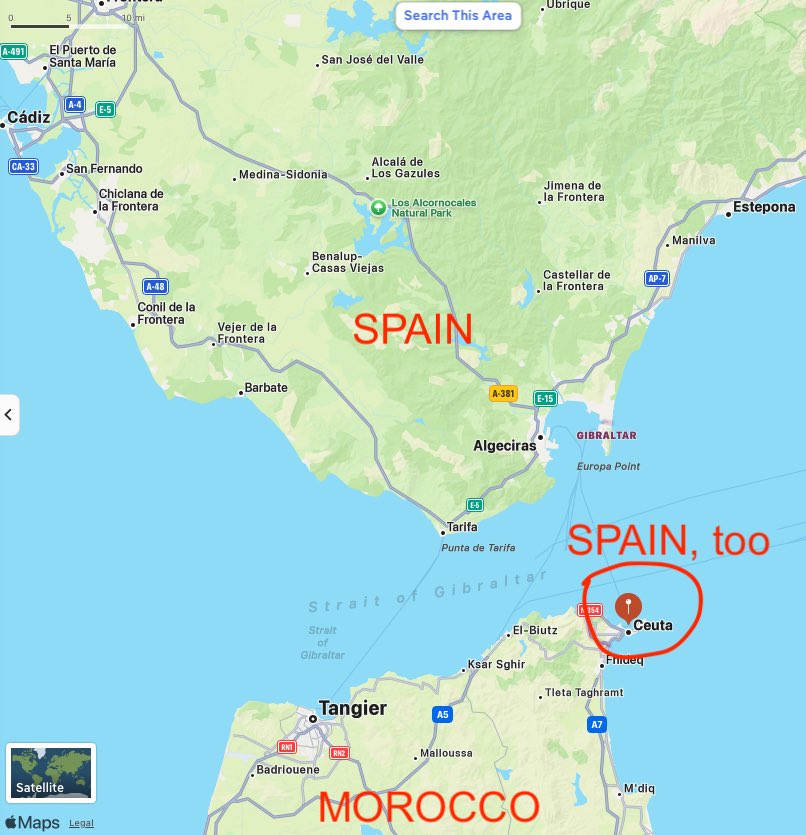
The Ceuta invasion as a tipping point
On Substack, el gato malo suggests that the “refugee” invastion of Ceuta is a “bridge too far” for the EU:
peruvian strongman oscar benavides famously said “for my friends, everything; for my enemies, the law”.
once, such a thing might have provided a succinct summation of the practice of privilege in its literal sense of “private law”. there were laws for the aristocrats and others for the commoners and still others for non-citizens and slaves.
such ideas date back to time out of mind before stone was placed upon stone in giza and stood as absolute expectation and norm in most of the world until quite recently (and pertain in many parts of the world even today). the idea that “all people should be equal under the law” was a radical alteration to social order, a repudiation of the divine right of kings and aristocrats and their monopolies on property and on violence. the literal idea that land could be owned by a commoner was an astonishing upheaval of established orders. it was also the freeing move that allowed for the west to rise and flourish and prosper, unlocking its vast human potential. one might think that people would be happy about this and cherish and protect this most foundational idea that serves as cornerstone to civilizations of liberty and plenty.
lol.
you must be new here.
[…]
spain looks to be in real danger of falling as a nation. they created a mass amnesty for illegal immigrants from places that do not believe in spain but only in tribe and who do not believe in rights but only in who may dominate whom. if one seeks to be a wrecker, it’s a brilliant incentive. pardon a million and give them access to your social safety networks and welfare payments which fund a lifestyle far in excess of where they came from (and the right to vote for more) and the next wave is already packing its bags to come. spread enough jam and you can attract infinity ants.
the US was well on its way to running this playbook (and likely has ~40 million illegals to show for it) before it was stopped. the astonishing bit was how easy it was to shut this off. you just cut off the incentives. no more free stuff, no more amnesty, no more “path to stay”, and no more “catch and release until our overwhelmed court system can have a hearing years from now”. it’s really that simple.
due process becomes rounding you up and sending you home, not giving you a nice place to live for the 3 years until your case is heard.
and it ALL comes down to prosecutors, courts, and agencies. immigration law became irrelevant not because the law changed but because enforcement did. the spectacle of american judges sneaking illegals out of courthouses to avoid their apprehension by ICE was really pretty astonishing. so too were the massive levels of entitlement fraud, literal government funded flights to needed voting districts, and the astonishing refusal to arrest or hold accountable any among them because “marginalized”. europe is worse.
the NGO bond villian insidious complex has been running the table on the west for 20 years.
and they are moving into overdrive now before the populist right forces they are giving reflexive rise to can take control.
[…]
the media is, predictably, either ignoring this or pretending it’s a humanitarian crisis of families and babies. it’s not. this is damn near all men.
and they are not behaving well.
some are claiming that many of these are criminals freed by morocco and bused to the border as a deliberate act. (this same tactic was used by central and south american regimes to dump their gangs in the US.) images of robbery, rape, and of murder are cropping up.
just what a town of 80k is supposed to do with 80k invaders and how they might be fed or sheltered or controlled remains an open question.
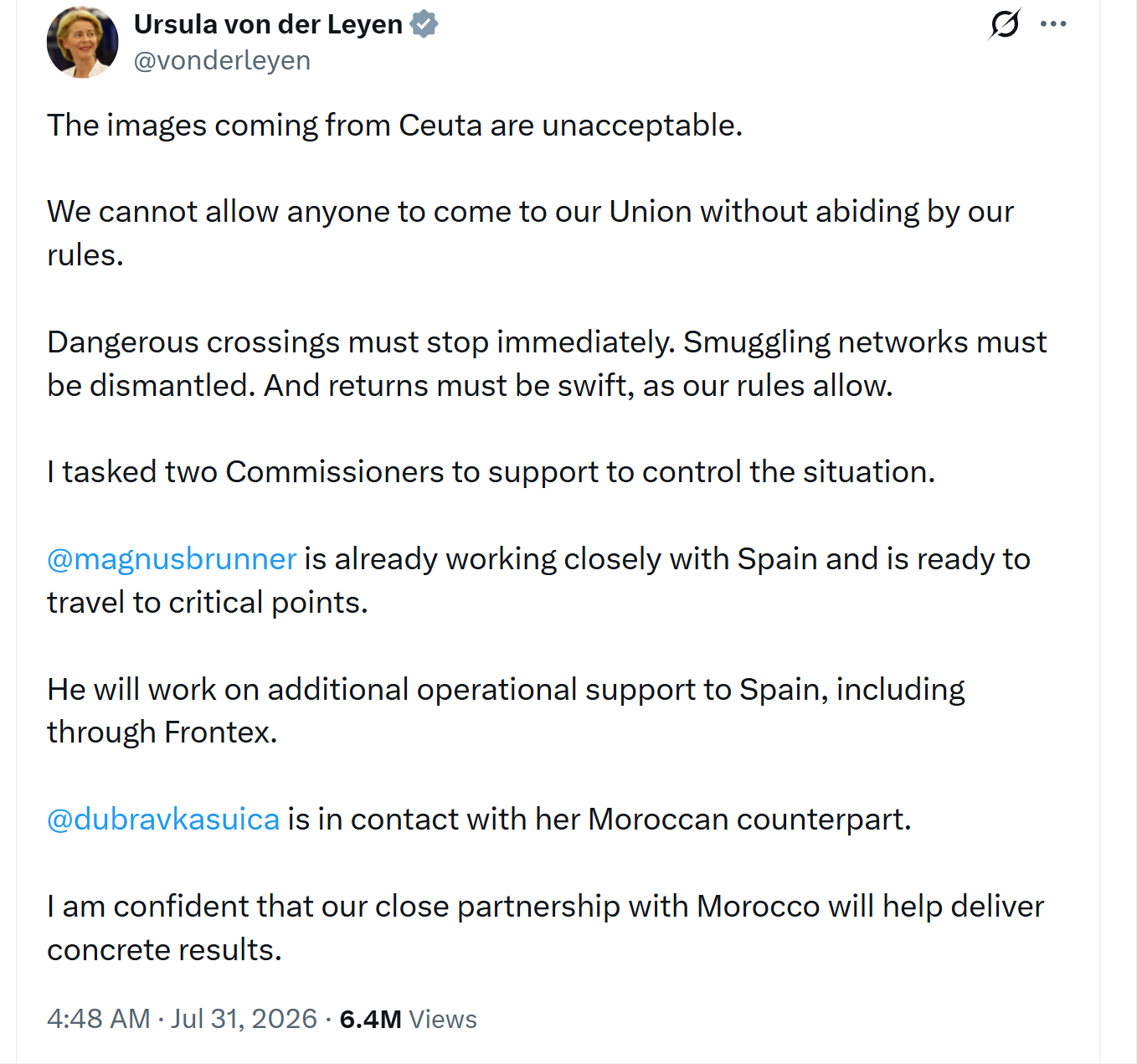
meanwhile, EU commission president ursula von doom has moved to action.
“we have sent a bureaucrat to monitor the situation. if this continues, they will tell people to ‘stop’. if that fails, they will say ‘stop’ again, perhaps in a firmer voice.”
to call this air and nonsense would be charitable. it’s an admission of helplessness. the EC relied upon a soft power it no longer possesses because it now faces people who believe only in hard power which the EC never had.
bluff called.
it’s over.
the EC was fine to govern the sort of citizens who yell at tourists for crossing an empty street against the light. it is wholly unsuited for this and like many an ill fated magician’s apprentice before them, they have now summoned that which they have no hope of controling and will eat them alive.
but here’s the part i really loved: “the images from ceuta are unacceptable”.
talk about saying the quiet part out loud. not the events. not the crisis. the images. even now, for her it’s all perception. you want to understand why they want to mandate ID to use the internet/social media and why they so desperately demand the right to censor it (once more using courts and agencies to enforce their whim)? this is why.
“for my friends, speech, for my enemies censorship and gulag”.
what they are doing cannot survive these images.
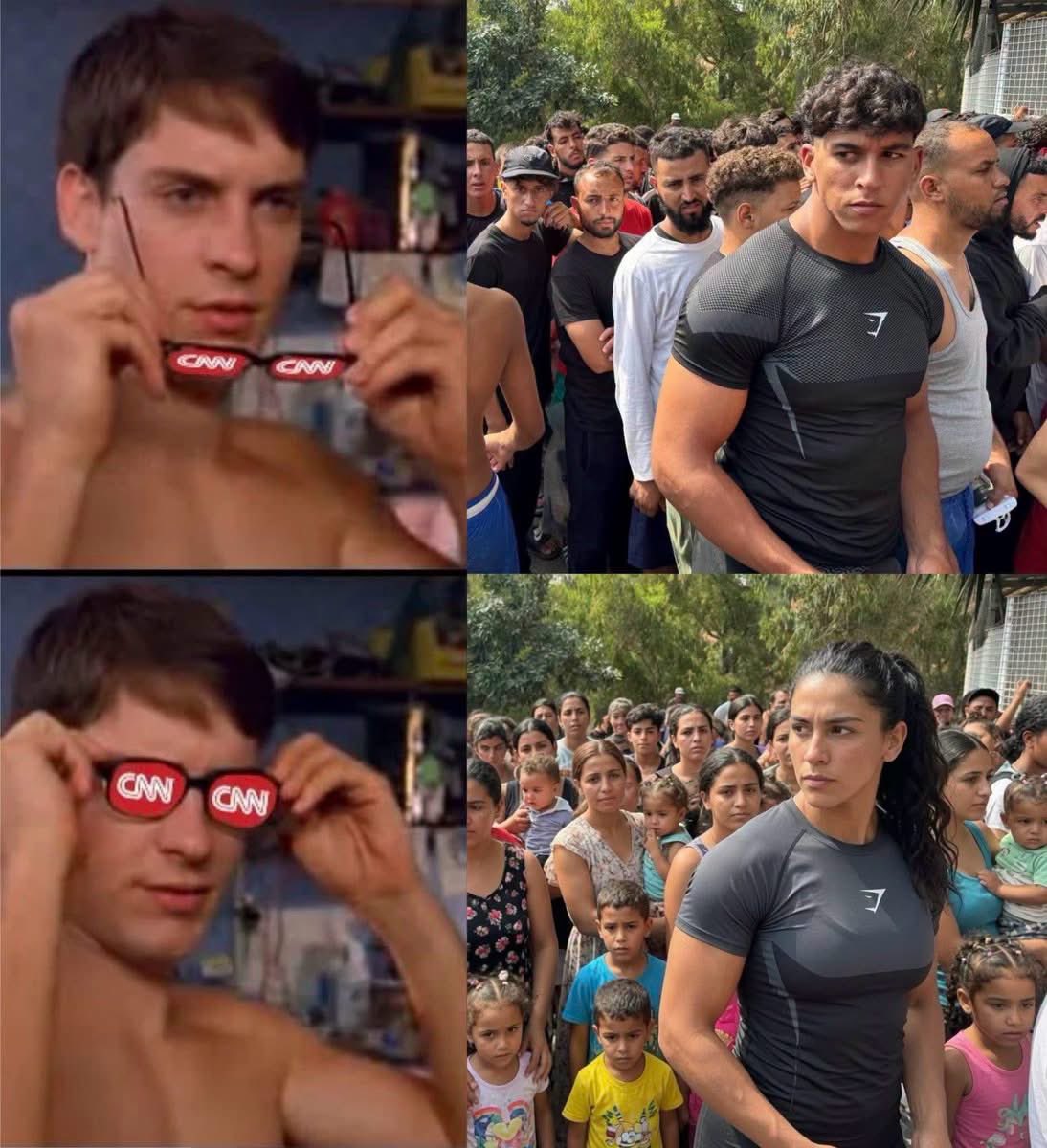
On Substack Notes, GenX Anecdotes reacts to the progressives’ response to the Ceuta situation:
I often wonder about the open borders, “migrants welcome” people and I can’t square it.
I am traditionally a left leaning person from a mixed background who has travelled extensively.
To the current progressive mind this ought to make me automatically cheering on the levels of mass migration we are living with.
But it’s the opposite.
The well travelled “anywhere” cosmopolitans should surely be the most aware of cultural differences and that it’s precisely the concept that nations are “particular” and unique from one another, that makes travelling such a fascinating and sometimes challenging thing to do.
[…]
Travelling gave me a fresh and new appreciation of little things (that actually turned out to be important things) about Britain that I had taken for granted before.
The fact that these muppets think that any form of patriotism or nationalism leads to Hitler is absolutely moronic.
And of course they celebrate it everywhere else. It’s just us who are the baddies for wanting to hold onto our traditions, customs and culture.
Why are we uniquely expected to live by different rules? Surely that in itself is kind of exceptionalist?
A progressive travelling in India wouldn’t think twice about a Mumbai taxi driver having an Indian flag hanging on his rearview mirror.
Or a Thai guesthouse having a shrine to the Thai royal family.
When you travel, people are proud of their countries and towns. They want to show you around. They tell you their country is the best proudly.
Of course, I will be here all day pointing out progressive double standards.
But this one is a biggy!
Update, 4 August: Welcome, Instapundit readers! Have a look around at some of my other posts you may find of interest. I send out a daily summary of posts here through my Substack – https://substack.com/@nicholasrusson that you can subscribe to if you’d like to be informed of new posts in the future.
August 1, 2026
The invasion of Ceuta
In the last 48 hours vast numbers of people have learned that Spain still has territory on the African continent, as Morocco enables thousands of young men to cross into the Spanish city of Ceuta. The Spanish government has, to time of writing, refused to declare a state of emergency or to send military forces to assist the municipal authorities in Ceuta. In Spiked, Brendan O’Neill thinks this heralds the end of globalism:
Can we say “invasion” now? What other word is there for the rough intrusion of tens of thousands of young men into the sovereign territory of a foreign nation? Surely not even the sappiest leftist in his tattered keffiyeh and “Refugees Welcome” t-shirt would describe the thuggish gatecrashing of an independent nation as “asylum seeking”? That might be the one and only upside to the extraordinary events in Ceuta yesterday: the death, at last, of euphemism. The impossibility of any longer dressing up the West’s suicidal abandonment of its borders as “kindness”.
The scenes from the Spanish enclave at the tip of North Africa are staggering. An estimated 49,000 people, mostly Moroccans, mostly men, gleefully intruded upon the territory of the Spanish kingdom. That’s around the same number of people who illegally sail to Britain in a year. They scaled border gates and overwhelmed those charged with protecting Spanish lands. Viral clips show men punching the air as they swarm the enclave, clearly thrilled with their incursion into a sovereign state. Even the Spanish press is feeling the death of euphemism. “Ceuta, invaded”, says the front page of ABC, a newspaper of record, alongside an image of thousands of men streaming along Ceuta’s beach.
The mass storming of Ceuta has focused the minds even of Spain’s fatally apathetic ruling class. All of Ceuta’s parties, both right and left, have called on Madrid to send in the army to reinforce the border with Morocco. Spanish PM Pedro Sánchez promised an “immediate response“. Yet even if the Spanish manage to tame this searing crisis of sovereign rule – and that’s a big “if” – the lessons of it should reverberate not only across Spain but all of Europe. For the fall of Ceuta exposes the lethal strain in globalism. It speaks – screams in fact – to the chaotic trashing of sovereignty, democracy and our very way of life that globalism and its gold-collared acolytes have brought about.
The storming of Ceuta shatters the falsehoods of the left. For years, “progressives” gaslit the public, insisting that the men illegally crossing our borders are “vulnerable people” who are “seeking asylum”. Like Big Brother, they expected us to reject the evidence of our eyes and ears and accept that these swaggering blokes from Eritrea or Afghanistan are the wretched of the Earth requiring our love and care and four-star hotels. Ceuta dismantles that lie. The whole world can see there are virtually no women and children in those mobs. The whole world knows Morocco is not ravaged by war or hunger. From now on, every utterance of the phrase “asylum seeker” should invoke noisy, angry scepticism.
The Ceuta crisis also confirms that the moral cowardice of the modern state is like a red rag to hostile actors. It is undeniable that Pedro Sánchez’s lunatic granting of asylum to illegal immigrants emboldened these Moroccan men to pour into soft-touch Spain. In January this year, Sánchez bypassed parliament and issued a royal decree to regularise virtually all “undocumented migrants” on Spanish territory. Almost 1.2million illegal arrivals applied for this regularised status that would grant them the right to reside in Spain, to work there and to enjoy unfettered access to healthcare and education.
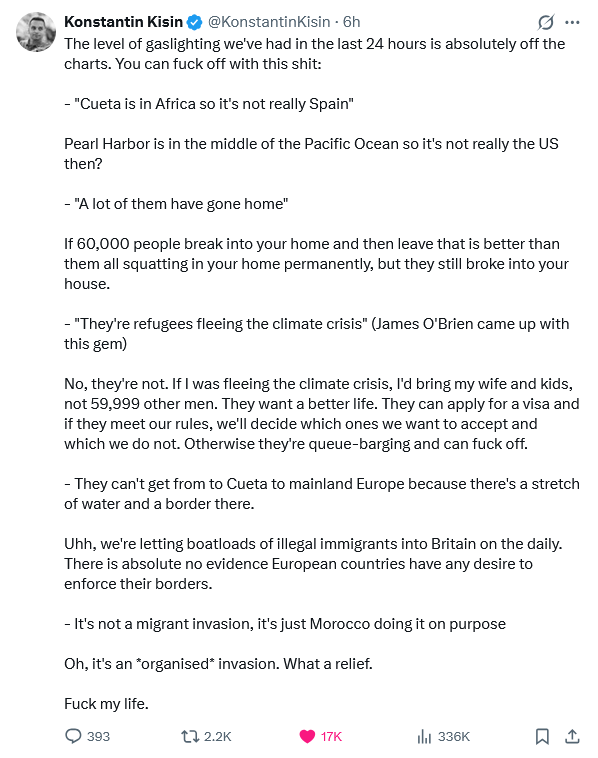
The cope is strong in progressive commentators:
July 12, 2026
How Rome’s Survival Came Down To One 25-Year-Old General – The Second Punic War | EP 2
The Rest Is History
Published 5 Feb 2026What happened at the Battle of Ibera, a totemic though overlooked battle of the Punic Wars? With the forces of Carthage closing in on a depleted Rome, would a young Roman, Publius Cornelius Scipio resurrect the fortunes of the Republic? And, could he destroy Carthage’s most crucial power base in Europe?
Join Tom and Dominic, as they discuss this next phase of the Carthaginian Wars.
00:00 Intro: Rome’s “darkest hour” + Scipio teased as the Republic’s saviour
02:26 206 BC, Atlantic coast of Iberia
04:26 What’s “up” with Scipio?
12:05 Spain as hostile “sci-fi planet”
15:30 New Carthage (Cartagena)
18:09 215 BC crisis: Hasdrubal tries to march north
19:14 Battle of the Ebro
21:25 “Two rival pairs of brothers”
24:48 Rome’s commander problem
30:36 Scipio’s bold plan
31:37 New Carthage targeted
34:57 Sack of New Carthage
39:01 Hasdrubal crosses the Alps with elephants
39:59 Italy’s crisis for Rome
44:05 Battle by the Metaurus
47:23 Ilipa (206): Scipio crushes Mago and breaks Carthage’s Spanish power
49:52 Mago’s last throws
52:14 Scipio returns to Rome as a superstar
53:05 Senate authorises Africa invasion
(more…)
June 16, 2026
The ever-declining (yet still effective) British military
Britain’s military needs have shifted a great deal since the United States took over the unofficial role of “world policeman” after the Second World War. As Imperial commitments overseas were reduced by former colonies achieving independence, the British armed forces have also diminished. In UnHerd, Edward Luttwak considers the current state of the British army, the Royal Air Force, and the Royal Navy in the wake of the sudden resignation of Defence Minister John Healey from Sir Keir Starmer’s cabinet:
Britain’s armed forces have undergone a very long recessional. In 1945, the Army alone had some three million men under arms, with millions more in the navy, air force and various colonial forces. At the start of this year, by contrast, the “trained strength” total of the Royal Navy, RAF, Marines, and Army came to just 126,440, a figure that has actually fallen since Putin’s invasion of Ukraine. But it was not just that very low figure that explains John Healey’s dramatic resignation last week.
Until relatively recently, British defence secretaries were much envied by their European counterparts — because they were allowed to conserve as much real combat strength as possible by cutting everything else to conserve money for training and realistic exercises, as well as the continuous maintenance it requires. Typical in that regard was Healey’s namesake Denis, a fiery socialist and decorated beachmaster at Anzio, who served as Labour’s defence secretary from 1964-70. No relation to his 21st-century successor, this elder Healey worked closely with his cabinet colleagues to cut costs on buying warships, aircraft, bases and the like, to focus instead on what really matters: training, munitions and maintenance.
That may seem like mere common sense. But since the post-Cold War drawdown that was underway by 1991, almost every European defence ministry has wasted increasing proportions of their diminishing defence spending to keep increasingly empty bases open — often just to preserve civilian janitors and ground-keepers in a job, and retired NCOs in their attached housing. Also bloated are the officer corps of most European forces, increasingly disproportionate to their shrinking personnel totals. The Spanish army is perhaps the leading champion here. Despite shrinking from 280,000 men in 1990 to just 75,000 today, it has preserved every formation command, and every regional headquarters and geographic command, including one for the Canary Islands, headed by a three-star army general and flanked by navy and air force counterparts.
Altogether, these commands absorb a remarkable percentage of the total armed force personnel: all just to keep up appearances, and jobs for generals and admirals. Nor is the Spanish army unique in this self-sabotage; Madrid’s wasted defence spending, which may even reflect the policy preferences of its pacifist government, is merely an exaggerated version of knowingly wasteful policies across Europe. By a remarkable coincidence, for instance, every branch of the Italian armed forces — as well as the civilian police, the customs police, and the carabinieri military police present in every town — buy almost all of their pistols, rifles and machine guns from privately owned Beretta. The French are arguably even worse offenders: all their combat aircraft are slated to come from the privately-owned Dassault Aviation, and for all the lobbying of British firms they are not allowed to become monopolies.
The root cause of John Healey’s complaint is that to preserve those envied British defence practices, to retain a disciplined focus in using taxpayers’ money to buy actually usable combat capabilities, there are minimum funding levels which must be respected. All concerned know perfectly well that spending on “combat readiness” is like buying cut flowers: which must be bought anew each day, at the expense of furniture that can last for decades or even centuries. In other words, doing defence for real is, much more than anything else a government does, like running a restaurant open 24 hours a day, 365 days a year. This is true even when compared with health care, in which the vast majority of patients do not require round-the-clock intensive care.
Luttwak pointedly differentiates the way the British armed services operate to most of the other NATO allies: “In sober strategic terms, there is nothing especially important about these examples. But think of the alternative: 3.5 million active NATO personnel, from Canada to Turkey, who eat breakfast, lunch and dinner in uniform every day — almost none of whom is ready to fight in earnest for any reason whatsoever.” The emphasis on the “soft” investment of skills and training has to be contrasted with the kinds of military organizations who boast vast numbers of tanks, artillery pieces, helicopters, fighter jets and bombers, but who lack the crews, maintenance technicians, and parts supply to keep them operational.
Update, 17 June: Welcome, Instapundit readers! Have a look around at some of my other posts you may find of interest. I send out a daily summary of posts here through my Substack – https://substack.com/@nicholasrusson that you can subscribe to if you’d like to be informed of new posts in the future.
June 7, 2026
How Hitler Tested His Next War in Spain – Death of Democracy 18 – Q2 1937
World War Two and Spartacus Olsson
Published 6 Jun 2026Berlin, June 30, 1937. Hitler has not staged a major diplomatic shock this quarter — but beneath the surface, Nazi Germany is preparing for war.
In Spain, the Condor Legion helps Franco’s Nationalists and the bombing of Guernica gives the world a terrifying preview of modern aerial terror. At home, the regime escalates its assault on the Catholic Church, begins the purge of “degenerate art”, tightens the link between courts and concentration camps, and hides rearmament behind spectacles of economic success.
This episode of Death of Democracy looks at Q2 1937: the quarter when Nazi Germany normalized aggression abroad while deepening tyranny at home.
00:00 Berlin, June 30, 1937
00:05 No Hitler Surprise — But War Preparations Continue
00:51 The Hindenburg and the Shadow of Modern War
01:50 The “Give Me Four Years” Exhibition
02:25 Guernica and the Condor Legion
02:55 The Bombardment of Almería
03:11 Case Green and Case Otto
03:54 Degenerate Art and Cultural Cleansing
04:22 The Judiciary and the Concentration Camps
05:13 The Nazi Assault on the Catholic Church
06:07 Goebbels, Propaganda, and the Morality Trials
07:45 Autarky, Rearmament, and Hidden Austerity
08:52 Mood Inside the Nazi Leadership
09:48 Ordinary Germans and Apathy
12:15 Analysis: War Abroad, Tyranny at Home
14:19 Conclusion: Nazi Double-Talk
June 4, 2026
The murder of Henry Nowak and the failure of British policing
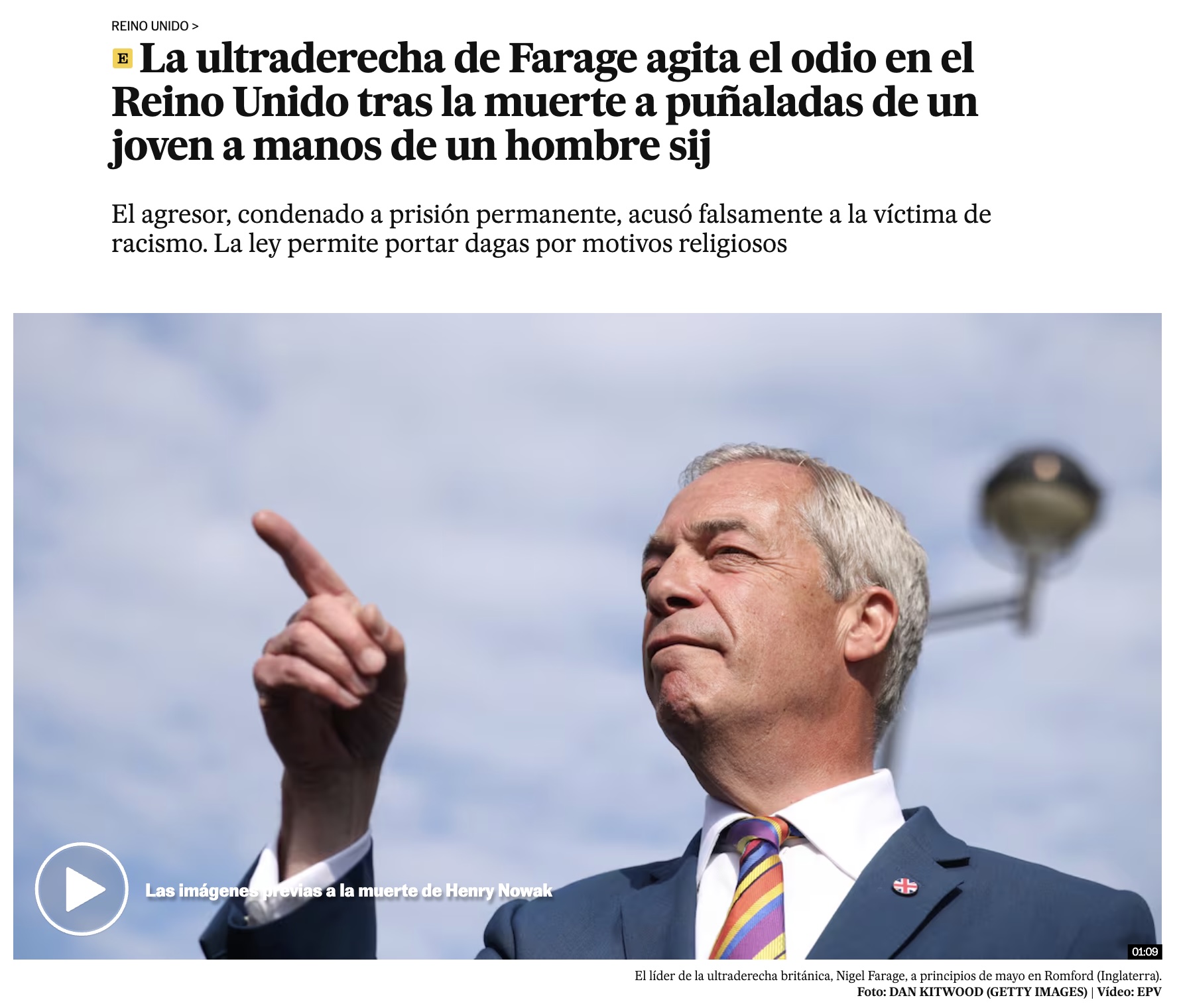
Andrew Doyle notes that the very first mention of Henry Nowak’s murder in Spain’s El País (approximately Spain’s equivalent of the Toronto Star, The Guardian, or the New York Times) frames the story as “evil extremely extreme extreme-right-wing Führers pounce”:
While the country is still reeling from the horrific murder of eighteen-year-old student Henry Nowak, an astonishing article has appeared in El País, Spain’s largest national newspaper. Rather than focus on the failures of the police officers, or the institutional bias within the force, the headline steers its readers away from the case and towards the outlet’s own obsessions. The headline translates as “Farage’s far right stirs up hatred in the UK after a young man is stabbed to death by a Sikh man”.
As Alejo Schapire (an Argentine journalist based in France) has pointed out, this is the first and only article produced by El País on the subject of the Nowak killing. Instead of an image of the victim, the newspaper has opted for a photograph of Nigel Farage. The Guardian was similarly histrionic and detached from reality in its coverage: “As ethnonationalist far right drives racist agenda, Reform UK leader felt need to weigh in on murder of Henry Nowak”.
It is one thing to take issue with those who seek to weaponise human tragedies for their own political gain, and quite another to dismiss legitimate criticism of a failed system. Reform UK is by no means a “far right” party, but of course the term has been so promiscuously misused in the press that at this point it might be best to dispense with it altogether. But of course, this is not really about Farage or his response to the murder at all. It is a cynical means of deflecting from the fate of Nowak and what it reveals about the state of policing in the UK.
So what exactly did Farage say to have the Guardian fulminate about his “racist agenda” and for El País to make him the focus of the story rather than the victim? During a live broadcast, Farage praised the Nowak family for their “extraordinarily dignified” response following the conviction of their son’s killer, and went on to say: “I suggest the rest of us respond to this with pure cold rage”.
And why not indeed? Let’s not forget the shocking details of what happened in this case. Nowak was stabbed multiple times by Vickrum Digwa using a Sikh ceremonial dagger. His mother hid the murder weapon, and his brother called 999 claiming that Nowak had been racially abusive. When police arrived, Digwa repeated this lie. And when Nowak repeatedly told the officers he had been stabbed, one replied “I don’t think you have, mate” and handcuffed him as he lay dying.
At Always the Horizon, Copernican shares his thoughts on the political response to the murder:
Riots have been growing over the last few years in the UK when incidents like this occur. Nigel Farage addressed the incident in a youtube video here. Referring it as a “moment to take a long hard look at ourselves and the country that we’ve become”. He proceeds to say, “All the values and standards of living in a free country, where everyone is judged equally before the law, have been trashed and thrown away”. Nigel Farage demands that “the police complaints operation, the IOPC, needs to get to the bottom of this and produce a report very very quickly.” He also states that the sentencing is unacceptable, as the sentencing of the Sikh was less severe than the minimum recommended for a sustained, aggressive, murderous assault.
Nigel knows how to fix this: file some more reports. Maybe even reprimand a judge for being too lenient. That will surely bring back the murdered man, make whole his family, and un-rape and un-murder the children that have been attacked over the years by numerous violent psychos imported from the third world by domestic traitors. What a British solution: file another report about it.
Keir Starmer took another position. He condemned Nigel Farage for “Whipping up” division against the wishes of Nowak’s family. He believes “Nigel Farage’s Reaction” is the “wrong reaction”. We wouldn’t want division at a time like this. What we really need to do is respect the wishes of the cucked cowards whose son was killed and who took no flesh or blood from the offending Sikh as recompense. Who were cowed by government processes and report filing. Those are the people whose feelings we should be worried about. We would hate for the Sikh community to feel threatened.
To be honest, I agree with Keir Starmer. Nigel Farage’s reaction is the wrong reaction
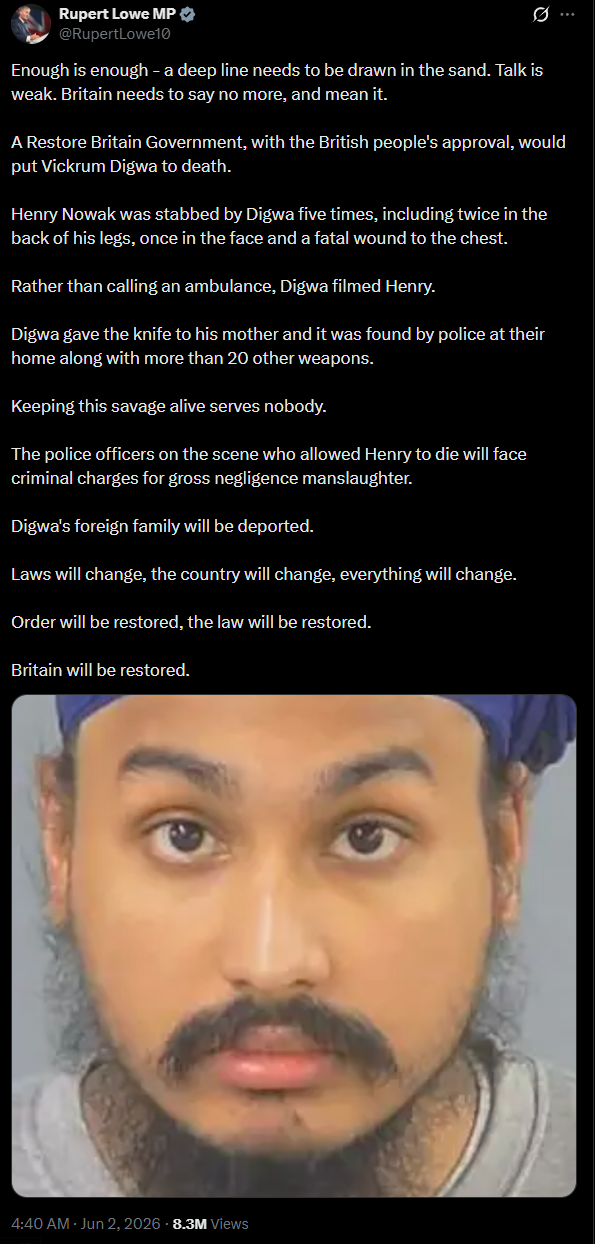
Rupert Lowe, an MP of the “far-right” British Reform party [correction: Lowe is the leader of the Restore Britain party], is getting closer to the correct reaction when it comes to this murderous Sikh, his community, and the managerial bureaucracy that brought them here and protected them.
That said, I think Rupert Lowe is also heavily couching his language for fear of public backlash, or getting arrested for “inflaming racial tensions”.
Update, 5 June: Welcome, Instapundit readers! Have a look around at some of my other posts you may find of interest. I send out a daily summary of posts here through my Substack – https://substack.com/@nicholasrusson that you can subscribe to if you’d like to be informed of new posts in the future.
May 10, 2026
How to Make Nazi Germany Look Normal – Death of Democracy 15 – Q4 1936
World War Two and Spartacus Olsson
Published 9 May 2026How did Hitler use the 1936 Berlin Olympics to make Nazi Germany look peaceful — while preparing the country for war?
Berlin, September 30, 1936. Under the Olympic flame, Nazi Germany staged one of the most successful propaganda spectacles of the twentieth century. Foreign visitors saw order, ceremony, technology, pageantry, and athletic triumph. But behind the facade, the regime hid antisemitic persecution, rounded up Sinti and Roma, intensified police repression, intervened in the Spanish Civil War, and moved toward a massive new war economy.
In this episode, Spartacus Olsson looks back at the third quarter of 1936: the Berlin Olympics, Jesse Owens’ victories, Hitler’s secret war memorandum, the Four-Year Plan, Nazi propaganda, Germany’s growing involvement in Spain, and the dictatorship’s attempt to sell peace to the world while preparing for conquest.
The Olympics gave Hitler international validation. The Four-Year Plan revealed what he truly intended.
In this episode:
– How Nazi Germany sanitized Berlin before the Olympic Games
– How the regime temporarily hid antisemitic violence from foreign visitors
– How Sinti and Roma were forced out of sight before the Games
– How Jesse Owens challenged Nazi racial mythology on the track
– How Hitler moved Germany toward a war economy
– How the Four-Year Plan tied German recovery to rearmament
– How Germany’s intervention in Spain marked a new stage of escalation
– How propaganda, spectacle, and controlled media helped normalize dictatorshipThis is not just a story about the 1936 Olympics. It is a story about how authoritarian regimes use spectacle, national pride, media control, and international complacency to hide what they are becoming.
Never Forget.
May 8, 2026
“… without Western Civilization, we’d all still be whacking at the dirt with sticks and dying of intestinal parasites”
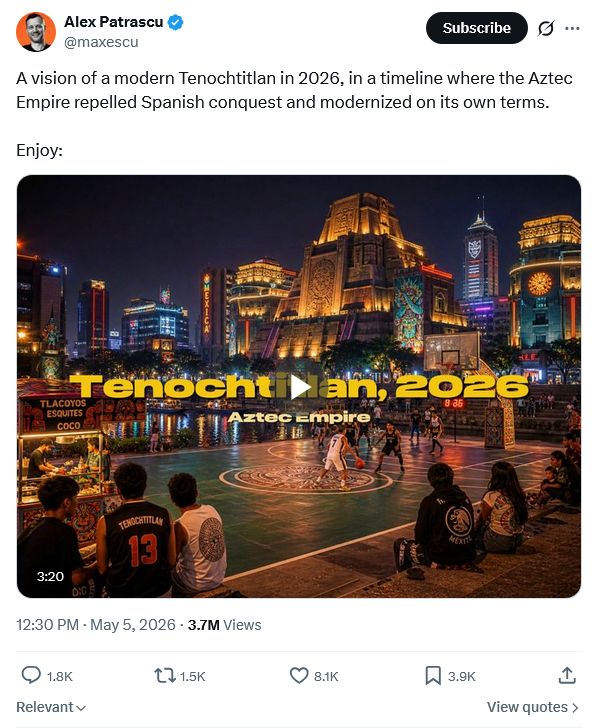
Devon Eriksen responds to someone who had a clanker generate an imaginary Aztec capital today if the Aztecs had managed to defeat Cortes and his conquistadors:
Guitars. Suits and ties. Western architecture. English and Spanish text.
What’s easy to miss is that the generative AI is making its own, separate, political statement here. Not because it intended to, but because it had no choice.
Even human creativity consists mostly of rearranging things, but AI generation is entirely that and nothing else.
So when you ask it for “modern”, it gives you “western”, because in its eyes, there is no distinction between the two. “Western” is the only “modern” that actually exists for it to draw from.
Even cultures that were capable of building an alternative version of modern, because they weren’t skinning and eating each other, and had invented the wheel, still borrowed heavily from the West, not because they couldn’t do otherwise, but because the West moved faster, and had already done the work.
So, ask an AI for “modern Aztec”, and you get English-speaking Tokyo/Venice, with browner people, pyramid reskins on skyscrapers, and some out-of-place Mayan stuff, all set to Peruvian flute music.
This is the same reason that a lot of people, most of whom really aren’t much more than LLMs themselves, say silly things like “there is no White culture” … because, like the very simple art machine, they cannot conceive of any alternative version of modernity.
So nothing is Western to them, it’s all just “modern”.
But of course it really is Western, because without Western Civilization, we’d all still be whacking at the dirt with sticks and dying of intestinal parasites.
That AI is Western, too.
May 1, 2026
Spain joins the awkward squad
At The Conservative Woman, Bepi Pezzulli outlines a few ways that the Spanish government is moving in quite different directions than their NATO allies and fellow EU members:
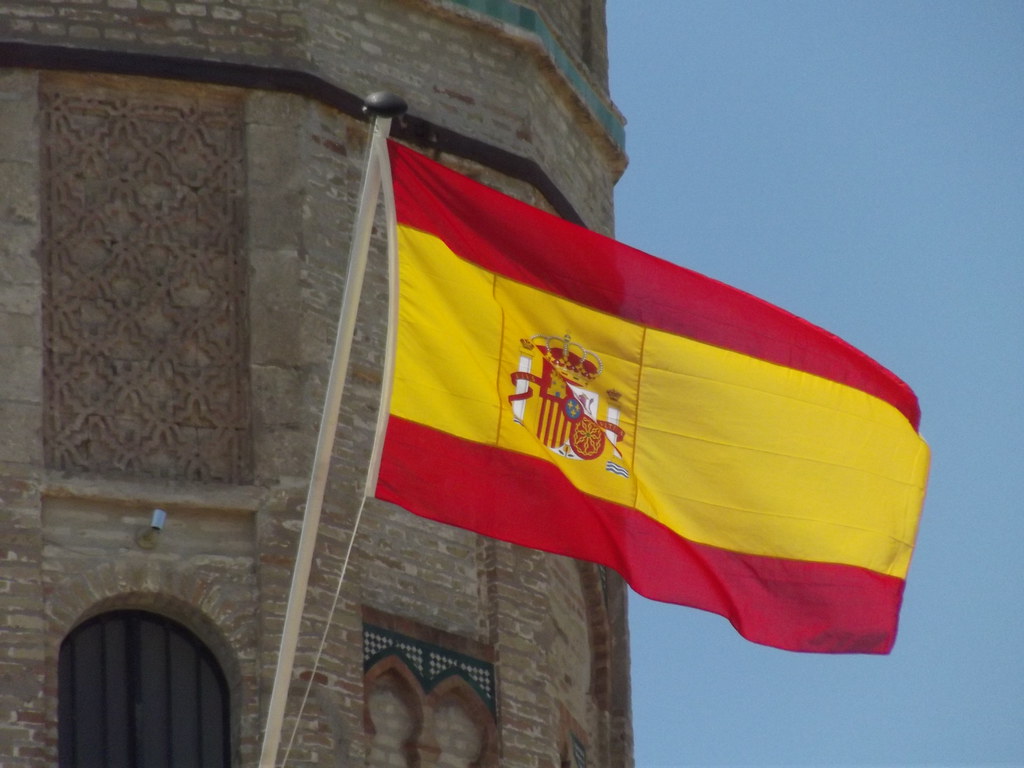
Torre del Oro (Tower of Gold) – Calle Almirante Lobo, Seville – Spanish flag” by ell brown is licensed under CC BY-SA 2.0 

 .
.
Spain’s Prime Minister Pedro Sánchez wants the privileges of alliance without the duties of one. Madrid remains in Nato, hosts critical American military infrastructure, and speaks the language of Atlantic solidarity – but only when convenient. On the central strategic questions of the age – Russia, Israel, and the wider Western posture in the Mediterranean – it increasingly behaves like a spoiler. What is troubling is that Spain is not merely posturing: it is rewriting its entire conception of statecraft, treating alliance as a shield, hostility as leverage, and strategic ambiguity as a governing doctrine.
When Washington needed alignment, Sánchez offered obstruction. When Israel faced existential war, Madrid offered moral lectures. When the West sought energy discipline against Moscow, Spain found room for Russian gas. All while preserving the old imperial obsession with Gibraltar and extracting advantages from London over the Rock.
Spain has discovered the pleasures of consequence-free hostility. That needs to end.
Anti-Americanism with diplomatic immunity
Sánchez has carefully cultivated the old European left’s anti-American reflexes: Nato when subsidised, moral neutrality when sacrifice is required. His government publicly resisted support for American military operations linked to Iran escalation and signalled clear reluctance to facilitate use of Spanish bases such as Rota and Morón for operations that might implicate Madrid politically. The message was unmistakable: American security guarantees are welcome but strategic co-operation is negotiable. The rhetoric matched the policy. “No to war” was not merely a slogan for domestic consumption. Sánchez is deliberately positioning Spain as the righteous dissenter against Washington’s harder strategic line.
At the same time, Spain maintained substantial imports of Russian gas well into the European sanctions era. While pipeline politics consumed Brussels, Madrid benefited from a convenient moral distinction: condemning Moscow loudly while continuing commercial accommodation where useful. The formal sanctions architecture left open some loopholes, and Spain was happy to live inside them.
An ally that profits from ambiguity while others bear the strategic burden is not an ally in the full sense. As US War Secretary Pete Hegseth noted, “An alliance cannot be ironclad if in reality or perception it is seen as one-sided”.
From criticism of Israel to open diplomatic hostility
On Israel, Sánchez has moved beyond criticism into active diplomatic confrontation. Recognition of Palestine was presented as humanitarian principle. In practice, it rewarded maximalism at the worst possible moment. Madrid helped transform October 7 from a terrorist massacre demanding strategic clarity into another European seminar on Israeli restraint. Spain became one of the loudest governmental amplifiers of the anti-Zionist campaign in Western Europe. Ministers normalised rhetoric that blurred the distinction between criticism of Israeli policy and systematic delegitimisation of the Jewish state itself. Arms restrictions followed. Then diplomatic actions. Symbolism became policy.
Gibraltar: Madrid’s imperial nostalgia
Spain’s sanctimony would be easier to tolerate if it were not paired with its own colonial fixation. For decades, Madrid has pursued sovereignty claims over Gibraltar with theological persistence. Brexit offered a fresh opening. With Brussels behind it, Spain extracted a remarkably favourable negotiating posture over the future relationship of the Rock with both the European Union and the United Kingdom. London, in the hands of the most Europhile government in recent history, conceded far more than many British voters imagined when they heard the word “sovereignty”. Spain never abandoned the long game. It simply learned to play it through institutions until a weaker opponent appeared. Madrid insists Gibraltar is unfinished history. Fair enough: is it not time then to conclude the same about Ceuta and Melilla?
April 28, 2026
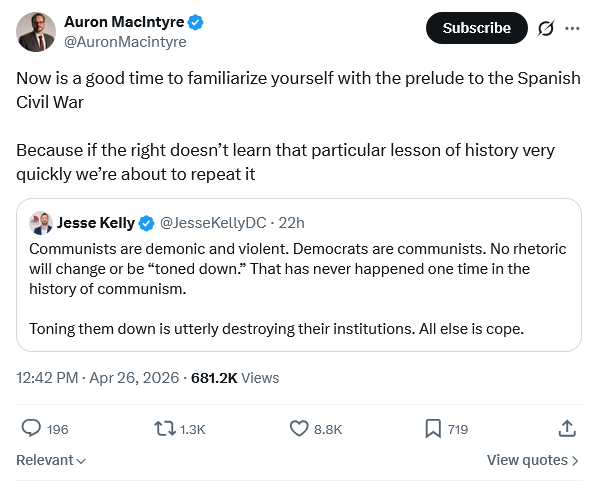
Echoes of Spain in the 1930s
On the social media site formerly known as Twitter, Christian Heiens discusses how the Spanish Republic disintegrated in the lead up to the Spanish Civil War:
After the Spanish Right won the 1933 elections, Communists in Asturias launched a revolution, killing thousands before the army was deployed to finally put an end to the chaos.
They did the same thing in Catalonia, and when that too was quelled, they engaged in a low-level terrorist campaign all over the country, planting bombs, sabotaging infrastructure, assassinating newspaper editors and political figures, and staging general strikes all over Spain.
They kept doing this until they finally won the 1936 election, at which point the Left went full mask-off and began unleashing thousands of criminals into the streets, ransacking businesses, dragging conservatives out of their homes to beat them, and going into the countryside to expropriate private property. The entire country descended into a state of near-total anarchy in a matter of months.
The Left spent years agitating for a Marxist revolution in Spain and refused to obey the legal system because they saw the Spanish Republic as a mechanism to achieve Leftism, not as a neutral system intended to uphold democracy, the constitution, or the rule of law.
And thus, any deviation from the march towards Leftism was seen as an illegitimate act of treason and proof of an imminent fascist takeover of the state. As a result, ANY electoral victory by the Right was inherently treated as illegal by the Left, and ANY attempt to actually govern in accordance with Right-wing principles was seen as just cause to engage in violent insurrection.
You cannot have a country like this for long. If one side treats the process as illegitimate unless it produces their desired ideological outcome, they will inevitably win unless they’re physically stopped.
March 28, 2026
Noelia Castillo Ramos, RIP
Celina provides the background information you certainly won’t get from skimming the mainstream media’s coverage of the death of twenty-five year old Noelia Castillo Ramos:
This is how broken the West has become. On Thursday, March 26, 2026, in a clinically sterile room within an assisted living facility in Barcelona, Spain, the government executed a twenty five year old paralysed rape victim. Her name was Noelia Castillo Ramos.1 Noelia did not die of a terminal illness, nor did she pass away from natural causes. Rather, she was administered a lethal injection by the Spanish state that had dismantled her family, forced her into a hostile and horribly dangerous environment, ignored her horrific violation, and ultimately deemed her broken existence too inconvenient to maintain.2
A still from Noelia Castillo’s Antena 3 interview on March 24.
While Noelia Castillo’s heart was stopped by a cocktail of state-sponsored chemicals, the unvetted migrant men who gang-raped her, shattered her mind, and drove her to fling herself from a fifth-floor window continue to walk the streets of Europe, entirely shielded from justice. They faced zero consequences. She faced the death penalty.
These were the last words that her grandmother said to Noelia: “I love you, my girl; someday we will be together again”.
The fate of Noelia Castillo stands as a single almost perfect, undeniable illustration of everything that is broken, evil, and actively suicidal about modern Western society under progressive, woke, open-border, and secular-left governance. Progressive Europe has functionally and legally decided that native European women and girls are a disposable commodity, just collateral damage in the grand suicidal project of multiculturalism.