Quotulatiousness

April 5, 2026

When military requirements conflict with national policies

On Substack, Holly MathNerd explains why the US military hasn’t ramped up production of drones in light of the experiences of other current conflicts:

Most people who have opinions about the war in Iran are not also reading the Federal Acquisition Regulations. I am, unfortunately for my social life, one of the people who does both.

And when you hold those two things in your head at the same time — what’s happening over the Strait of Hormuz and what’s happening in federal procurement policy — a contradiction emerges that is so glaring, and so consequential, that I could not write about anything else this week.

Here is the contradiction, in full, before I show you the data.

The United States is fighting a war where drones are the decisive tactical weapon. We are spending $2 to $4 million per intercept to stop Iranian drones that cost $50,000 each. Our own offensive drone program shipped what it had into an active war because full-rate production hadn’t started yet. Ukraine, which does not have this problem, produced two million drones in 2024 by building a distributed ecosystem of small manufacturers who iterate their designs every two weeks and sell units for $300 to $5,000 each.

We cannot do what Ukraine does, because Congress — correctly, for legitimate national security reasons — spent five consecutive National Defense Authorization Acts closing the door on Chinese drone hardware. DJI, the dominant global manufacturer, is now restricted by four separate federal authorities. There is no waiver for convenience. The wall is complete.

Which means the only path to drone dominance runs through a domestic industrial base capable of producing drones at volume, at low cost, with rapid iteration.

That base exists. Partially. Precariously. And it is built on exactly the kind of small, specialized, distributed manufacturers that the 8(a) federal contracting program was designed to bring into the market.

April 4, 2026

If we think that “ordinary criticism and disagreement are bullying, then we have an infantilized and feminized culture”

Filed under: Government, Media, Politics, USA — Tags: , , , , , , , — Nicholas @ 05:00

Chris Bray finds a highly accurate label for the pearl-clutching “elites” who — to a persyn — believe that your words are violence, but their violence (delivered through third parties, of course) is merely emphatic communication to the distasteful lower orders:

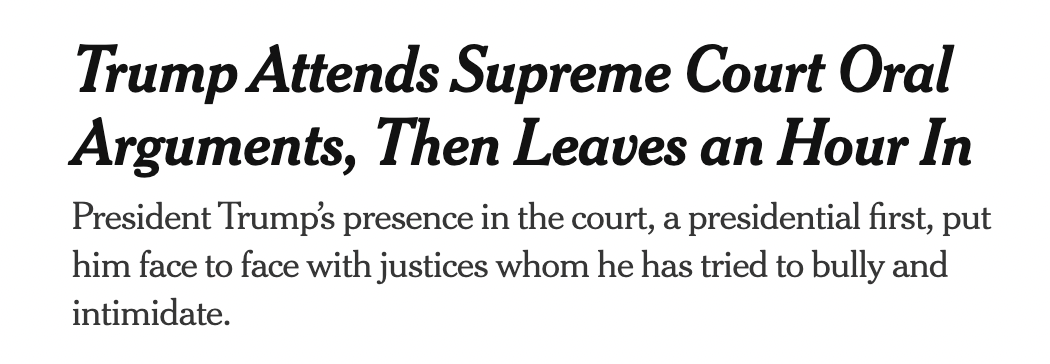
Donald Trump is a mean man. He’s a bully!

Oh no SCARY, he’s trying to BULLY the Supreme Court! I wrote at the Federalist this week about the stupidity of this argument — what is he implying he can do to the life-tenured justices, for crying out loud? — but I suspect I undersold the underlying sickness. Adults don’t use the word “bully” to talk about other adults, arguably outside of a few very narrow spaces involving things like domestic violence. It’s a preschool word. The easy recourse to toddler language at the New York Times is a sign of cultural regression. But it’s also a sign of habitual and persistent dishonesty. They’re pretending. I suspect they’ve pretended so much that they’ve forgotten they’re pretending, and the mask has become the face, but at root, they’re pretending.

We have fictional characters like Willie Stark and Frank Underwood because no one on the planet is dumb enough to think that politics is nice. The federal government spends $7 trillion a year, and the lure of that bucket of money brings out a bunch of throatcutters. This is possibly one of the most obvious realities of human existence. Politics is a knife fight. […]

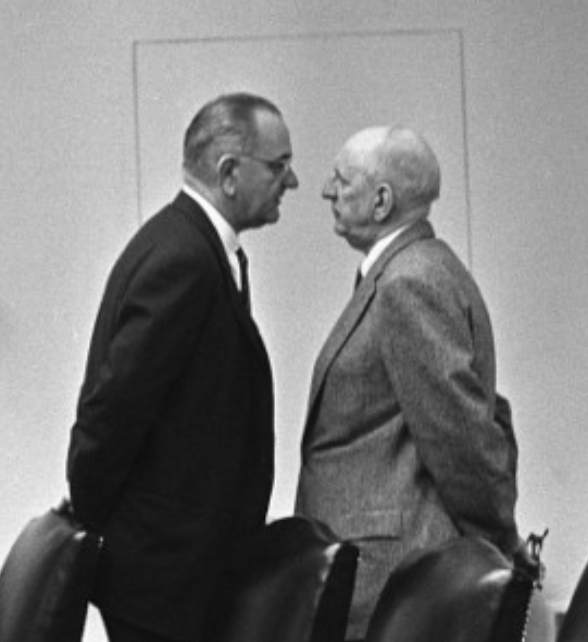
Quite famously, members of Congress who suggested that they would oppose the legislative priorities of President Lyndon Johnson would get phone calls in the middle night from the man himself, waking them up and letting them know that they were dead men. He’s supposed to have said things like, “I’m gonna cut your balls off, you cocksucker”, though it’s not like anyone had a stenographer on the calls to nail the quotes. He was threatening and nasty on all days ending in -y, and got bills passed by, among other things, actually, physically intimidating people who didn’t roll over. He was a leaner. He got in faces, constantly and openly.

You gonna pass my bill [insert string of highly personal threats and profanity], or is your political career over? Pressure, threats, and horsetrading are the default behaviors, the normal stuff. Andrew Jackson got the Indian Removal Act through Congress by handing out government sinecures. The premise that I can take care of you or I can go to war with you, and it’s your choice which one happens is … politics. The make-believe story about Mean Donald Trump bullying the Supreme Court by tweeting at them or sitting in a chair where they could see him is playtime, clutching at Fisher-Price pearls. Somewhat remarkably, Trump appears to bully institutional opponents quite a bit less than the historical norm, and Lisa Murkowski can do whatever she wants without consequence. I am personally calling for Donald Trump to start actually bullying some people who have it coming, but be sure to have a fainting couch ready in the newsroom at Times Square.

Update, 6 March: Welcome, Instapundit readers! Have a look around at some of my other posts you may find of interest. I send out a daily summary of posts here through my Substackhttps://substack.com/@nicholasrusson that you can subscribe to if you’d like to be informed of new posts in the future.

March 13, 2026

Enacting the original proposed 12th Amendment

Filed under: Government, History, Law, Politics, USA — Tags: , — Nicholas @ 03:00

At Astral Codex Ten, guest writer David Speiser discusses the two “extra” proposed amendments that didn’t make it into the Bill of Rights, but crucially, didn’t have an expiration date. The 11th did eventually make its way into the Constitution as the 27th Amendment in 1992, leaving only the 12th original still in limbo. The proposed 12th was a doozy:

Here is the text of the Congressional Apportionment Amendment, the sole unratified amendment from the Bill of Rights:

    After the first enumeration required by the first article of the Constitution, there shall be one Representative for every thirty thousand, until the number shall amount to one hundred, after which the proportion shall be so regulated by Congress, that there shall be not less than one hundred Representatives, nor less than one Representative for every forty thousand persons, until the number of Representatives shall amount to two hundred, after which the proportion shall be so regulated by Congress, that there shall not be less than two hundred Representatives, nor more than one Representative for every fifty thousand persons.

In other words, there will be one Representative per X people, depending on the size of the US. Once the US is big enough, it will top out at one Representative per 50,000 citizens.

(if you’ve noticed something off about this description, good work — we’ll cover it in the section “A Troublesome Typo”, near the end)

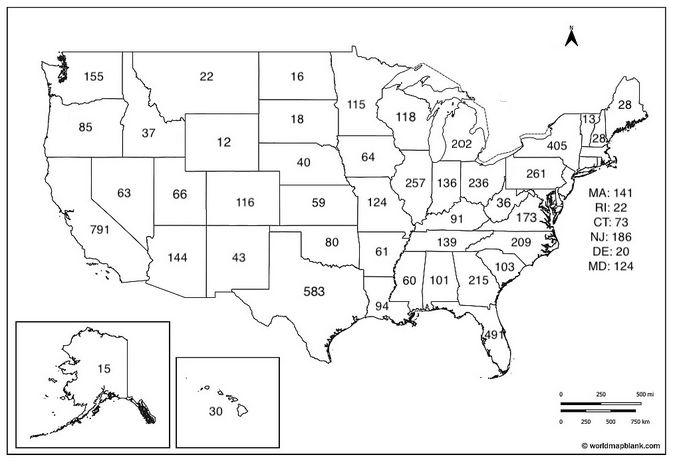
The US is far bigger than in the Framers’ time, so it’s the 50,000 number that would apply in the present day. This would increase the size of the House of Representatives from 435 reps to 6,6412. Wyoming would have 12 seats; California would have 791. Here’s a map:

This would give the U.S. the largest legislature in the world, topping the 2,904-member National People’s Congress of China. It would land us right about the middle of the list of citizens per representative, at #104, right between Hungary and Qatar (we currently sit at #3, right between Afghanistan and Pakistan).

Would this solve the issues that make Congress so hated? It would be a step in the right direction. Our various think tanks identified three primary reasons behind the estrangement of Congress and citizens: gerrymandering, national partisan polarization, and the influence of large donors. This fixes, or at least ameliorates, all of them.

Gerrymandering: Gerrymandering many small districts is a harder problem than gerrymandering a few big ones. Durable gerrymandering requires drawing districts with the exact right combination of cities and rural areas, but there are only a limited number of each per state. With too many districts, achievable margins decrease and the gerrymander is more likely to fail.

We can see this with state legislatures vs. congressional delegations. A dominant party has equal incentive to gerrymander each, but most states have more legislature seats than Congressional ones, and so the legislatures end up less gerrymandered. Here are some real numbers from last election cycle1:

So for example, in Republican-dominated North Carolina, 50.9% of people voted Trump, 60% of state senate seats are held by Republicans, and 71.4% of their House seats belong to Republicans. The state senate (50 seats) is only half as gerrymandered as the House delegation (14 seats).

In many states, the new CAA-compliant delegation would be about the same size as the state legislature, and so could also be expected to halve gerrymandering.

As a bonus, the Electoral College bias towards small states would be essentially solved. Currently, a Wyomingite’s presidential vote controls three times as many electoral votes as a Californian’s. Under the CAA, both states would be about equal.

Money: This one is intuitive. If you can effectively buy 1/435 elections, you’ve bought 0.23% of Congress. If the same money only buys you 0.02% of Congress, you’re less incentivized to try to buy House elections and more incentivized to try to buy Senate seats or just to gain influence within a given political party. Money in politics is still a thing, but it becomes much harder to coordinate among people. This makes it easier for somebody to run for Congress without having to fundraise millions of dollars. Because it’s less worth it to spend so much money on any one seat, elections to the House become cheaper2.

Polarization: Some of the think tanks that want to increase the size of Congress by a few hundred members rather than a few thousand claim that this increase will fix political polarization by making representatives more answerable to their constituents who tend to care more about local issues than national ones.

I’m more skeptical of this claim, mainly because it seems that all politics is national politics now. There’s one newspaper and three websites and all they care about is national politics. My Congressional representative ran for office touting her background in energy conservation and water management, arguing that in a drying state and a warming climate we really need somebody in Congress who knows water problems inside and out. Now that she’s actually in Congress, it seems that her main job is calling Donald Trump a pedophile3. The incentives here are to get noticed by the press and to go viral talking about how evil the other side is, so that people who are angry at the evil other side will give you money and you can win your next election.

But maybe Big Congress can solve that. Maybe in a district of less than 50,000 there will be less incentive to go viral and more incentive to connect with your constituents. At the very least, it seems that people trust their state representatives more. And when my state representative and my state Senator tell me about the good work that they’ve done and ask for me to vote for them again, they point to legislation that they’ve passed, not clips of them calling their opponents pedophiles.


  1. In case this smacks of cherry-picking, here is a breakdown of the “error” in every state’s Congressional delegation, state house delegation, and state senate delegation. “Error” here is defined as the difference between the representation of each state’s delegation and the percentage of that state that voted for Trump over Harris (or vice versa). In only two states, Florida and Virginia, is the error greatest in the largest body, and both of those states would have Congressional delegations larger than that largest body. In the case of Florida, their delegation would be nearly quadruple the size of their state house.
  2. There could also be an effect from the structure of the TV market. Stations sell ads by region, and each existing media region is larger than the new Congressional districts. So absent a change in market structure, a candidate who wanted to purchase TV advertising couldn’t target their own district easily; they would have to overpay to target a much larger region.
  3. And just to harp on this more, we just blew by the Colorado River Compact agreement deadline and now the federal government is going to start mandating cuts; everybody’s going to sue everybody else. Lake Powell is quite possibly going to dead pool this year, and as far as I can find the congressperson who ran on water issues is saying nothing about it.

March 6, 2026

Congress shrugs responsibility for declarations of war, as Trump expected

As many have noted, the President of the United States does not have the constitutional power to declare war, as that is explicitly assigned to the rights of Congress. But in this, as in many other areas, Congress is unlikely to interfere once a President has set the military machine in motion. It is convenient for both the sitting President and for the individual members of Congress, who can posture and speechify against or in favour, but won’t actually be held responsible by the voters regardless of the war’s outcome. President Trump’s use of trade war tactics against allies and enemies alike is also an area where Congress is apparently willing to turn a blind eye:

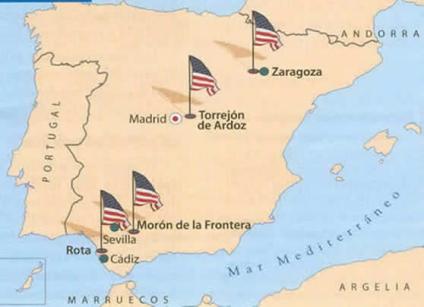
US military bases in Spain (Map from sutori.com)

No Spain, no gain? It was probably inevitable that President Donald Trump’s trade war would eventually get mixed up in his actual war.

Earlier this week, Spanish officials said they would prohibit American forces from using joint bases for war operations, unless those activities were covered by the United Nations Charter. Spanish Prime Minister Pedro Sánchez said his country would not “be complicit in something that is bad for the world”, the Associated Press reports.

On Tuesday, Trump declared that he intended to “cut off all trade with Spain”.

You might wonder: What legal authority does Trump have to unilaterally impose these sorts of revenge tariffs? After all, the Supreme Court ruled not that long ago that the authority Trump had been using to unilaterally impose tariffs based on his whims was unconstitutional. You might as well ask: On what legal authority did Trump launch a war against Iran? In theory, under the Constitution, Congress is supposed to authorize both tariffs and wars. In practice, they, uh, don’t.

Trump just does things, and the annoying constitutional worrywarts can figure it out later. (I say this as an annoying constitutional worrywart.)

In any case, yesterday, the Trump administration announced that Spain had changed its tune. “The U.S. military is coordinating with their counterparts in Spain”, White House Press press secretary Karoline Leavitt said. The implication was that the tariff threats had worked.

Spain, however, said otherwise. “I can refute (the White House spokesperson)”, Spanish Foreign Minister José Manuel Albares said. “The position of the Spanish government regarding the war in the Middle East, the bombing of Iran and the use of our bases has not changed one iota.” Maybe those tariff threats aren’t as effective as Trump thinks?

In a speech, Sánchez warned that the war could spin out of control. “Nobody knows for sure what will happen now”, he said. “Even the objectives of those who launched the first attack are unclear. But we must be prepared, as the proponents say, for the possibility that this will be a long war, with numerous casualties and, therefore, with serious economic consequences on a global scale.”

Sánchez also implicitly admonished Trump for escalating the war: “You can’t respond to one illegality with another because that’s how humanity’s great disasters begin”.

I will just note that in the Star Wars prequels, the fall of the Republic, and the descent into darkness and imperial rule, began with a planetary blockade and a trade war. At the time, people said it was wonky and boring. But here we are.

Where is Congress? The Constitution was built around the idea that each branch would fight to preserve its own powers, and this would create a system of checks and balances. But in Trump’s second term, Republicans in the legislature have been actively fighting to not preserve their power.

Yesterday, in a 47–53 vote, Senate Republicans voted against a resolution that would have required Trump to ask Congress to sign off on any further military aggression in Iran. Sen. Rand Paul (R–Ky.) voted with Democrats in favor of the measure; Sen. John Fetterman (D–Pa.) joined Republicans to vote against it.

The measure was mostly symbolic. Even a successful vote would have been subject to a House vote and a presidential veto. And the position of both the White House and the GOP Speaker of the House is that this whole situation in which America is spending billions of dollars dropping thousands and thousands of bombs on military and political targets in a foreign country is not, in fact, a war. Nothing to see here. Everyone in Congress can go home and crack open a beer.

March 3, 2026

Iran in the news

Filed under: Media, Middle East, Military, USA — Tags: , , , , , , — Nicholas @ 04:00

I haven’t bothered trying to keep up with the firehose of “news” about the combined US/Israeli operations against the Islamic State, as much of what is initially reported will be re-stated, retracted, refuted, and other words starting with “R” until something vaguely resembling objective analysis can be done. There are uncounted mainstream, specialist, and advocacy sites and there’s no point trying to keep up with them (for me, anyway). Here are a few bits of internet flotsam on issues arising from Operation Brass Balls (or whatever name they chose for it):

First up, J.D. Tuccille on the legality around President Trump’s decision to strike Iran:

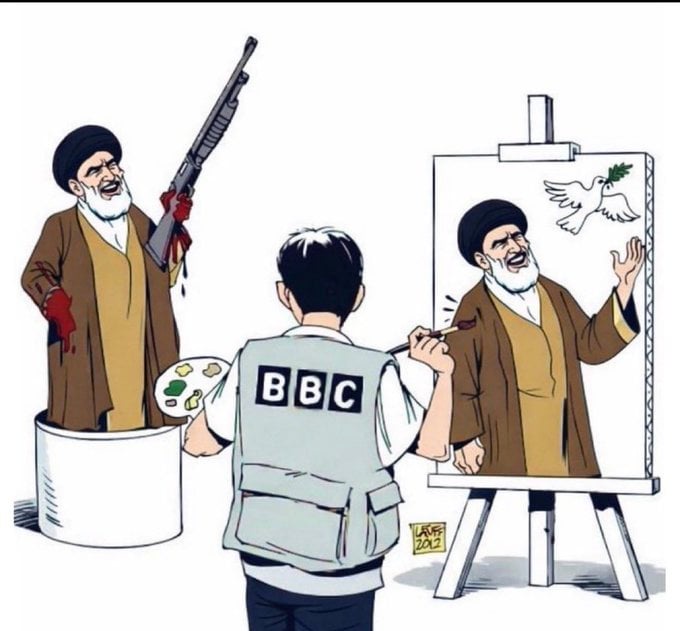
The BBC has a long history of … careful wording in describing events in Iran since 1979. I don’t think this cartoon is unfair in portraying that.

The world is undoubtedly a better place after the killing of Iran’s supreme leader Ayatollah Ali Khamenei and roughly 40 of his murderous colleagues by joint Israeli and American military strikes. Iran’s Islamist regime has slaughtered its own people while encouraging terrorism around the world for decades. But those strikes carry serious risks and costs. Are they worth the tradeoffs? The Trump administration should have made its case to Congress and the already skeptical public and satisfied the Constitution’s requirements by doing so.

War Without Debate

On Saturday, the U.S. and Israel launched much-anticipated strikes after claiming negotiations with the Iranian regime over the status of its nuclear weapons program had stalled.

“A short time ago, the United States military began major combat operations in Iran,” President Donald Trump announced. “Our objective is to defend the American people by eliminating imminent threats from the Iranian regime — a vicious group of very hard, terrible people. Its menacing activities directly endanger the United States, our troops, our bases overseas, and our allies throughout the world. For 47 years the Iranian regime has chanted ‘death to America’ and waged an unending campaign of bloodshed and mass murder, targeting the United States, our troops, and the innocent people in many, many countries.”

True enough. The president recited a litany of crimes in which the Islamist regime has been implicated, including the 1983 bombing of the U.S. Marine barracks in Beirut by Iranian proxy Hezbollah, and the October 7, 2023, Hamas attack on Israel, which Iranian forces helped plan. To this list we can add the attempted assassinations of Iranian dissident Masih Alinejad in Brooklyn and of then-presidential candidate Trump himself. Trump also called out Iran’s efforts to acquire nuclear weapons. And he urged the suffering Iranian people, who have weathered brutal attempts to suppress protests, to take advantage of the military strikes to overthrow the regime.

Unfortunately, this was the first time many Americans — members of the public and lawmakers alike — heard the Trump administration make a somewhat coherent argument for taking on Iran’s government. It came as strikes were already underway despite the Constitution reserving to Congress the responsibility to “provide for the common Defence”, “to declare War”, “to raise and support Armies”, and “to provide and maintain a Navy”. Lawmakers were informed of the attack on Iran, but only after the country was committed to hostilities and their related dangers and expense.

Congress and the People Were Never Consulted

“I am opposed to this War,” Rep. Thomas Massie (R–Ky.) objected. “This is not ‘America First’. When Congress reconvenes, I will work with @RepRoKhanna to force a Congressional vote on war with Iran. The Constitution requires a vote, and your Representative needs to be on record as opposing or supporting this war.”

Rep. Ro Khanna (D–Calif.) shares Massie’s skepticism towards military action. He and Massie might have voted against authorizing war with Iran even if they’d heard the administration’s arguments. Or perhaps they and other lawmakers would have been persuaded. We don’t know, because the president didn’t make a case until bombs and missiles had already been launched.

Andrew Doyle on the need for regime change:

The end point of armed conflict is impossible to predict. In her book On Violence (1970), the philosopher Hannah Arendt argued that when it comes to political violence, “the means used to achieve political goals are more often than not of greater relevance to the future world than the intended goals”. However well planned and executed, wars have a tendency to spiral out of control in ways never envisaged.

Whether Donald Trump’s decision to attack Iran will pay off depends upon the fates as much as anything else. The goal is regime change, which – given the appalling tyranny under which the Iranian people have suffered for five decades – is admirable and just. Yet the numerous unknown variables make this war the biggest risk that Trump has yet taken as president.

This war has the potential to escalate and engulf the entire region. Iran is already striking neighbouring Arab states allied with the US in a scattershot and desperate manner. With the death of the Ayatollah, it may be that the regime will be forced into a ceasefire while it seeks to re-establish its power. Yet the scenes of wild celebration on the streets of Iran would suggest that domestic revolution is its greatest threat. If the Islamic Revolutionary Guard Corps (not the country’s national army, but a kind of Praetorian guard for the mullahs) can be turned, the regime will fall.

Perhaps the worst case scenario is a widespread power struggle between competing militias and separatist groups. The IRGC itself could fragment, and we may see the kind of chaos that ensued after the Iraq war of 2003. The Trump administration has the advantage of the latest military technology and will insist that this enterprise will never require “boots on the ground”. It may be right, but who knows what factions will emerge with no centralised authority?

Those of us without a crystal ball should get used to the phrase: “we don’t know”. Various social media pundits are asserting with absolute certainty where all of this will lead. They would be wise to exercise greater caution. After the Twelve-Day War last June in which Israel and the US destroyed much of Iran’s nuclear infrastructure and air defence capabilities, many on the “America First” right were quick to prophesy the advent of World War III. Their claims to clairvoyance were unfounded.

CDR Salamander argues in favour of the punitive expedition as a legitimate tool in the nation’s war locker:

I support the strikes on Iran because it firmly fits into a view I have held on the use of national military power for decades, based on thousands of years of military practice. If you are not up to speed with the thousands of Americans dead and maimed by the Islamic Republic and its proxies over the last 47 years, then I have nothing more to discuss with you.

While I understand the academic argument of many that before any action takes place, there is a whole series of hoops, barriers, and puzzles of our own creation that we need to go through — I firmly believe that not only are those Constitutionally unnecessary for punitive expeditions in 2026, if done, needed and deserved strikes like we have seen in Iran could not take place without

Fortunes were made, institutions funded, and employment justified for legions under the old and failed post-WWII process swamp and GWOT nomenklatura that gave us unending and stillborn conflicts. To go that route again wouldn’t just be folly, it would be a self-destructive folly to refuse to change in the face of evidence.

I’ve seen older versions of OPLANS for Iran. Huge, bloody, and frankly undoable. They were only that way because they met the requirements of an old system that everyone nodded their heads to because all the smart people from Johns Hopkins, Harvard, Princeton and all the usual places said we had to do it this way.

Enough. Bollocks to all that. They have been measured the last quarter century and have been found wanting.

A series of events since October 7, 2023, including the 2024 election, has opened a window to do what we have not been able to do for a whole host of reasons — and there is a debt waiting to be paid.

We’ve been here before with Iran. In the modern context, we sank two warships and three speedboats of the Islamic Republic of Iran Navy in 1988 during Operation Praying Mantis as punishment for damaging USS Samuel B. Roberts (FFG 58) and Iran’s mining international waters in the Persian Gulf. We’ve played slap-n-tickle with them here and there while they have brutalized us at every turn when they are not brutalizing their own people.

Yes, it’s personal — but part of the reason we have been hesitant is that our national security intellectuals have been stuck in a world view that prevented action, by design.

Though not exclusive, the Powell Doctrine’s “Pottery Barn Rule” (that it appears he got from one of Thomas Frack’n Friedman’s columns), made it appear that we could only take action if we took the entire country and then remade it in our image.

We know how that operationalized over the last couple of decades.

We’ve done plenty of punitive expeditions in our nation’s history — but in the last few decades as a certain pedigree of policy maker held sway over our national security doctrine, it fell out of favor.

They failed the nation. Their institutions failed the nation. Their worldview was little more than a self-licking ice cream cone of self-regard.

There are also those who can find the funny aspects of any serious situation:

January 26, 2026

King Donald the First

Filed under: Government, History, Media, Politics, USA — Tags: , , , , — Nicholas @ 03:00

His most rabid fans liked to call him the God-Emperor, but Andrew Sullivan sees him much more as a modern King George III:

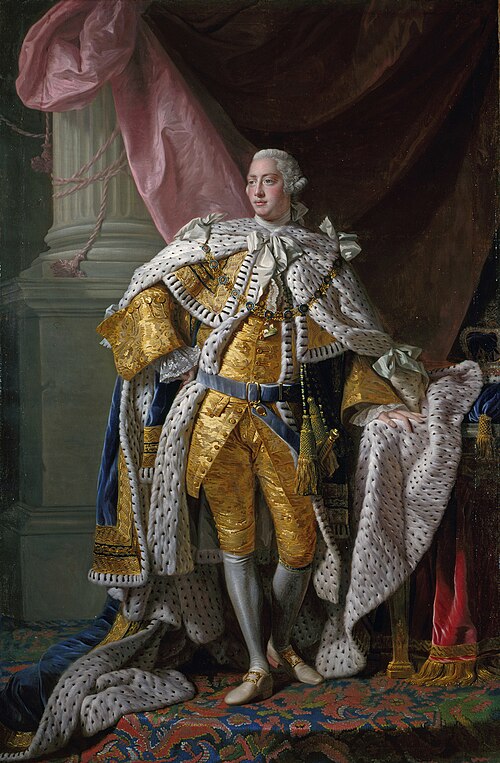
King George III in his Coronation robes.
Oil painting by Allan Ramsay (1713-1784) circa 1761-1762. From the Royal Collection (RCIN 405307) via Wikimedia Commons.

It is where lies and truth are entirely interchangeable; where the rule of law has already been replaced by the rule of one man; where the Congress has abdicated its core responsibilities and become a Greek chorus; where national policy is merely the sum of the whims and delusions of one man; and where every constitutional check on arbitrary power, especially the Supreme Court, is AWOL. In that abyss, even an attempt to explain events through the usual rubric of covering a liberal democracy is absurd. Because that rubric is irrelevant.

And so the wheels spin.

The only honest way to describe what is in front of our noses is that we now live in an elected monarchy with a manic king whose mental faculties are slipping fast. After 250 years, we appear to have elected the modern equivalent of King George III, and are busy dismantling the constitution Americans built to constrain him.

The situation is not irrecoverable — the forms of democracy remain even if they are functionally dead. We have centuries of democratic practice to fall back on. But every moment the logic of the abyss holds, the possibility of returning to democracy attenuates. Tyranny corrupts everything and everyone — fast. David Brooks returns to the ancients today to understand where we are:

    As the disease of tyranny progresses, citizens may eventually lose the habits of democracy — the art of persuasion and compromise, interpersonal trust, an intolerance for corruption, the spirit of freedom, the ethic of moderation. “It is easier to crush men’s spirits and their enthusiasm than to revive them,” Tacitus wrote. “Indeed, there comes over us an attachment to the very enforced inactivity, and the idleness hated at first is finally loved.”

Forty percent of the country still backs the tyrant. Forty percent watch this and cheer.

Let us briefly review what they are cheering. For the first time since the Second World War, the president of the United States declared last week that we no longer support the notion of national sovereignty or collective security, and reserve the right to invade and occupy other sovereign countries — even close allies — to extract their resources. Quite a Rubicon. His chief adviser declared international law a dead letter:

    [W]e live in a world, in the real world … that is governed by strength, that is governed by force, that is governed by power. These are the iron laws of the world since the beginning of time.

To put it bluntly, this was the argument of King George III. It was the justification for the British Empire, and, more hideously, for the Nazi and Soviet occupations of Europe. It’s a rejection of the principle that literally created the United States.

And yet this mad king threw this founding principle away because he believes a) we deserve Greenland as reparations for World War II, b) because Russia and China would invade otherwise, c) because rare earths are there — even though they are buried under a mile of ice — and d) because he didn’t win the Nobel Prize. Insane.

This staggering concession to evil — which cannot be withdrawn — robs us of any case against Russia’s invasion of Ukraine or China’s threat to Taiwan. It legitimizes war by major powers for conquest everywhere. It endangers the entire system of collective security that has kept the peace for nearly 80 years. Why? And for what? Because the king was on a high.

That’s where we are.

November 17, 2025

The US Supreme Court considers whether Trump’s tariffs are legal

Filed under: Government, Law, Liberty, Media, Politics, USA — Tags: , , , , — Nicholas @ 05:00

Thanks to the staggering incompetence (and/or deliberate provocation for domestic political advantage) of the Carney government’s dealings with President Donald Trump, the current case before the Supreme Court is of significant interest to those of us on the north side of the US-Canadian border. On his Substack, David Friedman discusses the issues before the court:

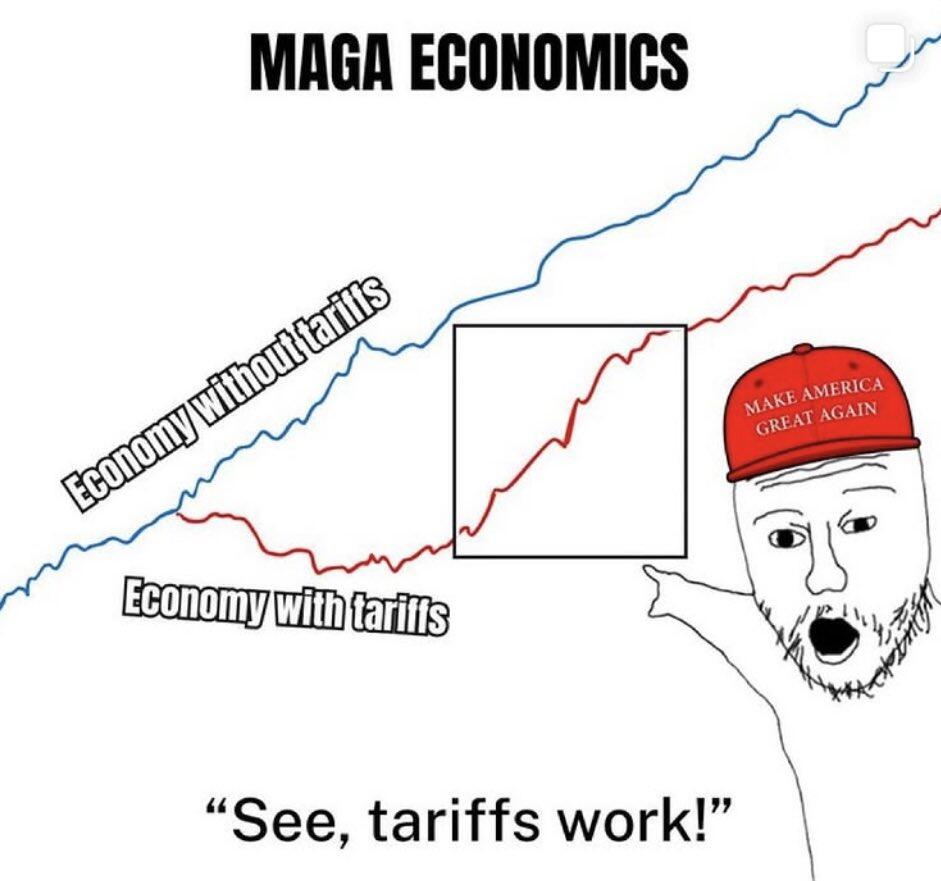
There are three things wrong with Trump’s tariffs. The first is that they cannot be expected to provide the benefits claimed, can be expected to make both the US and its trading partners poorer; the arguments offered for them depend on not understanding the economics of trade. For an explanation of why that is true, see an earlier post.

The fact that the tariffs make us poorer may be the most important thing wrong with them but it is irrelevant to the Supreme Court; nothing in the Constitution requires the president to do his job well. The questions relevant to the Court are whether what Trump is doing was authorized by past Congressional legislation and whether it was constitutional for Congress to authorize it.

What Counts As An Emergency?

Tariffs are under the authority of Congress, not the president.1 Trump’s justification for setting them himself is congressional legislation, the International Emergency Economic Powers Act.

    (a) Any authority granted to the President by section 1702 of this title may be exercised to deal with any unusual and extraordinary threat, which has its source in whole or substantial part outside the United States, to the national security, foreign policy, or economy of the United States, if the President declares a national emergency with respect to such threat.

    (b) The authorities granted to the President by section 1702 of this title may only be exercised to deal with an unusual and extraordinary threat with respect to which a national emergency has been declared for purposes of this chapter and may not be exercised for any other purpose. (IEEPA, 50 U.S. Code § 1701, emphasis mine)

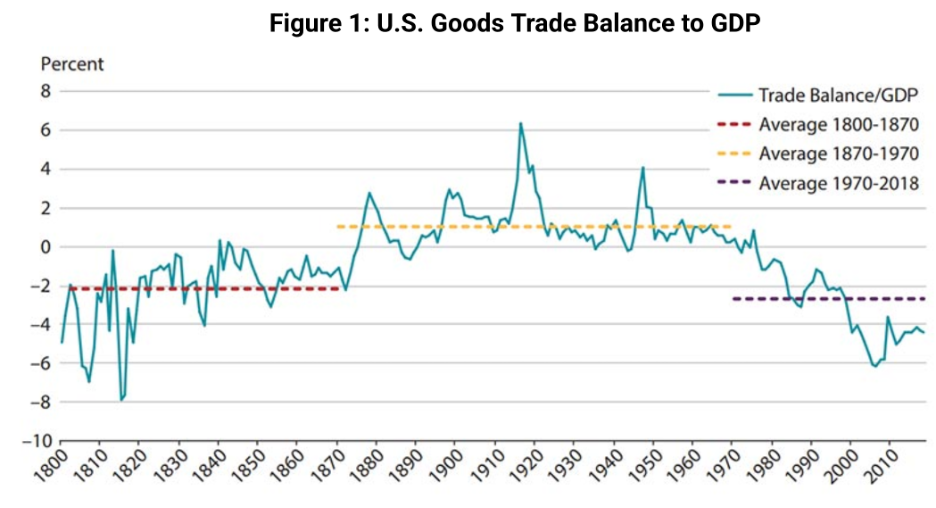
Trump declared that his Worldwide Reciprocal Tariffs were intended to deal with the US trade deficit.2 Whether the deficit is a threat and whether tariffs are a good way to deal with it are questions for economists3 but whether it is unusual is relevant to judges, since if it is not the IEEPA does not apply.

[…]

The Court on Trial

Delegating to the president the power to impose tariffs, a power explicitly given to Congress in the Constitution, is a major question. Under doctrine proclaimed by this court that means that the legislation claimed to delegate that power must be read narrowly. On a narrow reading, on anything but a very broad reading, the legislation fails to apply to President Trump’s tariffs for two independent reasons:

    It only grants power in an emergency, which under the language of the Act neither the trade deficit nor the illegal drug problem is; the deficit has existed since 1970, the War on Drugs was proclaimed in 1971.

    The powers granted to the president in the Act do not include the power to impose tariffs.

If the six conservative justices believe in the principles they claim, the administration will lose the case 9-0.


  1. The Congress shall have Power To lay and collect Taxes, Duties, Imposts and Excises … To regulate Commerce with foreign Nations … (U.S Constitution, Article I, Section 8).
  2. “I found that conditions reflected in large and persistent annual U.S. goods trade deficits constitute an unusual and extraordinary threat to the national security and economy of the United States that has its source in whole or substantial part outside the United States. I declared a national emergency with respect to that threat, and to deal with that threat, I imposed additional ad valorem duties that I deemed necessary and appropriate.” (Executive Order July 31, 2025).
  3. The answers are no and no.

August 31, 2025

Didn’t we once have “conflict of interest” rules for politicians?

Filed under: Business, Government, Media, Politics, USA — Tags: , , , , — Nicholas @ 03:00

It’s become a commonplace that politicians leave office vastly wealthier than they went in, far in excess of their official salaries. Once upon a time, even though it probably still happened, the fat cats managed to stay below the event horizon with their ill-gotten gains. Today, they no longer care if you find out that this or that senator has consistently beaten the market on their investments during their entire time in office. After all, what are you going to do about it, punks? Maybe something like this:

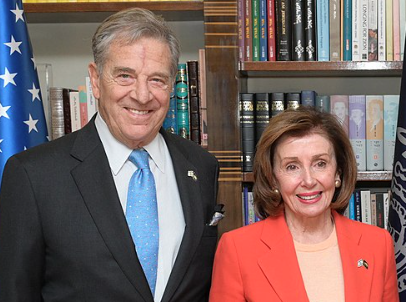
Paul and Nancy Pelosi, 16 February, 2022.
Detail of a photo by Amos Ben Gershom via Wikimedia Commons.

The original research was on how Senators seem to make 12% annually. That’s, erm, a lot.

Markets — something that always comes as a surprise to politicians — react:

    American lawmakers are so consistently successful that a flurry of new platforms and apps now compile filing data from US politicians as a key input in strategies for retail investors and even hedge funds.

    The number of people using these so-called “copy trading” strategies has exploded. Tens of thousands of Americans now follow and imitate trades made by members of Congress, and they are making millions of dollars in the process.

OK, what fun, eh?

Even more fun would be Megan McArdle’s suggestion, that the CongressThieves must announce that they intend to trade an hour before they do so that everyone else can front run them.

Because, you know, Ms. Pelosi:

    She beat every single hedge fund last year.

But there’s something even more fun:

    Dub launched in March 2024 as America’s first regulated brokerage to offer copy trading accounts to mimic politicians and star traders.

    “It’s been absolutely insane in terms of growth,” says Steven Wang, the founder and chief executive who dropped out of his freshman year at Harvard to build the platform. Today, it has 1.5 million users across America.

    Of the $100m or so invested across Dub, nearly $23m is in its Pelosi tracker account. Since its launch in early 2024, its paper gains are 172pc.

Stock prices do not move “because”. Interest rates change, profits go up, or down, or tariffs or … stock prices change because people buy and or sell more of them. That may be in reaction to those other things but the actual price movement is that buy and sell stuff.

Which means that if we copy Nancy’s trades — after she’s done them — then we’re making money for Nancy. Because we are piling in our weight of money into a position she already holds.

Which, when you think about it, is really pretty shitty. Sure, it’s nice to make money ourselves by trading upon that congressional information. But there is that very, very, heavy cost of making Ms. Pelosi even richer as a consequence.

August 9, 2025

Carney hints at backing away from Trudeau’s digital policy catastrophes

Filed under: Cancon, Government, Media, Technology, USA — Tags: , , , , , , , — Nicholas @ 04:00

Michael Geist on the possibility that Prime Minister Mark Carney is starting to recognize just how damaging to Canadian interests the previous government’s various online bills have been:

Digital policies did not play a prominent role in the last election given the intense focus on the Canada-U.S. relationship. Prime Minister Mark Carney started as a bit of a blank slate on the issue, but over the past few months a trend has emerged as he distances himself from the Justin Trudeau approach with important shifts on telecom, taxation, and the regulation of artificial intelligence. Further, recent hints of an openness to re-considering the Online News Act and heightened pressure from the U.S. on the Online Streaming Act suggests that a full overhaul may be a possibility.

This week’s decision to let the CRTC’s decision on wholesale access to fibre broadband networks stand is a case in point. Last November, the Justin Trudeau-led government sent the CRTC’s initial ruling back to the Commission for reconsideration, noting that it “has concerns about future and ongoing investments in broadband infrastructure and services in Ontario and Quebec, including in rural, remote and Indigenous communities, and concerns that those investments could, if they are unprofitable, lead to a decline in quality and consumer choice in the retail Internet services market”. Nine months later, the CRTC came back with the roughly same ruling. That led to yet another request for a cabinet review but this time the government stood by the CRTC despite significant industry opposition. New leader, dramatically new approach.

The CRTC is example was preceded by the decision to eliminate the digital services tax. While the strategic approach seemed misguided – dropping the DST should have garnered more than just an agreement from the U.S. to return to the bargaining table – some noted at the time that perhaps Carney wasn’t a supporter of the DST and had few qualms with rescinding it. The tax had been a foundational part of the government’s campaign to “make web giants pay” but in a matter of 72 hours in late June it was gone.

The government has also shifted its approach on AI regulation. After months of supporting Bill C-27 and the EU-style AI regulatory approach, a new government brought a new minister and a new approach. Evan Solomon, the newly installed AI and Digital Innovation Minister, used his first public speech as minister to pledge that Canada would move away from “over-indexing on warnings and regulation” on AI. That too represents a significant shift in approach, particularly since Trudeau had embraced the EU style regulatory model.

Then there is the Online News Act and Online Streaming Act. When asked about the Online News Act this week, Carney seemed to suggest he was open to change, stating “this government is a big believer in the value of … local news and the importance of ensuring that that is disseminated as widely and as quickly as possible. So, we will look for all avenues to do that.” While that isn’t a clear commitment to change, it is far from an ironclad commitment to legislation is viewed by many to have done more harm than good. Further, reports indicate that the U.S. Congress is escalating pressure to rescind the Online Streaming Act, which may put that law on the chopping block, particularly if a court appeal strikes down elements of the bill or the CRTC’s implementation of the law puts the bill on the Trump radar screen.

May 22, 2025

Trump, “the American Mussolini”, versus ever-so-democratic Mark Carney

Filed under: Cancon, Government, Media, Politics, USA — Tags: , , , , , — Nicholas @ 03:00

In the National Post, John Robson contrasts the authoritarian dictator at the helm of the American ship of state with our peaceful, democratic, and fully accountable to the voters prime minister:

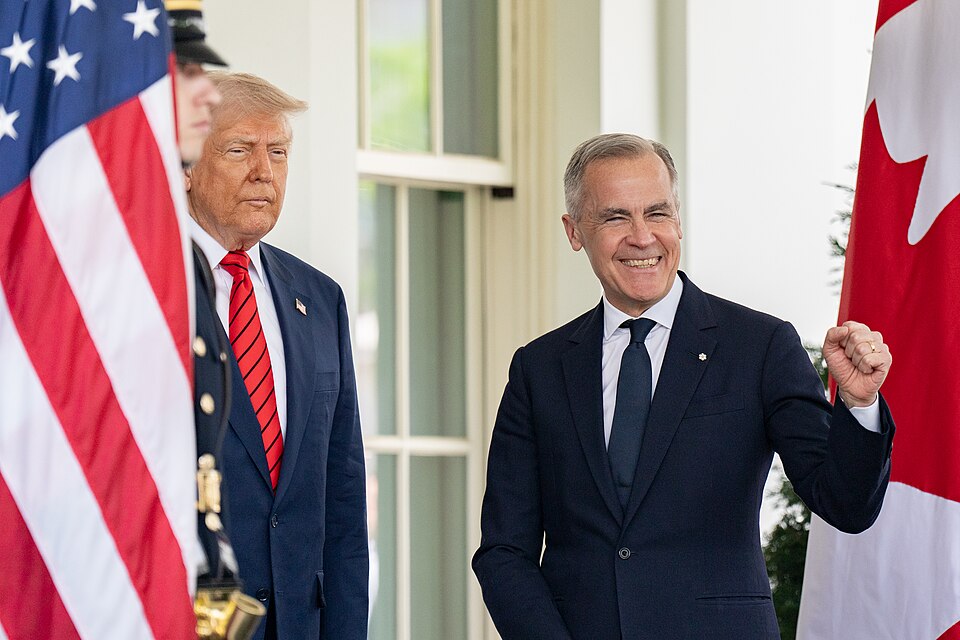
President Donald Trump greets Prime Minister of Canada Mark Carney, Tuesday, May 6, 2025, at the West Wing entrance of the White House.
(Official White House Photo by Gabriel B Kotico)

It was the best of budgets, it was the worst of budgets, it was the age of restraint, it was the age of profligacy, it was the epoch of the legislature, it was the epoch of the executive, it was the season of open debate, it was the season of closed doors, it was the spring of Canada, it was the winter of America. Or possibly the other way around.

The confusion arises because as a patriotic Canadian I keep hearing how U.S. President Donald Trump is an American Mussolini who has abolished the last vestiges of the old Republic, so we should drink rye not bourbon or some other decisive action easily performed while sitting down. Yet the news media mysteriously insist that the Bad Orange Man is having trouble getting his budget through some quaint relic called the United States Congress while Green Mark Carney isn’t bothering to get his spending plans rubber-stamped by some quaint relic called the Canadian Parliament. How can it be?

Tuesday’s the Morning newsletter from the New York Times, which is no MAGA outlet, reads: “Speaker Mike Johnson has a math problem. He wants to pass a megabill before Memorial Day to deliver President Trump’s legislative agenda.” But with only three spare votes in the House, “there are way more than three G.O.P. dissenters, and they don’t agree on what the problem is. Some think the cuts to Medicaid are too large. Others think they’re too small. Some want to purge clean-energy tax breaks. Others want to preserve them because their constituents have used them.”

Likewise The Atlantic, part of the thundering herd of independent liberal American minds, says: “The struggle to pass Donald Trump’s second-term agenda in Congress has never been between Republicans and Democrats … it’s been a battle between the House and Senate GOP, between moderates and hard-liners, and, most salient, between Republicans and reality.”

Egad. What manner of rambunctious folly is this? Open debate within the Maximum Leader’s own party? Dictatorship! By contrast here in decorous Canada can someone remind me which inane or malicious measures from former prime minister Justin Trudeau were ever put at risk by the principled courage, truculence or mere pandering even of his NDP coalition non-partners, let alone the trained seals in red?

Periodically one would bark. But which ever bit? To be sure, as the Canadian Press noted on Sunday, “Prime Minister Mark Carney says the Liberal government will present a federal budget in the fall, allowing time for clarity on some key economic and fiscal issues to emerge”. But if there’s going to be a brawl, it will be inside his office, or head, with his finance minister promising to brush aside Parliament with an “economic statement” before Carney overrode him, saying the government would introduce “a much more comprehensive, effective, ambitious, prudent budget in the fall”.

May 11, 2025

Will Amtrak survive the DOGE treatment?

Filed under: Economics, Government, Railways, USA — Tags: , , , — Nicholas @ 03:00

J.D. Wong outlines Amtrak’s never-ending financial difficulties:

“Amtrak” by Mike Knell is licensed under CC BY-SA 2.0 .

Founded 54 years ago, Amtrak set out on a bold adventure to see if passenger trains could be profitable. Fast forward to today, this experiment has been unsuccessful. Politicians have often crafted routes to win votes rather than attract riders. As a result, Amtrak has been squandering taxpayer money since its start in 1971.

Take, for instance, the Infrastructure Investment and Jobs Act of 2021. It allocated a monumental $66 billion to bolster passenger rail. Yet, even with this backing, Amtrak’s losses soared from $1.12 billion in FY2019 to $2.12 billion in FY2024. This financial drain isn’t new; America’s passenger trains have lost money for 79 years.

Amtrak asserts that it is “on-track to reach operational profitability”. Yet, this is a bald-faced lie. While Amtrak reported a loss of $705.2 million for FY2024, it didn’t include:

  1. $966.2 million in depreciation;
  2. $447.3 million in “Project Related Expenses”;
  3. $314.1 million in state subsidies, which it classified as “revenue”;
  4. $26.9 million in Office of Inspector General funding

By omitting these costs, Amtrak paints an optimistic view of its financial health. In reality, Amtrak needs larger subsidies than ever before. In fact, Amtrak has been deceiving Congress with its “path to profitability” since 1990.

Although Amtrak touted a “ridership record” for FY2024, this figure is misleading too. Ridership numbers don’t reflect the average length of each passenger’s trip. A more insightful metric is passenger-miles, which measures how far people are traveling. In fact, Amtrak only transported 6.54 billion passenger-miles in FY2024. This is a decrease of 3.40 percent since FY2013.

Amtrak often attributes its financial struggles to its long-haul routes. Yet, the outlook is even bleaker for its short-haul, state-supported routes. Amtrak reported a $251.5 million loss for these routes in FY2024. Yet, with $314.1 million in state subsidies included, the true loss hits $565.6 million. This represents a shocking 94 percent increase from the $291.7 million lost in FY2019.

Amtrak’s advocates often cite highway “subsidies” to explain its financial debacles. But Amtrak guzzles about 39 times more subsidies per passenger-mile than highways do.

Amtrak asserts that freight trains “interfere” with its passenger services. However, Amtrak often makes questionable route choices despite having legal priority over freight. Between Chicago and Los Angeles, the Desert Wind lost less money than the Southwest Chief. Despite this, Amtrak favored the Southwest Chief, which passed through more congressional districts. It discontinued the Desert Wind in 1997, leaving Las Vegas with no train service.

April 23, 2025

The Korean War Week 44 – Mac’s Lies Boil Truman’s Blood – April 22, 1951

Filed under: China, History, Military, Politics, USA — Tags: , , , , , , — Nicholas @ 04:00

The Korean War by Indy Neidell
Published 22 Apr 2025

The stage is set for the Chinese Communist Forces’ next big offensive in Korea, but that is not where American eyes are fixed this week. Instead, focus swings to Washington D.C. where the recently-fired Douglas MacArthur arrives and proceeds to address crowds and Congress alike. It soon becomes clear that he will not go gentle into that good night.

Chapters
00:00 Intro
00:58 Recap
01:46 Soviet Intervention?
04:22 Operation Rugged
07:01 Task Force 77
09:36 South Korean Porters
11:02 MacArthur and McClellan
13:55 Summary
14:13 Conclusion
(more…)

April 12, 2025

President Trump … or any president … shouldn’t have the unilateral power to levy tariffs

Filed under: Economics, Government, Politics, USA — Tags: , , , , — Nicholas @ 03:00

Love him or hate him — and there are lots of people in both camps — President Donald Trump has the power to randomly throw spanners into the international trade arena … because Congress ceded that power to the presidency long before Trump began his political career:

In response to Donald Trump’s tariff maneuvers, Senator Rand Paul has been arguing that presidents shouldn’t have the power to raise tariffs themselves. Taxing power belongs to Congress, and that’s where tariffs should be born. Trump’s tariffs result from the use of emergency power that Congress gave to the POTUS, and we shouldn’t normalize emergency rule. You can watch him say all of that here.

Every word of that is completely right. I don’t disagree with a single breath of it. I respect Rand Paul, and I’m inordinately fond of his dad. But it misses the point about how we got here, and why, starting with the fact that Congress gave away its taxing authority.

  1. Congress delegated its authority;
  2. Donald Trump used the authority that Congress gave him;
  3. Therefore, Donald Trump is very bad, and what he’s doing is wrong.

The core sickness at the heart of the American republic is Congress, and we keep discussing that sickness by saying that Trump sucks. He’s doing what you gave him the power to do, and he’s not the first.

See also my recent post in which I described a time when Congress made something illegal, than asked the administrative agencies to explain to them what they had just banned. Congress has delegated its authority, over and over again, and the resulting political vacuum is a serious problem. But anyway, TRUMP TRUMP TRUMP.

American political discourse keeps taking a wide range of political pathologies and assigning them to the same account. Orange Man Bad, Orange Man Bad, Orange Man Bad, they explained, with drool running down their chins. Donald Trump is our deflector object, our national excuse. [Problem name here]; OH NO WHY IS TRUMP DOING THIS TO US.

The commandant of the United States Coast Guard spoke at a maritime conference, a few days ago, and he said that the organization he runs wakes up every day and tries to keep the doors from falling off: “The US Coast Guard is less ready today than any other time since World War II. We are on a readiness spiral. Today our fleet of cutters are in significant decline. We are in repair failure mode … No ship today gets underway without cannibalizing others for parts.”

See also, from one of his subordinates:

Serious question: Did all of those problems begin at noon on January 20, 2025?

April 9, 2025

The Korean War Week 42 – Seize Hwacheon Reservoir? A Dam Good idea – April 8, 1951

Filed under: Asia, China, History, Military, USA — Tags: , , , , , , — Nicholas @ 04:00

The Korean War by Indy Neidell
Published 4 Apr 2025

Operation Rugged is in full swing, and it’s taking a decent amount of territory, but Matt Ridgway is worried about the possibility of the enemy blowing the dam at the Hwacheon Reservoir and flooding his army, so he gets set to try and soon take it. Meanwhile there’s an explosion in Congress in Washington DC, when the Minority Leader openly reads Douglas MacArthur’s letter of his plans for the war that are diametrically opposed to those of President Harry Truman. Truman realizes that he’s going to have to remove MacArthur from UN command.

Chapters
00:57 Recap
01:31 When to Fire MacArthur?
03:53 Joe Martin Speaks
07:11 Operation Rugged
09:23 The Hwacheon Reservoir Dam
13:35 Summary
13:51 Conclusion
(more…)

March 23, 2025

QotD: Herbert Hoover as president

Herbert Hoover spent his entire presidency miserable.

First, he has no doubt that the economy is going to crash. It’s been too good for too long. He frantically tries to cool down the market, begs moneylenders to stop lending and bankers to stop banking. It doesn’t work, and the Federal Reserve is less concerned than he is. So he sits back and waits glumly for the other shoe to drop.

Second, he hates politics. Somehow he had thought that if he was the President, he would be above politics and everyone would have to listen to him. The exact opposite proves true. His special session of Congress comes up with the worst, most politically venal tariff bill imaginable. Each representative declares there should be low tariffs on everything except the products produced in his own district, then compromises by agreeing to high tariffs on everything with good lobbyists. The Senate declares that the House of Representatives is corrupt nincompoops and sends the bill back in disgust. Hoover has no idea how to solve this problem except to ask the House to do some kind of rational economically-correct calculation about optimal tariffs, which the House finds hilarious. “Opposed to the House bill and divided against itself, the Senate ran out the remaining seven weeks [of the special session] in a debauch of taunts, accusations, recriminations, and procedural argument.” The public blames Hoover, pretty fairly – a more experienced president would have known how to shepherd his party to a palatable compromise.

Also, there are crime waves, prison riots, bootlegging, and a heat wave during which Washington DC is basically uninhabitable. Also, at one point the White House is literally on fire.

… and then the market finally crashes. Hoover is among the first to call it a Depression instead of a Panic – he thinks the new term might make people panic less. But in fact, people aren’t panicking. They assume Hoover has everything in hand.

At first he does. He gathers the heads of Ford, Du Pont, Standard Oil, General Electric, General Motors, and Sears Roebuck and pressures them to say publicly they won’t fire people. He gathers the AFL and all the union heads and pressures them to say publicly they won’t strike. He enacts sweeping tax cuts, and the Fed enacts sweeping rate cuts. Everyone is bedazzled […] Six months later, employment is back to its usual levels, the stock market is approaching its 1929 level, and Democrats are fuming because they expect Hoover’s popularity to make him unbeatable in the midterms. I got confused at this point in the book – did I accidentally get a biography from an alternate timeline with a shorter, milder Great Depression? No – this would be the pattern throughout the administration. Hoover would take some brilliant and decisive action. Economists would praise him. The economy would start to look better. Everyone would declare the problem solved – especially Hoover, sensitive both to his own reputation and to the importance of keeping economic optimism high. Then the recovery would stall, or reverse, or something else would go wrong.

People are still debating what made the Great Depression so long and hard. Whyte’s theory, insofar as he has one at all, is “one thing after another”. Every time the economy started to go up (thanks to Hoover), there was another shock. Most of them involved Europe – Germany threatening to default on its debts, Britain going off the gold standard. A few involved the US – the Federal Reserve made some really bad calls. The one thing Whyte is really sure about is that his idol Herbert Hoover was totally blameless.

He argues that Hoover’s bank relief plan could have stopped the Depression in its tracks – but that Congressional Democrats intent on sabotaging Hoover forced the plan to publicize the names of the banks applying. The Democrats hoped to catch Hoover propping up his plutocrat friends – but the change actually had the effect of making banks scared to apply for funding and panicking the customers of banks that were known to have applied. He argues that the “Hoover Holiday” – a plan to grant debt relief to Germany, taking some pressure off the clusterf**k that was Europe – was a masterstroke, but that France sabotaged it in the interests of bleeding a few more pennies from its arch-rival. International trade might have sparked a recovery – except that Congress finally passed the Hawley-Smoot Tariff, the end result of the corruption-plagued tariff negotiations, just in time to choke it off.

Whyte saves his barbs for the real villain: FDR. If the book is to be believed, Hoover actually had things pretty much under control by 1932. Employment was rising, the stock market was heading back up. FDR and his fellow Democrats worked to tear everything back down so he could win the election and take complete credit for the recovery. The wrecking campaign entered high gear after FDR won in 1932; he was terrified that the economy might get better before he took office, and used his President-Elect status to hint that he was going to do all sorts of awful things. The economy got skittish again and obediently declined, allowing him to get inaugurated at the precise lowest point and gain the credit for recovery he so ardently desired.

Scott Alexander, “Book Review: Hoover”, Slate Star Codex, 2020-03-17.

Older Posts »

Powered by WordPress