Quotulatiousness

March 25, 2026

UNDRIP’s malign power in Canada

Filed under: Cancon, Government, Law — Tags: , , , , , — Nicholas @ 03:00

The United Nations Declaration on the Rights of Indigenous Peoples (UNDRIP) has been adopted into law by the provincial government in British Columbia and the federal government. In BC, voters were assured that this was a purely symbolic act to advance reconciliation with First Nations groups in the province. But that was deliberate misdirection and lies:

During the debate on DRIPA [BC’s Declaration on the Rights of Indigenous Peoples Act] in the legislature in late 2019, government ministers of the day waxed lyrical that DRIPA and UNDRIP created no new rights, had no legal force, did not apply to private land, and did not provide a veto. Those assurances were used to justify passing DRIPA, which resulted in the B.C. Opposition unanimously supporting the legislation. It turns out that the government’s assessment and promises were neither correct in substance nor valid legally.

Much has been written lately about DRIPA, some of it wrong. Prior to the B.C. Court of Appeal decision in Gitxaala, some DRIPA defenders insisted it was merely a “process” piece of legislation that bound the government to an arguably undemocratic joint government and Indigenous leadership arrangement, set out in section 3, to evaluate every B.C. statute for conformity with the 46 Articles of UNDRIP and then amend statutes as deemed necessary to create that conformity.

DRIPA itself, though arguably highly undemocratic and perhaps unconstitutional, is not the real problem in this province. The real problem is that DRIPA has been effectively employed as a “smokescreen” by the B.C. NDP and certain of its allies, while the government, secretly and with no explicit public mandate, imposes the Articles of UNDRIP throughout B.C. as a fundamental matter of policy, as though they have the force of law.

Let’s be clear, this is a devious political manoeuvre, much of which is not underpinned in law by DRIPA or, more importantly, by Supreme Court of Canada jurisprudence at all.

Notwithstanding statements made to the legislature in 2019 to get DRIPA passed, the NDP government immediately chose to implement a policy approach to UNDRIP throughout B.C. under which UNDRIP Articles would be applied by the government and the public service as though they were, in fact, the law in this province, notwithstanding the fact that they are inconsistent in many respects with Canadian constitutional law.

In the wake of recent court decisions, there is no indication that the government’s policy approach has changed or that the Premier is thinking about backing away from it, even though there is now much greater public scrutiny of what the government has really been up to since 2019.

The Eby government claims to be upset that UNDRIP is now being applied by the courts as the law in B.C., which it knows will create utter chaos. What has upset it more, however, is that the courts have usurped the NDP government’s desire to quietly and secretly implement UNDRIP everywhere in the province as a matter of policy, a policy that they would like to be viewed as law but without being legally enforceable by judges.

This amounts to a policy of subterfuge by a government that has shown an inclination towards deception on matters concerning First Nations. It appears that a law is not a law unless the B.C. government says it is a law, but some laws, like DRIPA, can be used as a false “front” to allow the covert implementation of a complex UN-based policy that is clearly unfit for the Canadian context, with no one being the wiser.

In the National Post, Warren Mirko explains the murky theory that allows “indigenous ways of knowing” to be taken more seriously than science, history, and legal procedure:

Canada is rapidly abandoning a principle that has shaped western democracies since the Enlightenment: the idea that no person or group has privileged access to sacred or divine knowledge unavailable to everyone else.

Now, this principle is being threatened by Canada’s increasing embrace of “Indigenous Knowledge” — whereby knowledge is treated as collectively owned and restricted by ancestry rather than something open to examination and shared across society.

The governments of British Columbia and Canada — both of which have formally adopted the United Nations Declaration on the Rights of Indigenous Peoples (UNDRIP) — endorse “Indigenous Knowledge” as inherited, rooted in ancestral relationships to the land, and encompassing spiritual, cultural and metaphysical dimensions passed down through generations.

Remarkably, the defining quality to possess this knowledge is not study, training, time spent on the land, or lived experience by any individual alive today. Instead, it’s lineage itself.

That’s a paradigm shift. When knowledge is said to be possessed by birth rather than learned, its universality is replaced with mysticism and its value diminished.

This comes with real-world consequences: ancestry-based considerations are reshaping how public land and resources are managed on Canadians’ behalf.

In British Columbia, newly proposed changes to hunting and wildlife regulations are described as being informed by “the best available science and Indigenous Knowledge“. In practice, this means “Indigenous Knowledge” is being used to design a regulatory regime that falls almost entirely on non-Indigenous users. That’s because Indigenous harvesting rights are recognized under Section 35 of the Constitution, not bound by the same hunting seasons, bag limits, gear restrictions, or limited-entry systems that apply to the broader public.

The growing influence of this genetically transmitted, ancestry-qualified knowledge extends to matters of public safety and economic security, like nuclear regulation: “Indigenous ways of knowing and the Indigenous cultural context enhance the Canadian Nuclear Safety Commission’s understanding of the potential impacts of nuclear projects and strengthen the rigour of project reviews and regulatory oversight”, says the government of Canada website.

Governments championing the principles of UNDRIP insist that “Indigenous Knowledge” can be combined with “Western” science to produce better public policy. But this is a contradiction. Knowledge cannot at once be exclusive and universal.

March 15, 2026

Using US gun statistics to argue against Canadian gun owners

Filed under: Cancon, Law, USA, Weapons — Tags: , , , , — Nicholas @ 03:00

On the social media site formerly known as Twitter, Gun Owners of Canada respond to a troll post trying to confuse the legal situation for Canadian gun owners by using statistics from the US, where the laws are significantly different:

Typical. He blocked without further discussion.

But, he’s wrong.

There is a fundamental flaw in using that 1998 [US] DOJ literature review to argue the Stand on Guard Act will lead to more gun deaths. The claim relies on a completely broken comparison between U.S. and Canadian law.

Here is why applying that specific American data to this Canadian bill proposed by the CPC simply does not work.

The DOJ report relies heavily on American statistics where firearms kept for self defense are typically stored loaded and unlocked. That specific environment, meaning immediate and unrestricted access to a loaded weapon, is the primary driver for the increased rates of accidental shootings and suicides highlighted in those U.S. studies.

The Stand on Guard Act does not create that environment in Canada. Saying it does such is just fear-mongering.

This proposed legislation is strictly an amendment to Section 34(2) of the Criminal Code. It establishes a presumption that force used against a violent home invader is reasonable. The goal is to spare Canadians from years of legal limbo for defending their families.

Crucially, this bill does not amend the Firearms Act and it does not repeal Canada’s strict safe storage regulations.

A legally compliant Canadian firearm owner must still store their firearms unloaded and secured with a locking device, or locked inside a sturdy cabinet or safe. Ammunition must also be stored separately or locked up securely in the same safe.

The specific risks identified in the U.S. data, like a child finding a loaded gun or someone in crisis having instant access to a weapon, are mitigated by our existing storage framework.

Debating the merits of self defense thresholds is perfectly fair. However, importing U.S. data based on a completely different regulatory baseline to predict Canadian outcomes is a clear misapplication of the evidence. We need to ground this conversation in actual Canadian law rather than American statistics.

So, as a reminder — welcome to Canada — let’s buy Canadian, support Canadian and recognize Canadian facts.

March 11, 2026

The Supreme Court of Canada in Santa Claus mode (even if they no longer use those robes)

Filed under: Cancon, Government, Politics — Tags: , , , , , , , — Nicholas @ 05:00

In a pretty conclusive 8-1 decision, the Supreme Court of Canada seems to have overturned not only the Quebec childcare entitlement at issue in this case, but the notion of citizenship in a much wider sense:

The SCC recently abandoned their traditional red robes for black robes more similar to those of the US Supreme Court. This is a case where the older robes would be more appropriate for other reasons.

On Friday, the Supreme Court of Canada delivered its latest stupefying ruling. According to an 8–1 majority in the case of Quebec (Attorney General) v. Kanyinda, the Charter requires the Quebec government to extend subsidized daycare benefits to refugee claimants — asylum seekers who have not yet proven the legitimacy of their claim to refugee status. Founded on a prevalent but contentious reading of constitutional equality rights, the court’s reasoning has far-reaching potential to destabilize parts of the nation’s immigration and social welfare systems.

Until last week, Quebec law granted daycare subsidies to certain categories of parents, including Canadian citizens, permanent residents, and those with approved refugee status. When Bijou Cibuabua Kanyinda, the plaintiff in this case, arrived in the province and sought asylum in 2018, she fell into none of those categories. Aided by cause lawyers, and a coterie of social justice interveners (third party interest groups who submit arguments to the court), Kanyinda argued that the exclusion of refugee claimants from this welfare scheme amounted to unconstitutional discrimination.

Remarkably, the majority of the Supreme Court not only agreed with Kanyinda that the Quebec daycare scheme violated Section 15(1) of the Charter — which provides for “the right to the equal protection and benefit of the law without discrimination” — but bypassed the Quebec legislature by “reading in” a remedy directly into the law. In other words, the court rewrote the statute to immediately grant subsidies to “all parents residing in Quebec who are refugee claimants”.

More troubling than the outcome itself, however, will be the judicial reasoning that rationalized it. Writing for the majority, Justice Andromache Karakatsanis held that the Quebec scheme created a distinction “on the basis of sex”, a proscribed ground of discrimination under Section 15. But rather than fostering a distinction between men and women, Justice Karakatsanis asserted that the scheme discriminated between “men and women refugee claimants” — even though neither group was eligible for benefits at all. Because Quebec’s exclusion of refugee claimants worsened the economic disadvantage of the female claimants, she concluded, it constituted discrimination that violated Section 15.

The court’s reasoning is convoluted, to be sure. Readers may be forgiven for struggling to understand how a ruling that extends benefits to “refugee claimants” can follow from a supposed distinction on the basis of “sex”. In fact, the judgment exposes the incoherence into which the Supreme Court’s equality rights jurisprudence has fallen.

March 3, 2026

New name for Vancouver incoming in 3 … 2 … 1…

Filed under: Cancon, Government, Liberty, Politics — Tags: , , , — Nicholas @ 03:00

The Canadian federal government is not eager to share the details of a new agreement they’ve signed with the Musqueam First Nation that apparently cedes most of the city of Vancouver to the band, casting the property rights of two million people into legal limbo:

The Liberal government is refusing to publicly release an agreement with the Musqueam Indian Band that recognizes Aboriginal title over a vast area of British Columbia, including Metro Vancouver and surrounding areas, potentially affecting nearly two million people.

Buried in a seemingly mundane fisheries announcement put out on February 20th, the acknowledgement could radically undermine property rights in one of Canada’s largest and most populated metropolitan regions.

On February 20, Crown-Indigenous Relations and Northern Affairs Canada issued a news release with little fanfare titled “Musqueam and Canada Sign Historic Agreements Recognizing Rights, Stewardship and Fisheries”.

The news release reads: Canada “recognizes that Musqueam has Aboriginal rights including title within their traditional territory and establishes a framework for incremental implementation of rights and nation-to-nation relations with Canada”.

That phrase “including title” refers to Aboriginal title. Under Canadian constitutional law, Aboriginal title is a contentious but increasingly recognized property interest, affirmed by recent court rulings, including the controversial Cowichan decision. Courts have recognized Aboriginal title as a prior and senior right to land that critics say threatens fee simple title or traditional private property ownership in Canada.

The Musqueam Indian Band’s traditional territory encompasses virtually all of Metro Vancouver, including Vancouver, West Vancouver, North Vancouver, Burnaby, Richmond, New Westminster, parts of Delta and Surrey and other regions.

Based on 2021 census and other data, that territory is home to an estimated 1.8 million British Columbians.

The federal government has now formally recognized in writing Musqueam Indian Band’s Aboriginal title over that territory, yet Crown-Indigenous Relations and Northern Affairs Canada refuses to make the agreement public.

The February 20 announcement specifically refers to the “šxʷq̓ʷal̕təl̕tən Rights Recognition Agreement”, described as recognizing Musqueam’s Aboriginal rights, “including title” and establishing a framework for implementation.

Musqueam Chief Wayne Sparrow emphasized the Aboriginal title component directly in the release:

    Our Musqueam community celebrates these historic agreements as a step forward in our path to Reconciliation. In signing these agreements, the Government of Canada is acknowledging Musqueam’s Aboriginal title and rights to our traditional territory and recognizing our expertise in both marine management and fisheries management.

But when Juno News requested a copy of the agreement from Crown-Indigenous Relations, the department’s media relations spokesperson Eric Head confirmed receipt of the request and then cut communication altogether, even when pressed to ask if the agreement would be made public.

January 29, 2026

Starship Troopers: Service Isn’t The Point

Filed under: Books, Government, Media, Politics, USA — Tags: , , , , — Nicholas @ 02:00

Feral Historian
Published 5 Sept 2025

There’s a long-running argument over whether Heinlein’s book describes military service as the exclusive path to citizenship, or if “federal service” is a much broader basket of enfranchisement. While a close read of the book makes it unquestionably clear which is correct, it misses the greater point. Heinlein was writing about the role of civic virtue in the stability of a republic, his citizenship-through-service framing is the literary conceit for discussing that larger question.

For a more detailed examination of the nature of Federal Service, I recommend James Gifford’s essay on the subject: https://www.nitrosyncretic.com/rah/ft…

00:00 Intro
00:45 What is Federal Service?
02:18 An Exploration of Enfranchisement
03:13 Expanded Universe
05:38 But Why?
06:59 Starside R&D
09:07 “Unreasonable Facsimile”
10:54 Filtering Civic Virtue
(more…)

January 18, 2026

“Voluntary”. You keep using that word. I do not think it means what you think it means.

Filed under: Cancon, Government, Law, Liberty, Media, Politics, Weapons — Tags: , , , , — Nicholas @ 05:00

The federal government, rather than abandoning its ridiculous and ineffective “voluntary” firearm buyback program, is determined to carry on:

🇨🇦 The “Voluntary” Trap: Ottawa’s Buyback Is Coercion, Not Consent 🇨🇦
by GoC Admins

The federal government unveiled the next phase of its firearms confiscation program on Saturday, insisting, yet again, that the process is “voluntary”. But as the details emerge, that claim collapses under the weight of its own contradictions.

What the government is offering Canadians is not a choice. It is a trap designed to force compliance through financial coercion and the threat of criminal prosecution.

Beginning January 19, licensed firearm owners will be contacted by the National Firearms Centre and invited to voluntarily declare their property. The declaration period runs until March 31, 2026. Those who comply may receive compensation. Those who do not will be required to surrender, deactivate, or export their legally acquired property before the amnesty expires on October 30, 2026, or face criminal charges for illegal possession.

That is not voluntary. That is coercion dressed in bureaucratic language.

The “Voluntary” Deadline Is a Financial Squeeze
The most manipulative aspect of this program is its timeline.

The government has set the amnesty to expire on October 30, 2026, but the window to declare firearms for compensation closes seven months earlier, on March 31, 2026. Owners who wait to see whether a future election, court ruling, or policy reversal intervene are punished for doing so.

This gap is not accidental. It predictably pressures owners to act early, before political uncertainty can resolve itself.

If you wait until the summer or fall of 2026 to see whether the law changes, you will have missed the compensation window entirely. At that point, your only options will be to surrender your property for free or face criminal liability.

Yes, owners can technically wait until October 30, 2026, but only if they are willing to receive nothing in return.

That is not a voluntary choice. It is a financial ultimatum.

🇨🇦 Surrender First, Get Paid … Maybe 🇨🇦

Perhaps the most astonishing revelation from the government’s announcement is that declaring your firearms does not guarantee compensation.

Payment will be issued on a “first-come, first-served” basis, subject to available funding.

In any other context, forcing people to surrender lawfully acquired property without guaranteed compensation would violate basic principles of fairness and due process. Under this program, owners are asked to declare thousands, or tens of thousands, of dollars’ worth of property with no legal assurance that the money to compensate them actually exists.

If the budget runs dry, you are still left holding a prohibited firearm you must destroy or surrender. The cheque may never come.

Compliance is mandatory. Compensation is optional.

🇨🇦 A Pilot Project That Already Failed 🇨🇦

Ottawa insists this national rollout will succeed, despite the fact that the pilot version of this program was an embarrassment.

Public reporting indicates that when the government tested the scheme in Cape Breton, Nova Scotia, it resulted in the collection of approximately 25 firearms from just 16 individuals. After millions spent on administration, IT systems, and police coordination, only a handful of people participated.

If this were a private-sector initiative, it would have been cancelled outright. Instead, the government is expanding it nationwide without addressing the structural failures that doomed the pilot from the start.

🇨🇦 It’s Not About Safety; It’s About Control 🇨🇦

The government inadvertently revealed its true motivation when officials remarked that they do not want owners using compensation money to “buy an SKS”.

This statement exposes the emptiness of the public-safety argument.

The SKS is already licensed, regulated, and subject to existing Canadian firearms law. By acknowledging that owners might simply replace prohibited firearms with other legal ones that function similarly, the government is admitting that the bans are arbitrary.

The objective is not to remove a particular mechanical risk from society. It is to financially exhaust and discourage lawful firearm ownership altogether.

This program is not designed to stop criminals. Criminals do not declare firearms. Criminals do not comply with amnesty deadlines. Criminals do not interact with government portals.

Only compliant, vetted, RCMP-checked Canadians do.

🇨🇦 The Deadlines Are Real. The Logic Is Not 🇨🇦

Government officials closed their announcement by warning Canadians that “the deadlines are real”.
They are right about that.

The government is fully prepared to criminalize people who followed every rule it imposed. People who acquired their property legally, stored it safely, and harmed no one. It is prepared to spend billions enforcing a program that criminals will ignore entirely.

This is not a buyback. It is not voluntary. It is a forced surrender program aimed at the easiest possible target: responsible firearm owners.

While those driving Canada’s violent crime problem continue entirely outside the scope of this policy, law-abiding citizens are left facing a stark reality: Comply now, or be punished later.

History will judge this program not by its press releases, but by its results. And all available evidence suggests it will deliver exactly what it already has: massive cost, deepened division, and no measurable improvement in public safety.

January 14, 2026

Property rights and firearms in Canada

Filed under: Cancon, Government, Law, Weapons — Tags: , , , , , — Nicholas @ 03:00

On the social media site formerly known as Twitter, Gun Owners of Canada posted on the property rights deficiency in the Canadian constitution and specifically how it impacts Canadian gun owners:

🇨🇦 Without Property Rights, Canada Has No Protection Against an Ideological Government 🇨🇦

Canada’s firearm confiscation program exposes a constitutional weakness that has existed for decades but is now impossible to ignore. Unlike most Western democracies, Canada does not explicitly protect private property as a constitutional right. The consequences of that omission are no longer theoretical — they are being imposed on lawful citizens in real time.

For years, Canadians were assured that firearm ownership was secure so long as they complied with the law. Licensing, background checks, registration, storage requirements, and regular vetting were framed as the conditions under which ownership would be respected.

That assurance was never grounded in constitutional reality.

Because, in Canada, property exists not as a right, but as a revocable permission.

🇨🇦 Firearms Reveal the Constitutional Gap 🇨🇦

The federal government maintains that its confiscation program is about public safety. But the structure of the program and the results of its own pilot project reveal something else entirely: the exercise of power in the absence of constitutional constraint.

In the Cape Breton pilot program, the federal government projected the collection and destruction of 200 firearms. After planning and public expenditure, the outcome was 25 firearms surrendered by just 16 individuals.

More importantly, the government has declined to disclose the makes or models of those firearms. Without that information, Canadians cannot assess whether the program targeted anything relevant to criminal misuse.

Transparency is a constitutional principle. Withholding basic facts is not an accident. It is a shield against accountability.

Despite failing its own benchmarks, the program was not reconsidered. It was expanded, notably with Quebec agreeing to assist to the tune of $12.4 million of taxpayer money.

That response is not evidence-based governance. It is the predictable outcome of a system in which the state faces no constitutional barrier to taking property it has decided is politically undesirable.

🇨🇦 In Canada, “Lawful” Ownership Has No Legal Weight 🇨🇦

In countries with constitutional property rights, governments must clear an extremely high bar before seizing private property. There must be demonstrable necessity, due process, and just compensation. Courts are empowered to strike down overreach.

Canada provides none of these protections.

Parliament can prohibit previously lawful property by statute alone, retroactively invalidate ownership, and compel surrender, even where no criminal conduct exists. Licences confer no legal security. Compliance does not create vested rights. Good faith reliance on the law offers no protection.

This is not an accident. It is the direct result of leaving property rights outside the Constitution.

When property is not a right, it becomes an instrument of political control.

🇨🇦 Why This Extends Far Beyond Firearms 🇨🇦

Firearms are simply the clearest example because they are heavily regulated, highly visible, and politically convenient to target. But, constitutional gaps do not remain confined to a single issue.

Any property can be reframed as a social harm, an environmental risk, or a moral concern once the legal groundwork is in place.

Vehicles. Land. Energy infrastructure. Agricultural equipment.

Without constitutional limits, the scope of state power expands according to ideology, not necessity.

Property rights exist to prevent this exact outcome. They force governments to justify their actions under objective legal standards rather than political narratives. They ensure that citizens do not lose fundamental protections simply because a majority finds them unpopular.

🇨🇦 Constitutional Rights Are Meant to Restrain Government — Not Empower It 🇨🇦

Canada’s Charter of Rights and Freedoms is often described as a living document, but its purpose is fixed: to restrain government power and protect individuals from arbitrary state action.

The absence of property rights from that framework has created a structural imbalance. Governments may regulate, prohibit, and confiscate without confronting a constitutional wall and citizens have no clear legal recourse when that power is abused.

The firearm confiscation program demonstrates the danger of that imbalance. Law-abiding citizens are being compelled to surrender lawfully acquired property, not because of evidence, not because of necessity, but because Parliament has decided it may.

That is not the rule of law. That is legislative supremacy without restraint.

🇨🇦 A Country Without Property Rights Is a Country Without Security 🇨🇦

Rights exist to protect minorities from political tides. They are designed to outlast governments, survive elections, and constrain ideology.

Canada’s failure to constitutionally protect private property means that no ownership is secure. It’s only tolerated.

If Canadians want protection from future governments that may be more extreme, more punitive, or more ideologically driven, property rights must be explicitly recognized and enforced.

Not as a policy preference. Not as a statutory convenience.

But as a constitutional right.

Because when the state can lawfully take what you own without justification or consequence, citizenship itself becomes conditional.

No free society can survive under those terms.

At Without Diminishment, Joshua Hart discusses the role civilian firearm ownership has played in modern times, despite the federal Liberals’ open contempt for responsible gun owners (and their matching soft-on-crime preferences for criminal gun-use):

Image from Without Diminishment

As of December 2023, more than 2.35 million Canadians held a firearms licence (PAL), a number that has almost certainly grown since then. This represents roughly 5.9 per cent of the population, yet this group has been thoroughly demonised by our Liberal government.

In a country built on restraint and self-reliance, that smear corrodes civic trust. It has not always been this way, but things will get worse before they get better for lawful Canadian gun owners unless the public narrative is confronted head-on.

First, it is important to note that Canada has a deep tradition of firearms ownership that successive governments have worked hard to downplay or erase. Contrary to the popular myth, especially in a country that prides itself on “peace, order, and good government”, that only Mounties carried guns on the frontier, the reality was the opposite.

In our historically lawful society, ordinary Canadians were trusted to possess and carry firearms for protection, hunting, sport, and other legitimate needs in a vast and often harsh land.

In the 158 years since Confederation, Canada has transformed from a sparsely populated, pioneering dominion into one of the world’s most urbanised nations.

Most people in this country today find guns a strange and exotic topic, primarily associated with war films and history books. That does not mean urban Canadians are excluded from our heritage of firearms ownership. On the contrary, many Canadian cities boast thriving indoor shooting ranges with strong memberships, and despite, or perhaps because of, recent government overreach, enrolment in firearms licensing courses has risen sharply since the pandemic.

Clearly, more Canadians than ever are interested in joining the long tradition of responsible firearms ownership. With this growing interest in firearms, why is the government more apprehensive than ever?

My answer is the political economy of gun control in Canada. What we have witnessed over the past decade is a straightforward political calculation by the Liberals.

If the average suburban voter, after watching their nightly dose of American crime news, believes that most guns are inherently evil, dangerous, and unfit for civilian hands, then any non-Conservative political party has a powerful incentive to pursue gun-control measures, regardless of whether those measures actually help police or reduce firearm-related crime.

On the whole, Prime Minister Carney would gain no political advantage by dropping the gun-control agenda. Progressive voters are hungry for gun control, and neglecting the issue may cost Carney a significant number of seats in battleground ridings. In other words, compliant Canadians are being scapegoated in the headlines while violent offenders are ignored.

December 20, 2025

“We don’t want to change Canada; we want the Canada we grew up in back”

Filed under: Cancon, Government, Media, Politics, Weapons — Tags: , , , , — Nicholas @ 03:00

On the social media site formerly known as Twitter, Gun Owners of Canada refute claims that they want to change the nation and explain that the nation has been radically changed to the agenda of a small, urban pressure group by compliant politicians and civil servants:

For those of us who grew up in or lived through the 1980s and 1990s, the change is impossible to miss.

We remember a Canada where firearms ownership was ordinary, regulated, and largely uncontroversial. Target shooting, hunting, and collecting were part of everyday life. Gun clubs existed quietly on the edge of town. Weekend trap shoots, small-bore leagues, cadets, and hunting camps weren’t political statements, they were just normal parts of growing up.

That Canada had rules. Before the mid-1990s, ownership was governed through the Firearms Acquisition Certificate (FAC) system. You were screened, approved, and expected to act responsibly. Misuse was punished severely. But lawful owners weren’t treated as provisional citizens, waiting to see if the rules would change again next year.

Context matters. In the Canada of the 1980s, firearms that are now politically charged were treated very differently. The AR-15, for example, existed openly within the shooting sports community and was classified as non-restricted at the time. It was regulated, owned by vetted individuals, and largely absent from public controversy.

That isn’t shocking to people who lived through it. It simply illustrates how much the framework has shifted.

Firearms ownership in that era wasn’t limited to a single purpose. Most people participated through sport, hunting, or collecting. Some also possessed firearms with personal security in mind, particularly in rural areas, remote communities, or professions where police response was distant. This wasn’t sensationalized, and it wasn’t politicized. It was understood as part of lawful ownership, governed by responsibility and accountability.

In the Canada many of us grew up in, following the law meant something. If you complied with the rules as they existed, you could reasonably expect stability.

That’s what’s been lost.

Beginning in the mid-1990s, Canada transitioned to the modern licensing system and expanded registration, classification, and regulation. The shooting sports community adapted, again, to our own fault. We trained, we licensed, we registered, and we complied in good faith.

What we didn’t grow up with was the idea that entire classes of legally owned firearms could be redefined by regulation overnight. Or that decades of compliance could still end in confiscation, not because of misuse, but because of shifting political definitions and political theatre.

When firearm owners push back against this, we’re told we want to “change Canada.”

From our perspective, we’re responding to the change, not demanding it.

Other democracies have recognized the risk in allowing lawful ownership to exist solely at the discretion of the government of the day. Some have taken steps to ensure that civilian firearms ownership, particularly for sport, hunting, and lawful personal security, is anchored in a way that prevents arbitrary reclassification, while still allowing strong regulation and oversight.

That idea isn’t radical. It’s about predictability, due process, and trust between citizens and governance.

Firearm owners aren’t asking for chaos. We’re asking for the same social contract we grew up with: follow the rules, be accountable and don’t have the ground shift beneath your feet without warning.

So, no. We don’t want to change Canada.

We want the Canada we knew, back:
One where responsibility mattered, laws were stable, and lawful communities weren’t erased by regulation.

Bring that Canada back. This one doesn’t resemble it, at all.

December 12, 2025

British Columbia’s embrace of UNDRIP entails vast unintended consequences

Filed under: Cancon, Government, History, Law, Media, Politics — Tags: , , , , , — Nicholas @ 05:00

The government of British Columbia may have downplayed or even deliberately lied about the impact of incorporating the United Nations Declaration on the Rights of Indigenous People (UNDRIP) into BC’s legal system, but I suspect even they are suddenly realizing just what a legal disaster they have unleashed on their province (and indirectly, on the rest of Canada):

A map showing the Cowichan title lands outlined in black. These lands were declared subject to Aboriginal title by the BC Supreme Court earlier this year, in accordance with the UNDRIP provisions added to BC law in 2019.

When the B.C. NDP introduced a 2019 act committing the province to the United Nations Declaration on the Rights of Indigenous People (UNDRIP), they very specifically assured critics that it would not be a “veto” over existing laws.

“The UN declaration does not contain the word veto, nor does the legislation contemplate or create a veto”, Scott Fraser, the province’s then Indigenous relations minister, told the B.C. Legislative Assembly.

Fraser explained that it was not “bestowing any new laws”, it would not “create any new rights” and it certainly wouldn’t make B.C. subservient to a UN declaration.

Fraser would even explicitly assure British Columbians that there was no conceivable future in which, say, a private landowner could suddenly see their property declared Aboriginal land.

“We are not creating a bill here that is designed to have our laws struck down,” he said.

That it only took six years for all of these scenarios to take place may explain why there is so much panic in B.C. right now.

The newly appointed head of the B.C. Conservative Party is calling for an emergency Christmas session of the legislature to excise UNDRIP from provincial law, saying it has become an anti-democratic tool.

Even B.C. Premier David Eby — a onetime champion of the legislation — has said that “clearly, amendments are needed”.

And British Columbians, whose support for the UN law was already not great, are growing restless. According to an Angus Reid Institute poll released on Wednesday, Eby ranks as one of the least popular provincial leaders in the country.

What changed was a Dec. 5 B.C. Appeals Court ruling that not only struck down a B.C. law (the Mineral Tenure Act) on the grounds that it violated UNDRIP, but effectively ruled that any law or government action could similarly be overturned if it wasn’t in line with the 32-page UN declaration.

By writing UNDRIP into B.C. law, the province had adopted the Declaration as “the interpretive lens through which B.C. laws must be viewed and the minimum standards against which they should be measured”, read the majority decision.

Although UNDRIP is mostly filled with uncontroversial declarations about languages and traditional medicine, its clauses are pretty uncompromising when it comes to issues of land use or resource development.

“Indigenous peoples have the right to the lands, territories and resources which they have traditionally owned, occupied or otherwise used or acquired”, reads a subsection of Article 26. It also states that Indigenous peoples “own, use, develop and control” any land that they’ve held traditionally.

Eby is saying that the courts took it too far, and that writing UNDRIP into B.C. law was only ever meant as a holistic decision-making guide, rather than a law superceding all others.

As Eby told reporters this week, by signing onto UNDRIP, B.C. wasn’t intending to put courts “in the driver’s seat”.

October 21, 2025

The threat to legal title to land across Canada

Filed under: Cancon, History, Law — Tags: , , , , — Nicholas @ 03:00

I’d warned years ago that the performative “land acknowledgements” that so many Canadian organizations started using at the beginning of events and gatherings at least a decade back were a bad idea, because they were almost always historically misleading and might be used in future lawfare. Well, the future is here, and the precedent has been set in British Columbia with a court ruling that aboriginal land claims from a BC First Nation has more standing in court than the legal titles held by the current owners. On his Substack, Brian Lilley discusses the issue:

The City of Richmond, British Columbia is warning homeowners their title to their homes may be at risk. It all dates back to an August ruling from the B.C. Supreme Court called Cowichan Tribes that said Crown and private title in a 7 1/2 square kilometre area of Richmond was “defective and invalid.”

While some at the time said that the ruling would not impact homeowners, the legal department for the City of Richmond clearly thinks differently.

“The court has declared Aboriginal title to your property which may compromise the status and validity of your ownership – this was mandated without any prior notice to the landowners,” a letter sent to homeowners in the area impacted reads.

The letter was sent by Mayor Malcolm Brodie and tells residents the city will be appealing and holding public consultations. It’s not just the City of Richmond appealing this ruling it’s also the province and the Musqueam Indian Band.

You can read more from our friends over at Juno News.

The entire ruling from the B.C. Supreme Court is confusing, as is the jurisprudence set out by the Supreme Court on the issue of Aboriginal title dating back to one of those decisions in 2014. Thankfully Professor Dwight Newman, the Canada Research Chair in Rights, Communities and Constitutional Law at the University of Saskatchewan, has laid out an explainer of what happened in the Cowichan case, the 2014 Supreme Court case and what needs to be done going forward.

Give it a read.

Last week, Kim du Toit responded to an Australian land acknowledgement on a recent TV show:

The history of this entire world is a story of migration, settlement, wars over territory and Tribe A taking land from Tribe B — bloody hell, they’re still fighting the same wars in the Balkans — but it’s only recently that the arguments over who owns what have become a third-party issue rather than something that the involved parties settle between themselves. Or, to put it in a more scholarly fashion:

    Every person alive on this planet today has ancestors who were displaced by force somewhere in their lineage. Every person alive on this planet today has ancestors who displaced other people by force somewhere in their lineage. It’s an inevitable fact of human history. American natives fought with each other over land and resources, and some tribes, like the Dakota (Sioux), were notorious for attacking their neighbors. Europe’s history is rife with such, from the Vikings to the Norman invasion of Britain. In fact, few if any of the people of Europe today are the original inhabitants of the land they reside on now; the one exception may be the Basque of the Pyrenees Mountains, but even they, at some point, came there from somewhere else. The French people we know now derive their name from the Franks, a Germanic tribe, and as for the British Isles, that motley group of islands has seen so many invasions, from Picts to Celts to Romans, Saxons, Anglians, Jutes, and Normans, that it would be difficult to keep track as they go by.

Here’s the simple response to all the handwringing and aggrievement over the “stolen land” claims: get over it, because you’re never going to get it back. End of story.

And to a lesser extent, the same is true of “cultural appropriation”: where White kids are somehow forbidden to wear their hair in those disgusting dreadlocks because Africans somehow have “ownership” of a hairstyle. What bullshit. It’s like saying that Black people can’t drink Scotch whisky because whisky is traditionally a product of the northern provinces of (lily-white) Britain, or that the Irish can’t eat chips because potatoes originally came from America.

Everyone borrows cultural artifacts and customs from everyone else. That’s been the habit of mankind for millennia, and no cries of outrage can overturn it.

When it comes to land, the stronger group has taken it from its “original” (and sometimes not-so original) weaker inhabitants. That this activity has become somewhat less egregious and bloody in recent times does not gainsay its basic premise — and where it has become more bloody, the weaker continue to learn its hard history — as the “Palestinians” are (re-)learning in their efforts to eradicate the state of Israel. (They’re unlikely ever to give up, which simply means that Israel will be forced to teach them the same lesson again and again, ad infinitum. As I’ve said many times before, the Arabs are lucky that the Jews have an inexplicable aversion to genocide, or else “from the river to the sea” could easily have changed to “from the Golan to the Suez”. Vae victis — a Latin expression — has particular currency here.)

So enough with the kowtowing (a Chinese expression) to the Perpetually Aggrieved. Fuck off, all of you, and make the best of what you’ve got. Heaven knows, most of what you can achieve comes courtesy of Western civilization.

You’re welcome.

October 1, 2025

“Sean Fraser, the current minister of justice and attorney general, has made two major mistakes of late”

If you’re at all interested in Canadian affairs, you should subscribe to The Line … even a free subscription will definitely provide you with some excellent non-propagandistic coverage of what is happening in the dysfunctional dominion. For instance, last weekend’s weekly post from the editors included this segment about Sean Fraser, who is perhaps the worst of Mark Carney’s cabinet (and that takes some doing):

Sean Fraser, as Minister of Immigration, Refugees & Citizenship, during day one of Collision 2023 at Enercare Centre in Toronto, Canada.
Photo by Vaughn Ridley via Wikimedia Commons

We at The Line contend that Sean Fraser, the current minister of justice and attorney general, has made two major mistakes of late.

The first was in deciding not to rescind his decision to spend more time with his friends and family when it became clear that Justin Trudeau was no longer an anchor on his electoral chances. After failing to fix Canada’s housing problem and proving himself integral to blowing apart a pan-partisan consensus on immigration that was once the envy of the world, the man had a real opportunity to leave office on a high note. But, no.

Instead, after hitching his bloated baggage to Mark Carney’s trunk, Fraser decided that Canada needed more of him.

And so, as justice minister, instead of addressing petty stuff like, oh, bail reform, or fixing prisons, or getting crime under control, he turned his attention to … Section 33 of the Charter of Rights and Freedoms. The notwithstanding clause.

You may recall that Quebec’s contentious Bill 21 — which prohibits public-service employees in positions of authority, and teachers, from wearing religious symbols while on the job — is currently before the Supreme Court of Canada. Despite numerous mixed rulings on the law, Quebec moved forward with its stance on secularism by invoking Section 33, which allows parliaments to temporarily override judicial rulings.

Section 33 was placed in the Charter for precisely this kind of situation; one in which the courts and parliament disagree about governance. As we still live in a democracy, and are still nominally governed by representatives we elect, the clause was always a bit of a compromise gesture intended to preserve parliamentary supremacy after granting the courts broad powers to basically reinterpret law according to an expansive and ever-expanding understanding of both their jurisdiction, and of the concept of “rights” writ large.

Section 33, nonetheless, has maintained a heavy odour about it, which has generally limited its application, especially outside Quebec. Among the Sean Fraser set, and the largely Liberal collection of lawyers who will insist that the Supreme Court isn’t remotely political, and how dare we entertain the thought, Section 33 was only ever intended as a symbolic right.

But as the definitely-not-political Supreme Court has edged ever deeper into the territory of override and governance, so too have provincial parliaments responded with a very not-symbolic application of the clause.

We do think there’s some blame to be placed at everyone’s door, here. But we also never really took much issue with Section 33. That’s because, at heart, we at The Line believe in, well, democracy. We believe that the people we elect should be able to decide our laws; and we believe that while the Supreme Court of Canada serves as an important check on Parliamentary power, that power doesn’t and should never override the will of the people.

And that’s basically where we part ways with Fraser and many of his — dare we say it? — Laurentian Consensus ilk. Because the unstated critique of the use of Section 33 is basically always the same: these people dislike the application of the clause because they think politics is icky, and that politicians fundamentally cannot be trusted.

In other words, these people don’t actually want a democracy.

They want a technocracy. One in which the smartest and ablest individuals (as defined by them, of course) are the ones who actually get to set the rules and guardrails for society writ large. One in which parliament really is as theatrical, symbolic and pointless as it often regards itself.

There’s an obvious illogical inconsistency here — Fraser and his colleagues are politicians. We aren’t sure if this desire to go out and limit the ability of he and his fellow parliamentarians to do the best jobs they can for the citizens reflects mere self-loathing, or a particular brand of Liberal blindspot, one that leads them to believe that they alone among politicians are exempt from anything as crass political considerations and/or motivations. Those moral failures are apparently for the other guys. But in any case, we have an elected official making the case that unelected courts should have the ability to override legislators, and that the legislators should have no recourse. However Fraser rationalizes this to himself, it’s where we are.

We think the people who have issues with Section 33 are generally not being honest with themselves in that regard; we also think that their instinctual aversion to politics (or their exemption of themselves from it) tends to make them naive. If you vest all the real power of governance in a “non-partisan” Supreme Court, what you’ll get is not a dispassionate government, but rather a heavily politicized Supreme Court. We need only look at what has happened in the U.S. over the past 30 years to see how that pans out in the long run.

Look, we at The Line don’t like Bill 21. It’s a bad law. It needlessly tramples on minority rights. But there’s a very obvious way to get that law repealed that doesn’t involve flirting with a full-blown constitutional crisis in the midst of, you know, all of the other crises going on right now.

Elect a government that will repeal that law.

That’s what democracies do.

To me, one of the most puzzling things about the Carney government’s recent actions is the overall incoherence of them. They are going ahead with one of the worst policies inherited from the Trudeau years with the “gun buyback” program that the minister responsible has openly admitted is almost completely a sop to voters in Quebec. Okay, that makes cynical sense as the Liberal vote is about as “efficient” as it possibly can be so losing just a few seats in Quebec would make it impossible for the Liberals to get re-elected. Fine. Scummy as hell, but fine. Yet the challenge to Section 33 is guaranteed to piss off far more Quebec voters — and stir up controversy across the country to boot — and you’re going to stage a pitched battle against pretty much all the provinces before the Supreme Court? Are you sure about that?

August 24, 2025

The Supreme Court of British Columbia has detonated a legal mine under all of Canada’s established property titles

Filed under: Cancon, History, Law, Politics — Tags: , , , — Nicholas @ 05:00

Conrad Black discusses just how much the Supreme Court of British Columbia’s decision on First Nations land claims in BC will undermine established property rights across the entire country:

A map shows the Cowichan title lands outlined in black. (B.C. Supreme Court) Photo by B.C. Supreme Court

The decision earlier this month by the Supreme Court of British Columbia that the Cowichan tribes hold title over federal, city, and private land in Richmond B.C. that enjoys a higher legal status than the fee simple ownership of the current proprietors is outrageous but may have some positive consequences. The decades and $7 billion that have been spent or pledged for what is called the “reconciliation” process, has finally hit a stone wall. The almost universal desire to be fair to Indigenous people and where appropriate to compensate them for inequitable treatment, has finally collided with the entrenched economic rights and interests of every owner of real property in Canada, including those of Indigenous ancestry.

Inexplicable latitude has been granted to the thickening population of crusaders for indigenous rights. Even the NDP government of British Columbia, which has been pathologically addicted to prostrating itself at the feet of anyone or anything purporting to champion any definition of the Indigenous interest, was reduced to monosyllabic waffling by the court decision brought down by Justice Barbara Young. Premier David Eby’s office declared an ambition to continue seeking a negotiated resolution of the conflict between Aboriginal rights and common law rights of affected property owners, (including the municipal, provincial, and federal governments-of $100 billion of property in Richmond B.C. that is directly affected by the decision).

This is an understandable ambition, but in the circumstances, his government might have pressed the negotiations over the six years that this case has been litigated. Our judiciary has been addicted to truckling to almost any Indigenous claim, on the restricted occasions when the federal and provincial governments have even had the temerity to conduct a defense against them. Now the taxpayers’ negotiating position has been tanked by this ludicrous decision, which is being appealed.

If courts with authority for the whole country were to come to similar judgments, and we cannot doubt that activists will continue to push on an open door and quite rightly take all they can get, then every property title deed in the country is compromised, including the Houses of Parliament. There were only approximately 200,000 native people in all of what is now Canada when the French and British explorers and settlers came here starting at the end of the 15th century. Yet the implication of this ruling is that they legitimately owned all of Canada and that in the patchwork of numbered treaties and other agreements following absorption of the politically organized parts of Canada into the British Empire at the end of the Seven Years War in 1763, ancient and undocumented Aboriginal rights took precedence over any subsequent real estate law allocations of property rights under the common or civil law systems that gradually spread across Canada.

Given the activist preferences of courts across the country, we can expect to see similar cases pop up everywhere, as First Nations sensibly try to strike while the iron is hot and lay claim to as much of the real estate of Canada as the courts will let them … which might well be the entire land mass plus fishing rights.

August 19, 2025

Bad laws in Canada must be challenged in court

Filed under: Bureaucracy, Cancon, Government, Law, Media, Politics — Tags: , , , , — Nicholas @ 05:00

At Rigid Thinking, Damian Penny says — and I wholeheartedly agree — that it’s a good thing for laws to be challenged in the courts, but especially when it’s called an “emergency”:

[Retired Canadian veteran Jeff] Evely, with the help of some conservative/libertarian-ish legal organizations, plans to challenge the woods ban in court as a violation of the Canadian Charter of Rights and Freedoms. This is not a popular position here in Nova Scotia (in online discussions, the phrases “Maple MAGA” and the venerable “American-style” come up a lot) and I am not sure he’ll be successful.

But, honestly, I give him credit for trying. In fact, I’d argue his Charter challenge is win-win for everyone in Nova Scotia, whether one supports, opposes or remains indifferent to the policy.

That’s not despite the pressing emergency posed by the forest fire threat, but because of it.

When we’re faced with a crisis, that’s precisely when governments are tempted to seize as much power and authority as possible – and, more importantly, when the public is more inclined to go along with it.

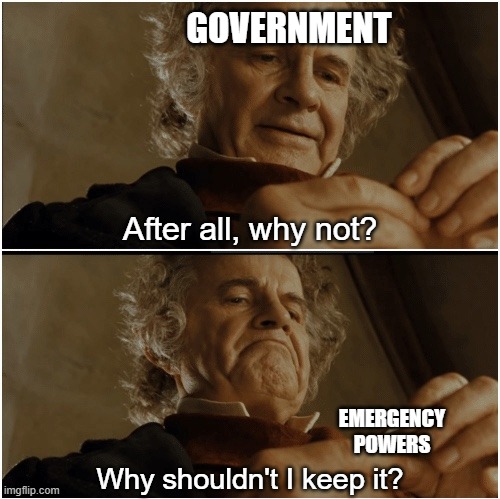
Hence, Trudeau I imposing War Measures Act provisions during the 1970 October crisis, the PATRIOT Act debate after 9/11, COVID-19 restrictions during the pandemic, Trudeau II using the Emergencies Act when the “Freedom Convoy” set up shop in downtown Ottawa, and now Premier Houston (whom I support, despite some misgivings about this issue) using sweeping measures to tramp down the forest fire risk.

And sometimes such powers are justified under the circumstances. Even self-professed libertarians will admit as such when the emergency is something they’re personally worried about, and when a leader from the “good” team is in power.1

But they aren’t always justified. And governments definitely can’t be trusted to handle such power responsibly the longer the “emergency” goes on.


  1. The rise of Trump has allowed many “libertarians” to reveal themselves as authoritarians, but that’s for another post.

August 17, 2025

QotD: The benefits of using auxilia units to the Roman Empire

Filed under: Europe, History, Military, Quotations — Tags: , , , , , — Nicholas @ 01:00

That frankly unusual structure for a multi-ethnic imperial army [the non-citizen auxilia numbering about half the total “Roman” army] brought three principal benefits for the Roman army and consequently for the Roman empire itself.

The most obvious of these is manpower. Especially with a long-service professional army, capable and qualified recruits are in limited supply. The size of the Roman army during the imperial period ranged from around 300,000 to around 500,000, but in 14 AD (the year of Augustus‘ death) there were only 4,937,000 Roman citizens (Res Gestae 8.11), a figure which probably (a word I am using to gloss over one of the most technical and complex arguments in the field) includes women and children. Needless to say, keeping something close to a fifth of the adult male citizen population under arms continually, forever was simply never going to be feasible. After his victory in 31 BC at Actium, Octavian (soon to be Augustus) had acted quickly to pare down the legions, disbanding some, merging others, until he reached a strength of just 28 (25 after the three legions lost in 9 AD were not replaced). It was a necessary move, as the massive armies that had been raised during the fever-pitch climax of the civil wars simply could not be kept under arms indefinitely, nor could a short-term service conscript army be expected to garrison the hundreds of miles of Roman limes (“frontier, border”) in perpetuity.

Harnessing the manpower of the provinces was simply the necessary solution – so necessary that almost every empire does it. By their very nature, empires consist of a core which rules over a much larger subject region, typically with far greater population; securing all of that territory almost always requires larger forces than the core’s population is able or willing to provide, leading to the recruitment of auxiliaries of all kinds. But whereas many imperial auxiliaries, as noted above, turn out to be potential dangers or weaknesses, Rome’s auxilia seem to have been fairly robustly “bought in” on the system, allowing Rome to access motivated, loyal, cohesive and highly effective manpower, quite literally doubling the amount of military force at their disposal. Which in turn mattered a great deal because the combat role of the auxilia was significant, in stark contrast to many other imperial armies which might use auxiliaries only in subsidiary roles.

The auxilia also served to supply many of the combat arms the Romans themselves weren’t particularly good at. The Romans had always performed very well as heavy infantry and combat engineers, but only passably as light infantry and truly poorly as shock cavalry; they generally hadn’t deployed meaningful numbers of their own missile cavalry or archers at all. We’ve already talked a lot about how social institutions and civilian culture can be important foundational elements for certain kinds of warfare, and this is no less true with the Romans. But by recruiting from subject peoples whose societies did value and practice the kinds of warfare the Romans were, frankly, bad at, the Roman skill-set could be diversified. And early on, this is exactly what we see the auxilia being used for (along with also providing supplemental heavy infantry), with sagitarii (archers), funditores (slingers), exploratores (scouts) and cavalry (light, heavy and missile), giving the Romans access to a combined arms fighting force with considerable flexibility. And the system clearly works – even accounting for exaggerated victories, it is clear that Roman armies, stretched over so long a frontier, were both routinely outnumbered but also routinely victorious anyway.

As Ian Haynes notes, the ethnic distinctiveness of various auxilia units does not seem to have lasted forever, though in some cases distinctive dress, equipment and fighting styles lasted longer. Most auxilia were posted far from their regions of origin and their units couldn’t rely on access to recruits from their “homeland” to sustain their numbers over the long haul (although some number of recruits would almost certainly come from the military families of veterans settled near the forts). But that didn’t mean the loss of the expertise and distinctive fighting styles of the auxilia. Rather skills, weapons and systems which worked tended to get diffused through the Roman army (particularly in the auxilia, but it is hard not to notice that eventually the spatha replaces the gladius as the sword of the legions). As Ovid quips, Fas est et ab hoste doceri, “It is right to learn, even from the enemy” (Met. 4.428); the Romans do that a lot. The long-service professional nature of these units presumably made a lot of this possible, with individual cohortes and alae becoming their own pockets of living tradition in the practice of various kinds of fighting and acclimating new recruits to it. Consequently, not only did the Roman army get access to these fighting-styles, because the auxilia were actually integrated into the military system rather than merely attached to it, they also got the opportunity to adopt or imitate the elements of the fighting styles that worked.

Finally, the auxilia system also minted new Romans. We’ve already mentioned that auxilia veterans received Roman citizenship on retirement, but that wasn’t the extent of it. We can see in inscriptions that the degree of cultural fluency that soldiers in the auxilia gained with Roman culture was high; they often adopted Roman or Romanized names and seem to have basically always learned Latin (presumably because their Roman officers wouldn’t have spoken their language). While some units of the auxilia kept distinctive national dress as a sort of uniform, most of the auxilia seem to have adopted a style of dress that, while distinct from the legions, was generally in keeping with the Roman tradition of military dress (which was not quite the same as Roman civilian dress). They also partook of the Roman military diet (Roman soldiers kept a similar diet all over the empire, even if that meant shipping thousands of amphora of olive-oil and sour wine to northern England) which would have given them a diet in common with many work-a-day Romans too. Once retired, auxilia soldiers tended to settle where they served (rather than returning to their “home” provinces), which meant settling in frontier provinces where their citizenship set them apart as distinctively Roman, wherever they may have come from.

Exactly how many auxilia would have retired like this requires a degree of number crunching. Given a 20-year tour of service and zero mortality, we might expect around 7,500 men to pass through the auxilia each year. But of course, mortality wasn’t zero and so we have to expect that of our c. 20-year-old recruits, some number are going to die before retirement. Using some model life tables (following B. Frier, “Demography” in CAH^2 XI (2000)), we should figure that very roughly one third of our recruits will have died before reaching discharge. We then we need to adjust our recruitment figures to retain the same total strength and we get something like 9,000 new recruits each year to keep a strength of c. 150,000 with mortality counted for and 20 year tours. That gives us roughly 6,000 auxilia living to retirement each year. That may seem a small number, but that gradual accretion matters when it runs for decades and centuries and the newly enfranchised family units (recall that the citizenship grant covers children and sort-of-kind-of his spouse1) tend to settle on the frontiers, which is a really handy place to have communities of citizens. If we assume that these new citizen families mostly reproduced themselves (or more correctly that they went extinct or split with multiple children at roughly the same rate with no natural population growth), then we’d expect this process to produce perhaps something like 1.5 million new citizen households up until the Constitutio Antoniniana. Being very back of the envelope then, we might – once we account for women and children descendants of those soldiers – assume that on the eve of the general grant of citizenship in 212, there were perhaps 4 million Romans whose citizenship status was a product of service in the auxilia somewhere in their history; perhaps representing something like 7% of the entire population (including non-free persons). Were we to assume larger households (which seems wise, given that retired auxiliaries are probably more likely than average to be in an economic position to have a larger family), that figure would be even higher.

That is a very meaningful number of new Romans. And those figures don’t account for some of the other ways Roman citizenship tended to expand through communities both through manumission but also the political networks citizenship created (your Latin-speaking former-auxiliary citizen neighbors are a lot more likely to be able to help intercede to get you citizenship or get your community recognized as a municipia with that attendant citizenship grant). And not only are those new Romans by legal status, but new Romans who have, by dint of military training and discipline, absorbed quite a lot of Roman culture. As best we can tell, they tended to view the Roman Empire as their polity, rather than as a foreign or oppressive entity. They were “bought in” as it were. Again, this does not seem to have been the Roman intent, but rather an opportunistic, self-serving response to the need to maintain the loyalty of these troops; citizenship was, after all, a free benefit the emperor might bestow at no cost to the treasury (since citizens who lived outside of Italy still owed taxes) or himself.

Of course that fits the auxilia in to a later pattern in the provinces which becomes perhaps most apparent as the Roman Empire begins to collapse …

Bret Devereaux, “Collections: The Queen’s Latin or Who Were the Romans, Part V: Saving and Losing and Empire”, A Collection of Unmitigated Pedantry, 2021-07-30.


  1. Note on the coverage of the spouse. The grant of citizenship covered any biological children of the discharged auxiliary but did not extend citizenship to his wife. It did however, give an auxiliary the right to contract a lawful marriage with effectively any free woman, including non-citizens and the children resulting from such a union would be citizens themselves. Consequently, it extended one of the core privileges of citizenship to the non-citizen wife of a discharged auxiliary: the right to bear citizen children. Since the wife would be part of the retired auxiliary’s household (and then later, if he predeceased her, potentially in the household of her male citizen children) she’d be legally covered in many cases because a legal action against her would generally be an action against her husband/child. Given that a number of the rights of citizens simply didn’t apply to women in the Roman world (e.g. office holding), this system left the wife of a retired auxiliary with many, but not all, of the privileges of citizenship, so long as her husband and her marriage survived. That said, the legal status remained vested in her husband or her children, which made it more than a little precarious. One of these days, we can talk more about the structure of the Roman familia.

August 16, 2025

Britain slides further down the free speech rankings

At The Conservative Woman, Bruce Newsome reports on the parlous state of free speech in the United Kingdom:

SINCE 2021, the Index on Censorship has ranked Britain as “partially open” (the third tier). Britain ranks 20th for press freedom (worse than Trinidad and Tobago).

Just released: The US State Department concludes that in 2024, Britain’s human rights “worsened” and the British government is partial in protecting rights and freedoms: “Significant human rights issues included credible reports of serious restrictions on freedom of expression, including enforcement of or threat of criminal or civil laws in order to limit expression; and crimes, violence, or threats of violence motivated by antisemitism. The government sometimes took credible steps to identify and punish officials who committed human rights abuses, but prosecution and punishment for such abuses was inconsistent.”

There are three main categorical freedoms being routinely violated in Britain. In US Constitutional law, they are known as speech, assembly and press. British authorities need a reminder.

Let’s fully understand how this started, more than 25 years ago. In 1999, the Macpherson inquiry into the 1993 murder of Stephen Lawrence recommended that police should record hateful incidents as a matter of intelligence, even if the incidents were not criminal. Quangos led by the College of Policing encouraged police forces to record non-crime hate incidents (NCHIs). Police took it upon themselves to visit the supposed haters, to “correct your thinking“, to intimidate them with warnings of escalation, and even to strong-arm them into taking thought-correction classes with the police, at cost.

The 2006 Racial and Religious Hatred Act criminalises hatred of protected characteristics. It was once sold as a protection against violence, but was soon wielded to criminalise speech.

Police make more than 30 arrests a day (more than 10,000 per year) for online speech and record 66 non-crime hate incidents per day.

Despite several administrations claiming to review and restrict the definitions of hate speech and NCHIs, the definitions remain too vague to prevent police from repressing speech they don’t like. In 2024, the Free Speech Union submitted freedom of information (FoI) requests to all 43 police forces in England and Wales to see if recording went down since a new code of practice of June 2023. The number has actually increased. This year the current government sneakily signalled its appreciation of NCHIs in response to a petition to abolish them.

The latest statute aimed at free speech came into force on July 25: the Online Safety Act. The Bill was marketed as a necessary legislation to protect minors from harmful material such as pornography, self-harm forums, and bullying towards suicide. Like the Hatred Act, the Online Safety Act is being used to suppress politically inconvenient content.

British public authorities (and social media) are suppressing speech and the press selectively with political, religious and ethnic prejudice.

Older Posts »

Powered by WordPress