Quotulatiousness

July 13, 2026

Teddy Roosevelt versus the “Robber Barons” of the Gilded Age

In the Coolidge Review, Burton W. Folsom, Jr. outlines the way President Teddy Roosevelt and his Progressives tried to rein in the wealthy industrialists who had helped create the Gilded Age:

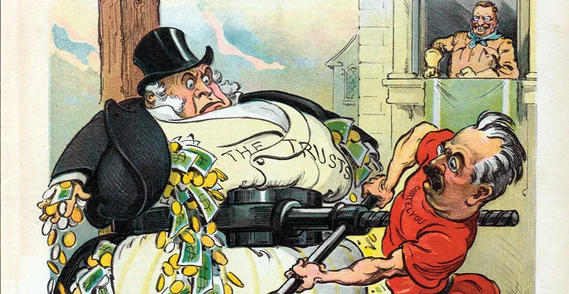
Theodore Roosevelt looks on with glee as his commerce secretary puts the screws to trusts.
(Puck magazine, Alamy Stock Photo, via The Coolidge Review)

The early twentieth century marked the height of the progressive movement, which sought to check the power of free markets and business. To understand what progressives did in the early 1900s, we need to understand what happened in the late 1800s, the period often called the Gilded Age.

After the Civil War, the United States experienced spectacular economic growth. The industries leading the way included railroads, oil, and steel. This expansion made the United States a global economic power. The profits of those businesses enriched the wealthiest — and the average American. That’s in part because bigger, more efficient businesses can offer cheaper prices. Between 1870 and 1880, for example, railroad freight prices fell by half. By 1890, they had fallen by half again. And by 1900, they had been cut nearly in half once more.

Similar advances occurred in many other industries. In the Gilded Age the United States saw perhaps the greatest burst of invention and economic development any country has ever experienced.

[…]

Progressives relied on three tools to restrain business.

The first was the Sherman Antitrust Act. Passed in 1890, this law was used sparingly for a decade. Government enforcement proved difficult in part because the act’s language was vague: the Sherman Act outlawed any contract or “combination” in “restraint of trade or commerce”. In 1895 the U.S. Supreme Court interpreted the law narrowly. In a case involving a sugar-refining business, the Court held that the Sherman Act did not apply to manufacturing. Theodore Roosevelt later wrote in his autobiography that the ruling produced “governmental impotence”.

But soon after entering the White House in 1901, Roosevelt seized on the Sherman Act to engage in “trust busting”. He directed the Justice Department to dissolve the Northern Securities Company, a railroad holding company that Hill had created. This time, the Supreme Court upheld the government’s intervention. Referring to the 1895 ruling, Roosevelt crowed, “This decision I caused to be annulled by the court that had rendered it”, giving the federal government the power “to deal effectively with the trusts”. Roosevelt’s Justice Department soon targeted Standard Oil, which was eventually broken into thirty-four separate companies.

The second tool progressives used against business was the Interstate Commerce Commission. Although railroad rates had declined dramatically for decades, progressives objected to the way those rates were structured. Railroads tended to give the largest discounts to customers that transported the most goods. The railroads still profited from these volume discounts, and smaller customers still paid much lower rates than they had earlier. But progressives argued that it was unjust for smaller shippers to pay higher rates than larger businesses.

In his 1905 annual message to Congress, President Roosevelt demanded legislation to put “a complete stop to rebates in every shape and form”. The 1906 Hepburn Act accomplished that goal. The law was expanded to give the Interstate Commerce Commission the power to inspect railroads’ financial records, eliminate targeted rebates, and set “just and reasonable” rates. In other words, the federal government now had significant pricing power over railroads, America’s largest business sector.

The progressives’ third tool was the federal income tax. In 1909 Congress approved the resolution for a constitutional amendment to establish an income tax. The Sixteenth Amendment took effect in 1913, after three-quarters of the states had ratified it. That was the year Coolidge was elected president of the Massachusetts State Senate.

From the beginning, the tax system was progressive, imposing higher rates on larger incomes. In 1913 most Americans paid no federal income taxes, while the top marginal rate — for income exceeding the equivalent of $16 million in 2026 dollars — was only 7 percent. But within five years, tax rates had soared, with the top bracket paying 77 percent.

July 9, 2026

A new proposal for limiting “unreasonable searches and seizures”

Filed under: Government, Law, Liberty, USA — Tags: , , , , , , — Nicholas @ 05:00

In Reason, Jacob Sullum outlines Justice Gorsuch’s proposed new test for limiting government abilities to surveil and monitor private actions:

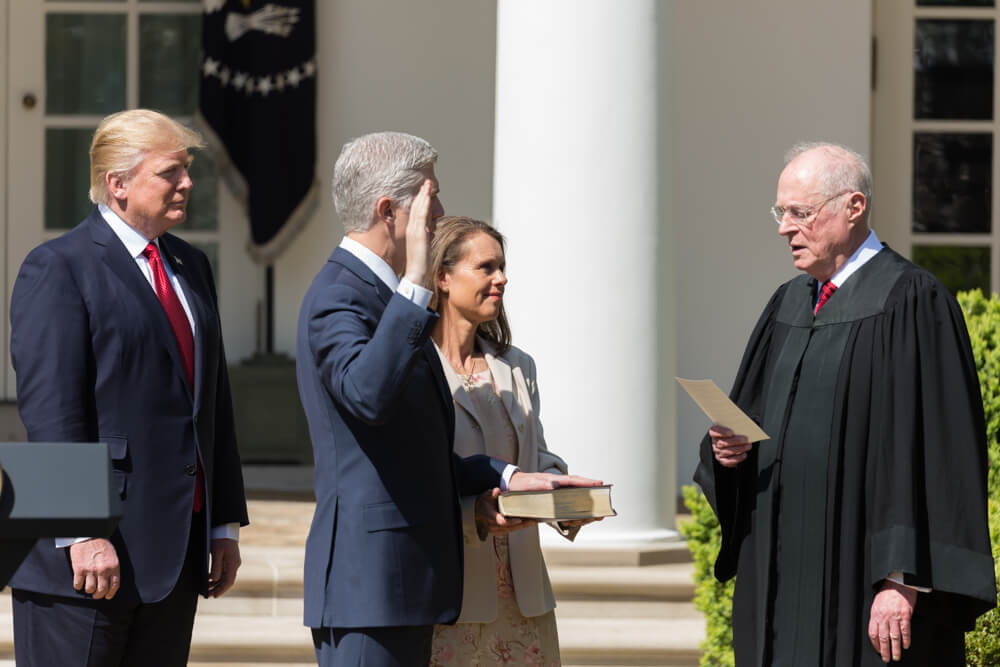
Supreme Court Justice Anthony M. Kennedy swears in Justice Neil M. Gorsuch on Monday, April 10, 2017, in the Rose Garden of the White House in Washington, D.C.
White House photo via Wikimedia Commons.

The Court’s 1967 decision in Katz v. United States, which held that the Constitution’s prohibition of “unreasonable searches and seizures” applies when people have a “reasonable expectation of privacy”, continues to shape Fourth Amendment rulings six decades later. That was clear on June 29, when the Court decided Chatrie v. United States, holding that a government-ordered analysis of cellphone location data qualifies as a “search” under the Fourth Amendment.

“An individual has a reasonable expectation of privacy in records about his cell phone’s location, and police intrude on that constitutionally protected interest when they demand the information”, Justice Elena Kagan wrote in an opinion joined by four of her colleagues. Justice Neil Gorsuch agreed with the result but not the rationale. The Katz test, he complained, “has no basis in the Constitution’s text or history”. He added that it has proven unworkable in practice because it has never been clear how courts should determine whether an expectation of privacy is “reasonable”.

Gorsuch is surely right that the Katz test has produced inconsistent and puzzling results. In cases addressing intrusions such as trash searches, demands for bank and telephone records, surveillance by low-flying aircraft, and police trespassing on private property, the Supreme Court has perceived no expectations of privacy it was prepared to recognize as reasonable. Applying the same test, it has repeatedly ruled that the Fourth Amendment does not apply to information that people voluntarily share with third parties. Yet the Court has repeatedly rebelled at the disturbing implications of that principle without explicitly renouncing it.

That is what happened in Chatrie, which involved a Virginia bank robbery investigation. Police used a “geofence” warrant to identify the perpetrator by requiring Google to search customer data collected by its Location History feature, which tracks the whereabouts of cellphone users. For reasons that are not entirely clear, the Court declined to apply the third-party doctrine, instead reverting to the original, unmodified Katz test.

A better approach, Gorsuch argued, would be to treat Location History records as “effects” covered by the Fourth Amendment — as a form of personal property, in other words. While it is not clear exactly how that property-rights approach would work in other contexts, it does seem less malleable than the Katz test, which gives courts wide discretion in discerning expectations and deciding whether they are reasonable. Gorsuch aptly likened the Court’s understanding of that test to its definition of obscenity in the 1960s: “We know a ‘reasonable expectation of privacy’ (and an exception to the third party doctrine) when we see it”.

July 2, 2026

Reining in the administrative state – Humphrey’s Executor overruled by the Supreme Court

Filed under: Bureaucracy, Government, History, Law, USA — Tags: , , , , — Nicholas @ 04:00

One of the two US Supreme Court rulings this week that sparked controversy was the court’s decision to overrule a 1935 precedent that enabled the growth of the administrative state:

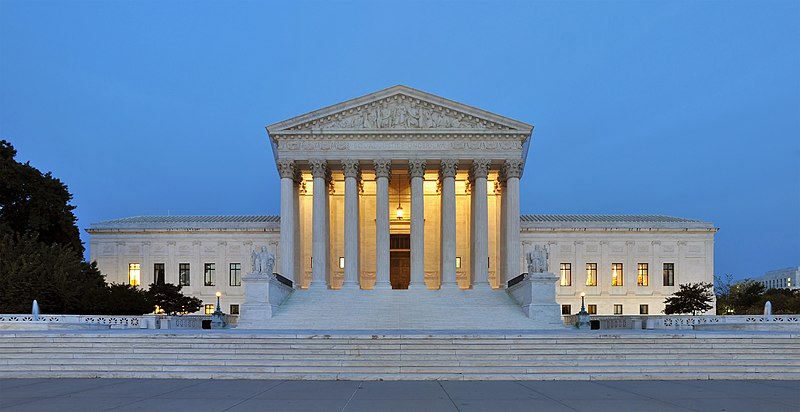
Panorama of the west facade of United States Supreme Court Building at dusk in Washington, D.C., 10 October, 2011.
Photo by Joe Ravi via Wikimedia Commons.

The Supreme Court this week restored an old-fashioned constitutional idea: if a principal federal officer exercises executive power, the president must be able to remove him. The justices’ 6–3 ruling in Trump v. Slaughter, which struck down a law prohibiting the president from firing members of the FTC except for cause, is the logical endpoint of a 15-year series of cases that have steadily chipped away at Humphrey’s Executor, the 1935 decision that blessed for-cause removal protections for the heads of so-called independent agencies.

The Court didn’t mince words. Chief Justice John Roberts wrote that “Humphrey‘s framework, in short, has not withstood the test of time”. Then came the sentence that will launch a thousand administrative-law articles: “If anything more is left of Humphrey‘s, we overrule it”. The New Deal compromise that invented quasi-legislative agencies has finally met Article II of the U.S. Constitution.

That’s good, because the Federal Trade Commission isn’t a debating society. It, along with its alphabet-agency brethren, writes rules with the force of law, investigates private parties, adjudicates violations, and sues in federal court on behalf of the United States. Whatever labels Congress attached to that body in the Progressive Era, the FTC — like the FCC, SEC, NLRB, and so on — today exercises executive power. And the Constitution vests “the executive power” in one president, not in commissioners serving staggered terms, answerable to no one whom voters can fire.

This ruling isn’t a gift to Donald Trump or his successors. It’s a restoration of constitutional accountability. Congress can create executive-branch agencies and specify what they may do, but it cannot create a fourth branch of government and then pretend its officers are independent of the only person the Constitution makes responsible for executing federal law.

Roberts put the point crisply at the end of Slaughter: “Subordinates who exercise the President’s power are subject to removal by him”. That’s a unitary, not an imperial, presidency, and it’s a hallmark of republican government. The president remains constrained by statutes, appropriations, courts, Congress, elections, and the Constitution itself. If the people dislike how the FTC enforces the law, they should be able to blame — and replace — the president, not chase a goulash of insulated mandarins.

Justice Neil Gorsuch’s concurrence adds the important next step. Killing Humphrey’s Executor doesn’t cure every constitutional disease in the administrative state. It simply reallocates the power Congress poured into independent agencies. As Gorsuch warned, “the fourth branch’s powers still exist; they have just been reassigned to the President”. If agencies possess vast legislative and judicial authority, the answer isn’t to hide those powers from presidential control, but to restore legislative powers to Congress. Make Congress great again!

QotD: The US federal election of 1848 and the resulting inevitability of the US Civil War

The Election of 1848 was an attempt to address the lingering issues from the Mexican War. The Treaty of Guadalupe Hidalgo ceded vast territory to the US, again almost all of it (except for northern California) below the Missouri Compromise line (a line of latitude above which slavery was prohibited, theoretically under the terms of the Northwest Ordinance of 1787). There was no question about Texas’s status as a slave state, but what about the rest of it? Specifically, what about California, which thanks to a massive gold rush was soon to pass the threshold for admission?

The Democrats’ candidate, Lewis Cass, pushed the idea of “popular sovereignty” in the territories. It wasn’t a bad move — since California was the only soon-to-be-state up for grabs, and since some parts of California are above the Missouri Compromise line, let them decide the terms on which they want to enter the Union. The problem with that, obviously, is that the Senate could become radically unbalanced very quickly, depending on how fast the rapidly-expanding population of the territories got their act together. Iowa and Wisconsin had just entered the Union (1846 and 1848, respectively), as free states under the Compromise. They were counterbalanced by Florida and Texas (both 1845), but obviously the balance was very delicate.

Cass was of course defeated (by Mexican War hero Zachary Taylor), so wrangling over California continued. Taylor wasn’t the greatest leader anyway, and when he died in office he was replaced by everyone’s favorite placeholder, Millard Fillmore. Fillmore gets an undeserved rep for incompetence; in reality, he was exactly the kind of president the Second Party System was designed to produce, even though he was never elected to the office. Most real political power before the Civil War was at the state level, so the President was supposed to be the steward and figurehead of his Party, not a strong national leader. (You can still see echoes of this as late as the early 20th century — William Howard Taft supposedly said “I forgot I ever was President;” he was much more concerned with his reputation as Chief Justice of the Supreme Court).

But slavery was a federal issue, indeed THE federal issue. In the absence of strong leadership at the top — and again, in all fairness to Fillmore and the rest, the system was designed to prevent strong Presidential leadership — it fell to Congress. Which a) is where it should’ve been, under the federal system the Founders designed; but b) meant that it was guaranteed to be a cock-up, because like all debating societies Congress was dominated by Very Clever Boys.

Worse, the immediate antebellum Congresses were dominated by the Very Cleverest Boy of them all, Stephen Douglas. I don’t think there has ever been a Cleverer Boy in American politics than Stephen Douglas, which is really saying something. (A case could be made for Lyndon Johnson, I suppose, and look how that turned out). Douglas’s signature “legislation” was the Compromise of 1850, which did a lot of things, including bringing California into the Union as a free state. It’s easy to get lost in the historical weeds here, so I’m keeping this deliberately superficial. Here are the highlights:

    First, it’s important to note that nobody except Stephen Douglas knew they were voting on “the Compromise of 1850”. You have to hand it to the bastard, it’s a really slick piece of politics. He put together a whole bunch of bills, horse-trading parts of each of them among the competing factions to cobble an overarching program together. Nobody would’ve voted on an omnibus bill called “The Compromise of 1850”, but when the dust settled and all the votes were tallied on a bunch of separate measures, that’s what emerged.

    Second: Douglas swiped Lewis Cass’s idea of “popular sovereignty” for the new territories (New Mexico and Utah) carved out of the Mexican Cession. At the time, this looked like a band-aid, a procedural quick-fix — those territories wouldn’t be coming into the Union as states anytime soon, and since cotton doesn’t grow so well in the desert it didn’t matter that much anyway. “Popular sovereignty” was just a way to kick the can down the road. Please note, however, that now the precedent was set: The Missouri Compromise is now officially a dead letter, though nobody will come right out and say it.

    Third: The Fugitive Slave Act essentially federalized slave-catching. The details aren’t important; the principle is. The US government is now officially the enforcement arm of what many folks were openly calling “the Slave Power Conspiracy”.

    Fourth: What looked like a purely symbolic measure, outlawing the slave trade in Washington DC. Here again, we misunderestimate the power of symbols at our peril. The practical effect of this was nil, since DC is tiny and if you wanted to buy slaves, the big markets literally right across the road in Maryland and Virginia would be happy to sell you some. But look at the glaring contradiction — Federal marshals can (and will, and did) dragoon local law enforcement into catching runaway slaves on the planters’ behalf, but the slave trade itself is outlawed in the Capitol’s sacred precincts, because freedom.

The term “fake and gay” hadn’t been invented yet, but since the Compromise of 1850 was the product of the Very Cleverest Boy of all, it was by definition fake and gay, and you can see it clearly with the DC slave trade ban.

So Very Clever was he, that he torpedoed his own signature achievement just four short years later in order to make a buck. Some Chicago railroad boys had him on the payroll, and while the details of the Kansas-Nebraska Act don’t matter, the principle very much does. Remember “popular sovereignty?” It didn’t matter in Utah or New Mexico; it mattered very much in Kansas, where fanatics from both sides flooded into the territory in order to vote.

Think about what kind of guy would uproot his entire life to move across state lines just to vote on shit, and Bleeding Kansas suddenly makes sense.

Here again, one is tempted to blame the President for not showing leadership, and Franklin Pierce and James Buchanan have well-deserved reps as do-nothings … except again, “doing nothing” was pretty much the President’s job description back then. That’s not to let them entirely off the hook — James Buchanan was very much a Current Year Democrat, in that even though he wouldn’t actually take any action he couldn’t stop shooting his mouth off; you have to get well into the 20th century to find a major political figure who stepped on his own dick as hard and as often as James Buchanan.

Finally, the coup de grace, the Dred Scott decision. I’m going to stop with this one, because even though things like John Brown’s Raid and the Caning of Sumner are important, they follow, as it were, from the logic laid down by Dred Scott. Some kind of Really Bad Shit was inevitable after that ruling; the precise form of the Really Bad Shit was incidental (n.b. the Caning of Sumner preceded Dred Scott (May 1856 vs. March 1857), but they were very much of a piece).

Here again, it’s easy to get lost in the details, so here are the two big takeaways:

First, Dred Scott was decided correctly as a purely legal matter. The issues surrounding the case were as broad as possible, but the narrow issue at law was this: In granting Dred Scott standing to sue in a federal court, the State of Missouri had implicitly granted him United States citizenship, which is the sole prerogative of Congress. It’s in the Constitution and everything, and back then the guys on the Supreme Court actually bothered to read the fucking thing, so they ruled against Scott on those very narrow grounds (from which all else flowed, legally).

But that’s the second big takeaway: Chief Justice Roger Taney didn’t stop there. If you only got Dred Scott in school, you got the stuff Wiki spends most of its time on — the whole bit about Taney ruling that blacks aren’t, and never can be, citizens of the United States. But the truly important part is this:

    Now, … the right of property in a slave is distinctly and expressly affirmed in the Constitution. … Upon these considerations, it is the opinion of the court that the act of Congress which prohibited a citizen from holding and owning property of this kind in the territory of the United States north of the [36°N 36′ latitude] line therein mentioned, is not warranted by the Constitution, and is therefore void.

In other words, not just the Missouri Compromise, but the Compromise of 1850, and indeed the very possibility of compromise over slavery, is now officially unconstitutional. Slavery is now de facto legal everywhere in the United States, because any law prohibiting it runs afoul of the 5th Amendment as interpreted by Dred Scott.

What other outcome could there be at that point? Flip the script in 1860 — let the Democrats have their shit together, and the Republicans split three ways. Stephen Douglas is now President, and while that’s a truly horrifying prospect (never, ever let a Very Clever Boy occupy the big chair), the outcome would’ve been the same, or near enough — it’d be the Yankee fanatics in the North seceding, not the Slave Power Conspiracy in the South, but somebody was calling it quits.

Severian, “1846-1861”, Founding Questions, 2022-06-25.

May 29, 2026

Debunking the “it’s just phone book information” claim for Bill C-22

Michael Geist explains why the “it’s just phone book information” hand-waving by politicians and government officials is worse than misleading: it’s deliberate mendacity.

en telefonbog (a Danish telephone directory)
Photo by Tomasz Sienicki via Wikimedia Commons

If this sounds familiar, it is because the same tired claims have been used for years. In September 2011, then-Public Safety Minister Vic Toews defended the Harper government’s lawful access proposals by claiming “linking an internet address to subscriber information is on par with the phone book linking phone numbers to an address”. Christopher Parsons, then a researcher at the Citizen Lab, responded with a detailed anatomy of what a lawful access “phone record” actually contained, showing that the three-field directory entry the government was invoking was being used to describe an eleven-field record including IP addresses, IMEI and IMSI numbers, SIM serials, device identifiers, and account information from multiple providers, any one of which could be cross-referenced to build a comprehensive profile of a person’s online life.

The Supreme Court of Canada put the issue to rest in the Spencer decision, holding unanimously in 2014 that there is a reasonable expectation of privacy in subscriber information precisely because the disclosure of such information “will often amount to the identification of a user with intimate or sensitive activities being carried out online, usually on the understanding that these activities would be anonymous”. It returned to the same terrain in Bykovets in 2024, extending Charter protection to IP addresses on the reasoning that an IP address is the “first digital breadcrumb that can lead the state on the trail of an individual’s Internet activity”.

Bill C-22’s new subscriber information production order applies a low evidentiary standard but covers name, pseudonym, address, telephone number, email address, account identifiers, types of services provided to the subscriber, the period during which they were provided, and information that identifies the devices, equipment, or things used by the subscriber in relation to those services. In short, a modern subscriber record is not a phone book entry but rather an index of a person’s digital life and the government is proposing to reduce the standard needed to gain access to that information.

Moreover, the same phony framing is now being stretched beyond subscriber data to mandatory metadata retention. As Conservative MP Andrew Lawton noted to Fraser at committee, the government and its officials have been telling Canadians that requiring electronic service providers to retain metadata for up to a year is “no different than just having a copy of the phone book that someone could leaf through”. That is a laughable comparison, given that metadata includes the date, time, duration, and type of a communication, the identifiers of the devices involved, and information identifying the location of the device. It is as if the phone book would include the details of every call made including location, call recipient, and device. And given retention for up to a year, the plan poses a disproportionate privacy risk that is likely to be struck down as unconstitutional by the Supreme Court, should it survive in its current form.

And in a follow-up post, he writes:

On encryption, Anandasangaree said the bill “was never meant to breach encryption” and promised to “clarify it in the Bill”. Language clarification is welcome but structural problems remain. The safeguards in Bill C-22 at ss. 5(5) and 7(5), which state that a provider is not required to comply if compliance would create a systemic vulnerability, are incompatible with s. 12, which unconditionally requires compliance with orders, and with s. 13, which specifies that orders prevail over regulations when inconsistencies arise. The term “systemic vulnerability” is not defined in the statute, and the Governor in Council has the power to make regulations “respecting the meaning of any term or expression for the purposes of this Act”. None of this is fixed by promising clearer language. It is fixed by the kind of amendment the Privacy Commissioner proposed this week, namely adopting Australia’s definition, which expressly covers actions that render encryption less effective, together with an explicit prohibition on regulations or orders that require the introduction of, or prevent the rectification of, a systemic vulnerability.

Moreover, Anandasangaree’s defence of the bill’s privacy implications was a deflection rather than an answer, as he tried to turn the attention to the privacy practices in the private sector, stating, “I drive a vehicle where every single point that I drive to is tracked. And that data is not with me.” Commercial data practices are indeed a real concern and Canada needs stronger laws to address them. However, the bill’s surveillance map of every Canadian is not justified by pointing to the absence of meaningful constraints on data collection and to the failure of his own government to address long-overdue private-sector privacy reform.

That brings the press conference back to the Privacy Commissioner. Asked directly whether he would accept Commissioner Philippe Dufresne’s amendments, the Minister said he would “be looking at” them and “looking to see what he has to offer”. Dufresne tabled eight concrete amendments at committee on Tuesday: narrowing subscriber information to a closed list (name, address, telephone number, IP address), restricting who can be compelled to telecommunications service providers, defining “publicly available information” to exclude information in which a person has a reasonable expectation of privacy, an overarching requirement that SAAIA obligations be necessary and proportionate, an Australian-style amendment to “systemic vulnerability”, an explicit prohibition on orders requiring vulnerability introduction or preventing rectification, an exemption to the SAAIA’s confidentiality rules to allow disclosure to regulatory bodies such as the OPC, and allowing his office to investigate if data breaches result from application of the new powers. Anandasangaree’s comments, coming a day after the Dufresne’s committee appearance, noted that “we have until like five o’clock today” for amendments. That window does not leave room to seriously consider the Commissioner’s recommendations. The “I will be looking at” claim, delivered hours before the deadline, amounted to a rejection of the recommendations.

May 4, 2026

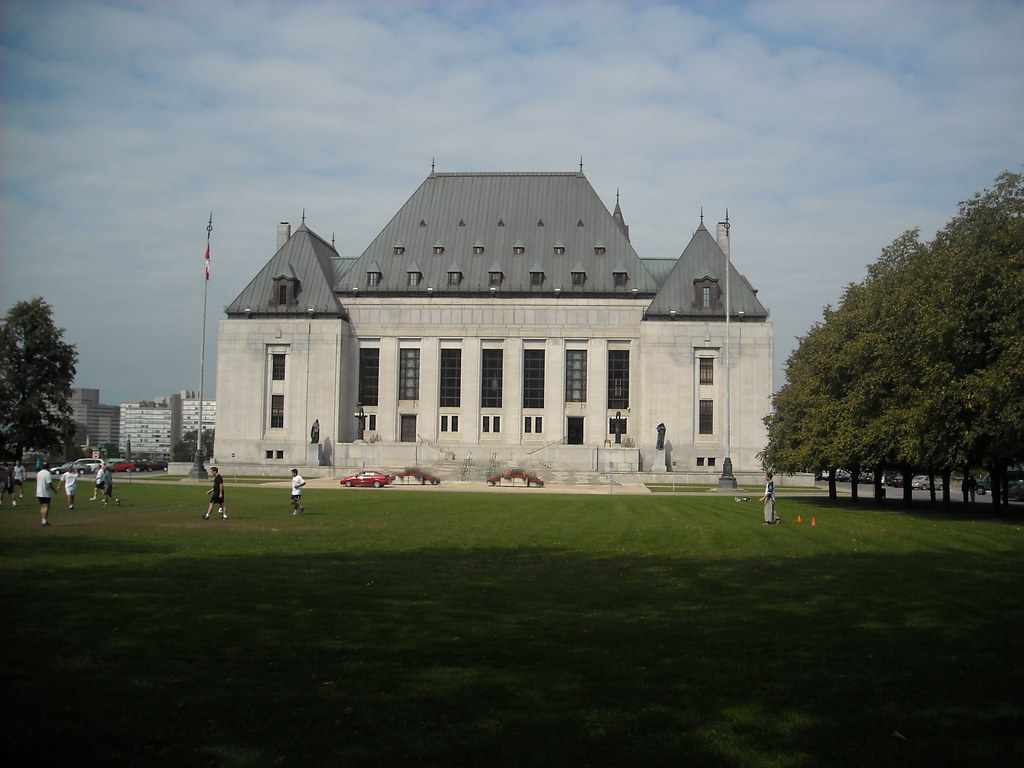
Chief Narcissist of the Supreme Court of Canada

Filed under: Cancon, Law, Media, Politics — Tags: , , , , — Nicholas @ 03:00

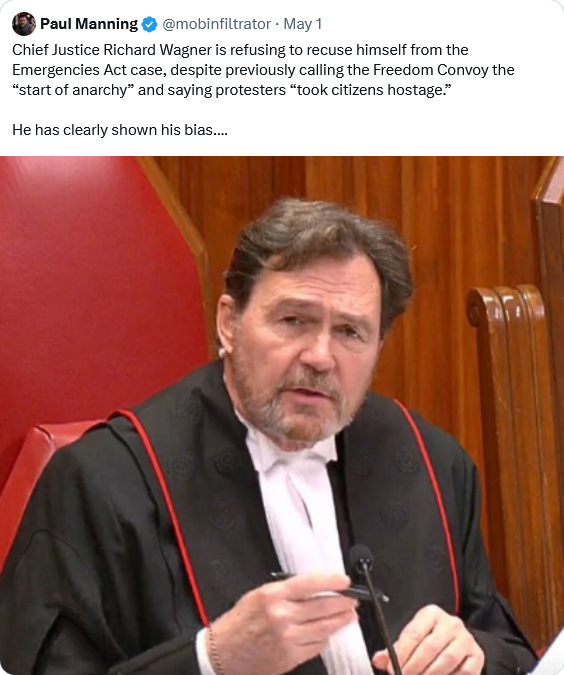
On the social media site formerly known as Twitter, David Knight Legg explains why the Chief Justice should recuse himself from deliberation on an upcoming Supreme Court case involving the Freedom Convoy 2022:

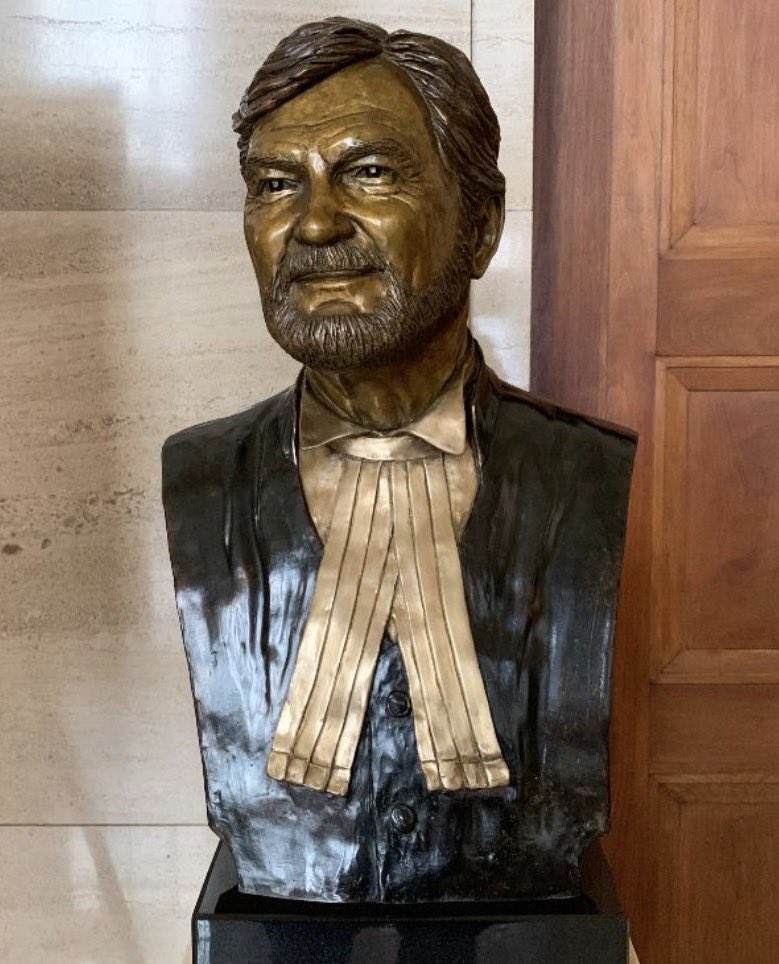
Canada’s Chief Justice Richard Wagner has installed a lifelike bronze bust of himself in our highest court.

It should be called “Narcissus Canadiannus

– There is no precedent for something this vulgar in the history of the Court. It should be taken down. Richard fancies himself.

– Richard also fancies his own opinion on things. He violated legal due process and the Court’s reputation by publicly accusing the Convoy — who protested backwards federal Covid policies that were soon dropped — of “anarchy” and “hostage taking”.

Now that the Convoy’s freedom of speech, assembly and due process rights have been asserted by lower courts the Supreme Court has to consider the appeal of the federal govt and weigh the rights of citizens against the decision of the federal government to impose the Emergencies Act to suspend those rights.

Wagner’s lack of judicial discretion in the first instance makes his recusal from such an important rights-defining case important because it signals not just fairness in the content of the decision but in the way the decision gets reached by the highest Court.

He has already shown his bias. Any decision against the convoy poisons the integrity of the Court if he remains present.

But Richard — the man with the bust of himself in our Court — doesn’t imagine himself under the law he imposes on others. He hasn’t completed any graduate work in law or published any academic work in law, philosophy or jurisprudence so it’s hard to know how he justifies himself in these matters.

Ironically, he has a reputation for warning others — including those far more qualified in formal jurisprudence than he is — not to critique Canadian judges like himself or their (increasingly bizarre and politicized) decisions.

But, from the Magna Carta onwards, Richard should know that in law as in politics dissent is democracy.

The dissent of the Convoy and the growing critique of Richards own bizarre behaviour and inability to articulate a judicial philosophy is exactly what’s needed to save Canada — and the Court’s reputation as a place where justice — not the ego of the Justices — is at stake.

Richard should recuse himself. And remove that vulgar bust from the Supreme Court.

#SCC #RuleOfLaw

Melanie in Saskatchewan also has concerns, expressed as an open letter to the Chief Justice:

To Chief Justice Richard Wagner,

Your refusal to recuse yourself from the Emergencies Act appeal, as reported in the National Post, is not a demonstration of judicial confidence. It is a failure of judgment at a moment that demanded restraint.

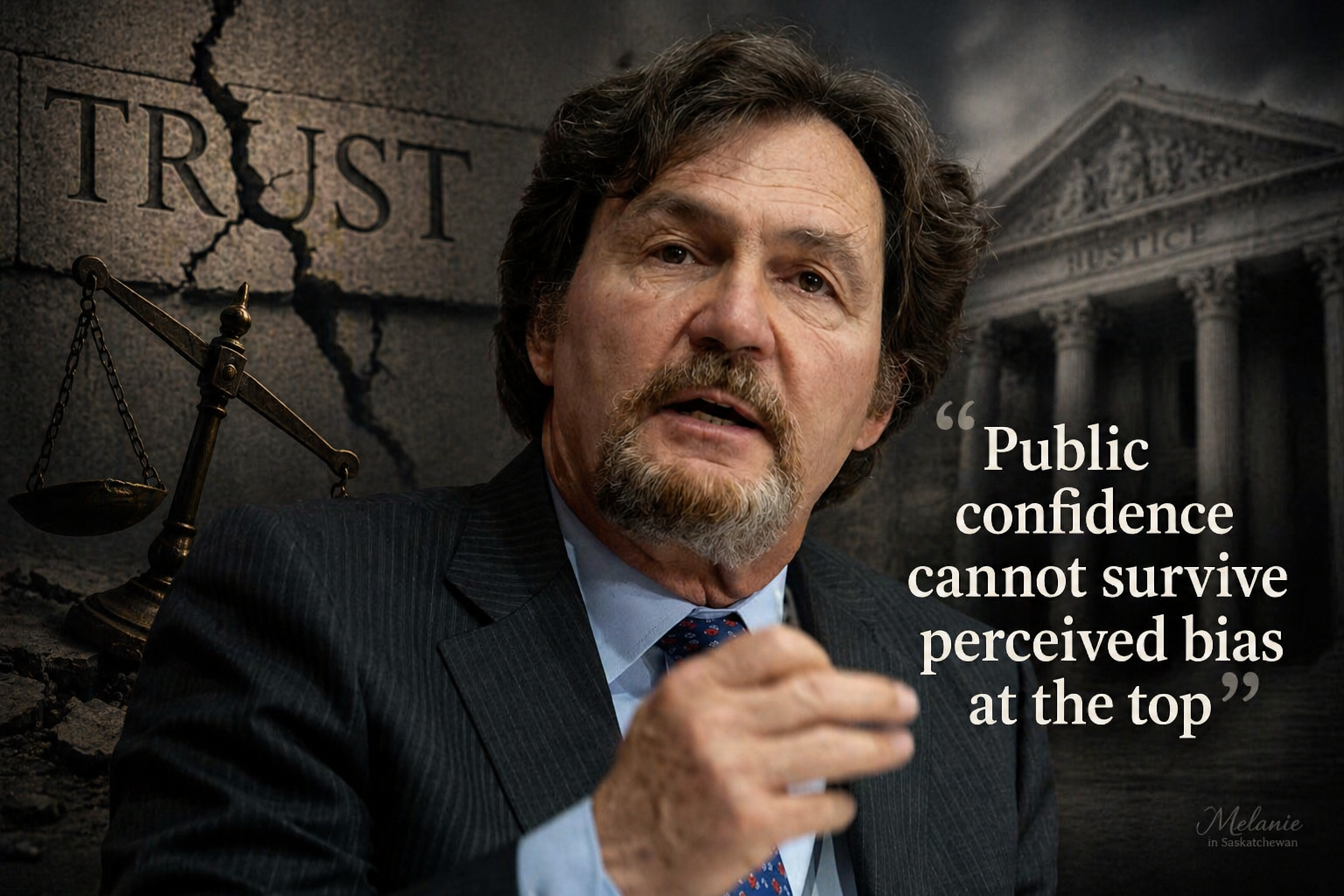
Image from Melanie in Saskatchewan

You have justified your decision on the basis that your prior public comments did not address the specific legal questions before the Court. That argument may satisfy a narrow, technical reading of judicial conduct. It does not satisfy the standard Canadians are entitled to expect from the Chief Justice of the Supreme Court.

The governing principle is not whether you commented on the precise statutory interpretation of the Emergencies Act. It is whether a reasonable and informed person would conclude that your previously expressed views could influence your assessment of the case.

You publicly characterized the convoy as the “budding start of anarchy”, described residents as being “taken hostage”, and spoke in terms that conveyed clear condemnation of the events and participants. Those were not neutral observations. They were judgments about the nature, legitimacy, and perceived threat posed by the very situation now under review.

This appeal is not a retrial. It does not exist to rehear evidence or relitigate the convoy as though the past can be reset. Appellate review in Canada is focused on whether the law was correctly interpreted and properly applied to established facts, with significant deference given to the findings already made by the lower courts.

That distinction matters.

[…]

As Chief Justice, you are not merely a participant in this case. You are the steward of the reputation of the Supreme Court of Canada itself. That reputation rests not on assertions of impartiality, but on decisions that demonstrate it beyond reasonable doubt. In choosing not to recuse yourself under these circumstances, you have not strengthened that reputation. You have placed it at risk, at a time when public confidence in national institutions is already fragile. The damage may not be immediate, but it is real, and it is yours to own.

April 9, 2026

The NFL’s “Rooney Rule”

Filed under: Business, Football, Government, Law, Politics, USA — Tags: , , , , — Nicholas @ 05:00

As the NFL in its modern incarnation exists as an exception to the normal rules governing corporate structure under US law, you can readily imagine that the NFL’s legal teams are extremely sensitive to the changing winds at the federal level. At a time that the federal government was emphasizing providing employment equity, the NFL scrambled to implement a hiring solution that gave black coaches a better chance of being hired for head coaching opportunities. The winds have shifted recently and the NFL risks being caught on the wrong side of evolving legal decision-making:

In a recent interview with the New York Times, Tampa Bay Buccaneers head coach Todd Bowles said he “absolutely” believed that he was sometimes brought in by NFL teams just to check the “Rooney Rule” box.

The Rooney Rule is an NFL policy instituted more than two decades ago that requires teams to interview — though not to hire — at least one minority candidate when hiring new coaches.

The rule was designed to increase the number of minority head coaches in the NFL, a goal it has failed to achieve. For years, it has been a source of moral controversy, but new developments suggest it may now be a legal issue for the league.

Last week, Florida Attorney General James Uthmeier (R) sent a letter to the NFL calling the Rooney Rule “blatant race discrimination“, adding that hiring decisions should be based solely on merit.

Though the NFL says it believes its policy “is consistent with the law” and promotes fairness, others have indicated the Rooney Rule may be on the chopping block, given recent legal challenges to other forms of racial preferences.

“There’s no question that the environment has changed in recent years“, said Pittsburgh Steelers owner Art Rooney II, the son of Dan Rooney, for whom the rule is named. “We do have an obligation to make sure that our policies comply with the laws, whatever the law is, and whatever the changes in law might be.”

Art Rooney didn’t specify the laws the NFL may not be in compliance with, but he might have been referring to last year’s Supreme Court ruling in Ames v. Ohio Department of Youth Services. In that decision, the court unanimously ruled that separate standards for minority and majority plaintiffs seeking redress for racial discrimination were illegal.

The ruling undercut the ability of organizations to use race or sex in hiring decisions — even for ostensibly benign or diversity-promoting purposes — because majority-group plaintiffs are now allowed to sue under the same legal standard as minority groups.

As I wrote at the time, the Ames decision was likely to be a wrecking ball to diversity, equity, and inclusion initiatives, which employers had used for years to discriminate against majority ethnic groups (and non-focus minorities, such as Asians), in violation of Title VII of the Civil Rights Act.

April 4, 2026

If we think that “ordinary criticism and disagreement are bullying, then we have an infantilized and feminized culture”

Filed under: Government, Media, Politics, USA — Tags: , , , , , , , — Nicholas @ 05:00

Chris Bray finds a highly accurate label for the pearl-clutching “elites” who — to a persyn — believe that your words are violence, but their violence (delivered through third parties, of course) is merely emphatic communication to the distasteful lower orders:

Donald Trump is a mean man. He’s a bully!

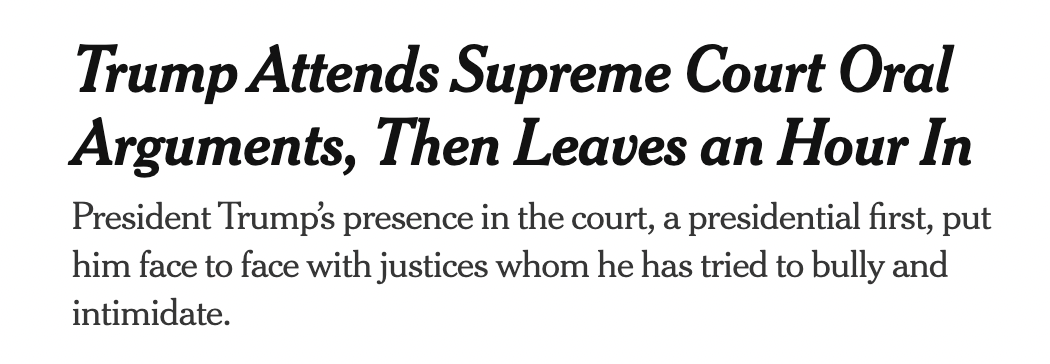
Oh no SCARY, he’s trying to BULLY the Supreme Court! I wrote at the Federalist this week about the stupidity of this argument — what is he implying he can do to the life-tenured justices, for crying out loud? — but I suspect I undersold the underlying sickness. Adults don’t use the word “bully” to talk about other adults, arguably outside of a few very narrow spaces involving things like domestic violence. It’s a preschool word. The easy recourse to toddler language at the New York Times is a sign of cultural regression. But it’s also a sign of habitual and persistent dishonesty. They’re pretending. I suspect they’ve pretended so much that they’ve forgotten they’re pretending, and the mask has become the face, but at root, they’re pretending.

We have fictional characters like Willie Stark and Frank Underwood because no one on the planet is dumb enough to think that politics is nice. The federal government spends $7 trillion a year, and the lure of that bucket of money brings out a bunch of throatcutters. This is possibly one of the most obvious realities of human existence. Politics is a knife fight. […]

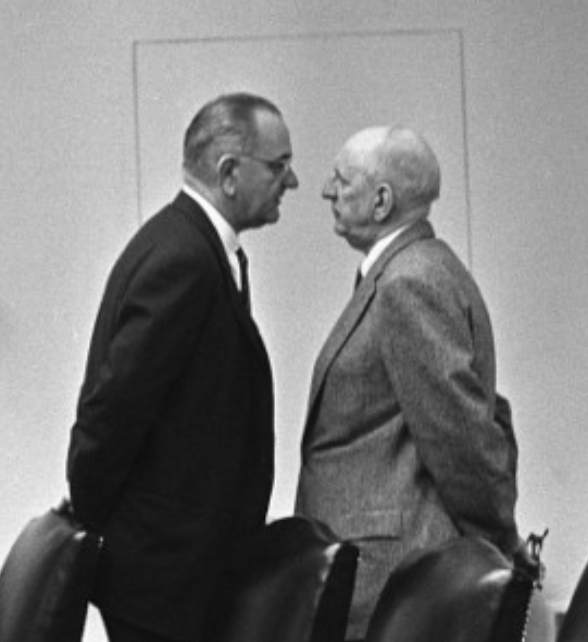
Quite famously, members of Congress who suggested that they would oppose the legislative priorities of President Lyndon Johnson would get phone calls in the middle night from the man himself, waking them up and letting them know that they were dead men. He’s supposed to have said things like, “I’m gonna cut your balls off, you cocksucker”, though it’s not like anyone had a stenographer on the calls to nail the quotes. He was threatening and nasty on all days ending in -y, and got bills passed by, among other things, actually, physically intimidating people who didn’t roll over. He was a leaner. He got in faces, constantly and openly.

You gonna pass my bill [insert string of highly personal threats and profanity], or is your political career over? Pressure, threats, and horsetrading are the default behaviors, the normal stuff. Andrew Jackson got the Indian Removal Act through Congress by handing out government sinecures. The premise that I can take care of you or I can go to war with you, and it’s your choice which one happens is … politics. The make-believe story about Mean Donald Trump bullying the Supreme Court by tweeting at them or sitting in a chair where they could see him is playtime, clutching at Fisher-Price pearls. Somewhat remarkably, Trump appears to bully institutional opponents quite a bit less than the historical norm, and Lisa Murkowski can do whatever she wants without consequence. I am personally calling for Donald Trump to start actually bullying some people who have it coming, but be sure to have a fainting couch ready in the newsroom at Times Square.

Update, 6 March: Welcome, Instapundit readers! Have a look around at some of my other posts you may find of interest. I send out a daily summary of posts here through my Substackhttps://substack.com/@nicholasrusson that you can subscribe to if you’d like to be informed of new posts in the future.

March 11, 2026

The Supreme Court of Canada in Santa Claus mode (even if they no longer use those robes)

Filed under: Cancon, Government, Politics — Tags: , , , , , , , — Nicholas @ 05:00

In a pretty conclusive 8-1 decision, the Supreme Court of Canada seems to have overturned not only the Quebec childcare entitlement at issue in this case, but the notion of citizenship in a much wider sense:

The SCC recently abandoned their traditional red robes for black robes more similar to those of the US Supreme Court. This is a case where the older robes would be more appropriate for other reasons.

On Friday, the Supreme Court of Canada delivered its latest stupefying ruling. According to an 8–1 majority in the case of Quebec (Attorney General) v. Kanyinda, the Charter requires the Quebec government to extend subsidized daycare benefits to refugee claimants — asylum seekers who have not yet proven the legitimacy of their claim to refugee status. Founded on a prevalent but contentious reading of constitutional equality rights, the court’s reasoning has far-reaching potential to destabilize parts of the nation’s immigration and social welfare systems.

Until last week, Quebec law granted daycare subsidies to certain categories of parents, including Canadian citizens, permanent residents, and those with approved refugee status. When Bijou Cibuabua Kanyinda, the plaintiff in this case, arrived in the province and sought asylum in 2018, she fell into none of those categories. Aided by cause lawyers, and a coterie of social justice interveners (third party interest groups who submit arguments to the court), Kanyinda argued that the exclusion of refugee claimants from this welfare scheme amounted to unconstitutional discrimination.

Remarkably, the majority of the Supreme Court not only agreed with Kanyinda that the Quebec daycare scheme violated Section 15(1) of the Charter — which provides for “the right to the equal protection and benefit of the law without discrimination” — but bypassed the Quebec legislature by “reading in” a remedy directly into the law. In other words, the court rewrote the statute to immediately grant subsidies to “all parents residing in Quebec who are refugee claimants”.

More troubling than the outcome itself, however, will be the judicial reasoning that rationalized it. Writing for the majority, Justice Andromache Karakatsanis held that the Quebec scheme created a distinction “on the basis of sex”, a proscribed ground of discrimination under Section 15. But rather than fostering a distinction between men and women, Justice Karakatsanis asserted that the scheme discriminated between “men and women refugee claimants” — even though neither group was eligible for benefits at all. Because Quebec’s exclusion of refugee claimants worsened the economic disadvantage of the female claimants, she concluded, it constituted discrimination that violated Section 15.

The court’s reasoning is convoluted, to be sure. Readers may be forgiven for struggling to understand how a ruling that extends benefits to “refugee claimants” can follow from a supposed distinction on the basis of “sex”. In fact, the judgment exposes the incoherence into which the Supreme Court’s equality rights jurisprudence has fallen.

January 26, 2026

King Donald the First

Filed under: Government, History, Media, Politics, USA — Tags: , , , , — Nicholas @ 03:00

His most rabid fans liked to call him the God-Emperor, but Andrew Sullivan sees him much more as a modern King George III:

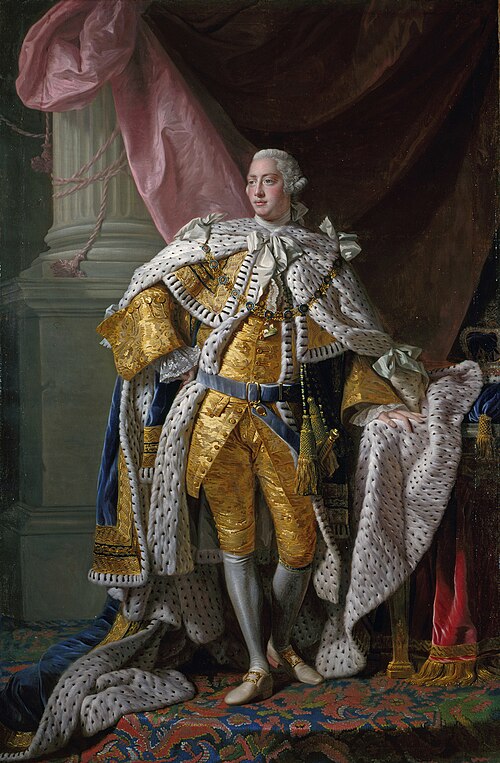
King George III in his Coronation robes.
Oil painting by Allan Ramsay (1713-1784) circa 1761-1762. From the Royal Collection (RCIN 405307) via Wikimedia Commons.

It is where lies and truth are entirely interchangeable; where the rule of law has already been replaced by the rule of one man; where the Congress has abdicated its core responsibilities and become a Greek chorus; where national policy is merely the sum of the whims and delusions of one man; and where every constitutional check on arbitrary power, especially the Supreme Court, is AWOL. In that abyss, even an attempt to explain events through the usual rubric of covering a liberal democracy is absurd. Because that rubric is irrelevant.

And so the wheels spin.

The only honest way to describe what is in front of our noses is that we now live in an elected monarchy with a manic king whose mental faculties are slipping fast. After 250 years, we appear to have elected the modern equivalent of King George III, and are busy dismantling the constitution Americans built to constrain him.

The situation is not irrecoverable — the forms of democracy remain even if they are functionally dead. We have centuries of democratic practice to fall back on. But every moment the logic of the abyss holds, the possibility of returning to democracy attenuates. Tyranny corrupts everything and everyone — fast. David Brooks returns to the ancients today to understand where we are:

    As the disease of tyranny progresses, citizens may eventually lose the habits of democracy — the art of persuasion and compromise, interpersonal trust, an intolerance for corruption, the spirit of freedom, the ethic of moderation. “It is easier to crush men’s spirits and their enthusiasm than to revive them,” Tacitus wrote. “Indeed, there comes over us an attachment to the very enforced inactivity, and the idleness hated at first is finally loved.”

Forty percent of the country still backs the tyrant. Forty percent watch this and cheer.

Let us briefly review what they are cheering. For the first time since the Second World War, the president of the United States declared last week that we no longer support the notion of national sovereignty or collective security, and reserve the right to invade and occupy other sovereign countries — even close allies — to extract their resources. Quite a Rubicon. His chief adviser declared international law a dead letter:

    [W]e live in a world, in the real world … that is governed by strength, that is governed by force, that is governed by power. These are the iron laws of the world since the beginning of time.

To put it bluntly, this was the argument of King George III. It was the justification for the British Empire, and, more hideously, for the Nazi and Soviet occupations of Europe. It’s a rejection of the principle that literally created the United States.

And yet this mad king threw this founding principle away because he believes a) we deserve Greenland as reparations for World War II, b) because Russia and China would invade otherwise, c) because rare earths are there — even though they are buried under a mile of ice — and d) because he didn’t win the Nobel Prize. Insane.

This staggering concession to evil — which cannot be withdrawn — robs us of any case against Russia’s invasion of Ukraine or China’s threat to Taiwan. It legitimizes war by major powers for conquest everywhere. It endangers the entire system of collective security that has kept the peace for nearly 80 years. Why? And for what? Because the king was on a high.

That’s where we are.

December 23, 2025

How Black WWII Veterans Ignited the Civil Rights Movement – W2W 058

Filed under: Education, Government, History, Military, Politics, USA — Tags: , , , , — Nicholas @ 04:00

TimeGhost History
Published 22 Dec 2025

Decades before the words Black Lives Matter existed, Black American veterans were already fighting the same battle at home. After World War II, hundreds of thousands of Black soldiers returned from the frontlines of Europe and Asia believing they had earned the rights they had defended abroad. Instead, they were met with segregation, voter suppression, police violence, and terror under Jim Crow laws.

This episode explores how Black WWII veterans became a driving force behind the early Civil Rights Movement — joining the NAACP, challenging segregation in court, organizing protests, and refusing to accept second-class citizenship in the nation they had fought to protect.

From the brutal blinding of veteran Isaac Woodard Jr., to landmark legal battles led by Thurgood Marshall, from the Journey of Reconciliation to Brown v. Board of Education, this is the story of how the fight for freedom moved from foreign battlefields to American streets, courtrooms, buses, and classrooms.

We follow the rise of mass nonviolent resistance through figures like Rosa Parks and Martin Luther King Jr., the Montgomery Bus Boycott, and the creation of the SCLC — while also confronting the violent backlash, political resistance, and human cost that defined the struggle.

This is not just the history of civil rights legislation. It is the story of veterans who refused to stop fighting — and a reminder that equality in the United States has never been automatic, inevitable, or finished.
(more…)

November 17, 2025

The US Supreme Court considers whether Trump’s tariffs are legal

Filed under: Government, Law, Liberty, Media, Politics, USA — Tags: , , , , — Nicholas @ 05:00

Thanks to the staggering incompetence (and/or deliberate provocation for domestic political advantage) of the Carney government’s dealings with President Donald Trump, the current case before the Supreme Court is of significant interest to those of us on the north side of the US-Canadian border. On his Substack, David Friedman discusses the issues before the court:

There are three things wrong with Trump’s tariffs. The first is that they cannot be expected to provide the benefits claimed, can be expected to make both the US and its trading partners poorer; the arguments offered for them depend on not understanding the economics of trade. For an explanation of why that is true, see an earlier post.

The fact that the tariffs make us poorer may be the most important thing wrong with them but it is irrelevant to the Supreme Court; nothing in the Constitution requires the president to do his job well. The questions relevant to the Court are whether what Trump is doing was authorized by past Congressional legislation and whether it was constitutional for Congress to authorize it.

What Counts As An Emergency?

Tariffs are under the authority of Congress, not the president.1 Trump’s justification for setting them himself is congressional legislation, the International Emergency Economic Powers Act.

    (a) Any authority granted to the President by section 1702 of this title may be exercised to deal with any unusual and extraordinary threat, which has its source in whole or substantial part outside the United States, to the national security, foreign policy, or economy of the United States, if the President declares a national emergency with respect to such threat.

    (b) The authorities granted to the President by section 1702 of this title may only be exercised to deal with an unusual and extraordinary threat with respect to which a national emergency has been declared for purposes of this chapter and may not be exercised for any other purpose. (IEEPA, 50 U.S. Code § 1701, emphasis mine)

Trump declared that his Worldwide Reciprocal Tariffs were intended to deal with the US trade deficit.2 Whether the deficit is a threat and whether tariffs are a good way to deal with it are questions for economists3 but whether it is unusual is relevant to judges, since if it is not the IEEPA does not apply.

[…]

The Court on Trial

Delegating to the president the power to impose tariffs, a power explicitly given to Congress in the Constitution, is a major question. Under doctrine proclaimed by this court that means that the legislation claimed to delegate that power must be read narrowly. On a narrow reading, on anything but a very broad reading, the legislation fails to apply to President Trump’s tariffs for two independent reasons:

    It only grants power in an emergency, which under the language of the Act neither the trade deficit nor the illegal drug problem is; the deficit has existed since 1970, the War on Drugs was proclaimed in 1971.

    The powers granted to the president in the Act do not include the power to impose tariffs.

If the six conservative justices believe in the principles they claim, the administration will lose the case 9-0.


  1. The Congress shall have Power To lay and collect Taxes, Duties, Imposts and Excises … To regulate Commerce with foreign Nations … (U.S Constitution, Article I, Section 8).
  2. “I found that conditions reflected in large and persistent annual U.S. goods trade deficits constitute an unusual and extraordinary threat to the national security and economy of the United States that has its source in whole or substantial part outside the United States. I declared a national emergency with respect to that threat, and to deal with that threat, I imposed additional ad valorem duties that I deemed necessary and appropriate.” (Executive Order July 31, 2025).
  3. The answers are no and no.

October 21, 2025

The threat to legal title to land across Canada

Filed under: Cancon, History, Law — Tags: , , , , — Nicholas @ 03:00

I’d warned years ago that the performative “land acknowledgements” that so many Canadian organizations started using at the beginning of events and gatherings at least a decade back were a bad idea, because they were almost always historically misleading and might be used in future lawfare. Well, the future is here, and the precedent has been set in British Columbia with a court ruling that aboriginal land claims from a BC First Nation has more standing in court than the legal titles held by the current owners. On his Substack, Brian Lilley discusses the issue:

The City of Richmond, British Columbia is warning homeowners their title to their homes may be at risk. It all dates back to an August ruling from the B.C. Supreme Court called Cowichan Tribes that said Crown and private title in a 7 1/2 square kilometre area of Richmond was “defective and invalid.”

While some at the time said that the ruling would not impact homeowners, the legal department for the City of Richmond clearly thinks differently.

“The court has declared Aboriginal title to your property which may compromise the status and validity of your ownership – this was mandated without any prior notice to the landowners,” a letter sent to homeowners in the area impacted reads.

The letter was sent by Mayor Malcolm Brodie and tells residents the city will be appealing and holding public consultations. It’s not just the City of Richmond appealing this ruling it’s also the province and the Musqueam Indian Band.

You can read more from our friends over at Juno News.

The entire ruling from the B.C. Supreme Court is confusing, as is the jurisprudence set out by the Supreme Court on the issue of Aboriginal title dating back to one of those decisions in 2014. Thankfully Professor Dwight Newman, the Canada Research Chair in Rights, Communities and Constitutional Law at the University of Saskatchewan, has laid out an explainer of what happened in the Cowichan case, the 2014 Supreme Court case and what needs to be done going forward.

Give it a read.

Last week, Kim du Toit responded to an Australian land acknowledgement on a recent TV show:

The history of this entire world is a story of migration, settlement, wars over territory and Tribe A taking land from Tribe B — bloody hell, they’re still fighting the same wars in the Balkans — but it’s only recently that the arguments over who owns what have become a third-party issue rather than something that the involved parties settle between themselves. Or, to put it in a more scholarly fashion:

    Every person alive on this planet today has ancestors who were displaced by force somewhere in their lineage. Every person alive on this planet today has ancestors who displaced other people by force somewhere in their lineage. It’s an inevitable fact of human history. American natives fought with each other over land and resources, and some tribes, like the Dakota (Sioux), were notorious for attacking their neighbors. Europe’s history is rife with such, from the Vikings to the Norman invasion of Britain. In fact, few if any of the people of Europe today are the original inhabitants of the land they reside on now; the one exception may be the Basque of the Pyrenees Mountains, but even they, at some point, came there from somewhere else. The French people we know now derive their name from the Franks, a Germanic tribe, and as for the British Isles, that motley group of islands has seen so many invasions, from Picts to Celts to Romans, Saxons, Anglians, Jutes, and Normans, that it would be difficult to keep track as they go by.

Here’s the simple response to all the handwringing and aggrievement over the “stolen land” claims: get over it, because you’re never going to get it back. End of story.

And to a lesser extent, the same is true of “cultural appropriation”: where White kids are somehow forbidden to wear their hair in those disgusting dreadlocks because Africans somehow have “ownership” of a hairstyle. What bullshit. It’s like saying that Black people can’t drink Scotch whisky because whisky is traditionally a product of the northern provinces of (lily-white) Britain, or that the Irish can’t eat chips because potatoes originally came from America.

Everyone borrows cultural artifacts and customs from everyone else. That’s been the habit of mankind for millennia, and no cries of outrage can overturn it.

When it comes to land, the stronger group has taken it from its “original” (and sometimes not-so original) weaker inhabitants. That this activity has become somewhat less egregious and bloody in recent times does not gainsay its basic premise — and where it has become more bloody, the weaker continue to learn its hard history — as the “Palestinians” are (re-)learning in their efforts to eradicate the state of Israel. (They’re unlikely ever to give up, which simply means that Israel will be forced to teach them the same lesson again and again, ad infinitum. As I’ve said many times before, the Arabs are lucky that the Jews have an inexplicable aversion to genocide, or else “from the river to the sea” could easily have changed to “from the Golan to the Suez”. Vae victis — a Latin expression — has particular currency here.)

So enough with the kowtowing (a Chinese expression) to the Perpetually Aggrieved. Fuck off, all of you, and make the best of what you’ve got. Heaven knows, most of what you can achieve comes courtesy of Western civilization.

You’re welcome.

October 14, 2025

White Hoods, Bloody Hands: The Klan as America’s First Terrorists – W2W 048

Filed under: History, USA — Tags: , , , , , , , , — Nicholas @ 04:00

TimeGhost History
Published 12 Oct 2025

From Pulaski to Stone Mountain to Brown v. Board, the Ku Klux Klan evolves from Reconstruction terror to a decentralized, Cold War–era movement that bombed churches, lynched citizens, and hid behind “anti-communism”. We trace the First, Second, and Third Klans — rituals, networks, and the brutal campaign against desegregation and civil rights.
(more…)

October 1, 2025

“Sean Fraser, the current minister of justice and attorney general, has made two major mistakes of late”

If you’re at all interested in Canadian affairs, you should subscribe to The Line … even a free subscription will definitely provide you with some excellent non-propagandistic coverage of what is happening in the dysfunctional dominion. For instance, last weekend’s weekly post from the editors included this segment about Sean Fraser, who is perhaps the worst of Mark Carney’s cabinet (and that takes some doing):

Sean Fraser, as Minister of Immigration, Refugees & Citizenship, during day one of Collision 2023 at Enercare Centre in Toronto, Canada.
Photo by Vaughn Ridley via Wikimedia Commons

We at The Line contend that Sean Fraser, the current minister of justice and attorney general, has made two major mistakes of late.

The first was in deciding not to rescind his decision to spend more time with his friends and family when it became clear that Justin Trudeau was no longer an anchor on his electoral chances. After failing to fix Canada’s housing problem and proving himself integral to blowing apart a pan-partisan consensus on immigration that was once the envy of the world, the man had a real opportunity to leave office on a high note. But, no.

Instead, after hitching his bloated baggage to Mark Carney’s trunk, Fraser decided that Canada needed more of him.

And so, as justice minister, instead of addressing petty stuff like, oh, bail reform, or fixing prisons, or getting crime under control, he turned his attention to … Section 33 of the Charter of Rights and Freedoms. The notwithstanding clause.

You may recall that Quebec’s contentious Bill 21 — which prohibits public-service employees in positions of authority, and teachers, from wearing religious symbols while on the job — is currently before the Supreme Court of Canada. Despite numerous mixed rulings on the law, Quebec moved forward with its stance on secularism by invoking Section 33, which allows parliaments to temporarily override judicial rulings.

Section 33 was placed in the Charter for precisely this kind of situation; one in which the courts and parliament disagree about governance. As we still live in a democracy, and are still nominally governed by representatives we elect, the clause was always a bit of a compromise gesture intended to preserve parliamentary supremacy after granting the courts broad powers to basically reinterpret law according to an expansive and ever-expanding understanding of both their jurisdiction, and of the concept of “rights” writ large.

Section 33, nonetheless, has maintained a heavy odour about it, which has generally limited its application, especially outside Quebec. Among the Sean Fraser set, and the largely Liberal collection of lawyers who will insist that the Supreme Court isn’t remotely political, and how dare we entertain the thought, Section 33 was only ever intended as a symbolic right.

But as the definitely-not-political Supreme Court has edged ever deeper into the territory of override and governance, so too have provincial parliaments responded with a very not-symbolic application of the clause.

We do think there’s some blame to be placed at everyone’s door, here. But we also never really took much issue with Section 33. That’s because, at heart, we at The Line believe in, well, democracy. We believe that the people we elect should be able to decide our laws; and we believe that while the Supreme Court of Canada serves as an important check on Parliamentary power, that power doesn’t and should never override the will of the people.

And that’s basically where we part ways with Fraser and many of his — dare we say it? — Laurentian Consensus ilk. Because the unstated critique of the use of Section 33 is basically always the same: these people dislike the application of the clause because they think politics is icky, and that politicians fundamentally cannot be trusted.

In other words, these people don’t actually want a democracy.

They want a technocracy. One in which the smartest and ablest individuals (as defined by them, of course) are the ones who actually get to set the rules and guardrails for society writ large. One in which parliament really is as theatrical, symbolic and pointless as it often regards itself.

There’s an obvious illogical inconsistency here — Fraser and his colleagues are politicians. We aren’t sure if this desire to go out and limit the ability of he and his fellow parliamentarians to do the best jobs they can for the citizens reflects mere self-loathing, or a particular brand of Liberal blindspot, one that leads them to believe that they alone among politicians are exempt from anything as crass political considerations and/or motivations. Those moral failures are apparently for the other guys. But in any case, we have an elected official making the case that unelected courts should have the ability to override legislators, and that the legislators should have no recourse. However Fraser rationalizes this to himself, it’s where we are.

We think the people who have issues with Section 33 are generally not being honest with themselves in that regard; we also think that their instinctual aversion to politics (or their exemption of themselves from it) tends to make them naive. If you vest all the real power of governance in a “non-partisan” Supreme Court, what you’ll get is not a dispassionate government, but rather a heavily politicized Supreme Court. We need only look at what has happened in the U.S. over the past 30 years to see how that pans out in the long run.

Look, we at The Line don’t like Bill 21. It’s a bad law. It needlessly tramples on minority rights. But there’s a very obvious way to get that law repealed that doesn’t involve flirting with a full-blown constitutional crisis in the midst of, you know, all of the other crises going on right now.

Elect a government that will repeal that law.

That’s what democracies do.

To me, one of the most puzzling things about the Carney government’s recent actions is the overall incoherence of them. They are going ahead with one of the worst policies inherited from the Trudeau years with the “gun buyback” program that the minister responsible has openly admitted is almost completely a sop to voters in Quebec. Okay, that makes cynical sense as the Liberal vote is about as “efficient” as it possibly can be so losing just a few seats in Quebec would make it impossible for the Liberals to get re-elected. Fine. Scummy as hell, but fine. Yet the challenge to Section 33 is guaranteed to piss off far more Quebec voters — and stir up controversy across the country to boot — and you’re going to stage a pitched battle against pretty much all the provinces before the Supreme Court? Are you sure about that?

Older Posts »

Powered by WordPress