
There’s a story that the Bush administration came into office in 2001 itching to get rid of Saddam Hussein and looking around for a pretext. Near as I can tell, this is totally false — actually, the entire US government had been looking for a pretext since at least a decade earlier than that. It all goes back to 1990 and the Iraqi invasion of Kuwait. Prior to that, Iraq was an American ally and proxy that helped contain the revolutionary regime in Iran. That relationship gave Saddam a long leash and meant he could get away with a tremendous amount. But the leash was not as long as Saddam thought, and he badly overstepped his limits when a diplomatic fight with Kuwait over the terms of some war loans escalated into a military confrontation. Improvisational decision-making was not out of character for Saddam, who had a tendency to do things like go alone into one of his many palaces and emerge wild-eyed the next day declaring that he had a prophetic dream which would henceforth guide state policy. But this time he got into some real trouble.
The Americans kicked Iraq out of Kuwait quickly and easily, and then … hesitated about what to do next. Nobody wanted to keep Saddam around (remarkably, when you have outlived your usefulness, people suddenly start to notice all of your human rights abuses), but nobody wanted to march into Baghdad and topple him either. There was some wishful thinking that the Kuwait defeat would cause Saddam’s regime to collapse, but most US foreign policy thinkers just shrugged their shoulders and figured better Saddam than chaos and a Vietnam-style quagmire. One especially perceptive official put it this way to a PBS journalist:
I felt there was a real danger here that you could get bogged down in a long drawn out conflict … and then you’ve got to worry about what comes after. And then you have to accept the responsibility for what happens in Iraq, accept more responsibility for what happens in the region. It would have been an all-US operation, I don’t think any of our allies would have been with us, maybe Britain, but nobody else. And you’re going to take a lot more American casualties if you’re gonna go much around in Iraq for weeks on end trying to run Saddam Hussein to ground and capture Baghdad and so forth and I don’t think it would have been worth it.
That official’s name was Dick Cheney.
So Saddam was left in place, and throughout the ’90s American policymakers seethed about it. There was no official policy that said we were going to overthrow him, but prominent politicians like Al Gore were out there writing op-eds saying that Saddam must be toppled and his government dismantled. This produced what Mazarr calls “destructive ambiguity” — everybody knew that everybody else knew that the real policy was to get rid of the guy, but since this was an unofficial position it went through none of the usual policymaking channels and was never formally debated. It also left a lot of room for freelancing.
For example, CIA clandestine operative Bob Baer (whose memoir is a terrifically fun read, by the way) began organizing a coup in 1995, not because he was directly ordered to do so but because he thought it was what his supervisors wanted. Even the strategy of the coup points towards this ambiguity — rather than straightforwardly overthrowing the government, it aimed to spark a rebellion that would gain some momentum but not enough to win, so that when Saddam moved to crush it the US would be pulled in and forced to act.1 Think for a moment about what an odd plan this is, and how it only makes sense if you believe the US secretly wants to invade while officially pretending not to.
The leader of this rebellion was supposed to be Ahmed Chalabi, one of the more fascinating characters in this story. Chalabi was a dapper, cosmopolitan, and erudite bank manager who got exiled from Iraq for gross financial corruption. He promptly reinvented himself as a freedom fighter, rented beautiful houses stocked with fine art in several major cities, and set about ingratiating himself with Western elites. He also began organizing his fellow emigrés and exiles into an effective political lobbying force. Unsurprisingly given his educated and aristocratic manner, he was extremely good at the lobbying part, and soon placed a special focus on the United States, wining and dining congressmen and writing op-eds for major newspapers. Soon he managed to convince the CIA that there were thousands of resistance fighters back in Iraq ready to follow him into battle.
He was good at convincing, but they also wanted to be convinced. Chalabi and his fellow emigrés were charming, cultured, westernized intellectuals who at least pretended to be pro-democracy. It was oh-so-tempting to believe that everybody in Iraq was like that, when in fact they were completely unrepresentative. As a rule of thumb, when a country has a revolution or a civil war or other social breakdown, the ones who make it out are the ones bright enough to see it coming and rich or well-connected enough to escape. Whether it’s the Russian Revolution, the Lebanese Civil War, or whatever you call what’s happening in South Africa, the people who leave are not a random subset — they’re the creme-de-la-creme. Unfortunately the US government somehow couldn’t figure this out in the case of Iraq. They met the emigrés, and were impressed by them, and decided that Iraq really was a civilized and cosmopolitan place under the surface, when in fact the society that created the emigrés had been destroyed decades earlier.
The emigrés represent one pole of the Baptists-and-bootleggers coalition that emerged in the ’90s to advocate for the overthrow of Saddam’s regime. The other is exemplified by Paul Wolfowitz, a soft-spoken academic who bounced between senior government positions and jobs at think tanks. Wolfowitz was a humanitarian in the most sincere sense. Much of his extended family had been killed in the Holocaust. The plight of oppressed peoples was not an abstraction for him, and he dedicated his life and career to the proposition that the United States should use all available means to end tyranny and oppression wherever they existed.
Wolfowitz is commonly described as a fanatical neoconservative, and he is, but I think it’s important to demystify that term. Too often it gets used as a catchall for “people we don’t like”, but at least when it comes to foreign policy the neoconservatives fit squarely within the American mainstream. With the notable exception of Donald Trump, every American president of the past few decades has had essentially the same foreign policy, driven by essentially the same core ideas: (1) Americans are the good guys, (2) it’s the job of the good guys to right wrongs wherever they are happening, (3) freedom and democracy are the non-negotiable inheritance of everybody on planet earth. These ideas drive the neoconservatives, yes, but they also drive Samantha Power and Susan Rice, not to mention Hillary Clinton and Barack Obama.
If you are an American, it may not be apparent to you how weird these ideas seem to the rest of the world. If I were to characterize how previous empires — and America’s current rivals — think about the world, it would be more like: (1) every country has core interests and peripheral interests, (2) you should not interfere in another country’s core interests if you can help it, (3) different peoples and cultures are adapted to different forms of government, and this diversity makes life spicy and interesting. Perhaps most shocking to Americans: most countries do not self-identify as “the good guys”, instead they think of themselves as a people with a history and a set of territorial claims.2
Mazarr describes this peculiar American quality as “the missionary impulse”, and notes that while it comes from a well-intentioned place, it “can produce a theological and absolutist conception of America’s responsibility as well as a romantic conviction that America can renovate other societies at will”. Or, to put it in blunter words, it makes us do insane things like invade and occupy a culturally alien country on the other side of the world, and stand there in blinkered incomprehension when people don’t like it. Perhaps the most damning thing about this missionary impulse is the way it provides a self-excusing justification for recklessness: since America is definitionally the good guys, all the horrible consequences of America’s dumb decisions must be somebody else’s fault, and anyway we meant well so you can’t really blame us.3 It’s like a speeding driver who hits and kills pedestrians over and over again, and when confronted gets huffy and points out he’s on his way to feed people at a soup kitchen.
Why is our national character like this? It’s one of those eternal questions. Maybe it’s because we were settled by various strains of fanatical Protestants, or because our ethnos was born during the Enlightenment, or some other “genetic” factor. Alternatively, it could be something about our historical development, or perhaps the large oceans that have always insulated us from most of the negative consequences of our decisions. Or maybe it’s just inevitable that whoever the current world empire is will feel this way, a consequence of our “unipolar moment”.4 Whatever the cause, it’s been a frequent source of misunderstanding between American and foreign diplomats, and few more so than Iraq’s.
The inability of the Iraqi regime, and of Saddam Hussein in particular, to “get” America or its motivations is a recurring bit of comic relief in Mazarr’s book, and one of the first big episodes of it occurs here in the mid ‘90s. This was the time when the Iraqis completely shut down their WMD programs and destroyed every trace of them. But even while halting their nuclear, chemical and biological weapons projects, they continued to loudly insist that they were operational. This appears to have been done out of fear that they would lose prestige if they admitted to backing down. Saddam also really wanted the Iranians to think that he still had chemical weapons out of fear that they’d invade if he didn’t, and he figured that US intelligence would obviously figure out that the programs had been stopped, so they didn’t have to come out and say it themselves.
I remember when I was a kid watching Dr. Strangelove, and laughing at the part where the Soviets built a doomsday device without telling anybody, completely defeating the purpose of having a doomsday device. Then I got older, and learned that no actually, in real life the Soviets built a doomsday device, and then didn’t tell anybody, because they apparently assumed that its psychological effect would be more powerful if America found out about it from its spies (naturally, we didn’t find out until after the Cold War was over). Saddam’s mistake was a weird inverse of this, destroying all his doomsday weapons and then just assuming we’d figure it out. I guess the moral of the story is that in real life, these too-clever-by-half schemes where you double-bluff your opponent are rarely worth it.5
Anyway, Saddam destroyed all of his WMD, and then kicked out the UN inspectors so as to maintain the charade that he still had them. At the same time that all of this was happening, the sanctions regime that the US had imposed was clearly falling apart. European and Asian businessmen were swarming all over Baghdad, trying to get things in place for when foreign investment inevitably flooded back into the country. All of this contributed to an ambient sense that something had to be done; the attempt to kick the can down the road was failing. By the late ’90s, the Clintons had already convinced themselves that a rematch with Saddam was inevitable, but they didn’t have time to act on it before their term was up and a new sheriff rolled into town.
John Psmith, “REVIEW: Leap of Faith, by Michael J. Mazarr”, Mr. and Mrs. Psmith’s Bookshelf, 2025-06-30.
- Yes, this was exactly Strelkov’s strategy in the Ukrainian civil war. And for similar reasons — the Russian government as an official body was dithering and indecisive, but a large faction within it wanted to act.
- My north star here is, as always, my former coworker from Bulgaria.
- Graham Greene did an exquisite job skewering this attitude in his novel The Quiet American. One character says of the titular American: “I never knew a man who had better motives for all the trouble he caused”.
- Did the Romans feel this way? Did the Chinese? I don’t actually know, but I think there’s something distinctive about the American imperial attitude. It really does come down to our belief that we’re bombing you for your own good (or overthrowing your government for your own good, or whatever). My sense is that past hegemons have been a bit more honest.
- Then again, Gaddafi did what Saddam arguably should have done, and look what that got him. I guess the real lesson is just not to make too much trouble until your nukes really work.
August 11, 2026
QotD: The long lead-up to the invasion of Iraq
July 18, 2026
The Top WW2 Spy Was a Disabled Woman
World War Two
Published 16 Jul 2026Virginia Hall was one of the most extraordinary spies of World War II. An American operative for Britain’s Special Operations Executive and later the OSS, Hall built resistance networks in occupied France, coordinated intelligence, organized safe houses, helped escaped prisoners and airmen, and supported maquis fighters who sabotaged German operations during the liberation of France.
Known to the Gestapo as “the Limping Lady”, Hall worked with a wooden prosthetic leg she nicknamed Cuthbert. After escaping over the Pyrenees, she returned to France in 1944 in disguise, operating a radio, arranging parachute drops, and helping organize resistance forces against the German occupation.
This is the true story of Virginia Hall: the disabled American spy who became one of the most feared Allied agents in Nazi-occupied Europe — and one of the most important women in WWII intelligence history.
July 12, 2026
This used to be active sabotage … now it’s standard EU practice
Ten years back, I posted an excerpt from a WW2 American espionage manual showing workers in occupied Europe how to bureaucratically sabotage their organizations to harm Nazi Germany’s war efforts. At the time I joked that it also sounded like a lot of company meetings in the modern world. Brivael Le Pogam uses the same set of guidelines to illustrate just how much the EU has embraced these sabotage methods as their standard operating practices:
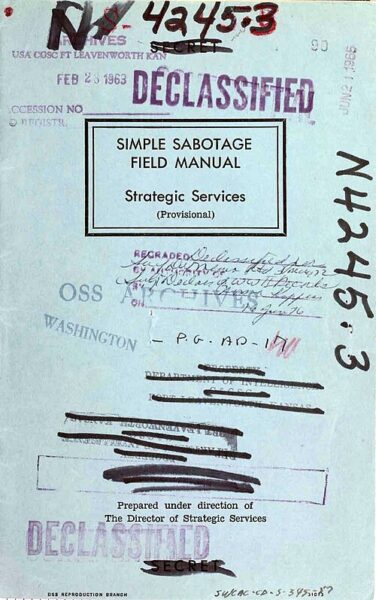
Link goes to full text at Wikisource
🚨 The OSS Simple Sabotage Field Manual (1944) describes how to paralyze an organization without explosives.
The European Union seems to have taken it as its official instruction manual. Here are the disturbing similarities:
1. “Insist on everything going through official channels.”
✅ 27 states, 24 official languages, 3 seats, thousands of committees and agencies. Even a directive on lightbulbs goes through 7 levels of validation.2. “Hold meetings. Speak at length with anecdotes.”
✅ 45-minute speeches in the European Parliament on minor topics. Strasbourg and Brussels locals applaud politely.3. “Refer everything to committees. Make them as large as possible (never fewer than 5 people).”
✅ The trilogue, COREPER, working groups, expert committees … A simple decision turns into a 3-to-7-year obstacle course.4. “Bring up unrelated matters repeatedly.”
✅ Talking agriculture? Let’s add the Green Deal, LGBT rights, Palestine, and the carbon border tax. Nothing is ever straightforward.5. “Haggle over the precise wording of communications.”
✅ Months of negotiation over a semicolon in a 400-page regulation. The word “should” vs. “must” can stall everything.6. “Reopen decisions that have already been made.”
✅ Directive adopted? We reopen it 2 years later for “revision”, “strengthening”, or “adaptation to the geopolitical context”.7. “Advocate caution and deliberation. Avoid all haste.”
✅ “We need more time to study the impact”, “let’s consult stakeholders more”, “better safe than sorry”. Result: nothing moves quickly.8. “Question the legitimacy of every decision.”
✅ “Is this really within the EU’s competence?” (even when it’s already in the treaties). Subsidiarity invoked when convenient, forgotten when not.The EU doesn’t need Russian or Chinese saboteurs. It has turned itself into a machine for slowing down Europe, exactly as the manual recommended to weaken the enemy.
The funniest part? All of this is done legally, democratically, and with the best intentions.
Automatically translated from the original French by X.
May 7, 2026
Tu-144 Concordeski – Speed, Spies and Failure
HardThrasher
Published 4 May 2026In great secrecy, in 1963 the USSR set about making aviation history with the world’s first Supersonic Transport (SST). In 1968, five months before Concorde, the Tu-144 became the first passenger jet to break the sound barrier. But it was a white elephant that crashed on multiple occasions, killed hundreds and flew for just a matter of months after over a decade of development. It was, perhaps the first of a string of failures that brought down the Soviet Union.
00:00 – 11:06 – Introduction and Background
11:07 – 23:10 – The Decision is made to build
23:10 – 35:31 – And then it got worse — how everything fell apart
35:32 – 39:10 – The En Crashening — From First Flight to Constant Crashes
39:11 – 48:49 – Enter the KGB — What role did spies play
49:22 – End – Like, Subscribe, Join the Patreon
(more…)
May 6, 2026
PSS: Russia’s Silent Captive-Piston Handgun
Forgotten Weapons
Published 13 Dec 2025The PSS is a semiautomatic pistol using captive piston ammunition to achieve a comparable level of sound suppression to a .22 pistol with a good normal suppressor. It was developed to replace a couple multi-barrel derringer style captive piston pistols in Soviet use, with the semiautomatic action and (6-round) detachable magazines making it suitable for a wider variety of missions than the previous guns.
It was given the GRU catalog designation 6P28 and entered service in 1983. It fires a cylindrical steel projectile weighing 155 grains at about 620 fps, with a noise of 122 dB (1m left of the muzzle) as measured by silencer legend Phil Dater. Mechanically, the design takes its fire control system from the Makarov but uses a floating chamber system to cycle reliably with the unique ammunition. After the fall of the Soviet Union, the pistols were available for commercial export by Russian state-run export companies, although that ended in 2018. In Russian service, the PSS was replaced with the much improved PSS-2 in 2011.
(more…)
April 27, 2026
Abstract Expressionism “… wasn’t even real art … just a psyop”
When I first got married, we had several friends in the Toronto arts community, and while I enjoyed their company, for the most part I heartily disliked their art. Everything seemed to be consciously designed to be unpleasant to look at: jagged, rusty metallic edges, weird proportions, bilious colour choices, and so on. I was assured more than once that this was what “art” was meant to be: if it didn’t evince a strong reaction, it wasn’t doing its job. On Substack, Celina discusses the claim that modern art was actually a psyop sponsored by, inter alia the CIA:
Abstract Expressionism is arguably the most famous American art movement of the 20th century.
There’s a 95% chance you’ve seen a painting by Jackson Pollock, Willem de Kooning, or Mark Rothko, even if you didn’t know their names.
And if you’ve spent any time online, you’ve probably heard the rumours:
They were funded by the CIA.
It was all propaganda.
It wasn’t even real art … just a psyop.That sounds absurd.
Except … there is a large, large grain of truth behind it.
Jackson Pollock, Number 1A, 1948, The Museum of Modern Art, New York, NY, USA.
Manufacturing Consent
After the First World War, the journalist Walter Lippmann helped pioneer the view that the control of information and, more importantly, the control of public response, had become essential to the stability of modern democracy. This was especially true in moments when the state required certain reactions from the public, as it did during wartime. Lippmann, who famously popularised the phrase “the manufacture of consent“, argued that representative government could no longer function without the deliberate use of mass communication in the supposed service of the public good:
That the manufacture of consent is capable of great refinements, no one, I think, denies. The creation of consent is a very old act, which was supposed to have died out with the appearance of democracy, but it has not died out. It has, in fact, improved enormously in technique, because it is now based on analysis rather than on rule of thumb. And so, as a result of psychological research, coupled with the modern means of communication, the practice of democracy has turned a corner. A revolution is taking place, infinitely more significant than any shifting of economic power.1
Lippmann’s ideas about the “manufacture of consent” would not remain theoretical for long. After the Second World War, they were tested on an unprecedented scale by the American establishment.
Poets, philosophers, critics, and intellectuals became participants in it. They were recruited, funded, and mobilised to form the cultural front line of a struggle against the Soviet Union. But this was not a conventional war. There were no trenches, no battlefields, no declarations.
Instead, it was a war of ideas, fought in publishing houses, universities, art galleries, and across the airwaves. At the centre of this effort stood the Congress for Cultural Freedom.
And its story reveals just how far a democracy was willing to go in shaping what its citizens and the world would come to believe.
- Lippmann, W. (1922). Public opinion. Harcourt, Brace and Company.

March 31, 2026
This Recipe Took 3 Years … Ninja Kikatsugan
Tasting History with Max Miller
Published 23 Sept 2025Very bitter, very sake-flavored balls that include ginseng, coix seeds, and licorice
City/Region: Japan
Time Period: 1676Much like cowboys, pirates, and knights, ninja have been fictionalized to be a far cry from the intelligence gathering and sabotage experts of history. The term “ninja” didn’t even become popular until the mid-20th century.
Even the historical text I’m using here, the Bansenshukai, has been called into question. Because it was written over the period of several centuries, often by people who weren’t even alive during the period when ninja, or shinobi, were active, who knows if it’s an accurate portrayal of their tools and methods.
If this recipe is accurate, I feel bad for the people who had to eat them. They’re really bitter with an overwhelming sake flavor that isn’t pleasant. Really, I wouldn’t recommend making these; they’re not worth the 3 year time investment, and hyōrōgan are a much tastier ninja survival food.
Kikatsugan
10 ryō Asiatic ginseng
20 ryō Buckweat flour
20 ryō Millet Flour
20 ryō Yam
1 ryō Liquorice
10 ryō Coix seed
20 ryō Rice flour
Grind this into a powder, soak it in three shō of sake for three years until it has dried. Afterward, roll it into balls the size of peach pits.
Eating three of these daily will keep you healthy even when you have nothing else to eat.
Eating three will prevent both mental and physical fatigue.— Bansenshukai, 1676
March 8, 2026
Star Trek – Section 31
Feral Historian
Published 7 Nov 2025Star Trek: Deep Space Nine introduced a dark undertone to the optimistic vision of the Federation with Section 31, a secretive organization doing dirty deeds behind the scenes. For some its a much-needed dose of Realpolitik to Trek, for others its a cynical ploy that has no place in Roddenberry’s vision. Either way, Section 31 is one of the most interesting pieces of Star Trek lore.
00:00 Intro
02:20 Backstories
04:09 DS9
06:30 Existential Threats
08:08 In The Pale Moonlight
10:43 Limits of Idealism
12:54 Enterprise
February 22, 2026
An Interesting Silenced Bulgarian Makarov
Forgotten Weapons
Published 29 Sept 2025Today we are taking a look at an interesting silenced Bulgarian Makarov with a mechanism added to lock the slide. This sort of feature is usually thought of as a sneaky way to avoid ejecting brass and leaving it behind, but it actually serves a much more practical purpose. One of the loudest elements of a suppressed pistol firing subsonic ammunition is actually the noise of pressurized gas escaping when the empty case is extracted and then the slide chambering a new round. A slide lock eliminates these sources of noise by preventing the slide from opening. While this is not a factory-made variant of the Makarov, it is an interesting mechanism that I thought worth covering.
(more…)
February 16, 2026
QotD: How nuclear weapons were viewed right after WW2
At the same time, US strategists (particularly associated with the RAND Corporation) were beginning to puzzle out the long term strategic implications of nuclear weapons. In 1946, Bernard Brodie published The Absolute Weapon which set out the basic outlines of deterrence theory; he did this, to be clear, three years before the USSR successfully tested its first nuclear weapon in 1949 (far earlier than anyone expected because the USSR had spies in the Manhattan Project). Brodie is thus predicting what the strategic situation will be like when the USSR developed nuclear weapons; his predictions proved startlingly accurate, in the event.
Brodie’s argument proceeds as a series of propositions (paraphrased):
- The power of a nuclear bomb is such that any city can be destroyed by less than ten bombs.
- No adequate defense against the bomb exists and the possibilities of such are very unlikely.
- Nuclear weapons will motivate the development of newer, longer range and harder to stop delivery systems.
- Superiority in the air is not going to be enough to stop sufficient nuclear weapons getting through.
- Superiority in nuclear arms also cannot guarantee meaningful strategic superiority. It does not matter that you had more bombs if all of your cities are rubble.
- Within five to ten years (of 1946), other powers will have nuclear weapons. [This happened in just three years.]
All of which, in the following years were shown to be true. Consequently, Brodie notes that while nuclear weapons are “the apotheosis of aggressive instruments”, any attacker who used them would fear retaliation with their enemy’s nuclear weapons which would in turn also be so destructive such that “no victory, even if guaranteed in advance – which it never is – would be worth the price”. Crucially, it is not the fact of retaliation, but the fear of it, which matters and “the threat of retaliation does not have to be 100 per cent certain; it is sufficient if there is a good chance of it, or if there is a belief that there is a good chance of it. The prediction is more important than the fact.” [emphasis mine]
This does not “make war impossible” by any means, but rather turns strategy towards focusing on making sure that nuclear weapons are not used, by making it clear to any potential aggressor that nuclear weapons would be used against them. And that leads to Brodie’s final, key conclusion:
Thus, the first and most vital step in any American security program for the age of atomic bombs is to take measures to guarantee to ourselves in case of attack the possibility of retaliation in kind. The writer in making that statement is not for the moment concerned about who will win the next war in which atomic bombs are used. Thus far the chief purpose of our military establishment has been to win wars. From now on its chief purpose must be to avert them. It can have almost no other useful purpose.
To sum that up, because both the United States and its key enemies will have nuclear weapons and because their destructive power is effectively absolute (so high as to make any “victory” meaningless) and because there is no effective defense against such weapons, consequently the only rational response is to avoid the use of nuclear weapons and the only way to do that is to be able to credibly threaten to retaliate with nuclear weapons in the event of war (since if you cannot so retaliate, your opponent could use their nuclear weapons without fear).
That thinking actually took a while to take hold in actual American policy and instead during the 1940s and 1950s, the United States focused resources on bomber fleets with the assumption that they would match Soviet superiority in conventional arms in Europe with American nuclear superiority, striking military and industrial targets (“precision attacks with an area weapon”, a notion that is as preposterous as it feels) to immediately cripple the USSR in the event of war, or else aim to “win” a “limited” nuclear exchange.
Bret Devereaux, “Collections: Nuclear Deterrence 101”, A Collection of Unmitigated Pedantry, 2022-03-11.
January 18, 2026
OSS Lockpick Pocketknife for Secret Intelligence Operatives
Forgotten Weapons
Published 23 Aug 2025In early 1944, the Office of Strategic Services purchase 1,000 specialized pocketknives made by Schrade. Instead of regular blades and tools, these were lock picking knives, with one small blade, three different picks, and two rakes. Able to easily pass as a normal pocketknife on casual inspection, nearly all of them were issued out to OSS Secret Intelligence agents across the European, Mediterranean, and Far Eastern theaters of operation. Today only a few are known to survive …
OSS Equipment Catalog from Headstamp Publishing:
https://www.headstamppublishing.com/p…CIA Equipment Catalog from Headstamp Publishing:
https://www.headstamppublishing.com/p…
(more…)
December 17, 2025
“The ‘liberal international order’ – a technocratic oligarchy sustained by tightly interlocked institutions”
Last week, Len D. Pozeram wrote about how the real (but mostly unacknowledged) American empire is facing unprecedented challenges and may indeed be in serious decline:

“The Empire’s Mask is Slipping”, The Libertarian Alliance
For generations, Americans were sold a saccharine myth: that our nation’s vast global presence — its military bases on every continent, its endless wars, its economic interventions — was all done in the name of “freedom” and “human rights”. This was the sales pitch. Washington, we were told, was the benevolent policeman of a dangerous world, upholding a Pax Americana designed to uplift humanity.
But for those willing to look beyond the rhetoric, the truth was never hidden — only ignored. This narrative was never more than a sophisticated marketing campaign, engineered to pacify a domestic public and legitimize imperial conquest abroad. From the very beginning, the post-WWII global order was not about freedom, but about power — and who would control it after the collapse of the old European empires.
With the fall of the British Empire, America did not merely “step up” to defend the West — it seized control of the imperial machinery and rebranded it. The British financial aristocracy gave way to a new though related American elite, its nucleus formed around Wall Street banks, the military-industrial complex, Big Oil cartels, and, increasingly, a rising Zionist lobby with ambitions stretching far beyond Tel Aviv.
Under the guise of “containing communism” or “defending democracy”, this new managerial class waged a quiet war against genuine national independence movements across the globe. Countries seeking to control their own resources, chart their own destinies, or resist Western financial domination were systematically targeted for destabilization or outright annihilation.
Guatemala in 1954. Iran in 1953. Indonesia in 1965. The Congo. Chile. Nicaragua. Greece. Even Australia, whose 1975 constitutional crisis remains a textbook case of covert Anglo-American regime change. The public, of course, was kept in the dark. History books were rewritten. Journalists who strayed from the script were destroyed or silenced. CIA fingerprints are now visible in dozens of these cases — operations sanctioned not to spread freedom, but to preserve a system of elite extraction and control.
This system — often referred to in polite company as the “liberal international order” — is, in fact, a technocratic oligarchy. It is sustained by tightly interlocked institutions: the Federal Reserve, the IMF, the World Bank, NATO, and a sprawling Intelligence Community whose true loyalties lie not with the American public, but with transnational networks of finance, energy, and geopolitical strategy. To the extent that ideology plays a role, it is the convergence of evangelical apocalypticism and messianic Zionism — two religious currents that have dangerously informed U.S. foreign policy since the Reagan era.
Yet today, this system is beginning to eat itself. The ideology of endless war, and top-down control has run up against hard limits: financial, and political. The de-dollarization trend in the Global South, the rise of multipolar alliances like BRICS, and the exposure of elite criminality — from Epstein to the endless intelligence scandals — are all symptoms of imperial overstretch and rot.
We are watching the slow collapse of an empire built not on democratic values but on lies, coercion, and institutionalized greed.
From a slightly different viewpoint, Spaceman Spiff maintains that the narratives that have been used to direct and control political thought in the west are in the process of collapsing:

Image from Postcards from the Abyss
As reality intrudes the naivety behind many sacred cows is exposed. The emperor is naked and his supporters look equally naked. The narratives driving their fantasies are failing.
The big three issues common in the West illustrate why people are noticing.
Diversity and immigration
The promotion of diversity as a strength is a consequence of blank slate thinking, a belief disparate populations are substantially the same with most observable differences due to environment only.
This is at odds with what we observe, the significant range in ability and proficiency between distinct groups that becomes apparent when we interact. So artificial variety is sold as a positive in an attempt to downplay the homogeneity that gets better results.
The consequence of this is quotas, where arbitrary rules are enforced to ensure a diverse outcome.
This destroys competency even if we ignore the potential for conflict when foreigners are imported in large numbers.
The main effect of pushing this absurd policy seems to be the rise of ethnic awareness among those who must step aside to accommodate it. How could it not? When people are excluded because of their ethnicity it becomes important to them.
This is not what advocates of diversity intended but is already happening.
Climate
Climate and energy policy is based on anti-scientific magical thinking. With the current emphasis on carbon dioxide we are told a tiny portion of our atmosphere is responsible for most of the future changes that will cause widespread harm. There is no evidence for such claims.
The reality of climate is different from the narrative. It is resilient, as many things are. Our obsession is arrogance. A belief we matter more than we do.
Intellectuals are prone to get lost in their theories of how the world ought to work. Activists then latch on to their utopian ideas to gain some sense of meaning in their lives.
Society also has people lacking conscience who will profit from anything no matter how much damage it causes. Combining these two, dreamers with schemers, is often lethal. Seemingly opposing forces, left-wing activists and capitalist profiteers, can cooperate even if they embrace distinct beliefs.
As many memes remind us, if you have corporate sponsorship you are not the resistance. This is precisely what we see.
Narratives begin to collapse as we witness ruthless corporations promote feelgood nonsense about climate while fleecing taxpayers in the background. Many are noticing.
And the effects of suicidal climate goals are difficult to hide. Every closed factory or power station kills another element of credibility.
Socialism
Socialism is based on the idea an educated elite can make decisions for us all while simultaneously conditioning us to be better versions of ourselves. It ignores all of history and everything we have learned of human psychology to embrace a literal fantasy utopia that no one has even come close to realizing.
Nothing sums up the bankruptcy of our intellectuals more than their inability to reject this failed ideology.
But it also shows us the Anglo-Saxon instinct to restrict others’ control over us is the only way to counter it.
It teaches us of the wisdom of documents like Magna Carta or the Bill of Rights, designed to constrain the powerful regardless of their motives, ambitions or mental state. Rare moments of historical sanity that remind us what effective countermeasures can look like.
It would seem this lesson must be relearned every few generations. But we are learning it. Real life is reminding us why we must limit government and its agents no matter how inconvenient.
Bad ideas are inevitable. It is the ability of activists and the powerful to enact them many are now waking up to as narratives visibly fail.
November 22, 2025
Why did the US Enter WW1?
The Great War
Published 11 Jul 2025In early 1917, the United States was still neutral in the First World War. Meanwhile, German leaders were getting desperate — if they couldn’t find a way to break the war of attrition on the Western Front, the Allies would probably defeat them. The result was multiple gambles that staked everything on a quick victory with the risk of drawing the US into the war.
(more…)
November 21, 2025
“You too can be a Tactical Espionage Dollar-Store Hobo for less than $1000”
At Anarchonomicon, Kulak is at it again … this time it’s a long, long post about how to manage “James Bond tricks” without a “James Bond budget”.

I have now seen 5+ different spy films, In which a CIA or MI6 spy has to breach a chainlink fence. An ordinary chainlink fence.
There’s barb or razor wire up top that prevents our hero from just climbing it … So he or she has to breach it. And on FIVE SEPARATE OCCASIONS … I have seen the goofiest inventions in the world come out. $10,000 super-spy wrist watches with hidden lasers in them, super-secret hairpins with scissors in them made of magic cutting alloys, aerosol sprays that instantly oxidize and rust out a massive section of solid steel fencing (don’t breathe that spray) allowing the spy to just push out a Wile E. Coyote style hole of fencing …
Completely over-designed over-specific insanity that’d cost thousands of dollars, and would basically instantly betray the CIA or MI6 was behind the breach …
Of course no sane human being would ever use those techniques even if they existed. The one semi-plausible breech I’ve seen is in Fight Club Ed Norton and Brad Pitt toss a rug over the razor wire surrounding a medical facility so they can climb the fence … but even this strikes me as profoundly unideal … Would you really want to PLAN on risking nasty lacerations climbing OVER razor wire? That seems more like a desperate break-out trick. Not a Break-in trick.
Of course this is all insane because BREACHING A FENCE is maybe the most SOLVED problem out there, 80% of people reading this already have the tools to do it.
You just use wirecutters or a multitool. Ideally creating a single vertical slit so you can crawl through without the breach being visible unless you look very closely. (be sure to fold the slit back as you crawl so you don’t cut yourself on the jagged edges.
Often the crappiest $15 Chinese Multi-tool is up for the task (although test it out on a random fence on a walk before you gamble on it).
(Note that a “Leatherman” is just a good make of multitool, and outperforms even larger wire-cutters … Your cheepo crappy surplus multi-tool will take more elbow grease (if it works, test it))
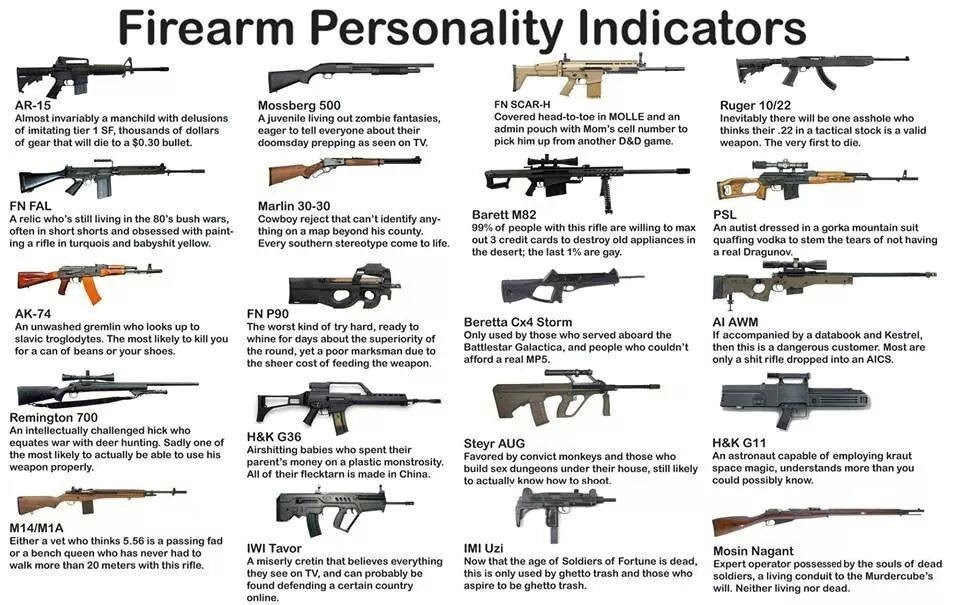
Almost everything on the pop-culture side of the tactical world is like this … There’s an obsession with ultra-expensive James Bond scifi inventions that double as a luxury brand to match your tuxedo … When in reality the cheapest rusty junk from your granddad’s tool shed probably gives you vastly more capability.
And even In the world of prepping, tacticool influences, camping, modern combat, and all matters “survival”, “guerilla”, and “outdoors adventure” there’s an intense focus on expensive kit.
All your favorite influencers are sponsored by various product sellers, and half the reason people watch them is for the vicarious or personal thrill of collecting expensive Gucci kit and showing off their rare or designer rifles and Military Artifacts.
Most will assemble load-outs, rigs, and rifles, far less as a preparation for disaster or war, or an exercise in capability expansion, and more as an artistic expression, fashion statement, or historical exercise … Whether they will admit it or not most of the people who buy Yugoslavian combat webbing, or archaic experimental 80s rifles meant for an upcoming war in the scifi future of 2005 have more in common with historical reenactors than they might care to admit … They just chose wars that didn’t happen towards the end of the cold war, instead of The American Revolution, 1812, or the Civil War.
It’s astrology for boys!
As such one could be forgiven for believing that the great wars of the 21st century to come, and the Urban Battlefield that much of the world is quickly becoming, is a “pay to win” combat-zone. And that unless one has close to 100,000 dollars for body Armour, thermal vision, night vision, precision optics, gucci rifles, and all manner of overpriced gadgets and gizmos that they are simply screwed in any 21st century conflict.
This is not the case. Indeed in some cases it is almost the opposite: given how mass surveillance defines the modern battlefield, there’s a lot of kit I wouldn’t want to use just for risk of dropping it and the Glowies tracking down the only 10-20 people who’ve ordered Czechoslovakian Mag-Pouches via NSA copies of online transaction records, or by just calling the 3 sellers who ever had them.
Put simply Skill, knowledge, resourcefulness, and a more than abundant paranoia are more overpowered than almost anytime since the neolithic period … Basic resourcefulness, daring, courage, B-Grade high-school shop-class craftiness, low level chemistry knowledge, basic boy-scout skills, physical fitness (tall order I know), and a nigh primitivist obsession with the pre-computer way of doing things … Is sufficient to achieve a shocking level of capability and inflict an extraordinary level of damage in any near-future conflict, tyrannical regime, or low intensity resistance.
The most important kit in any future conflict isn’t free. But it is near free.
Available at shockingly low prices from dollar-, convenience-, hardware-, surplus-, grocery-stores, and pawn shops … The necessary equipment and capabilities to fight a high impact Guerilla Campaign are available in almost any town of 20,000 almost anywhere in the western world.
Sadly in spite of being largely legal throughout most of the US and not a few odd other countries (assuming one navigates the proper tax stamps and legal statements) I will not be presenting a guide on how to manufacture black-powder, explosives, firearms, or more exotic weaponry … This is all largely trivially covered by Chemistry Youtube in a level of detail I could never hope to match and with a level of responsibility and maturity far beyond my juvenile imagination, and with a level of expertise and experience I cannot pretend to … Seriously! Chemistry/explosive Youtube is really cool, Some of this stuff is should be taught in schools, so historically relevant and useful is it.
If one Navigates to my Earlier “Warlord’s Reading List” you’ll find many listed works (not least published by the US, Canadian, British, and Swiss Governments) that give detailed guides to the manufacture of explosives, chemical weapons, rocket weapons, improvised firearms, homemade flamethrowers, etc … All from other publishers that I can gesture at without exposing me to legal risk and most of them largely available online in PDF form, or from Amazon, and sometimes from the governments themselves.
August 11, 2025
Stalin’s Death: The Day the USSR Changed Forever! – W2W 39
TimeGhost History
Published 10 Aug 2025March 1953: Stalin’s sudden death triggers a whirlwind of conspiracies, paranoia, and a deadly battle for control inside the Kremlin. As Beria, Khrushchev, and the Soviet elite scramble for power, the fate of the world’s largest superpower hangs in the balance. Was Stalin murdered by his inner circle, or did his own regime consume him? Discover the truth behind the downfall, the rise of Khrushchev, and the birth of the KGB in the Cold War’s most dramatic turning point.
(more…)


