
Ted Gioia
Published 5 Nov 2018This is the latest installment in a series of informal, unscripted videos featuring music historian Ted Gioia. In this video, Gioia talks about the legacy of jazz saxophonist John Coltrane. For more information on Ted Gioia, visit his website at http://www.tedgioia.com or follow him on Twitter at / tedgioia
September 25, 2026
John Coltrane, Prophet and Seer
Comments Off on John Coltrane, Prophet and Seer
August 29, 2026
The Origins of Aldo Uberti and Reproduction Cowboy Guns
Forgotten Weapons
Published 11 Apr 2026In 1958, Val Forgett of Navy Arms contracted with Beretta engineer Aldo Uberti to produce 1,000 reproductions of the Colt 1851 Navy revolver. That turned into the beginning of many decades of production of a wide variety of revolvers and rifles, from the LeMat to a line of Winchester lever actions. Fueled by both organized Cowboy Action competition and general widespread interest in these guns, Navy Arms grew very successful in the market, attracting many other companies who continue to exist to this day. Today I’m talking with Val Forgett’s son (also Val Forgett) about some of the interesting details of the business.
(more…)
Comments Off on The Origins of Aldo Uberti and Reproduction Cowboy Guns
August 25, 2026
Battle Rifles in the Jungle: Guatemalan AR-10
Forgotten Weapons
Published 8 Apr 2026Guatemala was one of the handful of countries to purchase original AR-10 rifles, made at Artillerie Inrichtingen (AI) in the Netherlands. The sale was made by Sam Cummings, legendary arms dealer. He spent much of 1957 and 1958 traveling through Central and South America demonstrating the new AR-10 to virtually every country’s military. In Guatemala, his demonstration resulted in an immediate order for 450 rifles to be delivered to the Escuela Politécnica (the military academy) for more extensive testing. The guns were delivered in late 1958, with serial numbers between approximately 3000 and 3500 (they were made immediately following production of the Sudanese contract batch). These Guatemalan rifles are distinctive for their ventilated bayonet shrouds, which were provided on no other rifles. While none of the Guatemalan rifles were fitted with bipods, a shortage of regular hand guards led AI to fit many of them with leftover Sudanese contract hand guards contoured for folding bipod legs.
The Guatemalan AR-10s were sold as surplus by the Escuela Politécnica to an American importer in 1985, and they were brought into the US as a mix of parts kits and pre-86 Dealer Samples. Today, most of the intact and unmodified Dutch-production AR-10s in the US (including this example) are from the Guatemalan contract.
(more…)
Comments Off on Battle Rifles in the Jungle: Guatemalan AR-10
August 18, 2026
M15 Automatic Rifle (aka T44E5): Adopted But Not Produced
Forgotten Weapons
Published 23 Mar 2026When the US replaced the M1 Garand, the plan was to adopt both a select-fire infantry rifle and a heavy-barreled support weapon on the same platform. During development, both the T44 (later M14) and T48 (FAL) rifles had heavy-barreled versions. In the case of the M14, the final iteration of the heavy-barreled weapon was the T44E5, which was formally adopted as the M15. Before it could be actually put into production, though, it was cancelled as unnecessary.
In testing, first the Marine Corps and then the Infantry Board found that fitting a standard M14 with a detachable bipod gave the same performance as the M15 — and so why bother with an extra version of the gun? Of course, the equal performance was really quite poor compared to proper light machine guns, and once the M14 got into service this shortcoming was noticed. this led to the M14A1 aka M14E2 project, to essentially recreate the M15 with a pistol grip stock and front grip.
Thanks to the Springfield Armory National Historic Site for giving me access to this truly unique specimen from their reference collection to film for you! Don’t miss the chance to visit the museum there if you have a day free in Springfield, Massachusetts: https://www.nps.gov/spar/index.htm
(more…)
Comments Off on M15 Automatic Rifle (aka T44E5): Adopted But Not Produced
August 9, 2026
Clearing Bannerman’s Castle: A Century of Explosive Ordnance
Forgotten Weapons
Published 11 Mar 2026The Bannerman family decided to sell Bannerman’s Island to the state of New York in the 1950s, but the sale required that they first clear all the ordnance off it. That was no simple task, and the military was not interested in the job. Instead, the family found Val Forgett Jr, a demolitions expert who happened to be looking for seed money to start a business making reproduction black powder revolvers. His offer to do the cleanup work was accepted, and he spent a summer doing the job and put the proceeds into the first Navy Arms reproduction 1851 Colt Navy revolvers.
This video includes the talk given by Forgett to the Armor and Arms Club of New York in the 1990s explaining the process of clearing out the ordnance from the island …
(more…)
Comments Off on Clearing Bannerman’s Castle: A Century of Explosive Ordnance
July 14, 2026
June 21, 2026
How Britain Made the L1A1 SLR: archive film with intro by Jonathan Ferguson
Royal Armouries
Published 21 Jan 2026Following last week’s look at the very first L1A1 SLR ever produced (1957), we’re sharing a remarkable Royal Small Arms Factory (RSAF) Enfield archive film, shot in the 1960s, showing the key stages of L1A1 manufacture and a rare glimpse of the original Enfield pattern room.
Then we step back and let the film speak for itself, nearly an hour of pure production and engineering process.
0:00 Intro
3:05 Enfield + Pattern Room
3:57 Planning & Tooling
4:37 Rifle body: Heat treat → Machining → Inspection
18:16 Barrels: Drilling, Rifling, Plating & Production line
34:28 Housing/Trigger, Furniture & Magazines
50:16 Assembly → Proofing/Testing → Packing & Dispatch
(more…)
Comments Off on How Britain Made the L1A1 SLR: archive film with intro by Jonathan Ferguson
June 5, 2026
The First Ever British SLR: Serial Number One L1A1 Explained
Royal Armouries
Published Jan 14, 2026The L1A1 Self-Loading Rifle is one of the most iconic service rifles in British military history and on this week’s episode we have the very first one ever produced.
Next week: an original Royal Small Arms Factory archive film found by our archive team showing how the L1A1 was made.
0:00 Intro
0:46 Serial Number One Explained (UE57 Alpha 1)
1:40 Factory Plaque, Proof Marks & Enfield Details
4:26 Condition, Finish & Standard Configuration
5:17 Distinctive British L1A1 Features
7:08 Controls, Ergonomics & Fire Selector Choices
10:35 Why the L1A1 Won & Closing ThoughtsThis week’s object’s collections online page: https://royalarmouries.org/collection…
(more…)
Comments Off on The First Ever British SLR: Serial Number One L1A1 Explained
May 25, 2026
CP-121 Tracker; carrier-borne ASW powerhouse turned aerial firefighter
Polyus
Published 31 Jan 2026This is an aircraft carrier borne submarine hunter, dressed up like a firefighter. Its story is one of Cold war posturing, coastal policing, and aerial firefighting. Quite the career for such an unassuming looking aircraft. It was the de Havilland Canada CP-121 Tracker, an icon of Canadian aviation for almost 60 Years.
0:00 Introduction
0:30 Historical Context
1:58 Tracker or Gannet?
4:26 Canadian built CS2F-1 Trackers
9:06 CS2F-2
10:23 CS2F-3
13:12 New roles
15:14 Marine Reconnaissance
16:10 Conair Firecat/Turbo Firecat
17:48 Conclusion
(more…)
Comments Off on CP-121 Tracker; carrier-borne ASW powerhouse turned aerial firefighter
May 18, 2026
“Three Days in Toronto” (1959, 1960 & 1962)
Transit Toronto Main Channel
Published 6 Oct 2025Among the huge collection within Richard Glaze’s archive of 16mm film from the 60s and the 70s were a number of 400 foot reels from the 1950s. These were taken during trips Richard made to Toronto before he immigrated, and they show scenes that have not been witnessed in over sixty years. Now that we’ve moved to the new channel, we’ve taken the opportunity to spruce up this film and make some corrections and minor improvements. Enjoy!
Thanks to the dozens of individuals who raised the funds to digitize the first two-thirds of Richard Glaze’s collection.
Corrections:
12:17 – Caption refers to “Hillcrest Wye” when it should be “Hillside”
(more…)
Comments Off on “Three Days in Toronto” (1959, 1960 & 1962)
April 19, 2026
HMCS Magnificent – Canada’s Forgotten Carrier
Skynea History
Published 13 Nov 2025The Royal Canadian Navy is probably not the first one you think about for naval aviation. You’re more likely to think of lighter ships, like Haida.
However, the Canadians would operate three aircraft carriers during the Cold War. The short-lived (well, short-lived in Canadian service) Warrior. The more famous Bonaventure, that I’ve covered before. And, the topic of this video, HMCS Magnificent.
The middle child and probably the least famous of the three. But the one that is, largely, responsible for building Canadian carrier doctrine. It was Magnificent that built up the Canadian naval air arm. Magnificent trained the pilots that would go on to serve with Bonaventure.
And Magnificent is often overlooked for being the middle child. Hence why I chose to cover her today.
Further Reading:
https://forposterityssake.ca/Navy/HMC…
https://naval-museum.mb.ca/rcnships/c…
Comments Off on HMCS Magnificent – Canada’s Forgotten Carrier
March 22, 2026
The Original AR-15: Serial Number 6 in Original Configuration
Forgotten Weapons
Published 1 Nov 2025The very first AR15 rifles submitted to US government trials were extremely lightweight, with an assortment of interesting features that did not last long. They had top-mounted charging handles, one-piece hand guards, very thin barrels with plain muzzles, and a different safety selector configuration than became normal later one. Updates and modifications were made to virtually all of the original rifles, but today we have a chance to look at serial number 6 in the Springfield Armory collection — which is still in completely original configuration.
Thanks to the Springfield Armory National Historic Site for giving me access to this truly unique specimen from their reference collection to film for you! Don’t miss the chance to visit the museum there if you have a day free in Springfield, Massachusetts: https://www.nps.gov/spar/index.htm
(more…)
Comments Off on The Original AR-15: Serial Number 6 in Original Configuration
March 6, 2026
How Not to Build a Plane – TSR2 vs F-111
HardThrasher
Published 5 Mar 2026In the late Cold War, Britain and the United States tried to build the ultimate low-level supersonic strike aircraft. The result was two of the most ambitious aviation programmes ever attempted: the BAC TSR-2 and the General Dynamics F-111 Aardvark. Both aircraft were designed to solve the same terrifying problem. Soviet surface-to-air missiles had made high-altitude bombing almost suicidal. The next generation of bombers would have to fly low and fast, automatically following the terrain, navigating using primitive onboard computers, and delivering nuclear or conventional weapons deep inside enemy territory. In theory, these aircraft would be revolutionary.
In practice … things went wrong.
The TSR2 programme became one of the most controversial cancellations in British aviation history. Plagued by spiralling costs, technical ambition far beyond the computers of the era, and a labyrinth of government bureaucracy, the aircraft was cancelled in 1965 after only a handful of test flights. Meanwhile the American F-111 survived the same technological challenges and political battles — but only just. Development disasters, crashes, exploding engines, and staggering cost overruns nearly killed the programme multiple times before the aircraft finally entered service.
In this video we explore:
• Why the TSR-2 was so technologically ambitious
• How terrain-following radar and early flight computers nearly broke both projects
• The political battles inside Whitehall and Washington
• Why the F-111 Aardvark survived when TSR2 did not
• And what these aircraft reveal about Cold War military technology and procurement
The TSR2 and F-111 weren’t just aircraft. They were early attempts at something closer to a flying computer, built decades before modern electronics made such systems reliable. And that ambition nearly destroyed both programmes.
(more…)
Comments Off on How Not to Build a Plane – TSR2 vs F-111
February 21, 2026
Canada’s Only Mass-Production Fighter Jet – Avro Canada CF-100 Canuck
Ruairidh MacVeigh
Published 18 Oct 2025During the 1940s and 50s, with World War II rapidly transitioning into the Cold War, Canada, as a major ally of the NATO nations and with large swathes of remote countryside that could easily be penetrated by Soviet fighters and bombers, created the CF-100 Canuck, one of the earliest production jet fighters in the world an a machine that, despite some early flaws, would go on to prove itself rugged and robust for patrolling the turbulent weather of the frozen Canadian north.
At the same time, though, the CF-100 was very much a product of its time, and despite its exceptional rigidity, by the middle of the 1950s it was very much obsolete as swept-wing and delta fighters rapidly became the norm for both Communist and Capitalist factions alike, and through its initial success would lay the groundwork for even more ambitious projects that sadly would not continue Canada’s major involvement in cutting edge military aerospace design.
Chapters:
0:00 – Preamble
0:49 – Facing a New Kind of War
4:28 – Ups and Downs
7:12 – Reworking the Design
10:36 – The CF-103 Project
15:51 – The Canuck Career
19:06 – Later Years
20:30 – Conclusion
(more…)
Comments Off on Canada’s Only Mass-Production Fighter Jet – Avro Canada CF-100 Canuck
February 11, 2026
The rise and fall of the “Western” on TV and in movies
Ted Gioia reconsiders his childhood loathing of the TV western (because of massive over-exposure to the genre):
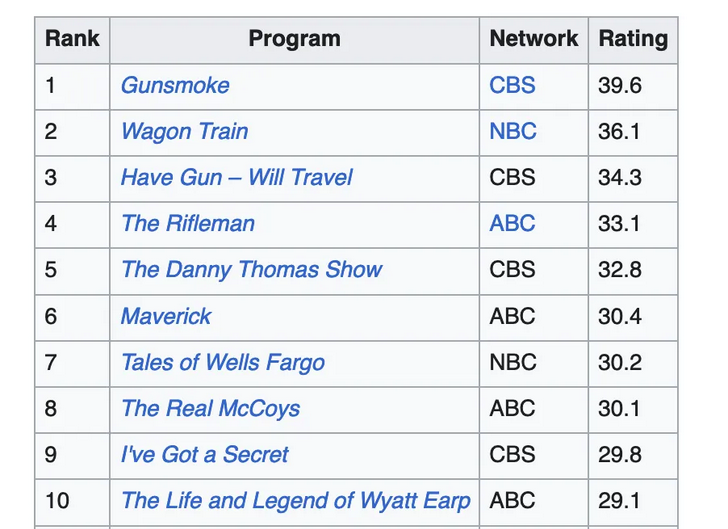
I hated cowboys when I was a youngster. Not real cowboys — I never met a single gunslinger, cowpoke, or desperado in in my urban neighborhood. My loathing was reserved for cowboys on TV.
And they were everywhere.
At one point, eight of the top ten shows on the flickering tube were westerns. And it got worse from there — Hollywood kept churning out more and more cowboy movies and TV series. I tried to avoid them, as did many of my buddies, but it was like dodging bullets in Dodge. There was nowhere to hide.
That’s because our parents loved these simple stories of frontier justice. They couldn’t get enough of them. And when they weren’t watching them on TV, they dragged us off to movie theaters to see The Magnificent Seven (128 minutes), The Alamo (138 minutes) or How the West Was Won (an excruciating 164 minutes).
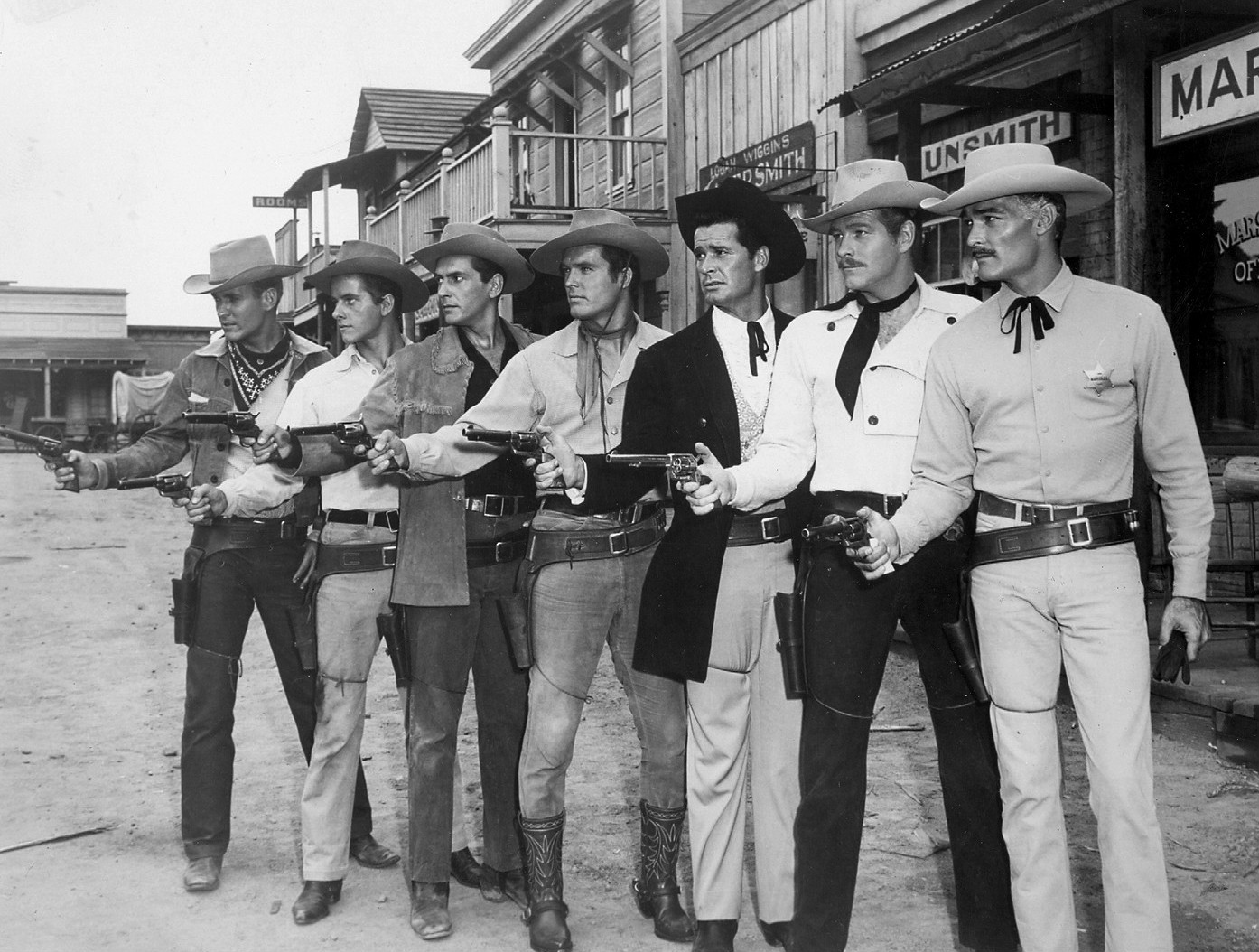
In 1959, Warner Bros posed some of their TV cowboy stars in a single photo (Source)
[…]
Many aspects of these films still put me off. I struggle with the clichés and tired formulas. But I’ve gradually acquired an affection for the genre — or maybe an affection for the audiences of an earlier day who could put such trust and faith in a sheriff or US marshal or gunslinger for hire.
Do any of us have that kind of faith in any authority figure nowadays? I doubt it. But I wish we could. And that’s impressed powerfully on my mind when I see Gary Cooper take on outlaws in the deserted western street of High Noon. Or James Stewart confront the dangerous Liberty Valance. Or John Wayne battle with a gang of desperadoes in Rio Bravo.
So forget all the shootouts and cattle drives and fancy roping. The real foundation of the western genre was moral authority. And Hollywood never let you forget it — that’s why heroes wore white hats and villains dressed in black.
The audience didn’t even have to think about it.
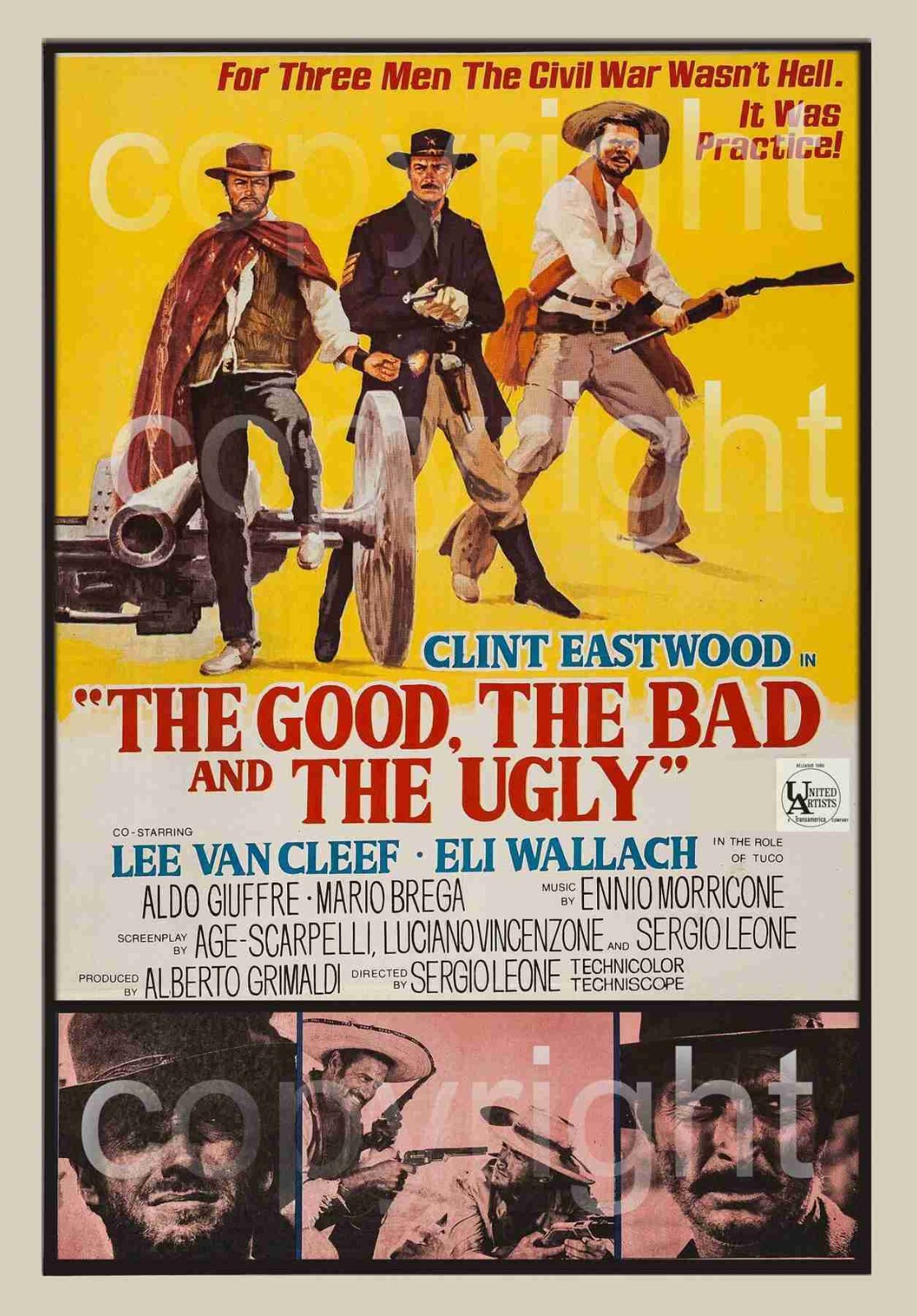
[…]Because that’s exactly what happened to the western. Just consider the unsettling film The Good, the Bad and the Ugly — which came out around the time the western genre died. Despite the movie’s title, it’s hard to identify any character in this film as good — instead they merely differ in their degrees of badness and ugliness.
And the same is true of The Wild Bunch or Once Upon a Time in the West and so many other films from that era. There are no heroes on display here, only various pathways into nihilism.
So long John Wayne. Hello Friedrich Nietzsche.
But this made perfect sense. The entire US of A was traumatized by the Vietnam War, and then Watergate — along with assassinations, riots, sex, drugs, and rock & roll. The moral sureness of the Eisenhower years, along with the complacent righteousness of so much of the public started to erode. At first it happened slowly, and then rapidly.
The classic western could not survive this.
Comments Off on The rise and fall of the “Western” on TV and in movies


