
Quotulatiousness

August 7, 2026

Blood Dawn by Hans van de Ven

Filed under: Books, Britain, China, History, India, Japan, Military, WW2 — Tags: , , , — Nicholas @ 05:00

On his Substack, Dr. Robert Lyman reviews a new book on the Second World War in Asia by Hans van de Ven:
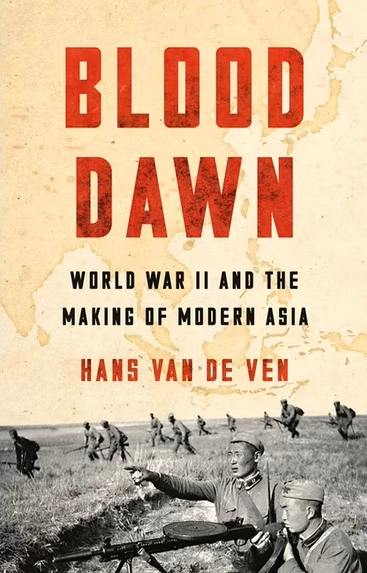
I really wanted to enjoy this book. The enthusiastic endorsements from Rana Mitter, Antony Beevor and Richard Overy raised my expectations considerably. Yet by page eight of Blood Dawn I felt as uncomfortable as the proverbial curate confronted with a rotten egg.

The author aims to provide a narrative that “contributes to a gradual shift in our understanding of the significance of World War II”. This is admirable. A more Asian-centred interpretation of the conflict is certainly needed, as the war is still too often viewed through a Eurocentric or North Atlantic lens. Historians such as Rana Mitter, Jonathan Fennell and Richard Overy have already helped redress this imbalance. It is unquestionably true that the conflict began with Japanese aggression in China as early as 1931 and that the war both began and ended in Asia.

The problem is that the book insists that the central dynamic of modern Asian history is a nationalist struggle to escape imperialism and colonialism. While both undeniably shaped Asia, it is a considerable stretch to explain the region’s political development primarily through resistance to empire. The author correctly notes that many Asian political movements saw the war as an opportunity to cast off colonial rule, but he greatly overstates their role in determining the war’s outcome.

Consequently, the analysis neglects the broader dynamics of power – local, regional and imperial – that shaped Asia before, during and after the war. The author assumes that modern Asia is the product of “Asian peoples’ continuing struggle to overcome the legacies of empire”. That seems reductive. A more convincing interpretation would describe modern Asia to be the result of a power-based confrontation among declining powers such as Britain, France and the Netherlands, a rising Japan, a developing China, and the emerging superpowers whose ideologies would shape postwar Asia: the United States and the Soviet Union. The war was principally caused by one rising empire, Japan, seeking to assert its dominance regionally and to replace existing empires.

As a result, some empires disappeared, others expanded, and many colonial territories gained independence as competing political elites seized opportunities created by wartime upheaval. Where those struggles could not be resolved peacefully, civil war followed. One may call this nationalism or self-determination, but it was power politics nonetheless.

In the postwar period, Asians were often less concerned with abolishing imperial legacies than with creating new centres of power controlled by local elites. Since 1945, Asia has been shaped by competing powers, some imperial in nature, such as China, the Soviet Union/Russia and the United States, and others nationalist and local.

A similar lack of nuance appears in the treatment of imperialism. British imperialism is lumped together with that of France and the Netherlands, with little appreciation for their differences. British involvement in 19th-century China is presented primarily as the cause of China’s problems rather than as part of a broader interaction with a declining and dysfunctional Qing polity. Imperialism was certainly influential, but so were domestic developments, including China’s internal sclerosis and Japan’s response to modernity, which produced its own imperial ambitions in China, Korea, Manchuria and the Pacific.

The author’s ideological predispositions are impossible to miss, and the book frequently descends into crude Anglophobia. We are told, for instance, that “British elites, who liked (and like) to think of themselves as natural and gifted rulers, found a new outlet for their yearning to govern India”. Such statements are simplistic, if not puerile. Similarly, discussing the collapse of the American-British-Dutch-Australia Command (ABDACOM) in 1942, the author remarks that “the Dutch were abandoned to their fate. Retreat is an underappreciated military skill, and the British were practiced masters of it, as they had shown at Dunkirk”. This is the sort of cheap point-scoring that would weaken an undergraduate essay, yet here it appears in a supposedly serious work of history.

The treatment of India is particularly problematic. The narrative focuses heavily on the Indian National Congress and consequently overlooks the diversity and complexity of the independence movement. There is little recognition that what Congress often described as British obstruction was, in part, a debate within Britain (especially the Conservative Party) about the form an independent India should take. The same debate also took place within Indian circles considering the subject.

During the 1920s and 1930s, the central political question in India was often not whether independence would occur but what form it would take and, crucially, who would benefit from it. The Quit India movement of 1942 followed the Cripps Mission, which had already offered India Dominion status after the war. Congress sought immediate separation, but many of its leaders privately supported the Allied war effort, believing correctly that victory would hasten independence. One could even argue that Congress’s greatest unintended achievement was not independence but the partition and communal violence that accompanied it. The book fails to engage adequately with these complexities.


Brexit plus ten

Filed under: Britain, Economics, Europe, Government, Media, Politics — Tags: , , , — Nicholas @ 04:00

Mark Nayler looks at the state of Britain ten years after the historic vote to leave the European Union. He notes that there appears to be a bit of buyer’s remorse among those who voted to leave the EU, although I would note that the political leadership, both Conservative and Labour, almost all did their level best to sabotage any positive results (although the “Boriswave” of immigrants would have swamped even a substantial economic boom all by itself).

In the run-up to the UK’s referendum on EU membership in June 2016, extravagant claims were made by both the Remain and Leave campaigns. Leaving the EU, the so-called Remainers warned, would propel the UK into recession and mass unemployment. Brexiteers, as they were dubbed, countered with promises of enhanced sovereignty, tighter borders, and liberation from Brussels’s stifling bureaucracy. The latter won the Brexit vote (as it came to be known) by 52% to 48%. But just over a decade on from that historic decision — and six and a half years since the UK officially left the bloc — it’s less clear whether they also won the argument.

This is in large part because of geopolitical turmoil since the vote. Throughout the last decade, there has been a global pandemic, Russia has launched a full-scale invasion of Ukraine (which, in turn, caused an energy crisis across Europe), and Donald Trump has waged a series of tariff wars across the world. The difficulty of disentangling the effects of these events on the UK economy from those caused by Brexit is formidable. One analyst has even said that “we will never know precisely what the impacts of Brexit were”.

Overall, however, the sweeping transformations predicted by both Brexiteers and Remainers — positive in the former case, negative in the latter — have not occurred. The actual changes have been less dramatic, more gradual, and more mixed than either side forecast. One also has to factor in the UK’s lack of a stable leadership since the vote: when Labor’s Andy Burnham took over from Keir Starmer on July 20, he became the UK’s 7th prime minister in 10 years. This, perhaps, has so far prevented the theoretical autonomy now possessed by the UK from being fully realized. According to a poll conducted in June, 57% of Britons now believe that it was a mistake to leave the EU — meaning there are a lot of dissatisfied Brexiteers out there.

Remainers forecast economic ruin for the UK if it chose to leave the EU. According to the then-Chancellor of the Exchequer George Osborne, “A vote to leave would represent an immediate and profound shock to our economy [and] that shock would push our economy into a recession”. A recession failed to materialize, although the pound suffered its biggest-ever one-day drop on June 24, 2016, the day after the vote, falling 10% against the dollar and 7% against the euro (it still hasn’t returned to its pre-Brexit values against either currency, although Trump’s tariff wars and the pandemic are also factors here). That said, researchers broadly agree that Britain’s economy has contracted due to Brexit. According to a 2025 paper for the US National Bureau of Economic Research, UK GDP per capita is 6–8% lower than it would have been had the UK remained in the EU. Investment is down by 12–13%, employment by 3–4%, and productivity has been reduced by about 4%, according to its authors.

Immigration was a major theme of the Leave campaign. The UK Independence Party’s widely criticized poster showed a large group of Syrian refugees at the Croatia–Slovenia border in 2015, next to a massive slogan reading “Breaking Point” — and, underneath it, in smaller letters, “The EU has failed us all”. The center-right party was playing to concerns about a surge in migration over the decade and a half preceding the referendum, triggered by EU enlargements in 2004,when ten new countries joined, and in 2007. In 2000, migration to the UK from other EU countries stood at 6,000, but by 2015 it had risen to 330,000. In 2015 and 2016 alone, more than a million migrants arrived in Britain. According to a poll conducted on the day of the referendum, 33% of Leave voters said the main reason for their decision was a belief that leaving the EU “offered the best chance for the UK to regain control over immigration and its own borders”. It seems the poster had done its job.

The composition of Britain’s migrant population has changed radically since Brexit, with an increase in non-EU migration more than compensating for the reduction in arrivals from the EU. But immigration has not decreased. In fact, the UK has witnessed record levels of immigration over the last decade. In the year ending March 2023, just over three years after Britain’s withdrawal from the bloc, net migration peaked at 944,000.

Microsoft has zero incentive or desire to fix Windows

Filed under: Business, Media, Technology — Tags: , , , , — Nicholas @ 03:00

As ESR points out, Microsoft has a long history of not fixing issues that anger users, so Windows 11 isn’t going away and it isn’t getting fixed (in ways that users demand, anyway):

Microsoft will never fix Windows, because the features that enrage users in Windows 11 are exactly the ones that generate recurring revenue and market control. That is exactly *why* they enrage users!

Yes, you’ll get reversals of some idiotic user interface decisions. You’ll get some speed tweaks. These will be loudly hyped in hopes that they distract you from what you’ll never get.

Don’t take my word for this, look at what Microsoft is hyping as fixes in their reform program and Windows 12. Do they say a word about no longer requiring a Microsoft account to do a local installation? Or about removing the repeating nag prompts for OneDrive? Do they make any promises to end the advertising spam?

No. And they won’t. Because that’s where the money is. Windows now exists to broker your eyeballs to third parties and upsell you into Microsoft subscription services.

I’ve been warning anybody who would listen for 30 years that when you install closed-source software you’re accepting a power asymmetry with the vendor. All of their incentives say they should use the control you grant them to take more control. Induce more dependency. Lock you in.

Microsoft has been on this path for a very long time. “DOS isn’t done until Lotus won’t run!”

You might think these tendencies would be restrained by their fear that when they increase the pain level above some threshold they can’t predict in advance, a critically large percentage of their userbase will pay the aggravation cost to escape their clutches. There are two reasons this won’t happen, one general and one specific to Microsoft.

The general problem is that corporations differentially respond to market incentives according to how easily they can be measured. Revenue from cloud services and the adtech vampires is a strong, visible signal; exit by pissed off users creates multiple signals that are diffuse and easy to misinterpret.

The Microsoft specific problem is Azure — which, ironically, mostly runs Linux instances. Microsoft now makes most of its money from Azure, which reduces its incentives to care about pissed-off desktop Windows customers bailing out.

Indeed, if I were a cold-blooded Microsoft strategic planner, I might be tempted to deliberately burn up the desktop business for short-term revenue, knowing that that’s not where my long-term fortress is. I’m not saying they’re actually doing that, but from outside the difference between this move and an over-focus on measurable revenue streams leading to accidental destruction is difficult to make and probably not very informative even if you could.

The bottom line is that it’s just not going to get any better. Ever. In fact, bailing out is doomed to get more painful over time. The more process habits you form around Windows, the harder the dependency gets to break.

The conclusion is obvious. Get out now. A lot of major tech influencers have noticed over the last 18 months that after decades of sour jokes about the year of the Linux desktop, Linux is finally ready for you. It’s time.

The History of Gumbo in New Orleans

Filed under: Food, History, USA — Tags: , , , — Nicholas @ 02:00

Tasting History with Max Miller
Published 10 Feb 2026

Shrimp and crab gumbo with beef and ham hock served with rice

City/Region: New Orleans
Time Period: 1885

New Orleans is one of my favorite food cities. Gumbo, a rich, thick soup or stew (depending on who you’re talking to), is an embodiment of the many cultures that have lived there. Ingredients and techniques from Native Americans, Africans, French, Spanish, and Acadian roots, just to name a few, have a place in gumbo.

While this is a relatively simple dish, it is absolutely packed with flavor. I was blown away by how a handful of ingredients, cooked down over time, came together to make such a delicious dish. Go to New Orleans and try one of the many versions of gumbo, and in the meantime, make this historical version that is so, so good.

    Gombo With Crabs, or Shrimp
    To a pound of beef add half a pound knuckle of ham; chop up both in inch pieces and fry them brown in two tablespoons of boiling lard; add to them four large crabs cut up, or a pound of peeled shrimps, or both if desired; cut into this four dozen small okra pods, one large onion, a little red pepper, and salt to taste. Let all simmer on a slow fire for about twenty minutes; then fill up with warm water, enough to cover the contents two inches deep. Let this boil for two hours. If it becomes too thick, add as much water as required. If preferred, a chicken can be used instead of beef.
    La Cuisine Creole compiled by Lafcadio Hearn, 1885

(more…)

QotD: A provisional taxonomy of “stupid smart guys”

Filed under: Books, Media, Quotations, USA — Tags: , , , — Nicholas @ 01:00

The low IQ: I know some of y’all don’t like [Julian] Jaynes [author of The Origin of Consciousness in the Breakdown of the Bicameral Mind], but one of the big reasons I like Jaynes is that he really brings home just how much of our behavior is unconscious. Including quite complex behavior, including stuff that we have to believe is the product of deep thought — he cites the “three B’s” his physicist friend told him about. Those are Bed, Bathroom, and Bus, which is where big important ideas seem to just come to them unbidden. You may not agree with where Jaynes goes with that, but we all have experienced something similar.

If we assume this is a universal mental process, I suggest, then saying someone has a low-normal IQ does not mean he’s always going to do stupid things. He has those three-B flashes too. It might take a while for him to cotton to something that seems obvious, but cotton he will, in three-B fashion.

Moreover, Jaynes is good on the complexity of unconscious tasks. The mechanical parts of driving, once learned, are completely unconscious. Try teaching someone to drive and you’ll see it right away. You’ll find yourself literally side-seat driving — your foot pushing down on an imaginary brake, unconsciously. And you never really forget those unconscious patterns, either. You may not have ridden a bike in 30 years, but you could go out and do it right now. Same way with swimming, or the manual of arms — if you’ve been through Basic, a guy with the proper tone of voice can have you twirling around like a marionette, even if you got out of uniform decades ago.

The actual low IQ guys might be the most dangerous cogs in the machine.

The Dunning-Krugerrand. That’s Larry Correia’s phrase, and it’s great. This is the person who believes he’s way smarter and more competent than he actually is. Which on the one hand, they all do. But on the other hand, there are levels above D-K, so please hold fire for now.

The Artiste. It’s been my great … fortune, actually, to have been around a lot of Media people in my youth. I dated a gal who did production work for one of the big tv news programs in a fairly large city, so I saw the video side of it, at least, from close range. The on-camera bobbleheads are all Ron Burgundy, of course, but the production people are usually quite bright … but in a very odd way. They have what I came to think of as “the artist’s eye”. They naturally see everything in terms of camera angles and visual presentation, and training develops this to a very high degree.

This leads to wildly divergent takes on things. You or I see the police approaching a stopped car with their guns drawn, or firemen pulling up in front of a burning building, and we think something like “Damn, crime is out of control!” or “I hope everyone’s ok.” News people — video people, at least — think “What a shot!” They frame the visuals first, then start processing the propositional content … if they ever do. The longer they work in “news”, the more the propositional content — “the cops are arresting a bad guy”; “there are real people in real danger in that burning building” — drops away.

Same thing, I imagine, with the folks on the verbal end. They have a novelist’s sense of pace, structure, and so on. Is what they’re writing true? Of course not! At one point about 30 years ago they felt the need to justify this, and created a whole new category of writing: “creative nonfiction“, aka lies, aka “the news”. The “creative nonfiction” people will tell you, in Wiki’s words, that it “uses literary styles and techniques to create factually accurate narratives”. Emphasis mine, because like the cameraman who ends up exclusively focusing on the shot and never thinks about the life behind the shot, so the writer of “creative nonfiction” gets caught up in the creative part, and just kinda forgets the “nonfiction” part.

Medicalization. Not a category of people, but a technique. We say smart people tend to be spergy, and stupid smart people tend to be really spergy, but that’s mistaking effect for cause. They’re not very good at reading people, and have no social savvy, but that’s because they don’t practice — because they don’t need to practice. They medicalize their deficiencies. Instead of acknowledging a weakness in their game, they attribute it to a pathology.

Severian, “The Stupid Smart Guy”, Founding Questions, 2022-07-13.

Powered by WordPress



