Quotulatiousness

August 13, 2026

A minimum 12-year sentence

Filed under: Cancon, Education — Tags: , , , — Nicholas @ 05:00

It’ll probably be no surprise to anyone who’s met me, but I was a terrible student in school. While I quite enjoyed learning (about some things, anyway), I hated the environment where that learning was supposed to be taking place. I did well enough in primary and middle school, but I dropped out of high school and finished my diploma through correspondence. I have a great deal of sympathy for those kids who don’t fit into the institutional framework, as I certainly didn’t feel I fit in during my sentence. (It’s often worse for boys, as it’s more difficult for boys to sit still and stay quiet, and teachers readily interpret distraction and fidgeting as something needing medical intervention rather than signs of normal human development for half the species.) At Without Diminishment, Sam Dagres considers the plight of the vast majority of children locked in to that minimum 12-year incarceration:
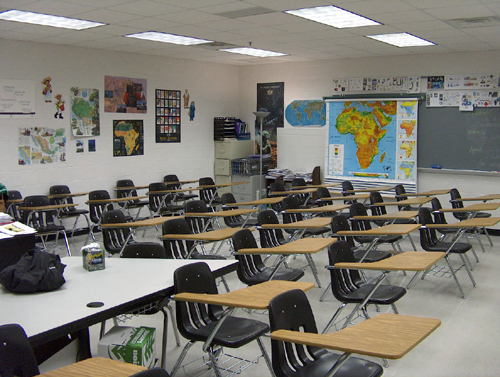
You’re sitting there, one eye on the clock, eagerly waiting for the bell to ring. How you crave the chime of that sweet-sounding bell, a ring marking the start of your allotted outdoor time. You rush outside, feel the sun on your skin, eat a snack reminding you of a world that exists on the other side of the fence. But for most of the day, you are sat, effectively immobile for 8 hours. Stillness is the highest virtue, and any violation leads to punishment and an ADHD diagnosis. Day in and day out, you wait for the last bell.

Most of us will have experienced this kind of imprisonment, befitting what crime, you may wonder? We are punished for the crime of being born into a society where all forms of care are by default institutional, a society whose “child care policy is adult policy, not early childhood policy”, as Katharine B. Stevens noted.

According to Statistics Canada, approximately 5.5 million students are enrolled in K–12 public schools, dwarfing the 67,000 who are home-schooled. Nearly 99 per cent of all school-aged children in Canada are currently institutionalised.

In 2025, 58 per cent of children aged 0 to 5 were in childcare facilities, representing approximately 1.4 million children. One-quarter of those were aged under 1.

As someone who attended public schools all my life, I never thought of it as anything but natural. But as I reach a point in my life where family formation is uppermost in my mind, I wonder whose interests are prioritised whenever I walk by a school and hear, not see, kids playing on the other side of a tall brick wall.

We do not leave it to children to decide very much for themselves, which means their interests are ours to safeguard. Luckily, the research exists: institutional, non-familial care is not what is best for most of our young.

The incomparable Institute for Family Studies recently enumerated the relevant studies, one of which is the NICHD Study of Early Child Care and Youth Development, which followed 1,000 children from infancy through adulthood and found that “children who had spent at least 30 hours per week in those settings beginning in infancy had three times the rate of social-emotional difficulties, including lower social competence, higher externalising behavior, and more conflict with teachers and peers. These effects persisted through elementary school, and by adolescence appeared as impulsivity, risk-taking, and substance use.”

Similarly, studies of Quebec’s universal childcare system have shown that the programme “has been associated with increased anxiety, aggression, hyperactivity, worse parent-child relationships, and lower self-reported life satisfaction in adolescence. By young adulthood, the negative effects extended to a 22% increase in criminal conviction rates.”

The foundations of our emotional and cognitive lives are formed early on while we bond with caregivers, and early institutionalisation disrupts that. The emotional downsides resulting from the systematic separation between the young children and their mothers are not broadly grasped, since the opposite is widely believed. When I share my musings about home-schooling with my friends, without fail, I receive the unanimous response: “Aren’t you worried they’ll turn out weird?” To that I respond, “Have you been paying attention?”

We are living through an era of weird, surrounded by friendless, non-eye-contact-making, socially anxious individuals. Nowadays, most schools encourage gender exploration and, through intense anti-bullying campaigns, demand a near-total embrace of any and all quirks. Not to mention that these tiny balls of anxiety, for some reason, require Vietnam-War-vet-levels of pharmacological intervention. I had someone tell me, “In my current role, I feel more like a pharmacist than a teacher”.

We can attribute the explosion of weirdness to a whole host of factors, notably digital devices and their role in mass social atrophy, but the forced dislocation of young children from their families is the foundation for a lifetime of alienation.
German democracy from the POV of “Our Democracy Enjoyers”

Filed under: Germany, Government, History, Media, Politics — Tags: , , , , , , , — Nicholas @ 04:00

If you’ve been wondering about the state of democracy in Germany, your first move should be to check the latest update from eugyppius:

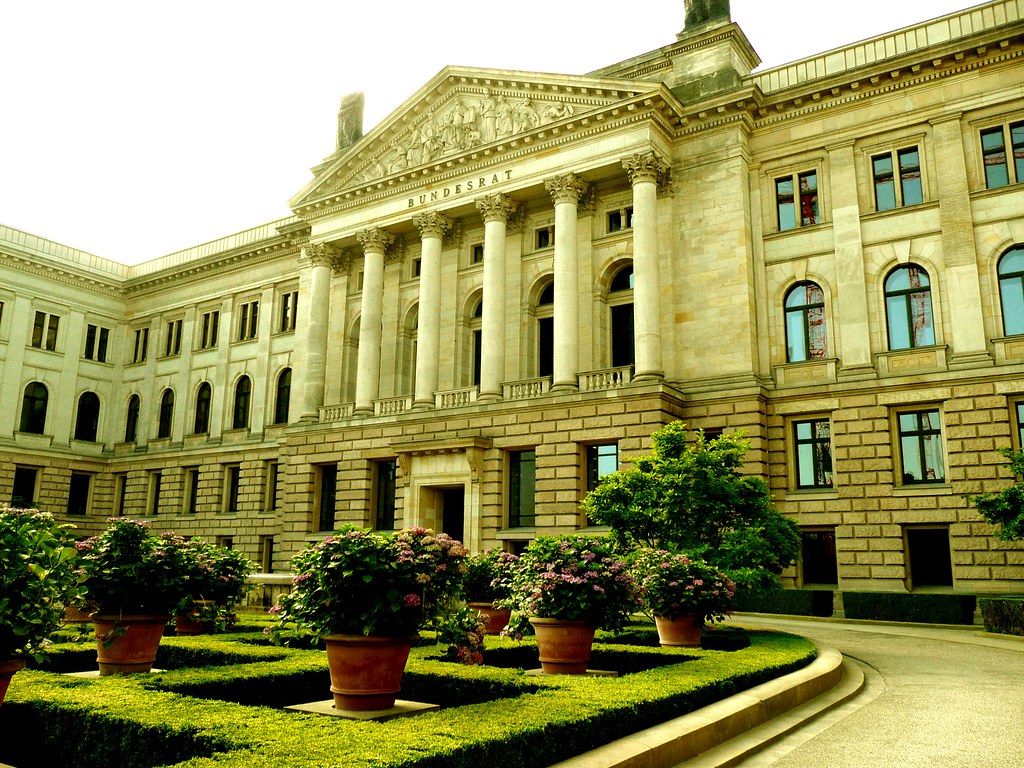
Bundesrat of Germany” by photosteve101 is licensed under CC BY 2.0 .

In civics class, parties appear as little more than informal election-winning cooperatives. Now and again “the sovereign” – that is to say, “the people” – may grant one or various parties a limited right to govern, but the state is held to be in some sense public property. Politicians and their parties are at best its temporary custodians.1

Our Democracy Enjoyers particularly deplore state systems in which parties have captured the state – a special political form we might call the “party state”. Germany became a party state after 1933, when the NSDAP seized the entire state apparatus and outlawed all competitors. Contemporary states owned and operated by single parties include China, Cuba and North Korea. Our Democracy Enjoyers hate all single-party states because they are not democratic.

Party states need not however be single-party states. While the Socialist Unity Party (SED) effectively owned the DDR, they tolerated an array of subservient bloc parties from the very beginning. None of these parties ever had any chance of governing; they functioned only as extensions or alternative faces of the SED itself. These parties included gutted, early opposition parties like the CDU (Ost) and the Liberal Democratic Party (LDPD), but also SED concoctions like the Democratic Farmers’ Party (DBD) and the cynically post-Nazi National Democratic Party (NDPD). The SED cultivated these parties both as a democratic figleaf and also to integrate “non-proletarian” (particularly Christian) elements within the communist system. The precedent of the DDR shows that the party state can assume various innovative forms and that multiple parties may be useful for political, propaganda or other purposes.

My thesis of the Federal Republic is that it is also a party state. The only difference between the DDR and the BRD is that, in the BRD, several different parties share ownership of the state among themselves.

The three anecdotes at the head of this piece reveal this party ownership in incidental but telling ways. They show, for example, how a substantial portion of the police consider their oath of office to preclude loyalty to a democratically elected opposition party. Should the voters go rogue and install any such party at the state level, a prominent police union functionary openly hopes for insurrection and federal intervention. Periodically voiced ambitions and campaigns to cleanse the civil service of AfD elements come from a similar place. The ownership parties cannot countenance opposition creep into the bureaucracy, because they correctly regard the bureaucracy as their property.

The hysteria surrounding a thwarted SPD nomination to the Federal Constitutional Court reveals that the parties that own the BRD extend their proprietary interests not only to the executive and legislative branches, but also to the allegedly independent judiciary. The ruling parties have divided the prerogative to nominate judicial candidates informally among themselves. This prerogative is so jealously guarded that a leading Union politician cited a single thwarted SPD nomination to make the case for mass censorship and regulation of “alternative” media.

And while it is a minor incident that hardly matters, the dispute over the Otto-Wels-Saal shows that the proprietary feelings of the state parties extend to physical architecture, even specific rooms and buildings, which the parties of the party state regard not as public property but as their very own chambers – to name, possess and use as they see fit.

While progressive liberal political systems are all oligarchies, and this because of the Iron Law of Oligarchy, they are not all party states – far from it. The party state is a clunky and outmoded political system that historically arose out of accident or necessity, generally following a revolution perpetrated by a single party or political movement in a moment of particular ascendance. The Federal Republic was founded as a party state in 1949, mainly to foreclose the possibility that subversive National Socialist or communist elements might return to influence via democratic processes. This is the basic meaning of German “defensive democracy”, which denotes an array of legal or constitutional tools for the parties that own the state to fend off or criminalise competitors.


  1. Now, we know this is mostly nonsense. “The people” are an abstraction and as such they cannot grant anybody anything. All political systems ultimately redound to the control of more or less stable oligarchies. “Democracy” describes little more than a set of procedures via which the these oligarchies (or their representatives) assume power and enact their will.

“Defund the police!” from around day five onwards

Filed under: Government, Law, Politics, USA — Tags: , , , , , , — Nicholas @ 03:00

A grim joke I’ve seen many times on various social media sites features the kind of people who’d agree to defund the police, but not because they want to take it easy on criminals … but because if there are no police enforcing the laws, there’d be no police limiting “bag counts”. With no police to make arrests (and likely no jails or courts to provide some kind of due process), the victims of crime will either surrender to the perps, or get as fully armed as they can manage. You can’t maintain a civil society if everyone has to take on the policing role for themselves everywhere and at all times.

“Defund the Police” by Taymaz Valley – CC BY 2.0

I always laughed at “defunding the police”, because I know how that would go. The people who advocate it are incapable of thinking beyond first-order consequences.

So, let’s suppose major American city X fully defunds its police. How will this play out?

For a short time, criminals will have a field day. They will shoplift, rob, mug, and invade homes to their hearts’ content. Because who’s going to arrest them?

But then their victims are going to arm up. Homeowners, shopkeepers, and ordinary citizens will start open-carrying and shooting criminals. Because who’s going to arrest them?

So far, so good.

Now, here’s the part that isn’t obvious. 60% of index crimes are committed by Black people. Once the shooting phase starts, Black criminals are going to form gangs (if they haven’t already) so they can overwhelm individual targets.

Once Black gang predation becomes routine, the rational strategy for whites and Hispanics and Asians becomes to simply start gunning down groups of multiple Blacks on sight. Because who’s going to arrest them?

The same dynamic applies to any minority with a higher criminal propensity than white people. Which is basically all of them except for Northeast Asians.

Innocents will not be spared. If there are any left — it’s a statistical fact, for, example, that Black women have a higher rate of criminal violence than white men.

The eventual result would be a white nationalist’s wet dream. Minorities dead or keeping very, very quiet in order not to get shot. They might be able to hold mono-ethnic enclaves in the short term, but venturing outside them would be asking for death.

I’m pretty sure this is not what advocates of defunding the police want to happen. But these are the same people who were all gung-ho for police bodycams, and we all know how that turned out.

Update: You can always count on the Babylon Bee to provide timely and informative context for any issues we face in today’s complex world – What If We Abolished Prisons and Defunded the Police?

The Ancient Greeks 04 – The Persian Invasion 1 – Xerxes Decides

Filed under: Greece, History, Middle East, Military — Tags: , , , , — Nicholas @ 02:00

seangabb
Published 23 Mar 2026

Greece: A Brief History, c.700 BC – 500 AD

What drove the greatest invasion force of the ancient world to march against Greece?

In this lecture, we move from the aftermath of the Battle of Marathon to the momentous decision of King Xerxes of Persia to launch a full-scale invasion of mainland Greece in 480 BC. We examine the political, strategic, and psychological factors behind the Persian decision, including the legacy of Darius, the revolt in Egypt, and the internal debates within the Persian court.

Drawing on Herodotus and other ancient sources, this video explores:

– The consequences of Marathon for both Persia and Greece
– Xerxes’ consolidation of power
– The famous debate at the Persian court
– The role of honour, revenge, and imperial ideology

This is the essential starting point for understanding how a regional conflict escalated into one of the defining wars of the ancient world.

Part of a full lecture series on the Persian Wars.

QotD: Marx was right about “class consciousness”

Filed under: Economics, History, Quotations, Religion — Tags: , , , , , , — Nicholas @ 01:00

Marx thought the Proletariat would develop class consciousness — that is, solidarity based on their mutual exploitation by the “capitalists” and “bourgeoisie” — and from that all else would flow. Lenin modified that, arguing that The Proletariat would never achieve class consciousness without a “Vanguard Party”. That’s why it’s Marxism-Leninism to this day. Lenin was closer to correct, but with this crucial difference: Instead of leading the Laboring Masses to Socialism, the Vanguard Party has decided “hey fuck the Laboring Masses, we’re getting ours“.

Marx called religion “the opiate of the masses” for a reason — by dulling their pain, it prevented them from realizing their true class position, thus achieving class consciousness, thus sparking The Revolution. What religion really does, of course, is satisfy a deep yearning in the human soul. There is more to life than shit, shoes, and bread. Karl Marx didn’t want to hear that, because his religious yearning was satisfied by his substitute god, Dialectical Materialism, and the half-assed (but very real) ceremonial it produced. Again, there’s a reason every Leftwinger practically from the French Revolution looked like [this]

I don’t know how you say “fake and gay” in Russian, but every single thing in that photograph is fake and gay. A pose. An affectation. And as with their look, so with their behavior. Leftwingers are, and always have been, famously boorish. They have no idea how longshoremen actually act, but they sure think they know, and so that’s how they act — like the worst caricature of a crude, illiterate, drunken longshoreman.

(I don’t know any longshoremen either, but I do know some folks who make a living from the sweat of their brows, and they’d turn Lenin’s head around for him if he came to their neighborhood and started acting like that. The Laboring Masses might indeed be “rude mechanicals” in Shakespeare’s sense — meaning, without too much formal education — but they’re surely not rude in the behavioral sense, because in their world, running your mouth gets you punched in it).

Dressing and acting like that is, quite literally, a religious ceremony for them … and ceremonial can only take place in a designated space, a liminal space that the community respects. A priest can indeed hold a mass on a street corner, but only if the passersby have enough residual respect for the institution of religion not to beat and rob the worshipers while their backs are turned.

The intelligentsia never understood that consciously. They sure as hell understood it unconsciously, though, which is why they immediately self-segregated — getting “sent down to the countryside, to reconnect with the laboring masses” was one of the worst punishments Mao’s boys could dish out to one of their mandarins, and again, there’s a reason for that. The upshot is, the intelligentsia, the Apparat, the Cloud People, whatever you want to call them, are the only ones who developed “class consciousness” in the Marxist-Leninist revolutionary sense …

… and their class consciousness is entirely oppositional. They are not us. That’s their sole criterion for virtue. Whatever we like, they dislike. Whatever we do, they must not do; and whatever we eschew, they must embrace.

Severian, “On Losing the Cold War”, Founding Questions, 2022-07-02.

Powered by WordPress