Quotulatiousness

August 26, 2026

Octavian “found Rome a city of bricks and left it a city of marble”

Filed under: Europe, History, Media — Tags: , , , , , — Nicholas @ 06:00

Octavian, if you’re new around here, is far better known as Augustus, the founder of the Principate. Over at SteynOnline, Tal Bachman continues his interesting series by touching on what the Roman Republic looked like to Octavian at the end of the civil wars:
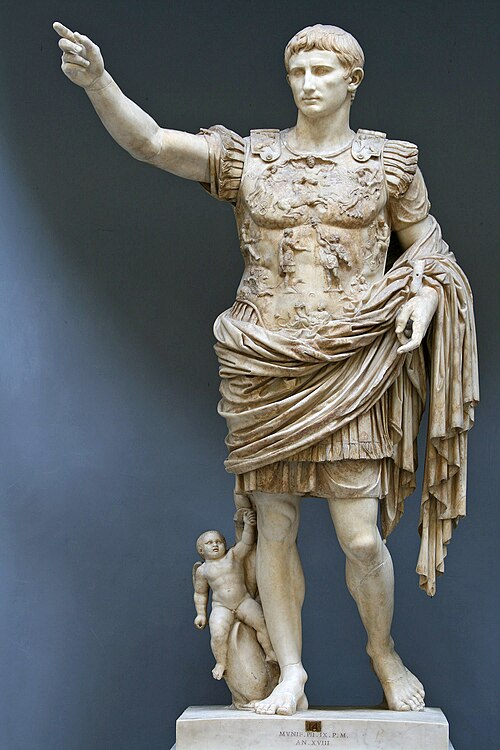
Augustus of Prima Porta
Currently in the Chiaramonti Museum of the Vatican Museums (image from Wikimedia Commons).

So as Octavian thought about his grand plans for renewing Rome, he naturally thought of Virgil. He didn’t need anyone like Horace telling everyone to give up. He needed positivity. He needed the guy who might even have been prophesying about him as Rome’s savior (Octavian was only 23 when Virgil wrote about Rome’s boy-rescuer).

Besides, Virgil’s prophecy had so far proved quite correct: the oft-heralded imminent demise of Rome hadn’t arrived yet. Maybe it never would. In fact, for the first time in over a century, things were looking up. And they were looking up because of what had happened in the previous year and a half.

The most important thing had been Octavian’s victory over the traitor Mark Antony at the Battle of Actium, September of 31 BC. (None other than Octavian’s best friend, Marcus Agrippa, had masterminded the victory as commander of the navy. Over the years of tumult and civil war since Caesar‘s assassination, Marcus had revealed himself to be as much of a natural military genius as Octavian was a political genius).

With his victory over Antony, Octavian had demolished the last of the traitorous military contingents threatening Rome. Less than a year later, Antony and his lover, Queen Cleopatra of Egypt, committed suicide in Alexandria. Suddenly, after decades of bloodshed, the civil war had come to an end.

Or so it seemed. Octavian was too smart to count on that. After all, in politics, an end is never really an end; a beginning is never really a beginning. Each is only a connecting point in time between what has come before, and what will now come to pass. Above everything else, politics is the art of shaping those moments.

It was at just this sort of moment Octavian now stood. Finding himself the undisputed great man of Roman politics, he now controlled (in reality, if not always in law) Rome’s senate, all its provinces, its vast military, its vast resources, its bureaucracy and administration, its appointments, and the immensely valuable, recently-acquired grain powerhouse of Egypt. He also held great influence over the city’s religious activity as part of the sixteen member College of Pontiffs. Moreover, after Actium and Antony’s suicide, no internal or external threat remained. Octavian had spent years making war. Now, with every last foe vanquished, he needed to make — and preserve — peace. The question was how.

A full description of Octavian’s comprehensive answer to that question is beyond our scope here. But what we can explore briefly is how he pushed cultural, spiritual, religious, and even psychological renewal — particularly through Virgil’s Aeneid — and how translation can best communicate that to us.

On that note, it’s worth pointing out that Octavian’s intention wasn’t quite to Make Rome Great Again. It was far more ambitious: he wished to make Rome much greater than anyone had ever imagined it could be, and much greater than any other nation had ever been, or ever would be again. For this to happen, Rome, in a real way, had to start over.

For Octavian, starting over meant laying the right foundation in the right way. What was that foundation? Devout reconnection to the gods. Everything, he believed, would flow from this: peace, identity, cohesion, stability, lawful behavior, ethical behavior, contentment, prosperity, flourishing, valor, self-discipline, excellence, and more. Octavian would do what he could in politics to initiate this renewal; Virgil would do what he could in literature. Together with others in their circle, they would remind people what it meant to be truly Roman, starting with the very first Romans of all. They would tell, and re-tell, in a hundred different ways, the story of who they were, who they weren’t, where they’d come from, and what the gods wanted.

I’ve added links to my Roman Glossary for some of the names and events mentioned in the article.

“Women who see in Clancy something not just sympathetic, but martyr-esque”

Filed under: Law, Media, USA — Tags: , , , — Nicholas @ 05:00

David Dennison clearly views-with-alarmhorror the phenomenon of women publicly demonstrating their support and claiming understanding for a woman who murdered her three children:

Pink-clad supporters of Lindsay Clancy
Photo from Aged Well

A disclaimer first: NOT ALL.

The Lindsay Clancy verdict could come as early as this week. If you have no idea what that sentence meant, honestly, just stop reading and go do something else. This case is not one you want in your head if it isn’t already. Trust me.

There really aren’t many things that are more distressing than what actually happened here. My complaining about other aspects of the Clancy saga is a bit like if somebody you loved died in a terrible car wreck and I said, “It’s a shame there was so much damage to the paint”. Still, that’s what I’m going to do.

The Lindsay Clancy trial has sparked an on and offline movement of women who see in Clancy something not just sympathetic, but martyr-esque. These women get her. They see themselves in her. They feel what they know she felt, and regard her as an avatar of the unsung stress of motherhood, and the woeful lack of attention paid to women’s struggles.

You may–especially if you are among the penis-havers – be asking yourself several things about now. Perhaps things like:

  • The stress of motherhood is unsung?
  • Women’s struggles receive insufficient attention?
  • Other moms see themselves in a woman who shooed her husband out of the house so she could wrap exercise bands around the necks of her three children and slowly choke the life out of them one by one while they stared into the deranged eyes of the person who brought them into this world in the first place? Really? That’s relatable?

Yes to all three, apparently.

These women are organized too. They are showing up. Clancy has pleaded not guilty by reason of lack of criminal responsibility – or in layman’s terms, not guilty by reason of insanity. Clancy was suffering from severe postpartum psychosis, was on enough meds to stock a pharmacy, and was, per her own reports, hearing voices.

[…]

Wrong Side

What is wrong with these women defending Lindsay Clancy? I can understand a sincere belief that postpartum depression and psychosis aren’t taken seriously enough (I don’t actually think that’s true, but I can understand somebody thinking it is). But I actually cannot understand somebody looking at Clancy’s actions and thinking, “Same, girl.”

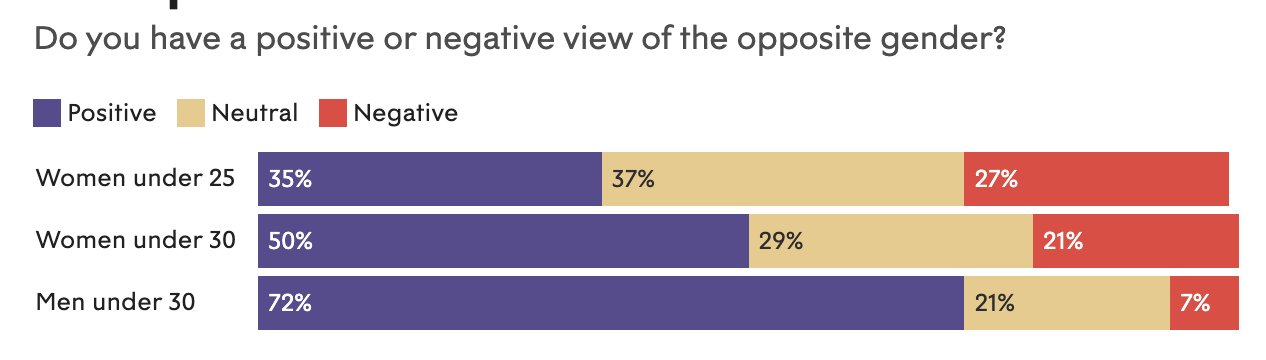
I’m not alone. We may be seeing the beginnings of a backlash to a backlash. The first backlash is the intense, unreturned dislike young women are experiencing these days for the coarser sex. A manifestation of that, I submit, is blaming the supposed inattentiveness of a man for his wife throttling his children to death.

Survey of British women done for The New Statesman.

This backlash though is one of men asking themselves, just as I did, what the fuck? Where is this tribalism coming from? What causes a person to look at Patrick Clancy, who returned home from a drug store after picking up his wife’s meds to find her sprawled on the yard, his three children strangled inside, and think, “I don’t like the look of him …?”

The Korean War Week 114 – Stalin’s Secret Plan – August 25, 1952

Filed under: China, History, Military, USA — Tags: , , , , , , , — Nicholas @ 04:00

The Korean War by Indy Neidell
Published 25 Aug 2026

Heavy rains prevent action in the field in Korea this week, so the big story worldwide is talks in Moscow between Josef Stalin and Chinese Foreign Minister Zhou Enlai. They talk about Five Year Defense Plans, artillery production, Soviet aid for the Chinese, and exactly how they see the war in Korea and what they think of the American forces.

00:00 Intro
01:09 Bunker Hill
01:51 South Korean Prisoners of War
02:44 Chinese Soviet Talks
05:06 Five Year Defense Plan
07:26 Artillery Production
11:23 Stalin and the USA …
12:52 Eisenhower and the War
16:05 Summary
16:18 Conclusion
18:29 Sign Up

Regulating away small company benefits in the EU

Cláudia Ascensão Nunes discusses yet another example of regulatory capture, as new European Union regulations will choke off business opportunities for small companies to the benefit of big companies and multinationals who can absorb the costs of the new environmental regulations:

Today, the European Commission estimates that the Single Market has increased the European Union’s GDP by 3–4% and created 3.6 million jobs since its creation. A study by Bertelsmann Stiftung estimated that integration increases European citizens’ incomes by an average of about €840 ($974) per person per year.

Yet the benefits created by this integration, and the freedom that made these benefits possible, began to come under threat on August 12, 2026, quietly and through an apparently harmless packaging regulation.

The Packaging and Packaging Waste Regulation (PPWR) will force sellers, both European and foreign, to comply with a complex set of rules that may be manageable for large brands but suffocating for small businesses.

The most problematic requirement is that sellers shipping packaged products to an EU country where they are not established must appoint a local authorized representative. That representative will act on behalf of the seller before that country’s recycling authorities. The representative must register the company in the national Extended Producer Responsibility, or EPR, system, file annual reports on the packaging the company places on that market, and charge a service fee of between €200 ($232) and €500 ($580).

The process of appointing a representative in one country is both bureaucratic and expensive. Doing so across several countries can become impractical for small sellers, who lack the scale to spread these fixed costs across a large volume of sales, especially since the PPWR does not provide a volume-based exemption.

Several businesses are already announcing the suspension of shipments to other EU countries or disabling shipping options to the EU altogether. The German company Copiaro, for example, suspended shipments to other EU member states while continuing to ship to European markets such as Switzerland, Norway, and the United Kingdom, which are outside the EU’s regulatory framework.

We are therefore returning to something resembling the old national markets, with barriers to entry.

The entire model of cross-border trade for small businesses risks being undermined in the name of environmental protection. Yet if larger companies, which produce far more packaging waste, are the ones best able to absorb these costs, we are facing a contradiction. Packaging regulations can shield large sellers from competition by smaller businesses, creating a more closed and concentrated market.

Europe may become greener by becoming poorer. European entrepreneurship is being strangled, and small business owners are paying the price.

Who Destroyed the Japanese Economy in WW2?

Filed under: History, Japan, Military, Pacific, USA, WW2 — Tags: , , , , , — Nicholas @ 02:00

Real Time History
Published 20 Mar 2026

As the war in the Pacific develops, the United States takes the fight to Japan itself – by crippling its economy, destroying its industry, and crushing civilian morale. To do this, American submarines and heavy bombers wage campaigns beneath the sea and above the clouds. And even 80 years later, there’s a fierce debate about which of these campaigns did more to bring Japan to its knees – perhaps even more than the atomic bombs.
(more…)

QotD: Putting US power generation in perspective

Filed under: Environment, Quotations, USA — Tags: , , , — Nicholas @ 01:00

A critical assumption of climate alarmism is that the ecosystem is fragile and we naughty, mighty humans can easily overwhelm it. So we were surprised to hear, at the recent Heartland Institute International Conference on Climate Change, that one single hurricane contains more energy than the US generates in a year. And not just surprised, we were skeptical. So we checked, and, by golly, it’s true and then some. As one website gushed, “any way you slice it, hurricanes release a phenomenal amount of energy. If we start by looking at just the energy generated by the winds, we find that for a typical mature hurricane, we get numbers in the range of 1.5 x 10^12 Watts or 1.3 x 10^17 Joules/day (this is according to the Atlantic Oceanographic and Meteorological Laboratory.) This is equivalent to about half of the total electrical generating capacity on the planet! For a single hurricane! But that’s not all, we’re just getting started. A hurricane also releases energy through the formation of clouds and rain (it takes energy to evaporate all that water). If we crunch the numbers for an average hurricane (1.5 cm/day of rain, circle radius of 665 km), we get a gigantic amount of energy: 6.0 x 10^14 Watts or 5.2 x 10^19 Joules/day! This is equivalent to about 200 times the total electrical generating capacity on the planet! NASA says that ‘during its life cycle a hurricane can expend as much energy as 10,000 nuclear bombs!’ And we’re just talking about average hurricanes here, not Katrina.” But sure, a few puffs from a human chimney and all those hurricanes are dancing to our Promethean tune.

John Robson, “Tidbits”, Robson on Climate Nonsense, 2026-05-24.

Powered by WordPress