Quotulatiousness

August 23, 2026

Julius Caesar’s will

Filed under: Europe, Government, History — Tags: , , , , , , — Nicholas @ 06:00

At SteynOnline, Tal Bachman continues his study on “The Art of Translation”, this time touching on the unlikely and unlooked-for rise of Caesar’s grand-nephew and eventual successor Octavian — better known to history as Caesar Augustus, the founder of the Principate:
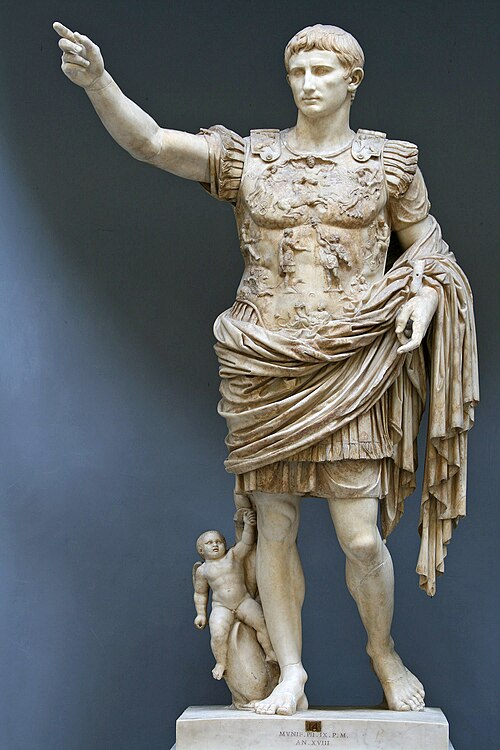
Augustus of Prima Porta
Currently in the Chiaramonti Museum of the Vatican Museums (image from Wikimedia Commons).

You’d think someone who’d just won as much power as the 32 year old Octavian would appreciate a best-selling epic poem in praise of himself. Only fourteen years earlier, in 44 BC, the then-obscure teenager still expected to live a quiet life in his hometown of Velitrae. True, he did have family connections to the political big leagues 25 miles up the road in Rome; but as things stood, a lower-key path looked a lot more likely for the frail, bookish student.

Alas, a quiet life was not to be. On Tuesday, March 15, his great-uncle, Julius Caesar — ruler of Rome — had just seated himself in the senate meeting hall when dozens of senators stabbed him to death. In the assassins’ minds, they’d done something noble: they’d protected the republic — the Roman people — from a future tyrant-king. Surely, they thought, ordinary Romans would now rise up and hail them as republican heroes.

Ordinary Romans, it turned out, thought much more highly of their favorite war-hero than the treacherous senators who’d killed him. Whatever his flaws, Caesar had at least imposed some long-overdue order on Roman life. Now that he was gone, the terrible troubles of former times would return, and probably in a form far worse than before. Shock, anger, despair, and fear filled the city.

It didn’t help that as the hours bled into the next day, it became clear the senator-assassins had no plan for what to do next. They’d eliminated the energetic, enterprising man who’d led Rome the previous five years, but the senate itself was deeply fractured, with a number of the assassins now second-guessing what they’d done. The senate wasn’t stepping up. No one was. As a result, in that moment, the city and empire had no functioning government.

Sensing the possibility of violent conflict, Caesar’s colleague Lepidus quickly ordered troops into the city to keep things stable. It worked. But a possible trigger appeared the next day in the form of Caesar’s father-in-law, Lucius Piso, who stepped forward as the custodian of Caesar’s will and informed the senate he was ready to settle Caesar’s affairs as duty demanded. The senate panicked. Not knowing what the will contained, the now-rattled group begged Piso to keep it confidential for fear its contents would provoke riots. Piso refused: Caesar was a public official, and the public deserved to know, come what may. He demanded a day be set for revealing the will.

Surveying the precarious situation, Caesar’s right-hand man, Mark Antony, called a senate meeting to figure out what to do next. In that Friday meeting, the senate and Antony agreed to let the assassins escape punishment, while still enforcing all of Caesar’s policies. This compromise, they hoped, would appease both the pro- and anti-Caesar factions, and keep Rome from convulsing in violence.

This, and much more, all happened within three days of the assassination. But what happened on the fourth day — Saturday, March 19 — would prove just about as shocking as anything else: it was on that day that Lucius Piso appeared before the senate to open up, and read aloud, the will left by his murdered son-in-law.

To put that moment in perspective, I note that by the time of his death at age 55, Julius Caesar was one of the richest men on earth. Moreover, he had no legal descendants: his daughter, Julia, had passed away at the age of 22 during childbirth, along with her child. The Egyptian queen Cleopatra claimed Caesar had fathered her son, but Caesar never felt certain the child was his, and never acknowledged him under Roman law.

In addition to all this, Caesar commanded the loyalty of tens of thousands of Roman soldiers, active and retired, along with the admiration of tens of millions of residents and citizens around the Mediterranean. Among these were many of Rome’s most influential movers and shakers.

In short, Caesar had a lot to bequeath. (This was especially true in a world in which the lifelong loyalty of others easily transferred from a deceased person to his named heir.) Surely, in the senate meeting hall that Saturday sat a number of figures who expected to receive extraordinary gifts from the man they’d served—Mark Antony in particular. Antony, after all, had fought with Caesar for years, worked side by side with him in government, and been his closest confidante and colleague.

So you can imagine the humiliation, shock, and indignation around the room as the bereaved father-in-law Lucius Piso stood reading a will which named not Antony, not Lepidus, not any of Caesar’s other comrades, but Caesar’s eighteen-year-old grand-nephew, Octavian, as his adopted legal son and heir to nearly everything he had. Octavian—whose biological father had died when he was five—would receive Caesar’s name, most of his incalculable fortune, his lands, the benefit of his status and loyalties, and the automatic approval of all those who trusted the judgment of the great-uncle who’d adopted him.

By all accounts, Octavian had no idea about any of this. Yes, he’d spent some time with his great-uncle, even visiting him during his Spanish military campaign the year before. But Caesar had kept his will entirely secret.

When Octavian — away studying in Apollonia, in present-day Albania — heard about the assassination and will a couple of weeks later, he found himself facing The Mother of All Crossroads. He could either travel to the now violent, dangerous, nearly-anarchic Rome, risking his own assassination in demanding all Caesar had left him (and accepting all the attendant obligations), or he could decline and pursue the safe, quiet life he’d always imagined for himself.

It is indeed a great curse to get everything you wished for

Filed under: Business, Education, Media, Politics, USA — Tags: , , , — Nicholas @ 05:00

I have no idea how authentic these are, but even if they were dreamed up in the 1940s by a chain-smoking ad guy trying to sell pre-printed matchbooks to Chinese restaurants, they have a distinct ring of truth to them:

  1. May you live in interesting times
  2. May you be recognized by powerful people
  3. May you get what you wish for

John C. Wright suggests that the third curse adequately explains why womens’ organizations are always so angry:

Photo from John C. Wright

Here is a comment from Twitter from a writer with the persican but cutting name of Peachy Keenan:


    Why are so many women sooo angry? They won. They got everything they wanted.

    Men have never been doing this badly, and women have never been doing this well.

    They make more, they have the majority of jobs, they are the majority of college graduates, (UCLA undergrad is 60% female), they make more money, have much lower rates of suicide, addiction, and alcoholism, and live longer.

    They won: they took over all men-only spaces, they took over the Boy Scouts, they ended men’s bathrooms, they can fly fighter planes and be in combat.

    Marriage is optional, divorce is no-fault, they win 99% of the custody battles, they can control fertility at will, and they can’t get drafted. We are all living in the female future they promised.


So many women are so angry precisely because they won.

Women are naturally submissive and self sacrificial, loving and supportive. Feminine.

The lone wolf quality of being one’s own man is lonely, self supportive, selfish and domineering. Masculine.

But the sole reward for being a lone wolf, a pioneer, a masterless man, is the promise that one day, after proving yourself, you will win the love of wife and child, and she will turn your cave or hut into a home. The reward of being an independent man, a lonely man, a rebel who plays by his own rules, is finding a wife who will love, honor, and obey.

Woman obviously cannot have that reward. Women are attracted to rebels, bad boys, wolves, winners. They do not want to be them.

Women do not want to win wives.

Woman naturally want to turn huts into homes, and make their man happy. They do not want to live in the hut, run in the rat race, fight in the war.

Women do not want to crush their enemies and drive their enemies before them and hear the lamentation of their women. That is Conan.

Women, by and large, far prefer character assassination, whisper campaigns, false friendships, as the means to undermine enemies: alive but humiliated, and forced to recant and apologize.

A womanly way to win a debate is not through facts and logic, obeying the rules of debate. That is the behavior of a sportsman, a knight in a joust. A womanly way to win a debate is by humiliating the opponent into silence, by threat, by backstabbing. Cancel culture is the perfect tool for the feminine approach.

Women as well as men would rather live in a world run by men. Men aspire to run a world with rules, with honor, with chivalry, where confrontations are direct, juries rule on evidence rather than feelings or group-loyalty, innocence is rewarded and virtue punished. Women, and womanly men, aspire to run a world as a welfare state, a nanny state, where good intentions matter more than good results, and you never get a change to confront the accuser nor answer the whispered accusations. No arguments, no debate, no discussion is allowed, because that would produce conflict, disharmony, and someone might get his feelings hurt.

We have seen in countless cases how a feminized world works: if a mother strangles her children to death, the female world defends her. If a notorious academic fraud is awarded a position far beyond his competence to serve, and commits suicide rather than face the shame of exposure, the female world defends him. Cowardly assassins shooting bankers or public speakers, third-world rape gangs, cross-dressers in woman’s sports or prisons, Mohammedan child-molesters, spotted owls, endangered whales, or anything or anyone who is or who can be shoehorned into being a victim, a sad sack, a crybaby … the female world leads the otherwise healthy and normal maternal instinct to comfort crying babies into comforting any and every monster and madness imaginable, and female fear of social disapproval does not allow her, even in her own mind, to question her master.

The End of the Battleship Era – Force Z

Filed under: Britain, History, Japan, Military, Pacific, WW2 — Tags: , , , , , — Nicholas @ 04:00

TimeGhost Cartographic and World War Two
Published 22 Aug 2026

In December 1941, Britain is fighting a global war on multiple fronts when Japan enters the conflict in Southeast Asia. At the centre of Britain’s strategy is Singapore, and the arrival of two powerful warships is meant to demonstrate that the Royal Navy can still project its power across the region.

HMS Prince of Wales and HMS Repulse, accompanied by a small destroyer force, form Force Z and sail into increasingly dangerous waters. But without the aircraft carrier originally intended to accompany them, the squadron is operating under a serious disadvantage.

As Japanese forces begin their invasion of Malaya, Force Z sets out to disrupt the landings. What follows becomes one of the most dramatic naval actions of the early Pacific War, as British battleships find themselves facing a threat they were never designed to fight alone.

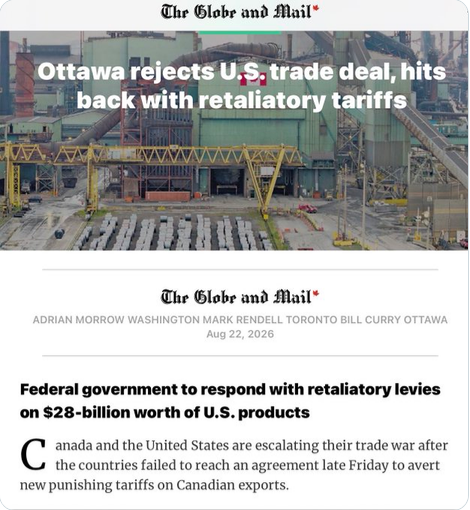
Trade deal? What trade deal? Best we can do is more tariffs

Filed under: Cancon, Economics, Government, Media, Politics, USA — Tags: , , , , , — Nicholas @ 03:00

My sense has always been that the Carney government didn’t really want to get a deal done with Trump, because it was far more politically useful to keep the eLbOzOs all angry and posturing than to negotiate in good faith. Canada’s premiers, taken as a group, have been a never-ending stream of clown car antics, political gamesmanship, and schoolyard baiting. Yes, Trump is infuriating, inconsistent, obnoxious, and even more performative than Justin Trudeau but he’s the current American president and we needed to send sensible politicians and diplomats to work with him.

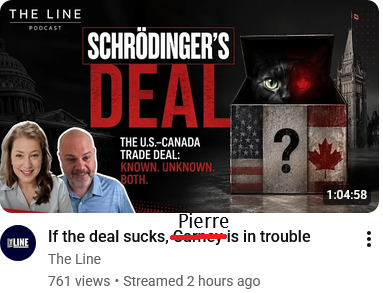
The presstitutes in the Canadian relic media have been eagerly fanning the flames of Trump Derangement Syndrome across the country, so when the latest episode of The Line podcast popped up yesterday, I had to provide a helpful edit to their episode title:

They’re going to do everything they can to deflect blame from their beloved paymaster, Dear Leader, and point accusingly at Pierre Emmanuel Goldstein and his band of anti-Canadian wreckers and looters in the Conservative party.

On the social media site formerly known as Twitter, @jaycurrie discussed this when the news broke of the breakdown in talks:

The last minute collapse of trade negotiations between Canada and the US demonstrates a fecklessness on the Canadian side which is astonishing. The walking resume — in the very good suits — could not get’er done.

Apparently those damn Yankees had unacceptable last minute changes. No shit. You are dealing with serious negotiators who will squeeze hard. It is said of Trump that he regarded signed contracts as the beginning of the negotiation.

Brutal, unscrupulous, nasty. Orange man very, very, bad. But you play the hand you’re dealt. Had Canada sent serious negotiators a year ago rather than posturing and dumbly sticking the official elbows in the air, we’d have a deal.

Or, had we had negotiators who did not take Dudley Doright as a model, we would have signed a “bad deal” and gone right back to the table to get a better deal. I’d love to know what the show stopper American last minute “demands” were.

Trade is a constant series of negotiations. A deal in place would have avoided the BS 50% tariffs and set the stage for the next deal. This collapse just puts us in a deep hole smarter people will have to climb out of.

“That’s my final offer” is a tactic. Is it an offer you like? No. Is it an offer you can live with? Probably. Again, the devil is in the details. But unless the offer required Canada to cede territory (which Eby is already more than willing to do) it was workable.

“A bad deal is worse than no deal at all” when there are 50% tariffs looming as a consequence of “no deal” is a very dumb position to take. Brace for “defense of Canadian Sovereignty” in a matter of minutes.

These trade talks have been bungled from the beginning simply because a combination of the political advantages of TDS and an inflated view of Canada’s relative bargaining strength created a reality free bubble.

The sheer arrogance and vile political opportunism of the Carney Liberals has been on full display for a year. Trump and his people called BS. Carney was euchred. Canada is, frankly, boned.

Maxime Bernier:

New 50-per-cent levies will hit around $28-billion worth of Canadian goods, which is roughly 5 per cent of Canada’s exports to the United States.

Carney has said it will respond with retaliatory tariffs on $28-billion worth of U.S. products.

Escalation is a very bad idea! Tariff retaliation has just triggered an escalatory trade war we cannot win. The U.S. economy is 10 times larger than ours.

A study released last week by the Canadian American Business Council concluded that the end of USMCA would have a surprisingly small impact on the Canadian economy.

It estimates that, even with high and long-lasting tariffs, Canada’s economy would only be about 1.6 per cent smaller in 2035 than if the USMCA were renewed and respected, and tariffs fell to near zero.

We are further damaging our economy with these “dollar-for-dollar” counter-tariffs.

Retaliatory tariffs are NOT a weapon. They are a tax on Canadians.

Who do you think absorbs that cost?
Canadian consumers, businesses, and workers.

Let’s be brutally honest: the Canadian government is worsening the situation. Canadian families will pay the price at the checkout counter.

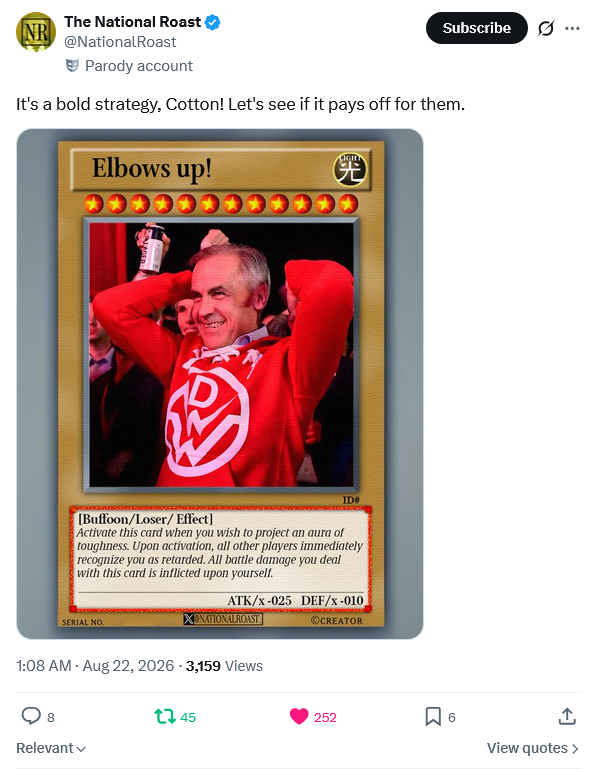
The National Roast gets it:

Why This “Foreign” Commonwealth Truck Was Built In 800,000 Units And Supplied Every Front

Filed under: Britain, Cancon, History, Military, WW2 — Tags: , , , , — Nicholas @ 02:00

BritishWarLegends and BritishWarArmory
Published 31 Mar 2026

The Canadian Military Pattern truck was built by two rival factories in Ontario for a nation of eleven million people. It ended up supplying the British Eighth Army across North Africa, Italy, Normandy, and Burma — and Canada built more of them than Germany, Italy, and Japan built trucks combined.

Almost nobody knows it existed.

When Rommel captured two thousand of them at Tobruk in 1942, he didn’t scrap them. The Afrika Korps pressed them straight into active German service. An enemy with his own purpose-built military trucks chose to keep using captured Canadian vehicles instead.

The full forgotten story.

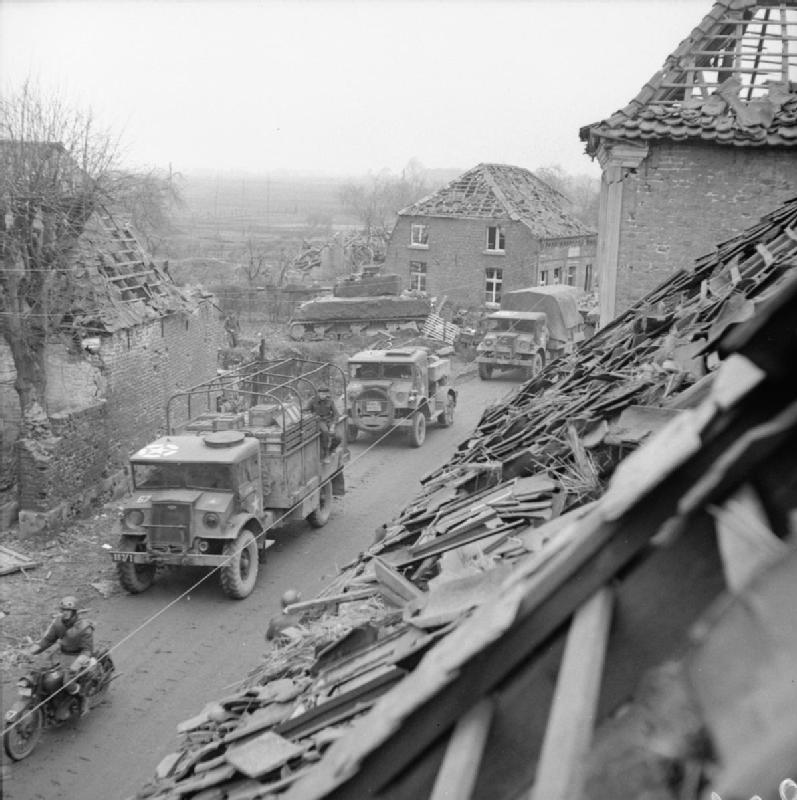
Update: I generally try to avoid watching or re-posting clearly AI-generated slop, but this was the first video I’d encountered discussing the hundreds of thousands of CMP trucks that Canada built during WW2. At some point between me scheduling the video and today, the channel has been banned. You’ve undoubtedly seen CMP vehicles in WW2 stills or movie footage, as they’re pretty distinctive – https://en.wikipedia.org/wiki/Canadian_Military_Pattern_truck

From The British Army in North-west Europe 1944-45,
CMP lorries passing through Uedem, 2 March 1945.
Photo by Carpenter (Sgt), No 5 Army Film & Photographic Unit, Photograph B 14966 from the Imperial War Museums via Wikimedia Commons.

QotD: “I found a million dollar baby in a five and ten cent store”

Filed under: Business, France, History, Media, Quotations, USA — Tags: , , , — Nicholas @ 01:00

It’s one of those numbers that sings so easily you’d have to be a total idiot to louse it up. I’ve always loved it because it’s pure Americana, a song that no other culture could have produced. As I mentioned last week, I’m often asked how I started writing, what got me interested, who were my influences, all the usual questions. And I don’t really have a ready answer. But, if I were to be semi-serious about it, it was songs like this that tickled my curiosity about language – not just the words and phrases and images, but the way the ideas were expressed so neatly. Compression is the essence of songwriting, and if you had to come up with a couplet that defines the genre, that encompasses a whole world and a whole point of view and an entire musical tradition, “I found a million dollar baby in a five and ten cent store” comes as close as any.

I once asked a friend in the French music biz how the song went over there. I hummed him the tune and he sang me the French lyrics and, although I can’t recall any of them, I remember they were entirely different from the English words. It’s not just the five-and-ten that’s hard to translate or the million dollar baby. But the concept of finding the latter inside the former is also very American. There are a ton of Mitteleuropean operettas in which the prince or duke or count wanders into the streets in disguise and falls in love with a serving wench, but the serving wench usually turns out to be a Countess or Margravine or some such also wandering around in disguise. Even the British are prone to this syndrome (Spring In Park Lane, etc). But in an American song the shop girl is a genuine shop girl, and she’s still a million dollar baby. That’s what makes it American.

In the Sixties, by the way, you could have found a future billion dollar baby in a five and ten cent store: Sam Walton, founder of Wal-Mart, got his start in retail as a franchisee at a Ben Franklin’s, founded in 1920 by the Butler brothers, who’d been in the five-and-dime business since the 1870s. I’m not saying “I Found a Million Dollar Greeter in the Big Box Store at the Strip Mall on the Edge of Town” would be as big a hit, but there is an historical continuity from the Butlers to Wal-Mart.

Mark Steyn, “I Found a Million Dollar Baby (in a Five and Ten Cent Store)”, Steyn Online, 2020-10-25.

Powered by WordPress