Quotulatiousness

August 9, 2026

Hopefully the last word on “L’affaire Arday”

Filed under: Britain, Education, Media, Politics — Tags: , , , — Nicholas @ 05:00

On her Substack, Helen Dale discusses the recently resigned Cambridge professor Jason Arday, the people who positioned him to fail, and what their motivations were in doing so:

Arday’s arrival to take up his professorship at Cambridge was recorded by at least two BBC cameras. Here he is talking to Hilary Cremin, head of the Faculty of Education at Cambridge.

Sometimes both institutions and people pick up a firearm and blow both feet off.

Cambridge University has done so with its gross mismanagement of the Jason Arday affair.

Oceans of ink have been spilt already on this issue, so I’m not going to relitigate the main background. Instead, I want to make four observations, in no particular order.

1. Oh, the humanities (and social sciences)

The problems across these two large disciplinary areas long predate the idiotic wokery that got Jason Arday appointed to a professorial chair at Britain’s second oldest, second most famous university. Yes, wokery has made them worse, chiefly because the theoretical frameworks animating it — which Lorenzo Warby has written about both here and at his own place — deny the possibility of truth outside that of personal experience. This means people don’t just get their own opinions, they also get their own facts.

[…]

2. Nathan Cofnas is not racist

There are two distinct things going on in the background to the Arday appointment(s). The first is that he was appointed despite being a complete doofus and as dumb as a stump. The second is that while there probably are black candidates out there qualified to be a Cambridge professor, there won’t be many, and they are highly unlikely to be the descendants of slaves (from the Caribbean, the United States, or South America). They’re much more likely to be from a posh Nigerian background, and a particular Nigerian tribe (Igbo).

In the words of computer scientist Eric S. Raymond:

    This is completely predictable to anyone who has spent 10 minutes reviewing the data on racial differences in mean IQ and knows what that implies for the right end of the bell curve.

    The intersection set of people with predominantly sub-Saharan African ancestry with people sufficiently bright to deserve a university professorship is not empty, but it’s vanishingly small. The demand greatly exceeds the supply.

    Which is why we’ve seen this movie many times before, and will again. They can’t help it. Corrupted academia would rather hire thousands of other incompetents than let go of its “anti-racism” to hire on merit alone.

The refusal to grapple with the black-white average IQ gap is astounding, and while the (mostly) white people responsible for appointing Arday look like absolute fools, the black intellectuals who refuse to accept an established fact look both truculent and dishonest. They don’t have to accept it’s genetic. They do have to accept that it’s real. As far as I’m aware, only one major black intellectual, Wilfred Reilly, accepts the existence of the gap (disclosure: I have been a guest on Wilfred’s podcast). If there are others, I would be delighted to know their names.

Two issues fall out of this. The first is that Nathan Cofnas is not racist for pointing it out. Facts are not racist. The second is that if people disagree with Cofnas’s secondary argument that the reason for the gap is primarily genetic, then yelling racist! at him does not prove him wrong. Evidence is what you need if you want to prove someone wrong, not moral abuse.

3. It’s the rule of law, Jim, but not as we know it

The idea that historically disadvantaged groups are entitled to extra civil rights — coupled with social preferment — over and above those held/enjoyed by people considered their oppressors is inimical to the rule of law, specifically the principle that people should not be punished for crimes they did not commit. We do not inherit criminality from our ancestors. This is in turn derived from the larger principle of treat like cases alike, which was first articulated in its modern form by the Roman jurist Ulpian.

Jason Arday got his job in large part because a lot of people — and especially humanities and social science academics — think it’s reasonable to punish whites (and sometimes East Asians) who have never wronged blacks by making it harder for them to get into university or gain employment. This punishment of whites/East Asians who have done no wrong is undertaken to compensate blacks who have not been wronged for wrongs committed by other white people against other black people in the past. This logic is the basis of all affirmative action schemes and preferential hiring regimes (provision for which exists — albeit in limited form — in the UK’s Equality Act 2010). It is also the logic of inherited vengeance.

[…]

4. Enter Carter-Ruck, or Journalism v. Law v. a bloke with a blog

It’s been widely — and accurately — reported that junior academic Nathan Cofnas broke the Jason Arday story on his personal blog. However, it shouldn’t have been his job to do. The same (or very similar) research had been done separately by both a retired academic (John Harris) and a journalist with Times Higher Education — an outlet dedicated to the tertiary education sector and owned, ultimately, by Rupert Murdoch. In response to both sets of revelations, either Cambridge or Arday or perhaps both in concert (this is unclear on the facts available to me) instructed Carter-Ruck, the most famous — and aggressive — specialist defamation law firm in the United Kingdom. Historically, Private Eye magazine (often a victim of their attention) referred to them as “Carter-Fuck” and, more recently, “Farter-Fuck”.

Despite the fact that the THE has libel insurance and Murdoch generally defends his publications, the magazine backed down. Jack Grove is the reporter who had his story spiked. I have it on good authority that several Cambridge academics — and perhaps people from other universities — then approached Cofnas with the material that they (and possibly the THE) had collated. Cofnas — being young & junior — is what lawyers call “a man of straw”. Suing him in defamation would benefit no-one, least of all Carter-Ruck. He published, scooping Jack Grove.


How To Launch the Apocalypse – Death of Democracy 27 – Q3 1939

World War Two and Spartacus Olsson
Published 8 Aug 2026

This is Step 27 in the Death of Democracy: LAUNCH A WORLD WAR — the moment when the collapse of democracy, diplomacy, and collective security culminated in an attack that would engulf the world.

In July and August 1939, Adolf Hitler turned the destruction of German democracy into the instrument for launching a European war.

While Nazi Germany armed Danzig, mobilized reservists, prepared its U-boats, introduced civilian rationing, and manufactured stories of Polish aggression, Britain, France, Poland, the United States, and the Soviet Union made a final series of increasingly desperate attempts to prevent catastrophe.

At the center of the crisis was the failed effort to construct an Anglo-French-Soviet alliance against Nazi aggression. Negotiations foundered on delay, mutual suspicion, the Baltic states, and the Soviet demand for military passage through Poland. Stalin then chose an agreement with Hitler: the Molotov–Ribbentrop Pact and its secret protocol divided Eastern Europe into German and Soviet spheres of influence and prepared the way for the destruction of Poland.

Inside Germany, there was little repetition of the supposed national enthusiasm of August 1914. Nazi leaders and Wehrmacht commanders ranged from confidence and opportunism to anxiety and fatalism, while many ordinary Germans feared that Hitler had finally pushed Europe beyond the point of no return. Yet propaganda, repression, and six years of dictatorship had stripped the population of any effective means of preventing the war.

The next episode will conclude the series with an epilogue examining what the destruction of the Weimar Republic teaches us about defending democracy today.

The drift toward socialism in the west

I’m reminded of that line from Kipling: “And the burnt Fool’s bandaged finger goes wabbling back to the Fire”, as most western countries have had plenty of opportunities to observe socialism in the wild, yet there’s always the chorus that it “wasn’t real socialism” and this time it’ll be great:

Socialism survives because it flatters the most powerful human instinct you have: the desire to believe that good intentions produce good outcomes.

The engine is pure motivated reasoning: not ignorance, not stupidity.

Venezuela collapsed from one of Latin America’s wealthiest economies into a country where citizens lost an average of 11 kilograms of body weight in 2017 because food disappeared. The Soviet Union murdered tens of millions in gulags and deliberately starved Ukraine in 1932-33. Cuba turned a middle-income Caribbean nation into a prison island. West and East Germany, North and South Korea. The pattern repeats, and yet the ideology never takes the blame.

Here’s why. Socialism’s defenders always move the goalposts. When the USSR fell, they said it wasn’t “real” socialism. When Venezuela imploded under Chavez and Maduro’s nationalizations, they blamed American sanctions. There is always an excuse, and that excuse always points away from the central planning mechanism itself.

Ludwig von Mises nailed this in 1920 in his essay on economic calculation. Without prices set by voluntary exchange, planners cannot allocate resources rationally. You get shortages and surpluses simultaneously, not because bureaucrats are evil, but because they are operating blind. The information simply does not exist in a form they can use.

Mises’s argument is uncomfortable in a specific way: it says the system cannot work regardless of who runs it. You cannot fix central planning by finding better central planners.

The real villain is the intellectual class, professors and politicians who build careers selling the promise of top-down coordination. They capture universities, media institutions, and government agencies, and they teach each new generation that the solution to failed socialism is more socialism.

Socialism survives because the people promoting it face zero personal cost when it fails. The Venezuelan peasant starves. The tenured professor in Boston gets a book deal.

That gap between who sells the idea and who pays for it is what keeps the whole rotten project alive.

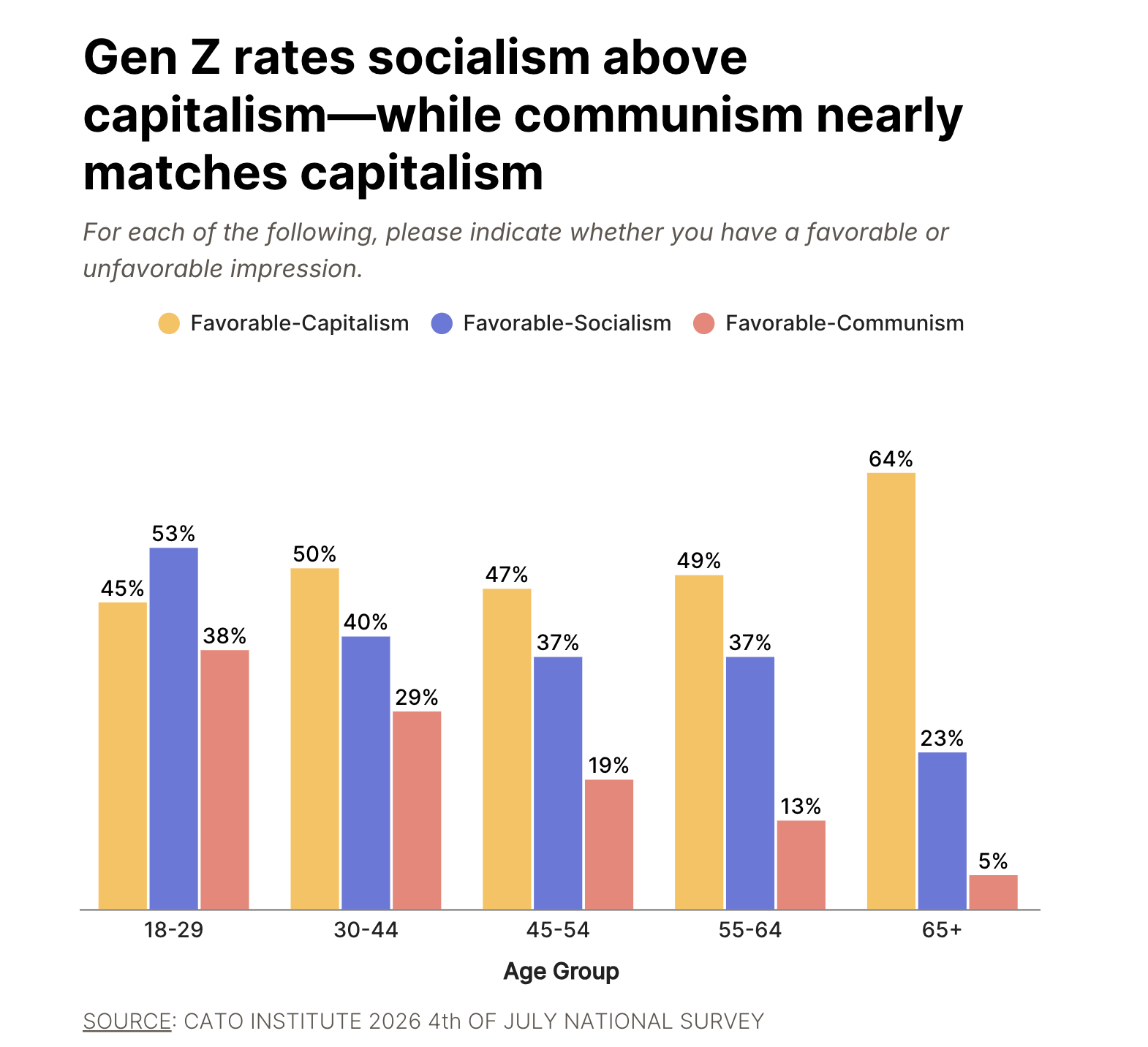
Celina notes that a recent Cato Instutute report shows uncomfortably strong support for both socialism and communism in the youngest groups:

This summer, America celebrated the 250th anniversary of its founding. At the same time, the Cato Institute, a libertarian think tank whose entire institutional purpose is the defence of free markets, commissioned a survey with Morning Consult of 2,253 American adults. The survey included the usual questions: pride in country, knowledge of what the anniversary commemorated, and belief in the American Dream.

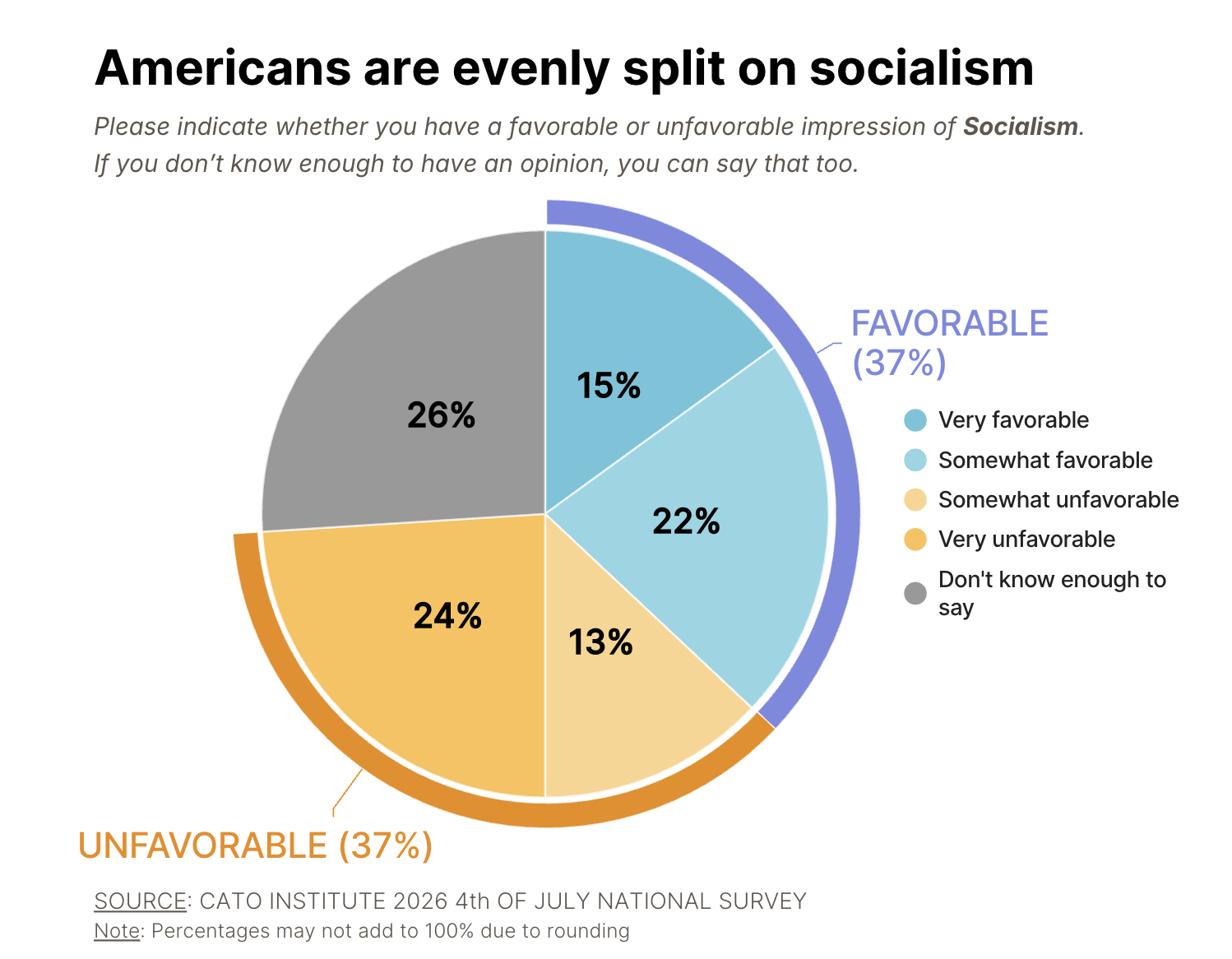
Besides the typical civic questions, the Cato questionnaire also asked Americans their feelings on communism, socialism and capitalism. The responses were quite explosive; the survey’s authors reported that: 21 percent of Americans said they held a favourable view of communism.1

Not socialism but communism. The word itself, which to the older Western mind is attached to the gulag and the Stasi and the Cultural Revolution, the one that American politics spent literally seven decades treating as roughly synonymous with treason.

Among Americans aged 18 to 29, the figure was 38 percent. In that cohort, favourable views of communism (38 percent) ran only seven points behind favourable views of capitalism (45 percent), and the generation was the only age group in which favourable views of communism actually edged out unfavourable ones, 38 to 36. Socialism, meanwhile, outpolled capitalism among the young outright: 53 percent favourable against capitalism’s 45. Also, the generational gradient was almost perfectly linear. Favourability toward communism fell from 38 percent among Gen Z to 29 percent among younger millennials, 19 percent among the middle-aged, 13 percent among those approaching retirement, and just 5 percent among seniors, the Americans old enough to remember duck-and-cover drills, Brezhnev, and the Berlin Wall as a piece of functioning infrastructure.

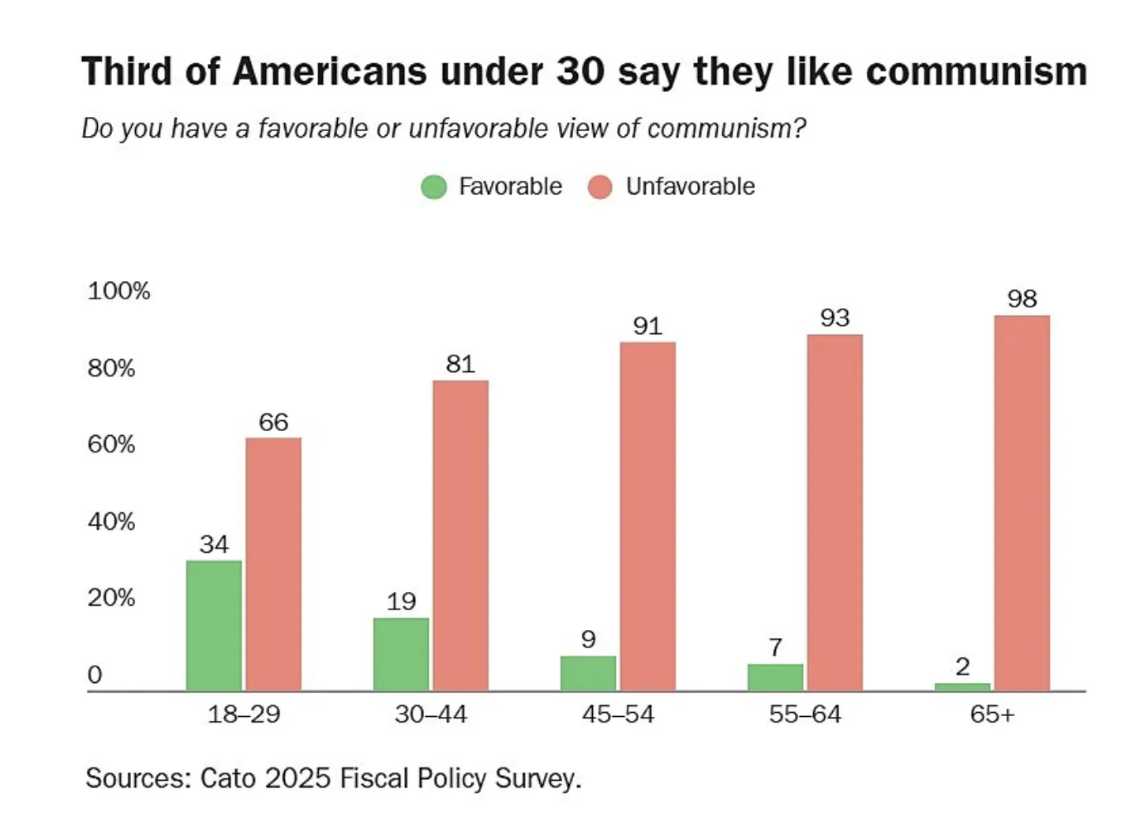
The 2026 Cato survey was not a fluke, which would be plainly obvious to people with even a slight interest in American politics. We also know this was not a fluke because the year before, in March of 2025, a Cato/YouGov survey of 2,000 adults found 34 percent of under-30s favourable toward communism and 62 percent favourable toward socialism. Cato’s senior editor Michael Chapman recorded roughly 52 million Americans aged 18 to 29, reporting a 34 percent favourability figure implying something on the order of eighteen million young people willing to say a kind word about an ideology that the Black Book of Communism credits with approximately 100 million deaths.

If you know a bit about the history of communism in America, you can understand why these numbers landed the way they did. American attitudes toward communism for most of the twentieth century were not just slightly negative; they were extremely so. Anti-communism was one of the few genuinely bipartisan commitments in American life, embraced by Cold War liberals and conservatives alike. Congress quite literally passed the Communist Control Act of 1954, effectively outlawing the Communist Party. Having any public sympathy for communism was politically and professionally fatal, as evidenced by the loyalty oaths, blacklists, and the House of Un-American Activities Committee (HUAC). When Gallup asked Americans in 1949 what “socialism” meant to them, the largest share answered on the lines of “government ownership of the means of production”, and they wanted no part of it. Communism, the harder and more explicit term, was too unthinkable during that time to even be asked in the poll.2


    https://www.cato.org/blog/new-poll-nearly-half-americans-dont-know-what-americas-250th-celebrating
    https://news.gallup.com/vault/240749/gallup-vault-americans-views-socialism-1949-1965.aspx

Clearing Bannerman’s Castle: A Century of Explosive Ordnance

Filed under: History, USA, Weapons — Tags: , , , — Nicholas @ 02:00

Forgotten Weapons
Published 11 Mar 2026

The Bannerman family decided to sell Bannerman’s Island to the state of New York in the 1950s, but the sale required that they first clear all the ordnance off it. That was no simple task, and the military was not interested in the job. Instead, the family found Val Forgett Jr, a demolitions expert who happened to be looking for seed money to start a business making reproduction black powder revolvers. His offer to do the cleanup work was accepted, and he spent a summer doing the job and put the proceeds into the first Navy Arms reproduction 1851 Colt Navy revolvers.

This video includes the talk given by Forgett to the Armor and Arms Club of New York in the 1990s explaining the process of clearing out the ordnance from the island …
(more…)

QotD: Spoilers — threat or menace?

Filed under: Books, Media, Quotations — Tags: , , — Nicholas @ 01:00

I used to think I was a control freak because I prefer knowing what happens before I watch a movie. Give me a book, and I will behave beautifully for the first hundred pages — then, suddenly, I’ll turn into a literary criminal and flick to the end. This doesn’t always happen; the writer has to be good enough to make me panic. Yet if I care deeply whether Harry Potter survives, or whether Catherine ends up with Heathcliff, I need the literary equivalent of someone taking my hand and saying, “Brace yourself, chapter thirty-two is going to be a bit of a donut”.

It turns out this may not be control freakery. How wonderful to think that I have been waiting years for science to rebrand my worst qualities as skills. Apparently, people who like spoilers are just trying to regulate their emotional response. We are not monsters, but only putting on a cardigan before the storm.

Those who hate spoilers also want control, but theirs is driven by a desire to preserve suspense. They want to receive information in the sequence designed by the storyteller. My own spoiler-seeking is also a form of control, although it works differently. I want the major facts early, so I can relax into the texture of the story rather than sit there like a meerkat scanning the horizon for emotional catastrophe.

So we are all control freaks, just wearing different cardigans.

Spoiler alerts began as a civilized courtesy. If someone on a bus was halfway through a book, it was not considered the done thing to lean across and announce the ending like a deranged town crier. There were rules. Perhaps not that many. But there were some.

Now the spoiler alert has become a moral siren. One can’t discuss a film, television show, podcast, documentary, memoir, cake reveal, or episode of Bluey without issuing a warning so elaborate that it requires its own stationery. People now approach plot discussion like bomb disposal experts. One innocent mention of a character’s demise, and the online village square bursts into flames. On “The Good Ship Murder” Facebook page, for instance, someone posts, “Can’t believe they killed Pierce”, and within seconds the spoiler militia descends.

    Admins should delete this spoiler.
    People might not have seen it yet.
    Can’t believe you’ve posted a spoiler…

You can almost hear the sirens. Somewhere, a moderator is reaching for a lukewarm tea and wondering how a cozy murder show has turned into the fall of Saigon.

Nicole James, “Tell Me Who Dies So I Can Relax”, The Freeman, 2026-05-07.

Powered by WordPress