Quotulatiousness

May 27, 2026

Tim Hortons now pretends they’re going to stop abusing the TFW program, maybe

Filed under: Business, Cancon, Government — Tags: , , — Nicholas @ 05:00

There are few Canadian companies who’ve done more to trash their own reputation than Tim Hortons over the last decade or so. What used to be everyone’s coffee chain of choice, through breathtaking abuse of the Temporary Foreign Worker scheme and other shady employment practices, has now become one of the most detested companies in the land. Everyone I’ve talked to seems to have their own Tim Hortons anecdotes, and none of them are complimentary to the firm or its largely non-Canadian workforce. Last week, Dunkin’ Donuts announced that they would be re-entering the Canadian market and suddenly Tim Hortons claims they’ll be hiring a whole bunch of Canadian workers to staff their restaurants:

“Tim Hortons Drive Thru” by baekken is licensed under CC BY 2.0 .

If you believe yesterday’s announcement that Tim Hortons plans to dial back its use (and clear abuse) of the Temporary Foreign Worker Programme (TFWP) to hire “10,000 people locally” out of the goodness of its heart, I have a below-sea-level basement apartment to sell you in Richmond, B.C.’s peat-based Delta soil.

Let’s start with the obvious: If those 10,000 positions suddenly exist now, they never should have been outsourced to begin with. And yet, Tim Hortons spent the better part of a decade lobbying the Canadian federal government to increase and maintain workforce percentage caps that directly impacted thousands of positions, and influenced the entirety of the Canadian labour market.

Rather than ever lobbying for a specific number of individuals (because, again, they didn’t have an actual need when the market was showing a perpetual 20+ percent youth unemployment rate), Tim Hortons and its parent company, Restaurant Brands International Inc., instead lobbied to manipulate the overall percentage (or cap) of TFWs allowed per restaurant. During supposed “pandemic-era shortages”, they successfully massaged wilful dupes in government to increase that cap, allowing up to 30 percent of a restaurant’s workforce to consist of TFWs.

When the federal government finally cut the cap back down to 10 percent to curb immigration numbers, Tim Hortons heavily lobbied through 2024 and late 2025 to raise the limit back to 20 percent or 30 percent. Up until yesterday, they argued that rural and remote franchises continued to face severe labour shortages.

What they actually face is competition from Dunkin’ Donuts, with the popular American coffee chain set to break ground on its first Canadian locations in 2026, under a plan to aggressively expand to 600-700 locations nationwide.

If one were to charitably take Tim’s sudden shift in labour strategy at face value, this framing of yesterday’s announcement from the Globe and Mail might be enough to let bygones be bygones.

    Tim Hortons was one of the biggest proponents of the TFWP, a controversial immigration stream that expanded in popularity during the pandemic and came to symbolise some of the failings of the Trudeau-era immigration strategy.

    Restaurant Brands International Inc., Tim Hortons’ parent company, is also pledging to stop lobbying the federal government to expand the TFWP, citing the high youth unemployment rate.

But the devil, they say, is in the details; in this instance, in the lack thereof. That “10,000 people locally” includes foreign students, and TFWs already in the country, with both groups still on active and expired permits in the millions.

And that’s just the start: graduates on Post-Graduation Work Permits (PGWP), and individuals under the International Mobility Program (IMP) do not require a Labour Market Impact Assessment (LMIA). Meaning a single restaurant could be staffed almost 100% by temporary visa holders, but if those employees are international students or PGWP holders, Tim’s corporate metrics classify them as “local hires”, not TFWs.

That also means Tim’s supposed “cap” on TFWs was never an inherently honest number.

Corporate cynicism is nothing new, but Tim Hortons’ hiring practices have effectively replaced tens of thousands of part time jobs for Canadian teens with full- and part-time jobs for foreign students, temporary foreign workers, asylum seekers, illegal immigrants, visa-overstayers, and any other kind of cheap and exploitable employee who can be depended upon to meekly accept whatever working conditions are on offer with minimal chance of anyone appealing to health inspectors or federal regulators. Very convenient for Tim Hortons and their franchisees. Not very Canadian, but very convenient.

Update: Perhaps another reason that Tim Hortons is backing away from the TFW designation is that the government has given them an even easier way to hire foreign workers:

Mark Carney is lying to you.

In the first 90 days of 2026, Canada issued 292,855 work permits, smashing the full-year target of 220k–230k.

247,895 under IMP (International Mobility Program)

44,960 under TFWP

Why employers love the IMP:

It’s a much cheaper, faster, and easier alternative to the TFWP.

Key Financial & Practical Benefits of IMP (vs TFWP):

No LMIA required → Saves $770+ per worker (no $1,000 LMIA fee)

No mandatory job advertising to Canadians

Much faster processing (weeks vs months)

Lower compliance costs — only $230 employer fee
Fewer obligations around housing, wages, and recruitment

More flexible permits for workers (easier to retain staff)

This is exactly why companies like Tim Hortons and many in hospitality/retail have shifted heavily to IMP workers. It’s faster, cheaper, and bypasses most of the strict labour market tests required under the TFWP.

That would seem to explain Tim Hortons’ sudden change of heart rather more than the risk of increased competition by a revived Dunkin’ Donuts expansion.

May 26, 2026

Canadian parents are increasingly adopting the “helicopter” or “bulldozer” model

Filed under: Cancon, Health, Media — Tags: , , , — Nicholas @ 03:00

Eva Chipiuk on concerning trends in Canadian parenting styles and the long-term impact on children:

Not many people have really turned their minds to the psychology of Canadians. Most are too busy reacting to the latest outrage, headline, or political controversy.

However, David Redman has cautioned about what he has identified as a trend in Canada: “helicopter” and “bulldozer” parenting, where children are either constantly hovered over or where every obstacle is removed before they ever have to face it themselves.

Over time, that kind of environment can produce people who become uncomfortable with uncertainty, overly dependent on authority, fearful of risk, and hesitant to think independently or challenge difficult ideas. As this article put it:

    Children, the authors observed, are now deliberately shielded from any sense of risk or uncertainty. How can anyone — young boys most of all — learn about the world around them when school principals announce at the onset of every snowfall that “all snow must stay on the ground”. The ideal of adventure and resilience has been replaced by a debilitating sense of fragility and risk-avoidance …

    Adventure should properly be considered a spirit, not a place. It is driven by a powerful mixture of curiosity, necessity, and an openness to experiencing new things. And it can be found wherever uncertainty reigns. Today, that might entail travelling to strange lands, meeting new people, or even engaging in uncomfortable discussions about whether Alberta should remain part of Canada forever.

    Wherever the unknown lies, adventure can be found.

That mindset does not just affect childhood. It shapes entire societies. It affects how citizens respond to disagreement, political debate, uncertainty, criticism, and even new ideas.

Somewhere along the way, many Canadians lost their sense of adventure, resilience, curiosity, and willingness to engage with uncomfortable conversations or difficult questions.

Where did that spirit go? What happened to the mindset that encouraged people to explore, question authority, take risks, debate ideas openly, and build something better even when the outcome was uncertain? Somewhere along the way, discomfort itself seems to have become something to avoid rather than something people grow through.

Because if we stop exploring, questioning, debating, and taking risks, we lose something essential about what it means to live freely and think independently. A society that becomes afraid of uncertainty eventually becomes dependent on being told what is safe, acceptable, and permitted.

If we are going to move forward in any meaningful way, we need to rediscover the spirit of curiosity, resilience, and adventure that pushes people to test ideas, challenge assumptions, and engage with the unknown instead of fearing it.

Perhaps one of the most important conversations we should be having is this: what does it actually mean to be Canadian today?

Because for many, it increasingly feels like the answer is becoming less about courage, resilience, curiosity, and self-determination, and more about compliance, comfort, and avoiding difficult conversations.

May 25, 2026

“When I was in high school, I was taught that every single Canadian adored Pierre Elliott Trudeau”

Filed under: Cancon, Education, Media, Politics — Tags: , , , , , , — Nicholas @ 03:00

My family arrived in Canada in October 1967, just as the last of the Centennial events were shutting down. Pierre Trudeau became Liberal leader and Prime Minister not long afterwards. I think the “Trudeaumania” of 1968 was nearly 100% media generated, but it was new to Canadian voters who liked the idea of Canada being led by a sophisticated international playboy rather than the stolid, rather unfashionable men who preceded Trudeau. The media continued to “love him long time”, which definitely helped keep him in power and then back into power after the brief Joe Clark experiment. Since he left office, his reputation has been cherished and burnished by progressives in the educational system, as Harrison Lowman relates:

A Toronto Sun editorial cartoon by Andy Donato during Pierre Trudeau’s efforts to pass the Canadian Charter of Rights and Freedoms. You can certainly see where Justin Trudeau learned his approach to human rights.

“When I was in high school, I was taught that every single Canadian adored Pierre Elliott Trudeau. I learned that when the rose-pinned prime minister winked and pirouetted, the whole nation swooned.

It wasn’t until first-year university that I was first exposed to the fierce Western backlash to his National Energy Program.

It wasn’t until I graduated that I learned about any opposition to his Charter of Rights and Freedoms, his policy of national bilingualism, and official multiculturalism.

It was my Ontario high school civics teacher’s fault. While she was a great educator in other ways, the politics lessons she taught us were clearly slanted in the Liberal direction; a direction she supported.

My experience as a young person 20 years ago demonstrates the immense power teachers hold in moulding young minds. It’s a power that concerns me when I imagine dropping off my eight-month-old son at school in three years. Today, that teaching slant has become even steeper, with too many educators unwilling or unable to provide political or ideological balance in their classes.

This week, I interviewed Stephen Reich, a PhD student at The Ontario Institute for Studies in Education (OISE) who researches the proliferation of critical theory in kindergarten to Grade 12 policymaking.

Reich told me I should be concerned—that the educational leaders in this country have all but abandoned what should be the true purpose of education: imparting civilizational knowledge to the next generation. Instead, they’ve replaced it with seeking multiple “truths” and a narcissistic obsession with oppression narratives. Never mind that 92 percent of Canadians polled say they don’t want their children separated by race: taught to see themselves as “privileged” vs. “oppressed”. Reich says certain teachers are far less interested in producing independent thinkers and far more interested in producing activists.

“I have a feeling that success [for them] is ideological conformity,” he explained. That they aim to help foment some sort of “liberation.”

CP-121 Tracker; carrier-borne ASW powerhouse turned aerial firefighter

Filed under: Cancon, France, History, Military, Technology, Weapons — Tags: , , , , , , — Nicholas @ 02:00

Polyus
Published 31 Jan 2026

This is an aircraft carrier borne submarine hunter, dressed up like a firefighter. Its story is one of Cold war posturing, coastal policing, and aerial firefighting. Quite the career for such an unassuming looking aircraft. It was the de Havilland Canada CP-121 Tracker, an icon of Canadian aviation for almost 60 Years.

0:00 Introduction
0:30 Historical Context
1:58 Tracker or Gannet?
4:26 Canadian built CS2F-1 Trackers
9:06 CS2F-2
10:23 CS2F-3
13:12 New roles
15:14 Marine Reconnaissance
16:10 Conair Firecat/Turbo Firecat
17:48 Conclusion
(more…)

May 23, 2026

A referendum? In our Alberta? There they go!

Filed under: Cancon, Media, Politics — Tags: , , — Nicholas @ 05:00

I hope Jen Gerson will forgive my hubristic use of “our Alberta” in my headline, as there’s at least a possibility that at the end of this process, Alberta won’t be “ours” any more:

So I guess we’re doing this, eh?

I mean, of course Alberta is holding a secession referendum. It’s Alberta; the province that consistently exhibits the inverse of one of Paul Wells’ most-famed Rule of Politics. To wit: “1: For any given situation, Canadian politics will tend toward the least exciting possible outcome”.

Okay, well. Yeehaw, I guess. Alberta hits different.

I suppose I’ll be doomed to die here — everywhere else would be boring by comparison.

For those who have not yet been fully read in: In a speech on Thursday that can only be described as a rhetorical onion of bad faith and gaslighting, Smith called for a secession referendum based on Forever Canadian leader Thomas Lukaszuk’s successful petition, which was intended to rally support of federalists ahead of an expected pro-secession petition. Lukaszuk’s question proceeded to the legislature, while the separatist Stay Free Alberta attempt was subsequently quashed in the courts.

Smith will continue to appeal that ruling and in order to stay ahead of the judicial process will now hold a non-binding secession vote in October based on the successful federalist petition. Except the actual question won’t be based on Lukaszuk’s exact wording, but will rather be something both novel and maybe able to pass judicial review.

The imminent question now to be posed to us reads: “Should Alberta remain a province of Canada or should the Government of Alberta commence the legal process required under the Canadian Constitution to hold a binding provincial referendum on whether or not Alberta should separate from Canada?”

So we’ll have a referendum on having another binding referendum. This, as far as I can tell, will please neither federalists nor separatists. It will increase the odds that an initial vote to leave Canada will pass if voters regard it as a harmless protest exercise; this will thus ensure that secession remains a live feature of Alberta politics for the foreseeable future.

Yes, I know this is confusing.

The trick is just don’t think about it too much. If you haven’t been following since at least March, you’ll never get fully caught up now. Just feel it out. If you get the sense that you are swimming in the surreality of an episode of Veep, you probably have it about right.

I can’t even give you ordinary political analysis, anymore. We just have to imagine that we’re all trapped in an improbable soap opera we can’t shut off, hostage to terrible over-actors whose intentions and actions only make sense to those of us who have been religiously following every B-rate plot twist for years. I’m waiting for a demonic talking puppet named Timmy to roll into town on the back of a Ford F150 driven by a malevolent witch who casts love spells and curses in order to triangulate a never-ending high school drama populated by bored corporate memo takers and Calgary School dorks who decided politics was the highest and best use of their short time on this God-given earth.

They could have started a soup kitchen, or taken up diamond painting from those kits they sell at Michael’s, but nah. It’s this.

So here we are. Staring down the barrel of a referendum that has a higher chance of securing a thin majority than anyone seems to realize, even if it is very unlikely to lead to a legal separation of the province. Either way, simply holding the vote opens the whole country up to an unpredictable cauldron of economic and political consequences, in addition to God-knows what foreign interference. It’s so goddamn crazy, the plot would get rejected for a one-man YouTube shorts series.

And all of this because Danielle Smith is beholden to an emboldened and committed political base of separatists that has threatened to blow up her leadership and her party if she doesn’t hold a secession vote. Meanwhile, the moderates in caucus are proving to be something less than profiles in moral courage. Only two, Matt Jones and Nate Horner, noted opponents of holding a vote, seem willing to speak up, and both of them resigned on Wednesday. Everyone else is either cowed, indifferent, or a separatist too lacking in integrity to say so outright in public.

The UCP has become a party of snivelling, weak little thieves who operate by night.

May 22, 2026

Canada – an example of a “cut-flower civilization”

Filed under: Cancon, Government — Tags: , , , — Nicholas @ 03:00

On the social media site formerly known as Twitter, L. Wayne Mathison explains why Canada still looks somewhat like a functioning country, but it’s just a fading illusion:

“Cut Flowers, 2021” by F. D. Richards is licensed under CC BY-SA 2.0 .

Os Guinness coined the phrase “cut-flower civilisation” to describe a culture cut off from the roots that once gave it life.

Look at Canada today under the Liberal machine and its latest boardroom saviour, Mark Carney, and the phrase fits a little too well.

Canada still looks alive. In many ways, it is. We are still a wealthy country. We still have decent people, vast resources, serious workers, inherited institutions, and enough stored national strength to keep the lights on for a while.

But the wilting is visible.

The problem is not that Canada lacks talent, land, energy, minerals, farmers, tradespeople, engineers, entrepreneurs, or ambition. The problem is that the governing class has spent the last decade cutting away at the very roots that made those things productive.

Canada did not become a G7 country because Ottawa held press conferences, hired consultants, or released glossy strategy documents. Canada became prosperous because earlier generations understood the basics. Build things. Produce things. Develop resources. Reward work. Protect property rights. Defend free speech. Keep government limited enough that private competence can actually breathe.

That was the soil.

And that soil has been poisoned by years of managerial arrogance.

Canadians were told that prosperity could be designed from above by technocrats, climate planners, corporate consultants, regulators, and global conference people with expensive credentials and no real skin in the game. They told us that taxing energy would make us richer. Blocking resource development would make us virtuous. Deficits did not matter. Productivity could wait. National unity could survive endless moral scolding from people who confuse a résumé with wisdom.

Now this same crowd wants applause because a few mines, rail terminals, aircraft deals, or manufacturing projects are being announced.

Fine. Good. Canada needs all of it.

But let’s not mistake oxygen for genius.

If a man spends ten years tightening his hands around your throat, he does not deserve a parade because he lets you breathe for ten seconds.

This is not some grand national renaissance because Mark Carney found a clean hard hat and stood beside a podium. Much of what we are seeing is an economy gasping for air after years of political strangulation.

The real question is not, “What project did they announce today?”

The real question is: what did they do to the soil?

Where did the habits of a serious country go?

Thrift. Production. Energy realism. Institutional integrity. Personal responsibility. Local grit. Honest media. Independent journalism. A government that protects the conditions for prosperity instead of replacing them with slogans, subsidies, and corporate welfare.

A cut flower can still look good for a while. That is the trick. It keeps its colour. It photographs well. It looks fine in the vase. But without roots, the clock is already running.

That is Canada’s problem.

We are living off stored capital: financial capital, moral capital, institutional capital, cultural capital. Previous generations built the reserves. This generation of elites is spending them and calling it leadership.

Eventually the runway ends.

And when it does, the speeches get louder, the excuses get thicker, and the very people who cut the roots start demanding credit for watering the vase.

An elite rebrand will not fix this. More Liberal managerial theatre will not save the dollar. Canada does not need another round of carbon-tax sermons from people who fly to international summits to lecture truckers, farmers, and working families about sacrifice.

Canada has to get back to the dirt.

Production. Responsibility. Truth. Energy abundance. Free speech. Strong families. Functional institutions. A state that remembers it serves national life. It does not create it.

The country is not dead.

But it is wilting.

And the first step toward recovery is simple: stop applauding the people holding the scissors.

May 21, 2026

Evaluating the Boomers’ complaints from the Zoomers’ point of view

Filed under: Cancon, Economics, Media, Politics, USA — Tags: , , , — Nicholas @ 06:00

As a dirt-poor boomer (or Generation Jones-er as some term us extra-late boomers), I don’t have a lot of sympathy for others in my age cohort who complain about their kids and grandkids not getting ahead when they’re occasionally back in Canada from their second or third extended exotic foreign vacation since before the snow fell last fall. (It’s been more than a decade since the last time we were able to take any kind of vacation … and that was just a week’s driving holiday to South Carolina.) The Zoomers (and Millennials, and even some of the Gen X’ers) have valid complaints that the boomers generally are not capable of understanding, as John Carter explains:

I’m going to have a little rant, here, so I’ll start by emphasizing: Not All Boomers. Look, my mother is a boomer, and I love her dearly, in large part because she represents the opposite of so many boomer stereotypes. Many of you reading this are boomers; I know this because you’re in the comments, writing some of the best comments, you can ask anyone, the very best comments, everyone says it, it’s true. I know full well that much of what follows doesn’t apply to you, because you’re the good ones, the exceptional ones, the few, the proud So, please, do not take any of this personally.

With that said.

The shouting match broke down along the expected lines. Boomers – including spiritual boomers – loudly agreed with O’Leary’s remarks. If you only spend $2 a day on lunch, they insisted, the resulting $26 a day that you save adds up to $9490 a year; after 5 years, you’ve got the down payment for a $250,000 house. Checkmate, you financially illiterate layabouts!

Zoomers, millennials, and Gen-X replied that $250,000 will get you a leaky shack in rural Arkansas with black mold in the unfinished basement; that by the time you save up the money for the down-payment, that shack will be going for $500,000; that recent immigrants receive government assistance to get onto the property ladder (along with preferential employment) and so do not have to spend years of their lives saving up at all. Disaffected youth (and these days, that is just ‘the youth’) generally heaped scorn on the idea that it’s even possible to save in this economy, or that there’s anything worth saving. “If you live on instant noodles and margarine sandwiches for twenty years, you too, my son, can one day afford a van down by the river.”

As an aside, isn’t it incredible how fashion has barely changed since Chris Farley did this skit on SNL back in 1993? Stuck culture is everywhere.
Image and caption from Postcards from Barsoom

I can see both sides of this. I tend to live frugally myself, not so much because I consider it virtuous but out of simple necessity. Throughout my 20s and 30s I was a career student living paycheck-to-paycheck, as a result of which I became very accustomed to cooking my meals and buying only what’s necessary. I’ve never once used DoorDash or Uber Eats. I buy my clothing at thrift stores, only purchase a new laptop once every decade or so, and have somehow managed to avoid racking up much in the way of debt … and by ‘somehow’ I mean that I’ve never owned a house or a car, partly because I changed continents too regularly to make such big-ticket purchases practical or necessary, but mostly because I couldn’t afford them. Even finishing my doctorate did not really bring anything you could call prosperity in its wake: my first position was for the princely some of just over USD30,000 per year. By the time I reached the median national income in my late 30s, I’d gotten so accustomed to frugal living that money started piling up in my account just because I had no idea what to do with it, and little inclination to spend it because I was honestly just happy to not have to worry about budgeting to make rent. That turned out to be very helpful when DEI came for my career track; I lived on those savings for a couple of years after.

[…]

There was a famous Stanford experiment called the Marshmallow Test which measured time preference in young children. A child would be left in a room with a single marshmallow on the table. They were of course free to eat the marshmallow, the experimenter would tell them, but if they didn’t, then later on they would get a second marshmallow. Children with high time preference – meaning that they strongly prefer the immediate reward to the hypothetical future reward – would cram the marshmallow into their candy-holes without a second thought. Children with low time preference – meaning that they value the future at a similar or even higher level to the present – would patiently wait, and be rewarded with a second marshmallow. These children were then followed, and it was demonstrated that the children with low time preference demonstrated better life outcomes: they maintained higher grades, were less likely to fall into debt, were less likely to develop drug addictions, were less likely to get pregnant before marriage, were less likely to get fat, and so on. All of which makes sense. The capacity to endure present pain – by studying, dieting, working out, what have you – in order to obtain a better future outcome is obviously going to be linked to better outcomes.

How would a smart kid react if the experimenter failed the marshmallow test?

For instance, say the experimenter simply lied. There was no second marshmallow; the child waited for nothing. Or, even worse, the first marshmallow was snatched away, and replaced with two marshmallows, each one half the size of the original? Or a third the size? Here are your two marshmallows, sucker, joke’s on you. What would the results be if, after this experience, the children were tested a second time? I don’t know if such an experiment has ever been conducted, but the outcome is not hard to guess. Every single one of the children, whether they’d passed the marshmallow test the first time or not, would scarf down the marshmallow the moment it was in front of them.

The capacity for low time preference may be largely innate, but whether it expresses or not is entirely a function of social trust. In order to defer gratification for a greater future reward, one must believe that there is a reasonably high chance of that reward manifesting. The less likely the future reward becomes, the more steeply a rational actor will discount the future.

I don’t want to minimize the hardships that boomers endured when they were young. Boomers worked hard, and they didn’t enjoy the same conveniences that we enjoy now. They fought in the Vietnam War (well, about 3% of them), they spent most of their lives under a nuclear sword of Damocles, they suffered through the oil shock and stagflation in the 70s, they were punished by double-digit interest rates in the early 80s, and they spent their working lives trying desperately to stay one step ahead of the skyrocketing inflation that was unleashed when Bretton-Woods fell apart and the last vestigial support of the gold standard was kicked out from under the brrrring money printer.

But, despite all of that drama, the one thing boomers could generally rely upon was that – so long as thermonuclear annihilation was averted – things would generally get better. Technology would advance. Working conditions would get safer. The special effects in movies would become more convincing. Houses would get larger. Cars would get nicer. Air conditioning would get quieter. The environment would get cleaner. Society would become more just. The world would become freer and safer for democracy. And so on and so forth. Baby boomers have enjoyed a charmed life such as no other generation has known: free of major wars, full of technical wonders, in which whatever difficulties you might endure now, you could generally count on the future being a better place. For the boomer, deferred gratification always had a payoff.

For the zoomer – and the millennial, and generation X – this has simply not been the case. After 9/11 a police state panopticon settled over society. The 2008 real estate crash pulled the rug out from under the millennials, after which real-estate got ZIRPed to the Moon. Mass immigration pumped real estate demand further, while undercutting wages and rendering public spaces steadily more alienating, unpleasant, and dangerous. Black Lives Matter immolated quaint notions of racial harmony. DEI threw young white men, their careers, their futures, and their unborn children to the wolves. COVID stole two years from young people’s lives so that old people could feel safe from the coof. Now, AI^2 (Artificial Intelligence + Actual Indians) means that the only thing the young expect in their future is gig work in the sex trade industry (until robots take that, too).

The RCAF Snowbirds

Filed under: Cancon, Media, Military — Tags: , , — Nicholas @ 05:00

The RCAF’s aerobatic flight demonstration team, the Snowbirds (431 Air Demonstration Squadron), have been needing new aircraft for a couple of decades, but there was never the political will to purchase new jets just for the PR benefits the Snowbirds provided. This year, the government announced they’d be “pausing” the Snowbirds until sometime — perhaps in the 2030s — when new aircraft could be provided. Paul Wells argues that, should the team survive this operational pause, they will be just as effective flying turboprops as the CT-114 Tutor jets they’ve been flying since 1963:

I’m just catching up to this story now, after a long weekend away. I won’t keep you long. I just want to make a few points. These are:

  1. Airplanes get old. Eventually it becomes harder to fly them safely, and harder to be proud of owning them when they do fly.
  2. Concern about the Snowbirds is almost as old as the Snowbirds. The Tutor jet is a sturdy beast, as are many things that first saw light in 1960 — the Twist, Hitchcock’s Psycho, televised presidential debates — but it’s always been fair to wonder whether a barnstorming team is the best use of scarce military resources, and people have wondered.
  3. Other countries have, on occasion, grounded their aerobatic teams; replaced old fleets with newer fleets for those teams; even occasionally replaced older jet-propelled fleets with newer prop-driven fleets. There seem to be countries that have viewed this sort of decision as routine and easy. Canada hasn’t been one of them. It would be good if we got better at making simple decisions that obviously have to be made.

A CT-114 Tutor of the Snowbirds team in St. Catharines, Ontario on 26 August, 2006.
Photo by Balcer-commonswiki via Wikimedia Commons.


[…]

In August 2003 the Defence Department’s director of major service delivery procurement wrote that the Snowbirds Tutors might last until 2010, or if heroic measures were used, perhaps as far as 2020. “With each passing year, the technical, safety and financial risk associated with extending the Tutor into its fifth decade and beyond, will escalate,” the review said. Emphasis, as always, added.

The Defence department should proceed “immediately” with Snowbirds fleet replacement, the report said.

It didn’t.

[…]

We’re supposed to get weepy over the beloved Snowbirds, but with great respect to the flight crews that have flown the Tutors with durable proficiency and the ground crews that have kept them airborne, surely it wouldn’t be a big deal if they never came back? Other countries sometimes ground their aerobatics teams — the Asas de Portugal in 2010, the Philippine Blue Diamonds in 2005, Sweden’s Team 60 in 2024. The old newspaper stories I just quoted all called the Snowbirds an unbeatable recruitment tool for the Canadian Armed Forces, but I suspect the Afghanistan war was a bigger boost to recruitment and morale, and Donald Trump might yet give it a run for its money. Also useful: the internet, which the Tutors predate.

I have enjoyed many fun hours at air shows, and in my high-school days was a bit of a fighter geek. But it’s always been strange to idolize a particular model of vintage trainer rather than the whole portfolio of work a competent military performs. Perhaps a parliamentary committee or, I don’t know, a parliament could have discussed such matters, at some point in my lifetime. Perhaps a government could make a decision. “Air shows are fine, but participating in them is not a priority of government policy,” one might say. And even: “We’re taking the sign out of the window.”

Committees, parliaments and governments having proven reluctant to grasp the nettle, perhaps we could farm it out to some arms-length body. An equivalent of the Parliamentary Budget Officer could make decisions, rather than simply costing them. Call her or him the Parliamentary Finding Some Stones Officer. Her or his office would make actual decisions, with funding attached, about official residences, flight-show equipment, and supply management. Parliamentarians could flutter their hands over their brows and exclaim, “I had nothing to do with it!” Everybody wins. Sorry that it’s come to this, but we tried it the other way and it went poorly.

May 20, 2026

Canadian politics can be bad for your mental health

Filed under: Cancon, Health, USA — Tags: , , , — Nicholas @ 03:00

As a rule of thumb, the more you pay attention to Canada’s political circus, the worse your state of mental health becomes, IMO anyway. On a more serious note, David Clinton got curious about a recent Manhattan Institute project tracing American mental health trends:

Image from The Audit

The Manhattan Institute’s research into the confluence of mental health trends and political leanings in the U.S. generated buzz a while back. Among other things, they discovered that, as of the 2021-22 school year, liberal students were 13-17 percent more likely to seek mental health treatment than their conservative peers. That’s a frightening gap.

I was curious to know if there’s anything like that going on here in Canada. And it turns out that there’s excellent public-facing data waiting for us to drop by and help ourselves. The most recent published version of the Canadian Election Study (CES) dates back to the period around the 2021 federal election — the full dataset from 2025 isn’t yet available.

There were 20,968 respondents in total in the CES survey data from 2021. Having now spent a couple of happy hours with the results, this looks like an excellent representation of Canadian society. The questions go both deep and wide.1

I was able to directly address the political angle to all this using responses to one core question. Participants were asked to situate themselves on a political “scale where 0 means the left and 10 means the right”.

I classified anyone who responded with a number higher than 6 as “far right”, and responses less than 4 were tagged “far left”. The far left cohort had 4,927 members, while there were just 3,891 people in the far right. Those numbers are easily large enough to make distinctions potentially statistically meaningful.

Anxiety

I explored both far right and far left cohorts for how accurately the words “anxious” and “easily upset” applied to them. A response of seven indicates a self-assessment of extreme anxiety, while zero would be Big-Lebowski-level calm.

The average for the right-coded group was 3.47, while those on the left rated themselves 3.88.

Overall Mental Health

Respondents were asked to rate their mental health in relation to their peers where “1” indicates excellent mental health and “5” indicates poor mental health. A total of 3,878 from the far right responded and 3,263 from the far left. The average of all responses on the right was 2.02 (standard deviation: 0.876859) and from the left, 2.32 (0.926268).


  1. In fact, the average survey took two hours and twenty five minutes to complete! I’m definitely glad they didn’t ask me.

I mentioned the other day that the US was fully justified in “pausing” their participation in the Permanent Joint Board on Defence due to the Canadian government’s continued delinquence on military matters (and Prime Minister Carney’s blatant desire to tweak American noses while neglecting joint interests with the United States. At The Line, Matt Gurney says this won’t be the only tangible sign of American impatience with our ongoing fecklessness:

As I posted on social media when sharing this: “This is another gentle reminder to the f*ckwits in the Canadian government that they are playing with existential fire when they work to actively piss off our American allies.”

First of all, and this will annoy the Elbows Uppers to no end, the undersecretary’s comments are, fundamentally, accurate. Canada has indeed massively underinvested in defence and has also prioritized rhetoric over reality. I completely understand why Canadians hate admitting this — I hate admitting this. Having your flaws pointed out to you by someone you dislike is always a mortifying experience. But I’ve spent almost two decades writing about the very things Colby is pointing out — Canada has allowed its military capability to atrophy to a point, as I noted just a week ago in an episode of On The Line, where we’ll need many years and untold billions of dollars just to rehabilitate the armed forces. Expanding them and adding capabilities will be a whole other level of investment. This is why Canada’s recent major announcements on defence, though good and welcome, are also not enough — it will take a long time and even more money to actually repair what we have allowed to rot.

The other half of what Colby identified is also, alas, accurate. While we were massively underfunding defence and allowing core capabilities to wither and die, or while just totally missing the bus on transformational military developments (hello, drones!), Canada did indeed talk a lot about the rules-based international order and the role of middle powers and punching above our weight and all the rest. Canada focusing on rhetoric instead of reality is, alas, a fair criticism.

Many U.S. administrations called us out on this. We ignored them. Donald Trump is unique in how viciously he is prepared to exploit our weakness, but he’s hardly the first to have noticed it and called us out on it. I carry no water for MAGA or Trump, but they’ve got us dead to rights on this one. The bad orange man didn’t let the navy rust out, repeatedly defer the fighter jet replacement and hobble the army with non-serviceable equipment and recruiting and procurement systems that were actually quite awful at both those things.

We did those things. We did it to ourselves. Colby is simply possessed of the gall to bluntly call us out on our failures, in a way that Canadians aren’t accustomed to and aren’t going to enjoy.

So that’s part of it. But it’s also worth asking why the U.S. is doing this, and especially why they’re doing it now.

Part of it, probably, is just sincere frustration with us. As noted above, Colby’s remarks are accurate. But the timing is interesting. The CUSMA renegotiation deadline looms in early July And in Colby’s remarks, do I detect a whiff of the art of the deal?

The Carney government has made, and continues to make, plenty of announcements about plans, and potential deals, and future capabilities, and so on … but the Americans can’t help but notice that little is actually being done despite all the sound and fury on the PR side. Canada belatedly reached the long-agreed-upon 2% of GDP target for military spending, but most of it was a bookkeeping exercise of moving existing costs onto the Department of National Defence budget (the Canadian Coast Guard and parts of Veterans Affairs) but not much improved in Canada’s actual defence capabilities.

May 19, 2026

“That is not diplomacy. That is national self-harm wearing a lanyard.”

Filed under: Cancon, China, Economics, Europe, Government, Media, Politics — Tags: , , , , — Nicholas @ 04:00

On the social media site formerly known as Twitter, L. Wayne Mathison responds to a post about the Canadian government’s amazing nonchalance about protecting Canada’s sovereignty:

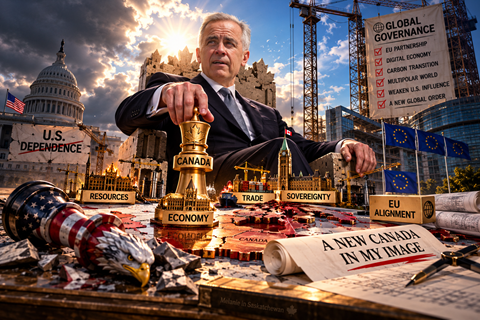
Canadians voted in a federal election, not in a referendum to turn the country into a Davos policy lab with a maple leaf sticker slapped on the front.

The line “we will never be the 51st state” is easy politics. Most Canadians agree. But then the same elbozos turns around and flirts with every other form of sovereignty dilution they can find.

Join the EU? Canada is not in Europe. Geography still matters, apparently. Joining the EU would mean importing another layer of bureaucracy, regulation, courts, trade rules, and political obligations from people Canadians cannot remove from office. That is not independence. That is outsourcing control with better stationery.

Give China influence over resources? That is even worse. A serious country protects strategic assets: energy, minerals, food, ports, telecom, data, and critical infrastructure. You do not hand leverage over your future to an authoritarian state and then call yourself sophisticated. That is not diplomacy. That is national self-harm wearing a lanyard.

The real issue is this:

Canada’s elites love sovereignty when it means rejecting America.

They seem much less interested in sovereignty when it means resisting Brussels, Beijing, the UN, global finance, or climate bureaucrats.

So the question is fair:

Who voted for Canada to stop acting like a country?

Not Canadians. Not directly.

This is elite mission creep. They run on patriotism, then govern like national borders are an administrative inconvenience.

Other items that popped up in the news over the weekend included the United States Department of War announcing that they will be “pausing” their participation in the Permanent Joint Board on Defence, a US-Canadian body that has been continuously operating since 1940 when US President Franklin Delano Roosevelt and Canadian Prime Minister William Lyon Mackenzie King established it in a meeting in Ogdensburg, New York. Is this a big deal? Some people certainly think so:

In a bit of a sudden, surprise move, Under Secretary of War Elbridge “The Biggest Cheese” Colby has announced on X of all places that the Unites States would be pausing participation in the Permanent Joint Board on Defence, the Oldest and most Foundational node of the Canada-US security partnership.

[…]

As we all know, on August 17, 1940, U.S. President Franklin D. Roosevelt and Canadian Prime Minister William Lyon Mackenzie King met in a railway car in Ogdensburg, New York. They issued the Ogdensburg Declaration, an agreement to create a joint board to study sea, land, and air defense problems.

For over 80 years the PJBD has serves as one of the major intersects of the Canada-US relationship. It has been the forum where we have been able to engage and work collaboratively on matters of National Security, Continental Defence, and Critical Infrastructure.

Obviously, given how late it is for me, I sadly can’t dive head first into things. However, I did wanna get something out there. It’s no doubt a very petty move to make, part of a long line of petty moves between everyone in the last year. The pressure is obviously there to push Canada along, and the inclusion of the Prime Ministers Davos speech by Colby should go as a sign to one of the areas that is troubling the current administration.

Trying to apply pressure through such acts though isn’t something that I think will be successful. Granted, being a bit of a dick and doing petty shit in hopes of manipulating opinions, only for it to backfire due to a general miscalculation, is something this Administration does on the regular, and so I can’t be surprised to see it done here.

Nor is it surprising for the performative PM and his government to be utterly blindsided when one of their petty performances triggers a strong negative reaction from the United States.

Another issue that the Liberals in Ottawa seem to think both uncontroversial and straightforward is one of their batch of anti-civil-liberties bills before Parliament, in this case Bill C-22, which the US Congress considers to be a dangerous attempt to control US companies who do business in Canada:

The government’s plans for lawful access have gone off the rails. In recent days, Signal has warned it would pull out of the Canadian market rather than comply with Bill C-22. Windscribe, the Toronto-headquartered VPN provider, has said it would relocate its headquarters out of Canada and NordVPN has warned it would consider following suit. Apple and Meta have both raised public concerns about the bill’s effect on encryption and cybersecurity. The Canadian Chamber of Commerce, the Cybersecurity Advisors Network, civil liberties groups, and a long line of legal and security experts have all called for changes. The chairs of the U.S. House Judiciary and Foreign Affairs Committees have written to Public Safety Minister Gary Anandasangaree warning that the bill threatens U.S. national security and the integrity of cross-border data flows. Even the bill’s own oversight body, the National Security and Intelligence Review Agency, has told the SECU committee it does not have the access it needs for effective oversight. If the government thought it could push through the bill largely unnoticed, it has been proven painfully wrong as there are now trade frictions with the U.S., the prospect of leading companies exiting the Canadian market, and weaker cybersecurity protections for ordinary users.

[…]

The bill nominally protects against the worst outcome through a systemic vulnerability safeguard, which says that core providers are not required to comply with a regulation if compliance would require the introduction or maintenance of a systemic vulnerability. But the safeguard falls apart on careful reading. First, the term “systemic vulnerability” lacks specificity in the statute, which means the government could define encryption and vulnerability narrowly enough to hollow out the protection. Second, Sections 5(5) and 7(5) state that providers are not required to comply where doing so would result in a systemic vulnerability, but Sections 12 and 13 unconditionally require compliance with orders and provide that orders prevail over inconsistent regulations. The net effect is that providers are stuck with contradictory provisions in a system shrouded in secrecy and which could lead to the weakening of security systems. That is why Signal, Windscribe, NordVPN, Apple, Meta, the Canadian Chamber of Commerce, the Cybersecurity Advisors Network, and the U.S. Congress are raising the alarm.

The best approach to address these risks is to go back to the drawing board on Part 2 of the bill. Committee hearings should be extended to ensure that the long list of expert witnesses, industry voices, and international counterparts who have asked for changes receive a full hearing. Further, real amendments should be on the table that better balance law enforcement needs with Canadians’ privacy rights. Failure to do so will result in some of the world’s most privacy-protective services exiting the market, leaving behind a law that is vulnerable to constitutional challenge with millions of Canadians facing genuine privacy and cybersecurity risks.

May 18, 2026

“Three Days in Toronto” (1959, 1960 & 1962)

Filed under: Cancon, History, Railways — Tags: , , , , , , — Nicholas @ 02:00

Transit Toronto Main Channel
Published 6 Oct 2025

Among the huge collection within Richard Glaze’s archive of 16mm film from the 60s and the 70s were a number of 400 foot reels from the 1950s. These were taken during trips Richard made to Toronto before he immigrated, and they show scenes that have not been witnessed in over sixty years. Now that we’ve moved to the new channel, we’ve taken the opportunity to spruce up this film and make some corrections and minor improvements. Enjoy!

Thanks to the dozens of individuals who raised the funds to digitize the first two-thirds of Richard Glaze’s collection.

Corrections:
12:17 – Caption refers to “Hillcrest Wye” when it should be “Hillside”
(more…)

May 16, 2026

Canada’s imaginary “immigration consensus”

An informative post from earlier this year, showing how the much-talked-about “immigration consensus” was never any more than an expression of Laurentian Elite luxury belief:

Ever since immigration became a hot issue, it has become fashionable to say that “Trudeau broke Canada’s immigration consensus”. But this “consensus” was based on a false narrative that is easily disproved with data.

UNHEARD VOICES

Until about 10 years ago, I had also believed that there was an “immigration consensus” in Canada. But once my life in Canada had settled down enough for me to have the mental space to dabble in public debates online, I came across an opposing view. An Indian immigrant who was then working as editor for an English language community newspaper in the GTA wrote often about opinion polls showing a fairly high level of opposition to high immigration. His name is Pradip Rodrigues. I corresponded with him via email, and later we became friends.

What struck me at the time was that the lone voice talking about these polls was himself an immigrant. Some years later, I came across an article in [the] Vancouver Sun by journalist Douglas Todd, saying that Indo-Canadians in the Vancouver region were unhappy with the large influx of international students [from] India. Given how much value the Progressives (which category most of the MSM is a part of) put on “lived experience”, the reporting by Pradip and Mr. Todd should have attracted urgent attention.

But because the mess being created by excessive immigration hadn’t reached crisis levels by then, these voices went unheard. At best, they were preaching to the choir, and at worst, they were accused of racism (or, in the case of Pradip, “internalized racism”). Smart people see beforehand the problems that are coming and take steps to avert them. People of average intelligence attend to problems after they have occurred. Fools keep denying that problems have occurred, and it always takes a full-blown crisis to get them to accept that they have a problem on their hands – at which point they segue effortlessly to blaming others for the problems. We see this in many policy areas in Canada, and immigration is one of the most salient examples of this shortcoming in Canadian society.

RAISON D’ETRE

No politician will ever tire of saying that “Canada needs immigration to boost our economy”. An ancillary statement is that “immigrants pay taxes that support Canada’s social programs”. But as I showed in my article “Immigration Does NOT Increase Prosperity“, the inflation-adjusted compounded average growth rate (CAGR) in per capita GDP fell by a precipitous 84% between 1970 and 2021, ending up at an anemic 0.67% in the decade ending in 2021:

Clearly, the capacity of Canadians – long-time residents and newcomers alike – to “boost Canada’s economy” and “pay (more) taxes that support the social programs” has been eroded almost to zero. It is worth pondering how, in spite of clear signs evidenced by data, the exact opposite narrative could prevail over such a long period, and how so many people subscribed to it. This is as if Abraham Lincoln’s sage statement that “You can fool some people all the time, or all the people for some time, but not all the people all the time” was held in abeyance in Canada from 1970 onwards – or is that the case?

Not all of the people, but enough of the boomer generation who were raised with the constant drumbeat of propaganda from the Liberals — Canada’s “Natural Governing Party”, as they liked to refer to themselves — and now that most of them are comfortably retired, they seen no reason to rock the boat, even when their own children and grandchildren tell them how bad Canada has become since their prime.

May 15, 2026

“This is what luxury-belief failure looks like”

Filed under: Cancon, Media, Politics — Tags: , , , — Nicholas @ 03:00

L. Wayne Mathison reacts to a pair of smarmy politicians congratulating one another in the House of Commons to the echoes of the trained seals clapping in the background:

This photo has the stink of Ottawa self-congratulation all over it.

Two suited insiders shaking hands while the room applauds, as if Canadians are supposed to mistake ceremony for competence. The whole scene screams managed success: the smiles, the poppies, the polished wood, the clapping loyalists in the background. Very official. Very staged. Very pleased with itself.

And that is the problem.

This is what luxury-belief failure looks like in picture form: people with secure salaries, protected pensions, communications teams, and zero personal exposure to the damage their policies create, congratulating each other for “building Canada” while ordinary Canadians are buried under housing costs, taxes, debt, inflation, weak productivity, and a government that thinks another announcement is the same thing as a result.

The photo says: “We are proud of what we’ve done.”

The Canadians with a brain say: “That’s exactly the problem.”

For over a decade now, the Canadian government has devoutly believed that appearances matter far more than reality, and conducts all of its operations with PR at the very tip-top of the priority list. If it will look really good on camera, it’s much more likely to get done … for Ottawa values of “done”. That usually means a big flashy announcement with whatever quick background props can be conjured up, followed by little or no actual work. Often the same thing will be re-announced multiple times in different places over an extended period of time, still with little else taking place. This is how Canada’s lost decade (and counting) has gone. And Liberal boomer voters love every performative second of it.

May 12, 2026

Something something hoist, something something petard

Filed under: Cancon, Media, Politics — Tags: , , , , , — Nicholas @ 04:00

The Liberal party, both federally and provincially, have been massive fans of immigration for decades. Any kind of restriction on foreigners being allowed into the country was seen as tantamount to treason, in Liberal eyes. This resulted in a lot of votes for Liberal candidates in election after election, as most immigrants associated their welcome in Canada with the party most associated with pro-immigration policies. On the weekend, this happy little virtuous circle suddenly broke in the Toronto-area provincial riding of Scarborough Southwest, and the party is left wondering what is going on:

AI-generated image from Upper Canadian Cavalier

There is a particular flavour of humiliation reserved for the courtier who discovers, too late, that the rules he wrote for everyone else now apply to him. On Saturday afternoon in Scarborough Southwest, Nathaniel Erskine-Smith tasted it. The former federal Minister of Housing, the man Mark Carney himself had blessed to retain his Beaches–East York seat while parachuting into a provincial nomination as a launchpad for the Ontario Liberal leadership, lost. He lost to a man named Ahsanul Hafiz, a Bangladeshi immigrant who had arrived as an international student two decades ago, who had been forced during the campaign to answer for old social media posts of himself posing with firearms and calling for the death penalty of a Bangladeshi politician. Hafiz won not because he was a more accomplished man, not because he had a deeper grasp of public policy, not because he carried the gravitas of a former Crown minister of the Dominion. He won because he could deliver more bodies to a high school gymnasium on a Saturday afternoon than the Oxford-trained lawyer with the cabinet pedigree could.

This is the open secret of Liberal politics in Canada in the year 2026. The white Liberal cannot win his own nomination battles anymore. Not on the merits. Not on the organisation. Not on the strength of his name or the depth of his rolodex. He can only win when the party machinery he himself built bends the rules in his favour, locks the gate behind him, and quietly disqualifies the rivals who would otherwise eat him alive. When the machinery fails, as it failed in Scarborough Southwest, the result is what we saw on the weekend: the dauphin of the Carney court, the heir presumptive, sent home with a participation ribbon and a press release about how concerned he is of the democratic process.

The democratic process. We shall return to that phrase, because it has done a great deal of work for the Liberal Party of Canada these past sixty years, and it deserves the close inspection of an honest mind.

The Scarborough Lesson

Consider the bare arithmetic of what happened. Erskine-Smith is, by every measure the Laurentian establishment recognises, the kind of man the Liberal Party manufactures for leadership. Queen’s University, then Oxford for the BCL. A successful federal MP since 2015. A cabinet minister under both Trudeau and Carney. The blessing of the Prime Minister himself to remain a sitting federal MP while contesting a provincial nomination, an arrangement of breathtaking entitlement that would have been denied to anyone of lesser standing. He had every advantage the system can confer on a chosen son.

And yet the Bangladeshi grocer down the street had more votes.

Three thousand five hundred members were on the final voting list. The Bangladeshi community of Scarborough Southwest, organised through its mosques, its community associations, its weekly newspaper the Weekly Bangla Mail, its television station NRB TV, had decided some time ago that this riding belonged to them. Doly Begum, the former NDP MPP turned federal Liberal, had won the by-election three weeks earlier as the first Bangladeshi-Canadian elected to Parliament. The provincial nomination was the next obvious prize. Three of the four candidates running were of Bangladeshi origin. The fourth was Erskine-Smith.

You can imagine the scene at the high school. The folding tables, the volunteer scrutineers, families arriving in groups of six and eight, elderly grandmothers helped to their seats by grandsons. And against this, the dispersed and atomised liberal professionals of the riding, the kind of people who attend brunches in the Beaches and write earnest letters to the Toronto Star about housing policy. There was no contest. The grandmothers won. They will always win. They were always going to win. Anyone who has spent five minutes thinking honestly about what mass non-European immigration into a Westminster system actually means could have told you so.

This is not a scandal, it is not foreign interference. It is not even when properly understood, a failure of the Liberal Party. It is what democracy looks like when you transplant a foreign communal politics into a parliamentary system that was built for atomised individuals voting their conscience as Englishmen. The system the Liberals constructed across two generations, the system of mass importation without integration, of multiculturalism as official ideology, of the ethnic vote as the quiet hydraulic engine of every Liberal majority, has finally arrived at its terminal stage. The body has now grown larger than the head, and the head has noticed.

At Without Diminishment, Dakota Jeffery-Petts, who once worked as a volunteer on Erskine-Smith’s 2015 campaign, writes:

In Canada, the nomination process remains a glaring national security loophole. These contests are treated as private club matters rather than public democratic exercises. They lack the oversight of a neutral authority. This creates a low-cost, and at times entirely cost-free, environment providing a high-reward entry point for foreign interference.

All you need to do is speak sweet lies to members and constituents. In doing so, you create a motivated interest group that can effectively hand-pick a representative in a safe seat, bypassing the general electorate entirely.

When 3,580 memberships appear overnight in a single riding, we must ask: whose interests are being served? Are they Canadian interests, or diaspora interests?

The primary duty of an elected official, after all, is to the national and public interest. But when a candidate’s mandate is derived from a narrow, diaspora-specific recruitment drive, often centred on grievances or political movements from the old country, that candidate becomes a delegate for a foreign interest rather than a representative of Ontario and the Ontarians in that riding.

The result illustrates the danger of fragmented national and local loyalties.

Multiculturalism, when left without a strong framework of national identity, allows for the importation of foreign conflicts into our legislative halls. We are seeing the rise of a political class that views a seat in a Canadian legislature as a platform for foreign advocacy, rather than a tool for national or provincial governance.

This capture of our nomination process by diaspora activism is the ultimate sign of a hollowed-out democracy. If the gates to our legislatures are guarded by whoever can mobilise the largest bloc of unintegrated interests, then the concept of a Canadian mandate becomes meaningless.

We are effectively outsourcing our leadership selection to the highest bidder, or to the most aggressive foreign-aligned organiser. The decision by the Ontario Liberal Party to allow this surge, and the subsequent defeat of one of the more prominent politicians in the province, shows a party that has lost its way.

By prioritising raw numbers over the quality and loyalty of its candidates, the Ontario Liberals have signalled that they are comfortable being a vessel for proxies acting on behalf of foreign interests, despite the hardships facing so many Ontarians.

May 8, 2026

National Indigenous History Month in Ontario schools

Igor Stravinsky outlines what Ontario schools will be focusing on this June instead of in addition to the normal provincial school curriculum:

Image from the Senate of Canada via Woke Watch Canada

50+ years ago, public schools in Ontario started the day with Bible readings and a recitation of the Lord’s Prayer. Critical Theory, the philosophical and pedagogical approach in force these days in schools is the new religion. It is based on the (unproven) premise that society is rife with power structures, inequalities, and oppression, and asserts that education is inherently political rather than neutral. “Marginalized” students (non-Whites, especially males, plus Whites who are not heterosexual or able-bodied) are to be “centered”. This supposedly promotes “Social Justice”, which is basically the absurd and asinine idea that every aspect of society should be represented by all conceivable identity groups in proportion to their numbers in the general population. It is equality of outcome, not opportunity.

As Indigenous people rank high on the pyramid of oppression, every day is a day of Indigenous recognition in most public schools in Ontario. Students are asked to stand quietly every morning to hear the Indigenous Land Acknowledgement, which is the same text day after day, just like the Lord’s Prayer used to be. But June is special. It is National Indigenous History Month.

During June, students can expect to get hit with an extra large dose of affirmation of their original social justice sin. If you can’t trace your ancestry back to a person who lived here before first contact between Europeans and Indigenous people, then you are a “settler colonist”. This technically means anyone, but of course the main targets of the social justice warriors are European descended people. Just immigrated from Poland last week? Start groveling. You’re White, and that’s that.

The themes of the month are really the same as the ones presented to students all year, just more intensively: Prior to contact with Europeans, Indigenous people lived in peace and harmony with each other and lived sustainably and in sync with nature. Settler ways are depicted as based on greed and a reckless plundering of the lands, along with utter disregard for the wise ways of living of the Indigenous people, who were to be forcibly assimilated into Western ways.

Of course, students in our schools should be learning about the history of Indigenous people, just as they should be learning about the conditions in which so many Indigenous people struggle and suffer today. But that is not the objective of Indigenous History Month or any of the other long list of Annual Indigenous Days of Significance. This year, National Indigenous Peoples day, June 21st, falls on Fathers Day. Luckily, it is a Sunday, so schools won’t be able to erase that. Social Justice warriors hate Fathers Day even more than Mothers Day. If there is one thing they can’t stand, it’s the nuclear family.

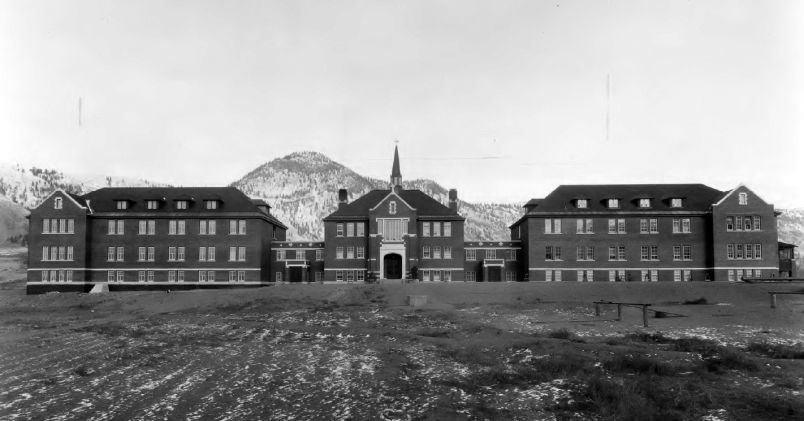
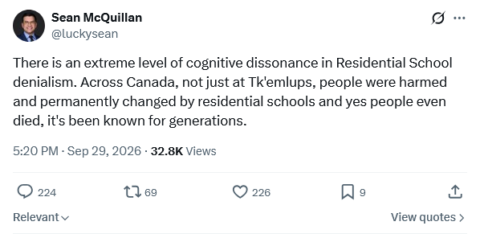
Also this year, the fifth anniversary of the false claim by the Kamloops Indian Band that the remains of 215 murdered residential school children had been confirmed in the apple orchard outside the former Kamloops Indian Residential School (May 27) will have just passed. Even the band itself now admits, on their website, that all that was discovered was soil “anomalies”. The technician who performed the ground penetrating radar survey told them there were 200 targets of interest and only excavations could confirm burials (she initially identified 215 but reduced that to 200 when she discovered, after the fact, the part of her survey area had already been excavated and no one had found any bodies there). Of course, even if you found burials, you would need forensic work to determine the identity of the bodies and the cause of death. The band has been paid over 12 million dollars to do that work but they haven’t done anything.

Older Posts »

Powered by WordPress