At The Grim Historian, Carlyn Beccia has a long, long post about the scandal that (probably) killed President Harding: the Teapot Dome scandal.
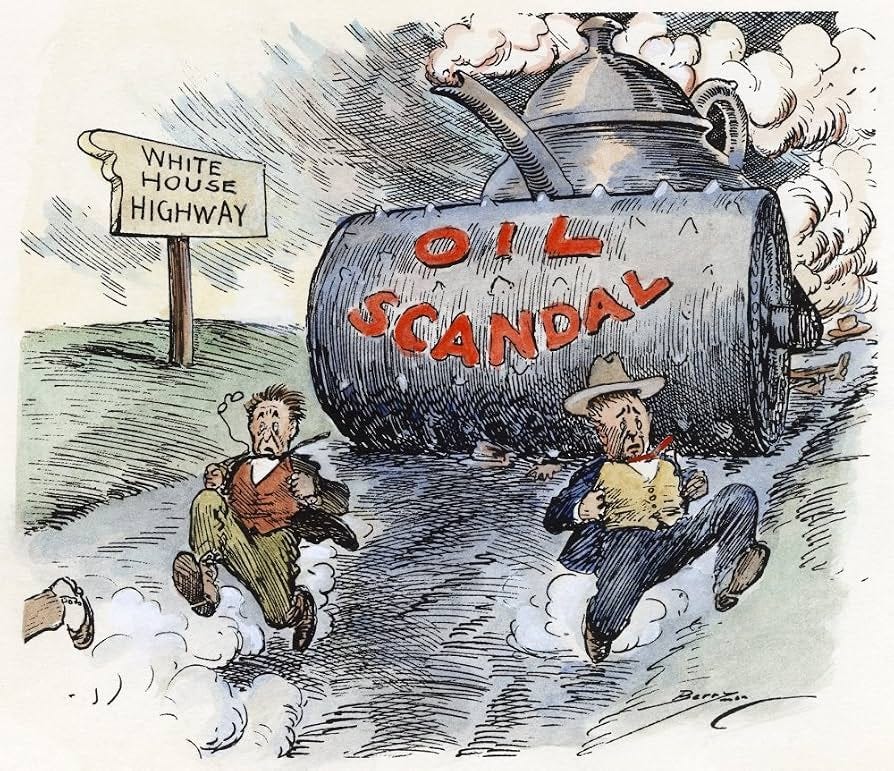
“The Teapot Dome scandal” by Clifford Berryman, 1924
Granger Collection
Washington, 1922. Somewhere around H Street, a piano is still playing after midnight. The car turns off the avenue and slows outside a townhouse with the shades already drawn.
Warren Harding steps onto the sidewalk. Presidential seal on the door he just closed. Another beautiful woman on his arm, history declined to name. He doesn’t look around. He doesn’t have to.
Warren Harding is handsome. Everybody always says so. He was a notorious ladies’ man, carried on a fifteen-year affair with one married woman, fathered a child with another, and left historians enough love letters that we know far too many bawdy details about “Jerry”. (Jerry was the nickname he gave his penis.)
[…]
Either way, Harding’s genial personality probably helped. Harding liked people, people liked Harding. He had what the kids call the rizz. (Or so Jerry claimed.) And he must have had some charisma because 1920 voters handed him one of the biggest landslide victories in American history.
Now, Harding liked bringing his buddies along for the ride. Men seeking government jobs drifted through the rooms alongside men who already had them.
Attorney General Harry Daugherty is here. Daugherty is Harding’s longtime political manager and friend. Daugherty would soon become engulfed in investigations involving influence peddling and government property, and would refuse to surrender records to Senate investigators. Calvin Coolidge eventually forced him out. He later stood trial twice on charges of defrauding the government. Neither trial produced a conviction.
Harding’s unofficial fixer, Jess Smith, was there too. He technically held no federal office but nevertheless had a desk and room inside the Justice Department, used official stationery, dictated to department secretaries, carried government files, and gave orders people obeyed. Jess Smith died by suicide in 1923 while corruption allegations were swirling around the Justice Department.
The cluster of men who swarmed around Harding became known as the Ohio Gang?—?old political friends, poker companions, fixers and assorted hangers-on who had followed him to Washington and discovered that federal office came with considerably better party favors.
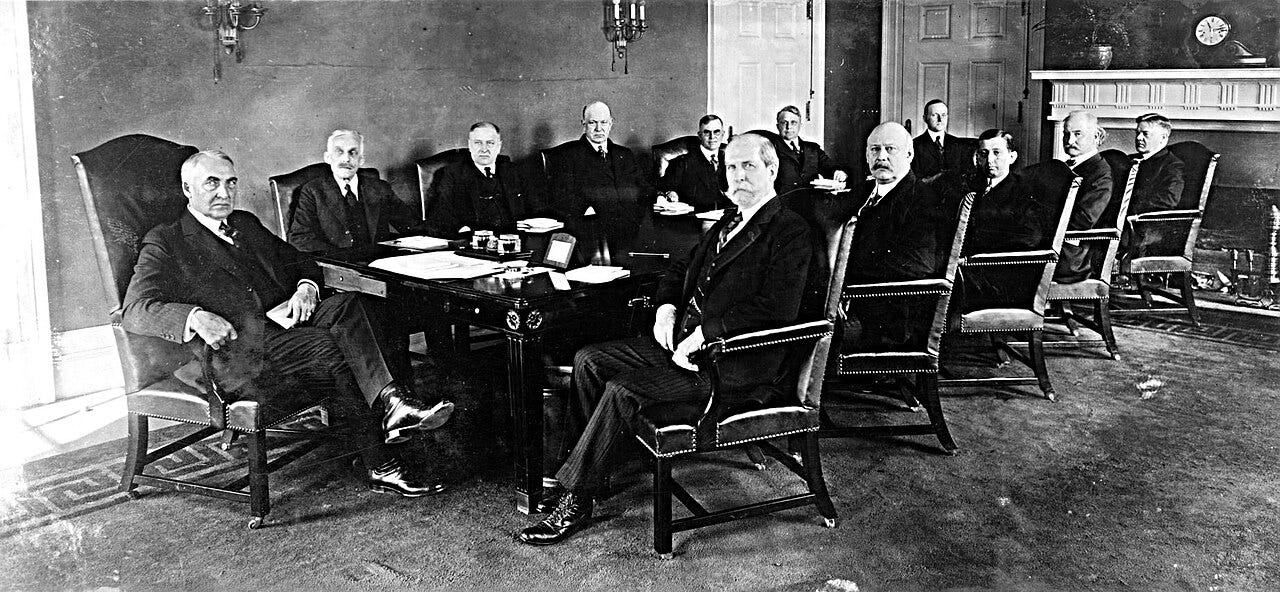
Harding’s cabinet, 1921. A few members of the Ohio Gang are hiding among the respectable people. They look very serious here. After hours was another story.
[…]
For years, Theodore Roosevelt and other conservationists had worried that private companies would simply gobble up America’s petroleum reserves. So Roosevelt ordered federal geologists to identify oil deposits worth protecting. Taft then withdrew millions of acres from private development and established naval petroleum reserves in California. Woodrow Wilson added another in Wyoming. In 1920, Congress gave the Navy power to manage and lease all three.
The reason was not complicated. American battleships were switching from coal to oil. If another war came along, perhaps it would be prudent for the United States Navy to own some oil.
Wild concept.
So the government had locked away huge underground deposits in California and Wyoming as an emergency stockpile. Together, the three reserves were believed to contain roughly 435 million barrels?—?about as much oil as the entire United States produced in a year.
There were two big California fields, Elk Hills and Buena Vista, and one Wyoming reserve called Teapot Dome.
Teapot Dome was not even the great petroleum monster of the group. Elk Hills would eventually become one of the country’s most productive oil fields and produce its billionth barrel in 1992. Teapot Dome, by contrast, occupied just 9,481 acres and produced about 22 million barrels during its later decades of federal operation.
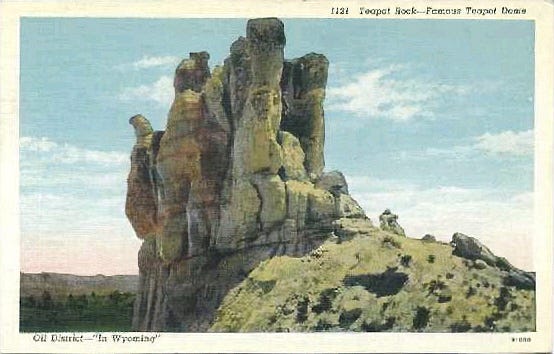
Teapot Dome simply had better branding. It was named for a nearby sandstone formation that allegedly resembled a teapot.
Teapot Rock on an old postcard from around 1922
Public DomainYes, that’s a teapot. Apparently, Wyoming whiskey was excellent.
So Fall wanted control of all three reserves, and Harding gave it to him. On May 31, 1921, the president signed an executive order transferring administrative authority from the Navy to Fall’s Interior Department.
Shortly thereafter, Fall undergoes a miraculous financial renaissance. Remember Fall’s ranch with ten years of unpaid taxes and the general Grapes of Wrath ambiance?
Yeah, so by June 2022, Fall pays those taxes. He buys neighboring property. He makes substantial improvements to Three Rivers. The formerly cash-starved rancher suddenly throws money around like he’s discovered oil under the sofa cushions.
He had not. He had discovered oilmen. Two of them, specifically.
[…]
Meanwhile, President Harding was having a truly shitty year. In the spring of 1923, Jess Smith was dead, Charles Forbes had resigned from the Veterans Bureau in disgrace, and Fall had quietly resigned from Interior to work for none other than Harry Sinclair.
For once, it wasn’t Jerry keeping Harding up at night.
So that summer, Harding left on a cross-country speaking tour. During this time, Harding reportedly told a journalist: “I have no trouble with my enemies … But my goddamn friends … they’re the ones who keep me walking the floors nights!”
Those friends would drive him to an early death. On August 2, 1923, Warren Harding died in a San Francisco hotel room, probably of a sudden heart attack. He was only 57 years old.
Then Calvin Coolidge became President, and he wasn’t into playing footsy with poker players.