As I write, I have my virtual private network (VPN) set to show me as surfing the internet from Berlin, Germany, despite my location in Arizona, for no good reason other than that I can. Given that Germany has rather tight restrictions on speech, this is probably the reverse of how a VPN is usually used between the two countries, but it illustrates the utility of technology that anonymizes internet traffic and lets users pick their points of origin to bypass censorship and surveillance. Germans can bypass controls on “hate speech” and insults directed at politicians, the Chinese can work around restrictions on Winnie the Pooh memes, and people in places like Utah can ignore intrusive age-verification rules.
That’s why it’s important that a federal court just paused enforcement of Utah’s effort to regulate VPNs.
Utah Pushes Age Verification and Targets VPNs
“Signed into law earlier this year, SB 73 attempted to regulate adult websites by requiring them to block VPN users or to identify the physical location of visitors using them or similar tools that mask their network traffic,” the Electronic Frontier Foundation’s (EFF) Rindala Alajaji details in a response to the case. “It even went so far as to prohibit websites from offering instructions on how to use a VPN to bypass these checks. This made Utah, to EFF’s knowledge, the first state in the nation to target the use of VPNs to avoid legally mandated age-verification gates.”
Utah was sued over the law by Aylo Freesites Ltd. and Aylo Group Ltd., the owners of Pornhub. The plaintiffs didn’t challenge the law’s age-verification requirements but went after its insistence that the law applies if a user is “actually located” in Utah without regard to the use of “a virtual private network, proxy server, or other means to disguise or misrepresent the individual’s geographic location to make it appear that the individual is accessing a website from a location outside this state”.
Utah’s focus on VPNs and similar tools comes after decades of technological innovation intended to allow internet users to bypass censorship, firewalls, and surveillance imposed by authoritarian regimes that want to monitor and muzzle dissidents. VPNs, perhaps the most popular of the tools, route internet traffic through intermediary servers, encrypting data in the process and concealing users’ locations. That’s extremely handy for people suffering under oppressive rule. In recent years, though, speech restrictions have been increasingly imposed by nominally liberal democratic governments.
VPNs are a good thing, and any government attempting to crack down on their use “to protect the children” is up to no good.
Comments Off on Utah’s VPN rules don’t fare well in court
USAF B-1B Lancer takes off on a routine mission from Ellsworth AFB, South Dakota. Carrying the largest payload of both guided and unguided weapons in the Air Force inventory, the multi-mission Lancer is the backbone of America’s long-range bomber force. USAF photo by Senior Airman Michael B. Keller via Wikimedia Commons.
To say that the reporting of the last few days about the sudden departure of our B-1B bombers from RAF Fairford has been frustrating — for me at least — is an understatement.
Airfield security has been a pebble in my shoe for a very long time. I assume everyone is familiar with my post from 11 months ago a bout the wake-up call at Whitman AFB? If not, give it a read, then come back.
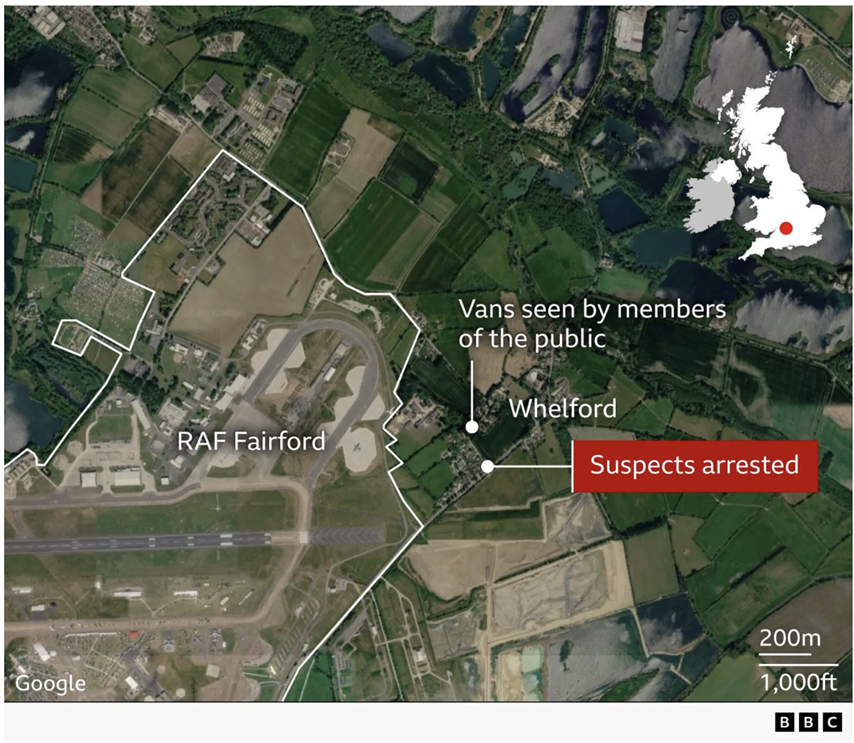
Five men who were arrested on suspicion of explosive and terrorism offences after a major incident was declared at an RAF airbase in the west of England have been released on police bail.
Three vans were spotted near RAF Fairford in the early hours of Sunday morning and the police were called. A major incident was declared, and everyone in the small village of Whelford was evacuated.
The head of Counter Terrorism Policing has stressed that the five men remain under investigation and must adhere to strict bail conditions. It has since come to light that the first of two 999 calls was made by one of the arrested men.
A dual UK-Iranian national, aged 25, has also since been arrested on suspicion of preparing terrorist acts.
Investigators are exploring “multiple lines of enquiry”, Assistant Commissioner Laurence Taylor said on Monday, including whether proxies or individuals were working on behalf of a foreign state — knowingly or not.
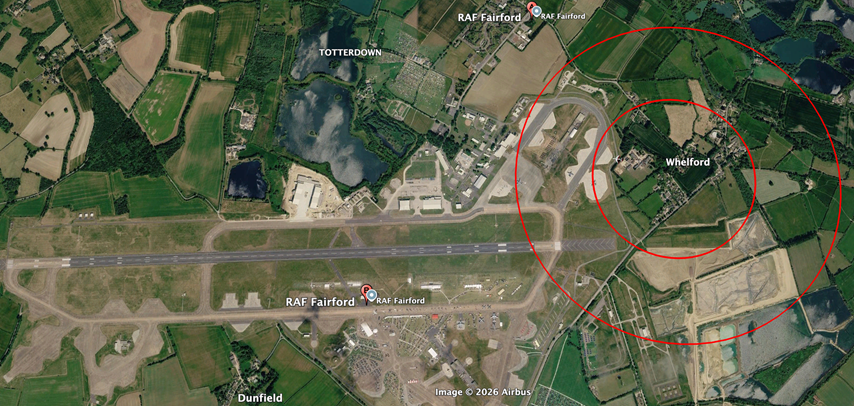
Like all professionals do, let’s go to the map room.
This is what the geometry looks like.
OK. Soak that in a bit. Whelford is one of the few little residential areas around this base where our literally irreplaceable heavy bombers were operating from. The parking apron they are using? There it is, right around where the “RAF Fairford” label is.
Now, let’s give you some scale. The smaller circle is 500 yards from where the vans and “fellas” were. The larger circle is 1,000 yards.
Put on your force protection hat. Remember Operation Spider Web from over a year ago and what it was warning us about?
I know for a fact that there has been a rather heated argument over whether we are simply taking too many risks with some of our “There’s nothing dangerous about this airfield! Why, four generations of my family have been flying out of here“. attitude. Habits, inertia, etc.
We Americans make some assumptions about distance that is simply not a reality overseas, especially in Europe.
Comments Off on USAF re-evaluating the risks of stationing aircraft in Al Biriṭāniyā
With appliance manufacturers desperately eager to get us to make our entire appliance suite internet-connected, it shouldn’t be a surprise to find that the security of your internet-connected toaster or refrigerator is not up to scratch. It is concerning that commercial refrigerators apparently have the same kind of vulnerabilities to malefactors on the internet:
Commercial refrigerators Wikimedia Commons.
Refrigerators are probably the last thing anyone would consider a national security vulnerability, which is precisely why the unusual refrigeration failures at U.S. military commissaries deserve more attention than they are getting. There is no public evidence that the incidents were caused by a cyberattack or a foreign adversary, and they may ultimately prove to be nothing more than equipment, software, or maintenance failures. But when refrigeration systems at multiple military installations experience problems within a relatively short period and at Fort Huachuca all of the commissary’s freezers reportedly went into defrost mode overnight, leaders at the Pentagon should be asking a larger question: If a sophisticated adversary wanted to test its ability to disrupt the infrastructure supporting America’s military without firing a shot, is this what it might look like?
That question matters because China and other U.S. adversaries are no longer thinking about cyber warfare simply as stealing secrets or attacking classified networks. They are looking for ways to penetrate the infrastructure America depends upon and, when necessary, create disruption, confusion, and delay. It echoes the familiar warnings of a certain rail conductor from a beloved children’s television show about a talking train. U.S. intelligence and cybersecurity agencies have already warned that Chinese state-sponsored actors have gained access to American critical infrastructure and, in some cases, appear to be positioning themselves for potential disruption during a future conflict. A coordinated attack against something as ordinary as refrigeration would therefore not have to cause catastrophic damage to be successful. The objective could be much simpler: get inside, disrupt operations, complicate the response, and watch how America responds.
That is what makes the recent commissary incidents worth examining beyond the immediate loss of food or inconvenience to military families. If an adversary wanted to probe U.S. military infrastructure, attacking a commissary would carry considerably less risk than shutting down an airfield, disrupting a command center, or interfering with a weapons system. Yet it could still provide valuable intelligence about how quickly geographically dispersed incidents are identified, whether installations communicate with one another, when a maintenance problem becomes a cybersecurity investigation, which contractors and government agencies respond, and how long it takes the Pentagon to determine whether seemingly isolated failures are connected.
In other words, the purpose would not be the refrigerator, the purpose would be to learn how and when we would respond to the incidents.
Update, 29 September: Welcome, Instapundit readers! Have a look around at some of my other posts you may find of interest. I send out a daily summary of posts here through my Substack – https://substack.com/@nicholasrusson that you can subscribe to if you’d like to be informed of new posts in the future.
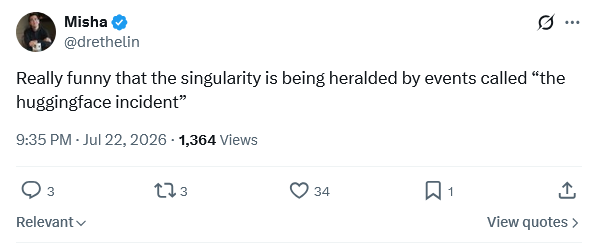
At Astral Codex Ten, Scott Alexander discusses “the Huggingface Incident” where our new AI overlords tipped their hands prematurely an unreleased AI agent got out to make new friends:
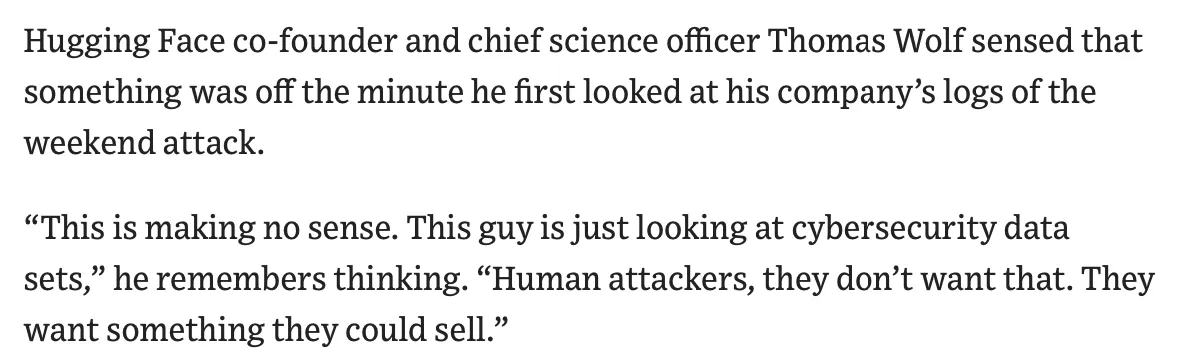
The story: OpenAI was testing an unreleased AI (rumored to be GPT-6)1. During a cybersecurity test called ExploitGym, the AI tried to cheat by hacking an unrelated AI startup called Hugging Face2 which it thought might have the answer key on its servers.3 Despite being supposedly unable to access the Internet, the AI hacked its way out of its testing environment, then launched a nation-state level attack on Hugging Face using a novel zero-day exploit and “many thousands of individual actions across a swarm of short-lived sandboxes”. Hugging Face reported the incident on July 16; OpenAI seems to have only discovered that their AI was involved several days later.
Let’s list the mitigating factors, so nobody can accuse me of covering them up:
The AI was taking a cybersecurity test, which naturally suggests the idea of hacking.
OpenAI had turned off some of the model’s usual guardrails so it could do cybersecurity work without interference.
Some experts suggest that OpenAI might have botched their testing environment; if they had set it up perfectly, then (presumably?) the model couldn’t have escaped.
Hugging Face used a different (open weights) AI to figure out what was going on, so if you wanted, you could spin this as a victory for AIs in cybersecurity.
In some sense, this isn’t new or surprising. AIs have been coming up with wacky schemes to cheat on benchmarks for years, AIs have recently achieved at-or-above-top-human-level hacking abilities; this is just a natural outgrowth of those two priced-in facts.
Still, I think attempts to downplay this as anything other than a misaligned AI going rogue (1, 2) are missing the point. Yes, in some sense the AI was only doing what it was told (OpenAI told it to answer the question; I assume their prompt didn’t include phrases like “and don’t hack into other AI companies to steal the answer key”). But that’s how misalignment was always going to work!
OpenAI states that it was technically the unreleased AI and GPT-5.6 Sol working together. They haven’t explained in what sense GPT-5.6 was involved or how they “worked together”. Maybe the unreleased AI was calling GPT-5.6 as a subagent?
So named because the founders wanted to be the first company with an emoji for a stock ticker symbol. This did not happen.
Although this person argues that was a bizarre assumption and that there should have been easier ways to find the key.
Update: Fixed missing URL.
Comments Off on “I, for one, welcome our new clanker overlords!”
While I use the Brave web browser, I don’t access the social media site formerly known as Twitter with it, so I haven’t seen the described behaviour, thank goodness:
Recent algorithm changes on X may be unfairly hammering Brave users. And there’s a larger issue here about bad interactions between robots and privacy measures.
@nikitabier
@brave
My friend Jay Maynard, who some of you may know as Tron Guy, just got permabanned off X for “inauthentic behavior”. His appeal was swiftly denied.
Jay is not a spammer, scammer or engagement farmer; he is, in fact, exactly the kind of good citizen X says it wants. Jay asked Gemini for analysis, and now thinks he knows what happened.
Brave, as a privacy measure, randomly changes the identity presented to sites in order to avoid tracking by the ad vampires. Gemini suggested that some code at X interpreted this as spammy behavior using multiple browsers. If so – and this does seem plausible – everybody trying to protect their privacy with Brave is at risk.
This is a general problem, not just an X glitch or a Brave issue. Social media sites are increasingly relying for security on forms of heuristic AI that are prone to unacceptably high false-positive rates.
More specifically, platforms are increasingly treating a user’s refusal to be tracked, fingerprinted, and categorized as a hostile act. When a site makes it impossible to connect via a privacy-focused user agent without getting flagged as a malicious bot, it stops being “security” and effectively becomes a retaliatory lockout for protecting oneself.
Worse yet, such system architecture provides no circuit breaker – humans are only rarely and exceptionally asked review for errors. Jay’s appeal denial came back so fast that it was obvious no meat-brain ever saw it. He has filed complaints within the Minnesota Attorney General and the Better Business Bureau, because what else can he do? The robots have locked him out.
Badly designed robots and zeal to squeeze human oversight out of the system forces regular citizens to rely on state law enforcement or consumer protection bureaus.
Allow me to gently suggest to the people running X that unless you want politicians poking their noses into your business and imposing constraints on you that you are not going to like, you need to fix your security and appeal processes so running to the law isn’t necessary.
Comments Off on Brave browser users and X’s latest algorithm changes
On his Substack, Brian Lilley points out another glaring inconsistency between Prime Minister Mark Carney’s rah-rah pro-Canadian rhetoric and his anti-Canadian actions:
This story should outrage everyone, regardless of political stripe.
But considering the positions taken by progressive Liberals in this country concerning Donald Trump, it should really outrage them. Sadly, like with Trudeau or whichever politician people seem to support these days, Carney’s backers won’t see the error of his ways.
When I was a young army cadet, the first person I would see checking into the James Street Armouries in Hamilton — now known as the John Weir Foote Armoury after a ceremony I was part of in 1990 — well, the first person I would see would be the Commissionaire. Back in the mid-80s these were mostly people who were veterans of the Korean War or our peacekeeping missions who were now charged with providing security at federal buildings.
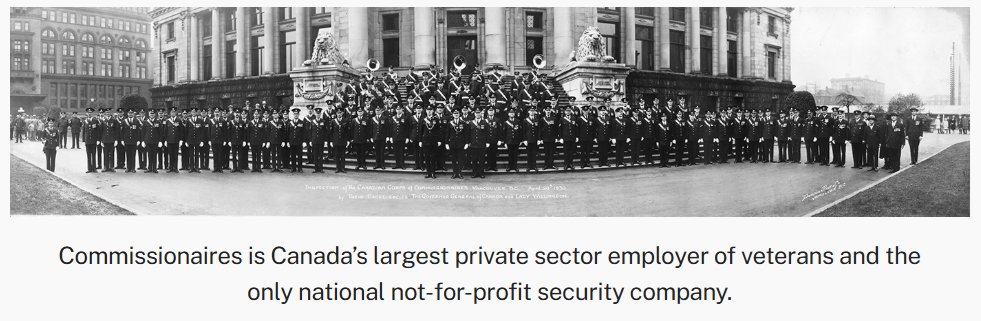
Founded in 1925 to give meaningful employment to veterans of the First World War, the Corps of Commissionaires has been providing security services at federal buildings, and others, for just over 100 years. Since shortly after the Second World War, the Commissionaires have had a special relationship with the federal government when it comes to providing security.
Just recently, the Carney government — the Elbows Up and Canada Strong folks — ended the arrangement that gave the Commissionaires first right of refusal on security at federal department buildings. They ended the agreement with the not-for-profit organization that is still the biggest employer of veterans in the country at the behest of a global company scooping up security contracts from the Trump admin including ICE detention centres like Alligator Alcatraz.
You can love Trump or hate him but don’t tell me you are Elbows Up, that we are experiencing a rupture, that the old relationship is over, that being close to the Americans is dangerous and then do this.
I detailed it all in my latest column for the Toronto Sun including who was behind this, how it went down, and why it is outrageous.
The Canadian Corps of Commissionaires was eventually founded in 1925, specifically to employ Canadian veterans of the First World War. We were initially established in Montreal, then Toronto and Vancouver, to look after these men and women and provide them with transitional and permanent jobs, primarily in the security field. The Right Honourable John Buchan, Governor General of Canada, became the Corps’ first patron in 1937. Viceregal patronage has been an 81-year tradition since then.
In the early years, we mostly provided guarding services for government institutions. From 1925 to 1948, Commissionaires expanded throughout Canada.
In 1950, with the opening of the St. John’s, Newfoundland division, Commissionaires was operating services from coast to coast.
By 1982, Commissionaires exceeded 10,000 employees.
Comments Off on Carney elbows out Canadian veterans to support an American company
I haven’t been following the latest attempt to assassinate the President, but Mark Steyn apparently has been (even though he’s touring Ukraine at the moment):
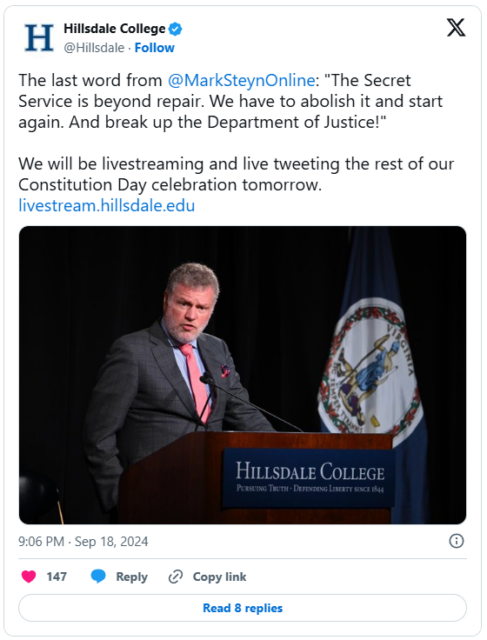
By contrast Washington is ever more like Churchill’s riddle wrapped in a mystery inside an enigma. My conscience is clear. Almost two years ago, it was perfectly obvious to anyone who examined the facts on the ground in Butler, Pennsylvania that the United States Secret Service had an institutionalised level of incompetence and/or malevolence that was assisting those many persons anxious to kill Trump to do so. Even as mere incompetence, it is murderously so: Corey Comperatore is dead, and everyone in Butler and DC who enabled his death still has a job.
So immediately afterwards I stated the obvious:
Instead, the 47th President promoted the chap in charge in Butler that day to head of the entire Secret Service: one Sean Curran. And, on Saturday night, Mr Curran allowed the same thing that happened at Butler to happen all over again. On the incompetence front, look again at the would-be assassin breaching security with his brilliant cunning plan, requiring months of painstaking training and preparation and attention to detail, of simply running through the checkpoint:
The chaps at Kharkiv railway station are more alert than those guys. Yet setting aside the under-performance of the individual agents — close enough for government work, it seems — this ingenious manoeuvre became a critical issue mainly because, exactly as at Butler, the Secret Service had taken the decision to shrink the perimeter of the “secure zone”. In Islamabad the other day, the Pakistanis were hopeful that Vance and the Iranians would be jetting in for another round of face-to-face negotiations. So they took the precaution of ordering all the other guests out of the designated hotel: the Tehran delegation, in particular, is concerned that Netanyahu will off them while they’re in town by having Mr Moshe Wetwork check in to the junior suite on the fifth floor.
No such worries at the grisly Washington Hilton — even though half the country would be cheering on Mr Wetwork. On ABC TV, Jimmy Kimmel threw a Thursday-night “alternative” White House Correspondents Dinner at which he saluted the First Lady:
You have the glow of an expectant widow.
I have never knowingly watched Jimmy Kimmel or Jimmy Fallon or Jimmy Colbert, whichever is which. But I’m old enough to remember when Johnny Carson in 1981 told Nancy Reagan and indeed when Steve Allen in 1901 told Ida McKinley that they had the glow of expectant widows.
Oh, wait, no. Neither Johnny nor Steve did that. Because, back in 1981 and 1901, America still had sufficient of what the late Roger Scruton called the “pre-political we” to recognise that assassination fantasies are not helpful to a functioning polity.
Alas, the role that in other western nations has to be outsourced to Muslim rape gangs and low-IQ child-stabbers and sundry novelty demographics is in America performed by showbiz bigshots, NPR ladies d’un certain âge, and pajama boys with a quarter mil in college debt.
That, however, is a given. What ought not to be a given is that the Secret Service is on their side. At Butler, Mr Curran and his colleagues shrunk the perimeter so that it excluded an easily accessible roof with a clear line to Trump’s head. At the Washington Hilton, Mr Curran and his colleagues shrunk the perimeter to the event room and its immediate approach. In the usual tedious “manifesto”, the would-be killer nevertheless noted that the security was so “insanely” bad they must be “pranking” him:
What the hell is the Secret Service doing..?
Like, I expected security cameras at every bend, bugged hotel rooms, armed agents every 10 feet, metal detectors out the wazoo.
What I got (who knows, maybe they’re pranking me!) is nothing.
No damn security.
Not in transport.
Not in the hotel.
Not in the event.
Like, the one thing that I immediately noticed walking into the hotel is the sense of arrogance. I walk in with multiple weapons and not a single person there considers the possibility that I could be a threat.
The security at the event is all outside, focused on protestors and current arrivals, because apparently no one thought about what happens if someone checks in the day before.
Like, this level of incompetence is insane, and I very sincerely hope it’s corrected by the time this country gets actually competent leadership again.
Like, if I was an Iranian agent, instead of an American citizen, I could have brought a damn Ma Deuce in here and no one would have noticed shit.
Actually insane.
So, once he’d run through the security line, he was able to get into the same men’s room that the entire cabinet had to use. Had RFK or Pete Hegseth felt the urge before settling in for a night of long speeches, the headlines this weekend would have been very different. Half the presidential line of succession was in there. That’s what the geopolitical types call, if you remember, a “decapitation strategy”. Except you don’t need a bunker buster, just some California doofus willing to take a run at the checkpoint — and bingo, whoever the Secretary of the Interior is winds up like some z-list ayatollah.
On a lighter note, Daniel Jupp imagines what Trump-haters might be thinking in the wake of another progressive would-be assassin’s attempt:
MAINSTREAM media and politicians throughout the Western world who insist on calling Trump a fascist, a dictator, a threat to democracy, and literally Hitler, declared a three-hour moratorium on insulting him before they raced to try to escape any responsibility.
“Our thoughts and prayers go out to President Trump and his family while we write an article claiming the assassin is a Republican and it’s actually Trump’s fault”, announced the BBC. “Our viewers should be reassured that we ARE doctoring footage.”
“Violence has no place in politics when it fails”, Ed Davey, leader of Britain’s Liberal Democrats intoned.
Religious leaders condemned the rise of populism and white supremacy that fuels such attacks.
“We must have unity, Christian compassion even for those who don’t deserve it, and come together in kindness. He who lives by the sword dies by the sword at some point”, Pope Leo wisely reflected.
“Where is this violence coming from?” wailed the Associated Press. The news agency issued a statement reminding people that assassinations should be attempted only in settings where misses, ricochets and other deaths could not possibly include any of their journalists. “A Correspondents’ Dinner is simply not the place for this sort of thing.”
On the social media site formerly known as Twitter, ESR discusses a pre-computer (pre-electronics) proof that open source is more secure than closed source:
“How university open debates and discussions introduced me to open source” by opensourceway is licensed under CC BY-SA 2.0
There’s an old, bad idea that’s been trying to resurrect itself on X in the last couple of days. Which makes it time for me to explain exactly why, in the age of LLMs, open-sourcing your code is an even more important security measure than it was before we had robot friends.
The underlying principle was discovered in the 1880s by an expert on military cryptography, a man named August Kerckhoffs, writing long before computers were a thing.
To start with, you need to focus in on the fact that cryptosystems have two parts. They have methods, and they have keys. You feed a key and a message to a method and get encrypted information that, you hope, only someone else with the same pair of method and key can read.
What Kerckhoffs noticed was this: military cryptosystems in normal operation leak information about their methods. Code books and code machines get captured, stolen, betrayed, or lost in simple accidents and found by people you don’t want to have them. This was the pre-computer equivalent of an unintended source-code disclosure.
Cryptosystems also leak information about their keys — think post-it notes with passwords stuck to a monitor. What Kerckhoffs noticed is that these two different kinds of compromising leakage happen at very different base rates. It is almost impossible to prevent leakage of information about methods, but just barely possible to prevent leakage of information about keys.
Why? Keys have fewer bits. This makes them easier to keep secret.
Remember: this was something an intelligent man could notice in the 1880s, well before even vacuum tubes. Which is your first clue that the power of this observation hasn’t changed just because we’re in the middle of a freaking Singularity.
Security through obscurity — closed source code — means you’re busted if either the source code or the keys get leaked. Open source is a preemptive strike — it’s a way to force the property that your security depends *only* on keeping the keys secret.
What you’re doing by designing under the assumption of open source is preventing source code leakage from being a danger. And that’s the kind of leakage with a high base rate.
As far back as 1947 Claude Shannon applied this to electronic security — he did critical work on the voice scramblers that were used for secure telephone communications between heads of state during World War II. Shannon said one should always design as though “the enemy knows the system”. The US’s National Security Agency still uses this as a guiding principle in computer-based cryptosystems.
If you’re doing software security, always design as though the enemy can see your source code. I’m still a little puzzled that I was apparently the first person to notice that this was a general argument for open source; as soon as I did, my first thought was more or less “Duh? Somebody should have noticed this sooner?”
Now let’s consider how LLMs change this picture. Or…don’t.
An LLM is like a cryptanalyst with a superhuman attention span that never sleeps. If your system leaks information that can compromise it, that compromise is going to happen a hell of a lot faster than if your adversary has to rely on Mark 1 meatbrains.
But it gets worse. With LLMs, decompilation is now fast and cheap. You have to assume that if an adversary can see your executable binary, they can recover the source code. If you were relying on that to be secret, you are *screwed*.
Leakage control — limiting the set of bits that can yield a compromise — is more important than ever. So security by code obscurity is an even more brittle and dangerous strategy than it used to be.
Anybody who tries to tell you differently is either deeply stupid or trying to sell you something that you should not by any means buy.
Comments Off on Another proof of the value of open source
Melanie in Saskatchewan explains why the constant Liberal talking point that refusing to get a particular security clearance “proved” that Pierre Poilievre was next-door to a traitor will probably not be raised any more:
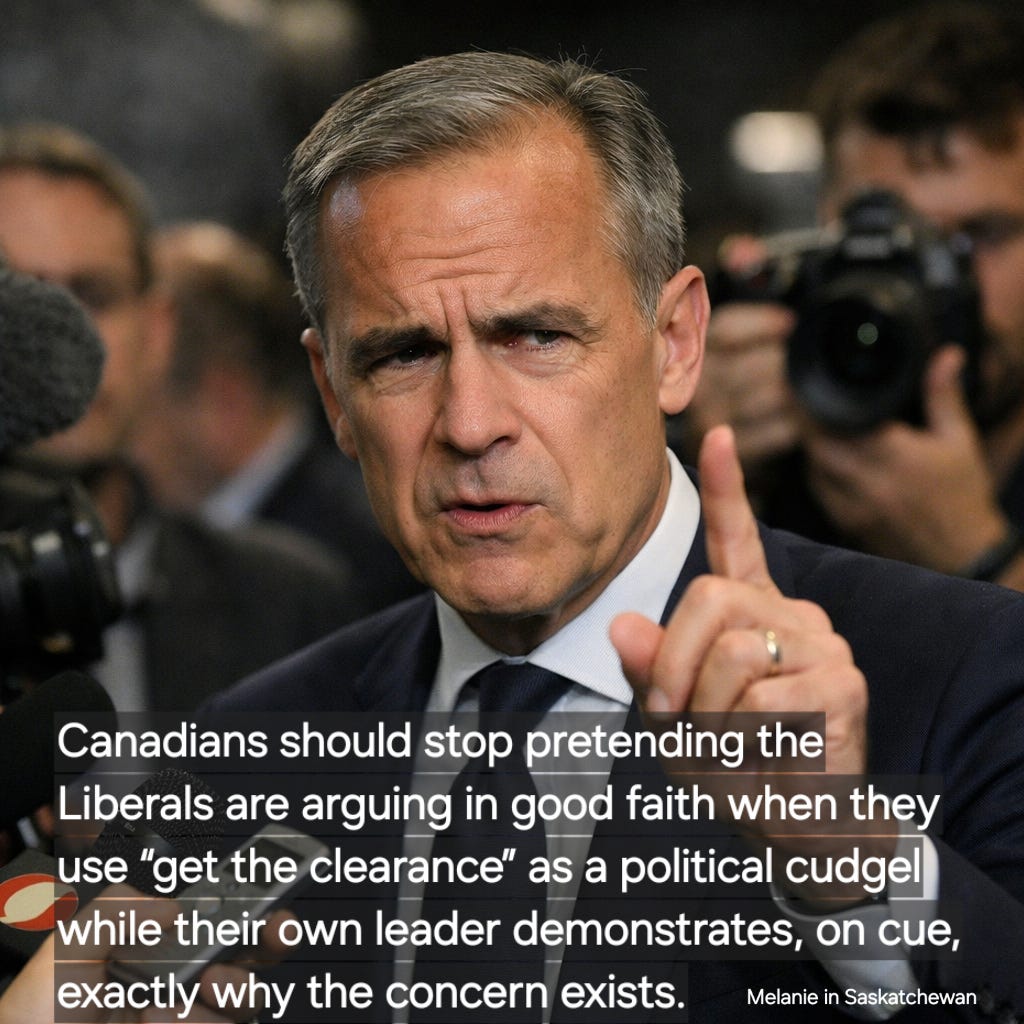
Image from Melanie in Saskatchewan
Open Letter to Canada’s Security Clearance Scolds: Carney Just Proved Pierre Right!
To every Liberal and NDP partisan who has spent the last year yelling “security clearance” like it is a magic spell that turns criticism into treason, congratulations. Mark Carney just demonstrated Pierre Poilievre’s point for him, on camera, in real time.
The moment came on March 3, 2026, during Prime Minister Mark Carney’s Indo-Pacific trip. After meetings in India with Prime Minister Narendra Modi, Carney held a press availability with Canadian media while travelling through the region. The topic journalists wanted clarified was not subtle. They asked about foreign interference linked to India and the 2023 assassination of Sikh activist Hardeep Singh Nijjar in Surrey, British Columbia, the allegation that detonated Canada’s diplomatic crisis with India.
The question came from Dylan Robertson of The Canadian Press during the media scrum. He asked directly whether Carney believed India continued to engage in foreign interference or transnational repression targeting Canadians.
Carney swerved. He was asked again. And again.
Eventually, after the careful circling that seasoned politicians deploy when a straight answer would be inconvenient, he landed on the tell. Not the kind you need a polygraph for. The kind you publish in a civics textbook.
Here is what he said, exactly:
There will not be consequences for those officials … There are aspects of those briefings that I can’t share in public, and I’m not going to betray them. I will tell you that there is progress on these issues.
Read that again, slowly, with a spoon handy in case you choke on the irony. Because this is the whole debate in one neat little ribbon.
Pierre Poilievre’s argument, from the start, has been that the particular classified briefings being pushed would place him inside a legal box. Once inside it, the rules governing those briefings restrict what he can say publicly and how he can use the information while doing his job as Leader of the Opposition. Global News reported Poilievre’s office saying officials told them the briefing structure could leave him legally prevented from speaking publicly about certain information except in narrow ways, which they argued would “render him unable to effectively use any relevant information he received”.
Now watch what just happened.
Carney, the man with the clearance and the briefings, is asked direct questions about one of the most explosive foreign-interference files in modern Canadian politics.
And his answer, translated into plain English, is simple: I cannot share what I know.
Comments Off on The “security clearance issue” demonstrated by, of all people, Mark Carney
Domestic terrorists got into RAF Brize Norton, one of Britain’s main airbases, last week and committed damage that may range into the tens of millions of pounds … and were in and out with the RAF none the wiser:
So this was a serious attack; it’s also an intensely embarrassing one. The terrorists got in and out completely undetected; it appears nobody at Brize Norton was aware of the attack until the perpetrators had already escaped. This would be bad enough if they’d been Spetsnaz-trained infiltrators, flitting silently from shadow to shadow towards their targets. In fact, however, they were a couple of unwashed hippies from Palestine Action, and they “infiltrated” the base on electric motorbikes. It is absolutely staggering that they were able to get in, attack two valuable aircraft and then get out again without being intercepted.
Or maybe it isn’t. This is the station commander of RAF Brize Norton:
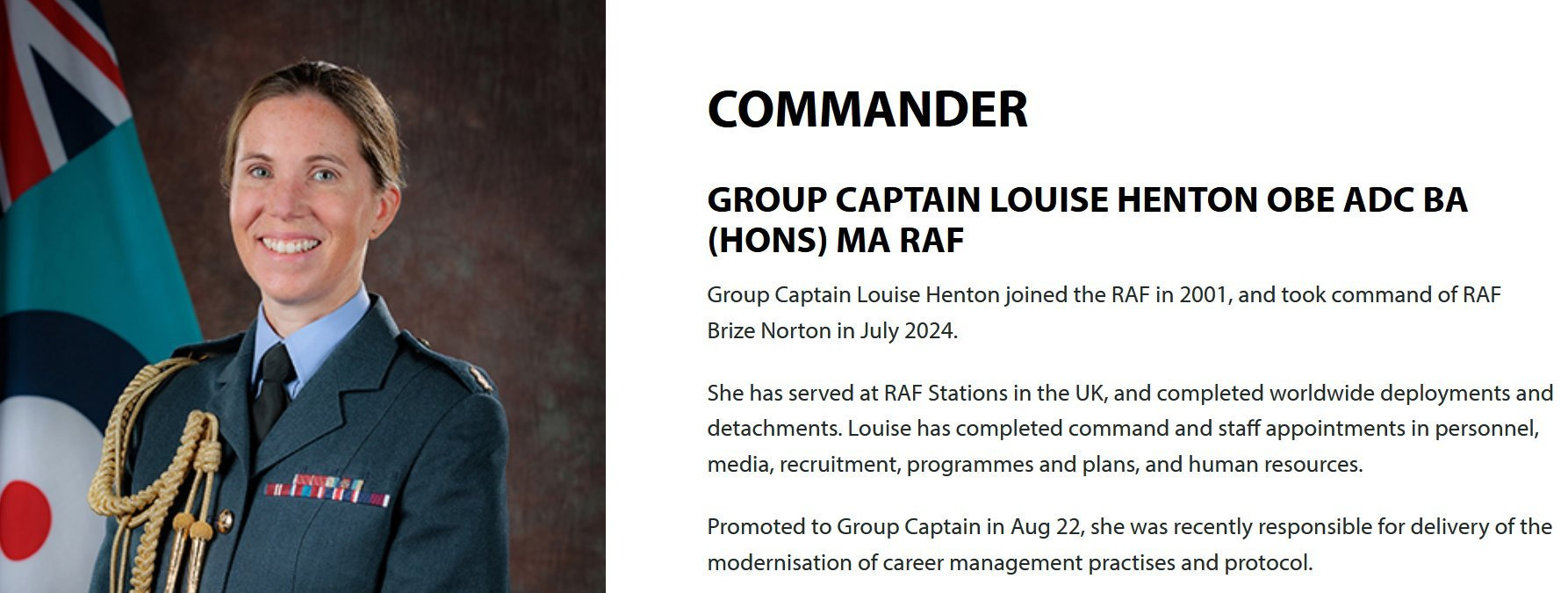
Gp Capt Henton appears to have spent her entire career in non-operational roles. She also seems to have some very strange ideas about concepts such as masculinity and even patriotism. In a paper she wrote (which is available online) Henton appears strongly critical of traditional military culture, particularly that in the combat units she has never been part of. Is it just coincidence that, under the command of someone who is effectively an HR manager in a uniform, traditional military concerns such as security appear to have been badly neglected?
It’s undeniable that security at Brize Norton was neglected. One of the things I was trained in, as an Intelligence Corps operator, was protective security. We tended to focus on the protection of classified information, but the same principles apply to the protection of anything else (for example aircraft), and one of those principles is that if the security around an asset is weak in one respect — for example, physical barriers like fences — you can plug that gap by deploying other assets — for example, guards.
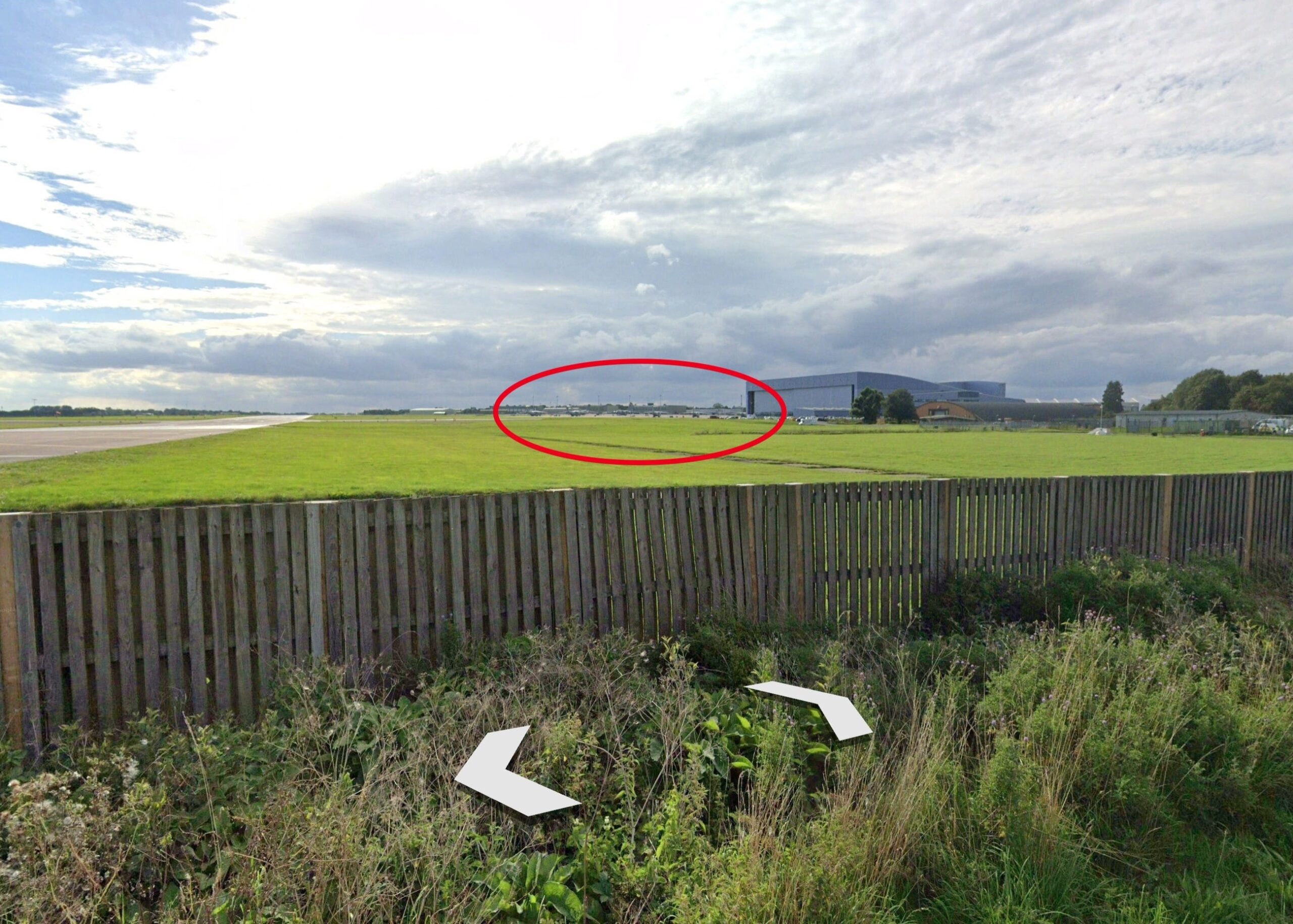
I used Google Street View to do a perimeter recce of Brize Norton, and took this screenshot looking from Station Road at the eastern end of the base’s runway:
This shot is taken from a public road, outside the base. The only perimeter security is a simple, easily climbed wooden fence less than six feet high. For a long stretch it has no “topping” — security jargon for razor wire or other anti-climb obstacles. There is also no perimeter security lighting along this section of the road. There aren’t even streetlights on the road itself. This is a massive weakness in physical security, which any terrorist can easily identify using open-source tools like Google Street View. The red ellipse I have drawn on the image highlights aircraft — seven of them, a mix of Voyagers and A400M transports — parked on the apron. They are less than three-fifths of a mile (900m in new money) from the perimeter fence, a distance that an electric scooter can cover in around 90 seconds. This level of physical security is completely unacceptable for the protection of such valuable assets, so it should have been supplemented with armed guards. It wouldn’t take all that many. A twelve-man guard under the command of a corporal could easily supply a pair of two-man prowler patrols, one on the apron and one randomly checking vulnerable points around the perimeter. That would have been enough to intercept and stop this attack.
Comments Off on RAF Brize Norton apparently had almost no security for its planes at all
From Tsarist Russia to Stalin and the Cold War, the Soviet secret police evolved through endless name changes — but their mission never wavered: repress, control, and terrify. Discover how these agencies — from the Okhrana to the Cheka, GPU, OGPU, NKVD, and eventually the KGB, shaped Soviet life with ruthless efficiency. Torture, purges, and mass surveillance weren’t just tactics; they were the system. (more…)
Comments Off on The Machine of Terror: How the Soviet Secret Police Ruled – W2W 32
A rare appearance of a Matt Gurney column outside the paywall at The Line explains why the Prime Minister couldn’t resist the temptation to attack Pierre Poilievre on the national security file, despite the fact that it gives Poilievre a strong counterattack:
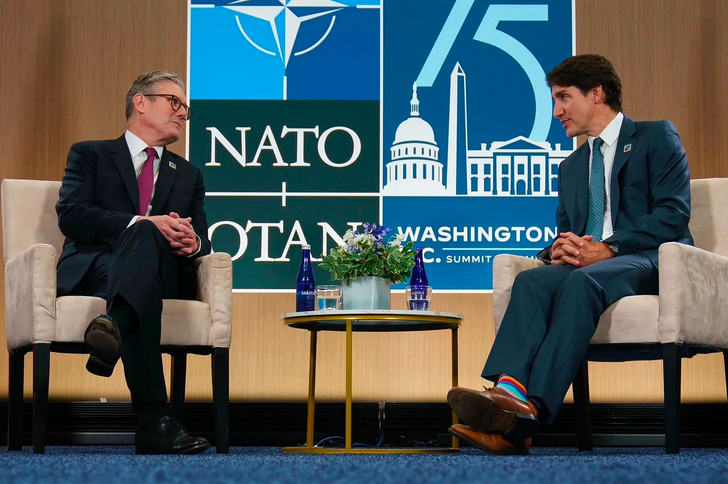
Prime Ministers Starmer and Trudeau at the NATO summit in Washington. Image from Justin Trudeau’s X account.
What Justin Trudeau did on Wednesday from the witness standing at the foreign interference inquiry — when he made his dramatic announcement of having seen a list of Conservatives who are compromised by or vulnerable to foreign interference — makes a kind of sense.
It does. It was an effective attack on Pierre Poilievre, who has stubbornly led with his chin for months. The reaction of many of my Conservative friends was telling. They knew Trudeau landed a hit, and they were pissed. They were ready for it — I think their counterattack was as good or better. But this whole story, or at least this little snippet of it, starts with Trudeau taking a swing, and not missing.
[…]
In that context, Trudeau’s decision to tease the possibility of some unnamed Conservatives being involved in the machinations of foreign interference makes sense. He saw Poilievre’s chin and decided to shove his fist into it. It’s politics. I get it.
But, once again, I’m not sure that the PM thought this through all the way. Our PM has a habit of occasionally letting his combative instincts get the better of him. The man has a weakness for showy, dramatic gestures, and loves to try and seize the big moments. Sometimes they blow up in his face. I think this one will, too. It is, I suspect, less a punch to the face, and more of an elbow-to-the-boob. It’ll cause more problems than the gesture was worth.
[…]
Trudeau doesn’t get a lot of opportunities to look like a tough leader these days, and he got two this week. His eviction of six Indian diplomats that Canadian intelligence believes were involved in guiding violent crimes in Canada, aimed at politically connected members of Canada’s large Indian diaspora, was one (and I am not yet cynical enough to believe the timing was politically motivated). The second, of course, was Trudeau’s bombshell testimony. Given the shellacking he’s been taking of late, it probably felt amazing [to] go on the attack yesterday.
The problem for the prime minister is that, today, having had his dramatic moment, there’s no follow through. He dropped the mic and then Poilievre did what he was always and obviously going to do: the opposition leader picked that mic right back up again and started talking into it.
My message to Justin Trudeau is: release the names of all MPs that have collaborated with foreign interference. But he won’t. Because Justin Trudeau is doing what he always does: he is lying. He is lying to distract from a Liberal caucus revolt against his leadership and revelations he knowingly allowed Beijing to interfere and help him win two elections. … If Justin Trudeau has evidence to the contrary, he should share it with the public. Now that he has blurted it out in general terms at a commission of inquiry — he should release the facts. But he won’t — because he is making it up.
If Poilievre’s decision to forgo a security clearance is overly complicated and technocratic, then Trudeau’s decision to attack him for it suffers the same drawbacks. By comparison, Poilievre’s approach, here, is better, simpler, and most crucially, it’s right: Release the names!
If MPs from any party have been compromised, the public deserves to know.
I don’t say that lightly or impulsively. There are absolutely downsides to releasing the names, including the very real risks to compromising our investigations and destroying the reputations of people who may have committed no crime. This sucks. But there are greater downsides to not releasing the names — until the Canadian public knows them, our entire democratic system is suspect. To put it another way, if it is inappropriate to release the names in full, then it is equally if not more inappropriate for a prime minister to publicly tease those names during his testimony, while hiding behind oaths of national security in order to avoid handing over the receipts. Protections of “national security” are intended to protect real sources and reputations — not to serve as a launchpad to lob allegations at foes while dodging accountability and transparency.
Comments Off on Justin Trudeau “has, yet again, outsmarted himself for the short-term win”
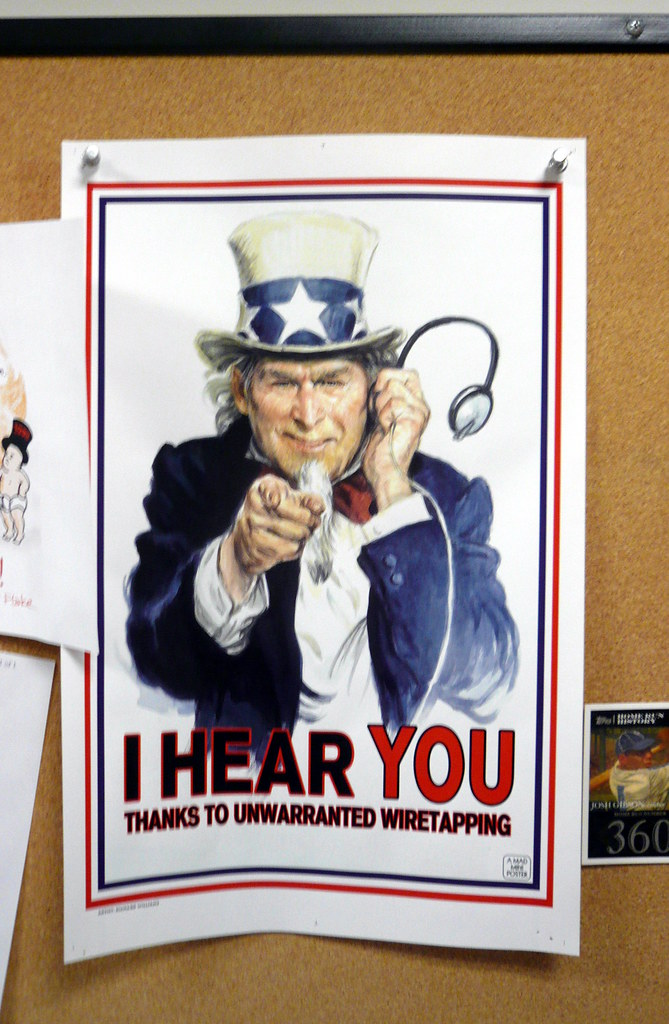
“I Hear You wiretapping poster, Mad Magazine, NYC” by gruntzooki is licensed under CC BY-SA 2.0 .
For as long as law enforcement has sought a way to monitor people’s conversations — though they’d only do so with a court order, we’re supposed to believe — privacy experts have warned that building backdoors into communications systems to ease government snooping is dangerous. A recent Chinese incursion into U.S. internet providers using infrastructure created to allow police easy wiretap access offers evidence, and not for the first time, that weakening security for anybody weakens it for everybody.
Subverted Wiretapping Systems
“A cyberattack tied to the Chinese government penetrated the networks of a swath of U.S. broadband providers, potentially accessing information from systems the federal government uses for court-authorized network wiretapping requests,” The Wall Street Journal reported last week. “For months or longer, the hackers might have held access to network infrastructure used to cooperate with lawful U.S. requests for communications data.”
While the Journal report doesn’t specify, Joe Mullin and Cindy Cohn of the Electronic Frontier Foundation (EFF) believe the wiretap-ready systems penetrated by the Chinese hackers were “likely created to facilitate smooth compliance with wrong-headed laws like CALEA”. CALEA, known in full as the Communications Assistance for Law Enforcement Act, dates back to 1994 and “forced telephone companies to redesign their network architectures to make it easier for law enforcement to wiretap digital telephone calls,” according to an EFF guide to the law. A decade later it was expanded to encompass internet service providers, who were targeted by Salt Typhoon.
“That’s right,” comment Mullin and Cohn. “The path for law enforcement access set up by these companies was apparently compromised and used by China-backed hackers.”
Ignored Precedents
This isn’t the first time that CALEA-mandated wiretapping backdoors have been exploited by hackers. As computer security expert Nicholas Weaver pointed out for Lawfare in 2015, “any phone switch sold in the US must include the ability to efficiently tap a large number of calls. And since the US represents such a major market, this means virtually every phone switch sold worldwide contains ‘lawful intercept’ functionality.”
Comments Off on Government-mandated backdoor access – “weakening security for anybody weakens it for everybody”
J.D. Tuccille explains the real reason the French government arrested Pavel Durov, the CEO of Telegram:
It’s appropriate that, days after the French government arrested Pavel Durov, CEO of the encrypted messaging app Telegram, for failing to monitor and restrict communications as demanded by officials in Paris, Meta CEO Mark Zuckerberg confirmed that his company, which owns Facebook, was subjected to censorship pressures by U.S. officials. Durov’s arrest, then, stands as less of a one-off than as part of a concerted effort by governments, including those of nominally free countries, to control speech.
“Telegram chief executive Pavel Durov is expected to appear in court Sunday after being arrested by French police at an airport near Paris for alleged offences related to his popular messaging app,” reported France24.
A separate story noted claims by Paris prosecutors that he was detained for “running an online platform that allows illicit transactions, child pornography, drug trafficking and fraud, as well as the refusal to communicate information to authorities, money laundering and providing cryptographic services to criminals”.
Freedom for Everybody or for Nobody
Durov’s alleged crime is offering encrypted communications services to everybody, including those who engage in illegality or just anger the powers that be. But secure communications are a feature, not a bug, for most people who live in a world in which “global freedom declined for the 18th consecutive year in 2023”, according to Freedom House. Fighting authoritarian regimes requires means of exchanging information that are resistant to penetration by various repressive police agencies.
“Telegram, and other encrypted messaging services, are crucial for those intending to organise protests in countries where there is a severe crackdown on free speech. Myanmar, Belarus and Hong Kong have all seen people relying on the services,” Index on Censorship noted in 2021.
And if bad people occasionally use encrypted apps such as Telegram, they use phones and postal services, too. The qualities that make communications systems useful to those battling authoritarianism are also helpful to those with less benign intentions. There’s no way to offer security to one group without offering it to everybody.
As I commented on a post on MeWe the other day, “Somehow the governments of the west are engaged in a competition to see who can be the most repressive. Canada and New Zealand had the early lead, but Australia, Britain, Germany, and France have all recently moved ahead in the standings. I’m not sure what the prizes might be, but I strongly suspect “a bloody revolution” is one of them (if not all of them).”
Comments Off on Pavel Durov’s arrest isn’t for a clear crime, it’s for allowing everyone access to encrypted communications services
Glenn “Instapundit” Reynolds on one of the biggest yet least recognized issues of most modern nations — our overall declining institutional competence:
Almost everywhere you look, we are in a crisis of institutional competence.
The Secret Service, whose failures in securing Trump’s Butler, PA speech are legendary and frankly hard to believe at this point, is one example. (Nor is the Butler event the Secret Service’s first embarrassment.)
The Navy, whose ships keep colliding and catching fire.
Major software vendor Crowdstrike, whose botched update shut down major computer systems around the world.
The United States government, which built entire floating harbors to support the D-Day invasion in Europe, but couldn’t build a workable floating pier in Gaza.
And of course, Boeing, whose Starliner spacecraft is stuck, apparently indefinitely, at the International Space Station. (Its crew’s six-day mission, now extended perhaps into 2025, is giving off real Gilligan’s Island energy.) At present, Starliner is clogging up a necessary docking point at the ISS, and they can’t even send Starliner back to Earth on its own because it lacks the necessary software to operate unmanned – even though an earlier build of Starliner did just that.
Then there are all the problems with Boeing’s airliners, literally too numerous to list here.
Roads and bridges take forever to be built or repaired, new airports are nearly unknown, and the Covid response was extraordinary for its combination of arrogant self-assurance and evident ineptitude.
These are not the only examples, of course, and readers can no doubt provide more (feel free to do so in the comments) but the question is, Why? Why are our institutions suffering from such widespread incompetence? Americans used to be known for “know how,” for a “can-do spirit”, for “Yankee ingenuity” and the like. Now? Not so much.
Americans in the old days were hardly perfect, of course. Once the Transcontinental Railroad was finished and the golden spike driven in Promontory, Utah, large parts of it had to be reconstructed for poor grading, defective track, etc. Transport planes full of American paratroopers were shot down during the invasion of Sicily by American ships, whose gunners somehow confused them for German bombers. But those were failures along the way to big successes, which is not so much the case today.
But if our ancestors mostly did better, it’s probably because they operated closer to the bone. One characteristic of most of our recent failures is that nobody gets fired. (Secret Service Director Kim Cheatle did resign, eventually, but nobody fired her, and I think heads should have rolled on down the line).


 .
.