Quotulatiousness

June 19, 2026

Nobody voted for this kind of dystopian nightmare, Mr. Carney!

The Liberal Party, having engineered themselves a majority in the House of Commons, are on a speed-run to the kind of dystopian police state we used to read about in science fiction novels:

Millions of Canadians are beginning to see the similarities between communist regimes and the direction of current government policy.

The pattern is always the same.

It begins with noble promises: safety, equality, compassion, protection, the greater good.

It ends with censorship, coercion, surveillance, prisons, ruined lives, and a police state.

Always.

It comes wrapped in slogans, experts, committees, emergency powers, censorship, enemies of the people, and the belief that the state has the right to crush the individual for the greater good.

Consider…

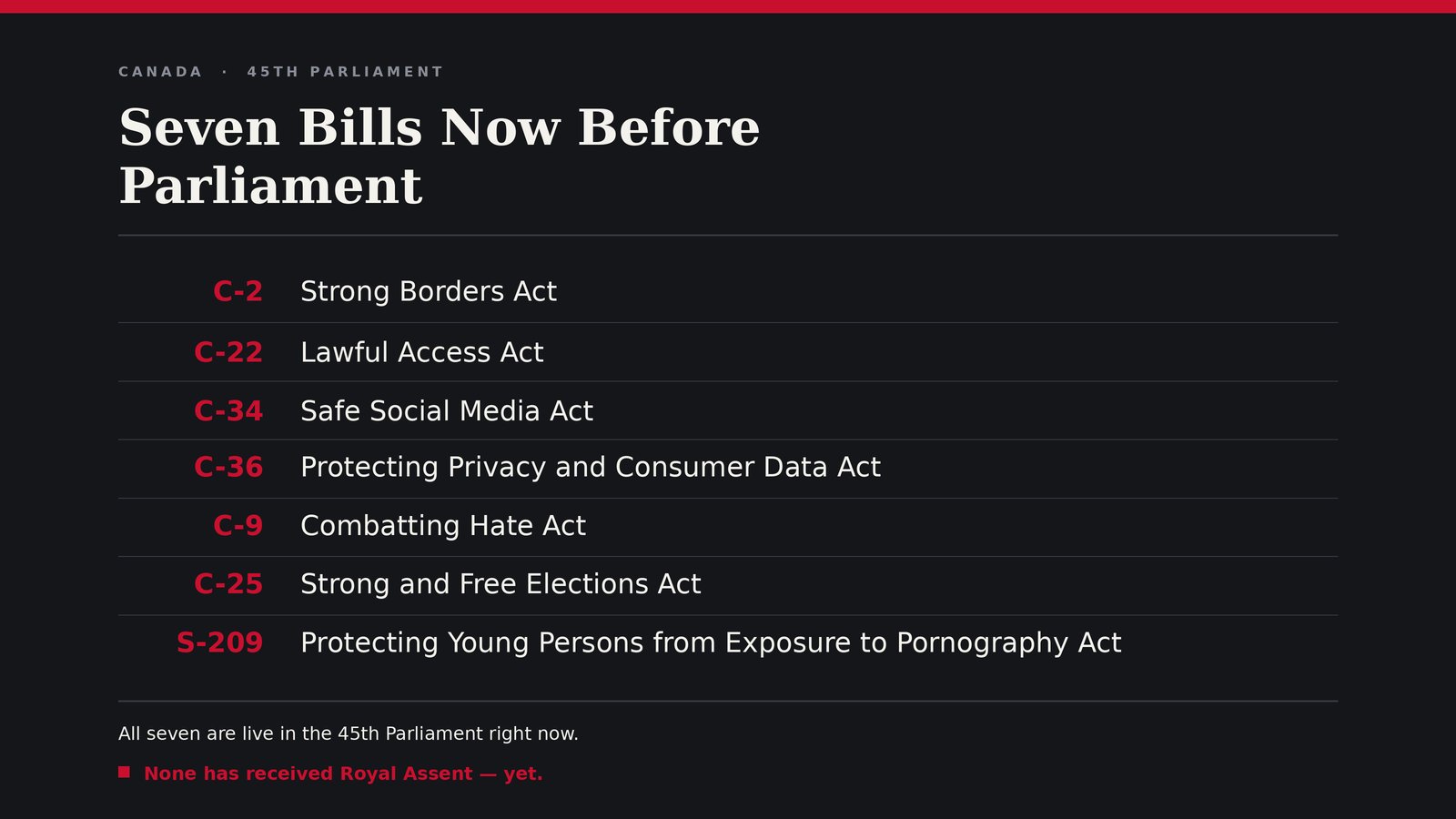
C-2 – Strong Borders Act
C-22 – Lawful Access Act
C-34 – Safe Social Media Act
C-36 – Protecting Privacy and Consumer Data Act
C-9 – Combatting Hate Act
C-25 – Strong and Free Elections Act
S-209 – Protecting Young Persons from Exposure to Pornography Act

All seven are live in the 45th Parliament right now. None has received royal assent yet.

Consider that good, law-abiding Canadians are being gradually and systematically disarmed.

This is not a warning about some distant future.

In 2022 the federal government invoked emergency powers it did not have, froze the bank accounts of citizens over their political views, and banned Canadians from funding a protest. Two levels of court have since ruled it unconstitutional — a violation of the very Charter rights every one of these bills now circles.

That was the trial run. It needed an emergency as the excuse.

The seven bills above are the permanent version — the same reach, made routine — so that next time, no emergency need be declared at all.

A free country is not lost in a single day. It is legislated away in pieces, each one introduced with a reassuring name and defended as necessary, while good people keep assuring themselves it could never happen here.

It already did. The only question is whether enough Canadians notice before it becomes permanent.

Read every bill. Watch every one of them. Because this is the stage where it can still be stopped … and perhaps our last chance.
The Justice Centre for Constitutional Freedoms is trying to get Canadians to pay attention to what just one of these bills will do:

Bill C-34 will affect every Canadian. Age verification. AI regulation. A new Digital Safety Commission. Most Canadians have never heard of it. Here’s what it will do.

Michael Geist posts a Substack Note about bill C-22:

Bill C-22, the lawful access bill, has been reported back from committee and is headed toward passage. There are some amendments, but many concerns remain. The updated bill with changes is at

parl.ca/Content/Bills/4…

There are two changes to metadata retention. First, the maximum retention period the government can impose drops from 1 year to 6 months. Second, it can now mandate a category of metadata only if satisfied the category and all its elements are essential to investigations.

The committee rewrote the definition of systemic vulnerability. A “substantial risk” becomes a “credible risk, based on recognized international technical standards”. But it also added a carve-out: a flaw exposing only a target’s data is not “systemic”.

Added a new section on decryption that says nothing in the Act can be read to compel a provider to decrypt user-encrypted data, unless the provider supplied the encryption and holds the key. Borrowed from US law, but doesn’t fit the same way.

Compliance with ministerial orders is now expressly subject to the systemic vulnerability exception. That addresses a contradiction in the original text, where the duty to comply appeared to be unconditional.

The original bill set no maximum duration on these ministerial orders. This now changes to a two-year cap without the open-ended review-and-extend mechanism.

The amendments will rightly leave many still concerned. Companies considering exiting Canada due to Bill C-22 are unlikely to conclude that it fully addresses their issues. Yet the government is likely to push it through the House today.


May 29, 2026

Debunking the “it’s just phone book information” claim for Bill C-22

Michael Geist explains why the “it’s just phone book information” hand-waving by politicians and government officials is worse than misleading: it’s deliberate mendacity.

en telefonbog (a Danish telephone directory)
Photo by Tomasz Sienicki via Wikimedia Commons

If this sounds familiar, it is because the same tired claims have been used for years. In September 2011, then-Public Safety Minister Vic Toews defended the Harper government’s lawful access proposals by claiming “linking an internet address to subscriber information is on par with the phone book linking phone numbers to an address”. Christopher Parsons, then a researcher at the Citizen Lab, responded with a detailed anatomy of what a lawful access “phone record” actually contained, showing that the three-field directory entry the government was invoking was being used to describe an eleven-field record including IP addresses, IMEI and IMSI numbers, SIM serials, device identifiers, and account information from multiple providers, any one of which could be cross-referenced to build a comprehensive profile of a person’s online life.

The Supreme Court of Canada put the issue to rest in the Spencer decision, holding unanimously in 2014 that there is a reasonable expectation of privacy in subscriber information precisely because the disclosure of such information “will often amount to the identification of a user with intimate or sensitive activities being carried out online, usually on the understanding that these activities would be anonymous”. It returned to the same terrain in Bykovets in 2024, extending Charter protection to IP addresses on the reasoning that an IP address is the “first digital breadcrumb that can lead the state on the trail of an individual’s Internet activity”.

Bill C-22’s new subscriber information production order applies a low evidentiary standard but covers name, pseudonym, address, telephone number, email address, account identifiers, types of services provided to the subscriber, the period during which they were provided, and information that identifies the devices, equipment, or things used by the subscriber in relation to those services. In short, a modern subscriber record is not a phone book entry but rather an index of a person’s digital life and the government is proposing to reduce the standard needed to gain access to that information.

Moreover, the same phony framing is now being stretched beyond subscriber data to mandatory metadata retention. As Conservative MP Andrew Lawton noted to Fraser at committee, the government and its officials have been telling Canadians that requiring electronic service providers to retain metadata for up to a year is “no different than just having a copy of the phone book that someone could leaf through”. That is a laughable comparison, given that metadata includes the date, time, duration, and type of a communication, the identifiers of the devices involved, and information identifying the location of the device. It is as if the phone book would include the details of every call made including location, call recipient, and device. And given retention for up to a year, the plan poses a disproportionate privacy risk that is likely to be struck down as unconstitutional by the Supreme Court, should it survive in its current form.

And in a follow-up post, he writes:

On encryption, Anandasangaree said the bill “was never meant to breach encryption” and promised to “clarify it in the Bill”. Language clarification is welcome but structural problems remain. The safeguards in Bill C-22 at ss. 5(5) and 7(5), which state that a provider is not required to comply if compliance would create a systemic vulnerability, are incompatible with s. 12, which unconditionally requires compliance with orders, and with s. 13, which specifies that orders prevail over regulations when inconsistencies arise. The term “systemic vulnerability” is not defined in the statute, and the Governor in Council has the power to make regulations “respecting the meaning of any term or expression for the purposes of this Act”. None of this is fixed by promising clearer language. It is fixed by the kind of amendment the Privacy Commissioner proposed this week, namely adopting Australia’s definition, which expressly covers actions that render encryption less effective, together with an explicit prohibition on regulations or orders that require the introduction of, or prevent the rectification of, a systemic vulnerability.

Moreover, Anandasangaree’s defence of the bill’s privacy implications was a deflection rather than an answer, as he tried to turn the attention to the privacy practices in the private sector, stating, “I drive a vehicle where every single point that I drive to is tracked. And that data is not with me.” Commercial data practices are indeed a real concern and Canada needs stronger laws to address them. However, the bill’s surveillance map of every Canadian is not justified by pointing to the absence of meaningful constraints on data collection and to the failure of his own government to address long-overdue private-sector privacy reform.

That brings the press conference back to the Privacy Commissioner. Asked directly whether he would accept Commissioner Philippe Dufresne’s amendments, the Minister said he would “be looking at” them and “looking to see what he has to offer”. Dufresne tabled eight concrete amendments at committee on Tuesday: narrowing subscriber information to a closed list (name, address, telephone number, IP address), restricting who can be compelled to telecommunications service providers, defining “publicly available information” to exclude information in which a person has a reasonable expectation of privacy, an overarching requirement that SAAIA obligations be necessary and proportionate, an Australian-style amendment to “systemic vulnerability”, an explicit prohibition on orders requiring vulnerability introduction or preventing rectification, an exemption to the SAAIA’s confidentiality rules to allow disclosure to regulatory bodies such as the OPC, and allowing his office to investigate if data breaches result from application of the new powers. Anandasangaree’s comments, coming a day after the Dufresne’s committee appearance, noted that “we have until like five o’clock today” for amendments. That window does not leave room to seriously consider the Commissioner’s recommendations. The “I will be looking at” claim, delivered hours before the deadline, amounted to a rejection of the recommendations.

April 18, 2026

Another proof of the value of open source

Filed under: History, Media, Technology — Tags: , , , , , — Nicholas @ 03:00

On the social media site formerly known as Twitter, ESR discusses a pre-computer (pre-electronics) proof that open source is more secure than closed source:

“How university open debates and discussions introduced me to open source” by opensourceway is licensed under CC BY-SA 2.0

There’s an old, bad idea that’s been trying to resurrect itself on X in the last couple of days. Which makes it time for me to explain exactly why, in the age of LLMs, open-sourcing your code is an even more important security measure than it was before we had robot friends.

The underlying principle was discovered in the 1880s by an expert on military cryptography, a man named August Kerckhoffs, writing long before computers were a thing.

To start with, you need to focus in on the fact that cryptosystems have two parts. They have methods, and they have keys. You feed a key and a message to a method and get encrypted information that, you hope, only someone else with the same pair of method and key can read.

What Kerckhoffs noticed was this: military cryptosystems in normal operation leak information about their methods. Code books and code machines get captured, stolen, betrayed, or lost in simple accidents and found by people you don’t want to have them. This was the pre-computer equivalent of an unintended source-code disclosure.

Cryptosystems also leak information about their keys — think post-it notes with passwords stuck to a monitor. What Kerckhoffs noticed is that these two different kinds of compromising leakage happen at very different base rates. It is almost impossible to prevent leakage of information about methods, but just barely possible to prevent leakage of information about keys.

Why? Keys have fewer bits. This makes them easier to keep secret.

Remember: this was something an intelligent man could notice in the 1880s, well before even vacuum tubes. Which is your first clue that the power of this observation hasn’t changed just because we’re in the middle of a freaking Singularity.

Security through obscurity — closed source code — means you’re busted if either the source code or the keys get leaked. Open source is a preemptive strike — it’s a way to force the property that your security depends *only* on keeping the keys secret.

What you’re doing by designing under the assumption of open source is preventing source code leakage from being a danger. And that’s the kind of leakage with a high base rate.

As far back as 1947 Claude Shannon applied this to electronic security — he did critical work on the voice scramblers that were used for secure telephone communications between heads of state during World War II. Shannon said one should always design as though “the enemy knows the system”. The US’s National Security Agency still uses this as a guiding principle in computer-based cryptosystems.

If you’re doing software security, always design as though the enemy can see your source code. I’m still a little puzzled that I was apparently the first person to notice that this was a general argument for open source; as soon as I did, my first thought was more or less “Duh? Somebody should have noticed this sooner?”

Now let’s consider how LLMs change this picture. Or…don’t.

An LLM is like a cryptanalyst with a superhuman attention span that never sleeps. If your system leaks information that can compromise it, that compromise is going to happen a hell of a lot faster than if your adversary has to rely on Mark 1 meatbrains.

But it gets worse. With LLMs, decompilation is now fast and cheap. You have to assume that if an adversary can see your executable binary, they can recover the source code. If you were relying on that to be secret, you are *screwed*.

Leakage control — limiting the set of bits that can yield a compromise — is more important than ever. So security by code obscurity is an even more brittle and dangerous strategy than it used to be.

Anybody who tries to tell you differently is either deeply stupid or trying to sell you something that you should not by any means buy.

November 9, 2025

North Africa Ep. 7: Hitler says No! Rommel doesn’t care!

Filed under: Africa, Australia, Britain, Germany, History, Italy, Military, WW2 — Tags: , , , , — Nicholas @ 04:00

World War Two
Published 8 Nov 2025

Rommel is called to Berlin, where he’s told to wait until May and settle for Benghazi, but he rejects that plan and decides to strike sooner. In Cairo, Wavell reads ULTRA decrypts and realizes the Luftwaffe is preparing something, while admitting he has almost nothing left to hold Cyrenaica. On the ground, the Australians storm Giarabub in a sandstorm, El Agheila is snatched after a botched British ambush, and Rommel orders preparations to hit Mersa Brega before the British can dig in.
(more…)

November 2, 2025

North Africa Ep. 6: Do You Smell What The Fox Is Cooking?

Filed under: Britain, Germany, History, Italy, Military, WW2 — Tags: , , , , , — Nicholas @ 04:00

World War Two
Published 1 Nov 2025

Rommel pushes his HQ toward the front, seizes the oasis at Marada, and sends a long-range Italo-German column deep toward Murzuk to harden his forces for true desert warfare. A brutal Ghibli sandstorm shows how the Sahara itself is a third enemy, choking engines, wrecking vehicles, and nearly killing Rommel in the air. At the same time, ULTRA intelligence finally reaches Wavell, Malta’s bombers are forced off the island under relentless Luftwaffe pressure, and Rommel is already ordering preparations to hit El Agheila despite supposedly leaving for Berlin.
(more…)

February 23, 2025

How WW2 Changed Espionage Forever

World War Two
Published 22 Feb 2025

In their struggle to defeat German and Japanese espionage efforts, the Allied intelligence agencies of the KGB, CIA, MI6 and DGSE are all transformed into modern, global, espionage forces. But even as East and West work together to defeat the Axis, they are fighting the first underground battles of a new Cold War against one another.
(more…)

February 10, 2025

Trump’s EO against central bank digital currencies

Filed under: Economics, Government, Politics — Tags: , , , , — Nicholas @ 03:00

The Trudeau government’s illegal move to freeze the bank accounts of Canadians who supported the Freedom Convoy should have clearly illustrated the dangers of allowing a government to exercise that level of control over individuals’ financial affairs. (It’s hard to express just how inhumane that move was to deprive thousands of Canadians their ability to conduct any financial business at all … in the middle of the winter just because they’d chipped in small donations to a cause Trudeau didn’t like.) I don’t know if Donald Trump took note, but another of his long list of executive orders directly addresses crypto and CBDCs:

“Bitcoin – from WSJ” by MarkGregory007 is licensed under CC BY-NC-SA 2.0

While the order has upsides and downsides concerning current crypto policies, the parts of the order I’m most excited about are the portions on Central Bank Digital Currencies, or CBDCs. A CBDC is essentially a government-created centrally controlled version of cryptocurrency. As FEE has discussed in the past, CBDCs are a very dangerous idea, and it was troubling that they were being pursued by the Biden administration.

So what does the Trump executive order say about them? Take a look:

    [The Trump administration is] taking measures to protect Americans from the risks of Central Bank Digital Currencies (CBDCs), which threaten the stability of the financial system, individual privacy, and the sovereignty of the United States, including by prohibiting the establishment, issuance, circulation, and use of a CBDC within the jurisdiction of the United States.

Section 5 of the order covers how this will be done. By the order, it’s now illegal for bureaucrats within government agencies to pursue any plans to establish a CBDC unless it is required by law. In other words, barring the possibility that some bureaucrats could break the law, CBDC initiatives must immediately end unless the legislature passes bills requiring them.

This is a big step because the establishment of a CBDC would require significant political, bureaucratic, and technological infrastructure to be implemented. Trump’s order puts a pause on the building of that infrastructure which began under Biden.

On net, Trump’s order seems to have been taken well by crypto markets, with Bitcoin seeing a small price surge after the announcement of the order. So while the future of government crypto regulation remains unclear, the new administration’s commitment to stopping CBDCs and protecting the rights of those engaging in crypto mining and transactions seems to be a good sign.

August 29, 2024

Pavel Durov’s arrest isn’t for a clear crime, it’s for allowing everyone access to encrypted communications services

Filed under: France, Government, Liberty, Media, Technology — Tags: , , , , — Nicholas @ 03:00

J.D. Tuccille explains the real reason the French government arrested Pavel Durov, the CEO of Telegram:

It’s appropriate that, days after the French government arrested Pavel Durov, CEO of the encrypted messaging app Telegram, for failing to monitor and restrict communications as demanded by officials in Paris, Meta CEO Mark Zuckerberg confirmed that his company, which owns Facebook, was subjected to censorship pressures by U.S. officials. Durov’s arrest, then, stands as less of a one-off than as part of a concerted effort by governments, including those of nominally free countries, to control speech.

“Telegram chief executive Pavel Durov is expected to appear in court Sunday after being arrested by French police at an airport near Paris for alleged offences related to his popular messaging app,” reported France24.

A separate story noted claims by Paris prosecutors that he was detained for “running an online platform that allows illicit transactions, child pornography, drug trafficking and fraud, as well as the refusal to communicate information to authorities, money laundering and providing cryptographic services to criminals”.

Freedom for Everybody or for Nobody

Durov’s alleged crime is offering encrypted communications services to everybody, including those who engage in illegality or just anger the powers that be. But secure communications are a feature, not a bug, for most people who live in a world in which “global freedom declined for the 18th consecutive year in 2023”, according to Freedom House. Fighting authoritarian regimes requires means of exchanging information that are resistant to penetration by various repressive police agencies.

“Telegram, and other encrypted messaging services, are crucial for those intending to organise protests in countries where there is a severe crackdown on free speech. Myanmar, Belarus and Hong Kong have all seen people relying on the services,” Index on Censorship noted in 2021.

And if bad people occasionally use encrypted apps such as Telegram, they use phones and postal services, too. The qualities that make communications systems useful to those battling authoritarianism are also helpful to those with less benign intentions. There’s no way to offer security to one group without offering it to everybody.

As I commented on a post on MeWe the other day, “Somehow the governments of the west are engaged in a competition to see who can be the most repressive. Canada and New Zealand had the early lead, but Australia, Britain, Germany, and France have all recently moved ahead in the standings. I’m not sure what the prizes might be, but I strongly suspect “a bloody revolution” is one of them (if not all of them).”

May 29, 2024

Why Germany Lost the Battle of the Atlantic

Filed under: Britain, Cancon, Germany, History, Military, USA, WW2 — Tags: , , , , , — Nicholas @ 02:00

Real Time History
Published Feb 2, 2024

In March 1943, German U-boats are on the attack – they sink 108 Allied vessels that month alone. Some Allied officials fear a German victory in the Atlantic is imminent. If the Allies lose the Atlantic, Britain loses its lifeline – and maybe even the war. But by May 1943, it will be the U-boats limping home in defeat. So how, in just two months, did the U-boats go from hunters to hunted?
(more…)

August 31, 2023

The Double Agent Saving London From the V-1 – WW2 Documentary Special

Filed under: Britain, Germany, History, Military, WW2 — Tags: , , , — Nicholas @ 04:00

World War Two
Published 30 Aug 2023

The Germans are assaulting London with waves of V-1 flying bombs. But Eddie Chapman, a career criminal, serial womaniser, and masterful double agent working for MI5’s Double Cross is fighting a secret battle to beat the bombs. When he’s done with that, he pulls the wool over the Reich’s eyes to help Britain beat the Kriegsmarine. This is Agent Zigzag.
(more…)

August 19, 2023

One Day in August – Dieppe Anniversary Battlefield Event (Operation Jubilee)

WW2TV
Published 19 Aug 2021

One Day in August — Dieppe Anniversary Battlefield Event (Operation Jubilee) With David O’Keefe, Part 3 — Anniversary Battlefield Event.

David O’Keefe joins us for a third and final show about Operation Jubilee to explain how the plan unravelled and how the nearly 1,000 British, Canadian and American commandos died. We will use aerial footage, HD footage taken in Dieppe last week and maps, photos, and graphics.

In Part 1 David O’Keefe talked about the real reason for the raid on Dieppe in August 1942. In Part 2 David talked about the plan for Operation Jubilee. The intentions of the raid and how it was supposed to unfold.
(more…)

August 18, 2023

One Day in August – Dieppe – Part 2 – The Plan

WW2TV
Published 17 Jan 2021

Part 2 – The Plan With David O’Keefe

David O’Keefe joins us again. In Part 1 he talked about the real reason for the raid on Dieppe in August 1942. In Part 2 we talk about the plan for Operation Jubilee and David will share his presentation about the intentions of the raid and how it was supposed to unfold.

A final show sometime in the summer will come live from Dieppe to explain how the plan unravelled and how the nearly 1,000 British, Canadian and American commandos died.
(more…)

August 17, 2023

Dieppe – One Day in August – Ian Fleming, Enigma and the Deadly Raid – Part 1

WW2TV
Published 29 Nov 2020

In less than six hours in August 1942, nearly 1,000 British, Canadian and American commandos died in the French port of Dieppe in an operation that for decades seemed to have no real purpose. Was it a dry-run for D-Day, or perhaps a gesture by the Allies to placate Stalin’s impatience for a second front in the west?

Canadian historian David O’Keefe uses hitherto classified intelligence archives to prove that this catastrophic and apparently futile raid was in fact a mission, set up by Ian Fleming of British Naval Intelligence as part of a “pinch” policy designed to capture material relating to the four-rotor Enigma machine that would permit codebreakers like Alan Turing at Bletchley Park to turn the tide of the Second World War.

In this first show we will look at how the raid has been written about in previous books and the research David undertook and as importantly why he did it. In a future show, we will look at filming in Dieppe itself and explain the sequence of events.
(more…)

June 4, 2023

The Allies are Driving for Rome – WW2 – Week 249 – June 3, 1944

World War Two
Published 3 Jun 2023

The Allies head north in Italy after the fall of Monte Cassino last week; the Japanese head south in China in a new phase of their offensive; and the Soviets and the Western Allies make ever more concrete plans for their huge offensives, to go off very soon.
(more…)

April 23, 2023

The Biggest Offensive in Japanese History – WW2 – Week 243 – April 22, 1944

World War Two
Published 22 Apr 2023

Japan Launches Operation Ichigo in China, their largest offensive of the war … or ever, but over in India things are not going well for the Japanese at Imphal and Kohima. The Allies also launch attacks on the Japanese at Hollandia, while over in the Crimea, the German defenses at Sevastopol are cracking under Soviet pressure.
(more…)

Older Posts »

Powered by WordPress