Quotulatiousness

November 12, 2022

Long distance communication in the pre-modern era

In the latest Age of Invention newsletter, Anton Howes considers why the telegraph took so long to be invented and describes some of the precursors that filled that niche over the centuries:
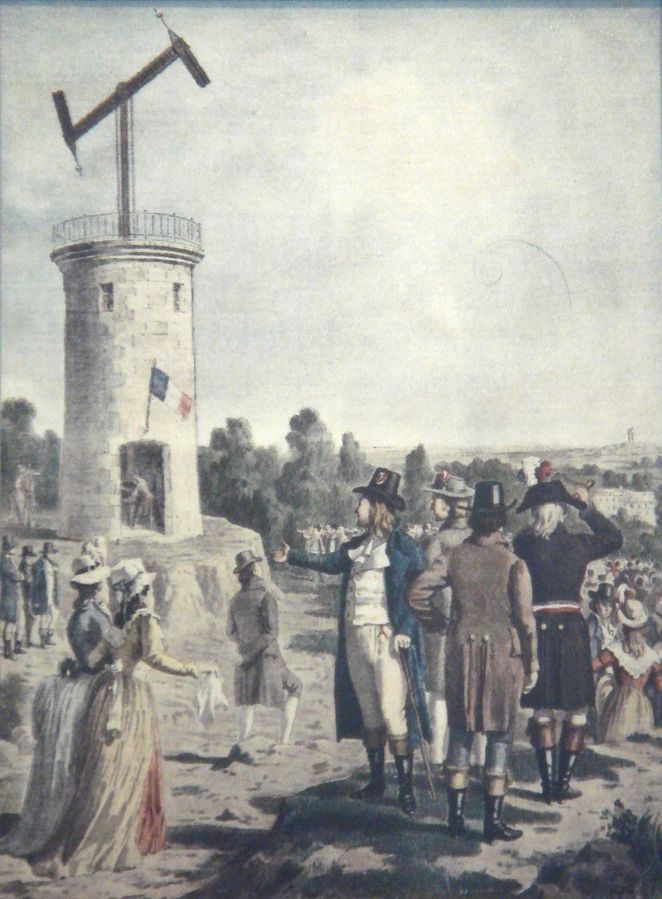
Early 19th century demonstration of Claude Chappe’s semaphore.
Wikimedia Commons.

… I’ve also long wondered the same about telegraphs — not the electric ones, but all the other long-distance signalling systems that used mechanical arms, waved flags, and flashed lights, which suddenly only began to really take off in the eighteenth century, and especially in the 1790s.

What makes the non-electric telegraph all the more interesting is that in its most basic forms it actually was used all over the world since ancient times. Yet the more sophisticated versions kept on being invented and then forgotten. It’s an interesting case because it shows just how many of the budding systems of the 1790s really were long behind their time — many had actually already been invented before.

The oldest and most widely-used telegraph system for transmitting over very long distances was akin to Gondor’s lighting of the beacons, capable only of communicating a single, pre-agreed message (with flames often more visible at night, and smoke during the day). Such chains of beacons were known to the Mari kingdom of modern-day Syria in the eighteenth century BC, and to the Neo-Assyrian emperor Ashurbanipal in the seventh century BC. They feature in the Old Testament and the works of Herodotus, Aeschylus, and Thucydides, with archaeological finds hinting at even more. They remained popular well beyond the middle ages, for example being used in England in 1588 to warn of the arrival of the Spanish Armada. And they were seemingly invented independently all over the world. Throughout the sixteenth century, Spanish conquistadors again and again reported simple smoke signals being used by the peoples they invaded throughout the Americas.

But what we’re really interested in here are systems that could transmit more complex messages, some of which may have already been in use by as early as the fifth century BC. During the Peloponnesian War, a garrison at Plataea apparently managed to confuse the torch signals of the attacking Thebans by waving torches of their own — strongly suggesting that the Thebans were doing more than just sending single pre-agreed messages.

About a century later, Aeneas Tacticus also wrote of how ordinary fire signals could be augmented by using identical water clocks — essentially just pots with taps at the bottom — which would lose their water at the same rate and would have different messages assigned to different water levels. By waving torches to signal when to start and stop the water clocks (Ready? Yes. Now start … stop!), the communicator could choose from a variety of messages rather than being limited to one. A very similar system was reportedly used by the Carthaginians during their conquests of Sicily, to send messages all the way back to North Africa requesting different kinds of supplies and reinforcement, choosing from a range of predetermined signals like “transports”, “warships”, “money”.

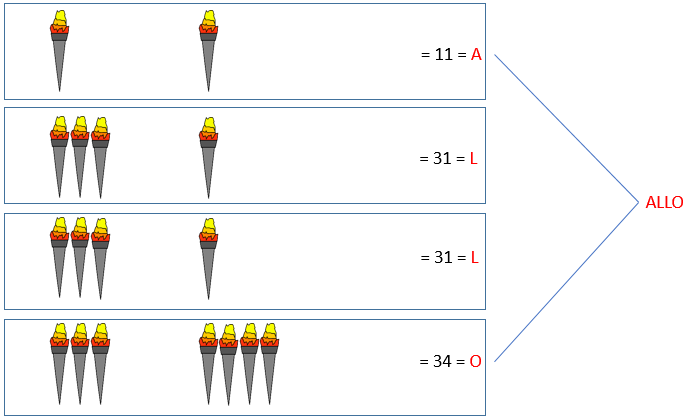
Diagram of a fire signal using the Polybius cipher.
Created by Jonathan Martineau via Wikimedia Commons.

By the second century BC, a new method had appeared. We only know about it via Polybius, who claimed to have improved on an even older method that he attributed to a Cleoxenus and a Democleitus. The system that Polybius described allowed for the spelling out of more specific, detailed messages. It used ten torches, with five on the left and five on the right. The number of torches raised on the left indicated which row to consult on a pre-agreed tablet of letters, while the number of torches raised on the right indicated the column. The method used a lot of torches, which would have to be quite spread out to remain distinct over very long distances. So it must have been quite labour-intensive. But, crucially, it allowed for messages to be spelled out letter by letter, and quickly.

Three centuries later, the Romans were seemingly still using a much faster and simpler version of Polybius’s system, almost verging on a Morse-like code. The signalling area now had a left, right, and middle. But instead of signalling a letter by showing a certain number of torches in each field all at once, the senders waved the torches a certain number of times — up to eight times in each field, thereby dividing the alphabet into three chunks. One wave on the left thus signalled an A, twice on the left a B, once in the middle an I, twice in the middle a K, and so on.

By the height of the Roman Empire, fire signals had thus been adapted to rapidly transmit complex messages over long distances. But in the centuries that followed, these more sophisticated techniques seem to have disappeared. The technology appears to have regressed.
July 28, 2022

The Posh Brits Betraying Their Country – WW2 – Spies & Ties 20

Filed under: Britain, History, Military, Russia, WW2 — Tags: , , , , , , — Nicholas @ 04:00

World War Two
Published 27 Jul 2022

Being allies does little to discourage Moscow from recruiting double agents in the British establishment. The most famous of them all, Kim Philby and the Cambridge Five, penetrate deep into MI5, MI6, and Bletchley Park. With friends like the NKVD, who needs enemies?
(more…)

June 1, 2022

How To Kill A U-Boat – WW2 Special

World War Two
Published 31 May 2022

How to kill a U-Boat? The threat of the illusive and nearly undetectable submarines had been on the mind of every Allied naval planner since the Great War. As the Kriegsmarine once more unleashed its wolfpacks to the high seas, it became a race against time to find a way to stop the deadly stalkers from beneath the surface.
(more…)

May 29, 2022

Black May, Nazi Subs Defeated – WW2 – 196 – May 28, 1943

World War Two
Published 28 May 2021

German Grand Admiral Karl Dönitz orders the U-Boats to leave the Atlantic this week; the losses lately have just been too great for their patrols to continue there. There is active fighting in China, the Aleutians, and the Kuban, and there are special weapons tests in the skies over Germany.
(more…)

May 25, 2022

The Spy Game That Killed Yamamoto – WW2 – Spies & Ties 17

Filed under: History, Japan, Military, Pacific, USA, WW2 — Tags: , , , — Nicholas @ 04:00

World War Two
Published 24 May 2022

We’ve already seen the power of signals intelligence. Churchill loves being fed information from MI6’s Ultra. Now it brings a vengeance for his American allies. They manage to bag the scourge of Pearl Harbor, C-in-C of the Imperial Japanese Navy, Admiral Isoroku Yamamoto.
(more…)

April 24, 2022

Ladies and Gentlemen, We Got Him – Yamamoto – WW2 – 191 – April 23, 1943

World War Two
Published 23 Apr 2022

The mastermind of Pearl Harbor meets his fate this week in the Solomons, as do a great many Italian airmen and sailors in the Mediterranean in the Palm Sunday Massacre trying to supply the desperate Axis forces in Tunisia.
(more…)

April 20, 2022

The Unbreakable ROCKEX: Canada’s answer to the Enigma machine

Filed under: Britain, Cancon, History, Military, USA, WW2 — Tags: , , — Nicholas @ 02:00

Polyus Studios
Published 30 Dec 2021

Well before digital encryption and VPNs there was Rockex, Canada’s unbreakable cipher machine that rivaled the German Enigma in its day. Although completely hidden from the public, Canada has played a noticeable role in the history of espionage. During the Cold War Canadian cipher machines worked alongside those of her allies to keep communications secure and helped to preserve the peace.

Check out cryptomuseum.com for more information about Rockex and to find the source of most of the pictures of the device I used.

March 20, 2022

Kharkov Falls Once Again – WW2 – 186 – March 19, 1943

World War Two
Published 19 Mar 2022

The British are attacking the Mareth Line in North Africa while the Americans hit the Axis flank, but the Allies are withdrawing in Burma. It’s the Germans who are pulling back in the USSR, though, and there is another attempt from within German command to assassinate Adolf Hitler.
(more…)

March 6, 2022

Another Naval Disaster for Japan – WW2 – 184 – March 5, 1943

World War Two
Published 5 Mar 2022

The Japanese again fail to reinforce New Guinea, losing many transport ships, and their forces there are ever more isolated. In Tunisia the Axis lose a bunch of new Tiger tanks, but in the Soviet Union it is the Axis forces that are on the offensive as Erich von Manstein’s offensive continues.
(more…)

February 10, 2022

MI6’s Secret War – WW2 – Spies & Ties 13

Filed under: Britain, France, Germany, History, Military, WW2 — Tags: , , , — Nicholas @ 04:00

World War Two
Published 9 Feb 2022

Britain’s MI6 is caught off guard when war breaks out. As the Germans advance across Western Europe MI6’s networks collapse, and Britain becomes almost blind. MI6 have their secret weapons at Bletchley Park but they now face a painful struggle to rebuild their eyes in Europe.
(more…)

December 9, 2021

The sequel to the British disaster at the Battle of Coronel, the German disaster at the Battle of the Falkland Islands

Filed under: Americas, Britain, Germany, History, Military, WW1 — Tags: , , , , — Nicholas @ 03:00

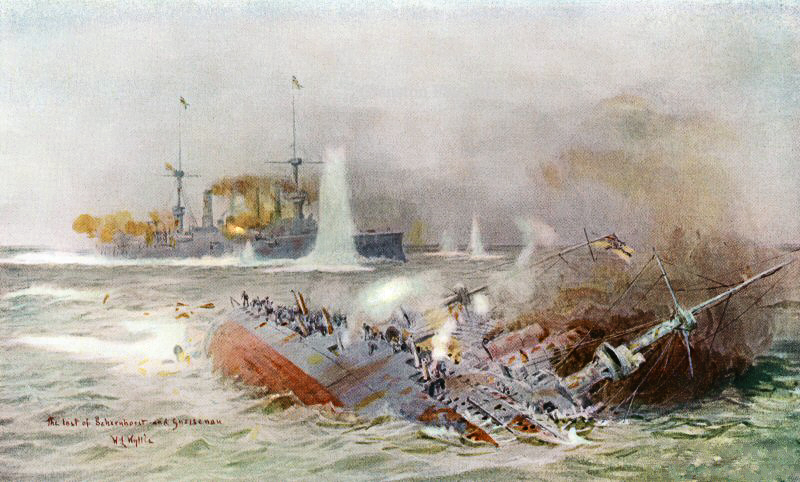
On December 8th, the people of the Falkland Islands observe “Battle Day” to commemorate the British naval victory off the islands in 1914. This is the bookend to the Battle of Coronel the previous month (described here and here), where a Royal Navy squadron was almost annihilated by Imperial Germany’s East Asia Squadron under Vice-Admiral Graf Maximilian von Spee. At the Battle of the Falkland Islands, an equally lop-sided victory eliminated von Spee’s ships with minimal damage to Rear Admiral Sir Frederick Doveton Sturdee’s squadron. In The Critic, A.S.H. Smyth outlines the events as shown in a British film released in 1927:

Battle of the Falkland Islands, 1914 by William Lionel Wyllie. SMS Scharnhorst rolls over and sinks while SMS Gneisenau continues to fight.
Originally published in 1918 by Cassel & Company. Retouched image via Wikimedia Commons

Rear Admiral Sir Frederick Doveton Sturdee (unimprovably British, isn’t it?), Chief of War Staff at the Admiralty, and at distinct risk of being scapegoated for the Coronel catastrophe, was summarily appointed Commander-in-Chief South Atlantic and Pacific(!) and despatched posthaste by [First Sea Lord John “Jackie”] Fisher (with whom he did not get on), on something of a do-or-die mission as the commander of new, eight-cruiser squadron.

The Admiral Superintendent of Devonport warns that Sturdee’s two battle cruisers, Invincible and Inflexible, cannot be ready before Friday the 13th November. First Lord of the Admiralty Winston Churchill balks at that ill-omened date, and orders that they sail on the 11th, ready or not. (Students of the 1982 conflict may see more than a couple of parallels here.) Cue: dockyard refitting montage.

Cut to the German colony at Valparaiso, where his countrymen fête von Spee’s glorious German victory in their first naval battle. “Damnation to the British Navy!” they want to toast. No, says, von Spee: “to a gallant enemy.” Handed a bouquet of flowers, he says he’ll keep them for his funeral “when my time comes.” For “when were the British ever content to leave an enemy to his triumph?”

Von Spee was well aware, it seems, that running the gauntlet up through the Atlantic was going to be a torrid prospect, even without a veangeful enemy on the look-out for him personally. But homeless (Tsingtau had fallen to the Japanese), in need of fuel, and down to half their ammunition, von Spee’s captains urged him now to head for Germany, and he agreed.

Von Spee’s ships were in need of dockyard maintenance and not steaming efficiently, but thanks to a captured British collier they were not in need of coal to be able to get home. Before setting off from where they’d been refuelling, Spee decided to strike another blow against the British and raid the Royal Navy’s supply base at Port Stanley in the Falkland Islands where only local militia were expected to be defending.

It was, among other things, sheer bad luck that von Spee came up to Stanley just a few hours after Sturdee had arrived with his group of cruisers — all newer, faster, and better-gunned than their fatigued German counterparts — and was busily refuelling. Likewise, that the sea was calm, there was little wind, and visibility was excellent. Too late, Gneisenau observes that there are British warships in the harbour! (The acting here is particularly terrible.)

It has been suggested that von Spee had not known that the British ships were “waiting” there (they hardly were); but it has also been alleged that he was misled by poor German intelligence, or even false British cryptography. [The Wikipedia article on the battle credits misinformation by British intelligence for leading von Spee into the trap.]

In Britain, meanwhile, the Admiralty is under the impression that Sturdee is the one who has been caught unawares in the Falkland Islands. Von Spee is a mere 12 miles away, and none of the British ships have their steam up. The FIVF [the Falklands Islands Volunteer Force] are called out, as the ships are ordered to go from zero to hero. One poor lad has to run up the Union Jack in local weather conditions (I’ve been that lad: he has my sympathies); another forgets his rifle, as emphasised by a heavily-asterisked title card.

As so often happens, Fate now played its hand, and Canopus, parked, with her fully-functioning 12-inch guns (so missed at Coronel) in Stanley Harbour, as the Islands’ main defensive battery, came into her own. As the Germans turn and run, Canopus opens fire, and soon enough the “grimly purposeful” cruiser group — “fittingly bearing names from the four corners of Britain … Kent, Cornwall, Glasgow and Carnarvon” — set off in pursuit.

The maths was simply not on the Germans’ side. Sturdee even sent his men below to eat. At midday, he called them back to Action Stations. Von Spee responded by ordering his light cruisers to scatter and make for neutral ports, while Scharnhorst and Gneisenau remained to “accept action to cover their escape”. Flashback to the presentation of those flowers.

December 8, 2021

Imperial Japan – A Spy Comedy? – WW2 – Spies & Ties 11

Filed under: History, Japan, Military, USA, WW2 — Tags: , , , , — Nicholas @ 04:00

World War Two
Published 7 Dec 2021

Japanese spy rings were somewhat successful up until December 1941, but after Pearl Harbor, Japanese intelligence remains only a shell of its former self.
(more…)

July 7, 2021

Poland’s Forgotten Spy War against the Nazis – WW2 – Spies & Ties 05

Filed under: Africa, Britain, Europe, France, Germany, History, Military, WW2 — Tags: , , , , , — Nicholas @ 04:00

World War Two
Published 6 Jul 2021

The Polish played a big part in cracking the Enigma codes. From there, the Polish spy and intelligence operation became even bigger.
(more…)

June 6, 2021

Midway, pt.1 – Clash of the Titans – 145a – June 5, 1942

Filed under: History, Japan, Military, Pacific, USA, WW2 — Tags: , , , , , — Nicholas @ 04:00

World War Two
Published 5 Jun 2021

The supposedly surprise Japanese operations against Midway Atoll and the Aleutian Islands kick-off, but they don’t know that Allied intelligence has cracked their codes. As the Japanese fleet advances in the Central Pacific and Japanese planes bomb Midway, the US Navy has a big surprise waiting for them.
(more…)

May 24, 2021

History Buffs: Midway Part One

Filed under: China, History, Japan, Media, Military, Pacific, Russia, USA, WW2 — Tags: , , , , , — Nicholas @ 04:00

History Buffs
Published 21 May 2021

Thank you guys so much for your patience. Quarantine has made somethings difficult and I know its been a while but it’s finally here! I hope you enjoy it!

You can join Nebula today and get Curiosity Stream at 26% off for a year! Click on the link below

http://curiositystream.com/historybuffs
Part Two of this review will be out next Friday on the 28th of May!

● Follow us on Twitter: https://twitter.com/HistoryBuffs_

« Newer PostsOlder Posts »

Powered by WordPress