
The Rest Is History
Published 5 May 2026What does The Odyssey teach us about the history of wine in the ancient world? How did Julius Caesar use wine to conquer the world? And why was The Judgement of Paris – when America took on France – the most controversial incident in the history of wine?
Join Dominic and Tom as they discuss the long history of wine; from ancient Jordan, to Bronze Age Greece, to the Vikings, and beyond …
00:00 The complete history of wine in 8,000 years
00:41 Lloyds
02:14 Pliny the Elder and the first wine snob
06:02 Why wine is such a rich subject for history
09:27 Noah, Mount Ararat and the biblical origins of wine
11:31 Georgia, Armenia and the world’s first wineries
13:15 The Canaanites and the invention of the wine trade
16:19 The Phoenicians, Greeks and wine culture across the Mediterranean
18:32 How Rome created the first international wine culture
20:32 Wine, slavery and the Roman conquest of Gaul
23:12 Italy becomes the heartland of Roman wine
24:40 How Christianity preserved wine after Rome’s fall
27:22 Why Islam transformed the history of wine
30:09 Wine drinking, loopholes and the caliphs
33:41 Rumi, Sufism and wine as a metaphor for divine love
37:29 England and the invention of the modern wine bottle
40:08 Kenelm Digby and the rise of English bottles
43:22 Cork, port and the Methuen Treaty
45:12 The English invention of the corkscrew
47:10 How French became the language of wine
50:07 Samuel Pepys discovers Haut-Brion
52:33 First growths, Bordeaux and the hierarchy of wine
56:09 Why wine was once an elite English obsession
57:49 Terroir and the spiritual language of French wine
1:00:59 The Judgment of Paris
1:03:57 Prohibition and the collapse of Californian wine
1:06:19 The blind tasting that humiliated France
1:08:08 Stag’s Leap and California’s victory
1:09:11 How New World wine changed the industry
1:10:44 Wine, competition and partnership
1:11:46 Henry Jeff, the bonus episode and the Mona LisaVideo Editor: Jack Meek, Adam Thornton & Harry Swan
Social Producer: Harry Balden
Producers: Aaliyah Akude & Tabby Syrett
Senior Producer: Callum Hill
Executive Producer: Dom Johnson
Head of Digital & Social: Sam Oakley
October 5, 2026
Tom Holland Explains the Entire History of Wine in 72 Minutes
August 14, 2026
What Did the Builders of Stonehenge Eat?
Tasting History with Max Miller
Published 17 Feb 2026Roasted pork ribs with blackberries and honey with Stonehenge Nettle and Hazelnut Soup
City/Region: Britain
Time Period: 3000-1500 BCEAbout 2 miles from Stonehenge is Durrington Walls, the place that archaeologists believe was the living settlement for the people who built and used Stonehenge. Amongst the evidence of what was eaten, there are a lot of bones, about 90% of them being pig bones. Based on scientific analysis of the pig teeth found there, they were probably fattened on something sweet, which would have probably been honey or berries, so I’m using both to prepare these pork ribs.
This is a simple preparation, but these ribs are so good. The honey is the dominant flavor and the blackberry does come through. The other 10% of bones found at Durrington Walls were mostly cattle, so you could use beef ribs instead if you’d like, you’ll just have to cook them longer.
(more…)
July 27, 2026
Timeō Danaōs et dōna ferentēs
The tag in my chosen headline means roughly “beware of Greeks bearing gifts”, which anyone who has read anything about the Trojan War can understand. A huge problem for modern translators of works like The Iliad and The Odyssey is that there’s a double layer of cultural change built in before you start: the Mycenaean Greek culture of the Bronze Age — the setting of the Trojan War — is significantly different from the Greek culture of the classic era — when the oral tales were first written down (and attributed to Homer).
Classic Greek culture is often misunderstood by modern audiences through the most prominent survivals of that time: especially Greek philosophy, as the philosophers we think of as most representative of Athenian and the wider Greek culture were actually a fairly small and relatively powerless subculture at odds with the mainstream of their times.
All that said, going from a translation to an on-screen interpretation requires a lot of picking and choosing of elements to highlight and others to leave unrepresented or actively suppressed. In the most recent film of Odysseus and his extended return journey from Troy to Ithaca, director Christopher Nolan chose to portray Odysseus as a modern man in ways that may suit today’s audiences, but don’t accurately portray the Homeric interpretation or the times in which it is set:
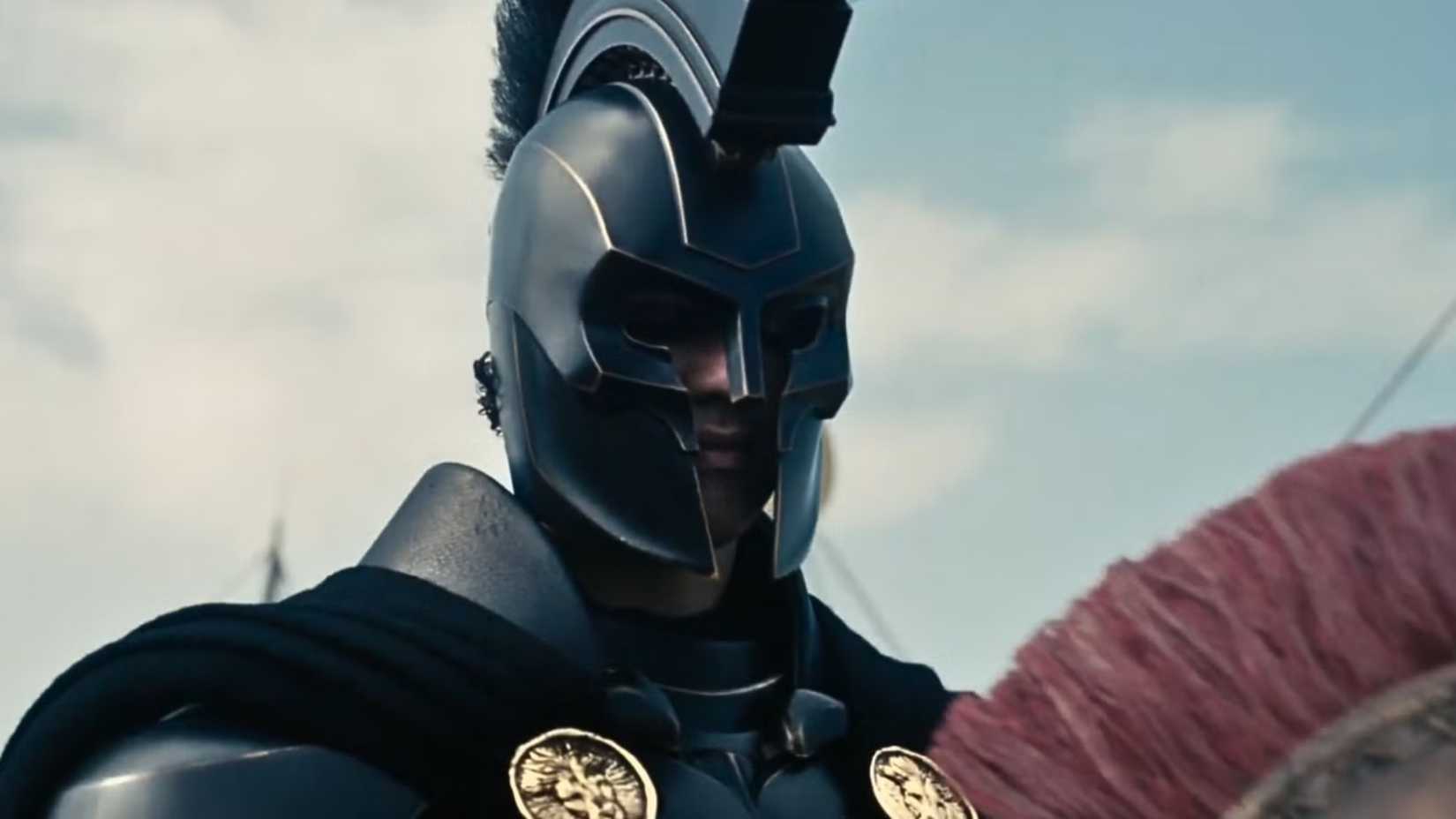
Some viewers have described Nolan’s version of Odysseus as suffering from post-traumatic stress disorder. But moral injury is the more accurate term. It overlaps with PTSD, but it’s not the same thing. Moral injury occurs when a person commits, witnesses, or fails to prevent an act that violates his moral convictions. In war, moral injury can arise when a person does something that violates his own ideals, loyalties, or sense of right and wrong. The result is lasting guilt. A combat veteran comes to see himself as corrupt, unworthy, or beyond forgiveness.
In the film, Odysseus describes his guilt over the violence he witnessed during the sack of Troy. He is conscience-stricken about his Trojan Horse gambit. Odysseus took an object that appeared to be a gift of peace and used it as a weapon of deception. His stratagem allowed the Greeks to enter Troy, destroy the city, and slaughter its people.
But the Trojan Horse is Odysseus’s crowning achievement. Homer’s Odysseus is a wily trickster, and a trickster would not be tormented by the fact that his trick succeeded.
During his journey, he repeatedly deceives his own men for what he believes is the greater good, and these acts clearly trouble him. The war itself is remembered as grim and pointless. Men are drafted rather than rushing eagerly toward glory.
This is not Homer’s moral universe. In the poem, the Greeks rape, rob, enslave, and pillage without displaying anything like modern guilt. We can tolerate this when reading an ancient text. It is harder to tolerate when those acts are placed directly before us on a movie screen.
This may explain Nolan’s decision. Had he shown the violence of the original story without softening it, would the audience still have been able to sympathize with Odysseus?
Consider what happens to the enslaved women accused of consorting with the suitors after Odysseus returns home. Odysseus orders them to be killed, and Telemachus hangs them. Homer does not present the scene as morally complicated. Their punishment is part of restoring order.
Modern films sometimes allow their heroes to inhabit moral worlds very different from our own. Robert Eggers’s 2022 film The Northman asks us to sympathize with Viking characters who obey codes that most moviegoers today would find reprehensible. But The Northman was a mid-budget film. Nolan made a summer blockbuster that cost hundreds of millions of dollars. A blockbuster can’t afford to depict a hero from whom audiences recoil. Eggers could let his Viking be a Viking. Nolan needs his Greek warrior to be one of us.
Yet such individuals lived in societies that existed before Christian morality reshaped the Western understanding of guilt, mercy, and the value of every human life. The moral injury that afflicts Nolan’s Odysseus belongs more naturally to the AD world than the BC one.
In the film, Odysseus grieves for the men he lost and appears to blame himself for their deaths. But Homer presents that suffering as the result of pride, fate, divine anger, and human foolishness. The original story does not depict Odysseus as a man tormented by the fear that he has violated his own moral code.
The difference is clear in the episode of the lotus-eaters. In Nolan’s film, Odysseus eats the lotus because he seeks mental relief, a kind of ancient Greek version of using psychedelics to treat combat trauma. In the poem, Odysseus does the opposite. He refuses to eat the lotus and orders his men away from it.
July 25, 2026
QotD: “… the major evolutionary pressure is other humans”
One of the grand joys of being ignorant on a subject is that it’s possible to project one’s own insistences onto the findings of others. This explains Gazza on wealth, Sir Lenworth on reparations and Spud on any aspect of economics. Given the fun they’re having why not partake?
The Reich Lab article on genetic selection in Europe over the last 10,000 years is finally online, and it includes such interesting results as:
— Intelligence has increased
— People got lighter
— Mental disorders became less common
Clearly, given Gazza, Sir Lenworth and Spud less common is not a synonym for does not happen. But to proceed to my own ignorance:
In a sort-of confirmation of the Cochran-Harpending thesis, they also found that, for several traits, the intensity of selection appears higher more recently in time.
Specifically, selection intensity increased in the Bronze Age compared to the Neolithic, then it stabilized!
At which point I get to project my own mental wibbles onto the results of others.
Now, think of that deep history. Up until agriculture — roughly that Bronze Age — the driver of human evolution was the wolves trying to eat us. OK, mebbe the staphilococci, the crocs, hippoes, Venus Human Traps and so on. We were, as with most species, not really competing against ourselves but against those who saw us as either food or as competitors for an ecological niche.
Yes, yes, I know, this isn’t true but it’s a reasonable pencil sketch start to an argument.
OK, so now Bronze Age. We’ve got agriculture. We also, at this exact same time, see human populations change quite a lot. There’s a massive expansion of certain Y chromosomes and much less of maternal mitochondria. You know, the blokes from over the hill come in, kill all the men and shag the birds. We’ve — perhaps through agriculture, perhaps through bronze, perhaps through the simple absence of any more terra nullius — made the major threat to human other humans.
Or, of course, given the genetics here we could say that the major threat to male humans is now other male humans but that doesn’t make much difference to the argument — men, after all, the only ones who ever do anything.
Well, if the major threat is now humans then that means that the major evolutionary pressure is other humans. And they’re fighting with the same weapons we are. Same basic DNA possibilities, roughly the same physique, about the same IQ and on and on. This is going to have much more pressure on that evolution than being chased by a hippo is — that’s a one time win or lose event. Whether your genes persist is now a permanent battle with others who share near all of your capabilities. The importance being that word “near”.
Yes, I do know that it’s possible to make much the same argument for any species and their access to breeding. But the thing we’re interested in explaining here is why did this speed up in humans at one point? I claim that’s it’s because of the above — the rough settlement of decent agricultural land, worldwide, (or in the case here, in Europe. This doesn’t apply to Wales, say, or Scotland, which explains both of them now neatly) means that the competitor is other humans, not the more general environment. We’ve changed the evolutionary pressure. We’re no longer trying to outhink a pig — something Gazza, Spud etc often don’t — but that other bastard with his eye on our field and our wife.
So, that’s the thing. Human evolution sped up because it was the other bastard humans we were competing with, not the general environment. QED, I’m right and go boil your heads.
Tim Worstall, “Human Beings Were The Enemy In Human Evolution”, It’s all obvious or trivial except …, 2026-04-24.
July 20, 2026
Eating the Food of Homer’s Odyssey
Tasting History with Max Miller
Published 14 Jul 2026Skewer of roast pork covered in seasoned barley meal, accompanied by the Ancient Greek potion, Kykeon
City/Region: Greece
Time Period: c. 1650-1100 B.C.E., Mycenaean PeriodWhen Odysseus finally makes it back to his home of Ithaca, he goes to the home of the swineherd Eumaeus. Disguised as a beggar, Odysseus is welcomed into Eumaeus’s home, and Eumaeus prepares skewers of roasted pork sprinkled with barley meal.
While I could just make plain roast pork sprinkled with plain barley flour, let’s assume that Eumaeus does the disguised Odysseus the courtesy of seasoning the meal. Archaeologists have found evidence that the people living in Greece during the Mycenaean Period, when The Odyssey is supposed to have taken place, commonly used coriander, cumin, celery, and fennel, so that’s what I used to season the barley flour coating.
This dish is very simple, and surprisingly flavorful. I made mine in the oven, but if you can cook it over an open fire, it would be even better. The cumin and fennel seeds are both very strong flavors, so choose one or the other so as not to completely overpower everything else.
Eumaeus went off to the sties where the pigs were penned. Choosing two sucklings, he carried them in, slaughtered and singed them both, then cut them in pieces and spitted them on skewers. Then, when all was well roasted, he served it to Odysseus piping hot on the skewers, sprinkling the meat with white barley meal.
— The Odyssey, Book XIV
April 26, 2026
The Ancient Greeks: 01 – What Made Them Special? (a): Origins, Collapse, and Reinvention
seangabb
Published 31 Jan 2026This section introduces the Greek world and challenges common assumptions about Greek civilisation.
It examines who the Greeks were, where they came from, and how fragmented their political and cultural world was. It then explores the collapse of Bronze Age Greece around 1200 BC and the long Greek Dark Age that followed, during which writing disappeared, monumental architecture ceased, and long-distance trade declined.
When Greek civilisation recovered around 800 BC, it did not restore the Mycenaean world. Instead, it reinvented itself, drawing on epic poetry and myth rather than historical memory.
A central argument of this section is that the later Greeks knew less about their own early history than we do, and that Greek civilisation was rebuilt not on continuity, but on reinvention.
April 15, 2026
QotD: Archaeological evidence of human achievement misses a lot
“What cultural achievements?” you may ask, eyeing the world’s few remaining hunter-gatherers, and it’s true: we judge barbarians of the past by analogy to barbarians of today.2 But that’s not entirely reasonable; there’s no reason to assume that a lack of cultural elaboration among, say, the highlanders of Papua New Guinea reflects anything about the Lapita culture, let alone about the Middle Stone Age or Neolithic Europe.3 It reminds me of the friend who once explained to me, quite seriously, that he would never work for a startup because they’re all culturally dysfunctional and have stupid products. And, you know, statistically he’s probably right: most startups suck, because if they’re any good at what they do they don’t stay startups for long.4 But we all know that different cultures are different: some groups of people see a horizon and burn with the desire to know what’s beyond it, and others don’t. Well, guess who those horizons are going to end up belonging to?
Of course there’s something nice about things that last: the written works and monumental architecture give succeeding generations something to point to and discuss, a jumping-off point for their own striving. Reading Latin is great, partly because you can read what the Romans had to say but more because you can read the same things that every educated person since the Romans has read. But that’s talking about their utility for us, not anything intrinsic to them; if the Huns or the Mongols or the Turks had come a little farther west and despoiled a little more thoroughly, it wouldn’t have retroactively detracted from the grandeur that was Rome. It would simply have turned it into a dark age because it would have left us blind.
Jane Psmith, “REVIEW: Against the Grain, by James C. Scott”, Mr. and Mrs. Psmith’s Bookshelf, 2023-08-21.
- Calvert Watkins argues for a Proto-Indo-European Ur-myth in the charmingly-titled How to Kill a Dragon: Aspects of Indo-European Poetics, which really ought to contain more stat blocks than it does.
- Or, more often, a hundred years ago, since there are vanishingly few non-state peoples left.
- I can’t get over how annoying it is that there’s an entirely different set of terms for periods of human history depending on what continent you’re discussing.
- I’m sorry if it’s uncool, but by the time you employ someone with a certification from the Society of Human Resource Managers you’re not really a startup anymore even if your office fridge is full of energy drinks.
October 18, 2025
QotD: Civilizational survival after the Bronze Age Collapse
Sometimes the answer is obvious. The Assyrians and Babylonians clearly survived the Collapse: if you compare their architecture, inscriptions, artwork, settlement patterns, and political structures from the Late Bronze Age to the Iron Age, they are recognizably the same people doing the same things and talking about them in the same way. The Egyptians, too, are plainly the same civilization throughout their (very long!) history, even if they were notably weaker and less organized after the Collapse. The Hittites, just as obviously, did not survive (at least not outside their tiny rump states in northern Syria). But the Greeks and the Phoenicians are both murkier cases, albeit in very different ways.
On the one hand, Mycenaean civilization — the palace economy and administration, the population centers, the monumental architecture, the writing — indisputably vanished. The Greeks painstakingly rebuilt civilization over several hundred years, but they did it from scratch: there is no political continuity from the Mycenaean kingdoms to the states of the archaic or classical worlds. And yet as far as we can tell, there was substantial cultural continuity preserved in language and myth. Admittedly, “as far as we can tell” is doing a lot of work here: Linear B was only ever used for administrative record-keeping, so we can’t compare the Mycenaeans’ literary and political output to their successors the way we can in Assyria or Egypt. We can’t be sure that the character, the vibe, the flavor of the people remained. But the historical and archaeological records of the later Greeks contain enough similarities with the descendants of the Mycenaeans’ Indo-European brethren that the answer seems to be yes.
By contrast, civilization never collapsed in central Canaan. No one ever stopped having kings, writing, building in stone, or making art. The Bronze Age population centers were continuously occupied right up to … well, now. And yet their way of life shifted dramatically, to the point that we call them by a new name and consider them a different people. Cline thinks this is a success story: borrowing an analytical framework from a 2012 Intergovernmental Panel on Climate Change report, he praises their “transformation”,1 which “include[d] actions that change the fundamental attributes of a system in response to actual or expected impacts”. (The Assyrians, by contrast, merely “adapted”, while the Egyptians barely “coped”.) But does there come a point when the change is so great, so fundamental, you’re no longer the same civilization? Can the Ship of Theseus really be said to have “survived”?
In the final section of his book, titled “Mycenaeans or Phoenicians”, Cline asks how we’ll react to the societal collapse we all sort of know is coming sooner or later. Our world just is too complicated, too interconnected, to survive a really massive shock (or, as in the Late Bronze Age, a “perfect storm” of smaller ones). Even the relatively mild disruptions of the past few years have revealed fragilities and vulnerabilities that we’ve done nothing to shore up since. Of course, he has an answer: Transform! Innovate! Flourish amidst chaos! Become a new iteration of yourself, like the bog-standard Canaanite cities that reinvented themselves as an Iron Age mercantile superpower and turned the Mediterranean into a “Phoenician lake”. But at what price?
Or, to think of it another way, what would you prefer for your society five hundred years from now?
Behind Door Number One: governmental collapse, abandonment of the population centers, dramatic reduction in societal complexity, and then a long, slow rebuilding where your time and your people are remembered only as myth — but when civilization is restored, it’ll be by people whose the desires, values, attitudes, and beliefs, their most basic ways of understanding the world, are still recognizably yours. They may have no idea you ever lived, but the stories that move your heart will move theirs too.
And behind Door Number Two: expansion, prosperity, and a new starring role on the world stage — but a culture so thoroughly reoriented towards that new position that what matters to you today has been forgotten. Do they remember you? Maybe, sort of, but they don’t care. They have abandoned your gods and your altars. Those few of your institutions that seem intact have in fact been hollowed out to house their new ethos. A handful of others may remain, vestigial and vaguely embarrassing. But boy howdy, line goes up.
Obviously, given our druthers, we’d all be the Assyrians: seize your opportunities, become great, but don’t lose your soul in the doing. But if it comes down to it — if, when the IPCC’s warning that “concatenated global impacts of extreme events continues to grow as the world’s economy becomes more interconnected” bears out, the Assyrian track isn’t an option — then I’d take the Greek way.
I don’t care whether, on the far side of our own Collapse, there’s still a thing we call “Congress” that makes things we call “laws”. Rome, after all, was theoretically ruled by the Senate for five hundred years of autocracy as all the meaning was leached from the retained forms of Republican governance. (Look, I’m sorry, you can call him your princeps and endow him with the powers of the consul, the tribune, the censor, and the pontifex maximus, but your emperor is still a king and the cursus honorum has no meaning when the army hands out the crown.) I don’t even really care if we still read Shakespeare or The Great Gatsby, although it would be more of a shame to lose those than the Constitution. But I do care that we value both order and liberty, however we structure our state to safeguard them. I care that we’re the sort of people who’d get Shakespeare and Fitzgerald if we had them around. Maybe we should start thinking about it before our Collapse, too.
Jane Psmith, “REVIEW: After 1177 B.C., by Eric H. Cline”, Mr. and Mrs. Psmith’s Bookshelf, 2024-07-08.
- “Transformation” is always a term worth taking with a pinch of salt because so often it’s a euphemism for “total civilizational collapse”. In the chapter on the Hittites, for example, Cline quotes one archaeologist to the effect that “[a] deep transformation took place in the former core of the empire around the capital Hattusa, resulting in a drastic decrease in political complexity, a shift to a subsistence household economy and a lack of evidence for any public institutions”. Relatedly, one of my children recently transformed a nice vase into a pile of broken glass.
In this case, though, Cline really does mean transformation.
October 13, 2025
Stephen Fry’s Odyssey weighed in the balance and found wanting
Bryan Mercadente received a copy of Stephen Fry’s latest foray into Greek mythology and not only is not impressed, he writes, “Every page wasted on Fry is a page stolen from the real thing. The copy my aunt has given me for my birthday is already skimmed with disgust and thrown into the dustbin: it is too disgusting for the charity shops.”

The Iliad and Odyssey are the founding works of our civilisation. They are poems of war, loss, exile, and return. The hero of The Odyssey is a liar, a man of cunning and cruelty, but also a survivor who longs for home. The Homeric poems have come to us out of the Bronze Age. They have survived the collapse of at least two civilisations, and will survive the collapse of our own. They survive because they are already perfect. The hexameters carry an austere music. Their formulaic epithets — “ῥοδοδάκτυλος Ἠώς“, “πόδας ὠκὺς Ἀχιλλεύς“, “δῖος Ὀδυσσεύς” — are the memory-tricks of a sung tradition, but they also give the poems a dignity that no one who reads them can ever forget. Like The Iliad, The Odyssey was not written to be read in comfort with a cup of tea. It was composed to be chanted in smoky halls to men who might be dead tomorrow.
Stephen Fry knows none of this. Or if he knows it, he does not care. His Odyssey is Homer without the difficulty. It is Homer stripped of his grandeur, reduced to banter and “relatable” anecdotes. The Observer praised it for bringing “contemporary relevance” to the myths. That line is damning enough. Homer does not need contemporary relevance. A book that has spoken to audiences across three thousand years already possesses the only relevance that matters. To make Homer relevant is to make him trivial.
The Guardian called the book “relatable and full of humour“. Again, the praise condemns. Relatable? Homer is not relatable. The world he describes is harsh and alien. His heroes live by honour and die by the sword. They weep like children and sacrifice to gods who may or may not answer. That strangeness is the point. It is what makes Homer worth reading. To make him “relatable” is to gut him of meaning.
The Irish Independent calls Fry “A born storyteller“. This blurb, like the others, is the language of people who cannot read. No serious critic would praise a reteller of Homer as “a born storyteller”, as if the original poet were not the greatest storyteller of them all. These blurbs are not criticism. They are advertising slogans. And they work. The book is a bestseller.
Why, then, is Fry’s book a bestseller? Not because of merit. It sells because of Stephen Fry himself. For thirty years, he has been cultivated as a “national treasure”. He is the ideal leftist intellectual: clever enough to appear learned, shallow enough never to disturb. He quotes Wilde, sprinkles in Latin tags, and sprinkles them badly. His claque tells us that he is bipolar, gay, witty, and charming. He is on panel shows, chat shows, and literary festivals. He is always agreeable, always moderate, and always applauded.
Fry has built a career on the fact that the English middle classes like to feel cultured without effort. They want Plato without philosophy, Shakespeare without metre, Wagner without subversion, Homer without Greek. They want to be reassured that the classics are not difficult or dangerous, but fun. Fry gives them what they want. He domesticates the wild. He reduces epic to anecdote. He packages civilisation as entertainment.
It is not enough to call this dumbing down. It is worse. Dumbing down implies a reduction in complexity. What Fry does is not simplification but falsification. The Odyssey is not a sequence of funny stories about gods and monsters. It is about endurance and the fragility of human life under the indifference of the divine. To make it “funny” is to destroy it. It is as if someone rewrote the Inferno as a travel blog or recast the Iliad as a football commentary. The whole point of the work is lost.
Popularity, however, is not a defence. It is an indictment. Books that sell by the million are almost always worthless. They are consumed because they flatter the prejudices of the public. They make readers feel clever without having to be clever. They make them feel cultured without culture. They are the literary equivalent of processed food: cheap, sweet, addictive, fattening.
What, then, is the harm? Why not let people have their Fry and be happy? So what if his writing is as inconsequential as his suicide attempts? The harm is that time is short. Every hour spent on Stephen Fry is an hour not spent on Homer. It is an hour subtracted from Gibbon, Johnson, or Shakespeare. It is an hour less of life. The opportunity cost is everything. Bad books are not neutral. They are parasites. They feed on the hours that might have been spent on good ones.
September 23, 2025
QotD: “Bye, Phoenicia”
The long-distance trade of the Bronze Age had been dominated by large state actors. The ships were probably built and crewed by men from the Levantine coast, but the cargo was purchased and shipped by local representatives of the Great (and lesser) Powers of the age: luxury goods were an integral part of high-level diplomacy, so most trade was a virtual monopoly centrally directed from the palaces. When these polities were weakened (or in some dramatic cases like Ugarit completely destroyed) in the Collapse, they left behind a vacuum that independent Phoenician traders, operating without centralized control and serving only profit rather than the demands of empire, rapidly filled.
By the tenth century BC, the Phoenicians were importing silver from Spain, copper from Cyprus and Sardinia, and cinnamon from southeast Asia. They exported timber (the much-vaunted “Cedars of Lebanon”)1 and the valuable purple dye extracted from the murex sea snail, as well as a wide variety of finished luxury and quotidian goods they produced at home from raw materials obtained abroad. They founded colonies throughout the Mediterranean. And perhaps most importantly for the future of “the West”, they introduced the alphabet,2 which enabled the return of literacy to Greece and its far wider adoption than had ever been possible with Linear B.3
By the time the ascendant Neo-Assyrians began to encroach on their territory, the Phoenician city-states were so rich and economically well-connected that they were more valuable as semi-autonomous tributaries and middlemen than as conquered subjects. In fact, it was the Assyrian demands for metal (especially silver) that drove Phoenician colonization in the western Mediterranean: they founded Cadiz (Phoenician Gadir) to access the rich silver mines in the Spanish interior, as well as dozens of other smaller entrepôts along the sailing routes to and from the Levantine coast. Eventually they removed so much silver from Spanish mountains that its value in Assyria collapsed, inflated away by oversupply, just like Peruvian silver would destabilize the Spanish economy two thousand years later — but with the roles flipped. I enjoy these echoes.
It’s worth pointing out here that Phoenicians never called themselves Phoenicians: it’s a Greek word, deriving from a Mycenaean era (e.g., pre-Collapse) term for purple dye. In fact, they didn’t even have a term that clearly limned what the Greeks meant by “Phoenician” (essentially, “Levantine traders with really good ships who speak a related set of Semitic languages”). Instead, they sometimes referred to themselves more narrowly by reference to their native cities (Sidonian, Tyrian, Byblian, etc.) and other times more broadly as “Canaanite”, because of the cultural heritage they shared with the other survivors of Bronze Age Canaan. But even if they never employed it themselves, “Phoenician” is a terribly useful word, because these particular city-states had a lot in common with one another but diverged sharply from their Canaanite kin to both north and south.
Bronze Age Canaan had been relatively culturally homogenous, though the cities in the north came into the Hittites’ sphere of influence and those in the south the Egyptians’. After the Collapse, though, the city-states of northern Canaan (modern Syria), like their Neo-Hittite neighbors, seem to have continued more or less as they had been. Those in southern Canaan were not so lucky: weakened by the invading Sea Peoples and the withdrawal of Egyptian hegemony, the southern Canaanites were displaced by (or assimilated to) the new Semitic kingdoms in the region, including Israel, Judah, Edom, and Ammon. And the central Canaanites became the Phoenicians: master sailors and traders, they had seized their opportunity and so thoroughly transformed themselves that we join the Greeks in identifying them by a new name.
Most of the larger cities of the central Levant are buried beneath their modern equivalents, and Lebanon has not been a particularly salubrious place to excavate for the last few decades, so it’s hard to say a great deal about Phoenician continuity with their Bronze Age ancestors. There was obviously some, certainly genealogically but also linguistically and in terms of material culture. However, we also know that their lifestyles changed dramatically as their economic reach expanded and their cities became centers not only of exchange but of manufacturing. We know their commercial firms were organized around extended families, and that they began to settle foreign lands both as colonists in their own new cities and elsewhere as resident merchants with their own dedicated enclaves. And we know that as their city-states grew more powerful, they increasingly directed worship away from the traditional Canaanite pantheon, led by El, and towards the tutelary deity of each individual city. (The story that King Hiram of Tyre actually tore down the temples of El and Baal to make room for a magnificent new temple of his patron, Melqart,4 is probably an exaggeration, but points to the scale of the break with the past.)5
Jane Psmith, “REVIEW: After 1177 B.C., by Eric H. Cline”, Mr. and Mrs. Psmith’s Bookshelf, 2024-07-08.
- For a very funny story about an Iron Age Egyptian attempt to buy some, which I simply could not fit into this review, see the “Story of Wenamun“. Bonus points for imagining how it would have played out under the New Kingdom.
- Okay, the Phoenician “alphabet” is actually an abjad — it contains no symbols for vowels — but the Greeks quickly added those.
- It is much, much easier to learn to write with an alphabet than with a logosyllabic system like Linear B or cuneiform.
- Melqart is also the patron of the Tyrian colony of Carthage, and his name contributes one element to that of Hamilcar Barca. The –bal in Hannibal, Hasdrubal, etc., is of course from Baal.
- Cline doesn’t give a ton of detail on Phoenician culture; in this section I am also drawing heavily on the opening chapter of Richard Miles’s Carthage Must Be Destroyed: The Rise and Fall of an Ancient Civilization, which sentiment I fully endorse even though I haven’t finished the book yet.
August 10, 2025
Al Stewart – “Helen and Cassandra”
jonnoms
Published 19 Jun 2011Slight re-working of ‘Where Are They Now?’ video to another, Al Stewart song.
August 7, 2025
QotD: The lost-then-found-again Hittite civilization
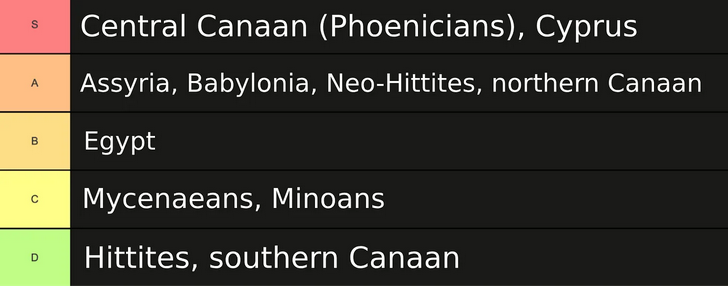
… Mycenaean Greece was as much an outlier as sub-Roman Britain: the civilizational collapse in the Aegean was unusually prolonged and severe compared to the fates of many of the other peoples of the Late Bronze Age. Here I have helpfully reformatted Cline’s chart of how resilient the various societies proved:
Let’s take a brief tour through the various fates of these societies. I’ll come back to the Phoenicians at the end, because their example raises interesting questions when considered in contrast with the Mycenaeans. For the moment, though, let’s begin like civilization itself: in Mesopotamia.
Before the Late Bronze Age Collapse, the Assyrian and Babylonian empires had numbered among the Great Powers of the age: linked by marriage, politics, war, and trade to the other mighty kings, they spent much of their time conducting high-level diplomacy and warfare. As far as we can tell, they did well in the initial collapse: there’s a brief hiatus in Assyrian royal inscriptions running from about 1208 to 1132 BC, but records resume again with the reign of Aššur-reša-iši I and his repeated battles with his neighbor to the south, the Babylonian king Nebuchadnezzar I (no relation). But although the kings of the late twelfth century continued much as their Bronze Age predecessors had — waging war, building palaces, going hunting, accepting tribute, collecting taxes, and ordering it all recorded in stone and clay — the world had changed around them. No longer were there huge royal gifts sent to and from fellow great kings, “My Majesty’s brother”1 overseas; now their diplomatic world consisted of tiny petty kings of nearby cities who could be looted or extorted at will.
Mesopotamia didn’t escape unscathed forever: beginning around 1080 BC, texts begin to record severe droughts, invading Aramaeans, and total crop failures. There was a major drought in 1060 BC, and then both the Assyrian and Babylonian records record further drought every ten years like clockwork — sometimes accompanied by plague, sometimes by “troubles and disorder” — until the end of the eleventh century BC. Most of the tenth century was equally dire, with chronicles recording grain shortages, invasions, and a cessation of regular offerings to the gods.
But unlike the Mycenaeans, and in spite of real suffering (ancient Babylonia is estimated to have lost up to 75% of its population in the three hundred years after the Collapse), both Mesopotamian empires were able to hang on to civilization. There were still kings, there were still scribes, and there were still boundary stones on which to record things like “distress and famine under King Kaššu-nadin-ahhe”. And when conditions finally improved, Assyria and Babylonia were both able to bounce back. When at last the Assyrian recovery began under Aššur-dan II (934-912 BC), for example, he (or more realistically, his scribe) was able to write: “I brought back the exhausted people of Assyria who had abandoned their cities and houses in the face of want, hunger, and famine, and had gone up to other lands. I settled them in cities and homes which were suitable and they dwelt in peace”. Clearly, Assyria still retained enough statehood to effect the sort of mass population transfer that had long been a feature of Mesopotamian polities.2
Over the next few centuries, the Neo-Assyrian Empire would come to dominate the Near East, regularly warring with (and eventually conquering) Babylon and collecting tribute from smaller states all over the region. At its peak, it was the largest empire history had ever known, covering a geographic extent unsurpassed until the Achaemenids. The Babylonians had to wait a little longer for their moment in the sun, but near the end of the seventh century they overthrew their Assyrian overlords and ushered in the Neo-Babylonian Empire. (Less than a century later, Cyrus showed up.)
So how did Babylon and Assyria hold on to civilization — statehood, literacy, monumental architecture, and so forth — when the Greeks lost it and had to rebuild almost from scratch? Unfortunately, Cline doesn’t really answer this. He offers extensive descriptions of all the historical and archaeological evidence for the diverse fates of various Late Bronze Age societies, but only at the very end of the book does he briefly run through the theories (and even then it’s pretty lackluster). He does have a suggestion about the timing — the ninth century Assyrian resurgence lines up almost perfectly with the abnormally wet conditions during the Assyrian megapluvial — but why was it the Assyrians who found themselves particularly well-positioned to take advantage of the shift in the climate? Why not, say, the Hittites?
Sometime around 1225 BC, the Hittite king Tudhaliya IV wrote to his brother-in-law and vassal, Shaushgamuwa of Amurru, that only the rulers of Egypt, Babylonia, and Assyria were “Kings who are my equals in rank”.3 A mere thirty years later, though, his capital city of Hattusa would lie abandoned and destroyed. Modern excavators describe ruins reduced to “ash, charred wood, mudbricks and slag formed when mud-bricks melted from the intense heat of the conflagration”.
And with that, the Hittites essentially vanished from history.
They were so thoroughly forgotten, in fact, that when nineteenth-century archaeologists discovered the ruins of their civilization in Anatolia, they had no idea who these people were. (Eventually they identified the new sites with the Hittites of the Bible, who lived hundreds of years later and hundreds of miles to the south, out of sheer ¯\_(ツ)_/¯.)4
What happened to the Hittites? Well, Cline suggests the usual mélange of drought, famine, and interruption of international trade routes, as well as a potential usurpation attempt from Tudhaliya’s cousin Kurunta, but the actual answer is that we’re not sure. Given the timing, they may have been the first of the Late Bronze Age dominos to fall; given the lack of major rivers in central Anatolia, they may have been uniquely susceptible to drought. Hattusa may have been abandoned before the fire — its palaces and temples show little sign of looting, suggesting they [may] already have been emptied out — but many other sites in the Hittites’ central Anatolian heartland were destroyed around the same time, and some of those have bodies in the destruction layer. But whatever the order of events, Hittite civilization collapsed as thoroughly and dramatically as the Mycenaeans’ had done, and with a similar pattern of depopulation and squatters in the ruins. Unlike the Mycenaeans, though, the Hittites would never be followed by successors who inherited their culture; the next civilization of Anatolia was the Phrygians, who probably arrived from Europe in the vacuum following the Hittites’ fall.
There was one exception: in the Late Bronze Age, cadet branches of the Hittite royal family had ruled a few small satellite statelets in what is now northern Syria, and many of these “Neo-Hittite” polities managed to survive the Collapse. A tiny, far-flung corner of a much greater civilization, they nevertheless outlasted the destruction of their metropole and maintained Hittite-style architecture and hieroglyphic inscriptions well into the Iron Age.5 (They would be swallowed up by the Neo-Assyrian Empire in the late eighth century BC.) And though the Neo-Hittite kings ruled over tiny rump states, we’re now able to translate inscriptions in which they referred themselves by the same titles the Bronze Age Hittite “Great Kings” had employed. The records of their larger neighbors, which had a much greater historical impact, seem to have followed suit: the Neo-Hittites in Syria probably actually were the Hittites of the Bible! Chalk up another one for nineteenth century archaeology.
Jane Psmith, “REVIEW: After 1177 B.C., by Eric H. Cline”, Mr. and Mrs. Psmith’s Bookshelf, 2024-07-08.
1. I really think we should bring back monarchs referring to themselves as “my Majesty”. So much cooler than the royal “we”. Or combine them: “our Majesty”!
2. The Babylonian Captivity, much later in the Iron Age, was far from historically unique.
3. The list actually reads, “the King of Egypt, the King of Babylonia, the King of Assyria,
and the King of Ahhiyawa” — the strikethrough appears in the original clay tablet! A generation earlier, under Tudhaliya’s father Hattusili III, the Hittite texts had consistently referred to the king of Ahhiyawa as a “great King” and a “brother”, but apparently the geostrategic position of the Mycenaean ruler had degraded substantially.4. We now know that the Hittites spoke an Indo-European language and referred to themselves “Neshites”, but the name has stuck.
5. I went looking for a good historical analogy for the Neo-Hittite kingdoms and discovered, to my delight, the Kingdom of Soissons, which preserved Romanitas for a few decades after the fall of the Western Roman Empire. The Neo-Hittites lasted a lot longer.
July 6, 2025
QotD: After the Bronze Age Collapse
But what surprised me most about After 1177 B.C. is how short this era was. In some places, anyway.
We have a vague picture of what happens after a civilizational collapse, but it’s been disproportionately influenced by two particularly dramatic examples: sub-Roman Britain and the Greek Dark Ages. This was perfectly sensible coming from the Anglo historians and archaeologists who have dominated the public conception of the field — after all, the only thing more interesting than the history of your own island is that of the classical world you’ve been studying since you got your first Latin grammar at age six — but it turns out that neither of these are the general rule. Foggy, faraway Britain, so reliant on imported goods and troops, was far more seriously impacted by the withdrawal of Rome than was most of the Empire and saw a longer and more significant reduction in cultural complexity, standards of living, average stature, and of course population. (Imagine what would happen to a Mars colony if the connections to the home planet stopped working.)
Greece after the fall of the Mycenaeans suffered an even more striking decline. As Austrian archaeologist Sigrid Deger-Jalkotzy summarizes:
The impressive palatial structures were not rebuilt, and very little of the representational arts and crafts of the palaces seems to have survived. The complex forms of political, social, and economic organization fell into oblivion. Palaces, kings, and royal families became matter for Greek myths. The art of writing was lost for centuries. In short, Greek civilization was reduced to the level of a prehistoric society.
The Greeks of the classical era had little conception that the Mycenaeans had even existed, let alone that they were their own ancestors: they retained a vague mythological tradition of past kings, but they attributed the few surviving Mycenaean structures to the work of cyclopes. In fact, the disconnect between the civilization of the Late Bronze Age and the later classical world was so great that until Michael Ventris deciphered Linear B, it was an open question whether the people responsible for the Lion Gate and the Treasury of Atreus were even Greeks at all. (The answer, in case you’re wondering, is yes: Linear B turns out to be a syllabic script for the most ancient attested form of Greek. It features a number of uniquely Greek words and deity names even in the limited surviving corpus. More recently, ancient DNA has confirmed the linguistic evidence: the classical Greeks were the descendants of the Mycenaeans.)1
But the more you look at the archaeological record, the more you can pick out signs of cultural continuity. Agricultural practices don’t seem to have changed much, nor did Mycenaean pottery styles, and the names and attributes of the gods preserved in Linear B are close if not identical to their forms as codified in Homer and Hesiod. Even the cyclopean architecture continued to provide shelter: the Mycenaean palace at Pylos was almost completely destroyed in the Collapse, but the few rooms that survived intact show signs of having been inhabited by squatters over the next century or two.
Homer too is chock full of details that turn out to be distant memories of the Mycenaean world, somehow preserved in the oral tradition until writing was reintroduced to Greece.2 For instance, he describes a kind of boar’s tusk helmet that, by his time, no one had worn for centuries, but which archaeologists have since regularly discovered in Mycenaean shaft graves throughout the Aegean. But my favorite example, which is of course linguistic, is the word for “king”: Homer describes Menelaus, Agamemnon, Odysseus and others with the word anax, which is recognizably the Linear B word 𐀷𐀙𐀏, wa-na-ka, used in the Bronze Age to describe the supreme rulers of the Mycenaean palatial societies. (The w sound was lost with the tragic death of the digamma.) By the classical era, however, anax had fallen out of use in preference for basileus (Linear B 𐀣𐀯𐀩𐀄, qa-si-re-u), which in the Mycenaean period had referred to a much lower-level chieftain.
This all paints an evocative picture of a post-apocalyptic world. You can imagine it transplanted to an American context, with the scattered survivors of some great cataclysm huddled around fires built in the corners of a crumbling Lincoln Memorial. You can picture them passing on stories of the great men of the past with their tall tube-shaped hats and the shiny black stones they carried in their pockets. And by the time this remnant rebuilt, they might well have forgotten the word “President” except as an archaism; after centuries of as a small-scale society, “Mayor” might become so deeply engrained as the highest title that two thousand years later they would still use it to refer to their emperor.
Jane Psmith, “REVIEW: After 1177 B.C., by Eric H. Cline”, Mr. and Mrs. Psmith’s Bookshelf, 2024-07-08.
1. It’s slightly more complicated than that, because of course it is; see here for more detail from Razib Khan.
2. A reasonable ballpark guess is that the poems traditionally attributed to Homer were composed in something like their current forms around 750 BC and written down for the first time shortly before 525 BC, although like the dating of Beowulf there’s a great deal of argument.
June 4, 2025
QotD: Conquest empires
Specifically, metal.
Soft metals are not for conquest empire. Gold, silver, copper, tin, etc, may be used for plates or posts or jewellery or skin scrapers, but they are not war fighting metals. Even the lightest leather armour or layers of feather padding makes them practically valueless for war fighting. Metal only becomes an imperial material when it can be made hard enough for combat purposes.
The first such metal is Bronze, which is made by combining different metals in compounds. Copper compounded with enough tin (usually 5-10 percent) makes Bronze. Bronze can make armour and weapons and even axles and bearings. But copper (mined in mountains) and tin (usually from swamps) and the charcoal needed to melt them (from forests) combined in sufficient quantities for mass production (cities supported by taxed farmers), require extensive trade routes, and probably a stable currency of some sort. But once these elements can be combined, empires can give up on mere Security, and enter Conquest.
All the early Sumerian, Egyptian, Hittite, Persian, Greek, Roman, Indian and Chinese empires that we now scrawl across maps with lines to show how they conquered the territories of other empires are based on this simple concept. The Hittites with their Bronze, Egyptians with their chariots, and Romans with their Steel: being only different developments from the same basic “metal technology” roots.
Yet this is where motive becomes uncertain. All these empires got into conquest, but in many cases they did it either to continue their security (by pushing the dangerous boundaries ever further), or to protect the trade that made their system work. Conquest for the sake of conquest was certainly an element — particularly with rulers like Alexander the Great — but the original reason why Phillip of Macedon and his predecessors had developed the world’s most efficient fighting machine had more to do with constant threats from Persians and Greeks and other “barbarians” than with any desire to get into the conquest game itself. Sometimes things done for security lead to expanded boundaries for security, which then lead to expanding further for conquest. (Often because the system developed for paying those fighting for security requires conquest to pay them off … see Julius and many later Caesars!)
Nigel Davies, “Types of Empires: Security, Conquest, and Trade”, rethinking history, 2020-05-02.
June 1, 2025
QotD: Robert E. Howard was more accurate with Conan than the historians of his day
(I’m not the first to point this out. Credit goes to Greg Cochran, co-author of “The 10,000 Year Explosion”, on his blog West Hunter.)
How did this happen? Scholars, reacting against 19th century Romanticism (and especially the weird polyp of it that turned into Nazi racial theory) adopted a sort of meta-model of prehistoric civilizations in which they usually evolved peacefully in place, with large-scale migration and warfare being exceptional.
It was only the advent of paleogenetics that shattered this cozy image. We now know that the Cimmerians (the Yamnaya ancestors of modern Europeans) did in fact come storming off the steppes to kill every male in sight and take all the women as sex slaves. We can read the traces of this catastrophe in our chromosomes.
ESR, Twitter, 2025-02-10.


