
Tasting History with Max Miller
Published 17 Feb 2026Roasted pork ribs with blackberries and honey with Stonehenge Nettle and Hazelnut Soup
City/Region: Britain
Time Period: 3000-1500 BCEAbout 2 miles from Stonehenge is Durrington Walls, the place that archaeologists believe was the living settlement for the people who built and used Stonehenge. Amongst the evidence of what was eaten, there are a lot of bones, about 90% of them being pig bones. Based on scientific analysis of the pig teeth found there, they were probably fattened on something sweet, which would have probably been honey or berries, so I’m using both to prepare these pork ribs.
This is a simple preparation, but these ribs are so good. The honey is the dominant flavor and the blackberry does come through. The other 10% of bones found at Durrington Walls were mostly cattle, so you could use beef ribs instead if you’d like, you’ll just have to cook them longer.
(more…)
August 14, 2026
What Did the Builders of Stonehenge Eat?
May 24, 2025
History of Britain, II: Stonehenge; The Druids, Vates, and Celtic Religion
Thersites the Historian
Published 15 Jan 2025In this episode, I briefly examine the presence of prehistorical megaliths on the British Isles and talk about the religion of the Celts, which was ascendant at the time that Britain entered entered the historical record.
July 28, 2018
Historical vandalism at Stonehenge
Jocelyn Sears on the barbaric “souvenir” habits of 18th century English “tourists”:
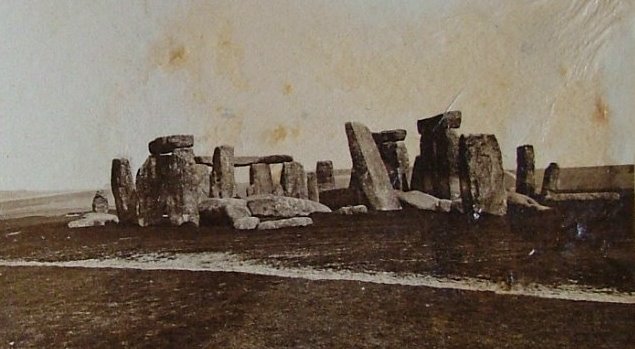
A photograph of Stonehenge taken in July 1877 by Philip Rupert Acott
Via Wikimedia Commons
In 1860, a concerned tourist wrote to the London Times decrying the “foolish, vulgar and ruthless practice of the majority of visitors” to Stonehenge “of breaking off portions of it as keepsakes.” Today, taking a hammer and chisel to a Neolithic monument seems like obvious vandalism, but during the Victorian era, such behavior was not only common but expected.
English antiquarian tourists, who were mostly upper class, had developed the habit of taking makeshift relics from the historical sites they visited during the 18th century. By 1830, the practice was so widespread that the English painter Benjamin Robert Haydon dubbed it “the English disease,” writing, “On every English chimney piece, you will see a bit of the real Pyramids, a bit of Stonehenge! […] You can’t admit the English into your gardens but they will strip your trees, cut their names on your statues, eat your fruit, & stuff their pockets with bits for their musaeums.”
For centuries, both locals and visitors had taken pieces of Stonehenge for use in folk remedies. As early as the 12th century, rumors of the stones’ healing properties appear in the writing of Geoffrey of Monmouth, and in 1707, Reverend James Brome wrote that their scrapings were still thought to “heal any green Wound, or old Sore.” In the 1660s, the English antiquarian John Aubrey reported a local superstition that “pieces or powder of these stones, putt into their wells, doe drive away the Toades.”
Eventually, tourists were not just taking from Stonehenge, but also leaving their mark, too. By the middle of the 17th century, tourist graffiti was appearing on the stones. The name of Johannes Ludovicus de Ferre — abbreviated “IOH : LVD : DEFERRE” — is etched, and so is the engraving “I WREN,” which may refer to Christopher Wren, the famed architect who designed St. Paul’s Cathedral.
As early as 1740, the archaeologist William Stukeley was decrying “the unaccountable folly of mankind in breaking pieces off [the stones] with great hammers,” and by the end of the 19th century, according an 1886 commenter, “Almost every day takes some fragment from the ruins, or adds something to the network of scrawling with which the surface of the stone is defaced.”
July 19, 2018
Mucking around with Stonehenge
Many people are still under the impression that Stonehenge was built by the Druids (debunked in this video by Siobhan Thompson). At least as many people think that the modern day stone circle is an undisturbed historical relic, and that the stones are standing today as and where they have for thousands of years. All the way back in 2001, Emma Young did a quick debunking of that theory in New Scientist:
An early photograph of Stonehenge taken in July 1877 by Philip Rupert Acott
Via Wikimedia Commons
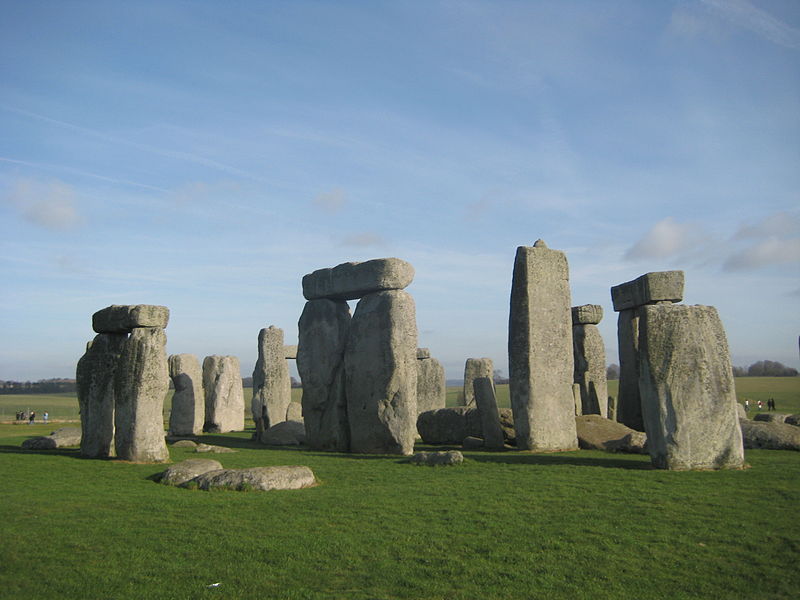
Photo from a similar angle in 2008 showing the extent of reconstruction.
Via Wikimedia Commons
Most of the one million visitors who visit Stonehenge on Salisbury Plain every year believe they are looking at untouched 4,000-year-old remains. But virtually every stone was re-erected, straightened or embedded in concrete between 1901 and 1964, says a British doctoral student.
“What we have been looking at is a 20th-century landscape, reminiscent of what Stonehenge might have looked like thousands of years ago,” says Brian Edwards, a student at the University of the West of England in Bristol.
Stonehenge isn’t the only ancient site to have been transformed in recent years, he says. “Even many of the local people in Avebury weren’t aware that a lot of the stones were put up in the 1930s,” he told New Scientist.
[…]
English Heritage says it is now considering covering the Stonehenge alteration programme in detail in the next edition of its official guidebook to the site. A decision not to include the work in official guides was taken in the 1960s, says Dave Batchelor, English Heritage’s senior archaeologist.
The first restoration project took place in 1901. A leaning stone was straightened and set in concrete, to prevent it falling.
More drastic renovations were carried out in the 1920s. Under the direction of Colonel William Hawley, a member of the Stonehenge Society, six stones were moved and re-erected.
Cranes were used to reposition three more stones in 1958. One giant fallen lintel, or cross stone, was replaced. Then in 1964, four stones were repositioned to prevent them falling.
The 1920s ‘restoration’ was the most “vigorous”, says Christopher Chippindale of the Cambridge University Museum of Archaeology and Anthropology. “The work in the 1920s under Colonel William Crawley is a sad story,” he says.
As I commented on a post back in 2010:
I imagine, given how many times Stonehenge has been mucked about with by earlier enthusiasts, there must be much misleading data has to be sifted and re-sifted before any definite discoveries can be announced. Stonehenge has been fascinating people for centuries and there are probably lots of amateur investigations that may well have made the situation more confusing (think of a sixteenth century equivalent of Indiana Jones or Lara Croft with a nose for treasure).
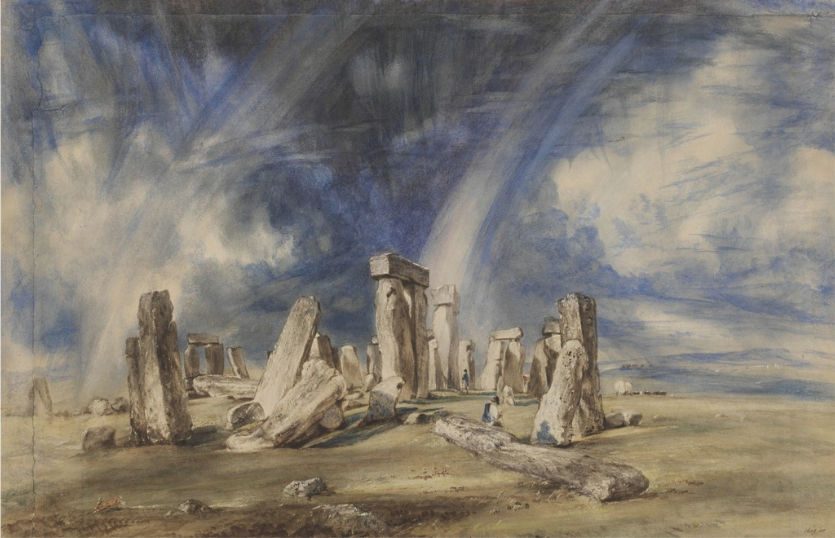
Atlas Obscura recently had a set of photos of Stonehenge taken in 1867 likely featuring the family of Colonel Sir Henry James, of the Ordnance Survey. There’s also a watercolour by John Constable from around 1835 showing a very different, more ruin-y monument:
September 25, 2017
The Truth About Stonehenge – Anglophenia Ep 6
Published on 26 Jun 2014
Siobhan Thompson follows up ‘One Woman, 17 British Accents’ with a video dispelling a commonly believed myth about Stonehenge.
And by the way, Stonehenge isn’t the only stone structure worth visiting in Britain: http://www.bbcamerica.com/anglophenia/2014/06/impressive-british-stone-structures-arent-stonehenge/
Photos via AP Images.
July 22, 2010
First results from new study around Stonehenge
A new study of Stonehenge by the University of Birmingham and Vienna’s Ludwig Boltzmann Institute for Archaeological Prospection and Virtual Archaeology has made its first major discovery:
Archaeologists have discovered a second henge at Stonehenge, described as the most exciting find there in 50 years.
The circular ditch surrounding a smaller circle of deep pits about a metre (3ft) wide has been unearthed at the world-famous site in Wiltshire.
Archaeologists conducting a multi-million pound study believe timber posts were in the pits.
Project leader Professor Vince Gaffney, from the University of Birmingham, said the discovery was “exceptional”.
The new “henge” — which means a circular monument dating to Neolithic and Bronze Ages — is situated about 900m (2,950ft) from the giant stones on Salisbury Plain.
I imagine, given how many times Stonehenge has been mucked about with by earlier enthusiasts, there must be much misleading data has to be sifted and re-sifted before any definite discoveries can be announced. Stonehenge has been fascinating people for centuries and there are probably lots of amateur investigations that may well have made the situation more confusing (think of a sixteenth century equivalent of Indiana Jones or Lara Croft with a nose for treasure).


