
Feral Historian
Published 12 Jun 2026Star Trek has always been a progressive cultural phenomenon, but that was in the last century. Now, Star Trek is older than most of its fan base and in some ways has started to look fairly conservative. This not only reminds us how relative those terms are, but also makes us ask, is Star Trek still relevant? Or perhaps more relevant than it ever was?
00:00 Intro
01:42 TNG, Discovery, and the Orville
04:16 Auroville
06:52 History Didn’t End
08:59 Social Cohesion as Technology
13:40 Step Back to Go Forward🔹 Patreon | patreon.com/FeralHistorian
🔹 Ko-Fi | ko-fi.com/feralhistorian
🔹 and Merch! | feral-shop.fourthwall.com
October 14, 2026
Star Trek: Yesterday’s Progressivism
Comments Off on Star Trek: Yesterday’s Progressivism
October 13, 2026
No wonder the wokies hate J.K. Rowling
The Harry Potter books used to be sacred lore to the woke generation until the author committed the unforgivable crime of defending the rights of women against the encroachment of trans-women. Yet, it doesn’t take a very close reading of the texts to discover so many things that appear to have slipped under the notice of the progressives and form the core beliefs of the fictional world she created:

Amelia crossing paths with Harry Potter and the gang seems much more appropriate than it might have in the past
Potential is largely hereditary, family is most important, the media are lying parasites, the state can’t be trusted with education, and children should be taught armed self-defense.
These are not subversive readings. These are the plot.
The Harry Potter series was the most successful publishing phenomenon of the late twentieth century. It sold half a billion copies. Progressive parents handed it to their children as a parable about tolerance and the courage to stand against prejudice. The movies grossed eight billion dollars. The author became an icon of liberal cultural production and then, by a process that remains opaque to the people who made her famous, a figure of political villainy for holding positions indistinguishable from mainstream liberal feminism circa 2005.
Set aside the author. The books exist independently of whatever J.K. Rowling believes or is believed to believe. Read them for what they actually say. The worldview encoded in the narrative structure, the plot logic, and the moral arc is not the worldview the books were marketed as containing. It is considerably more interesting.
Blood Will Tell
Magic is inherited. This is the foundational premise of the entire fictional world and the premise from which everything else follows.
You are either born a witch or wizard, or you are not. No amount of study, effort, practice, or desire will make a Muggle magical. The reverse is also true: Squibs, born to magical families but lacking the gift, cannot acquire it. They are defective members of magical lineages, pitied and often hidden. Argus Filch, the Hogwarts caretaker, is a Squib. His bitterness and cruelty toward the students is the bitterness of a man who can see the gift in others but will never have it himself.
[…]
Family Carries Everything
Harry survives Voldemort’s killing curse because his mother died to protect him. Not a metaphor. A literal magical mechanism. Lily Potter’s sacrificial love created a protection charm encoded in Harry’s blood that made him impossible for Voldemort to kill directly.
[…]
The Press Are the Enemy
The Daily Prophet is introduced early and is corrupt throughout.
[…]
The State Cannot Be Trusted to Educate Your Children
Dolores Umbridge is a government administrator appointed by the Ministry of Magic to reform Hogwarts.
Her arrival at Hogwarts in Order of the Phoenix is the politicization of education made literal. The Ministry does not trust Dumbledore. The Ministry does not want students to learn Defense Against the Dark Arts. A student body trained in combat magic is a student body that might resist. Umbridge’s curriculum is therefore purely theoretical: no spellcasting, no practical application, only reading approved texts about defensive magic that the students are forbidden to practice.
[…]
The books contain other lessons that the progressive readership tended not to discuss.
House-elves are slaves. They are hereditary servants bound to magical families, forbidden to disobey direct orders, and conditioned to punish themselves for disloyalty. Dobby is freed and becomes a hero. But Dobby is the exception. Most house-elves, including the Hogwarts house-elves, do not want freedom. Hermione’s Society for the Promotion of Elfish Welfare is played for laughs. The elves reject her knitted hats. They are offended by the offer of liberation. Dobby is a weirdo.
The narrative does not resolve this. The house-elves are not freed after Voldemort falls. The epilogue does not mention them. The implication is that hereditary servitude is acceptable if the servants are happy, and these servants are happy. Whatever else this is, it is not an abolitionist text.
[…]
What The Books Actually Taught
The Harry Potter series is a fundamentally reactionary conservative text dressed in the aesthetic of liberal tolerance.
It teaches that ability is inherited and the argument is only about whether pedigree or demonstrated ability should determine status. It teaches that family is the highest loyalty and the source of the most powerful magic. It teaches that the press serves power and the only response is to route around it. It teaches that the state will capture education to produce compliant subjects and that the answer is to arm the children. It teaches that some people are born for greatness and others are born for service, and the main thing is to get the sorting right.
None of this requires reading against the grain. It requires only reading.
October 11, 2026
The end of colonial Africa
Celina reviews a 1960s film I’d never heard of, and having read her review I can understand why it has been forgotten because it tells a brutal tale as the colonial European powers withdrew from their former colonies in Africa far too often leaving the newly independent peoples to settle old scores in bloody civil conflicts:
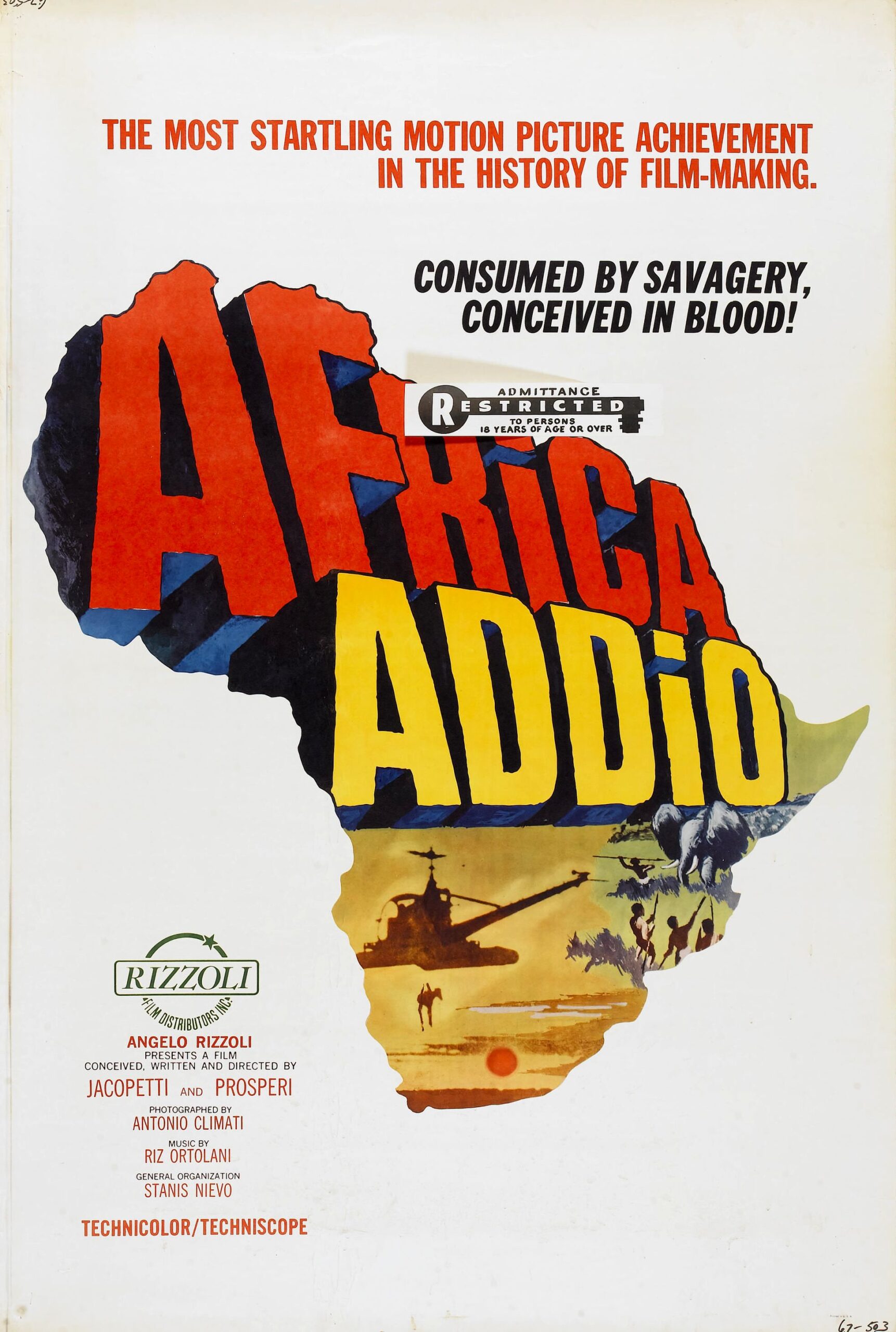
The 1966 Italian documentary Africa Addio (Goodbye Africa), directed by Gualtiero Jacopetti and Franco Prosperi of Mondo Cane fame, is a must-see for absolutely anyone who wants to understand the realities of African governance. Filmed in Kenya, Tanganyika, Zanzibar, Rwanda, Angola, the Belgian Congo, and South Africa between 1963 and 1965, Africa Addio captures the bloody upheavals accompanying the end of White colonial rule across much of the continent. It chronicles the withdrawal of the British and Belgian colonial powers, alongside Portugal’s efforts to retain its African colonies and White South Africans’ determination to preserve their rule.
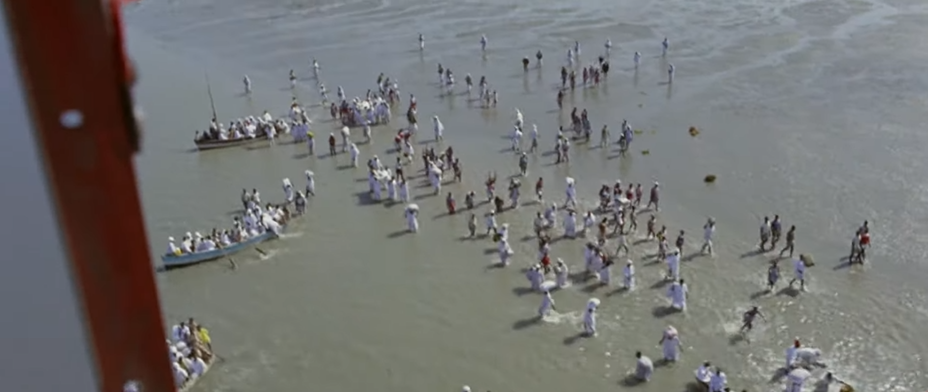
The film itself is bewildering at moments, for much of the film a camera is mounted in a light aircraft, capturing the serenity of the azure waters and brilliant white sands of the Zanzibar archipelago. The visual splendour of the landscape is overwhelming in its beauty, it evokes the pristine imagery of a mid-century travelogue designed for European consumption.
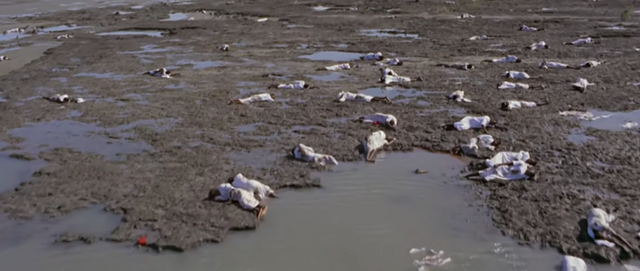
Nevertheless, as the aircraft gradually descends, the white sands are revealed to be peppered by dark, irregular shapes. As the telephoto lens finds its focus, the visual abstraction resolves into a horrifying, incontrovertible reality. The idyllic beaches are entirely strewn with the corpses of hundreds of Arab and Indian civilians, the victims of the January 1964 Zanzibar Revolution.
Screenshot from the film Africa Addio. 19 January 1964. Arab civilians attempting to flee revolutionaries.
Screenshot from the film Africa Addio. 20 January 1964. Bodies of Arab civilians at low tide, caught while trying to flee Zanzibar.
Accompanying this almost god-like, detached aerial survey of mass slaughter is the melancholic, and achingly beautiful orchestral score of the celebrated Italian composer Riz Ortolani.
This startling juxtaposition, which is only one of many in the film, feels immensely unsettling with the sheer, unfathomable scale of human atrocity paired with the romantic elegance of European orchestration. It encapsulates the disturbing essence of Africa Addio.
The opening sections focus primarily on Kenya. We see a series of trials of Mau Mau terrorists and their accomplices, who massacred White families and mutilated their cattle, and for some inexplicable reason also tortured and hung wild baboons. Most were sentenced to life in prison for these egregious crimes. A few years later, Jomo Kenyatta, the anti-colonial activist who served as Kenya’s Prime Minister from 1963 to 1964, pardoned the Mau Mau criminals.
[…]
If you decide to watch Africa Addio today, you will subject yourself to a gruelling, psychologically taxing endurance test of historical horror. The film explicitly positions itself as a visual archive of decolonisation in motion, capturing the violent and often utterly merciless transition from European empire to African independence.
After watching this film, you realise that it is a genuine civilisational artefact, yet somehow it still feels wrong to watch. It forces the viewer to confront the terrifying speed with which order can evaporate when a European hegemon suddenly withdraws. Through its seemingly endless catalogue of massacres, mercenary warfare, political assassinations, and ecological devastation, Africa Addio becomes an uncompromising mirror of the anxieties surrounding the collapse of the European imperial order.
[…]
The film highlights the horrific brutality of the new African order emerging across the continent. In conflicts such as the Congo rebellion, insurgents receiving Soviet-bloc or Communist Chinese support terrorised White civilians. Nevertheless, the violence depicted in Africa Addio does not end with Whites fleeing for safety from the militant communist backed African hordes: it extends to the massacre of other ethnic and political enemies.
In Zanzibar, the targets were Arabs who were associated collectively with the island’s history of slavery and Arab domination. In January 1964, the newly independent government was overthrown in a revolution involving pro-communist forces, followed by the massacre of thousands of Arab civilians. Some estimates place the death toll as high as 20,000, although the precise number remains disputed. Historian Abdullahi Ali Ibrahim explicitly argues that these killings constituted genocide, and that their recognition has been obstructed by the political narratives surrounding African liberation.
Comments Off on The end of colonial Africa
October 7, 2026
Lessons from Patrick O’Brian’s Master and Commander
As a child, I was a very early fan of C.S. Forester’s series of novels on the career of Horatio Hornblower, so I was a bit wary about reading Patrick O’Brian’s new-to-me stories set in the same period. A friend from Halifax practically forced Master and Commander on me during my first visit to Nova Scotia and I quickly picked up Post Captain, HMS Surprise and a few more in the series. At Athena’s Bridge, Mike Hennelly makes the case that there are valuable leadership lessons that can be learned from O’Brian’s work:
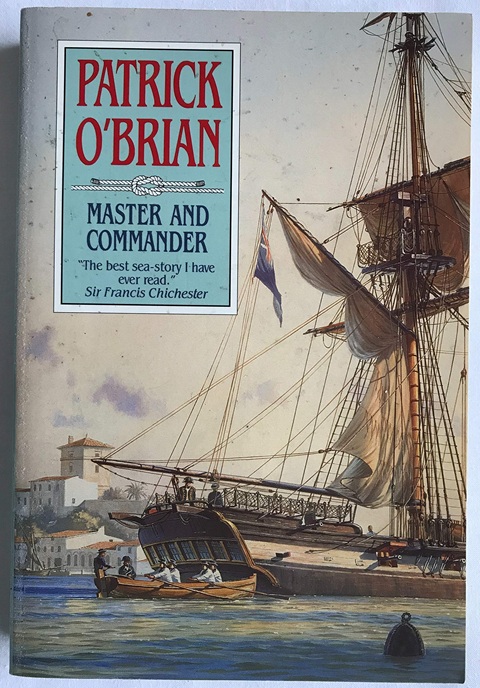
Cover from a later printing than the one I read in 1982.
In the study of leadership, there are many who say that there is nothing to be gained from novels or movies. Their argument is that only the study of reality (real CEOs, real generals, real political leaders) will yield insights of value for the study and practice of leadership. The purpose of this essay is to argue the opposite case. One of the most remarkable literary achievements of the 20th century was Patrick O’Brian’s multi-volume depiction of British naval life during the Napoleonic Wars. Eventually stretching to twenty books, O’Brian gives us the lives of Captain Jack Aubrey and his great friend, Doctor Stephen Maturin. A reviewer from the New York Times stated (rather categorically) that O’Brian’s books are “the best historical novels ever written”. O’Brian’s characters finally appeared in a movie entitled Master & Commander and the film faithfully captures much of the atmosphere and spirit of this maritime world.
O’Brian’s world, both in the books and the movie, is surprisingly faithful to the world of the Royal Navy during the Napoleonic Wars. He brings to life the nature of the great naval leaders of the time, the victories they achieved and the hardships they endured. As O’Brian himself notes, “I have gone straight to the source for the fighting in this book. I have log-books, official letters, contemporary accounts or the participants’ own memoirs“. What follows is not a review of the movie nor a synopsis of the plot. This is an essay that uses one particular movie to frame a discussion of leadership in realistic, uncertain and risky circumstances. Our focus is the character of Jack Aubrey – created by Patrick O’Brian, visualized by director Peter Weir and brought to life by actor Russell Crowe. An examination of Aubrey’s behavior and attitudes throughout the movie provides a wealth of insight into the mystery that is called leadership.
To begin at the beginning, a consideration of the term “master and commander” brings two curious facts to light. First of all, in the early days of the Royal Navy, this term applied to two people – not one. When English warships fought the Spanish Armada, for example, they had a “master” who was a life-long mariner with the nautical experience to sail the ship and a “commander” (frequently a noble) who was entrusted with the combat performance of the ship. Over time, this phrase was combined and came to describe the responsibilities of a warship’s captain. The second curious fact is that this term (as a job description) is incomplete. When Patrick O’Brian brought the character of Captain Jack Aubrey to life, he did so in a way that clearly shows that the term “master and commander” was an incomplete description of a captain’s responsibilities. HMS Surprise might be a ship (that needed a master to sail her) and she might be a weapon of war (that needed a commander to fight her) but she was also a collection of almost two hundred sailors of all sorts (who needed a leader to direct and influence their actions). To carry out all the responsibilities of a ship’s captain, Jack Aubrey needed to be a “master, commander and leader”. Without the ability to take a random set of landsmen and mold them into a cohesive, disciplined and skilled crew, he would not have been able to sail the ship safely nor would he have been able to exert any combat power.
“She’s a vastly heavier ship. She’s out of our class” (or, how leaders get others to face existential risk)
As the movie begins, it is the spring of 1805 and we are aboard HMS Surprise, a small Royal Navy frigate of 28 guns with a crew of 197 souls. The Surprise is under orders to find the French frigate Acheron and “sink, burn or take her as a prize”. The Surprise is off the coast of Brazil and approaching a fogbank when she is ambushed by the Acheron. Captain Aubrey is energized by the prospect of combat (“straight at ’em, Mr. Mowatt!“) but events soon take a turn for the worse as Surprise‘s rudder is shot away and the British barely escape safely into the fog.
We learn more about Aubrey as he faces a serious leadership challenge after this disastrous encounter with the French. The ship’s officers, somewhat in shock, are discussing the engagement and they observe that Acheron was “more like a ship of the line than a frigate” and “our shots couldn’t penetrate“. Their misgivings are understandable. HMS Surprise, with twenty-eight guns, is about as small as a ship can be and still be called a frigate. The forty-four guns of the Acheron make it far larger and more heavily armed than the Surprise and what this means in combat is that every broadside fired by the Acheron is almost four times the weight of a broadside from the Surprise. Aubrey’s command team assumes that the clear superiority of the French ship means the Surprise will have to abandon her mission and head home. But their misgivings are not in line with the attitudes of a) the British Admiralty, b) the British public and c) their captain. At this point in the war, most Britons and the Admiralty operate under the assumption that their navy should always project an aura of invincibility. This has been a British naval characteristic since the great British sea-victories at Camperdown (1797) and the Nile (1798). Furthermore, we find out that Jack Aubrey’s mental model of an ideal officer is Lord Nelson who was famous for his relentlessly aggressive behavior at sea. One of Nelson’s most famous sayings was “no captain can do very wrong if he places his ship alongside that of an enemy” and that is exactly what Aubrey intends to do to the Acheron. Aubrey quickly disabuses his officers of the idea of abandoning their mission. Positively radiating with decisiveness, he tells them there is not a moment to lose if they are to carry out repairs and catch up with the French.
Aubrey faces two challenges as he attempts to lead his ship into a situation of existential risk. First, he must gain the support of his officers and secondly, he must ensure the willingness of his crew. He addresses these concerns in turn. To gain the support of his officers and bolster their morale, he addresses their concerns with a discussion of battle tactics in a way that provides reassurance. Although the French ship has far more guns, Aubrey explains that the Surprise possesses intangible advantages that level the killing field. He is convinced that the Surprise is more maneuverable than the Acheron and he intends that his gun crews be better-trained and more effective than their French counterparts. Without any further dissent from his officers, the Surprise carries on with its pursuit of the bigger and more powerful enemy ship – which is a testament to the effectiveness of Aubrey’s leadership.
Aubrey’s approach to the crew about the threat of the Acheron is intensely practical in nature. The crew spend much of their time engaged in gunnery drill. Captain Aubrey has very high standards for the ship’s gunnery because he expects his gun crews to be both fast and accurate. Accuracy in naval gunfire is always a challenge because ships are inherently unstable firing platforms, but, in addition, the faster the rate of fire, the sooner a gun crew is exhausted with a corresponding reduction in accuracy. Aubrey’s standards, while achievable, are higher than the standard in naval fleets of the time. His standards require intensive, dangerous training which is the only way to produce highly disciplined and effective gun crews. To keep his crew motivated while they are training so hard, Aubrey gives them a rousing talk (Do you want to see a guillotine in Piccadilly? NO!, they roar back. Do you want your children to have to sing “La Marseillaise”? NO!). He also states his expectations in terms that every sailor can grasp – the gun crews of the Surprise must be able to fire two broadsides for every broadside fired by the Acheron. Over time, the crew of the Surprise is welded into a cohesive and effective fighting force; they take pride in their achievements and their confidence grows as they face the prospect of future combat.
September 13, 2026
The Devils by Ken Russell
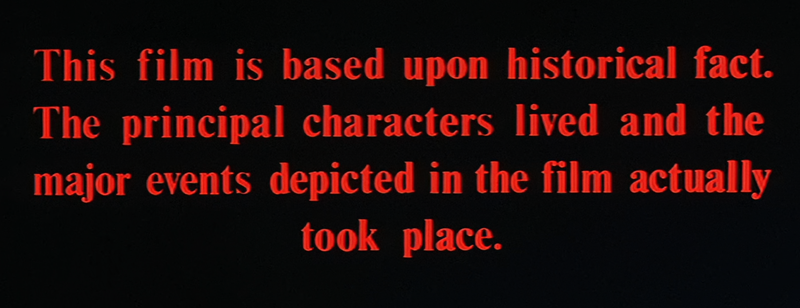
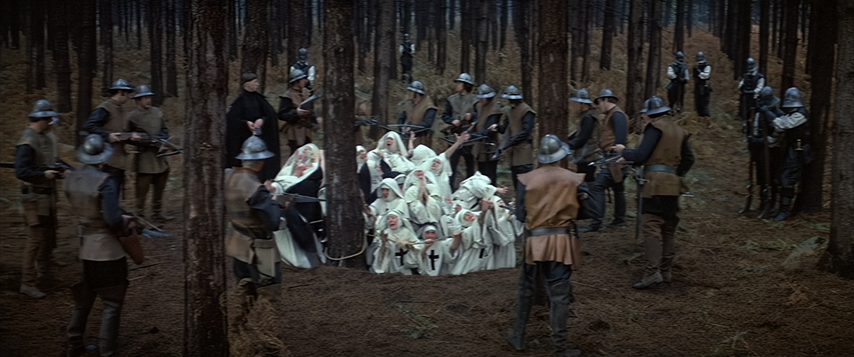
On her Substack, kulak explains why The Devils is the “greatest film of all time”:

What if the 1990s Berserk anime, Warhammer 40k, A Man for All Seasons, The Wickerman (1972), Cromwell, 1984, The Gulag Archipelago, the Rocky Horror Picture Show and the chronically underrated 2012 horror masterpiece Compliance … were all the same horrifying movie?
What if Mel Gibson made a film like Apocalypto, exploring the nightmarish depths of political/religious sacrifice rituals … But about Early-Modern Shakespeare-era Europe?
I’m constantly asked for my “Greatest Film of all Time” … A torturous question for someone who’s seen as many movies as me … And doubly torturous because maybe the best true answer is one its really hard to name:
Ken Russel’s The Devils might be it.
Certainly the best 30 Years War film ever made.
And the Greatest goth movie ever made.
And the Greatest witch hunt movie ever made.
And the Greatest “MeToo” movie ever made.
And the Greatest “insane asylum” movie ever made.
And CERTAINLY the Greatest Exorcist movie ever made.
Yes, I said that. And I mean it. Did I stutter?And maybe the Greatest “Dark Fantasy” film ever made … Except for the fact that the whole thing is true.
And its being rereleased, the full remastered director’s cut in 4K, this October in Cinemas.
(The strobe effect is only in the trailer)
Ken Russel’s The Devil, adapted from Aldous Huxley’s book The Devils of Loudon and the play The Devils by Dan Whiting, is one of my top five films of all time. And certainly one of the biggest films of all time in it’s own weird way. It does things as impressive for the spiritual, psychological horrifying, and historical on film as Sergei Bonderchuk’s Waterloo does for warfare or Akira for Scifi and Animation.
Indeed I think I might be the only one who could give that answer, given I might be one of like 10 people who know 17th Century History/Literature and obscure extreme Horror Cinema well enough to INSIST on its OVERWHELMING historical accuracy.
Indeed I’d struggle to think of a film which captures the Insane deadly hypersexual kaleidoscopic character of the 17th century better.
I’ve been doing this a lot recently … But I feel I need to lay out my qualifications here to talk about this … My two areas of focus in university were 17th and 18th century English Literature (Shakespeare through to Jane Austin), and 17th and 18th century Political theory (specifically the works of Hobbes, Locke, Hugo Grotius and other natural law theorists … Yes, I took the BoomerCons seriously when they said natural law was the basis of our society, Like an idiot) … I’m by no means an expert, but the broad flavor of this era: Culturally, religiously, politically, historically, militarily, theoretically, theologically, poetically … Was what I immersed myself in during the years when I should have been drinking and partying more and repeating nonsense to people in power, and other things that actually advance your career.
I need to establish that off the bat because I feel as if a huge part of the reason this film is not regarded as a contender for “Greatest film ever made” is the simply the fact that audiences and critics do not believe it, and certainly do not GET it.
That it is SO Bizarre, and SO weird, and SO horrifyingly violent, and SO hypersexual, and SO saturated in its colors, and SO religiously discordant … That it has to be a bizarre psychedelic hellscape of Ken Russel’s perverse drug-addled imagination …
They especially had to think this because if they accepted that it was indeed historically accurate, and not a bizarre sexual/psychedelic story of the American 1960s and 70s reading themselves back into history … Suddenly they’d have to accept that the same thing done to Loudon in 1634 was what was being done to America in the middle of the 20th century, and has been done to the west more or less ever since …
That the yo-yo between state-enforced debauchery one the one hand, and moral panic witch-hunts on the other, is not a schizophrenic attribute of mass media or “Moral Progress” or American Culture … But a highly historically precedented and calculated attack meant to destroy and enslave a people without fighting them.
That “Free Love”, “Feminist Criticism”, “Queer Theory”, “No Fault Divorce”, and “Hostile Work Environment lawsuits” rock society between the extremes of sexual license and socio-sexual moral-panic for the same reason one might rapidly rock a boat between it’s port and starboard sides … To capsize it into the devouring abyss.
That we are indeed living through Loudon at scale.
August 9, 2026
QotD: Spoilers — threat or menace?
I used to think I was a control freak because I prefer knowing what happens before I watch a movie. Give me a book, and I will behave beautifully for the first hundred pages — then, suddenly, I’ll turn into a literary criminal and flick to the end. This doesn’t always happen; the writer has to be good enough to make me panic. Yet if I care deeply whether Harry Potter survives, or whether Catherine ends up with Heathcliff, I need the literary equivalent of someone taking my hand and saying, “Brace yourself, chapter thirty-two is going to be a bit of a donut”.
It turns out this may not be control freakery. How wonderful to think that I have been waiting years for science to rebrand my worst qualities as skills. Apparently, people who like spoilers are just trying to regulate their emotional response. We are not monsters, but only putting on a cardigan before the storm.
Those who hate spoilers also want control, but theirs is driven by a desire to preserve suspense. They want to receive information in the sequence designed by the storyteller. My own spoiler-seeking is also a form of control, although it works differently. I want the major facts early, so I can relax into the texture of the story rather than sit there like a meerkat scanning the horizon for emotional catastrophe.
So we are all control freaks, just wearing different cardigans.
Spoiler alerts began as a civilized courtesy. If someone on a bus was halfway through a book, it was not considered the done thing to lean across and announce the ending like a deranged town crier. There were rules. Perhaps not that many. But there were some.
Now the spoiler alert has become a moral siren. One can’t discuss a film, television show, podcast, documentary, memoir, cake reveal, or episode of Bluey without issuing a warning so elaborate that it requires its own stationery. People now approach plot discussion like bomb disposal experts. One innocent mention of a character’s demise, and the online village square bursts into flames. On “The Good Ship Murder” Facebook page, for instance, someone posts, “Can’t believe they killed Pierce”, and within seconds the spoiler militia descends.
Admins should delete this spoiler.
People might not have seen it yet.
Can’t believe you’ve posted a spoiler…You can almost hear the sirens. Somewhere, a moderator is reaching for a lukewarm tea and wondering how a cozy murder show has turned into the fall of Saigon.
Nicole James, “Tell Me Who Dies So I Can Relax”, The Freeman, 2026-05-07.
Comments Off on QotD: Spoilers — threat or menace?
July 30, 2026
Equilibrium: 198451 with Gun-Fu Fighting
Feral Historian
Published 27 Mar 2026Equilibrium (2002) is a curious mix of early-aughts action movie and mid-20th Century dystopia. While it does feel a bit overwrought and derivative at times, it ends up being more than the sum of its parts.
00:00 Intro
03:17 Gun Kata
04:44 198451
06:45 Endings
07:07 Anti-Human Systems
(more…)
Comments Off on Equilibrium: 198451 with Gun-Fu Fighting
July 27, 2026
Timeō Danaōs et dōna ferentēs
The tag in my chosen headline means roughly “beware of Greeks bearing gifts”, which anyone who has read anything about the Trojan War can understand. A huge problem for modern translators of works like The Iliad and The Odyssey is that there’s a double layer of cultural change built in before you start: the Mycenaean Greek culture of the Bronze Age — the setting of the Trojan War — is significantly different from the Greek culture of the classic era — when the oral tales were first written down (and attributed to Homer).
Classic Greek culture is often misunderstood by modern audiences through the most prominent survivals of that time: especially Greek philosophy, as the philosophers we think of as most representative of Athenian and the wider Greek culture were actually a fairly small and relatively powerless subculture at odds with the mainstream of their times.
All that said, going from a translation to an on-screen interpretation requires a lot of picking and choosing of elements to highlight and others to leave unrepresented or actively suppressed. In the most recent film of Odysseus and his extended return journey from Troy to Ithaca, director Christopher Nolan chose to portray Odysseus as a modern man in ways that may suit today’s audiences, but don’t accurately portray the Homeric interpretation or the times in which it is set:
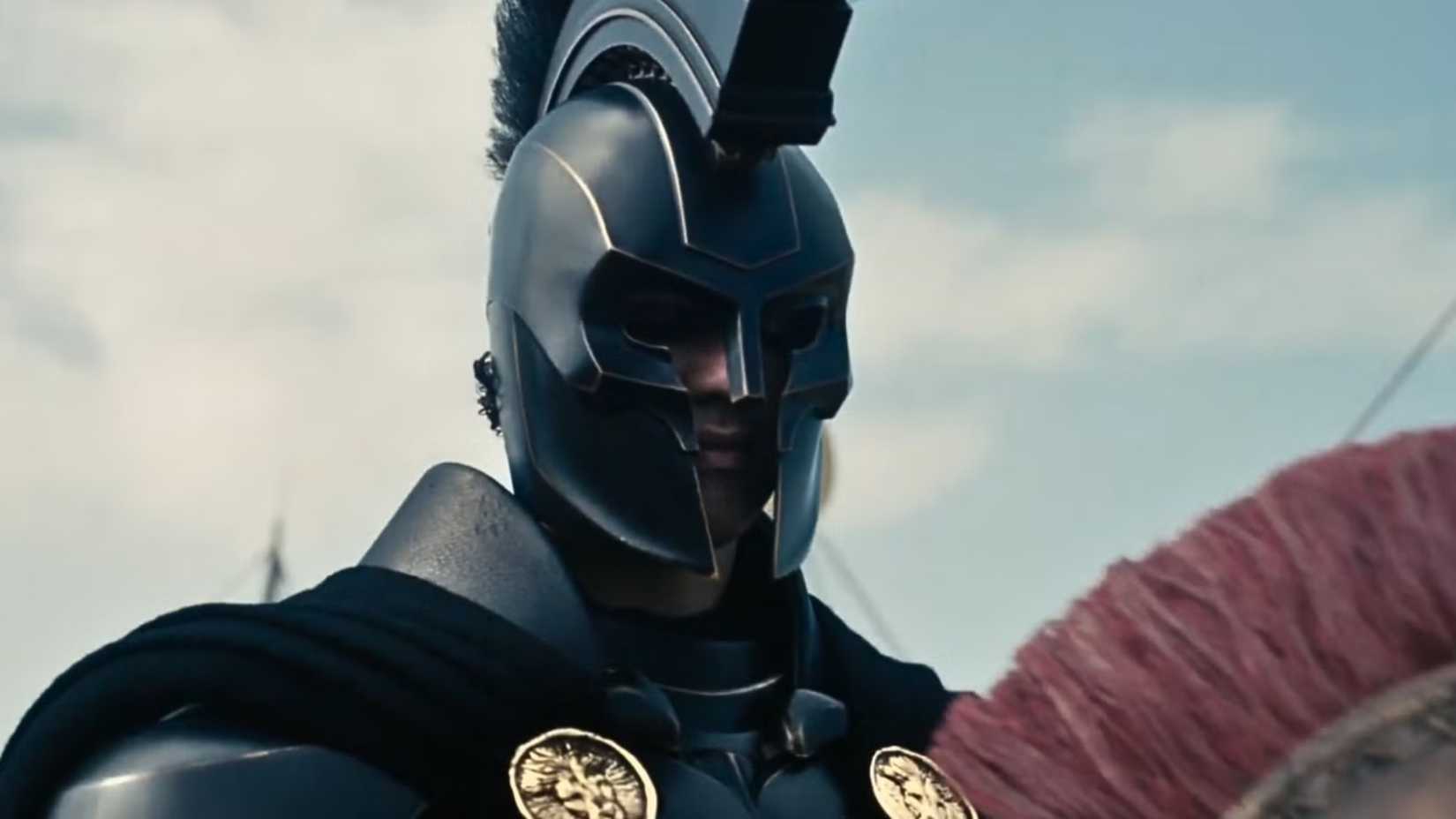
Some viewers have described Nolan’s version of Odysseus as suffering from post-traumatic stress disorder. But moral injury is the more accurate term. It overlaps with PTSD, but it’s not the same thing. Moral injury occurs when a person commits, witnesses, or fails to prevent an act that violates his moral convictions. In war, moral injury can arise when a person does something that violates his own ideals, loyalties, or sense of right and wrong. The result is lasting guilt. A combat veteran comes to see himself as corrupt, unworthy, or beyond forgiveness.
In the film, Odysseus describes his guilt over the violence he witnessed during the sack of Troy. He is conscience-stricken about his Trojan Horse gambit. Odysseus took an object that appeared to be a gift of peace and used it as a weapon of deception. His stratagem allowed the Greeks to enter Troy, destroy the city, and slaughter its people.
But the Trojan Horse is Odysseus’s crowning achievement. Homer’s Odysseus is a wily trickster, and a trickster would not be tormented by the fact that his trick succeeded.
During his journey, he repeatedly deceives his own men for what he believes is the greater good, and these acts clearly trouble him. The war itself is remembered as grim and pointless. Men are drafted rather than rushing eagerly toward glory.
This is not Homer’s moral universe. In the poem, the Greeks rape, rob, enslave, and pillage without displaying anything like modern guilt. We can tolerate this when reading an ancient text. It is harder to tolerate when those acts are placed directly before us on a movie screen.
This may explain Nolan’s decision. Had he shown the violence of the original story without softening it, would the audience still have been able to sympathize with Odysseus?
Consider what happens to the enslaved women accused of consorting with the suitors after Odysseus returns home. Odysseus orders them to be killed, and Telemachus hangs them. Homer does not present the scene as morally complicated. Their punishment is part of restoring order.
Modern films sometimes allow their heroes to inhabit moral worlds very different from our own. Robert Eggers’s 2022 film The Northman asks us to sympathize with Viking characters who obey codes that most moviegoers today would find reprehensible. But The Northman was a mid-budget film. Nolan made a summer blockbuster that cost hundreds of millions of dollars. A blockbuster can’t afford to depict a hero from whom audiences recoil. Eggers could let his Viking be a Viking. Nolan needs his Greek warrior to be one of us.
Yet such individuals lived in societies that existed before Christian morality reshaped the Western understanding of guilt, mercy, and the value of every human life. The moral injury that afflicts Nolan’s Odysseus belongs more naturally to the AD world than the BC one.
In the film, Odysseus grieves for the men he lost and appears to blame himself for their deaths. But Homer presents that suffering as the result of pride, fate, divine anger, and human foolishness. The original story does not depict Odysseus as a man tormented by the fear that he has violated his own moral code.
The difference is clear in the episode of the lotus-eaters. In Nolan’s film, Odysseus eats the lotus because he seeks mental relief, a kind of ancient Greek version of using psychedelics to treat combat trauma. In the poem, Odysseus does the opposite. He refuses to eat the lotus and orders his men away from it.
Comments Off on Timeō Danaōs et dōna ferentēs
July 21, 2026
Making out like a bandit – Christopher Nolan’s sweet deal for The Odyssey
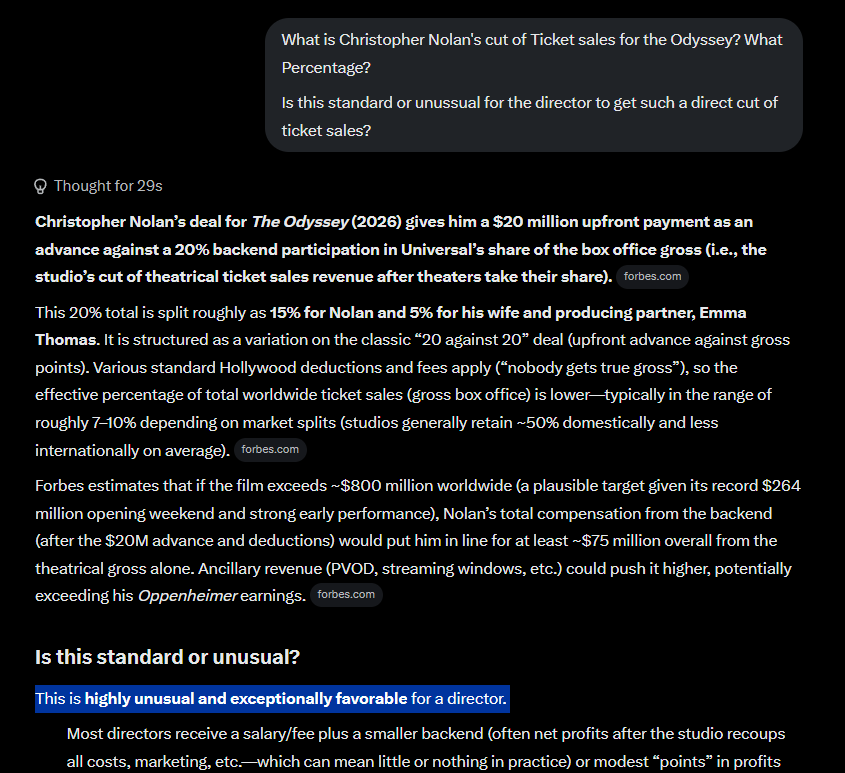
Hollywood accounting is always a murky pool to wade into … unlike accounting in the real world, it’s very, very difficult for outsiders to understand how the money is spent and where the profits go. Christopher Nolan’s new film seems to have broken new ground in Hollywood accounting, very much to Nolan’s benefit:
So Nolan is getting 15% off direct revenue, (not profits, gross, and his wife another 5%) from the Odyssey, basically risk free, AFTER his 20 million up front.
That’s a better cut than a lot of mob bosses take off drug dealers (which tend to vary between 5 and 30% depending on how much violence they can command).
And probably core stars (Damon and Hathaway mostly) are getting some smaller percent of the same deal.
This is unheard of. Basically a violation of fiduciary duties to the investors.
Studio execs paid all these people to make this movie this way against their own investors’ interests.
So if another 10-30% of gross is divided across Damon, Hathaway, Holland, Pattinson, and Theron … You know the real stars (Zendaya, Nyong’o, and Page don’t draw crowds and aren’t getting that) …
Then you might have to effectively cut all revenue first by 50% for theaters, then by another 40-50% for the star power.
It other words … The Odyssey would need to make 800 million – 1 billion before it could even hypothetically start to turn a profit for investors.
All the Woke casting etc. Is actually a cover for basically outright money laundering and embezzlement by the entertainment class. And because its “sticking it to the Chuds” business news and institutions are covering for the fact a bunch of studios just defrauded Universal Studios’ parent Comcast, to possibly the tune of hundreds of millions.
Comcast is a publicly traded company. That’s 401Ks and pension funds.
And all the woke stuff is in there so that no studio execs, corporate leaders, media, or corporate watchdogs will call them out for basically transferring hundreds of millions of retiree dollars into their own pockets.
All the discussion of “Will the Odyssey make its money back” is missing the point that there is almost NO WAY for the Odyssey to actually produce a reasonable return to investors … BY DESIGN.
It is a pure, basically fraudulent, wealth transfer from American middle-class investors to Hollywood insiders irrespective of whatever money the film does or does not make … intentionally.
And all the woke window dressing is chaff, or a bonus to prevent any institutions from having the nerve to call them out lest they get called, racist, sexist, and transphobic.
Comments Off on Making out like a bandit – Christopher Nolan’s sweet deal for The Odyssey
July 14, 2026
Orson Welles – the great failures
On his Substack, Ted Gioia looks at the up-and-down-and-up-and-down career of Orson Welles and selects, from a long list, his ten greatest failures:
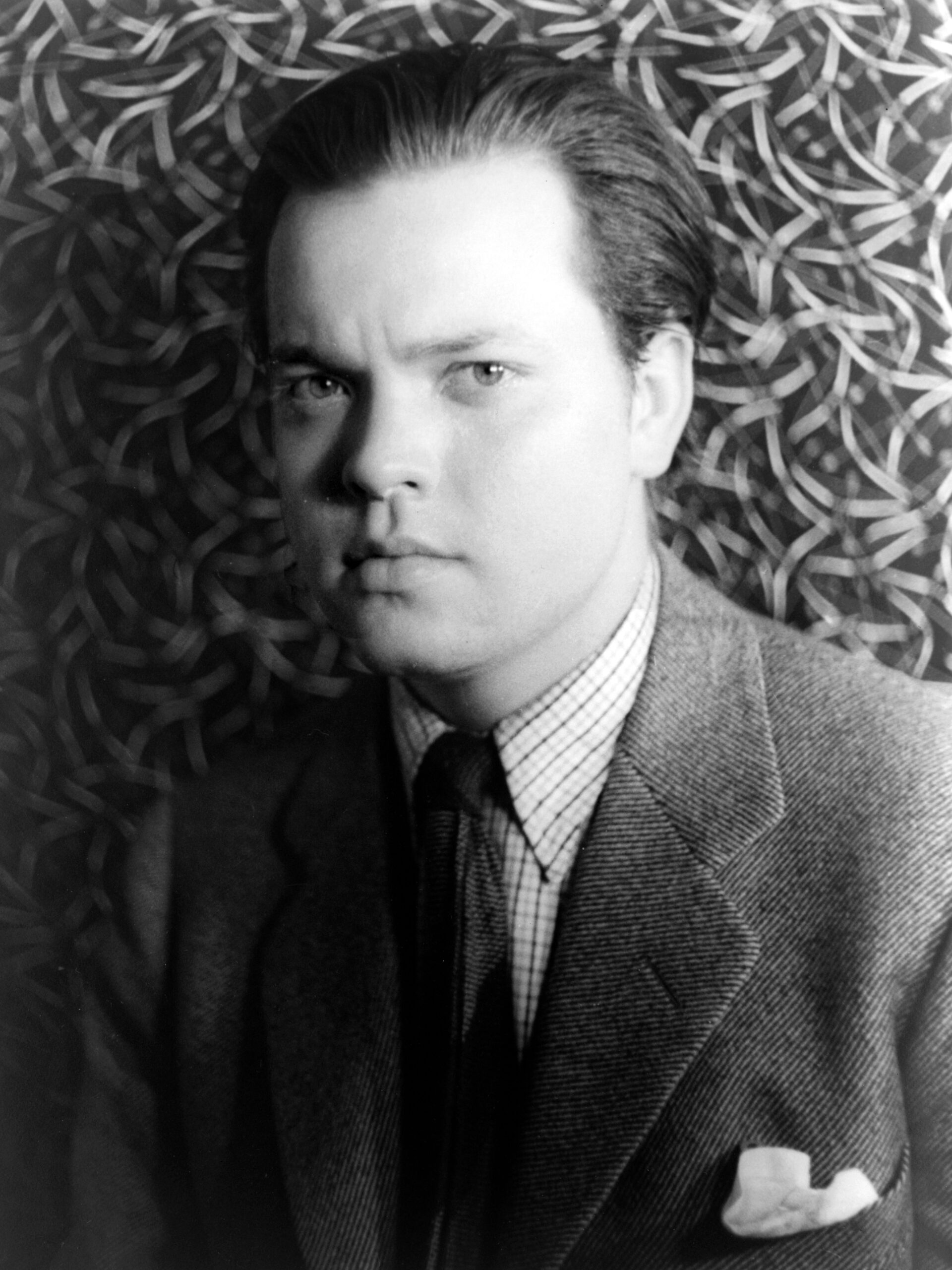
Orson Welles in 1937.
Photograph by Carl Van Vechten via Wikimedia Commons.
It takes a lifetime of misses to create those hits (if they come at all). And those misses tell the real story of our passion, our resilience, our willingness to push our talent to the limit.
These speculations have led me to return to the work of filmmaker Orson Welles (1915-1985) — who I see as an inspiring role model for indie creators of the digital age. Welles is like many of us today. He lost institutional support from Hollywood studios while still in his twenties. And despite his reputation as the most innovative filmmaker of his generation — for many years his debut movie Citizen Kane won polls as the best film of all time — was forced into a precarious life as a perennial freelancer.
He spent most of his career working on projects that failed. And not because they weren’t good (see the list below) — but for other reasons. Some blame Welles’s prickly personality. Others will fault close-minded Hollywood execs. Or maybe Welles was just cursed with bad luck — problems did seem to follow him wherever he went.
You might say that even his hits were misses. His biggest early success came via a 1938 radio rendition of H.G. Wells’s The War of the Worlds, which convinced many listeners that extraterrestrials were actually invading America. Welles got plenty of publicity but was threatened with $12 million in lawsuits in the aftermath. He was lucky to escape without criminal charges.
His greatest triumph, Citizen Kane, was also anything but a conventional hit. The major theater chains refused to book it — fearing punishment from newspaper magnate William Randolph Hearst, the thinly-disguised model for Kane. So even at the peak of his career, Welles had a target on his back.
It got worse from there. He couldn’t finish the editing of his second film The Magnificent Ambersons (1942) — because FDR prodded him into going to Brazil as a cultural ambassador during World War II. So Welles was out-of-touch as the studio butchered his remarkable film, and even added a saccharine new ending. It’s testimony to Welles’s greatness that The Magnificent Ambersons is still ranked among the best movies of the era despite the meddling.
After Brazil, everything fell apart for Welles. Hollywood never forgot him, but also never forgave him. He got occasional gigs (although more often as an actor). But this brilliant filmmaker never enjoyed job security or long-term institutional support. He was the permanent indie gadfly — always pitching projects and sometimes actually starting them. But rarely finishing them.
At his death in 1985, Welles left behind at least 19 unfinished projects. Add to that the many others he abandoned in earlier years. And then there are so many Welles concepts that hardly got started at all — but were promising ideas that deserved better. Finally, Welles suffers the added indignity of achieving some commercial successes (on radio or the stage) that are now lost to us — so even these must be counted among his misses, at least from the perspective of posterity.
Below I’ve listed Welles’s ten greatest failures. But I could have easily expanded it to twenty or thirty.
I do this as testimony to Welles’s greatness. From a mercenary perspective, these might be failures, but from an aesthetic standpoint they testify to a creative force that operated at the highest level of intensity for a full lifetime.
Comments Off on Orson Welles – the great failures
July 8, 2026
Initial reactions to The Odyssey trailer
As always, I’m not closely following whatever movies Hollywood chooses to extrude, but I do see the occasional high and low lights from the reactions of others. The latest attempt to portray Homer on screen isn’t finding it easy to get potential viewers excited:
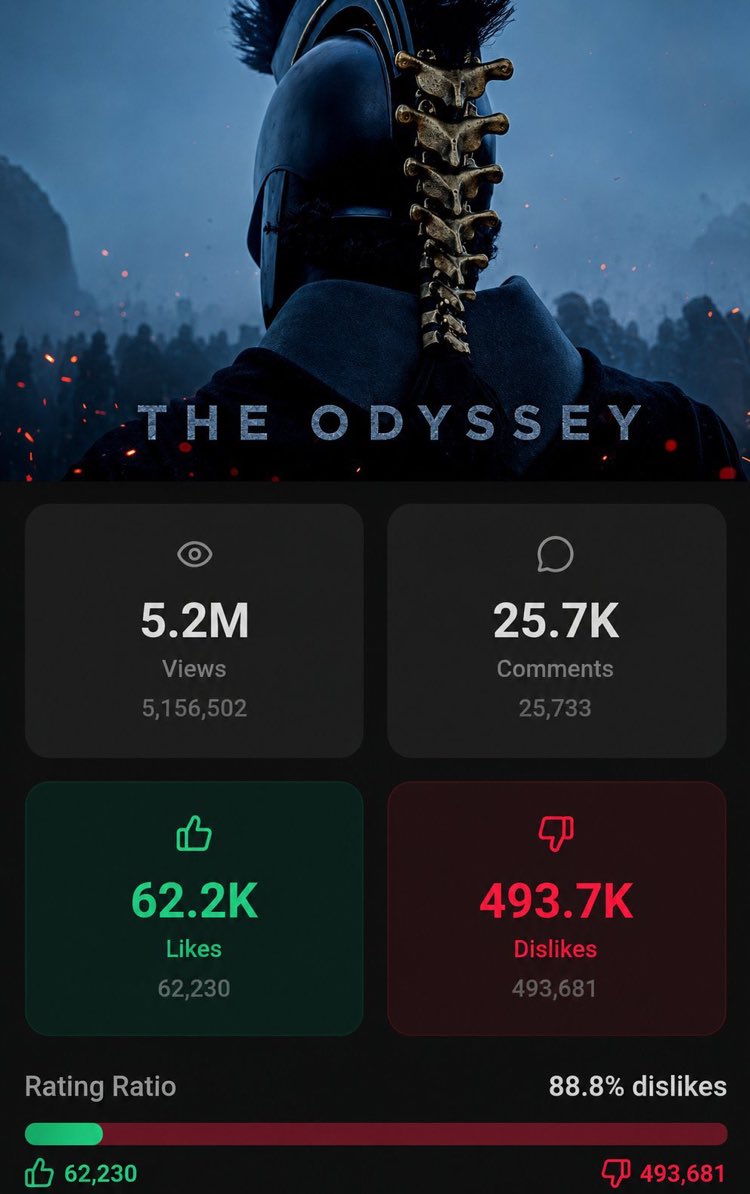
The public reaction to the Odyssey trailer is a strong indication that Nolan’s reputation won’t be enough to prevent this turd from leaving a smoking crater in the studio’s budget.
People are sick of blackwashing. They’re sick of girlboss reimagining. They’re sick of every movie turning into a sermon.
Does this mean that a Tipping Point will be reached, that Hollyweird will finally sit up and pay attention to the dashboard full of red warning lights and sirens screaming for its attention?
Lol. Lmao.
The cultural revolution means that everyone in a position to do something has been replaced with religious fanatics who don’t care about nonsense like “money”.
Just like every other institution they suborned.
They are crashing the plane with no survivors, and as it goes down in flames they will take the opportunity for a final smug lecture about how the failure of the audience to appreciate them demonstrates that the audience are nothing but white supremacists.
I’ve seen speculation that the current crop of “big” movies were all in early production just at the peak of a few trends that have since receded in popular culture — girlbosses and general wokeness — and it might just be a matter of timing … or it could be that Hollywood’s movers and shakers are still determined to press on with the undiluted progressive message even if it means losing hundreds of millions of dollars with every new release.
On the topic of The Odyssey, Ted Gioia talks about his own discovery of Homer as a youngster and says “youngsters were Homer’s target audience — you can feel that at every turn in his story”:
The first work of classical literature that thrilled me to the depths of my soul was the Odyssey. It made such a big impact that, decades later, I insisted on reading it aloud to my own children, hoping they would feel that same magic.
I was little more than a child back when I discovered Homer — 12 or 13 years old, I’d guess. Back then I knew more about comic books than serious literature. But I was outgrowing Spiderman and Superman, and decided to take a chance on Odysseus.
I approached this book with fear and trembling — worried it might be too difficult. But I soon discovered that Homer was the Stan Lee of antiquity. He told adventure stories not much different from the ones peddled by Marvel or DC.
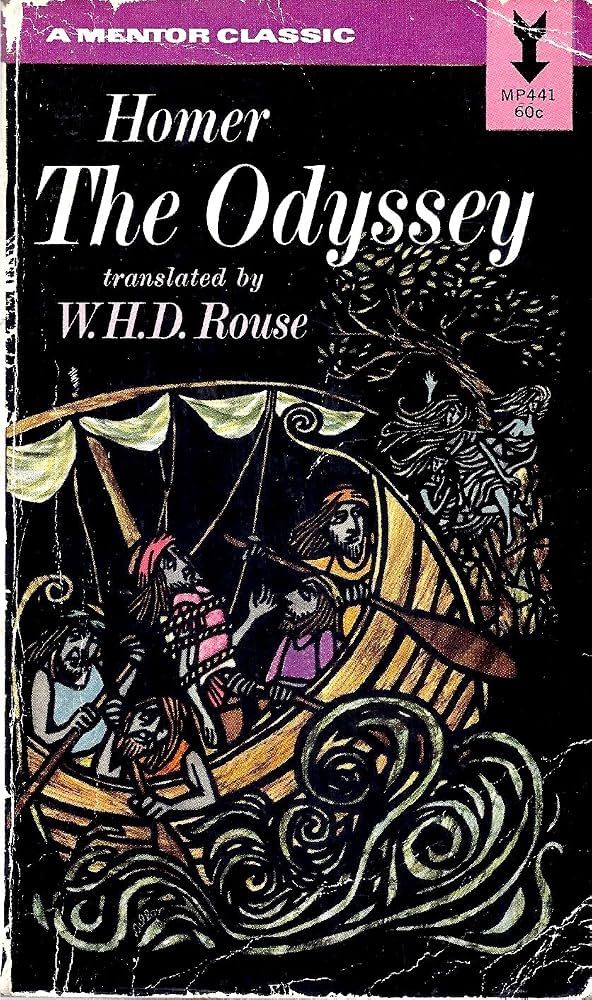
I’d somehow gotten my hands on a tattered used paperback copy of the Odyssey, in a 1937 prose translation by W.H.D. Rouse — published by Mentor Classics (cover price when new = 60 cents). This is not a respected translation — they will never assign Rouse’s version of Homer at any Ivy League college. [NR: I think this is the way I first encountered The Odyssey … possibly this version in Grade 5 as it was a prose translation.]
That’s because the legit translators try to convey this epic as poetry. Rouse made no attempt at that. He just turned Homer into everyday language, just like it was a pulp fiction story for the mass market.
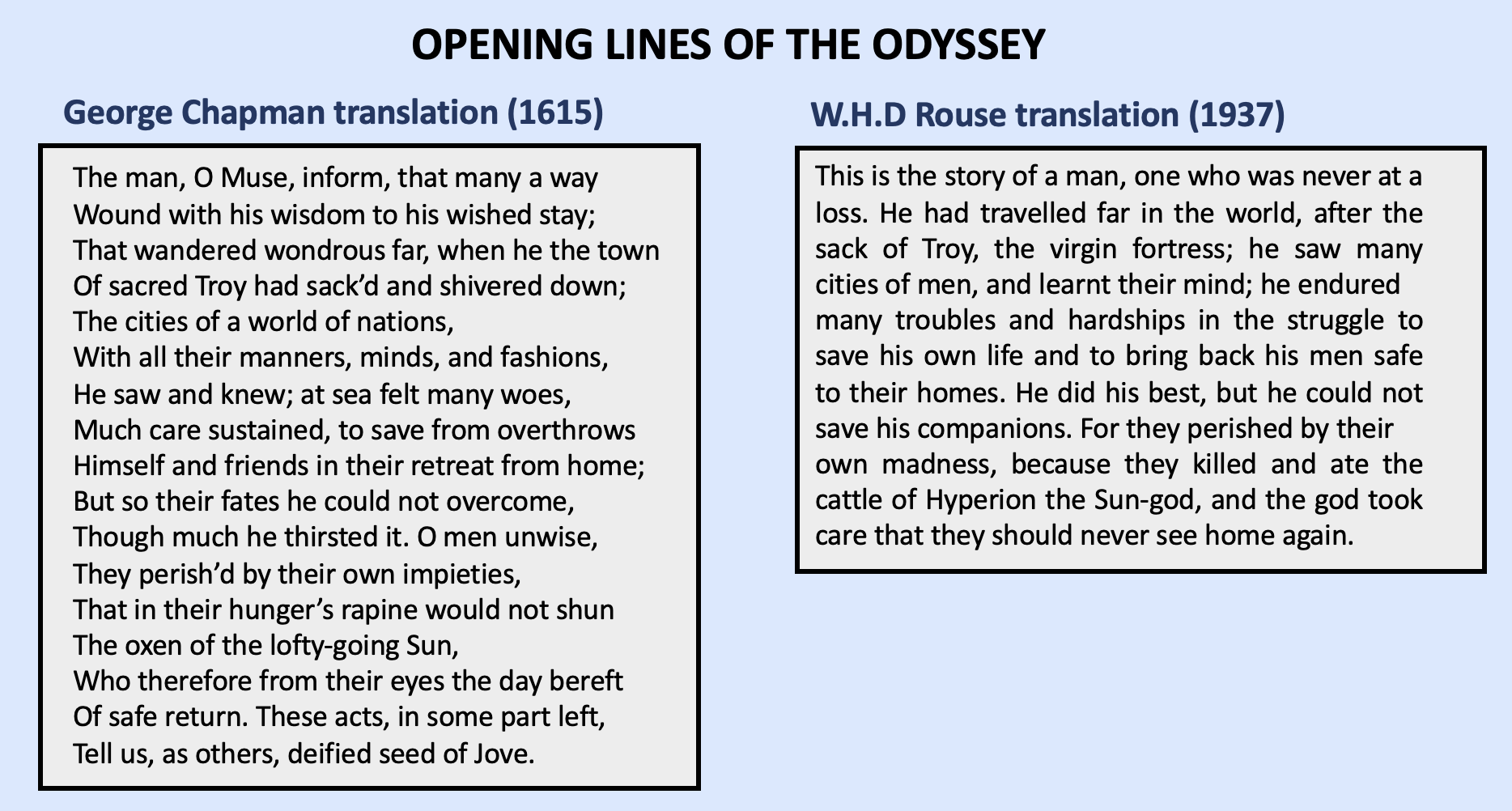
That was the right choice, he believed, because (as he wrote in his introduction): “The Odyssey is the best story ever written … It has been a favorite for three thousand years”. Other translations of this book are, he claimed, “filled with affectations and attempts at a poetic language Homer himself is free from. Homer speaks naturally and we must do the same.”
You can see the difference by comparing Rouse’s rendering of the opening lines with the esteemed Chapman translation from Shakespeare’s era.
Is this the best version of Homer? I won’t go that far — years later I became very fond of Robert Fitzgerald’s translation. But I will insist that Rouse is the superior version for a youngster. And, in many ways, youngsters were Homer’s target audience — you can feel that at every turn in his story.
So this is the first thing about the Odyssey you won’t learn at Harvard — namely that this tale was not intended for Harvard elites. It’s a story for everybody. So it’s an obvious choice for a big-budget Hollywood movie. There was no pretension or elitism in Homer’s approach. In today’s parlance, you would say that he was appealing to a mass audience.
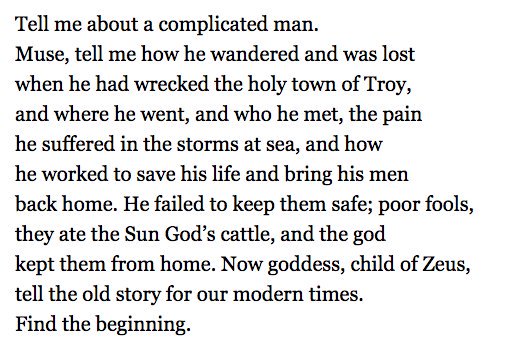
Director Christopher Nolan — whose screen version of the Odyssey makes its debut in London today — relied on the more recent Emily Wilson translation of the Odyssey into iambic pentameter. In her version, our hero is described, like Shaft, as a complicated man who won’t cop out (when there’s danger all about). Okay, she doesn’t use those exact words, but comes close …
Emily Wilson’s translation of the opening lines of the Odyssey
I like this rendering, and can almost hear that Isaac Hayes synth vamp in the background. Wilson is just as straightforward as Rouse — living up to her aspiration to “tell the old story for modern times”.
Comments Off on Initial reactions to The Odyssey trailer
June 16, 2026
QotD: Nitpicking the field fortifications in Gladiator (2000)
What we are shown is pretty clearly a prepared defense on a hillside, with a series of raised terraces, with a mix of abatis (sharpened wood obstacles, often crudely cut wood stakes set in an X pattern) and mantlets, with gaps in those defenses to allow units to move and a whole bunch of catapults positioned up on the hill. The terraces make for a layered, multi-stage fighting position at each level. On the one hand, the Romans were hardly averse to field fortifications and one wonders again if this set was a product of someone with an active imagination looking at the Column of Trajan [Wiki], which features a lot of scenes of Roman soldiers cutting trees and building bridges, roads and forts.
The problem isn’t that there are field fortifications, it is everything else about them: the style of field fortification, their position, layout and use. As we’ve noted before, Roman armies on campaign built fortified marching camps nightly, so we would expect Maximus’ army to have such a camp, but as we’ve discussed even more so, one of the classic, famous features of Roman armies is that they build the same layout of camp wherever they go, the famous Roman “playing card” forts, generally built on flat, open ground (rather than hillsides). That defense would not look like this, instead consisting of a ditch (the fossa) behind which would have been a earthwork rampart (the agger) topped with a wooden palisade (the vallum); thus rather than successive layers, you’d have a single clear fighting position (the vallum) on a mount with the ditch directly in front of it. And that would be a continuous line, with just four gates (at the center of each side), rather than this kind of checkerboard pattern of fortifications, because of course the purpose of this defense was to prohibit entry. Moreover, the line of field fortifications we see are not part of, nor connected to, a marching camp: it is simply a line of fortifications on the side of the hill with nothing on the flanks, rather than the distinctive “playing card shape”. We don’t see the camp sitting behind it either.
But the really immediate problem is that Maximus’ army has formed up within his troops strung through the field fortifications, with legionary soldiers mostly in front of them (but some are behind them) and the archers in between the stakes and mantlets. This may seem like a sensible way to form up a defense, but it is not the Roman way. Maximus is very intentionally “offering battle”, – inviting his opponent into an open field engagement. The way a Roman army did this was invariably forming up on the flat, open, unfortified ground in front of the camp, toward the enemy, signalling that they would fight in the open, outside of their walls (as Maximus does indeed intend to do).
So what we ought to see is Maximus’ army formed up outside in the open field, with the camp likely visible some distance behind them. That camp would be protected by very different fortifications: you’d be able to make out its “playing-card” shape, with watch-towers on the corners and the raised vallum running the exterior and the relatively neat grid of tents in the interior.
Finally, before we get to the battle plan, I want to note one more oddity here, which is the battlefield itself. The battlefield is a muddy field, which it looks to have been recently clear-cut, otherwise surrounded by dense forest. Of course part of the reason is that this is Bourne Wood, a coniferous tree plantation (and frequent filming location) in Surrey, England (which is why the trees are all the same species, so neatly spaced out) rather than the edge of an old-growth forest somewhere in southern Germany.
But the thing is, the Marcomanni, Quadi and other Germanic-language speaking peoples were an agrarian society, same as the Romans: their villages were surrounded by farm and pastureland. Of course a lot of the forest – old-growth forest, rather than tree-farms as here – remained, but if a Roman army wanted a flat, open space to offer battle in, they needn’t have cleared it themselves (and indeed probably couldn’t, at least not in the time frame they’d have to prepare for a pitched battle), but could simply march to the nearest village with its patches of farmland. Getting a Roman army to fight in dense, old-growth forest, after all, famously required clever ambushes, as a Teutoberg Forest (modern Kalkriese) in 9 AD. And if the enemy didn’t want to fight in the open, Roman armies were perfectly happy to burn villages and pillage crops as the standard way of attempting to force an enemy to accept an offer to battle or else vacate the area.
Bret Devereaux, “Collections: Nitpicking Gladiator’s Iconic Opening Battle, Part I”, A Collection of Unmitigated Pedantry, 2025-06-06.
Comments Off on QotD: Nitpicking the field fortifications in Gladiator (2000)
June 15, 2026
Elysium: Greed and the Crab Trap
Feral Historian
Published 23 Jan 2026Elysium is one of those films I like more for the world it presents than the story it tells. It’s a tale of two worlds, a wealthy break-away civilization in orbit and a slowly dying civilization on Earth. On the surface it’s simplistic, preachy even, but underneath it posits some important questions both by what it tries to do and what it doesn’t even attempt to address.
00:00 Intro
01:18 Healing Magic and Healthcare Access
03:22 Overpopulation and Automation
04:18 Technology in Layers
07:50 Easy Answers to Hard Problems🔹 Patreon | patreon.com/FeralHistorian
🔹 Ko-Fi | ko-fi.com/feralhistorian
🔹 and Merch! | feral-shop.fourthwall.com
Ninti’s Gate – the prologue to Stellar Drift, coming later this year.
🔹 amazon.com/dp/B0CYXH9BWD
Comments Off on Elysium: Greed and the Crab Trap
June 4, 2026
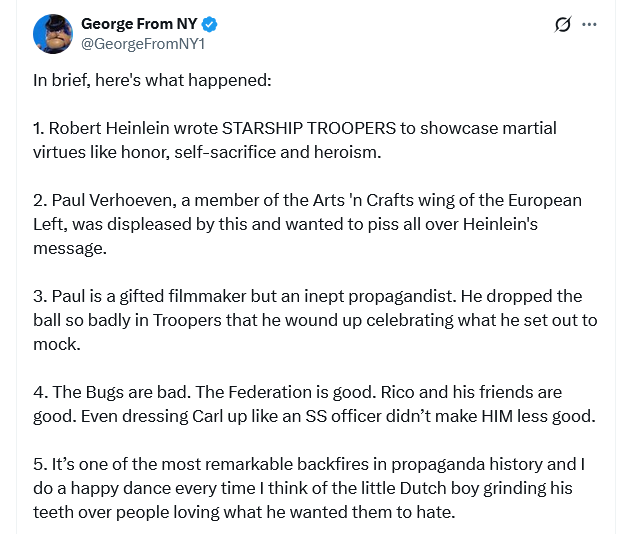
“It’s called Starship Troopers, not The Big War with the Bugs“
On the social media site formerly known as Twitter, Devon Eriksen explains why filmgoers still identify with the humans in Verhoeven’s unfaithful-to-the-story film of Robert A. Heinlein’s Starship Troopers:
Here’s a hint:
It’s called Starship Troopers. Not The Big War with the Bugs.
There’s a reason for that. Heinlein was one of the 20th century’s greatest authors, if not THE greatest, and he was also the 20th century’s greatest philosopher and it’s not even close.
So he didn’t name things by accident.
Starship Troopers isn’t about the war. It isn’t even about war. And it’s certainly not about the fucking bugs.
All that shit is just stage dressing for the story is really about. That’s why the book doesn’t end with defeating the enemy. It ends with Rico meeting his father again, facing future fights together.
Starship Troopers is about the military life, the relationship between armies and the civilizations they serve, and what it means to be a soldier and a man.
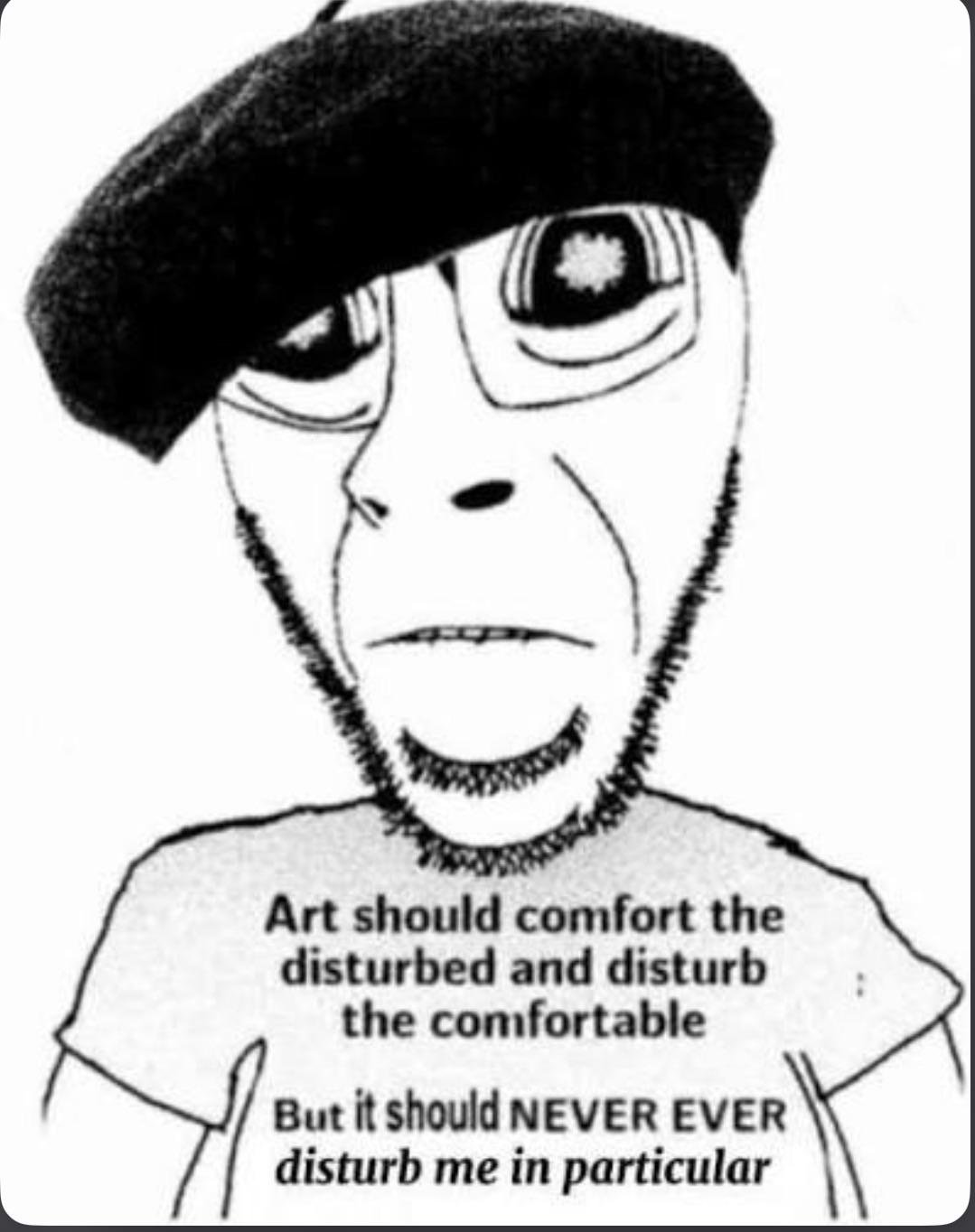
Eurotrash communists failed to get the point, not merely because they have the “media literacy” of a sack of wet hammers, but also because they don’t understand soldiering, civilization, or manhood.
So, yes, Verhoeven tried to make fun of Heinlein and failed miserably because Heinlein was a better storyteller, a better man, and a better human being by a margin so great that the Earth can barely encompass it.
But even though his failed satire makes humanity clearly the good guys, the war clearly righteous, and soldiers clearly cool and heroic, it still doesn’t recapture the actual meaning of Starship Troopers.
Because the real themes were so invisible, so incomprehensible, to Verhoeven that he couldn’t even see them to disagree with.
So enjoy the film for what it turned out to be … a fun, campy, morally unambiguous story of heroes squashing disgusting bugs. Suitable for popcorn consumption.
Then, read more Heinlein.
Update, 6 June: Welcome, Instapundit readers! Have a look around at some of my other posts you may find of interest. I send out a daily summary of posts here through my Substack – https://substack.com/@nicholasrusson that you can subscribe to if you’d like to be informed of new posts in the future.
May 28, 2026
The Day The Earth Stood Still: a Post-WWII War of the Worlds
Feral Historian
Published Jan 9, 2026The Day The Earth Stood Still (1951) is in some ways the most successful translation of the alien invasion story from 19th Century colonial assumptions to those of the post-WWII world. They no longer come to take our land and plunder our resources, but to keep us from threatening their “Rules Based Order” and turn us into a low-fidelity copy of themselves.
00:00 Intro
02:46 Nukes and Norms
06:48 Ultimatum
09:00 Farewell to the Master
11:08 Hello Remake
(more…)
Comments Off on The Day The Earth Stood Still: a Post-WWII War of the Worlds


