
The Rest Is History
Published 5 May 2026What does The Odyssey teach us about the history of wine in the ancient world? How did Julius Caesar use wine to conquer the world? And why was The Judgement of Paris – when America took on France – the most controversial incident in the history of wine?
Join Dominic and Tom as they discuss the long history of wine; from ancient Jordan, to Bronze Age Greece, to the Vikings, and beyond …
00:00 The complete history of wine in 8,000 years
00:41 Lloyds
02:14 Pliny the Elder and the first wine snob
06:02 Why wine is such a rich subject for history
09:27 Noah, Mount Ararat and the biblical origins of wine
11:31 Georgia, Armenia and the world’s first wineries
13:15 The Canaanites and the invention of the wine trade
16:19 The Phoenicians, Greeks and wine culture across the Mediterranean
18:32 How Rome created the first international wine culture
20:32 Wine, slavery and the Roman conquest of Gaul
23:12 Italy becomes the heartland of Roman wine
24:40 How Christianity preserved wine after Rome’s fall
27:22 Why Islam transformed the history of wine
30:09 Wine drinking, loopholes and the caliphs
33:41 Rumi, Sufism and wine as a metaphor for divine love
37:29 England and the invention of the modern wine bottle
40:08 Kenelm Digby and the rise of English bottles
43:22 Cork, port and the Methuen Treaty
45:12 The English invention of the corkscrew
47:10 How French became the language of wine
50:07 Samuel Pepys discovers Haut-Brion
52:33 First growths, Bordeaux and the hierarchy of wine
56:09 Why wine was once an elite English obsession
57:49 Terroir and the spiritual language of French wine
1:00:59 The Judgment of Paris
1:03:57 Prohibition and the collapse of Californian wine
1:06:19 The blind tasting that humiliated France
1:08:08 Stag’s Leap and California’s victory
1:09:11 How New World wine changed the industry
1:10:44 Wine, competition and partnership
1:11:46 Henry Jeff, the bonus episode and the Mona LisaVideo Editor: Jack Meek, Adam Thornton & Harry Swan
Social Producer: Harry Balden
Producers: Aaliyah Akude & Tabby Syrett
Senior Producer: Callum Hill
Executive Producer: Dom Johnson
Head of Digital & Social: Sam Oakley
October 5, 2026
Tom Holland Explains the Entire History of Wine in 72 Minutes
September 19, 2026
QotD: Islam and the rise of Western hegemony
Governments across the Islamic world began to adopt constitutions that directly contradicted what Muslims had always believed was the perfect and eternal law given to them by God. Simultaneously, they began to sign up to international bodies that, despite their claims to neutrality, were shot through with the ideological assumptions of the West. The most significant of these was the United Nations, which in December 1948 issued a definitive statement of its guiding principles: the Universal Declaration of Human Rights.
This, which claimed in its preamble that acknowledgement of “the equal and inalienable rights of all members of the human family is the foundation of freedom, justice and peace in the world”, was in reality not at all as “universal” as it affected to be. Standing recognisably in a line of descent from the proclamations of the French Revolution, it served as well as a repudiation of some of the more foundational assumptions of Islamic theodicy.
The concept of human rights was an alien one to Islam. Muslims, traditionally, had not believed in natural law. There were only laws authored by God. The insistence of United Nations agencies on “the antiquity and broad acceptance of the rights of man” derived, not from the great inheritance of the Sunnah, but from the philosophes of the 18th century. Tellingly, the Universal Declaration of Human Rights had been signed — where else? — in Paris.
Western hegemony over the Islamic world, then, did not end with the collapse of direct rule over it by the European powers. Western values, Western assumptions, Western concepts of law, all of them packaged and marketed as “universal”, continued to exercise an overweening dominance in global affairs. If this was true for Muslims in lands that had sought to reconstitute themselves as nation states, then how much more so was it for Muslims who, in the decades that followed the Second World War, travelled to Europe, and settled there in growing numbers.
Tom Holland, “The age-old tension between Islam and France”, UnHerd, 2020-11-02.
September 16, 2026
Veterans of the GWOT “saw things with our own eyes that are hard for others to believe”
On the social media site formerly known as Twitter, Cynical Publius explains why some of the strongest opposition to Islamification comes from people who’ve seen Islamic culture up close in countries where it’s the majority religion:
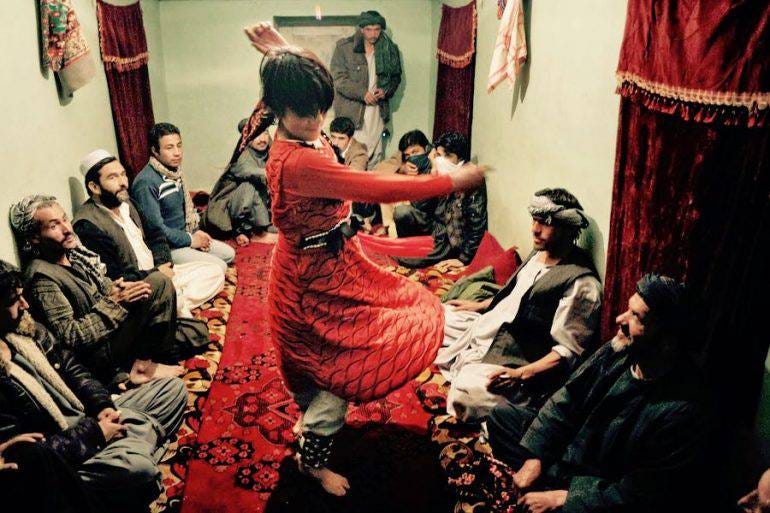
Does this photo of Afghan men watching a young boy dance give you the creeps? It should.
Have you noticed that the community that is most vocal in warning about the Islamification of the USA is the GWOT veterans’ community?
That’s because we saw things with our own eyes that are hard for others to believe:
- The treatment of women as chattel property. Goats are treated better than daughters — no exaggeration.
- Widespread pedophilia and bestiality while at the same time people we call “LGBTQ+” in the West are subject to barbaric methods of execution.
- An absolute lack of freedom of religion.
- Wanton disregard for human life.
- Insanely paranoid antisemitism straight out of The Protocols of the Elders of Zion.
- Wholly corrupt governments; bribery as a uniform standard.
- Tribalism to an extreme: tribe trumps truth and justice, always.
- In the Gulf Arab countries, “Third Country Nationals” from poor Muslim countries engaged in menial labor and literally treated as slaves.
- Absolute confidence that Islam will violently conquer the rest of the world, and a belief that this is just and proper.
- Acceptance of the idea that lying can be and is necessary and proper.
These are not one-off observations; these are widespread norms that are easily observed and experienced in day-to-day life in any nation that accepts Sharia law. ALL OF THESE THINGS ARE COMMONPLACE. Having seen this stuff up close and personal across the entire Middle East, Central Asia and the Horn of Africa, American veterans have unwittingly become like the prophets of old, warning everyone else of the dangers we have seen that we never wish to see come ashore in America.
Yet somehow our voices are not being heard sufficiently, and we now see literal Communists wishing to import these evil practices to the USA en masse, as a path to their own power.
Guess what Commies? It’s the other way around, you are the ones being used and when the Green forces dispose of you Red forces, it’s not going to be pretty.
Wise up.
Update, 17 September: Welcome, Instapundit readers! Have a look around at some of my other posts you may find of interest. I send out a daily summary of posts here through my Substack – https://substack.com/@nicholasrusson that you can subscribe to if you’d like to be informed of new posts in the future.
September 14, 2026
The demands for reparations should be rejected, firmly
Large-scale slavery has been a dead letter in most parts of the world since the Slave Trade Act of 1807 made the transportation of slaves illegal within the British empire and on the high seas where the Royal Navy patrolled. Legal abolition of slavery followed in 1833 with the Slavery Abolition Act. Chattel slavery in the United States was ended by the American Civil War. The last major power to allow slavery was the Ottoman Empire, which was dissolved after the First World War. Slavery still exists … mostly in the Islamic world and in the criminal underworld elsewhere, but is no longer an almost universal condition. (Despite ridiculous recent claims, slavery was not “invented” in 1619: pretty much every civilization we know of had forms of slavery from before the earliest cities were built.)
Despite nearly 200 years since the suppression of the slave trade and the abolishment of the institution, many countries are now presenting claims for reparations to Britain for the history of slavery. And feeble-minded politicians are treating these claims as though they are somehow morally correct despite all the evidence of history. On his Substack, Spaceman Spiff demands that we treat these grifters firmly and refuse any such future claims:
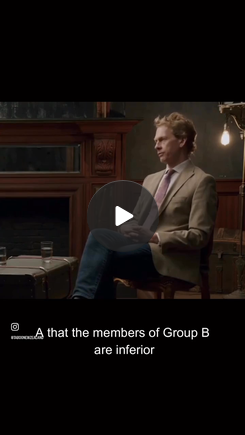
I came across a video that explains how absurd modern views on European colonization are. Accusations of racism aimed at our ancestors are meaningless since everyone was racist. Only one group attempted to be non-racist. Transcript below.
The Maori were racist towards other Pacific Asian tribes. I mean, everyone is a racist if by that term we mean the assumptions by GROUP A that members of GROUP B are inferior and deserve to be conquered if they can be.
That is a universal human phenomenon and it arises from evolutionary needs for basically in-group solidarity. So racism is the standard default position for all peoples.
To say that the Europeans were racist is just to state the obvious because all peoples were racist.
If it is not a statement of the obvious then it’s patently false. And by that I mean that if I were to judge the racism of the Europeans vis-a-vis the places they conquered, compared to the racism of other groups at the time, we find the Europeans much less racist. And if we were going to put it on a spectrum the only anti-racists in the whole world at the time of European colonialism were the Europeans. Because they were the ones who went abroad and said, these peoples have the capacity to be just like us. These people deserve freedoms. These people deserve to be freed from slavery. They deserve to be developed. They deserve to be civilized, which of course is seen as a sort of great racist act but it is quite the opposite.
It is the act of saying all peoples have the potential to be self-governing, to be flourishing, to have a written language, history, arts and culture. This was the great anti-racist campaign that European colonialism represented. So that’s why I say it is simply a statement of the obvious or it is patently false.
The video calmly debunks the notion European colonization was driven by racism. Quite the opposite. It was an early form of anti-racism on a global scale based on a belief everyone deserved a high standard of living like Europeans.
This quirk of Western man has encouraged calls to pay reparations for the slave trade thanks to our continuing concern with the welfare of out-groups, a preoccupation unique to Europeans and shunned by the rest of the world even today.
Pay us in cash, guilty Westerner
It has become fashionable to suggest Britain and America pay reparations for the transatlantic slave trade. This is partly because of Britain’s involvement in European colonization of Africa, and partly the presence of slaves in the USA and some British colonies in the Caribbean.
The facts surrounding the abolition of slavery are well documented. They represent one of the most astonishing acts of decency in history, all the more amazing as one of those countries was the unchallenged global superpower of its day. There was no one else strong enough to make them do it; it was entirely voluntary.
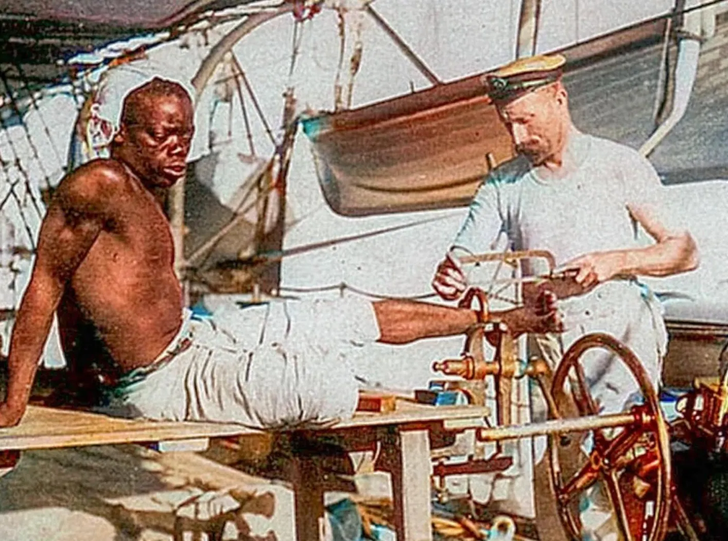
Manacles being removed by Able Seaman Joseph Chidwick in 1907 from an enslaved man who had worn the leg irons for three years. HMS Sphinx operated off the coast of Oman in the Arabian sea and attracted a number of slaves from a nearby slave-trading village whom the British immediately freed.
Britain’s actions were quickly followed by France and then the USA which led to the abolition of slavery throughout most of the world.
And yet reparations have become a rallying call among some. Everyone from the United Nations to individual countries like Jamaica and Ghana are baying for blood.
Underlying the drive is the additional charge of racism, a very modern idea.
August 6, 2026
QotD: John Nicholson, a Muslim saint who really hated India
[…]
[The First Anglo-Afghan War (1838-1842)] began with the British efforts to replace Afghan Emir Dost Muhammad with a more pliant leader, which in a pattern seen from the days of Alexander onward, involved an invasion, an attempt at a pacification, followed by a grim and growing awareness that the place is full of some of the most brutal and fractious people on Earth and is simply ungovernable, which terminates in a costly retreat, the country itself returning to its customary barbarism, efforts to change it having had all the effect of flinging an encyclopedia into a chimp enclosure. For the British, this meant early success, then an overwinter occupation in which their position deteriorated, then a mass uprising, whereupon they negotiated with the locals for a peaceful exit upon surrendering their arms. The retreating British were of course betrayed and massacred. One man made it out.
Nicholson, serving as an adjutant officer with a native regiment, had earlier been taken prisoner, and endured horrific conditions as such. He watched as his Hindu soldiers refused — to a man — to convert to Islam, and were executed one after the other. After having been released, he discovered that his younger brother Alexander had been murdered and mutilated by the Afghans while retreating with the rest of the army. The entire effort had been a great traumatic waste.
One might expect that Nicholson would hate the Afghans and perhaps revise upward his estimation of the brave Indian soldiers who had served under him. But while he did indeed revile the Pashtun tribesmen (“the most vicious and bloodthirsty race in existence”) he actually seems to have disliked them slightly less than the Hindus, perhaps on the grounds that no one that eager to kill Indians can be all bad. Indeed, he seems to have learned there some harsh lessons concerning what it would take to actually accomplish anything in the subcontinent, doctrines he would apply fastidiously and thoroughly. In many ways, he went a bit more native than he would have cared to admit.
After the war, Nicholson was promoted and given a series of administrative jobs, where he became well-acquainted with the chaotic political situation in the Punjab region. Mostly under the control of the Sikh Empire, the area had long been contested ground between that new faith and Islamic invasions from the Mughals to the southeast and the Afghans through the Khyber Pass to the west, not to mention restive Hindu Rajputs and Marathas to the south. The unstable (then and now) region of Kashmir lay to the north, and the whole of the region was plagued by innumerable bandits and warlords. The BEIC ruled through direct administration, client kings, and various alliances, the latter two of which its political officers (“politicals”) had to interact with on a regular basis. It was very much a situation out of George R. R. Martin’s fever dreams, constant betrayals, perversions of every kind, and even a Ramsey Bolton-esque Sikh despot who flayed men alive for amusement.
Nicholson was in charge of the Bannu area, where he rapidly made a name for himself as a local administrator. The whole of the Bannu was infested with bandits of all kinds, from jihadis to Hindu cultists to normal brigands, and the people lived in constant fear of their depredations. Nicholson had no real interest in bettering lives, but he had even less interest in allowing any Indian, anywhere, to challenge his authority. So he set about fixing the problem as only he could.
Nicholson arrested and executed scores of bandits, rapidly processing them through his very efficient court system. The idea of impartially dispensing justice without respect to person or affiliation was quite new to the area, but Nicholson made sure the locals adjusted quickly, tolerating not even the slightest hint of disrespect from anyone, no matter who he was. When a local Muslim leader casually spit on the ground in front of him, Nicholson made him kneel and lick it up. Anyone who failed to display prompt obedience to his commands he had flogged immediately, and was the bane of servants, who were often the causal recipients of hurled cups and dishes. He was a very hands-on leader, not the least hesitant to get them dirty in a quite literal sense. At one point, when his local police were unwilling to pursue a dangerous gang leader, Nicholson rode alone to the man’s village, approached him on the street, and killed him with his sword after the suspect failed to submit to arrest. Nicholson kept his severed head on his desk pour encourager les autres.
Interestingly, such draconian brutality seems to have actually made Nicholson popular. He was harsh, unyielding, and wholly indifferent to their culture, but that very indifference made him unassailable to anything but his sense of duty. He was unbribable, as the people of India had absolutely nothing he wanted, and his complete contempt for their social norms meant that Hindu, Muslim, or Sikh, Brahmin or outcast, Aryan or Dravidian, all got the exact same treatment, prompt and thorough. His mad fearlessness meant that he was similarly immune to threats. Criminals, whoever they were, received savage punishment, but the law-abiding were left in peace; Nicholson had no desire to “improve” them or their society like his contemporary Macaulay. In a real sense, for the first time, the diverse people of the area were free, under Nicholson’s rule, to live as they wished without the violent misery that had previously characterized the region. It was a multicultural success story, festooned with the occasional decapitated head.
This being India, the people expressed their feelings towards him in particular ways. A body of wild Pashtun raiders, admiring Nicholson’s capacity for ruthless violence and his grim charisma, attached themselves to him as a personal guard, fedaykin to his Muad’Dib, serving without pay and loyal only to him. In a theologically fecund area with a strong tradition of syncretism and cults of personality, Nicholson naturally became the object of worship for a group of fanatical devotees. He in turn naturally despised this, having his worshipers flogged as public nuisances, but this only served to increase their devotion to their inscrutable, violent deity. In some parts of India, the Cult of Nikal Seyn survived as a Shia devotional movement, with Nicholson cast as a Muslim saint bringing justice to a war torn land. The last member died in 2004.
Librarian of Celaeno, “The Man Who Hated India”, The Library of Celaeno, 2026-05-04.
August 2, 2026
QotD: Churchill’s views on India
On the other hand, Churchill repeatedly voiced his admiration for the gallantry of Indian troops, noting in his war memoirs: “The unsurpassed bravery of Indian soldiers and officers, both Moslem and Hindu, shine for ever in the annals of war. Upwards of two and a half million Indians volunteered to serve in the forces … The response of the Indian peoples, no less than the conduct of their soldiers, makes a glorious final page in the story of our Indian Empire.”
Despite his fears about Indian independence, Churchill’s views noticeably mellowed over the years. On 5 February 1942, Churchill proposed in cabinet to visit India to make its Congress leaders an offer of postwar independence, in return for their supporting the war effort. But instead the war cabinet sent its senior Labour minister, Sir Stafford Cripps, known for his friendship with Congress leaders. When the Cripps mission failed to meet their demand for immediate independence, Congress launched the Quit India movement of civil disobedience against the Raj and resolved to offer only passive resistance to the Japanese invasion.
On being informed of this in September 1942, an apoplectic Churchill exclaimed to Amery: “I hate Indians. They are a beastly people with a beastly religion.” He was referring to Hinduism, rather than Islam, given loyal support for the war effort from the Muslim League. Churchill saw Gandhi’s decision to launch the Quit India movement in the middle of the war as a stab in the back when Britain most needed and deserved loyal support.
He also (like many Indian liberals and socialists) saw Gandhi’s political fasts as a form of emotional blackmail. And he was appalled, as were many Congressmen, by extreme nationalists such as the Bengali leader Subhas Chandra Bose joining hands with Hitler and the Japanese, a fact not calculated to endear Bengalis in general to Churchill.
Churchill’s abusive comments about Gandhi, Indians and Bengalis need to be seen in that context. They also need to be seen in the context of his penchant for making outrageous comments that he didn’t really mean in order to shock or tease.
Zareer Masani, “Churchill and the genocide myth”, The Critic, 2020-12-06.
August 1, 2026
The invasion of Ceuta
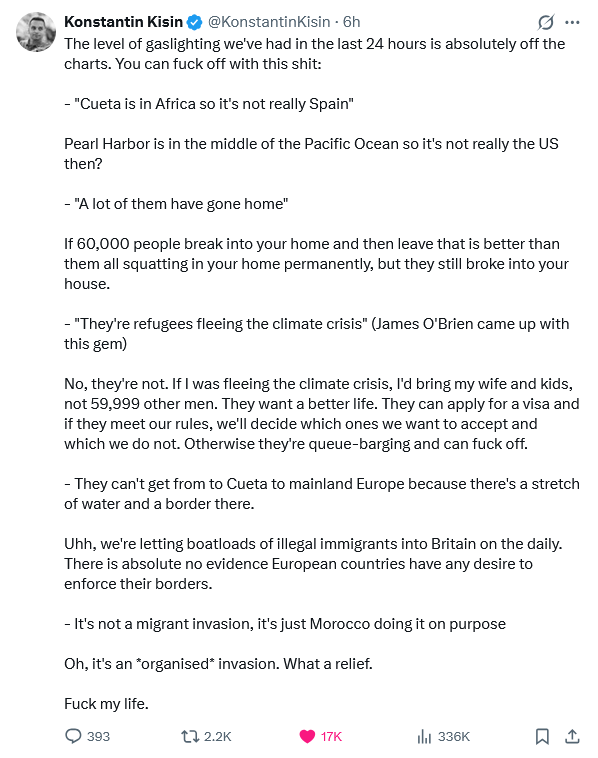
In the last 48 hours vast numbers of people have learned that Spain still has territory on the African continent, as Morocco enables thousands of young men to cross into the Spanish city of Ceuta. The Spanish government has, to time of writing, refused to declare a state of emergency or to send military forces to assist the municipal authorities in Ceuta. In Spiked, Brendan O’Neill thinks this heralds the end of globalism:
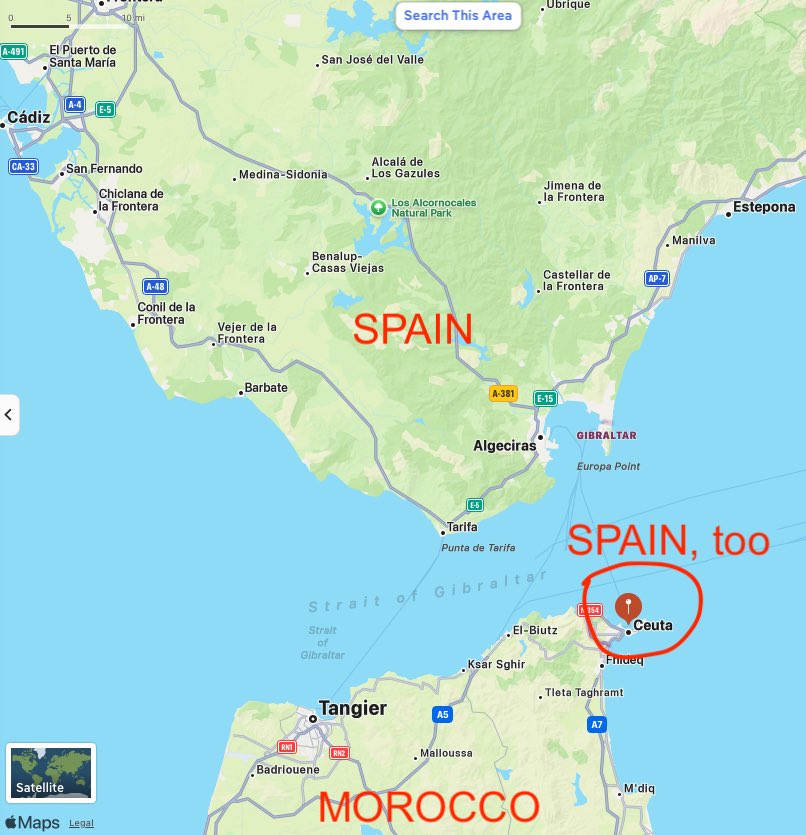
Can we say “invasion” now? What other word is there for the rough intrusion of tens of thousands of young men into the sovereign territory of a foreign nation? Surely not even the sappiest leftist in his tattered keffiyeh and “Refugees Welcome” t-shirt would describe the thuggish gatecrashing of an independent nation as “asylum seeking”? That might be the one and only upside to the extraordinary events in Ceuta yesterday: the death, at last, of euphemism. The impossibility of any longer dressing up the West’s suicidal abandonment of its borders as “kindness”.
The scenes from the Spanish enclave at the tip of North Africa are staggering. An estimated 49,000 people, mostly Moroccans, mostly men, gleefully intruded upon the territory of the Spanish kingdom. That’s around the same number of people who illegally sail to Britain in a year. They scaled border gates and overwhelmed those charged with protecting Spanish lands. Viral clips show men punching the air as they swarm the enclave, clearly thrilled with their incursion into a sovereign state. Even the Spanish press is feeling the death of euphemism. “Ceuta, invaded”, says the front page of ABC, a newspaper of record, alongside an image of thousands of men streaming along Ceuta’s beach.
The mass storming of Ceuta has focused the minds even of Spain’s fatally apathetic ruling class. All of Ceuta’s parties, both right and left, have called on Madrid to send in the army to reinforce the border with Morocco. Spanish PM Pedro Sánchez promised an “immediate response“. Yet even if the Spanish manage to tame this searing crisis of sovereign rule – and that’s a big “if” – the lessons of it should reverberate not only across Spain but all of Europe. For the fall of Ceuta exposes the lethal strain in globalism. It speaks – screams in fact – to the chaotic trashing of sovereignty, democracy and our very way of life that globalism and its gold-collared acolytes have brought about.
The storming of Ceuta shatters the falsehoods of the left. For years, “progressives” gaslit the public, insisting that the men illegally crossing our borders are “vulnerable people” who are “seeking asylum”. Like Big Brother, they expected us to reject the evidence of our eyes and ears and accept that these swaggering blokes from Eritrea or Afghanistan are the wretched of the Earth requiring our love and care and four-star hotels. Ceuta dismantles that lie. The whole world can see there are virtually no women and children in those mobs. The whole world knows Morocco is not ravaged by war or hunger. From now on, every utterance of the phrase “asylum seeker” should invoke noisy, angry scepticism.
The Ceuta crisis also confirms that the moral cowardice of the modern state is like a red rag to hostile actors. It is undeniable that Pedro Sánchez’s lunatic granting of asylum to illegal immigrants emboldened these Moroccan men to pour into soft-touch Spain. In January this year, Sánchez bypassed parliament and issued a royal decree to regularise virtually all “undocumented migrants” on Spanish territory. Almost 1.2million illegal arrivals applied for this regularised status that would grant them the right to reside in Spain, to work there and to enjoy unfettered access to healthcare and education.
The cope is strong in progressive commentators:
Why UK crime victims’ families always sound so similar talking to the media
On Substack Notes, John Carter linked to an article about the British Home Office’s “nudge unit” who, among other things, coax and cajole the families of murder victims to avoid any hint that they blame the perpetrators for the loss of their loved ones:

This is incredible. I always wondered how family liaison officers from RICU or the CRS reliably got the families of victims murdered by political or racial terrorists to provide such anodyne, don’t look back in anger public statements. I figured in most cases it would be concern trolling, with legal threats held in reserve.
This lays the technique bare, using interviews conducted both with victim’s families and former police officers. Liaison officers serve as anesthetic patches that get slapped on the open wounds of the migration war. They apply therapeutic techniques to calm and reassure the families, establishing dependent relationships and using the trust they build to guide them away from saying anything inflammatory when the time comes to speak to the public. If families become noncompliant in this respect, they’re threatened with causing a mistrial should they speak too openly about their feelings.
That isn’t all RICU does, of course. “Communications” includes a huge propaganda arm, which uses every tool at its disposal, including battalions of fake social media profiles. You have to wonder how much of the culture war of the last decade or more was pure hallucination.
The article in question is by David Shipley for the Pimlico Journal:

RICU, the Home Office’s Research Information and Communications Unit, is often the subject of much attention online, particularly around its role in the consistently bland calls for “unity” after horrific acts of violence. Many people online suggest that either the Unit itself, or the “specially trained officers” (Victim Liaison Officers or Family Liaison Officers) must threaten victims and their families to ensure their compliance with approved messaging. This always struck me as unlikely — widespread coercion would surely have leaked by now. There was also good reason to be sceptical of the efficacy of behavioural science applications to government. And yet public statements by those victims and their families are remarkably consistent.
So I was delighted when, a couple of months ago, Pimlico Journal asked me to investigate RICU and victim liaison properly. In order to do so, I studied historic statements, publications and coverage of RICU and spoke with victims’ families, some of whom are named in this piece and former police officers, none of whom are named, with knowledge of the Victim and Family Liaison units. What I discovered is fascinating and far more insidious than the imagined coercion. This article provides an overview of RICU’s history, goals and methodology, followed by details from those interviews. I hope it sheds some light on this murky area of the state’s “communications management”.
RICU was established in 2007 “under the Prevent strand of [the UK government’s] CONTEST strategy” with its stated goal being to “understand and counter terrorist and extremist ideologies to reduce the risk to the UK, its citizens and its interests overseas”. Giving evidence to MPs in 2009, Charles Farr, a former SIS officer, and head of the Office of Security and Counter Terrorism, who set RICU up in 2007, said the unit is “responsible for advising the rest of government [and] officialdom, from a brigade commander in Helmand province through to a chief constable in Yorkshire, about how they wish to characterise the threat we face and describe the response that we are making and, secondly, rather different, they are responsible for challenging the propaganda which comes to us from al-Qaeda and associated groups — generally not from people in this country; usually from the incessant 4,500 websites that are in one way or another associated with radical Islamist terrorist organisations around the world”.
The unit embraced convenient lies from the start. Part of their strategy was to send advice to “local authorities, people working on community cohesion projects, local police, neighbourhood policing teams” and “the Chief Constable” that they should not “talk about Islamic terrorism, not because in certain circumstances that is an inaccurate description but because the language admits of a number of interpretations which are not always helpful to us“.
RICU was also always concerned with the whole of British society — while Farr said the unit decided to “start” with Muslim communities, he told MPs that he did “not want to give the impression that RICU’s sole purpose is to communicate with Muslim communities in this country. It is not.” So by 2009 a unit existed which had “about 35 people” working for it, “and a bit of the private sector in there to advise us on aspects of communications”, which was telling every arm of the state, along with much of civil society, that they should lie about the nature of the threats the country faced, to serve the state’s perceived interests. It was also already building wide and deep relationships within many parts of the state, including policing.
What has it become, in the 17 years since Charles Farr gave his evidence?
In 2011, when the government reviewed Prevent, it found that RICU’s communications sometimes “erred in seeking to make language acceptable to some in Muslim communities, at the expense of candour”. The unit was described as having “a central role in developing counter-ideological or counter-narrative work”, although its track record was described as “mixed”. It was directed to take “more care … to identify credible partners to develop powerful and specific narratives across a range of communications channels, especially on the internet“. Despite these criticisms, the state chose to “retain RICU, largely in its current form”, but with the expectation that it would produce “much sharper and more professional counter-narrative products” — there was also a commitment to “continue to work with social media enterprises” in the battle against “propagandists and radicalisers” including those whose “propaganda work” might be illegal under “race and religious hatred legislation”. The shift is notable — Farr’s commitment that RICU would work across the whole of British society is clearly underway, with Islamic terrorism and radicalisation no longer the main focus.
More recently, RICU has long been the subject of much discussion on social media, and of occasional interest in the mainstream press. It’s often accused of being behind the anodyne calls for unity and calm issued by public bodies, victims and their families after the latest “Yookay” Event in which a migrant has done something appallingly violent. Not unrelatedly, it is generally the right who are more vocal in their criticism of RICU, and it is regularly suggested that they threaten families into sticking to the regime-approved line.
July 30, 2026
Intramural conflict in the progressive “big tent”
On the social media site formerly known as Twitter, L. Wayne Mathison identifies some of the major fault lines among the temporary coalition-of-convenience on “the left”:
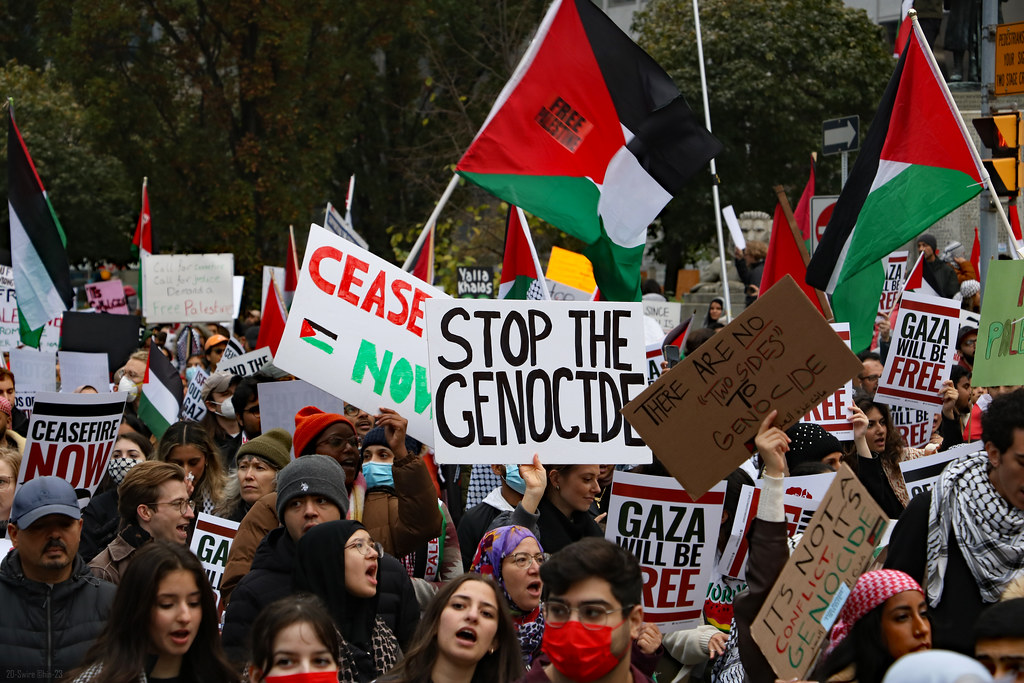
“Free Palestine/Anti-Israel protest” by Can Pac Swire is licensed under CC BY-SA 2.0 

 .
.
The modern woke worldview keeps colliding with reality because it sorts people into fixed moral categories: oppressed people are presumed good, while designated oppressors are presumed guilty. Once that framework takes hold, facts become secondary.
That is why some progressives can condemn “Christian nationalism” before breakfast, then struggle to name radical Islam when an Islamist attacks the very people they claim to defend.
The contradiction is obvious. Radical Islam is deeply hostile to homosexuality, women’s equality, free expression and secular liberalism. Pretending otherwise does not make anyone tolerant. It makes society dishonest and vulnerable.
This does not mean every Muslim is dangerous, nor does it justify collective blame. It means an ideology should be judged by what it teaches, what its extremists do, and whether its institutions openly confront the problem. The same standard should apply to every religion and political movement.
The woke response is usually predictable: redirect attention toward the far right, blame Western society, or accuse anyone raising the issue of hatred.
That protects the ideology, but it does nothing to protect ordinary people. Compassion without boundaries becomes negligence.
A healthy society needs openness, but openness is not the absence of judgment. Immigration, asylum and multiculturalism require enforceable limits, cultural confidence and a clear expectation that newcomers accept the laws and basic freedoms of the country receiving them.
You cannot build social trust by demanding that citizens ignore obvious conflicts. You cannot defend gay people while excusing movements that despise them. You cannot defend women while tolerating misogyny from politically protected groups.
Reality does not care which side has the approved slogans. Eventually, contradictions collect a human cost.
July 28, 2026
The establishment pretends not to understand why AfD is still on the rise
Normally, I get my updates on German politics from eugyppius’ Substack, but this article is from the New English Review with Bruce Bawer reporting:

… even as the problematic aspects of Islam become increasingly manifest, mainstream politicians and journalists in Germany feign puzzlement over the growing popularity of AfD, which ever since its founding in 2013 has been characterized by the German establishment as heralding a Nazi renaissance. How, the German elites pretend to wonder, can so many voters transfer their loyalty from seasoned, sensible, upright political leaders to ragtag radicals who bring to mind Munich putsches and Nuremberg rallies? How on earth can they have become so misguided? Such is the coy approach of Jochen-Martin Gutsch in a recent article for Der Spiegel, in which he takes a spin around the former East Germany in purported search for an explanation as to why the “far-right” AfD has won majority backing in that part of the Bundesrepublik.
Gutsch’s first move is to act astonished at the fact that an AfD gathering in Salzwedel, Saxony-Anhalt, drew ordinary-looking families, plus “[a] surprising number of young people in their twenties, smartly dressed in blazers”. What, no Hitler Youth uniforms? Gutsch’s line is that he’s just plain perplexed by the numbers: “in the state of Saxony-Anhalt, the AfD is currently polling at more than 40 percent. In the ARD Deutschlandtrend poll, the AfD is in first place; it’s even the most popular party, nationwide.” But it’s one thing to read the numbers, another thing to see all these – gasp! – ordinary-looking people flocking to show their support. This is what really blows Gutsch’s mind, or so we are meant to believe: the “normalization” of AfD, the party’s growing “acceptance”, its rapid “transformation into a mainstream party in the east”, all of which was, in Salzwedel, brought to vivid, terrible life before his eyes.
Ten years ago, Gutsch recalls, AfD received 20 percent of the vote in Saxony-Anhalt, and he, for one, was sure that it had peaked. He’s from eastern Germany himself, and he thought he knew his neighbors. He was wrong, and now, he claims, he’s alarmed – unlike his “friends and colleagues sitting in Hamburg, Cologne, or Munich, who give a friendly, bored look when I talk about the AfD. For them it’s still far away. Somewhere ‘over there’, whereas for me it’s a reality I can’t escape.” Therefore, he tells us, it’s important for him to make unravel the mystery of the AfD‘s remarkable rise in the polls.
Of course, the reason for the rise of AfD is obvious to anyone who’s been following developments in Western Europe for the last quarter-century or so. More and more voters have been demanding that immigration, especially from Muslim countries, be drastically curbed, if not altogether ended, and that the unassimilated masses who’ve already relocated to Western Europe from the Muslim world – only to swell the welfare rolls and the crime statistics – be sent back to where they came from. We’re told that the Berlin Pride killer, Abdul Ballout, belongs to “Islamist circles” in Germany. Why, ask AfD voters quite reasonably, should there be “Islamist circles” in Germany?
Yet Gutsch is, or pretends to be, blind to such concerns. His initial hypothesis, as he heads into the east, is supposedly that AfD is gaining popularity there because of economic hardship. But no, when he drives through Brandenburg now, he encounters prosperity. The city of Großräschen, once the Ruhr of East Germany, became a “ghost town” after 1990; now it’s thriving again, with the unemployment rate a mere seven percent, the old lignite mine converted into a lake with “a lovely beach” lined by “white houses” with “luxury SUVs parked out front”. Why, then, asks Gutsch, are the residents of these stately homes casting their ballots for AfD?
A veteran local politician tells Gutsch that he travels often to Bochum, in western Germany, which, compared to Großräschen, is an economic basket case. And yet the residents of Bochum are “more easygoing” than those in Großräschen. They possess a “fundamental optimism”. They “trust” and “respect” their political leaders. “What beautiful words”, Gutsch comments. He’s not being ironic. To be sure, he understands why eastern Germans aren’t brimming over with love for their leaders, whether in Berlin or Brussels. Many of them are old enough to remember 1990, when the once-mighty East German state “crumbled … before their very eyes.” One might add that before 1990, that same state was the very picture of totalitarian tyranny, as chillingly depicted in the film The Lives of Others. And before that – well, you know. Then there’s 2015, when Angela Merkel opened the floodgates to insufficiently vetted Muslim immigrants, who proceeded to cause mayhem in both east and west.
But why, then, do so many western Germans still “trust” and “respect” their leaders? It seems baffling. Yet to listen to Gutsch, loyalty to the political establishment remains the way to go – the only intelligent, mature, and reasonable option. When he talks with an AfD politician, Karsten Hilse, to get the latter’s perspective on things, he’s lost at sea. In Hilse’s opinion, mainstream German politicians are too obsessed with “tolerance”; they have at least a degree of hostility toward Germany; and they accept without question the preposterous ideologies of gender and climate-change.
July 27, 2026
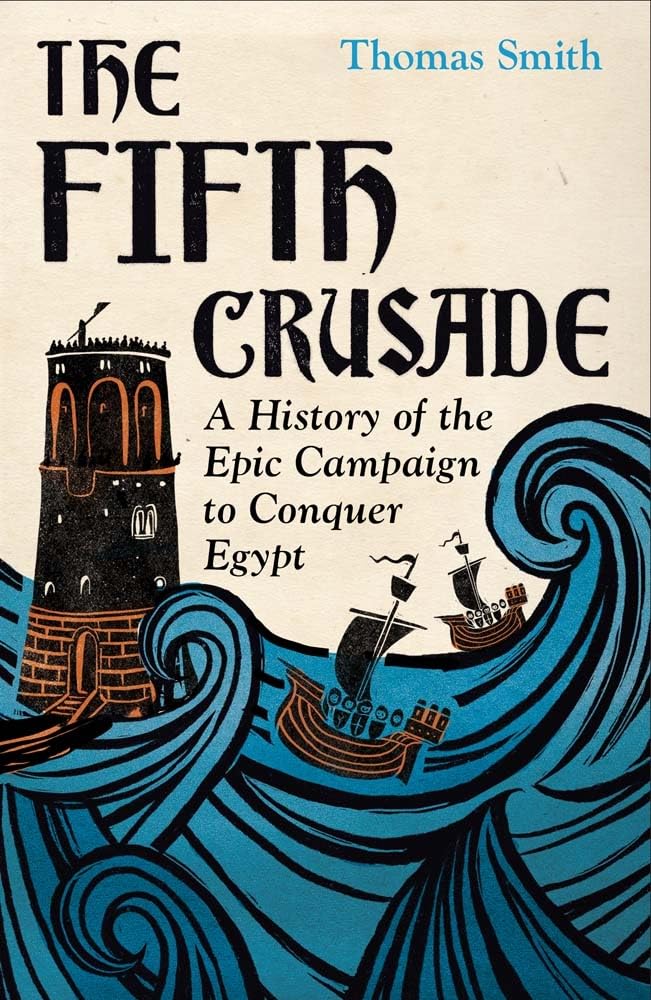
The shambolic Fifth Crusade, or “Waiting for Fredot”
In The Critic, Anatoly Grablevsky reviews a new book on one of the less well-known attempts to wrest control of the Holy Land from the Islamic conquerors:
By the early 13th century, the military and geopolitical situation of the Crusader Kingdom of Jerusalem was dire. After the Third Crusade (1189-92) had failed to retake Jerusalem, the Frankish realm in the Holy Land was reduced to a thin coastal strip centred on the heavily fortified city of Acre. The rest of the Near East was in the hands of the Ayyubids, the successors of Saladin.
In response to Ayyubid encroachment, in 1213 Pope Innocent III called for a new holy war to reinforce the Kingdom of Jerusalem and reclaim the Holy City for Christendom. The bulk of the expedition was recruited in the Holy Roman Empire, whose young emperor, Frederick II, the wonder of the world himself, ostentatiously took up the cross. He was, however, in no hurry to join his countrymen in the east.
Learning from their bitter past experiences, this time around the Crusaders adopted a novel strategy. Instead of focusing their efforts on the Holy Land, the Christians targeted Egypt, the political and economic heartland of the Ayyubids.
The Crusader army’s first port of call was the coastal city of Damietta, which, after a lengthy siege, fell in 1219. This was a major victory for Christendom: Crusaders had not captured a city of Damietta’s size, wealth and strategic importance since the fall of Jerusalem in 1099.
The Ayyubid Sultan Al-Kamil, under pressure from Mongol attacks at the rear, now offered attractive peace terms that included the return of Jerusalem to the Christians. The Crusaders, overconfident and under orders from the absentee emperor, rebuffed Al-Kamil and instead decided to march on the Ayyubid capital of Cairo.
Here, the crusade took a shambolic turn. The Christians wasted precious months awaiting the arrival of Frederick II, but the emperor never bothered to show up (Smith might have called his book “Waiting for Fredot”). By the time the Crusaders finally began the march south, Al-Kamil had gathered his strength, and the Franks were quickly outmanoeuvred by the Sultan, who used his superior knowledge of the Nile’s flooding patterns to trap them against the river.
The Crusaders reacted by launching an all-out assault on their substantial wine provisions so that, when the Muslims attacked, the Christian army disintegrated in a drunken rout.
In the ensuing peace deal, Al-Kamil regained Damietta, in return for giving safe passage back to Europe to the Christian survivors.
June 29, 2026
King Charles disclaims the title “Defender of the Faith”
His Majesty has been hinting of his preference for Islam since at least his thirties … becoming formal head of the Church of England fits poorly with his likely personal beliefs. This isn’t really a surprise, as the Church of England has been drifting a long way from its roots for generations now, but symbolically it is quite important, as Donna-Louise Flowers writes on Substack Notes:
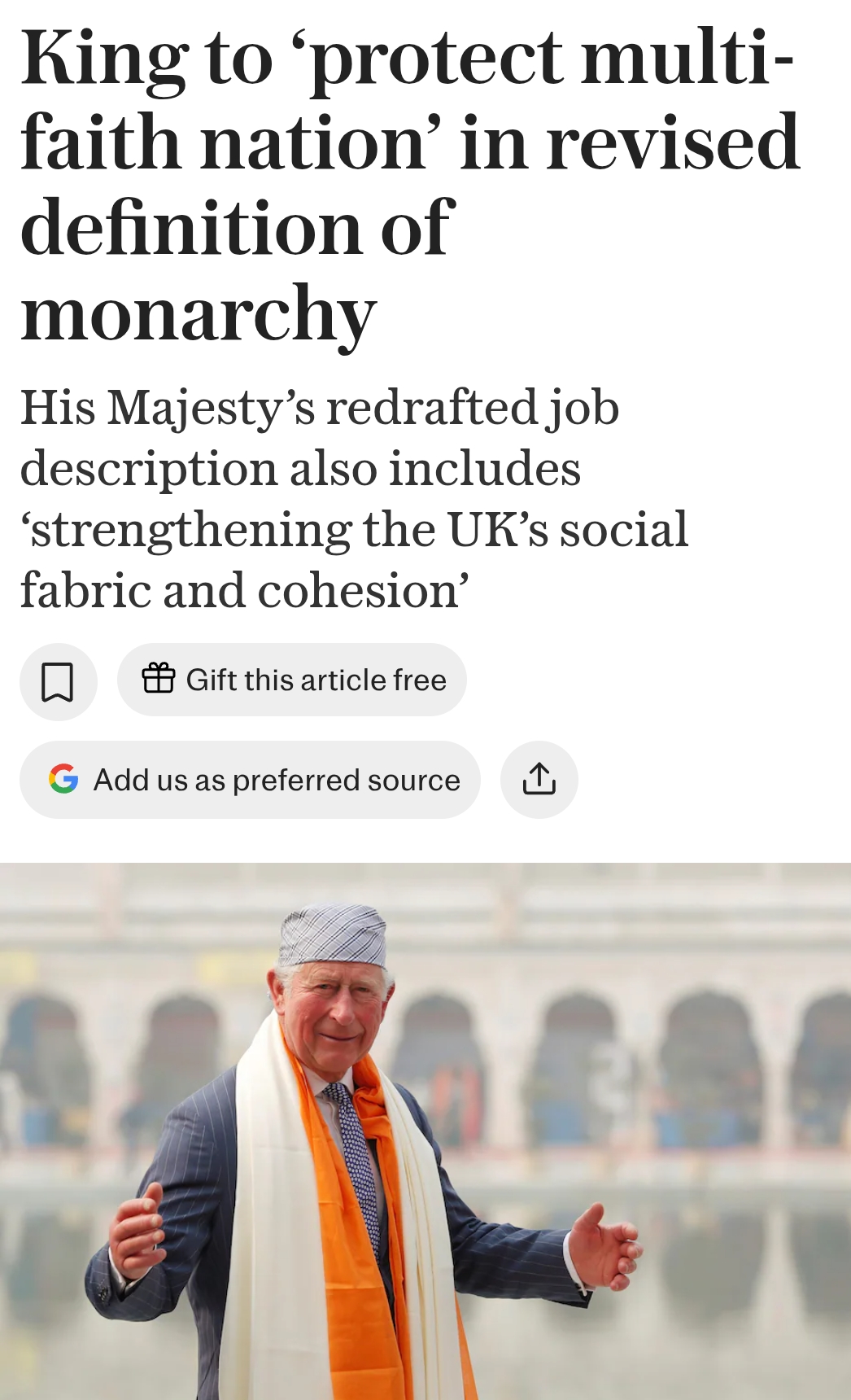
This Is the End of Britain: King Charles Just Formalised the Surrender
This is absolutely shocking. It is an absolute outrage. And it feels like the beginning of the end for Britain as we have known it.
In the latest Sovereign Grant report, Buckingham Palace has ditched the ancient title “Defender of the Faith”. No more defending the Christian foundation of this realm. Instead the King is now described as protecting “the space for Faith within the multi-faith nation”. What utter nonsense. Britain is a Christian country. That is not up for debate or negotiation. If the monarch abandons that core duty, then the institution itself has abandoned the British people.
Other faiths exist here, yes. But their presence does not require the Head of State and Supreme Governor of the Church of England to water down his role into some vague, multi-faith referee. His job is to defend the Christian faith of this nation. Full stop. Not to bend over backwards for every new arrival.
King Charles has spent decades signalling exactly this shift — praising interfaith dialogue, building ties across communities, and even calling Islam a religion of peace. Now it is baked into official Palace language. While we watch our Christian heritage eroded, churches close, and British identity dissolve, the monarchy chooses accommodation over duty.
This is more than infuriating. It is a profound betrayal. We see the reality on the ground: halal meat quietly served in the NHS and in schools to everyone — often without proper consent or even basic awareness. Islamic practices are increasingly imposed on the wider population while native Britons are expected to stay silent and pay for it. Everything is tilting. Sharia norms creep in, demands multiply, and our own traditions are treated as optional extras.
We do not fly to Saudi Arabia, Pakistan or anywhere else and demand they rewrite their entire way of life, abandon their religion, and serve us bacon sandwiches in their institutions. Why then must Britain endlessly accommodate, dilute, and apologise for existing as a Christian country? Why are we expected to change everything while others refuse any compromise?
This multi-faith rebranding is not progress. It is cultural surrender dressed up in polite language. A monarch who stands for everything stands for nothing. Britain had a specific, Christian character that allowed it to become the tolerant society it once was. Hollow that out and you do not get harmonious diversity — you get the slow erasure of the host culture.
I am deeply offended. Millions of ordinary Britons are deeply offended. This feels like the end of Britain as a coherent nation with its own history, faith and identity. The King’s role was never to manage a neutral spiritual marketplace. It was to defend the faith of this realm.
Enough of the euphemisms and the quiet capitulation. Call it what it is: a disgraceful abandonment of duty at the very top. If this continues, there will be nothing left worth defending. Britain deserves better.
Amusingly, the title “Defender of the Faith” was granted to King Henry VIII by Pope Leo X for a book (almost certainly co-written if not ghostwritten) refuting Martin Luther. King Henry “forgot” to disclaim the title when he broke with Rome a few years later …
June 28, 2026
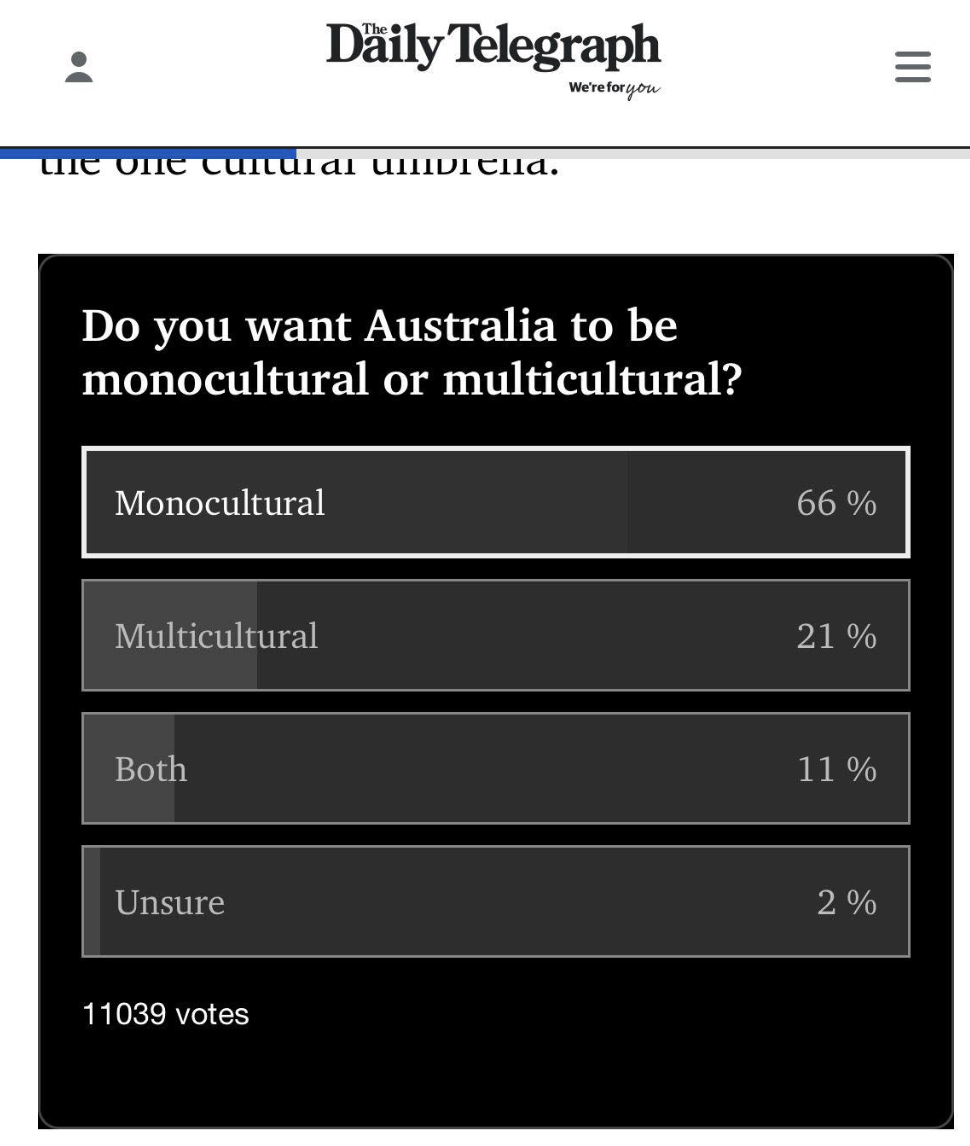
Multiculturalism in Australia: theory and practice
Australia, like the rest of the Anglosphere (with the notable exception of the United States) has adopted multiculturalism as a secular national religion, yet all is not well Down Under, as Celina illustrates:
Pauline Hanson’s National Press Club address last week has thrust the conversation of multiculturalism back into the centre of Australian politics. With One Nation now the most popular party in the polls, her pledge for a “monoculture” is no longer being pushed into the fringes. Yet, as it stands One Nation doesn’t really have any concrete policy on how to abolish multiculturalism.
Firstly, we must distinguish what is meant by multiculturalism in relation to politics. Multiculturalism is not just the presence of different cultural practices in Australia. That is a deliberate straw-man. “Abolish multiculturalism and you lose your Bah mi or Chinese takeaways” is a lazy reductionism pushed by people who are either stupid or as a sarcastic question from the left about the lack of One Nations ability to provide actual policy.
Multiculturalism, as it operates in Australia, is the institutionalisation of minority ethnic and religious lobbying. It is a system in which governments treat organised ethnic, religious and minority identity-based groups as permanent stakeholders with privileged access to policy-making. These groups receive taxpayer funding, sit on advisory bodies, submit formal recommendations, and see their priorities turned into law on hate speech, anti-discrimination, social cohesion and diversity policy. The broader Australian public is expected to accept the resulting consensus.
The Machinery That Actually Exists
Australia maintains a Minister for Multicultural Affairs, an Office for Multicultural Affairs inside the Department of Home Affairs, an Australian Multicultural Council, and a Ministerial Forum on Multicultural Affairs. States have their own legislation: the Multicultural NSW Act, Victoria’s Multicultural Victoria Act, South Australia’s Multicultural Act, Queensland’s Multicultural Recognition Act and others. They create recurring funding streams, annual reporting obligations, advisory councils and grants programs that sustain an entire ecosystem of peak bodies, settlement providers and advocacy organisations.
Commonwealth multicultural grants run into tens of millions annually. Additional streams exist for “social cohesion”, security upgrades for specific communities and settlement services. Peak bodies such as the Federation of Ethnic Communities’ Councils of Australia (FECCA), the Executive Council of Australian Jewry (ECAJ), the Australian Federation of Islamic Councils (AFIC) and the Hindu Council routinely prepare submissions, appear before inquiries and maintain ongoing relationships with ministers and bureaucrats. Personnel overlap between federal and state advisory structures is visible and recurring.
This is what political scientist Theodore Lowi called “interest group liberalism“.1 Lowi’s insight was that the pluralist system does not represent the public interest but rather rewards whichever organised groups can gain access to the machinery of government. The democratic problem is that the state has granted specific groups a structural position that ordinary, unorganised citizens do not enjoy. This results in something called mobilisation of bias, as coined by E.E. Schattschneider. described this form of power as the “mobilisation of bias“, where “some issues are organised into politics while others are organised out“.2,3
- https://en.wikipedia.org/wiki/Interest_group_liberalism
- https://www.powercube.net/analyse-power/forms-of-power/hidden-power/
- (2011). “Mobilization of bias”. In K. Dowding (Ed.) Encyclopedia of power (pp. 424-424). SAGE Publications, Inc., https://doi.org/10.4135/9781412994088.n234


June 19, 2026
US history is unique, it does not map onto the histories of other nations
I’ve noticed this pattern myself, but I hadn’t considered that a lot of Americans don’t just use the patterns of their national history when looking at other western nations:
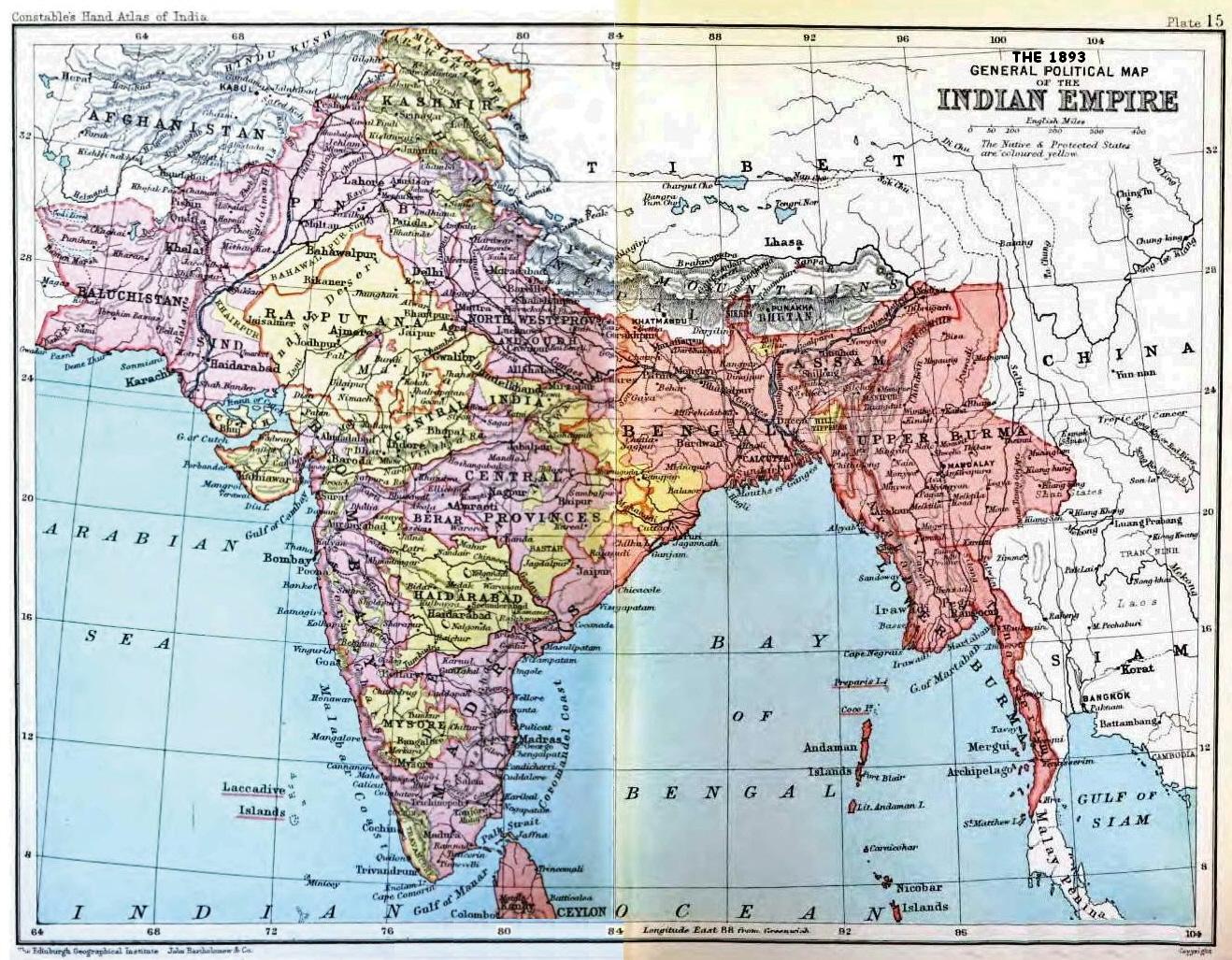
“Political Map of the Indian Empire, 1893” from Constable’s Hand Atlas of India, London: Archibald Constable and Sons, 1893. (via Wikimedia Commons)
Not every place in the world can be examined through the historical template of the United States.
One of the reasons conversations about India are so difficult for folks in the West to untangle is that many of the frameworks Americans use to understand power, intergroup dynamics, identity, and historical injustice do not map onto India. Not at all.
For Americans who have adopted a critical lens, the template derived from American history is fixed. A dominant demographic majority group seeks to preserve power while marginalized demographic minorities fight for recognition and inclusion. Because this template is so fixed in the imagination, there is a tendency to view and interpret dynamics and events in other countries in exactly the same way. I have seen it myself. “We’ve all seen how this works”, someone will say, and proceed to apply the American template to a different place.
And the history of the Americas (both North and South) is dominated by European (white) Christian colonization. As a result, Americans are familiar with the legacies of European empire and Christian missionary expansion. By contrast, the history of Islamic conquest and rule, which shaped large parts of Asia, Africa, and Europe for centuries, occupies far less space in the American imagination. So too does the contemporary influence of petrodollar-funded religious institutions, transnational Islamist movements, and the global circulation of Islamist narratives.
This does not mean these forces explain everything. It does mean that many Americans have little historical or conceptual framework for understanding how they might shape politics, memory, education, or intergroup relations in places like India.
India’s history is not the same as that of the Americas.
For centuries, India experienced successive waves of colonization. The first came through a series of Muslim invasions and dynasties, culminating in the Mughal Empire. The second came through British colonial rule, predated by British mercantile and missionary efforts. Yet unlike many colonized societies, the civilizational majority was never fully displaced, converted, or absorbed. Hindu traditions, practices, languages, stories, temples, and collective memories survived.
This is perhaps the single hardest aspect of India for many Americans to grasp because it has no real analogue in American history: the Hindu demographic majority is also the historically colonized population.
For many Western observers, this creates immediate suspicion because it violates the assumptions embedded within our familiar frameworks. The expectation is that majorities defend power while minorities challenge it.
As a result, contemporary debates about textbooks, public memory, historical figures, temples, and national identity are often seen and interpreted by folks in the West through frameworks that retrofit Indian history into contemporary American critical analysis through the reductive binaries of majority/minority, right/left, which are memeable and digestible, but obscure much more than they reveal about power, history, equity, policy, foreign influence, etc.
When Hindus argue that violent and painful aspects of Mughal conquest have been whitewashed in public education, they are frequently accused of attempting to rewrite history to justify the alleged “Hindu right wing” suppression of a minority group today. (Please do read my analysis of religious-based violence in India. It’s not what you think it is. Link.)
Yet Americans themselves are familiar with the process of revisiting historical narratives to advance truth and reconciliation. We have debated how slavery is taught, how Indigenous history is taught, how immigration is taught, and how women and minority groups have been represented in textbooks and in classrooms. We generally accept that historical narratives evolve as new evidence emerges and as previously marginalized perspectives are taken seriously.
What makes India different is that the group seeking rigorous reconsideration of historical narratives is often the majority population. For many Western observers, this creates immediate suspicion. The assumption is that majorities seek dominance while minorities seek justice.
But history does not always work that way.
The result is that efforts by Hindus to recover historical memory are often denounced as nationalism (which is falsely equated with white or Christian nationalism in the United States) before they are examined on their own terms. Questions about historical representation become questions about political motives. Efforts to revisit narratives become “evidence of extremism” or, even more bizarre, “anti-intellectualism”. And figures who have occupied a central place in Hindu memory for centuries are presented as newly invented symbols of contemporary political power.
The result is that the Indian voices most readily amplified in Western media are often those whose analyses are already legible within familiar Western frameworks. Their arguments are immediately understandable, which lends them “credibility”. Perspectives that do not fit those frameworks are frequently dismissed as “Hindu nationalist” before they are seriously considered.
One need not agree with every argument made in these debates to recognize that they are, in fact, debates. The question is not whether history should be examined. The question is whether everyone is permitted to participate in that examination without having their motives presumed in advance.
April 24, 2026
Britain’s Green Party … not your weird cousin’s old Green Party
The Green Party have been more of a punchline than a party for decades in British politics, but the Green Party of today shares only a name with its earlier incarnations (the old UK party is now split into three separate Green Parties for England and Wales, Scotland, and Northern Ireland). Now, it’s become a significant threat to the Labour Party thanks to its unlikely fusion of socialist and green policies with strong support from Britain’s growing Muslim community:

The Green Party is a growing force in British politics. In February, they gained the Parliamentary constituency of Gorton and Denton in a by-election — a supposedly “safe” seat for the Labour Party. Local elections in May see them set to make big gains — perhaps sweeping to power in several town halls in London, perhaps including Camden, where Sir Keir Starmer is one of the local MPs. Opinion polls often show them roughly level with Labour and the Conservatives.
This is quite a change from previous decades when they were indulged as eccentrics on the political fringe. The Green Party (or the Ecology Party, as it was earlier named) were the sandal-wearing, muesli-munching environmentalists who wanted to go back to nature. They opposed economic growth — but their supporters tended to be affluent enough that they could afford to do so. Its leader was the aristocrat Sir Jonathon Porritt.
They were the breed George Orwell was thinking of when he wrote: “One sometimes gets the impression that the mere words ‘Socialism’ and ‘Communism’ draw towards them with magnetic force every fruit-juice drinker, nudist, sandal-wearer, sex-maniac, Quaker, ‘Nature Cure’ quack, pacifist, and feminist in England”.
Great fun. But there was a darker side to the quackery then and now. A totalitarian mentality which, as Orwell also vividly described, proves horrific when it prevails.
Increasingly, the Green Party has shifted its focus away from the environment. In the few towns and cities where it has gained power locally, such as in Bristol and Brighton, it has proved ineffective at practical work in this respect. Typical behaviour would be to pass a motion declaring a “climate emergency” but then perform lamentably when it comes to recycling or tree planting or any of the relevant matters they have the power to deal with.
There was always a distortion in its supposed concern for sustainability in that it was really an excuse to denounce capitalism. The Property and Environment Research Center, a US think tank which champions free-market environmentalism, has shown a more enlightened approach. Their work has included a comparison of privately-owned and state-owned forests. Another applies property rights to marine assets. But the role of property rights as a means of good stewardship of our planet is dismissed by the Green Party out of hand.
In any case, much of the campaigning by the Green Party now is on non-green issues. Its leadership talks a lot about foreign policy and a broader economic pitch focusing on class war rhetoric and an extreme programme of state control. Taxing the rich is always seen as the panacea, despite the reality that many entrepreneurs are already fleeing the United Kingdom due to its hostile fiscal environment.
Its Manifesto for the last election two years ago proposed a Wealth Tax, a pensions tax, and a big increase in Capital Gains Tax. A £90 billion carbon tax would have closed down much of British industry, which was probably the idea.


