Quotulatiousness

April 29, 2026

Three views on the Iran conflict

Filed under: Media, Middle East, Military, Politics, USA — Tags: , , , — Nicholas @ 05:00

In The Conservative Woman, Alex Story outlines the three distinct ways that western opinions differ on the ongoing struggle with Iran:

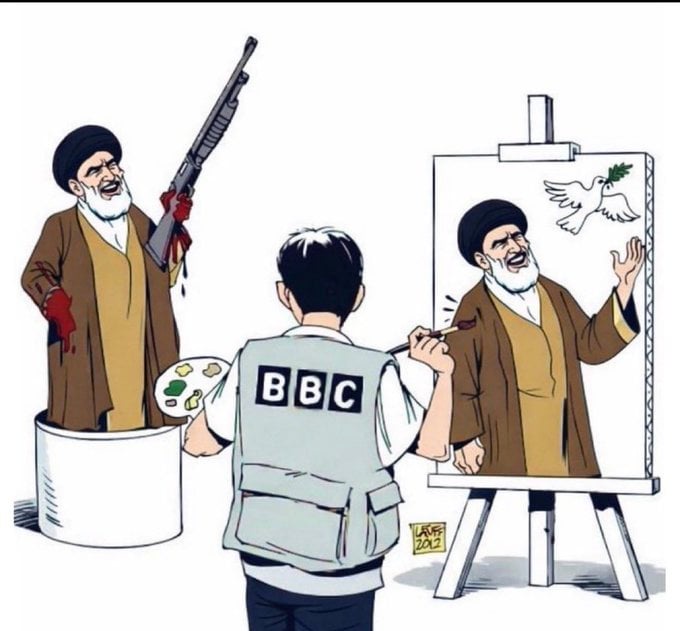
The BBC has a long history of … careful wording in describing events in Iran since 1979. I don’t think this cartoon is unfair in portraying that.

TRUTH is the first casualty of war.

Opinions on a conflict depend deeply on the prevailing culture, erasing nuance in the process. The less of it there is, the easier it is to convince yourself of your righteousness and your opponents’ wickedness.

For instance, the Iranian question divides the world in three main groups.

The first staunchly believes that the Israeli tail wags the American foreign policy dog, working around the clock to recreate Israel’s “from the river of Egypt to the great river, the River Euphrates” Old Testament borders as described in Genesis 15:18.

The second will accept the long-standing Islamic Republic of Iran’s evil nature and its core philosophy of perpetual warfare leading in due course to the unbeliever’s submission but are sceptical if it can be removed solely by this war. As David, an exiled Iranian, said: “I’m caught between wishing for the end of the regime and the very real prospect of its entrenchment through external violence”.

The third will argue that the Iranian leadership should be obliterated. Ending the regime’s five-decades long barbarism, exemplified by the slaughter of “40,000 Iranians” across the country in January 2026 in Prince Reza Pahlavi’s recent words, would make the world a better place. Having lived by the sword, the mullahs should die by the sword, they will say, adding that few will miss them.

Positions turn into intellectual fortresses at the speed of light, fed by a constant stream of “news” destined to further harden preconceived ideas. Little is provided that offers any hope of peaceful co-existence. Data is used, ignored and abused, thus ensuring escalation and lying becomes the accelerator for a world on its irrevocable path to war.

But while truth dies early in the antagonists’ deadly exchanges, war eventually reveals it, and its revelations tend towards the astounding.

In our case, for instance, it has become crystal clear that Britain is now effete, irrelevant and defanged. It is a flotsam on rough international seas, bullied by some, ridiculed by others and ignored by all who have not yet emasculated themselves.

The United Kingdom, the former global hegemon and only European country to come out of the Second World War justified, is not the same country it once was, dismantled stone by stone by an establishment haughtily bent on demise over decades and encouraging others, partially successfully, to follow them down to the Gates of Hades.

Our end, however, cannot all be pinned on Starmer, Hermer, Sands, the Fabians and purple-haired socialists.

He then goes on to make the case that only a counter-revolution will rescue Britain from its current path to misery and global irrelevance.

April 22, 2026

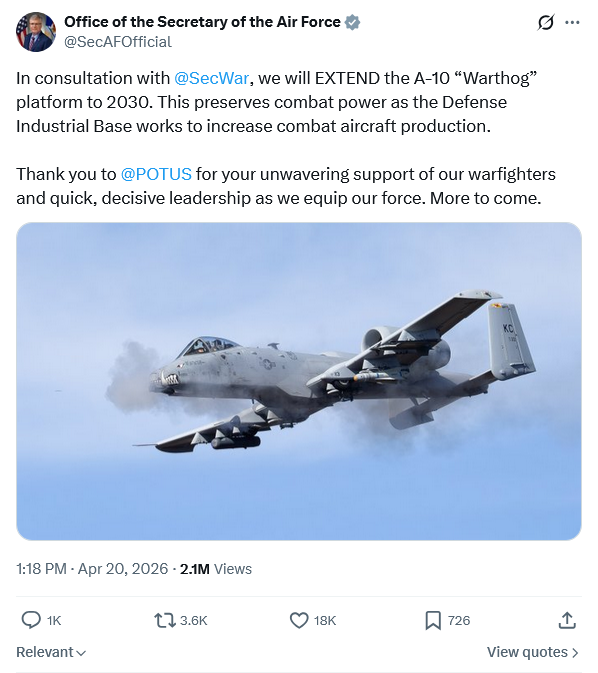
Reflections on the life extension of the A-10 – “we ought to be seriously looking at building an A11”

Filed under: Middle East, Military, USA, Weapons — Tags: , , , — Nicholas @ 03:00

On the social media site formerly known as Twitter, ESR admits that there clearly still is a role for the “Warthog” in modern combat … under the right conditions:

Gotta admit I’ve changed my mind about this. I was in the camp that loved the Hog but was grudgingly prepared to concede that its time had passed — not survivable in a modern threat environment stiff with drones and MANPADs.

But damned if the A-10 didn’t turn out to be an effective tool against small-boat swarms in the Straits of Hormuz. And not so expensive to fly or ammo up that you end up with a nasty shot-exchange problem either — not something you can say for putting the F-35 on that job.

The Hog has demonstrated that there is still a tier of missions in between the envelope of an attack helicopter and a fast fighter for which the Hog is excellently fitted. Still. In 2026.

Of course you need to have done SEAD to lower the odds that it will be popped by competent air defense, but the US Air Force is very good at that mission. As it keeps demonstrating.

I was wrong. The Hog deserves its extension. And we ought to be seriously looking at building an A11. Maybe not a manned A11, but a functionally similar instrument with a big fucking gun and the ability to fly low and slow and loiter on a patrol area.

In conclusion: “Let me sing you the song of my people: BRRRRRRRRRT.”

April 19, 2026

Simple rules for judging commentary on the Iran situation

Filed under: Media, Middle East, Military, Politics, USA — Tags: , , , , — Nicholas @ 05:00

You’ve probably noticed that I don’t include a lot of content on Iran or Ukraine these days. That’s largely because the fog of war propaganda is too dense for much reliable information to come to us and be subject to any kind of fair analysis. Lorenzo Warby has a few rules to suggest to those of you trying to sift real information out of the noise — both specifically on the Iran conflict and also more generally for these kinds of low-signal/high-noise conflicts:

There is a lot of poor quality commentary about on the current Iran War — or, as the Chinese call it, the War in West Asia. Fortunately, there are two simple tests that winnows out much of the noise so you can focus on signal.

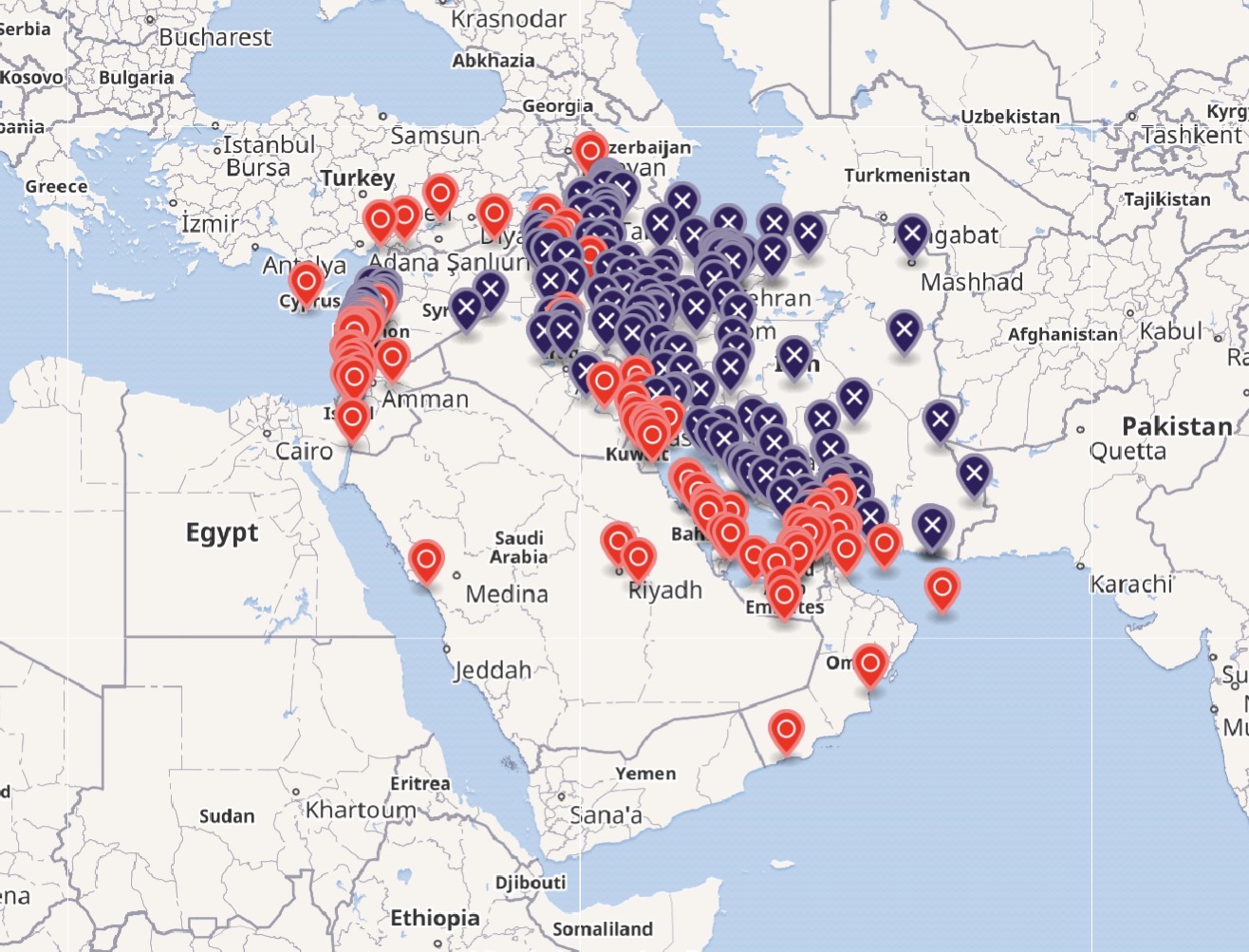
Locations struck by:
– United States and Israel (blue)
– Iran, Hezbollah, Houthis, and PMF (red)

First Easy Test

Would this commentator ever admit that Trump had done something positive?

If the answer is no, ignore them. They are not commenting on the War, they are commenting on Trump. They are just providing anti-Trump talking points for this particular issue.

Second Easy Test

Does this commentator pay any attention to the record of the Islamic Regime? Its record of domestic repression, including various mass executions and mass killings of protesters? Its record in supporting and constructing proxies: in Lebanon, in Gaza, in Yemen, in Iraq, in Syria, in …? The record of those proxies and how they disrupt and degrade those countries? Its record in promoting terrorism across the globe? Its record in massive economic and environmental dysfunction …?

If the answer is no, ignore them. This is especially so if what they do comment on is Israel. They are not commenting on the War, they are commenting on Trump and on Israel. They are just providing anti-Trump, anti-Israel talking points for this particular issue.

The more of a regime of internal exploitation the Islamic Regime has become, the more it has built up its proxy forces. The more it built up its proxy forces, the more disruptive and destructive it has become.

[…]

Third, More Subtle, Test

The third test is about how wars work. Does the commentator understand that good strategy in war is a decision-tree? If you do X and Y happens, then follow up with Z. If you do X and A happens, follow up with B.

If they do not understand that, if they treat successful war strategy as being able to operate according to some plan so what the opponent does in response to it does not matter, then they do not understand war, and you can ignore them.

A classic way to fail in military affairs, is to not treat military action as a decision-tree, but to continue with the previous plan of action despite some crucial change in circumstances.

April 10, 2026

Trump’s intemperate, irresponsible, unhinged rants … worked?

Filed under: Media, Middle East, Military, Politics, USA — Tags: , , , , , — Nicholas @ 04:00

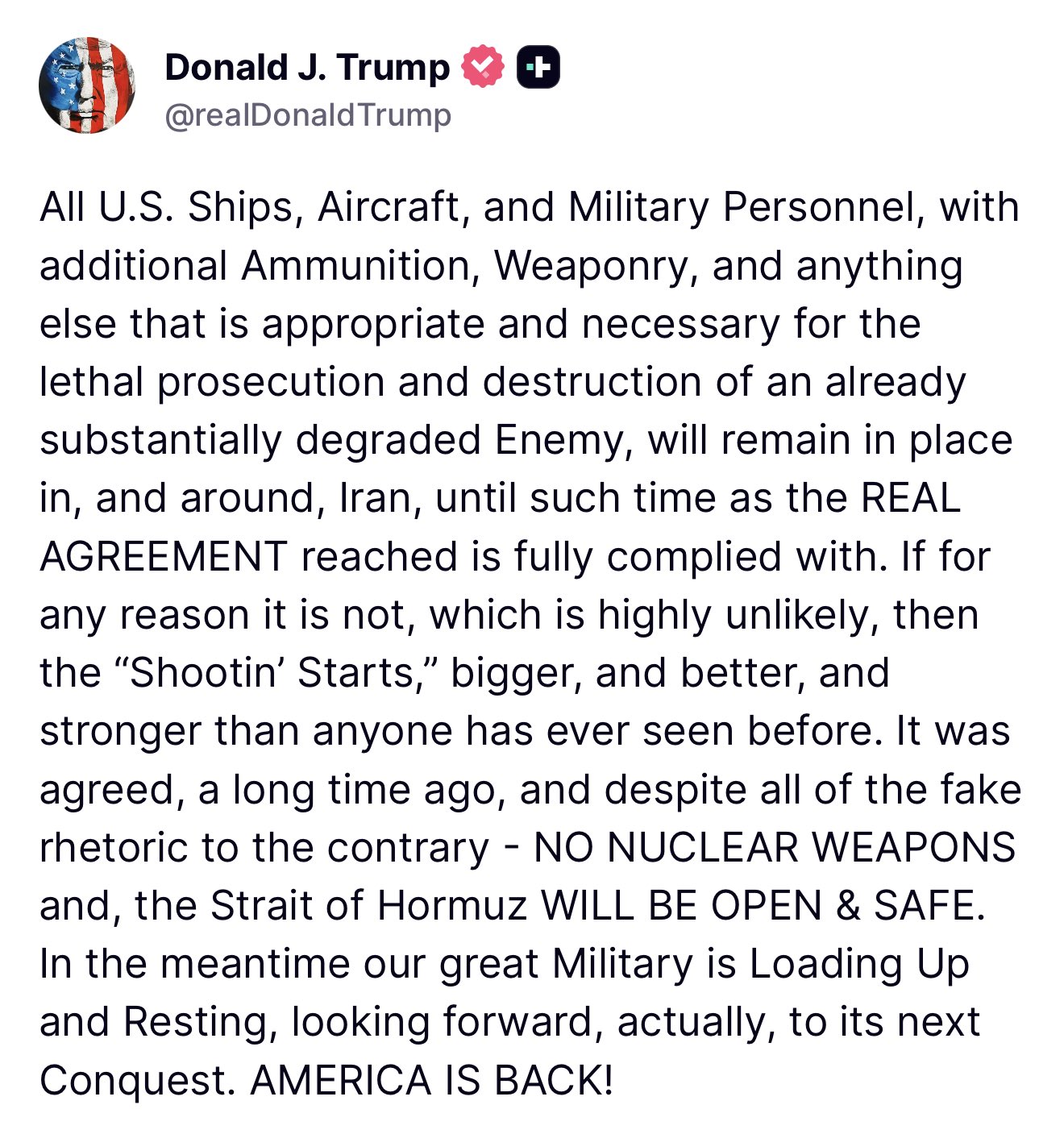
For all that Trump’s habitual form of social media post seem to frequently dance on the edge of incoherence — if not insanity — his track record is far better than his critics give him credit for. I thought his most recent blustering threats against the Iranian leadership would be counter-productive, but something approximating a ceasefire began just before his deadline. As Brendan O’Neill put it, this gives Iranian civilization a bit of a reprieve, but what about the West?

Imagine calling for the destruction of a civilisation. Imagine dreaming about violently scrubbing an ancient nation from the face of the Earth. Imagine flirting with the idea of obliterating a land with thousands of years of rich history. I am referring, of course, to the activist class and its annihilationist hatred for the Jewish State. For nearly three years, these people have beat the streets and swarmed the digital networks to agitate for the erasure of Israel, all the way “from the river to the sea“. President Trump’s juvenile bluster on Iran has nothing on their existential loathing for the Jewish homeland.

The frenzy of the past 48 hours, following Trump’s potty-mouthed and threatening social-media posts about Iran, has felt unhinged. The nukes are coming, influencers wailed. Trump must be “removed as president” in order to “prevent a catastrophe that our species will never recover from”, said the Guardian‘s Owen Jones. Within hours of this giddy apocalypticism, this huddled descent of the chattering classes into the pit of End Times prophesying, Trump had done what many of us expected he would: struck a kind of deal. The great detonation was not of a nuclear bomb but of the common sense of the cultural establishment. That’s the only thing that got vaporised yesterday.

Then there was the sheer cant. It was Trump’s ominous yelp that “A whole civilisation will die tonight” that got leftists and liberals frothing. It’s genocidal lunacy, they said. Let’s leave to one side that the target of his digital ire appeared to be the Islamic Republic, not Persia. “Forty-seven years of extortion, corruption and death will finally end”, he said. The more striking thing is the industrial-level gall of a cultural elite that is devoted to the dismantling of Israel, puffing itself up in fury over Trump’s hyperbole on Iran.

I agree that “A whole civilisation will die tonight” is a chilling thing to say. That’s why I’m so horrified by the frenzied anti-Zionism of our times. Our intellectual classes furiously deny Israel’s “right to exist”. Our activist classes openly call for Israel’s excision from the family of nations, by intifada (violence) if necessary. Our celebrity classes cheer the armies of anti-Semites (Hamas, Hezbollah) that were founded with the express intention of vaporising the Jewish nation. One minute the keffiyeh set is accusing the likes of Pete Hegseth of being in the grip of an anti-Iranian “bloodthirst”, the next it’s chanting for the death of the Jewish nation’s soldiers.

Future historians will marvel at the brass neck of an influencer class that took 24 hours off from calling for the destruction of Israel to bash Trump for posting about the destruction of Iran. I raise this not to be facetious but to draw attention to the moral disarray here on the home front that has been so spectacularly exposed by events in Iran. For it is undeniable now – we are surrounded by people who salivate over the violent disappearance of Israel but who fret over the withering of the Islamic Republic. They have taken sides – the side of the barbarous regime that dreams of “Death to America” over the side of the democratic state rebuilt by Jews in the aftermath of the Holocaust. I’m delighted the Persian civilisation is safe – now what about the West’s?

April 6, 2026

NATO without the United States?

Filed under: Europe, Military, Politics, USA — Tags: , , , — Nicholas @ 05:00

At The Conservative Woman, Jonathan Riley considers the sudden existential crisis facing the NATO alliance with President Trump openly musing about pulling the United States out of their current commitment to joint European defence:

PRESIDENT Trump’s warning that the US could pull out of Nato should shock even the most complacent and anti-American elements on the political left. Mr Trump has raised the issue in private discussions with White House aides in recent days, and on Wednesday confirmed that he was “absolutely” reviewing membership.

I have underlined several times in these pages why this is so – the global reach and sheer size of US military power and the fact that the USA brings capabilities to Nato that no other country has, or is ever likely to have. With American backing, Nato has credibility in its deterrent posture – deterrence being built on capability and will to use those capabilities. Without the US, credibility remains only in the nuclear sphere because of the independent British and French arsenals, but not in the conventional sphere. An aggressor could well, therefore, be tempted to take actions that fell short of the use, or riposte, of weapons of mass destruction. A Russian incursion into a non-Nato state, for example, Bosnia and Herzegovina or Moldova; or even a limited incursion in the Baltic, either on land or at sea.

The President’s threat came as the latest in a sequence of angry responses to the failure of traditional allies to give their support, as he sees it, to the US/Israeli war on Iran. Not least was his disappointment with Starmer, first over his refusal to give the US use of Diego Garcia and RAF Fairford in Gloucestershire for strikes on Iran, second over Starmer’s reluctance to deploy the Royal Navy and then his refusal to take the lead on re-opening the Strait of Hormuz. France’s preference for diplomacy has irked him too. Austria, not a Nato member, has become the latest EU country to deny US military use of its airspace.

Whether or not this outburst was more than a mark of his frustration with unappreciative allies – more wake-up call than genuine warning – it still suggests an alarming failure on his part to understand what Nato is and is not; why a US pull-out would be a lose/lose situation for Europe and the US.

Nato is an alliance founded in the Treaty of 1949 and is about mutual defence. Article Five affirms that an attack on one member state is an attack on all and obliges all other states to come to the aid of whoever has been attacked. During the Cold War, there was no discussion about resources, or caveats, or vetoes – what mattered was survival. Once the Cold War was over, nations did have a choice about what they committed – and in the case of every European country, it was less.

The water was muddied by the Nato-led expeditions to Bosnia, Kosovo and Afghanistan. These were carried out using coalitions built on the Alliance and in some cases, simultaneously, coalitions built within the Alliance. For example, in Afghanistan, there were really two International Assistance Forces (ISAFs): one was a coalition of the willing confronting insurgency and terrorism; the other was a non-kinetic coalition based on the Bonn Agreement, concerned with nation-building. Some people and member states may therefore believe that Nato is a vehicle for Allies to climb aboard and support US (or French, or British) expeditionary operations. It is not.

April 5, 2026

When military requirements conflict with national policies

On Substack, Holly MathNerd explains why the US military hasn’t ramped up production of drones in light of the experiences of other current conflicts:

Most people who have opinions about the war in Iran are not also reading the Federal Acquisition Regulations. I am, unfortunately for my social life, one of the people who does both.

And when you hold those two things in your head at the same time — what’s happening over the Strait of Hormuz and what’s happening in federal procurement policy — a contradiction emerges that is so glaring, and so consequential, that I could not write about anything else this week.

Here is the contradiction, in full, before I show you the data.

The United States is fighting a war where drones are the decisive tactical weapon. We are spending $2 to $4 million per intercept to stop Iranian drones that cost $50,000 each. Our own offensive drone program shipped what it had into an active war because full-rate production hadn’t started yet. Ukraine, which does not have this problem, produced two million drones in 2024 by building a distributed ecosystem of small manufacturers who iterate their designs every two weeks and sell units for $300 to $5,000 each.

We cannot do what Ukraine does, because Congress — correctly, for legitimate national security reasons — spent five consecutive National Defense Authorization Acts closing the door on Chinese drone hardware. DJI, the dominant global manufacturer, is now restricted by four separate federal authorities. There is no waiver for convenience. The wall is complete.

Which means the only path to drone dominance runs through a domestic industrial base capable of producing drones at volume, at low cost, with rapid iteration.

That base exists. Partially. Precariously. And it is built on exactly the kind of small, specialized, distributed manufacturers that the 8(a) federal contracting program was designed to bring into the market.

March 21, 2026

The Complete Chieftain Tank

Filed under: Britain, History, Military, Weapons — Tags: , , , , , — Nicholas @ 04:00

The Tank Museum
Published 20 Mar 2026

Chieftain. The world’s first main battle tank. An icon of the Cold War, it served the British Army for more than 30 years. Yet, it had something of a Jekyll and Hyde reputation. It was prized for having the best gun in the world but, for the British, it never fired a shot in anger. Loved by gunners. Loathed by mechanics. The Chieftain was often referred to as the best tank in the world as long as it broke down in the right place.

But was the gun truly as good as the stats make it out to be? And was the engine really that bad? It’s time to take a dive into the heart of the Iron Triangle to find out.

00:00 | Introduction
00:36 | Gun
03:44 | Engine
06:19 | Armour
11:07 | Just Deserts
13:53 | A Tragic Hero

In this film, join James Donaldson as he delves into the good, the bad, and the ugly sides of the Chieftain tank. With a great gun, revolutionary armour, and a misunderstood engine, Chieftain’s service with the British ensured the Cold War never turned hot. And hear from Chieftain veterans, Bob and Steve, as they share their experiences with this iconic tank.
(more…)

March 17, 2026

The mine threat in the Straits of Hormuz

Filed under: Middle East, Military, USA, Weapons — Tags: , , — Nicholas @ 03:00

CDR Salamander discusses the naval situation in Iranian coastal waters as the threat of mines in the busy seaway helps deter civilian tanker traffic even more than existing drone and missile threat:

At the end of last week, things were a’buzz’n about ‘ole silent-but-deadly … MINES!

There is a lot of bad and in some places intentionally misleading reporting from traditional media on down over this weekend, so let’s do a quick summary.

The NYT got the ball rolling.

    Iran has begun laying mines in the Strait of Hormuz, the Persian Gulf channel that carries 20 percent of the world’s oil, according to U.S. officials, an effort that could further complicate American efforts to restart shipping there.

    While the U.S. military said it had destroyed larger Iranian naval vessels that could be used to quickly lay mines in the strait, Iran began using smaller boats for the operation on Thursday, according to a U.S. official briefed on the intelligence.

    Iran’s Islamic Revolutionary Guards Corps can deploy hundreds, even thousands, of the small boats, which the Iranian force has long used to harass larger ships, including the U.S. Navy’s.

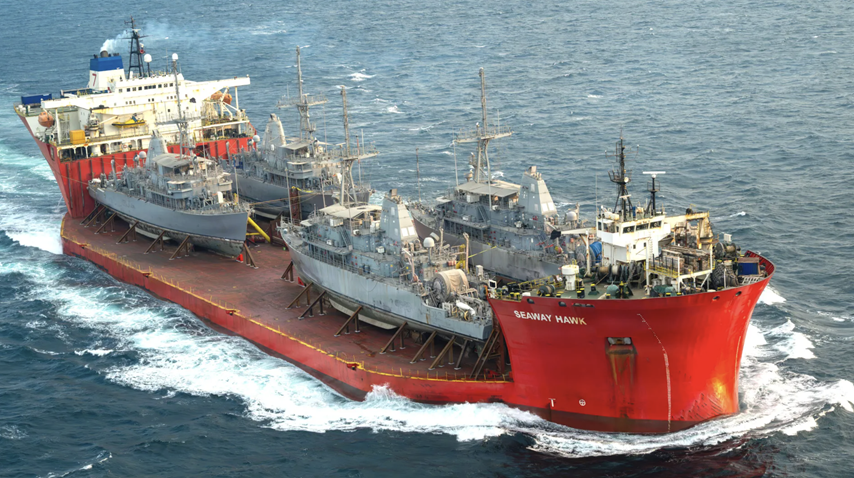
This quickly reminded everyone of a little event from the start of the year that had a memorable visual.

Via TWZ:

    Four decommissioned U.S. Navy Avenger class mine countermeasures ships have left Bahrain on what may be their final voyage aboard a larger heavy lift vessel. Avengers had been forward-deployed to the Middle Eastern nation for years, where critical mine countermeasures duties have now passed to Independence class Littoral Combat Ships (LCS).

    The public affairs office for U.S. Naval Forces Central Command (NAVCENT) and U.S. 5th Fleet first released pictures of the M/V Seaway Hawk, a contracted semi-submersible heavy lift vessel, carrying the former Avenger class ships USS Devastator, USS Dextrous, USS Gladiator, and USS Sentry last Friday. The Navy released more images and a brief statement yesterday. The date stamps on the pictures show the Avengers were physically loaded onto the Seaway Hawk in Bahrain on January 9.

This had a second echo of a seapower past.

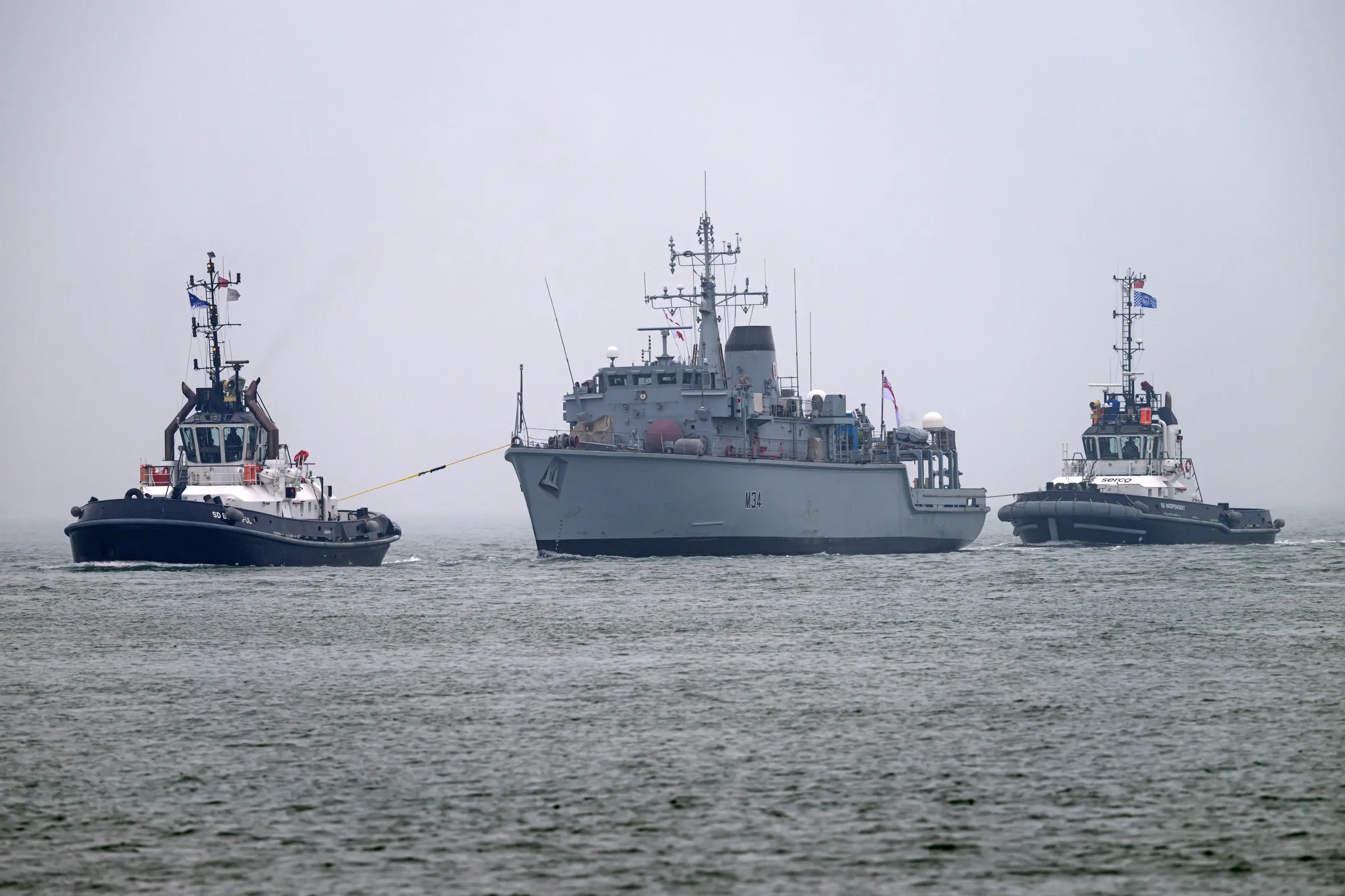
    Battered and unseaworthy, HMS Middleton was dragged by tugs into Portsmouth naval base on Sunday.

    The Hunt class mine countermeasures vessel (MCMV) returned to the home of the Royal Navy on March 8 after being brought back from the Gulf by a heavy-lift ship.

    The ignominious piggy-back was cheaper than letting the more than 40-year-old ship make the 6,200-mile journey back from Bahrain under her own power and freed her crew to join other ships.

    But her return after a journey that took weeks meant the end of the Royal Navy’s anti-mine vessel presence in the Middle East after almost 50 years. Only unmanned drone systems are left, according to the Navy.

Another metaphor, etc.

However, there is a worry that Iran might mine the Strait of Hormuz because it has been a concern — and occasionally a reality — for almost half a century.

March 12, 2026

“It is precisely the embracing of such inconsistency that shows your commitment to the cause”

Filed under: Media, Politics, USA — Tags: , , , , , , — Nicholas @ 05:00

Many, many people have called attention to the incongruity — if not total absurdity — of progressives agitating and protesting for what appear to be thoroughly anti-progressive causes. And all of those people have discovered that most progressives are in accord with Emerson’s opinion that “a foolish consistency is the hobgoblin of little minds”. As Lorenzo Warby explains, “the issue is never the issue; the issue is the revolution”:

There is a common “culture war” sport where more conservatively-minded folk, and various liberal ones, point out how inconsistent it is for various ideological/identity groups to make a thing of supporting organisations and regimes which are very much against — even murderously against — the ideals those ideological/identity groups allegedly stand for.

Queers for Palestine, and feminists for Hamas/Hezbollah/Iran, are particularly blatant examples of this. Hamas in Gaza and the Islamic regime in Iran literally kill homosexuals and violently repress women’s rights: they are religiously committed to women having less rights than men and being subordinate to them.

The inconsistency between who Hamas and the Islamic regime are, what they do, and the alleged ideals of Queers for Palestine and the feminists supporting Hamas/Hezbollah/Iran is obvious. Pointing out such inconsistency has, however, no purchase on Queers for Palestine, feminists for Hamas/Hezbollah/Iran, or similar groups.

On the contrary, pointing out the inconsistency brands one as not merely an outsider, but an enemy. It is precisely the embracing of such inconsistency that shows your commitment to the cause; to the shared political goals; to the shared politicised moralised status games. Doing all the required not-noticing, the required rationalisations, is a signal of commitment.

If they can make people ignore — or, even better, embrace — such inconsistency, that manifests their social and political dominance. The propensity of academics to be “risk averse“, and be conformist in various ways, has enabled motivated zealots to create the Critical Theory magisterium that has come to dominate more and more of Anglo-American academe.

As women are more risk averse and conformist than men, this has gathered steam as academe has feminised. This effect is all the stronger when they generate an accompanying elite status strategy based on “good people believe X”, turning beliefs into moralised cognitive assets. Assets to be defended — and defended together — as shared assets in a shared status game.

By attacking such inconsistency, one is simultaneously signalling one’s outsider status and attacking the signal they are using the show commitment to the cause; to the moral in-group.

As part of such signalling commitment, believers produce commentary shorn of all inconvenient context. We saw plenty of that in commentary blaming NATO and the US for the Russian attack on Ukraine. We are seeing plenty of the same on Iran.

Even more important than this—at least among the core believers — is that, at the foundational belief level, it is not inconsistent at all. The question is not what Hamas or Hezbollah or the Islamic Regime actually stands for: the question is, who they are enemies of.

March 11, 2026

Britain’s reputation in the Near East just cratered

Filed under: Britain, Middle East, Military, USA — Tags: , , , , , — Nicholas @ 03:00

On Substack Notes, Earl explains why the inexplicable delay in getting a Royal Navy warship out to protect Gulf allies from Iranian missiles is having serious negative impact on Britain’s longstanding relations with the targeted nations:

A MASTERCLASS IN MILITARY INCOMPETENCE

The Starmer administration’s handling of the Iranian crisis is being whispered about in the corridors of Whitehall as a historic “cock up” of the highest order. Despite receiving a formal request from the Americans on 11 February — a full 17 days before the offensive actually commenced — the British government appears to have spent that critical window in a state of paralyzed indecision. The U.S. request was not an invitation for Britain to join the initial “decapitation strikes”, but rather a plea for the Royal Navy to help shield vulnerable Gulf allies from the inevitable Iranian retaliation. Instead of stepping up to protect the 240,000 British citizens living in Dubai and Abu Dhabi, the Ministry of Defence oversaw a period of baffling inaction that has left regional partners feeling utterly betrayed.

The diplomatic fallout has been described by insiders as nothing short of catastrophic, with Middle Eastern allies expressing “undiluted fury” at the lack of British support. A former minister with deep ties to Amman reports that Jordan is “fking furious”, while leaders in Kuwait and the Emirates are openly questioning whose side Britain is actually on. The Cypriots are reportedly “incandescent” after learning that military assets were actually withdrawn from their vicinity just as the threat level spiked. Only this week did it emerge that HMS Dragon would finally deploy — nearly three weeks after the initial American SOS — a timeline that military experts say is far too little and far too late to restore trust.

Strategic failures have been compounded by what veteran commanders call a total lack of foresight regarding naval positioning. The only available Astute-class submarine was permitted to continue its journey toward Australia, despite having passed through the Gulf just weeks ago when it could have been held as a vital contingency. Security officials now warn that the Trump administration is viewing the UK’s “free riding” with growing contempt. There is a palpable fear in the MOD that the Americans, tired of London’s dithering, will simply cut Britain out of the loop entirely and strike a direct deal with Mauritius to secure the long-term use of Diego Garcia for future operations.

Inside the government, the situation is being described as “incoherent” and “unconscionable”. By allowing the United States to utilize British bases like RAF Fairford for strikes while simultaneously refusing to participate in the missions themselves, Starmer has managed to achieve the worst of both worlds. Critics say they have invited the risk of being targeted by Tehran without the benefit of having any say in the coalition’s strategic direction. One former defence chief has branded this policy “reprehensible”, arguing that Britain has effectively surrendered its seat at the table in exchange for a front-row seat to its own strategic irrelevance.

The sobering reality in Whitehall is a growing sense that the UK no longer has the capacity to shape events in the Middle East. A former Downing Street adviser noted that the “intensity of Labour’s feelings” on the conflict is now matched only by their lack of influence. Allies have stopped listening because they no longer believe Britain can — or will — deliver on its security promises. As the Trump administration continues its high-tempo campaign to dismantle the IRGC, the United Kingdom finds itself sidelined, watched with suspicion by its friends and emboldened by its enemies, all due to a fortnight of inexcusable hesitation.

On March 9th, The Guardian reported that HMS Dragon will sail “in the next couple of days”, heading to Cyprus to take over duties from French, Greek and Spanish ships in providing missile defence to the British air base at Akrotiri. YouTube channel Navy Lookout posted footage of HMS Dragon leaving Portsmouth here.

CDR Salamander looks back at the naval “special relationship” that appears more and more to be just a fading memory:

We need to stop pretending we have a Royal Navy we knew in our youth or even that of two decades ago. No, we have something altogether different. Something shrunken. Something weaker. Something that is, in the end, really sad. A symptom of a nation who has lost an enthusiasm for herself or even an understanding of her national interest and led by a ruling class that seems uninterested in stewardship.

The state of the Royal Navy — a condition that took decades of neglect to manifest into its form today and will take decades to repair if there is ever the will to do so — has become, as navies can often do, a symbol of the state of the nation it serves.

There is a lesson here, not just for the United States, but all nations who consider themselves a naval power.

If you fail over and over to properly fund, develop, train, and support your navy, you can coast for quite awhile on the inertia of the hard work and investment of prior generations, but eventually that exhausts itself, and you are left with the husk of your own creation.

Yes, I’m looking at you, DC.

March 10, 2026

Iran in the news

Filed under: Media, Middle East, Military, Politics, USA — Tags: , , , , — Nicholas @ 04:00

As I mentioned last time, as I don’t try to stay on top of the “breaking news” cycle, I’m not feverishly refreshing all my social media feeds to get the latest dope about the latest confict with the Islamic State. It’s not that I don’t care, but that as with all modern wars the ratio of signal to noise renders almost all of it worthless for finding out what’s actually happening. At Postcards from Barsoom, John Carter tries to gather his thoughts on the issue, subject to the same kind of informational constraints:

When I sit down to write, I usually have some idea of what I want to say – not only a topic I want to address, but a specific message I want to communicate. This is not going to be one of those essays. My feelings on the war on Iran are conflicted, to say the least. Nor do I feel that I understand enough about what’s happening to say much of substance. Nevertheless, on a matter that is of such potentially world-shaking import, I owe it to you not to be silent. So I’m setting out here to try and organize my thoughts on the matter. Whether they come to some conclusion or not, I have no idea. If nothing else, perhaps this will serve as a jumping off point for further discussion in the comments. Many of you, I’m sure, will have strong opinions on the subject, and many will also possess insights that I do not.

Will this war be of world-shaking import? That is perhaps the core of the matter. If it is not, and the principle of Nothing Ever Happens holds, then bombing Iran will not actually matter that much. A month from now, or even a couple weeks, the bombardment will fade back into the news cycle, the storm and fury of a million passionately articulated hot takes fading back into the warm, frothing ocean of discourse.

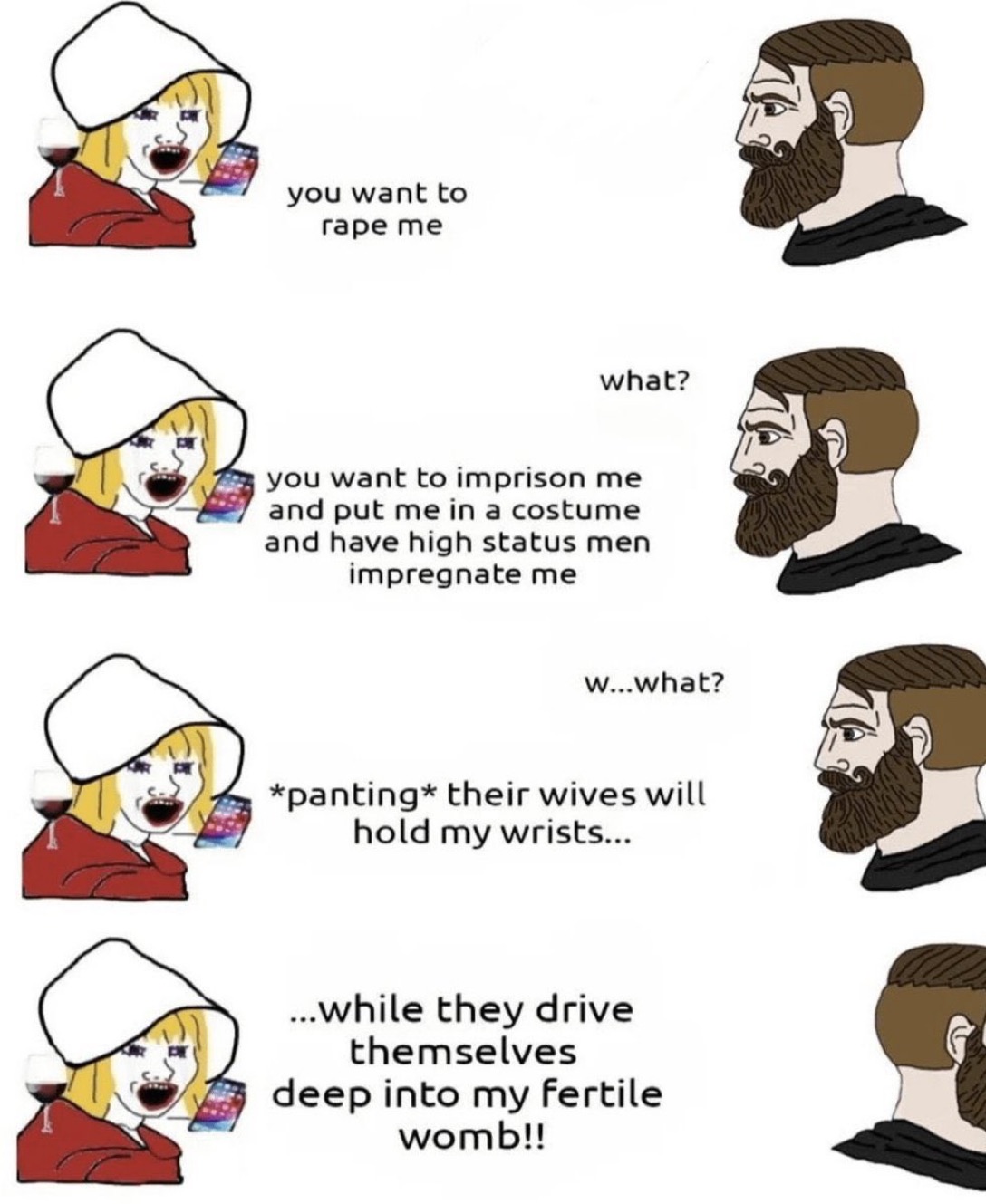
Certainly this has happened before. Trump has bombed Iran’s nuclear research facilities a few months ago, and assassinated the Iranian Revolutionary Guard Commander Qasem Soleimani a few years ago. Every time this kind of thing happens there are panicked shouts that thermonuclear Ragnarok is imminent, alongside outraged cries that Zion Don has betrayed MAGA by engaging in precisely the foreign interventionism that he repudiated, that he has been captured by the Neocohens, and that We Will Not Die For Israel. In each case, nothing much happened. Iran raised the red flag of revenge, or the gold flag of implacable annihilation, or the black flag of this time we really mean it, all of which amounted in practice to a few rockets being fired ineffectually in Israel’s general direction, to be absorbed by an Iron Dome that really seems to work quite well. There was no World War III. There were no boots on the ground. As I saw someone observe recently, We Will Not Die For Israel has become the groyper version of the Handmaid’s Tale: no one is actually asking anyone to die for Israel; there are no imminent plans for mass conscription; therefore protestations that one will resist a non-existent draft amount to the same kind of lurid masturbatory fantasy as declarations that one would never, pant, allow oneself to be confined in a harem, pant pant, and turned into, pant pant pant, breeding stock.

Brief pause for meme:

And back to John Carter:

Maybe that will change. Maybe a year from now I’ll be ruefully eating those words, as American boys are being shipped off by their hundreds of thousands to run around blinded by Russian electronic countermeasures in the cold mountain passes of the Zagros, getting picked off by snipers and shredded by Chinese drones.

But I doubt it.

Modern warfare doesn’t have much use for conscript armies. That lesson was learned in Vietnam: conscripts generally have poor morale, they aren’t highly motivated, they aren’t usually of the highest quality, and so they are of limited usefulness on the battlefield. Soldiers are highly trained professionals who have chosen the military as a career. That makes them much less likely to mutiny. Moreover, modern warfare is highly technical: soldiers have to be extremely well trained to be any use at all. The young men who volunteer for military service usually do so with some hope of adventure and even danger. As such, they often positively look forward to war.

None of this should be taken to imply that Israel hasn’t played a massive role in orchestrating and precipitating this war. They clearly have. Marco Rubio let this slip when he admitted that part of the reason the US attacked when they did was that Israel had signalled that they were going to attack with or without America’s blessing or assistance; since Iran would certainly direct some of its retaliation against the Little Satan towards the regional assets of the Great Satan, America’s hand was forced. This is a bit like when your shithead friend has had one Jameson’s too many and you sit down next to him at the bar only to find that he’s about to throw hands at some asshole you’ve never met: you’re liable to take a punch to the nose no matter what you do, so you might as well have your friend’s back. You can call him a shithead later.

Israel’s involvement goes much deeper than this, of course. Zionism’s penetration of American conservatism is hardly a secret. There are Dispensationalists all over the Republican party, including the Secretary of War Peter Hegseth, and probably Marco Rubio (though technically he’s a Catholic). Republicans who shrug off open anti-white bigotry systematically directed against America’s core population in essentially all of its universities react with fury to campus anti-Semitism, threatening to withhold funding from any institutions that tolerate hurt Jewish feelings. Then of course there’s the big guy himself. Trump has never been much of a Christian, still less an evangelical ZioChristian, but he seems to have undergone something of a religious awakening after divine intervention saved his life in Butler, Pennsylvania. And who can blame him? It certainly doesn’t seem implausible that since then, Trump has been influenced by Zionists who have convinced him that G-d saved him so that he could save America and, more importantly, G-d’s Chosen People. “You are the second coming of Cyrus the Great” would be an appealing narrative to a man with a vast ego. It would be even more appealing given the political and economic support it would come with. Certainly there would be no shortage of avenues for approach: Trump’s daughter is married into the tribe, after all.

March 6, 2026

Congress shrugs responsibility for declarations of war, as Trump expected

As many have noted, the President of the United States does not have the constitutional power to declare war, as that is explicitly assigned to the rights of Congress. But in this, as in many other areas, Congress is unlikely to interfere once a President has set the military machine in motion. It is convenient for both the sitting President and for the individual members of Congress, who can posture and speechify against or in favour, but won’t actually be held responsible by the voters regardless of the war’s outcome. President Trump’s use of trade war tactics against allies and enemies alike is also an area where Congress is apparently willing to turn a blind eye:

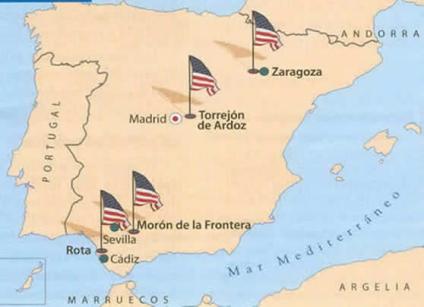
US military bases in Spain (Map from sutori.com)

No Spain, no gain? It was probably inevitable that President Donald Trump’s trade war would eventually get mixed up in his actual war.

Earlier this week, Spanish officials said they would prohibit American forces from using joint bases for war operations, unless those activities were covered by the United Nations Charter. Spanish Prime Minister Pedro Sánchez said his country would not “be complicit in something that is bad for the world”, the Associated Press reports.

On Tuesday, Trump declared that he intended to “cut off all trade with Spain”.

You might wonder: What legal authority does Trump have to unilaterally impose these sorts of revenge tariffs? After all, the Supreme Court ruled not that long ago that the authority Trump had been using to unilaterally impose tariffs based on his whims was unconstitutional. You might as well ask: On what legal authority did Trump launch a war against Iran? In theory, under the Constitution, Congress is supposed to authorize both tariffs and wars. In practice, they, uh, don’t.

Trump just does things, and the annoying constitutional worrywarts can figure it out later. (I say this as an annoying constitutional worrywart.)

In any case, yesterday, the Trump administration announced that Spain had changed its tune. “The U.S. military is coordinating with their counterparts in Spain”, White House Press press secretary Karoline Leavitt said. The implication was that the tariff threats had worked.

Spain, however, said otherwise. “I can refute (the White House spokesperson)”, Spanish Foreign Minister José Manuel Albares said. “The position of the Spanish government regarding the war in the Middle East, the bombing of Iran and the use of our bases has not changed one iota.” Maybe those tariff threats aren’t as effective as Trump thinks?

In a speech, Sánchez warned that the war could spin out of control. “Nobody knows for sure what will happen now”, he said. “Even the objectives of those who launched the first attack are unclear. But we must be prepared, as the proponents say, for the possibility that this will be a long war, with numerous casualties and, therefore, with serious economic consequences on a global scale.”

Sánchez also implicitly admonished Trump for escalating the war: “You can’t respond to one illegality with another because that’s how humanity’s great disasters begin”.

I will just note that in the Star Wars prequels, the fall of the Republic, and the descent into darkness and imperial rule, began with a planetary blockade and a trade war. At the time, people said it was wonky and boring. But here we are.

Where is Congress? The Constitution was built around the idea that each branch would fight to preserve its own powers, and this would create a system of checks and balances. But in Trump’s second term, Republicans in the legislature have been actively fighting to not preserve their power.

Yesterday, in a 47–53 vote, Senate Republicans voted against a resolution that would have required Trump to ask Congress to sign off on any further military aggression in Iran. Sen. Rand Paul (R–Ky.) voted with Democrats in favor of the measure; Sen. John Fetterman (D–Pa.) joined Republicans to vote against it.

The measure was mostly symbolic. Even a successful vote would have been subject to a House vote and a presidential veto. And the position of both the White House and the GOP Speaker of the House is that this whole situation in which America is spending billions of dollars dropping thousands and thousands of bombs on military and political targets in a foreign country is not, in fact, a war. Nothing to see here. Everyone in Congress can go home and crack open a beer.

March 5, 2026

“[I]nternational law is not law; it is a set of rules and claims that pretends to be law”

Filed under: Government, Law, Middle East, Military, USA — Tags: , , , — Nicholas @ 05:00

Lorenzo Warby discusses the charming illusion that “international law” is a real thing and must be treated as a real thing:

In domestic (“municipal”) law, questions of illegality arise. They arise because states have laws. They have laws because their laws come with remedies — consequences for breaking the law.

So, it is a genuine question whether President Trump is exceeding his constitutional authority in his attack on Iran. But that is a genuine question because the US has a Constitution that matters. The US is a rule-of-law state, no matter how much other common law jurisdictions may point and laugh at how politicised US law is.

Nimitz-class aircraft carrier USS Abraham Lincoln (CVN 72), Arleigh Burke-class guided-missile destroyers USS Michael Murphy (DDG 112) and USS Frank E. Petersen Jr. (DDG 121), Henry J. Kaiser-class fleet replenishment oiler USNS Henry J. Kaiser (T-AO-187), Lewis and Clark-class dry cargo ship USNS Carl Brashear (T-AKE 7) and U.S. Coast Guard Sentinel-class fast-response cutters USCG Robert Goldman (WPC-1142) and USCGC Clarence Sutphin. Jr. (WPC-1147) sail in formation in the Arabian Sea, Feb. 6, 2026. The Abraham Lincoln Carrier Strike Group is deployed to the U.S. 5th Fleet area of operations to support maritime security and stability in the Middle East.
U.S. Navy photo by Mass Communication Specialist 1st Class Jesse Monford via Wikimedia Commons.

In terms of the international order, however, there is no such thing as an illegal war, because (public) international law is not law. It is a set of rules and claims that pretends to be law. It only pretends to be law as it has no remedies — apart from declarative statements, which are not enough to make it law. (Private international law does have enforceable and enforced remedies, so is law.)

One of the consequences of this is that (public) international law, as an academic discipline, has no substantive reality-tests. There are no decisions by judges that are enforceable and enforced. This has led to academic international law being the vector by which the toxic ideas of the Critical Theory magisterium, that increasingly dominates Anglo-American universities, have infected Law Schools.

(Public) International law should not be taught at Law Schools, because it is not law. It should be taught in International Relations or Political Science Departments. A PhD in International Law should not qualify you to teach in Law Schools. Indeed, if you cannot tell the difference between actual law — with genuine remedies — and a simulacrum of law, you should not be teaching students at all.

Rules-based international order

When folk refer to the rules-based international order, they are not referring to nothing. There are various rules and conventions it is convenient for states, and other agents, to follow.

There is also a difference between the mercantile maritime order and continental anarchy. It is not an accident that the original international conventions pertained to sea travel and trade.

Within continental anarchy, it is relative power that matters. A war that depletes your resources and capacities, but depletes those of your neighbours more, is a winning proposition, within the state-geopolitics of continental anarchy. The geopolitics of continental anarchy leads states to seek weak or subordinate neighbours. The mercantile maritime order, on the other hand, is all about creating win-win interactions.

Russia, India and China are all continental Powers that live, at least to some extent, in a situation of continental anarchy. But they are also trading States that benefit from the mercantile maritime order maintained by the US-and-allies maritime hegemony. The tension between China as a trading nation becoming the biggest single beneficiary of the mercantile maritime order maintained by the US-and-allies maritime hegemony, and the interests of the CCP (the Chinese Communist Party), is the central strategic difficulty that CCP China faces.

Israel faces the strategic dilemma of operating in a region of continental anarchy but seeking support from states deeply embedded in the mercantile maritime order. Whether the Middle East has to be a region of continental anarchy, or can it become far more embedded in the mercantile maritime order, is precisely what is at stake in the latest conflict.

Any social order has to be enforced. This is even more true of international orders. As there is no such thing as international (public) law, enforcing an international order is not a matter of rules, it is a matter of those who actively support and enforce that order and those who seek to subvert it.

A vivid example of how central enforceability is to any international order is given by comparing the treatment of Germany after the two World Wars. Germany was treated far more harshly after the Second World War than after the First World War. The crucial difference was that the Versailles order was not enforceable by the victors and the Potsdam order was.

Update, 6 March: Welcome, Instapundit readers! Have a look around at some of my other posts you may find of interest. I send out a daily summary of posts here through my Substackhttps://substack.com/@nicholasrusson that you can subscribe to if you’d like to be informed of new posts in the future.

March 3, 2026

Iran in the news

Filed under: Media, Middle East, Military, USA — Tags: , , , , , , — Nicholas @ 04:00

I haven’t bothered trying to keep up with the firehose of “news” about the combined US/Israeli operations against the Islamic State, as much of what is initially reported will be re-stated, retracted, refuted, and other words starting with “R” until something vaguely resembling objective analysis can be done. There are uncounted mainstream, specialist, and advocacy sites and there’s no point trying to keep up with them (for me, anyway). Here are a few bits of internet flotsam on issues arising from Operation Brass Balls (or whatever name they chose for it):

First up, J.D. Tuccille on the legality around President Trump’s decision to strike Iran:

The BBC has a long history of … careful wording in describing events in Iran since 1979. I don’t think this cartoon is unfair in portraying that.

The world is undoubtedly a better place after the killing of Iran’s supreme leader Ayatollah Ali Khamenei and roughly 40 of his murderous colleagues by joint Israeli and American military strikes. Iran’s Islamist regime has slaughtered its own people while encouraging terrorism around the world for decades. But those strikes carry serious risks and costs. Are they worth the tradeoffs? The Trump administration should have made its case to Congress and the already skeptical public and satisfied the Constitution’s requirements by doing so.

War Without Debate

On Saturday, the U.S. and Israel launched much-anticipated strikes after claiming negotiations with the Iranian regime over the status of its nuclear weapons program had stalled.

“A short time ago, the United States military began major combat operations in Iran,” President Donald Trump announced. “Our objective is to defend the American people by eliminating imminent threats from the Iranian regime — a vicious group of very hard, terrible people. Its menacing activities directly endanger the United States, our troops, our bases overseas, and our allies throughout the world. For 47 years the Iranian regime has chanted ‘death to America’ and waged an unending campaign of bloodshed and mass murder, targeting the United States, our troops, and the innocent people in many, many countries.”

True enough. The president recited a litany of crimes in which the Islamist regime has been implicated, including the 1983 bombing of the U.S. Marine barracks in Beirut by Iranian proxy Hezbollah, and the October 7, 2023, Hamas attack on Israel, which Iranian forces helped plan. To this list we can add the attempted assassinations of Iranian dissident Masih Alinejad in Brooklyn and of then-presidential candidate Trump himself. Trump also called out Iran’s efforts to acquire nuclear weapons. And he urged the suffering Iranian people, who have weathered brutal attempts to suppress protests, to take advantage of the military strikes to overthrow the regime.

Unfortunately, this was the first time many Americans — members of the public and lawmakers alike — heard the Trump administration make a somewhat coherent argument for taking on Iran’s government. It came as strikes were already underway despite the Constitution reserving to Congress the responsibility to “provide for the common Defence”, “to declare War”, “to raise and support Armies”, and “to provide and maintain a Navy”. Lawmakers were informed of the attack on Iran, but only after the country was committed to hostilities and their related dangers and expense.

Congress and the People Were Never Consulted

“I am opposed to this War,” Rep. Thomas Massie (R–Ky.) objected. “This is not ‘America First’. When Congress reconvenes, I will work with @RepRoKhanna to force a Congressional vote on war with Iran. The Constitution requires a vote, and your Representative needs to be on record as opposing or supporting this war.”

Rep. Ro Khanna (D–Calif.) shares Massie’s skepticism towards military action. He and Massie might have voted against authorizing war with Iran even if they’d heard the administration’s arguments. Or perhaps they and other lawmakers would have been persuaded. We don’t know, because the president didn’t make a case until bombs and missiles had already been launched.

Andrew Doyle on the need for regime change:

The end point of armed conflict is impossible to predict. In her book On Violence (1970), the philosopher Hannah Arendt argued that when it comes to political violence, “the means used to achieve political goals are more often than not of greater relevance to the future world than the intended goals”. However well planned and executed, wars have a tendency to spiral out of control in ways never envisaged.

Whether Donald Trump’s decision to attack Iran will pay off depends upon the fates as much as anything else. The goal is regime change, which – given the appalling tyranny under which the Iranian people have suffered for five decades – is admirable and just. Yet the numerous unknown variables make this war the biggest risk that Trump has yet taken as president.

This war has the potential to escalate and engulf the entire region. Iran is already striking neighbouring Arab states allied with the US in a scattershot and desperate manner. With the death of the Ayatollah, it may be that the regime will be forced into a ceasefire while it seeks to re-establish its power. Yet the scenes of wild celebration on the streets of Iran would suggest that domestic revolution is its greatest threat. If the Islamic Revolutionary Guard Corps (not the country’s national army, but a kind of Praetorian guard for the mullahs) can be turned, the regime will fall.

Perhaps the worst case scenario is a widespread power struggle between competing militias and separatist groups. The IRGC itself could fragment, and we may see the kind of chaos that ensued after the Iraq war of 2003. The Trump administration has the advantage of the latest military technology and will insist that this enterprise will never require “boots on the ground”. It may be right, but who knows what factions will emerge with no centralised authority?

Those of us without a crystal ball should get used to the phrase: “we don’t know”. Various social media pundits are asserting with absolute certainty where all of this will lead. They would be wise to exercise greater caution. After the Twelve-Day War last June in which Israel and the US destroyed much of Iran’s nuclear infrastructure and air defence capabilities, many on the “America First” right were quick to prophesy the advent of World War III. Their claims to clairvoyance were unfounded.

CDR Salamander argues in favour of the punitive expedition as a legitimate tool in the nation’s war locker:

I support the strikes on Iran because it firmly fits into a view I have held on the use of national military power for decades, based on thousands of years of military practice. If you are not up to speed with the thousands of Americans dead and maimed by the Islamic Republic and its proxies over the last 47 years, then I have nothing more to discuss with you.

While I understand the academic argument of many that before any action takes place, there is a whole series of hoops, barriers, and puzzles of our own creation that we need to go through — I firmly believe that not only are those Constitutionally unnecessary for punitive expeditions in 2026, if done, needed and deserved strikes like we have seen in Iran could not take place without

Fortunes were made, institutions funded, and employment justified for legions under the old and failed post-WWII process swamp and GWOT nomenklatura that gave us unending and stillborn conflicts. To go that route again wouldn’t just be folly, it would be a self-destructive folly to refuse to change in the face of evidence.

I’ve seen older versions of OPLANS for Iran. Huge, bloody, and frankly undoable. They were only that way because they met the requirements of an old system that everyone nodded their heads to because all the smart people from Johns Hopkins, Harvard, Princeton and all the usual places said we had to do it this way.

Enough. Bollocks to all that. They have been measured the last quarter century and have been found wanting.

A series of events since October 7, 2023, including the 2024 election, has opened a window to do what we have not been able to do for a whole host of reasons — and there is a debt waiting to be paid.

We’ve been here before with Iran. In the modern context, we sank two warships and three speedboats of the Islamic Republic of Iran Navy in 1988 during Operation Praying Mantis as punishment for damaging USS Samuel B. Roberts (FFG 58) and Iran’s mining international waters in the Persian Gulf. We’ve played slap-n-tickle with them here and there while they have brutalized us at every turn when they are not brutalizing their own people.

Yes, it’s personal — but part of the reason we have been hesitant is that our national security intellectuals have been stuck in a world view that prevented action, by design.

Though not exclusive, the Powell Doctrine’s “Pottery Barn Rule” (that it appears he got from one of Thomas Frack’n Friedman’s columns), made it appear that we could only take action if we took the entire country and then remade it in our image.

We know how that operationalized over the last couple of decades.

We’ve done plenty of punitive expeditions in our nation’s history — but in the last few decades as a certain pedigree of policy maker held sway over our national security doctrine, it fell out of favor.

They failed the nation. Their institutions failed the nation. Their worldview was little more than a self-licking ice cream cone of self-regard.

There are also those who can find the funny aspects of any serious situation:

January 11, 2026

Iran in the news

Filed under: Media, Middle East, Politics, Religion — Tags: , , , , , — Nicholas @ 03:00

There’s a major upheaval going on in Iran, but the western media seem to be incapable of covering it with any depth — or in far too many cases, at all — even though it’s exactly the sort of thing they used to be very interested in. On the social media site formerly known as Twitter, Tahmineh Dehbozorgi provides useful context:

The Western liberal media is ignoring the Iranian uprising because explaining it would force an admission it is desperate to avoid: the Iranian people are rebelling against Islam itself, and that fact shatters the moral framework through which these institutions understand the world.

Ideally, to cover an uprising is not just to show crowds and slogans. It requires answering a basic question: why are people risking death? In Iran, the answer is simple and unavoidable. The people are rising up because the Islamic Republic of Iran has spent decades suffocating every aspect of life — speech, work, family, art, women, and economic survival — under a clerical system that treats liberty as a crime. There is no way to tell that story without confronting the nature of the regime.

Western media refuses to do so because it has fundamentally misunderstood Islam. Or worse, it has chosen not to understand it.

Islam, in Western progressive discourse, has been racialized. It is treated not as a belief system or a political ideology, but as a stand-in for race or ethnicity. Criticizing Islam is framed as an attack on “brown people”, Arabs, or “the Middle East”, as if Islam were a skin color rather than a doctrine.

This confusion is rooted in historical illiteracy. Western liberal media routinely collapses entire civilizations into a single stereotype: “all Middle Easterners are Arabs”, “all Arabs are Muslim”, and “all Muslims are a monolithic, oppressed identity group by white European colonizers”. Iranians disappear entirely in this framework. Their language, history, and culture — Persian, not Arab; ancient, not colonial; distinct, not interchangeable — are erased.

By treating Islam as a racial identity rather than an ideology, Western media strips millions of people of their ability to reject it. Iranian protesters become unintelligible. Their rebellion cannot be processed without breaking the rule that Islam must not be criticized. So instead of listening to Iranians, the media speaks over them — or ignores them entirely.

There is another reason the Iranian uprising is so threatening to Western media is economic issues.

As you know, Iran is not only a religious dictatorship. It is a centrally controlled, state-dominated economy where markets are strangled, private enterprise is criminalized or co-opted, and economic survival depends on proximity to political power. Decades of price controls, subsidies, nationalization, and bureaucratic micromanagement have obliterated the middle class and entrenched corruption as the only functional system. The result is not equality or justice. It is poverty, stagnation, and dependence on government’s dark void of empty promises.

Covering Iran honestly would require acknowledging that these policies are harmful. They have been tried. They have failed. Catastrophically.

This is deeply inconvenient for Western media institutions that routinely promote expansive state control, centralized economic planning, and technocratic governance as morally enlightened alternatives to liberal capitalism. Iran demonstrates where such systems lead when insulated from accountability and enforced by ideology. It shows that when the state controls livelihoods, non-conformity becomes existentially dangerous. That lesson cannot be acknowledged without undermining the moral authority of those who advocate similar ideas in softer language.

Western liberal media prefers not to hear this. Acknowledging it would require abandoning the lazy moral categories that dominate modern discourse: oppressor and oppressed, colonizer and colonized, white and non-white. Iranian protesters do not fit. They show that authoritarianism is not a Western invention imposed from outside, but something many societies are actively trying to escape.

That is what terrifies Western liberal media. And that is why the Iranian people are being ignored.

So the silence continues.

John Cleese:

On Substack Notes, Fergus Mason shares what might be the most iconic photo of the young year:

Update, 12 January: Welcome, Instapundit readers! Have a look around at some of my other posts you may find of interest. I send out a daily summary of posts here through my Substackhttps://substack.com/@nicholasrusson that you can subscribe to if you’d like to be informed of new posts in the future.

Older Posts »

Powered by WordPress