
There’s a story that the Bush administration came into office in 2001 itching to get rid of Saddam Hussein and looking around for a pretext. Near as I can tell, this is totally false — actually, the entire US government had been looking for a pretext since at least a decade earlier than that. It all goes back to 1990 and the Iraqi invasion of Kuwait. Prior to that, Iraq was an American ally and proxy that helped contain the revolutionary regime in Iran. That relationship gave Saddam a long leash and meant he could get away with a tremendous amount. But the leash was not as long as Saddam thought, and he badly overstepped his limits when a diplomatic fight with Kuwait over the terms of some war loans escalated into a military confrontation. Improvisational decision-making was not out of character for Saddam, who had a tendency to do things like go alone into one of his many palaces and emerge wild-eyed the next day declaring that he had a prophetic dream which would henceforth guide state policy. But this time he got into some real trouble.
The Americans kicked Iraq out of Kuwait quickly and easily, and then … hesitated about what to do next. Nobody wanted to keep Saddam around (remarkably, when you have outlived your usefulness, people suddenly start to notice all of your human rights abuses), but nobody wanted to march into Baghdad and topple him either. There was some wishful thinking that the Kuwait defeat would cause Saddam’s regime to collapse, but most US foreign policy thinkers just shrugged their shoulders and figured better Saddam than chaos and a Vietnam-style quagmire. One especially perceptive official put it this way to a PBS journalist:
I felt there was a real danger here that you could get bogged down in a long drawn out conflict … and then you’ve got to worry about what comes after. And then you have to accept the responsibility for what happens in Iraq, accept more responsibility for what happens in the region. It would have been an all-US operation, I don’t think any of our allies would have been with us, maybe Britain, but nobody else. And you’re going to take a lot more American casualties if you’re gonna go much around in Iraq for weeks on end trying to run Saddam Hussein to ground and capture Baghdad and so forth and I don’t think it would have been worth it.
That official’s name was Dick Cheney.
So Saddam was left in place, and throughout the ’90s American policymakers seethed about it. There was no official policy that said we were going to overthrow him, but prominent politicians like Al Gore were out there writing op-eds saying that Saddam must be toppled and his government dismantled. This produced what Mazarr calls “destructive ambiguity” — everybody knew that everybody else knew that the real policy was to get rid of the guy, but since this was an unofficial position it went through none of the usual policymaking channels and was never formally debated. It also left a lot of room for freelancing.
For example, CIA clandestine operative Bob Baer (whose memoir is a terrifically fun read, by the way) began organizing a coup in 1995, not because he was directly ordered to do so but because he thought it was what his supervisors wanted. Even the strategy of the coup points towards this ambiguity — rather than straightforwardly overthrowing the government, it aimed to spark a rebellion that would gain some momentum but not enough to win, so that when Saddam moved to crush it the US would be pulled in and forced to act.1 Think for a moment about what an odd plan this is, and how it only makes sense if you believe the US secretly wants to invade while officially pretending not to.
The leader of this rebellion was supposed to be Ahmed Chalabi, one of the more fascinating characters in this story. Chalabi was a dapper, cosmopolitan, and erudite bank manager who got exiled from Iraq for gross financial corruption. He promptly reinvented himself as a freedom fighter, rented beautiful houses stocked with fine art in several major cities, and set about ingratiating himself with Western elites. He also began organizing his fellow emigrés and exiles into an effective political lobbying force. Unsurprisingly given his educated and aristocratic manner, he was extremely good at the lobbying part, and soon placed a special focus on the United States, wining and dining congressmen and writing op-eds for major newspapers. Soon he managed to convince the CIA that there were thousands of resistance fighters back in Iraq ready to follow him into battle.
He was good at convincing, but they also wanted to be convinced. Chalabi and his fellow emigrés were charming, cultured, westernized intellectuals who at least pretended to be pro-democracy. It was oh-so-tempting to believe that everybody in Iraq was like that, when in fact they were completely unrepresentative. As a rule of thumb, when a country has a revolution or a civil war or other social breakdown, the ones who make it out are the ones bright enough to see it coming and rich or well-connected enough to escape. Whether it’s the Russian Revolution, the Lebanese Civil War, or whatever you call what’s happening in South Africa, the people who leave are not a random subset — they’re the creme-de-la-creme. Unfortunately the US government somehow couldn’t figure this out in the case of Iraq. They met the emigrés, and were impressed by them, and decided that Iraq really was a civilized and cosmopolitan place under the surface, when in fact the society that created the emigrés had been destroyed decades earlier.
The emigrés represent one pole of the Baptists-and-bootleggers coalition that emerged in the ’90s to advocate for the overthrow of Saddam’s regime. The other is exemplified by Paul Wolfowitz, a soft-spoken academic who bounced between senior government positions and jobs at think tanks. Wolfowitz was a humanitarian in the most sincere sense. Much of his extended family had been killed in the Holocaust. The plight of oppressed peoples was not an abstraction for him, and he dedicated his life and career to the proposition that the United States should use all available means to end tyranny and oppression wherever they existed.
Wolfowitz is commonly described as a fanatical neoconservative, and he is, but I think it’s important to demystify that term. Too often it gets used as a catchall for “people we don’t like”, but at least when it comes to foreign policy the neoconservatives fit squarely within the American mainstream. With the notable exception of Donald Trump, every American president of the past few decades has had essentially the same foreign policy, driven by essentially the same core ideas: (1) Americans are the good guys, (2) it’s the job of the good guys to right wrongs wherever they are happening, (3) freedom and democracy are the non-negotiable inheritance of everybody on planet earth. These ideas drive the neoconservatives, yes, but they also drive Samantha Power and Susan Rice, not to mention Hillary Clinton and Barack Obama.
If you are an American, it may not be apparent to you how weird these ideas seem to the rest of the world. If I were to characterize how previous empires — and America’s current rivals — think about the world, it would be more like: (1) every country has core interests and peripheral interests, (2) you should not interfere in another country’s core interests if you can help it, (3) different peoples and cultures are adapted to different forms of government, and this diversity makes life spicy and interesting. Perhaps most shocking to Americans: most countries do not self-identify as “the good guys”, instead they think of themselves as a people with a history and a set of territorial claims.2
Mazarr describes this peculiar American quality as “the missionary impulse”, and notes that while it comes from a well-intentioned place, it “can produce a theological and absolutist conception of America’s responsibility as well as a romantic conviction that America can renovate other societies at will”. Or, to put it in blunter words, it makes us do insane things like invade and occupy a culturally alien country on the other side of the world, and stand there in blinkered incomprehension when people don’t like it. Perhaps the most damning thing about this missionary impulse is the way it provides a self-excusing justification for recklessness: since America is definitionally the good guys, all the horrible consequences of America’s dumb decisions must be somebody else’s fault, and anyway we meant well so you can’t really blame us.3 It’s like a speeding driver who hits and kills pedestrians over and over again, and when confronted gets huffy and points out he’s on his way to feed people at a soup kitchen.
Why is our national character like this? It’s one of those eternal questions. Maybe it’s because we were settled by various strains of fanatical Protestants, or because our ethnos was born during the Enlightenment, or some other “genetic” factor. Alternatively, it could be something about our historical development, or perhaps the large oceans that have always insulated us from most of the negative consequences of our decisions. Or maybe it’s just inevitable that whoever the current world empire is will feel this way, a consequence of our “unipolar moment”.4 Whatever the cause, it’s been a frequent source of misunderstanding between American and foreign diplomats, and few more so than Iraq’s.
The inability of the Iraqi regime, and of Saddam Hussein in particular, to “get” America or its motivations is a recurring bit of comic relief in Mazarr’s book, and one of the first big episodes of it occurs here in the mid ‘90s. This was the time when the Iraqis completely shut down their WMD programs and destroyed every trace of them. But even while halting their nuclear, chemical and biological weapons projects, they continued to loudly insist that they were operational. This appears to have been done out of fear that they would lose prestige if they admitted to backing down. Saddam also really wanted the Iranians to think that he still had chemical weapons out of fear that they’d invade if he didn’t, and he figured that US intelligence would obviously figure out that the programs had been stopped, so they didn’t have to come out and say it themselves.
I remember when I was a kid watching Dr. Strangelove, and laughing at the part where the Soviets built a doomsday device without telling anybody, completely defeating the purpose of having a doomsday device. Then I got older, and learned that no actually, in real life the Soviets built a doomsday device, and then didn’t tell anybody, because they apparently assumed that its psychological effect would be more powerful if America found out about it from its spies (naturally, we didn’t find out until after the Cold War was over). Saddam’s mistake was a weird inverse of this, destroying all his doomsday weapons and then just assuming we’d figure it out. I guess the moral of the story is that in real life, these too-clever-by-half schemes where you double-bluff your opponent are rarely worth it.5
Anyway, Saddam destroyed all of his WMD, and then kicked out the UN inspectors so as to maintain the charade that he still had them. At the same time that all of this was happening, the sanctions regime that the US had imposed was clearly falling apart. European and Asian businessmen were swarming all over Baghdad, trying to get things in place for when foreign investment inevitably flooded back into the country. All of this contributed to an ambient sense that something had to be done; the attempt to kick the can down the road was failing. By the late ’90s, the Clintons had already convinced themselves that a rematch with Saddam was inevitable, but they didn’t have time to act on it before their term was up and a new sheriff rolled into town.
John Psmith, “REVIEW: Leap of Faith, by Michael J. Mazarr”, Mr. and Mrs. Psmith’s Bookshelf, 2025-06-30.
- Yes, this was exactly Strelkov’s strategy in the Ukrainian civil war. And for similar reasons — the Russian government as an official body was dithering and indecisive, but a large faction within it wanted to act.
- My north star here is, as always, my former coworker from Bulgaria.
- Graham Greene did an exquisite job skewering this attitude in his novel The Quiet American. One character says of the titular American: “I never knew a man who had better motives for all the trouble he caused”.
- Did the Romans feel this way? Did the Chinese? I don’t actually know, but I think there’s something distinctive about the American imperial attitude. It really does come down to our belief that we’re bombing you for your own good (or overthrowing your government for your own good, or whatever). My sense is that past hegemons have been a bit more honest.
- Then again, Gaddafi did what Saddam arguably should have done, and look what that got him. I guess the real lesson is just not to make too much trouble until your nukes really work.
August 11, 2026
QotD: The long lead-up to the invasion of Iraq
August 3, 2026
Invasion of Iraq, 2003
Real Time History
Published 6 Mar 2026In March 2003, a US-led coalition invades Iraq. US President George W. Bush claims he must disarm Iraqi dictator Saddam Hussein of weapons of mass destruction and depose a brutal regime supporting global terror. But after a lightning capture of Baghdad and other Iraqi cities in the south, the war is far from over.
(more…)
March 21, 2026
The Complete Chieftain Tank
The Tank Museum
Published 20 Mar 2026Chieftain. The world’s first main battle tank. An icon of the Cold War, it served the British Army for more than 30 years. Yet, it had something of a Jekyll and Hyde reputation. It was prized for having the best gun in the world but, for the British, it never fired a shot in anger. Loved by gunners. Loathed by mechanics. The Chieftain was often referred to as the best tank in the world as long as it broke down in the right place.
But was the gun truly as good as the stats make it out to be? And was the engine really that bad? It’s time to take a dive into the heart of the Iron Triangle to find out.
00:00 | Introduction
00:36 | Gun
03:44 | Engine
06:19 | Armour
11:07 | Just Deserts
13:53 | A Tragic HeroIn this film, join James Donaldson as he delves into the good, the bad, and the ugly sides of the Chieftain tank. With a great gun, revolutionary armour, and a misunderstood engine, Chieftain’s service with the British ensured the Cold War never turned hot. And hear from Chieftain veterans, Bob and Steve, as they share their experiences with this iconic tank.
(more…)
January 15, 2025
Desert Storm: The Gulf War 1990-1991
Real Time History
Published 6 Sept 2024When Saddam Hussein invaded Kuwait in the summer of 1990, he didn’t anticipate a massive international backslash and unanimous Security Council response. Soon a broad military Coalition under leadership of the United States assembled and kicked the Iraqi Army out of Kuwait. In the aftermath several Iraqi groups rose up against Saddam but the Coalition didn’t support a regime change.
CHAPTERS:
00:00 Intro
00:29 Saddam Hussein Victorious (but Broke)
03:49 Iraqi Invasion of Kuwait
06:02 The Coalition Against Iraq Forms
08:37 Operation Desert Shield
10:55 Operation Desert Storm
20:26 Iraqi Highway of Death
21:39 Iraqi Uprisings
(more…)
April 4, 2023
Tank Chats Reloaded | Challenger 1 | The Tank Museum
The Tank Museum
Published 16 Dec 2022In the first episode of Tank Chats Reloaded we hear from Major General Patrick Cordingley who both commanded Challenger 1 during the First Gulf War and was involved in its design. Also introducing our new presenter Chris Copson, host of the new Tank Chats Reloaded series — where we’ll be revisiting old favourites from Tank Chats.
(more…)
October 19, 2020
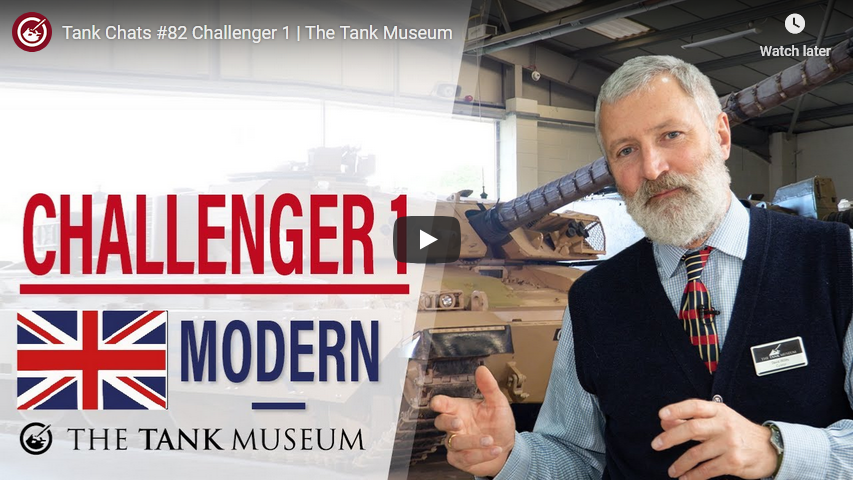
Tank Chats #82 Challenger 1 | The Tank Museum
The Tank Museum
Published 9 Aug 2019David Willey, The Tank Museum Curator, discusses the development and deployment of the UK’s Main Battle Tank from 1983 – 2001, the Challenger 1.
Challenger 1 was in service with the British Army and saw action during the First Gulf War. It remains in service with the Jordanian Army.
Support the work of The Tank Museum on Patreon: ► https://www.patreon.com/tankmuseum
Visit The Tank Museum SHOP: ► https://tankmuseumshop.org/
Twitter: ► https://twitter.com/TankMuseum
Instagram: ► https://www.instagram.com/tankmuseum/
Tiger Tank Blog: ► http://blog.tiger-tank.com/
Tank 100 First World War Centenary Blog: ► http://tank100.com/
November 29, 2019
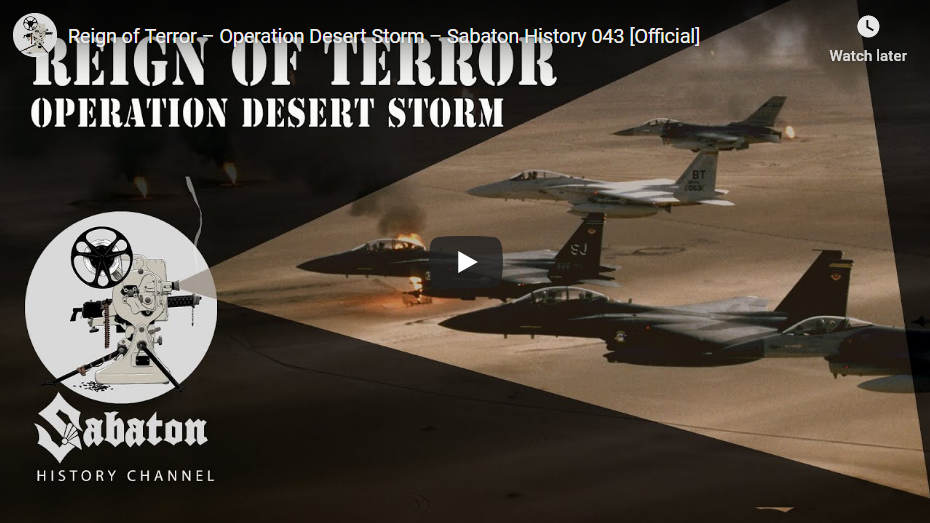
“Reign of Terror” – Operation Desert Storm – Sabaton History 043 [Official]
Sabaton History
Published 28 Nov 2019After Saddam Hussein invaded Kuwait in 1990, most of the whole world gets together to avenge this attack. This will be the basis for Operation Desert Storm — one of the largest battles since the Second World War.
Support Sabaton History on Patreon: https://www.patreon.com/sabatonhistory
Listen to Primo Victoria (where “Reign of Terror” is featured):
CD: http://bit.ly/PrimoVictoriaStore
Spotify: http://bit.ly/PrimoVictoriaSpotify
Apple Music: http://bit.ly/PrimoVictoriaAppleMusic
iTunes: http://bit.ly/PrimoVictoriaiTunes
Amazon: http://bit.ly/PrimoVictoriaAmzn
Google Play: http://bit.ly/PrimoVictoriaGooglePlayListen to Sabaton on Spotify: http://smarturl.it/SabatonSpotify
Official Sabaton Merchandise Shop: http://bit.ly/SabatonOfficialShopHosted by: Indy Neidell
Written by: Markus Linke and Indy Neidell
Directed by: Astrid Deinhard and Wieke Kapteijns
Produced by: Pär Sundström, Astrid Deinhard and Spartacus Olsson
Creative Producer: Joram Appel
Executive Producers: Pär Sundström, Joakim Broden, Tomas Sunmo, Indy Neidell, Astrid Deinhard, and Spartacus Olsson
Post-Production Director: Wieke Kapteijns
Edited by: Iryna Dulka
Sound Editing by: Marek Kaminski
Maps by: Eastory – https://www.youtube.com/c/eastoryArchive by: Reuters/Screenocean https://www.screenocean.com
Music by Sabaton.An OnLion Entertainment GmbH and Raging Beaver Publishing AB co-Production.
© Raging Beaver Publishing AB, 2019 – all rights reserved.
June 5, 2014
Conspiracy theorist’s festival day
Matt Welch on the last few decades that paved the way for a re-expansionist Russia:
On September 10, 1990, U.S. President George Bush and Soviet President Mikhail Gorbachev issued a simple and remarkable joint statement. “We are united in the belief that Iraq’s aggression must not be tolerated,” the former Cold War opponents declared after a seven-hour meeting in Helsinki to discuss Saddam Hussein’s annexation of Kuwait. “No peaceful international order is possible if larger states can devour their smaller neighbors.”
Observers understood immediately the historical significance of two previously antagonistic superpowers agreeing on the principle that countries cannot swallow one another. What was less obvious at the time is that the moment would look like science fiction from the perspective of the future as well.
President Bush — we did not need to differentiate him as “H.W.” back then — was so giddy about the prospects of rules-based global cooperation that on the not-yet-portentous date of September 11, 1990, he gave an unfortunate name to the concept during an address to a joint session of Congress: new world order.
“Most countries share our concern for principle,” he asserted. “A new partnership of nations has begun, and we stand today at a unique and extraordinary moment. The crisis in the Persian Gulf, as grave as it is, also offers a rare opportunity to move toward an historic period of cooperation. Out of these troubled times, our fifth objective — a new world order — can emerge: a new era-freer from the threat of terror, stronger in the pursuit of justice and more secure in the quest for peace. An era in which the nations of the world, east and west, north and south, can prosper and live in harmony. […] A world where the rule of law supplants the rule of the jungle. A world in which nations recognize the shared responsibility for freedom and justice. A world where the strong respect the rights of the weak.”
Because “new world order” sounded creepy and was already a phrase used by conspiracists worried about one-world government, Bush’s larger point got washed away in the ensuing brouhaha. But terminology aside, the creation of an international taboo against subsuming weaker countries was a worthwhile endeavor.
March 3, 2013
Arms merchant’s golden customer: an Arab nation with oil money
Strategy Page explains why some of the most lucrative customers for high-tech weaponry are Arab nations:
Britain has been quite successful selling their new Typhoon fighter to Middle East nations. Two years ago Saudi Arabia bought 72 Typhoons from Britain. That was followed by an order for 12 from Oman and now the UAE (United Arab Emirates) is negotiating the purchase of 60 of these expensive aircraft. This is big money, as the aircraft have a basic price of $65 million each and there are many ways to greatly increase that. For warplanes sold to Arab Gulf states there is an additional bonanza. The biggest additional cost is providing support services and personnel to keep the aircraft operational. The Typhoon manufacturer, BAE Systems, is energetically recruiting qualified maintenance personnel to keep these aircraft flying. This a much larger profit center for Arab customers than for anyone else. Few local Arabs will be recruited for this work and most of these technicians will come from the West. That is very expensive. Why can’t locals be found for these high paying jobs? The reason is simple; there are few Arabs qualified or even interested in such exacting work. This is a common problem in the Middle East.
For example, the unemployment rate in Saudi Arabia is 12 percent and many of those men are unemployed by choice. Not even counted [are] most women, who are barred from most jobs because they are women. Arab men tend to have a very high opinion of themselves, and most jobs available, even to poorly educated young men, do not satisfy. Thus most Saudis prefer a government job, where the work is easy, the pay is good, the title is flattering, and life is boring. Thus 90 percent of employed Saudis work for the government. In the non-government sector of the economy, 90 percent of the jobs are performed by foreigners. These foreigners comprise 27 percent of the Saudi population, mostly to staff all the non-government jobs and actually make the economy work. This means most young Saudi men have few challenges. One might say that many of them are desperate for some test of their worth, but a job in the competitive civilian economy does not do it, nor does the military.
The Saudi employment situation is not unique. The UAE (United Arab Emirates) has foreigners occupying 99 percent of the non-government jobs. The unemployment rate is 23 percent, but only a tenth of those are actually looking for a job. A survey indicated that most of the unemployed are idle by choice. Kuwait is more entrepreneurial, with only 80 percent of the non-government jobs taken by foreigners. The other Gulf Arab states (which have less oil) have a similar situation.
August 25, 2012
From wargaming to war-making
Wargames have been used to plan real wars for more than a century, but in at least one instance, a commercial wargame was a significant planning tool for a real war:
By the end of the Cold War, American military planners had contingencies and plans for just about every conceivable crisis – Latin American counterinsurgencies, confrontations on the Korean Peninsula, a full out Warsaw Pact onslaught against NATO. But on August 2, 1990, when Iraqi tanks surprised the world and rolled into the tiny Persian Gulf nation of Kuwait, decision makers in the Pentagon had virtually no plans on the shelf for the defeating the world’s fourth largest army. Out of desperation, someone in the American military nerve-centre reached for a copy of a hobby store military board game entitled Gulf Strike. Designed in the late 1980s by a subsidiary of the commercial war game company Avalon Hill, Gulf Strike allowed civilian hobbyists to battle through a series of hypothetical wars involving the U.S., Soviet Union, Iraq and Iran on a hexagonal-grid map of the Gulf region. According to a 1994 Military History article on war games by Peter Perla, before lunch on the day of the invasion, the Pentagon had the game’s designer, Mark Herman, on the phone. By mid afternoon, he was on the military’s payroll. And by day’s end, Herman and a group of senior officers had already successfully played out a shorthand version of what in five months would go down in history as Operation Desert Storm.
Of course, the results of wargames can’t predict with great accuracy: the level of abstraction is too high and the “fog of war” quickly introduces far more uncertainty than any simulation can dispell in advance. However, disregarding the data from wargaming a battle or campaign has resulted in disaster at least once: the Japanese navy wargamed the attack on Midway Island in 1942. the wargame showed that the Japanese would lose at least one aircraft carrier from the attacking forces. The admirals, suffering as a group from what was known as “victory disease”, disregarded the game result and ordered the sunken ship “refloated” and the exercise continued.
In the real world, of course, the IJN lost not one but four aircraft carriers and the majority of their combat-trained pilots and crew. It was the turning point of the war in the Pacific.
June 5, 2011
Surely this “cure” is worse than the “disease”?
John Perry Barlow retweeted a link to this Kuwait Times post:
A female political activist and former parliamentary candidate has recommended the introduction of legislation to legalize the provision of enslaved female concubines for Muslim men in Kuwait in a bid, she says, to protect those men from committing adultery or corruption.
The activist, Salwa Al-Mutairi, suggested apparently seriously in a video broadcast online that she had been informed by some clerics that affluent Muslim men who fear being seduced or tempted into immoral behavior by the beauty of their female servants, or even of those servants ‘casting spells’ on them, would be better to purchase women from an ‘enslaved maid’ agency for sexual purposes.
She suggested that special offices could be set up to provide concubines in the same way as domestic staff recruitment agencies currently provide housemaids.
November 24, 2010
Kuwait has a problem with some cameras
Cell phone cameras and compact cameras are okay, but DSLR cameras are not:
Kuwait has banned DSLR cameras in public places — except if you are a journalist.
But the ban does not apply to compact cameras or cameras in smart phones. Eccentric or what? And what about camcorders?
Majed Al-Saqer told the English-language Kuwait Times, which broke the news of the DSLR ban, that “sometimes people stop him while he is in his car with his camera, as if he were planning to kill someone with it. He said that he isn’t sure what the real problem is, whether it is people taking photos of each other or the size of the camera”.
There must be a reason, but it’s not immediately apparent.


