Quotulatiousness

November 3, 2026

The Polish coup attempt, explained

Filed under: Europe, Government, Law, Media, Politics — Tags: , , , , , , — Nicholas @ 05:00

On his Substack, Gawain Towler condenses several years of political infighting within Poland to try to explain what happened over the weekend and why:
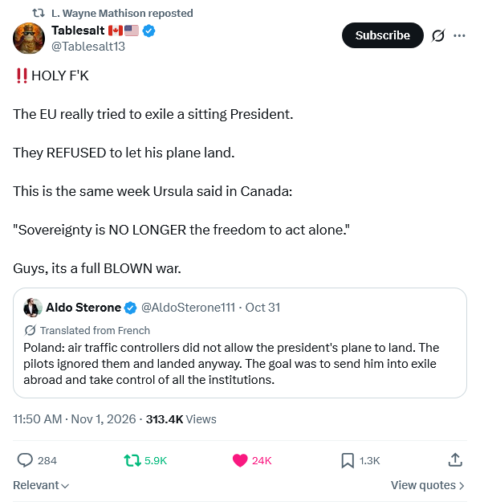
There is something rather splendidly 19th century about struggling to understand a constitutional problem the other side of Danzig. I’m trying to understand the Poland problem. On Friday night the President of Poland turned his aeroplane round somewhere over Spain. Karol Nawrocki had been on his way to Senegal on a state visit. By the small hours he was in Warsaw, shoving his way past a line of men (and a woman) in suits who were trying to stop him walking through the front door of his own country’s highest court.

The people in suits called themselves judges. Riot police stood in the road outside. A crowd had gathered, some of them in fancy dress, one in the full armour of a seventeenth-century Polish hussar. Objects were thrown. By morning the President was calling it a forcible takeover of the state, the Prime Minister was on television promising no compromise, and the chief justice of Poland’s Supreme Court was using the words “coup d’état“.

Inside, the suspended chief justice was heard asking whether anyone had a crowbar. At the door the President, a former amateur boxer who once worked as a hotel bouncer, looked at the judges blocking him and said, “You are not real judges”. Five words. It’s the whole argument.

You’d have struggled to find any of this on the BBC, I’ve looked and failed. Yet it’s the most serious constitutional crisis inside the European Union since Brexit, in a country of 38 million that is the EU’s fifth largest and Britain’s closest NATO ally on the eastern flank. And it’s ours as much as theirs. The judges who tried to bar their own President from the door hold their seats on the say-so of a court in Strasbourg, the European Court of Human Rights, the same court that still binds Britain, the one that grounded the Rwanda flight. In a couple of weeks Andy Burnham sits down with the EU at a summit meant to pull us back towards Brussels. Nobody at the BBC has thought to ask what the Poles are learning about Brussels this week.

The building is the Constitutional Tribunal. Fifteen judges, elected one at a time by the Polish parliament, the Sejm, for nine years each, and sworn in by the President. Its job is to strike down laws that break the constitution. It can’t write a law, only kill one.

That sounds dry until you ask who decides what counts as a law. In Poland a ruling of the Tribunal is final and binding on everyone, but only once the government prints it in the official gazette. For two years Donald Tusk’s government has simply declined to print the rulings it doesn’t like. The court has gone on judging into thin air.

Control the Tribunal and you control which laws survive, which ministers can be sacked, which officials can be hauled before a court and whether the President’s veto means anything. Every other quarrel in Warsaw runs through this panelled room.

The row is older than most of the people shouting about it. In 2015 the outgoing liberal parliament elected five judges on its way out of the door in order to lay a constitutional landmine. The incoming conservative Law and Justice party, PiS, refused to swear them in and put its own people on the bench instead. Brussels howled, opened disciplinary proceedings against Poland and spent eight years calling the court a sham.

Then Tusk won in October 2023 and the shoe changed foot. His coalition elected new judges. The new President, Nawrocki, elected in June 2025 and no friend of Tusk, refused to swear most of them in, exactly as the other side had done a decade earlier. He has since refused to appoint 46 ordinary judges as well and has hinted he may appoint none at all for his whole five-year term. The European Court of Human Rights ordered the Tribunal to seat four of Tusk’s nominees anyway.

So on Friday night Tusk’s judges, several of them never sworn in by anyone, and one of them the man Tusk calls his right-hand man, walked into the building and announced that the sitting chief justice was suspended. Not by any vote, not by any court, by a notice on a website.

The government’s answer is that this is the old catch-the-thief trick. Waldemar Żurek, the justice minister, says the nationalists spent eight years wrecking the constitution and have found religion only now it suits them. He’s got a point, and it’s the best one his side has. It just doesn’t make two wrongs a right.

Whoever you blame, one fact is awkward for Tusk. The President has the fresher mandate. Tusk was elected in 2023. Nawrocki was elected two years later, and the most recent time Poles were asked, they chose his side.

And Tusk has managed something nobody else could. He has united the right. Outside the court on Friday night Jarosław Kaczyński, the PiS founder, posed for a selfie with Grzegorz Braun, the Polexit campaigner he’d sworn never to govern with. Sławomir Mentzen of the Confederation party told the right to bury its quarrels until Tusk is gone, and his deputy Anna Bryłka said toppling the Prime Minister was now the “fundamental common goal“. Two years spent dividing them, undone in a night.

Oxfam began as a famine relief organization, now they’re redefining their goals

The venerable non-governmental organization known as Oxfam began as an effort to relieve famine, but like all NGOs, they’ve moved a long way from their initial goals, says Tim Worstall:

Oxfam started out as famine relief — a good, Godly, righteous thing to be doing. Get food to the starving — bonzer.

Then two things happen. One, we find out that shipping food to the starving — except in the most obvious cases of outright famine — isn’t really the way to do it. Because that bankrupts all the farmers for the next year, we make the problem permanent. Instead, we should ship money to poor people so they can buy food.

This requires fewer bureaucrats in aid agencies.

Second, obviously, any and every organisation gets colonised by lefties. They’re parasites who cannot create so they take over.

The two combined leads to this:

    The world’s wealthiest people are not just profiting from the polluting causes of climate breakdown, they are also increasingly cashing in on the catastrophic consequences, according to a study by Oxfam.

    The global equality organisation

Global equality organisation, eh?

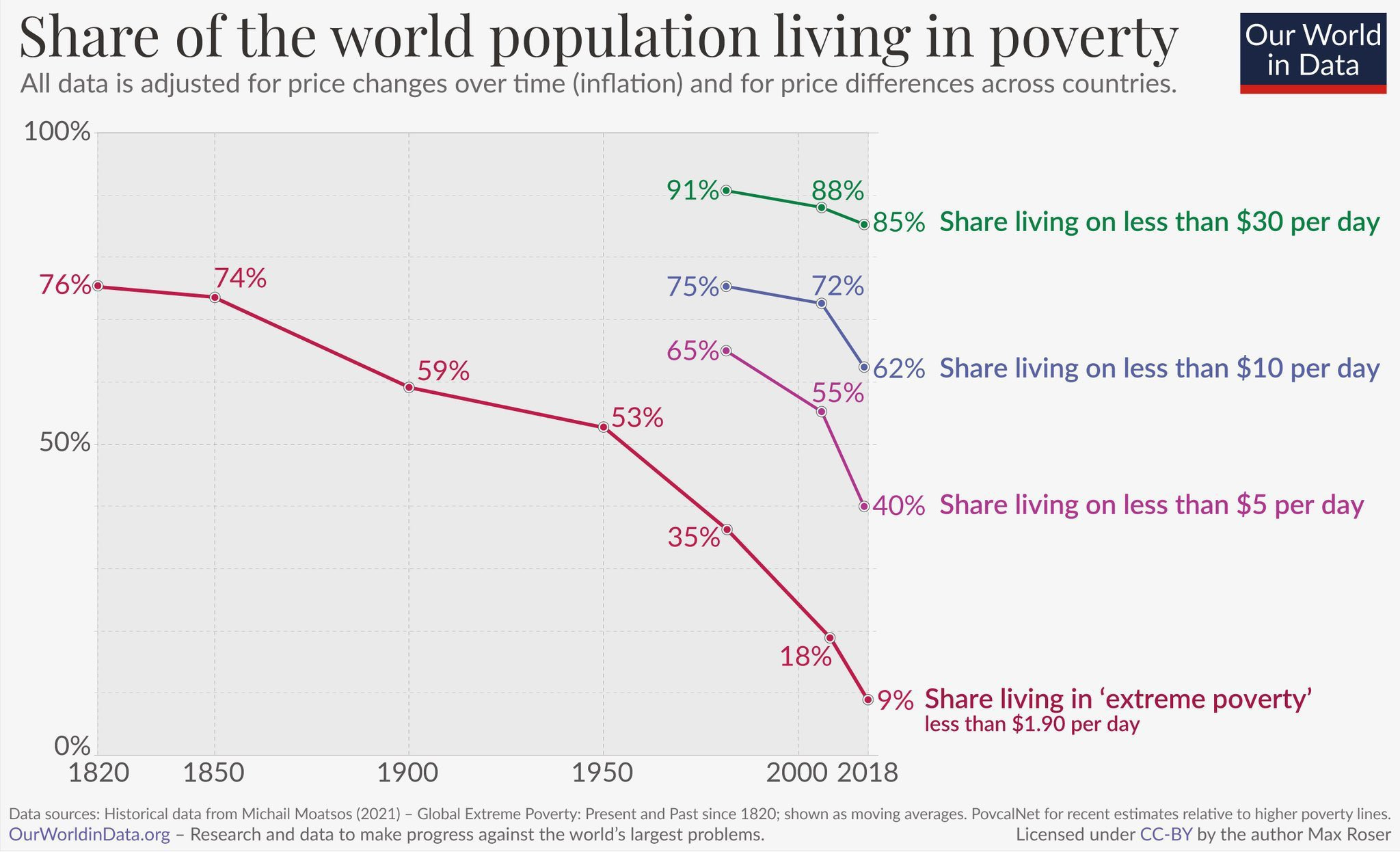
Actual poverty, real absolute poverty, has been falling off a cliff these past 50 years. It’s the one grand achievement of that neoliberal free trade and globalisation thing. So, if you’re a lefty bureaucracy you’ve got to find something else to worry about. There just aren’t that many poor people to keep the money rolling in. Further, everything we know about poverty reduction tells us that a bureaucracy stuffed with lefties isn’t the way to alleviate it.

Just as with the definition of poverty in the rich countries these days. There simply isn’t anyone, not in all of North America, all of Europe, trying to live on that $3 a day consumption value (at US supermarket prices as well) definition of absolute poverty. Just not a one. So, given that we’ve solved poverty — as capitalist free markets and neoliberalism, free trade, do — what’s to be the justification for still expropriating the rich and continuing to have vast bureaucracies stuffed with lefties consuming society from within? Redefine poverty, obviously, claim that inequality is poverty and anyone who disagrees is a fascist and quite possibly a racist to boot.

And what’s Oxfam doing on that global scale? Reinventing itself as an inequality campaigner, not a feeder of the — few remaining — starving. In order, obviously, to keep the grift going and keep paying $150,000 a year salaries in gibs to those senior people in Kampala, Uganda.

At which point, obviously, fuck ’em.

He’s quite right that true poverty has fallen dramatically, worldwide:

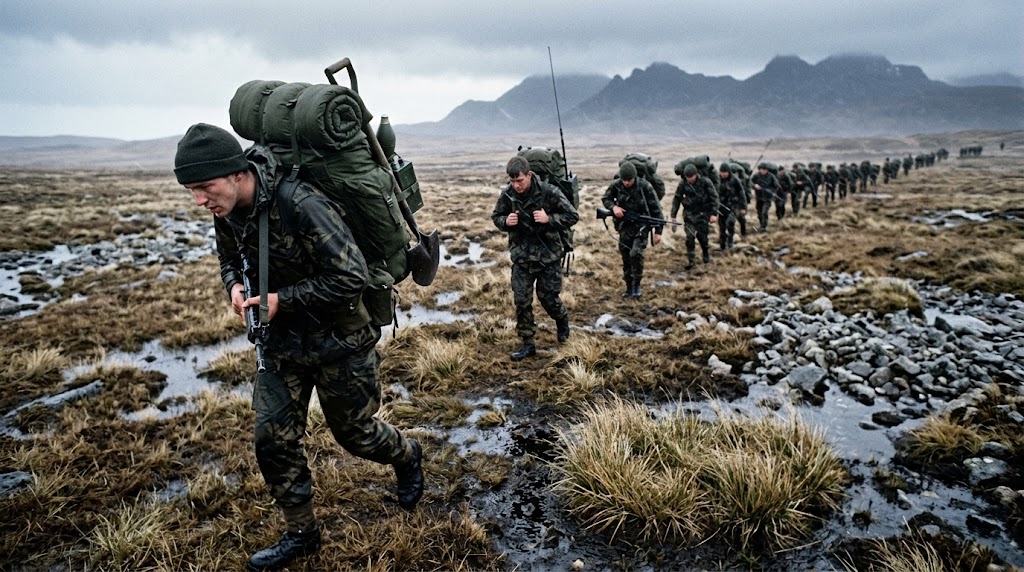
“Around 2020 the fitness industry discovered walking about with a heavy pack and called it rucking”

Filed under: Americas, Britain, History, Military — Tags: , , , , , , — Nicholas @ 03:00

On the social media site formerly known as Twitter, Sama Hoole discusses the British advance from San Carlos to Port Stanley during the Falkland Islands campaign:

On 25 May 1982 an Exocet sank the ship carrying Britain’s heavy-lift helicopters, so the Royal Marines and the Paras carried the war across the Falklands on their backs.

The Atlantic Conveyor went down with three of the four big Chinooks, six Wessex and a Lynx. Twelve men died with her. The plan to fly the troops forward sank with them.

From the beachhead at San Carlos to Stanley was around 56 miles. Nothing on the Falklands runs in a straight line.

Peat bog that swallowed a boot to the shin. Tussock grass in knee-high clumps. Rivers of loose rock. Rain two days in three, sleet, and a wind straight off the Southern Ocean.

45 Commando went first. Twelve miles to New House, eight more to Douglas, then on to Teal Inlet. 3 Para marched for 24 hours in two columns. The Marines called it yomping. The Paras called it tabbing.

Each man carried 80 pounds and often far more. Rifle, ammunition, mortar rounds, radio batteries, sleeping bag, rations, a shovel. About the weight of a grown Labrador, carried for days, then dug in under at night.

At the end of it there was no rest. They went up Two Sisters, Mount Longdon and Mount Harriet, and fought at night, up rock, some of it with bayonets.

The photograph of the yomp, a Marine with a Union flag tied to his radio aerial, became the picture of the whole war.

Those men are in their sixties and seventies now.

Around 2020 the fitness industry discovered walking about with a heavy pack and called it rucking.

The Marines called it getting to the fight.

AS Val: The Soviet 9x39mm Silent Assault Rifle

Filed under: History, Military, Russia, Weapons — Tags: , , , , , — Nicholas @ 02:00

Forgotten Weapons
Published 8 Jul 2026

The AS (Special Assault rifle) Val was one of two dedicated silenced rifles developed in Russia in the 1980s. The Val was intended for assault use with full auto firing, while the VSS (Special Sniper Rifle) Vintorez used the same action and suppressor, but had a thumbhole stock and was intended as a specialized sniper’s rifle. Both were chambered for the 9x39mm round, which came out at subsonic velocities to ensure very quiet operation. Both designs also included a selector switch.

The example I am looking at today is a military-issued AS Val of the original early pattern. The modernized version of the rifle replaced the smooth top cover and AK-style receiver side rail with a Picatinny railed top cover, as well as revising the handguard design.

Internally, the VSS and AS are very different from the Kalashnikov design. They use a linear hammer much like a vz58, and a six-lug rotating bolt. The gas system is a long-stroke piston, and the barrel has four rows of ports just a few inches in front of the chamber. The suppressor consists of an initial expansion chamber filled by the barrel ports and then a series of five very simple baffles.

Doctrinally, these rifles were intended to replace the use of suppressors and subsonic 7.62x39mm on standard AKM rifles, although only for special operations sort of troops (not standard Army recon). While very quiet and effective, they are liable to overheat quickly under sustained fire, and were not deemed appropriate for uses where they might be drawn into a conventional infantry battle. Instead, they went to groups like special police and intervention teams who were basically intended to deploy, shoot a couple bad guys in a blockaded building, and then return to base. By today, they have been generally replaced by newer designs, but like so much else, they have both appeared in the fighting in Ukraine.
(more…)

QotD: Human Resources

Filed under: Business, Quotations — Tags: , , — Nicholas @ 01:00

Humans cannot be reduced to objects, as Kant proclaimed. Or, more exactly, they should not be. Still, as I approach the man, I slip on a patch of black ice, named David Hume.

A large part of the power tussle everywhere, might be captioned, “The victory of transhumanism”.

Or, to put it in more preposterous form: “The Final Solution of HR”.

For departments of human resources state the transhumanist position baldly. They declare that humans are resources, like oil and gas, or pork bellies. Or, robots. Humans can be used — or discarded — by a cost-benefit analysis. If a human can do something cheaper than a robot, then very well, we’ll continue to pay him. But if the robot can do it cheaper, then the human has to go.

There is a practical problem, getting rid of him, but they have a plan for that in Human Resources.

David Warren, “One last harrumph for Trumph”, Essays in Idleness, 2021-01-16.

Powered by WordPress