
On the social media site formerly known as Twitter, Sama Hoole discusses the British advance from San Carlos to Port Stanley during the Falkland Islands campaign:
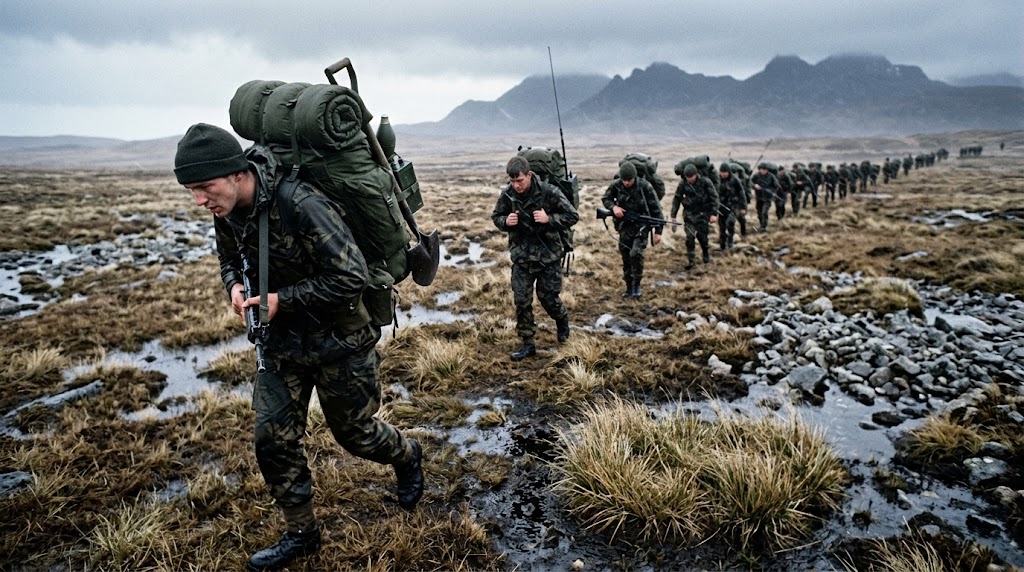
On 25 May 1982 an Exocet sank the ship carrying Britain’s heavy-lift helicopters, so the Royal Marines and the Paras carried the war across the Falklands on their backs.
The Atlantic Conveyor went down with three of the four big Chinooks, six Wessex and a Lynx. Twelve men died with her. The plan to fly the troops forward sank with them.
From the beachhead at San Carlos to Stanley was around 56 miles. Nothing on the Falklands runs in a straight line.
Peat bog that swallowed a boot to the shin. Tussock grass in knee-high clumps. Rivers of loose rock. Rain two days in three, sleet, and a wind straight off the Southern Ocean.
45 Commando went first. Twelve miles to New House, eight more to Douglas, then on to Teal Inlet. 3 Para marched for 24 hours in two columns. The Marines called it yomping. The Paras called it tabbing.
Each man carried 80 pounds and often far more. Rifle, ammunition, mortar rounds, radio batteries, sleeping bag, rations, a shovel. About the weight of a grown Labrador, carried for days, then dug in under at night.
At the end of it there was no rest. They went up Two Sisters, Mount Longdon and Mount Harriet, and fought at night, up rock, some of it with bayonets.
The photograph of the yomp, a Marine with a Union flag tied to his radio aerial, became the picture of the whole war.
Those men are in their sixties and seventies now.
Around 2020 the fitness industry discovered walking about with a heavy pack and called it rucking.
The Marines called it getting to the fight.


