Quotulatiousness

July 16, 2026

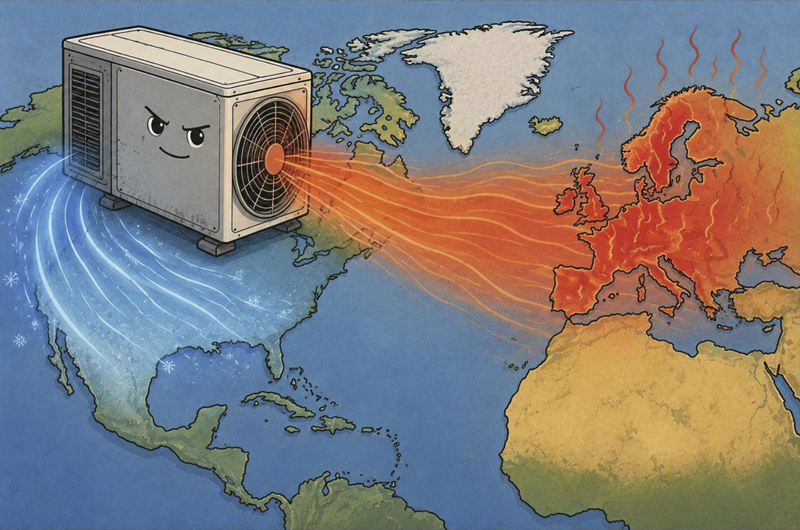
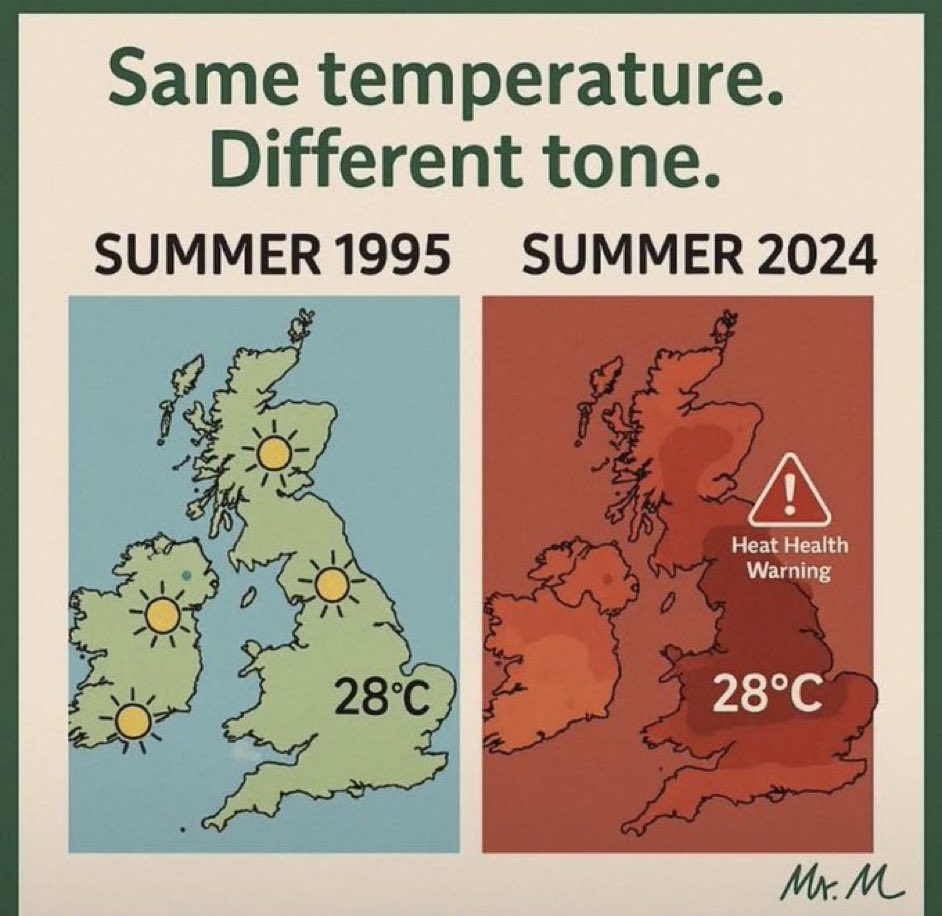
“Only fans – Europe’s approach to air conditioning”

From the free-to-cheapskates portion of Ed West‘s most recent article on his Substack:

The EU may not actually believe this, but they thought you would …

Different climates have enjoyed advantages at different points in time. For most of history, industry and scholarship in southern Europe benefitted from significantly longer hours of sun and daylight much of the year compared to the north, allowing for more hours of work and study. James Belich noted in The World the Plague Made that this all changed with the expansion of the Basque whaling trade in the late medieval period, providing cheap wax for candles.

England and the Netherlands subsequently overtook the south in their levels of literacy, a transformation usually attributed to Protestantism, although this technical solution to a physical disadvantage certainly helped. As the northern countries grew richer, and were able to use more energy, so the climate came to be an advantage. Cooler areas of Europe in particular benefitted from a relative absence of vector-borne disease, dangerous insects and food poisoning, which made hotter regions of the world more lethal.

Yet the biggest curse of the lower latitudes is that heat makes us sluggish — since people struggle to work above 23° centigrade. As Maarten Boudry writes on his substack, “For every degree above 25°C (77°F), our cognitive performance declines by around two percent. And if synapses suffer, so does economic activity. At 30°C, office performance drops by almost 9 percent.”

I see that. I’ve been trying to write this in temperatures of up to 34°, which equates to a production level similar to a moderate hangover. If only there was some sort of technology that could make my home cooler.

Until relatively recently the world was dominated by a handful of relatively cold regions, and Paul Johnson observed in his history of the United States that human industry thrives in what Fahrenheit appreciators would call “the 60s”, a Goldilocks zone that turned New England and Greater Yankeedom into a powerhouse. The southern states, in contrast, were held back by higher mortality and the impossibility of productive work in the sweltering summer months, and until the mid-20th century were about 40 per cent poorer than the Union states.

The northerners were especially known for their work ethic and their inventiveness, a characteristic epitomised by the Boston-born Benjamin Franklin. Then in 1902, New York’s Willis Carrier changed everything with the one of the most world-changing inventions, the air conditioning unit; aircon has notably shifted population and power in the US southwards, but Dixieland is just part of a broader, global “sunshine belt”.

Among the most notable beneficiaries of this technology are the financial powerhouses of Dubai and Singapore. Lee Kuan Yew famously said of air conditioning that it was “perhaps one of the signal inventions of history. It changed the nature of civilization by making development possible in the tropics … The first thing I did upon becoming prime minister was to install air conditioners in buildings where the civil service worked.” Indeed, it has often been noted as characteristic of the city-state that the aircon is usually set to icy levels, reflecting their determination to be on work mode throughout the day.

While Singapore is the most famous beneficiary of Carrier’s invention, Japan has almost universal air conditioning, with 91 per cent of homes equipped, compared to 88 per cent in the US. China is home to more than 500 million aircon units, is the world’s largest manufacturer, and has also seen an economic shift towards the south. Vietnam, also likely to be a major economic power by mid-century, is as dependent on this technology as it is on its people’s ingenuity. The development of aircon, and medical breakthroughs in the treatment of tropical diseases, has shifted the centre of gravity away from the cold regions of the earth — just as the globe is warming up.

This year’s European heat wave, still ongoing, saw temperatures reach 37 last month in England, a June record. Many schools shut early, although one in Kent instead used air raid tunnels to teach children. London’s Central Line hit 39.4c, presenting a real risk of heat stroke.

Across Europe the hot weather has closed down not just schools but factories, offices and rail lines, and led to an estimated 10,000 deaths, with France top of the heat mortality charts. Indeed as Boudry writes, Europe has the worst heat-related excess deaths of any region — while fatalities in the US have declined by 75 per cent since the adoption of air conditioning.

Update, 17 July: Welcome, Instapundit readers! Have a look around at some of my other posts you may find of interest. I send out a daily summary of posts here through my Substackhttps://substack.com/@nicholasrusson that you can subscribe to if you’d like to be informed of new posts in the future.

July 11, 2026

Road to Rangoon, Ep. 2 – Jungle Commandos Operation Romulus & Hill 170

HardThrasher
Published 10 Jun 2026

In the Arakan, it turned out the third time was the charm, at least for those lucky enough to survive the jungle, malaria and a coastline without maps.

In this episode we return to Burma and the Arakan, where Operation Romulus turned a miserable sideshow into a strategically vital victory. We look at XV Corps’ third attempt to take Akyab, the extraordinary march of the 81st and 82nd West African Divisions, the improvised amphibious landings at Myebon, and the brutal fight for Hill 170, where the Royal Marine Commandos as we know them today, cut their teeth

Featuring Operation Romulus, Pungent, Lightning, Akyab, Myebon, Kangaw, Hill 170, the Black Tarantulas, 3 Commando Brigade, 25th and 26th Indian Divisions, and Japanese 28th Army.

00:00:00 – Intro
00:02:28 – Recap
00:08:15 – Operation Romulus – the Plan to take the Arakan
00:20:57 – The Attacks Begins
00:30:34 – Meanwhile in land
00:43:10 – Op Pungent and the Fight for Meybon
00:50:43 – The Final Assault
00:56:06 – Aftermath
00:57:41 – Epilogue
00:59:13 – Survivor’s Club
(more…)

July 5, 2026

Canary in a Climate World

On his Substack, John Robson begins a series looking at a new book that covers the skeptic view of the great climate change debate, Canary in a Climate World:

Today we start a series looking at the new bestselling book Canary in a Climate World: Climate Realism vs. the Net Zero Myth. From the title you can guess the slant, but you may not expect the sheer number (38) of well-credentialed contributors. And we begin where they did, with the first chapter called “A Personal Awakening: from Covid to Climate” by Dr. Angus Dalgleish, Professor of Oncology at University of London. What’s an expert in cancer research doing writing about climate? Well, he doesn’t claim to be a climate scientist in the narrow sense (though he certainly understands statistics). Instead he writes about how his experience as a medical expert during Covid opened his eyes to the way science can be politicized and hijacked to serve an agenda. Once he saw the same pattern in climate, he realized it was essentially the same story, with many of the same characters, just being played out on a much slower time scale.

Dalgleish is a man who understands how science is done, or should be. He’s an expert in cancer immunotherapy and virology, who has made award-winning contributions to the fight against HIV, among other diseases. When Covid broke out he found himself at the forefront of research on the unfolding pandemic. But soon his suspicions were aroused.

    I was surrounded by experts and doctors who believed every word they were being told. What first shook me was work done with my close collaborator Birger Sorensen, with whom I had been helping to improve an already effective HIV therapeutic vaccine, Vacc-4X. Sorensen spotted that the sequence of SARS CoV-2 published in Nature in February 2020 contained several highly positively charged inserts that one simply did not see in natural viruses.

So, a scientific discovery to be shared, right? Dalgleish explains why the six sequences in question could not be natural, and moreover two of them matched ones published earlier by researchers at the Wuhan Institute of Virology. But when he pointed this non-coincidence out to colleagues he was told, basically, to shut up. In a revealing echo of the “not a climate scientist” trope, people with far less training than him told him he wasn’t an expert and wasn’t qualified to comment on the matter. And in another revealing echo, when he took his findings to the government he was accused of spreading misinformation for saying something true.

It gets worse. He then watched the official response to Covid break all the rules. China could have stopped the spread within days by preventing people from leaving Wuhan, but instead they and the WHO allowed daily flights to leave the city, sending the pandemic around the world. The data began to show that only the elderly or people with comorbidities were at risk of death, yet governments around the world imposed universal lockdowns, urged on them by incompetent and narrow-minded scientists whose computer models consistently overpredicted infection rates, painting an alarmist picture of catastrophe that went unchallenged.

Dalgleish was also dismayed to see that standard symptomatic treatments, such as vitamin D3 and inhaled steroids, that he was using successfully on his patients, were being cast aside by the General Medical Council in favour of dangerous alternatives including ventilators which, he says, “in many cases certainly killed rather than saved lives by pushing secretions back into the lungs and effectively drowning the patients.” He accused the GMC of:

    prosecuting good doctors for looking after their patients and not slavishly following official guidelines, which often had more in common with what I can only describe as highly coercive and authoritarian behaviour.

Then the vaccines arrived. Dalgleish and his colleagues reviewed all the available literature and concluded that no coronavirus vaccine had ever succeeded. Instead the vaccines were likely to program the immune system against obsolete variants and impair its ability to recognise the current one. The demand that everybody everywhere take the shot, despite the knowledge that it was a futile treatment and posed serious risks to people who were not at risk of dying, convinced Dalgleish that what was happening was a scam or worse.

June 9, 2026

Road to Rangoon, Ep. 1 – Slim’s Hammer and Anvil

HardThrasher
Published 8 Jun 2026

The Road to Rangoon Ep1: Hammer & A Hard Place — The Battle for Burma Begins By the start of the monsoon rains in 1944, British and Indian forces of General Sir William “Bill” Slim’s XIVth Army had been pegged back inside India. Five months later, after the battles of Imphal and Kohima, the Fourteenth Army had not only retaken the ground it had lost, but inflicted catastrophic losses on the Imperial Japanese Army.

The question was: what now? There would be no more forces coming from Europe, no additional fire power or support, and apparently no belief in the men by the Imperial General Staff in London or the US Army high command in Washington. Could the DUKE forces push into Burma through monsoon rains, jungle, mountains, disease, impossible supply lines and against an enemy willing to die for each yard of ground? Could Slim, Mountbatten, Oliver Leese, the US-led Northern Combat Area Command — NCAC — turn victory in India into the reconquest of Burma?

In this opening episode of “The Road to Rangoon”, we begin the story of the epic advance that would throw the Imperial Japanese Army out of Burma (modern day Myanmar) and become familiar with some of the places, names and concepts that will shape our story.

We look at the geography of Burma and eastern India, the aftermath of Imphal and Kohima, the state of the Japanese Burma Area Army under General Kimura Heitarō, the role of XIVth Army, XV Corps and NCAC, and the Allied plans that became Operation ROMULUS, Operation CAPITAL, Operation DRACULA and EXTENDED CAPITAL. This is the story of how the Burma Campaign moved from defence to attack — and how Slim planned one of the most ambitious offensives of the Second World War.
(more…)

May 29, 2026

“Tornados are like a warning sign God put up saying you’re not tall enough to ride this ride”

Filed under: Britain, Europe, Humour — Tags: , , , — Nicholas @ 05:00

Larry Correia is feeling a bit rant-y about Europeans lecturing Americans about their morally superior continent without air conditioning:

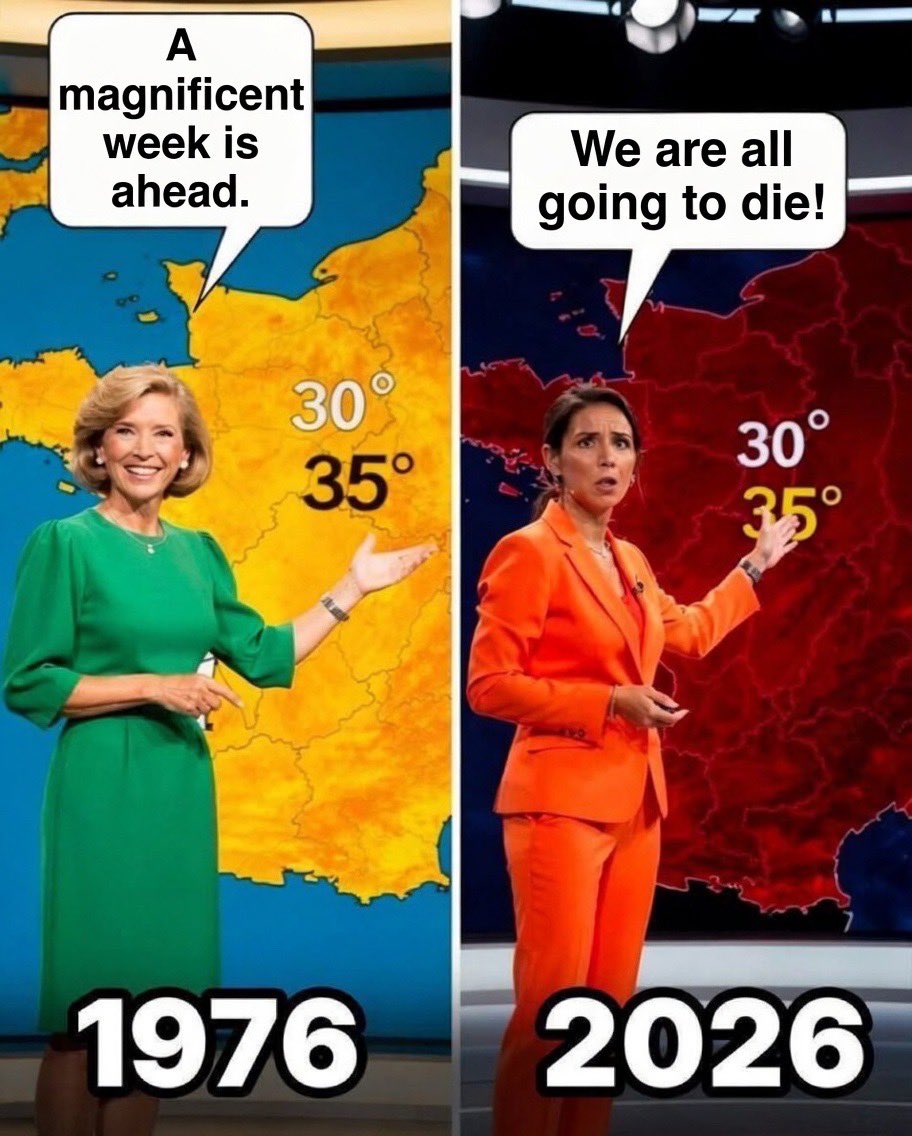
Even the weather reports emphasize that this is the heat death of the continent …

Oh goody. It is Europe whining about America having air conditioning while they drop like flies season again. This is my favorite time of year (the other continents call it “summer”).

This year they seem fixated on American houses being made of wood and how we have tornados?

Because you know, Europeans all live in two thousand year old mud huts and windowless castles that can’t accept a window unit, and that somehow makes them morally superior to us, so they can die miserably by the thousands when it hits 78 degrees, while lecturing us smugly about “climate change” the whole time.

I live in a place that’s Norway in the winter, Algeria in the summer, five thousand feet higher than the average elevation in the UK, in a house that’s so large the average UK home would fit in my office/game room, but please, do go on about how amazing your 800 square foot mud brick shack built after the Blitz is.

Listen, you absolute pussies, if you’re that scared of living where there’s tornados that’s okay. Tornados are like a warning sign God put up saying you’re not tall enough to ride this ride. That’s why our ancestors came here and yours stayed to decay there.

A couple generations ago the UK used to be our peer. Now they’ve got the per capita GDP of Mississippi, there’s only 5 UK companies in the global top 100, it took them a month to get their one functioning destroyer out of dock (and it promptly broke a week later), and they’re menaced by the rape gangs their government imported and protected. You’d think there would be some self-awareness exercised in there somewhere, but nope. It’s all hubris. America sucks because our average house (which is about 3x bigger than the UK’s, only its insulated and has air conditioning) is made of wood. Oooh sick burn. We also put ice in our water. GASP.

I just saw some Brit bragging about how he had a pub in his neighborhood older than America. Cool. The guys who built that pub would be ashamed of what’s become of you, while their descendants who weren’t scared of tornados moved here. Then he bragged his house was two hundred years old and would be standing in two hundred more! Sure, but living in it will be five dudes named Achmed and their twenty wives.

For the record I don’t hate the British. I like most Brits. I just despise your bossy weenie socialists who want you to live like fucking peasants to sacrifice on behalf of global warming, and those are the ones who mouth off on X all day. I’m actually rooting for you normal sane Brits to continue overthrowing your shitty labor government in the hopes you can move into the modern air conditioned world with the rest of us.

So anyways, happy summer. Try not to die.

May 15, 2026

Bloodier Than Verdun? Winter Battles on the Eastern Front 1915

Filed under: Germany, History, Military, Russia, WW1 — Tags: , , , — Nicholas @ 02:00

The Great War
Published 16 Jan 2026

The first four months of 1915 witnessed a titanic struggle on the Eastern Front, in East Prussia, the Carpathians, Bukovina, and at Przemysl. Both sides suffered staggering casualties that surpass those of the Somme or Verdun the following year. Ironically, the Austro-Hungarians lost far more men trying to save Przemysl than there were in the fortress.
(more…)

February 6, 2026

QotD: FEMA

Before we get to anything or anybody else, it’s vitally important to discuss FEMA [the Federal Emergency Management Administration]. Shortly after the San Francisco earthquake that famously dropped a two-level highway on hundreds of cars and cracked the baseball stadium while a World Series game was being played, I spoke with a friend in the Bay Area who was a police officer on the scene. Deeply frustrated, he told me several hair-curling stories about the way these federal bureaucrats got in the way of real disaster relief workers, strutting around for the television cameras, trying to look important, following an agenda of their own that had little to do with what needed to be done.

FEMA, in fact, is an illegal organization. It’s mentioned nowhere in the Constitution (which lists the lawful powers of the government in Article I, Section 8), nor did anybody ever vote about it, neither you nor I, nor even the Congress. It was created out of thin air by Presidential fiat, and given unprecedented power to override, at gunpoint, the Constitution, the Bill of Rights, and the rule of law in general.

Since the San Francisco earthquake, I have been paying attention. In all that time, I have never heard anybody, civilian or local official, who had anything to say about FEMA that didn’t make it seem like a combination of the Nazi Gestapo and the Black Death. Apparently there is no situation so tragic and overwhelming that they can’t make it even worse. FEMA has an unanswerable power of life and death over entire communities and there is nothing to protect those communities — or anything else that is uniquely American — from its foul dictatorial grasp.

L. Neil Smith, “Good Mornin’ America, How Are Ya?”, The Libertarian Enterprise, 2005-09-04.

November 2, 2025

North Africa Ep. 6: Do You Smell What The Fox Is Cooking?

Filed under: Britain, Germany, History, Italy, Military, WW2 — Tags: , , , , , — Nicholas @ 04:00

World War Two
Published 1 Nov 2025

Rommel pushes his HQ toward the front, seizes the oasis at Marada, and sends a long-range Italo-German column deep toward Murzuk to harden his forces for true desert warfare. A brutal Ghibli sandstorm shows how the Sahara itself is a third enemy, choking engines, wrecking vehicles, and nearly killing Rommel in the air. At the same time, ULTRA intelligence finally reaches Wavell, Malta’s bombers are forced off the island under relentless Luftwaffe pressure, and Rommel is already ordering preparations to hit El Agheila despite supposedly leaving for Berlin.
(more…)

September 12, 2025

Britain’s network of weather stations is becoming less and less reliable

Well-sited weather stations can provide useful raw data on temperature ranges, wind speed, precipitation, and other measurables, but that “well-sited” makes a huge difference. Older weather stations situated in areas of rapid urban expansion will often be less reliable as they become part of the urban heat island and report higher temperatures due to locally generated heat sources rather than the ambient temperature they were able to record before. This is what has apparently happened to far too many of the UK’s temperature measuring sites, according to Chris Morrison in The Daily Sceptic:

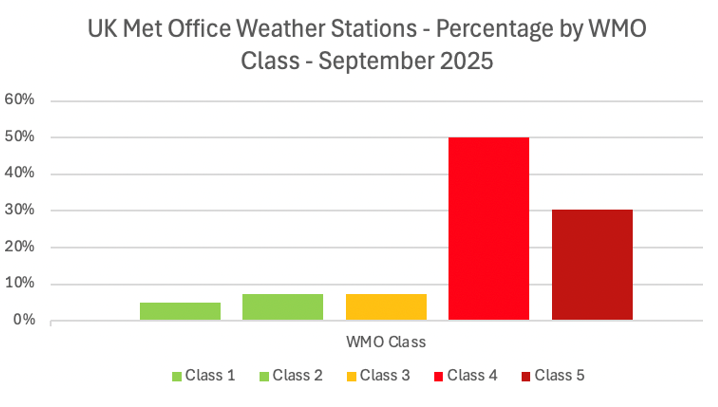
The latest WMO Class figures at the Met Office shown in block graph form. The higher the class number, the less reliable the station reports become.
Image from The Daily Sceptic

In March 2024 the Daily Sceptic shocked the science and political world by disclosing that nearly 80% of the UK Met Office’s temperature measuring sites were so poorly located that potential “uncertainties” could corrupt the readings by a numbers of degrees of centigrade. World Meteorological Organisation (WMO) Classes 4 and 5 in its CIMO scale come with “uncertainties” up to 2°C and 5°C respectively, and a Freedom of Information (FOI) request found that 77.9% of its sites were in these two “junk” categories. It should have been a wake-up call demanding immediate improvement of the nationwide network, not least because the Met Office frequently catastrophises its temperature figures in the interest of promoting the Net Zero fantasy. Alas, no. A new FOI has found that the Classes 4 and 5 junk sites have increased significantly over the last 18 months and now total an appalling 80.6% of the entire network. Pristine Class 1 sites – which measure a credible ambient air temperature with little chance of unnatural heat corruption – are just 4.9% of the total, having fallen in number in this short period from 24 to 19.

Hundreds of millions of pounds have flowed through this Government department over the last 18 months but little effort seems to have been made to improve its basic and important meteorological measuring function. What is worse is that the Met Office doesn’t seem to understand the scale of the problem. Over the 18 months, it appears that 20 new sites have been opened in its now 387-strong network. Seventeen of these have been given WMO classifications, of which a frankly ludicrous 64.7% are starting life in the Class 4/5 junk lane.

The WMO rates weather stations by the degree of possible temperature corruption caused by nearby unnatural or natural influences. Classes 1 and 2 are considered what we might call pristine, with no significant errors arising from artificial influences. The latest figures show that the Met Office has just 12.1% of its sites in these two unadulterated categories. Class 3 comes with an uncertainty of up to 1°C and accounts for 7.23% of the total. The real shocker is Class 4 where the percentage of the total has risen from 48.7% to over half at 50.1%. Class 5 has no defining conditions and could be located next to a blast furnace door. It has risen over the last 18 months from 29.2% to 30.5%. The WMO states that a Class 1 location can be considered a “reference site”. A Class 5 site is said to be a location “where nearby obstacles create an inappropriate environment for a meteorological measurement that is intended to be representative of a wide area”.

Despite this, Class 5 “extremes”, often caused by temporary but obvious heat spikes, litter the Met Office databases and record books. Of course such Class 5 data, unsuitable for providing an accurate temperature for a “wide area”, are loaded into databases producing “hottest evah” days, months, seasons and years. Their final destinations are the global datasets that exaggerate recent warming, again to promote Net Zero. Sprinkling the Class 4 and 5 fairy dust over the figures adds a bit more of the urgency required for elite political purposes.

August 24, 2025

Fireside Chat: Moscow 1941 – Turning Point of WW2?

Filed under: Germany, History, Military, Russia, WW2 — Tags: , , , , , — Nicholas @ 10:10

World War Two
Published 23 Aug 2025

Indy and Sparty dig into the Battle of Moscow. Was this the Soviet defence of the city the turning point of WW2? What if the Germans had taken Moscow in December 1941? How did the Holocaust transition from bullets to gas?
(more…)

August 14, 2025

D-Day’s Flat Pack Ports OR Lord HT Gets Cross with The Fat Electrician

HardThrasher
Published 13 Aug 2025

In which we use the ‪@the_fat_electrician‬ as an excuse to talk about the Mulberry Harbours, make a specific threat to a building in the United States and get to oogle at giant bits of floating concrete.

Primary Source – Codename Mulberry – Guy Hartcup, Pen & Sword Military. Kindle Edition 2014 (org. 1977)
(more…)

July 5, 2025

Surviving a Medieval Winter

Filed under: Europe, Food, History — Tags: , , , , , — Nicholas @ 02:00

Tasting History with Max Miller
Published 4 Feb 2025

Hearty wheat berry porridge thickened with egg yolks and tinted with saffron

City/Region: France
Time Period: c. 1300

There was little in the way of fresh food during a medieval winter. Meat, if you could get it, was salted, brined, or smoked (or some combination of the three). During some particularly harsh winters in the beginning of the 1300s, rivers froze for months at a time, making it impossible for water-powered mills to grind wheat into flour.

At such a time, this hearty porridge would be just the ticket. Everyone ate frumenty during the Middle Ages, from royalty to peasants, though wealthier people would add expensive spices and sugar and serve it with venison.

This frumenty is made of whole wheat berries and is a rib-sticking, satisfying meal all by itself. The wheat berries retain some wonderful texture so that it’s not just a mush, and egg yolks add richness and flavor. It’s more flavorful than I thought it would be, but I’d add some cinnamon and sugar.

    Formentee
    Take wheat, prepare it, wash it very well, and cook it in water. When it is cooked, drain it. Take cow’s milk and bring it to a boil, add the wheat, and boil it again stirring frequently. Remove it from the fire, stir often, and add in plenty of beaten egg yolks, and it should not be too hot when they are added. Some people add spices, a little saffron and venison stock. It should be yellowish and quite thick.
    Le Viandier de Taillevent by Guillaume Tirel, c. 1300

(more…)

May 19, 2025

The Roman Empire and climate change

Sebastian Wang considers “what we all know” about the rise and fall of the Roman Empire in the light of more recent research (not all of it politically motivated) into climate change:

The approximate extent of the Roman empire circa 395AD.

Before we get into climate, and for those who tend to the wholly ignorant spectrum of my readers, we need a quick sketch of Roman history. The Empire officially began in 27 BC, when Octavian — better known as Augustus — became the first emperor. It ended in the west in AD 476, when the last western emperor was kicked out. As said, the eastern half, based in Constantinople, carried on for another thousand years.

Broadly, we can divide Roman history as follows:

  • 27 BC – AD 180: The golden age. Augustus and his successors took over and further expanded a huge empire. There was peace (mostly), trade flourished, and cities grew. People call it the “Pax Romana“.
  • AD 180 – 284: Everything starts to fall apart. This is called the Crisis of the Third Century. Civil wars, foreign invasions, plagues, and economic collapse all hit at once.
  • AD 284 – 395: The empire pulls itself together. Emperors like Diocletian and Constantine bring in reforms. But the empire is now divided for administrative convenience — east and west.
  • AD 395 – 476: The west goes under. It’s invaded. It’s conquered and broken up. Very quickly, it disappears. Though, once again, a parochial view of history, we call this the Fall of the Roman Empire.

The standard histories still blame bad rulers or too many wars. That’s fair enough. There were some very bad rulers, and the wars without number. But if you look at the climate data — tree rings, ice cores, sediment levels — you start to see another pattern underneath what may be called the political and economic superstructure of Roman history.

When Rome came to greatness, the climate was unusually good. From around 200 BC to AD 150, there was a long phase of stable, warm, and mostly wet conditions. Scientists call this the Roman Climate Optimum. In Egypt, the Nile flooded regularly and well. That meant lots of grain. In the Alps, glaciers shrank. In northern Europe, people were growing grapes in places too cold for vineyards today. In the Middle East, the Dead Sea stayed high, showing good rainfall.

This kind of weather made everything easier. Crops were reliable. Surpluses could be taxed. Cities could be fed. Roads and aqueducts could be built and maintained. And because the army was well supplied, the Empire was protected, and could even continue a modest expansion. But, as McCormick and his team point out, the high phase of Nile flooding correlates exactly with the high point of Roman prosperity — and once those floods became less predictable, problems followed.

The good times came to an end. By the mid-second century, a wave of volcanic eruptions thew great masses of dust into the atmosphere, blocking sunlight. Solar activity dropped. The climate became less stable. Then came the Antonine Plague in AD 166. It probably started in the east and spread quickly. Some think it was smallpox. Whatever it was in terms of microbiology, it was almost certainly brought on by changes in the climate. It may have killed a third of the Empire’s population.

Worse was coming. By AD 200, climate records show more erratic rainfall and cooling. In Gaul and the Balkans, harvests became less predictable. Glaciers began to advance again. Speleothem data from Austrian caves shows sharp shifts in rainfall patterns.

At the same time, the empire started to shake. Between 235 and 284, Rome had over twenty emperors. Most were generals who seized power, then got killed. Civil wars broke out. Trade declined. Foreign tribes pushed harder at the frontiers. Coin hoards — money buried for safety — increased in number. That’s usually a sign of fear and instability. Cities shrank. The economy shrivelled.

Was this all because of climate? No — not wholly. A good definition of historical crank is someone who tries to explain everything in terms of one cause or set of causes. But as McCormick et al. argue, bad weather made everything worse. It weakened agriculture, strained supplies, and made people more likely to panic or rebel. In a world without modern logistics, you couldn’t afford bad harvests two or three years in a row.

The empire buckled in the third century, but didn’t collapse. And its survival probably was an effect of human agency. A line of competent Emperors rose from the army and stabilised the frontiers. This line culminated in the reigns of Diocletian and Constantine, who restructured the Empire. They fixed taxes. They reorganised the army. Constantine built his new capital in the east. His successors found Constantinople safer and more strategically useful than Rome.

This being said, around AD 290, climate records suggest a small rebound. Warmer temperatures and better rainfall returned — especially in the east. That helped the eastern provinces recover faster. They had stronger governments and better infrastructure. But climate helped. Dead Sea levels remained relatively high, which meant steady rain in the Levant.

The west wasn’t so lucky. Italy and parts of Gaul stayed unstable. In Britain, pollen records show that farmland was being abandoned. The archaeology matches this, with fewer building projects and shrinking urban centres. The killing shock for the west came in the fifth century. In Central Asia, a long drought began around AD 370. Steppe tribes like the Huns were hit hard. They migrated west, pushing other tribes like the Goths ahead of them. In AD 376, the Goths crossed the Danube into Roman territory. Two years later, they crushed a Roman army at Adrianople. This all happened in the eastern half. But greater wealth and better leadership allowed the government in Constantinople to push the barbarians west. Over the next century, the western empire was hit again and again.

Meanwhile, the weather got worse. Europe cooled. Rainfall patterns shifted. Flooding and crop failures increased. Volcanic sulphur levels spike in the ice core record from Greenland.

Rome was sacked in AD 410. Again in 455. Finally, in 476, the last western emperor was deposed. That was it. The western Roman Empire was gone.

The east survived. But was hardly untroubled. In AD 536, a huge volcanic eruption darkened skies around the world. The sun barely shone. Crops failed. Famines spread.

A few years later, the Plague of Justinian broke out. It probably started in Egypt and spread through trade routes. Some say it killed half the population in affected areas.

Climate and disease worked together. Hunger weakened people. Infection finished them off. As McCormick et al. put it, the event of 536 and the plague that followed created one of the worst demographic shocks in recorded history.

March 7, 2025

Soviet Invasion of Finland: Winter War 1939-40

Filed under: Europe, History, Military, Russia, WW2 — Tags: , , , , , — Nicholas @ 02:00

Real Time History
Published 18 Oct 2024

November 1939. Germany and the Soviet Union have conquered Poland, and Germany is at war with France and Britain. Moscow is free to do as it pleases in Eastern Europe and sets its sights on Finland – but the Winter War will be a nasty surprise for Stalin.

Corrections:
02:19 The dot marking Leningrad is about 80km too far east, it’s of course directly at the far eastern end of the Gulf of Finland.
(more…)

February 26, 2025

The Korean War 036 – MacArthur Gets Dumber Every Week – February 25, 1951

The Korean War by Indy Neidell
Published 25 Feb 2025

Operation Killer begins this week, and its objective is what the name implies, to destroy as much of the enemy as possible rather than just trying to merely take territory. But once again, UN Commander Douglas MacArthur threatens to telegraph it before it starts. The offensive itself, though, is stymied its first few days by the weather. Meanwhile in China, Peng Dehuai meets with Mao Zedong to clear the air.
(more…)

Older Posts »

Powered by WordPress