
Tasting History with Max Miller
Published 7 Apr 2026Deep golden fried toast topped with anchovy filets and melted parmesan
City/Region: England
Time Period: 1759While spending time in London, Benjamin Franklin wrote about lodging with an elderly widow whose food was meager, but whose conversation was excellent. He wrote of one meal consisting of a bit of anchovy on a strip of bread and butter and a little ale. He was also a big fan of Parmesan cheese and fervently longed for a recipe for it, which he did eventually receive.
It almost goes without saying, but if you like anchovies and Parmesan, you’ll like this dish. It’s also quite salty, and unfortunately, I’m not the biggest fan of very salty foods or anchovies, but the toast is wonderfully crunchy and rich.
Des anchoise au Parmesan.
Anchovies, with Parmesan cheese.
Fry some bits of bread about the length of an anchovy in good oil or butter, lay the half of anchovy, with the bone upon each bit, and strew over them some Parmesan cheese grated fine, and colour them nicely in an oven, or with a salamander, squeeze the juice of an orange or lemon, and pile them up in your dish and send them to table. This seems to be but a trifling thing, but I never saw it come whole from table.
— A Complete System of Cookery by William Verral, 1759
October 1, 2026
How to Eat Like Benjamin Franklin
September 30, 2026
That “far-Right” fantasy that “never really existed”
Gawain Towler responds to the claims of a British MP that the nostalgic view of the rural life in England that George Orwell praised is something that the “far-Right” will try to capitalize on even though, she says, it “never really existed”:
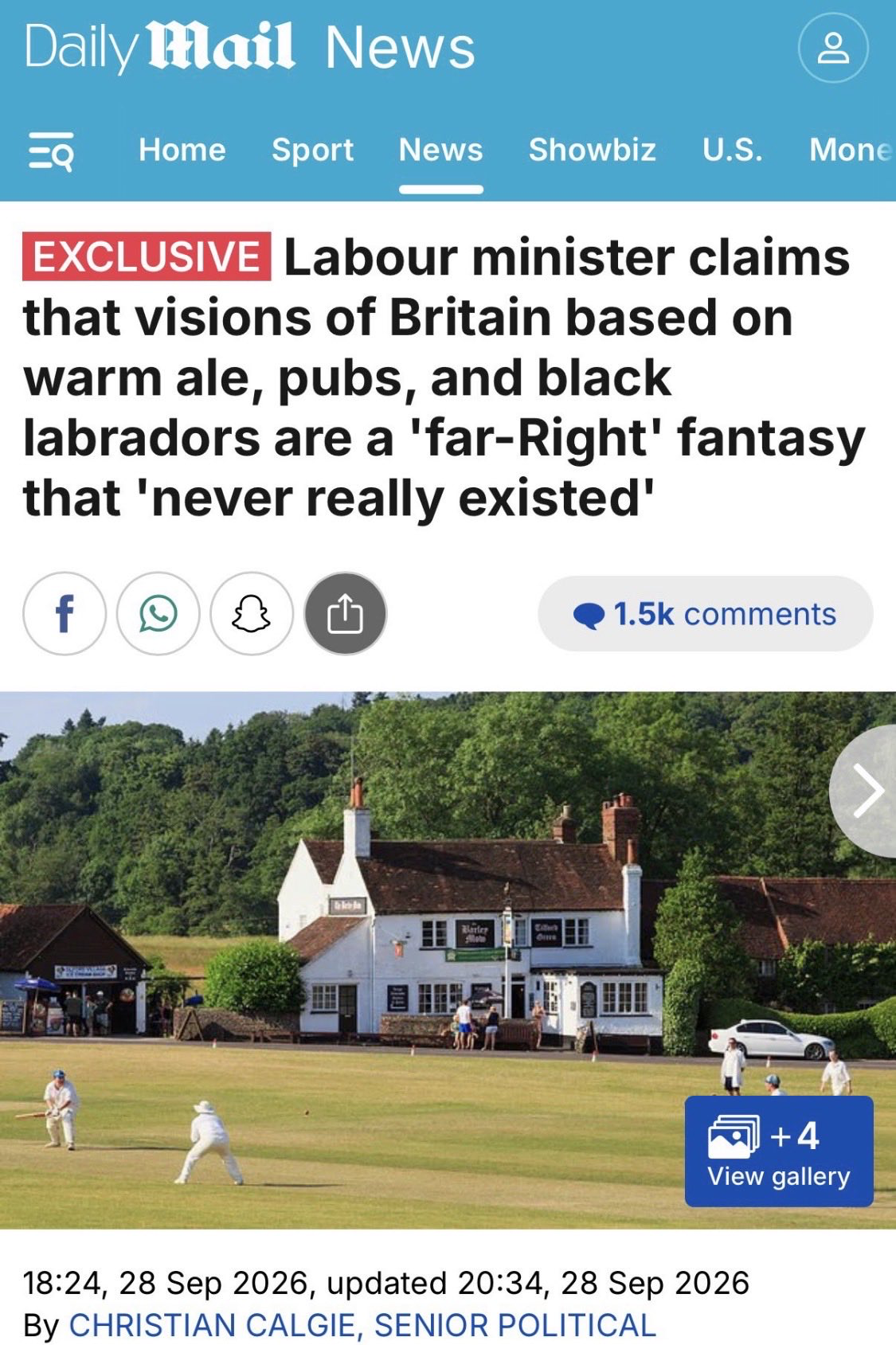
I was going to go to bed, but the malevolent inanity that is Jenny Riddell-Carpenter MP has riled me. She has disturbed my sleep, because she says that she cannot sleep. She told a Labour fringe meeting in Liverpool today what keeps her awake, and it was not rural bus cuts or the last shop closing in a Suffolk village. It was her own voters. She fears the far right will fight the next election on “a nostalgic vision of Britain that never really existed“, one of “warm ale, a black Labrador by your feet in a pub that doesn’t exist, and with symbolism of fox hunting all around them“.
A pub that doesn’t exist. The Minister for Nature represents Suffolk Coastal. Allow me to draw her a map.
Adnams brews in Southwold, just inside the protected landscape of the Suffolk Coast and Heaths, and the town is in her seat. From there a rowing-boat ferry crosses the Blyth to Walberswick for a pound, worked by a family that has pulled the oars for generations. The Bell on the far bank is six hundred years old and lets dogs in. The Cross Keys at Aldeburgh has served drink since 1540, and the Crown at Snape is a fifteenth-century inn with its own allotment. Most MPs would put these places on the constituency Christmas card. Ms Riddell-Carpenter prefers to tell a hall in Liverpool they are a far right hallucination.
Her non-existent warm ale has a pedigree she ought to recognise. She must be thinking of John Major in 1993, but he lifted it from George Orwell, who had written of “old maids biking to Holy Communion through the mists of the autumn morning“. Orwell was a socialist who spent years at his parents’ house in Southwold. The fantasy she fears was written by a man of the left, in her constituency. She clearly doesn’t know.
Then comes the sentence that gives her away. Labour, she said, must make the case for “what we believe rural communities look like“. Not what they are. What Labour believes they look like. The countryside is not to be listened to but corrected, its shape agreed at a fringe meeting and posted back to the people who live in it. When they describe their own lives, the pub, the dog, the Saturday match, their MP hears Ladybird nostalgia and smells fascism.
Cricket will be next on the charge sheet. Yoxford plays at Grove Park beside St Peter’s church and fields girls’ sides at under-11, under-13 and under-15, alongside women’s teams. At Orford the Sudbourne Hall ground drained well enough to save every home game in a previous sodden summer, and women’s sessions ended with a Pimm’s at close of play. This is the reactionary idyll that haunts her nights. It is busy doing, on a village green, what her party only issues press releases about.
She cannot plead ignorance, which makes it worse, no culpable. Her family moved to Martlesham Heath when she was seven, and she went to Woodbridge School. At eighteen she left and did not come back until the voters sent her. The years between went to London, to SOAS (oh brother), to the housing developer L&Q and to the lobbying trade, where she rose to run Cratus Group. Her husband still works in London social housing. She came home remembering every pub by name and having learned in town to be embarrassed by all of them. She now chairs the Labour Rural Research Group, which is a little like putting a vegan in charge of the pork pie.
A rural minister’s job is to carry the countryside’s case into Whitehall. This one carries Whitehall’s sneer back out and waits for the applause. Nobody who talks about her own patch like this can be trusted to defend it when a solar farm or a trail-hunting ban comes over the hill. She will side with the department and call it progress. She will be wielding the new Landuse Framework that tokenises the countryside, and she hates what exists before.
September 17, 2026
The Brutal Life of a Medieval Butcher
Tasting History with Max Miller
Published 24 Mar 2026Tender stewed spiced meat and onions with bright yellow saffron sauce
City/Region: England
Time Period: c. 1430It’s a well-circulated myth that medieval cooks spiced meat heavily in order to hide the fact that the meat had gone bad. And it is, indeed, a myth. Amongst the many reasons why this doesn’t hold up is the fact that in medieval Europe, spices were expensive, and if you could afford to use a lot of them on your meat, you could afford not-spoiled meat. Dishes like this one, which uses five different spices and saffron, which has always been expensive, would be only for the wealthy.
This dish has the classic medieval flavors of warm spices and vinegar, and I really enjoyed it. The meat and onions are tender, the sauce is a beautiful bright yellow, and it’s quite unlike anything we typically eat today.
Brawn en peuerade
Take might broth of Beef or Capon, and then take clean fresh meat, and seeth it, but not too much; And if it be fresh meat, roast it, but not too much, and then cut it in pieces, and cast it into the broth; And then take whole onions, and peel them, and then take vinegar thereto, and cinnamon, … then take cloves, mace, and powdered pepper, and cast thereto, and a little saunders, and set it on the fire, and let boil till the onions and the meat be cooked enough, and not too much; then take liquor made with bread and vinegar and wine … and cast thereto saffron to make the color bright, and salt, and serve it forth.
— Harleian Ms. 279, c. 1430
September 14, 2026
George Orwell according to family and friends – Writers & Wordsmiths
BBC Archive
Published 21 Mar 2026This programme contains attitudes of its time.
Recollections of George Orwell by his wife Sonia Orwell, sister Avril Dunn, and friends Malcolm Muggeridge and Cyril Connolly. [Original billing]
“From early in his writing career, Eric Blair adopted the nom de plume, which he is now universally known. He became George Orwell. In his will, he emphatically directed that no biography of him should be written. And to insure his wishes were respected, effectively covered up his traces. Blair hid behind Orwell.”
The man behind Nineteen Eighty-Four, Animal Farm and The Road to Wigan Pier was elusive, but in this programme family and friends share memories of the influential author.
Clip taken from George Orwell: 1903-1950, originally broadcast on 20 November, 1965.
September 5, 2026
QotD: The first (of many) near-death experiences of William Marshal, the greatest knight
In 1152, King Stephen of England very nearly killed a five-year-old boy.
He would have been far from the first child to die on Stephen’s account, because at this point England was fourteen years into a civil war so brutal that the Peterborough Chronicle recorded that men “said openly that Christ slept” (þa sæden openlice ðæt Crist slep. ⁊ his halechen),1 but this time was different. This time, the king had to order the boy’s death himself.
The medieval English royal succession was never as neat as Crusader Kings mechanics would have you believe, but even so Stephen I (and only) was an unlikely king. His mother Adela was the youngest child of William the Conqueror. She had four older brothers, three of whom survived their father, and Stephen himself was the third of her sons. But the Conqueror’s eldest son, Robert Curthose, mortgaged his duchy of Normandy to fund his participation in the First Crusade and would go on to spend the decades after his return in comfortable captivity. His second son, Richard, was killed as a teenager in a hunting accident in the New Forest in 1070, and his third son, William Rufus, succeeded him as king, never married, and was also killed in a hunting accident in the New Forest (this time in 1100). If this seems suspiciously convenient, it was: the youngest brother, Henry, was also on the fatal hunting trip. He immediately rode hard for Winchester, where he was crowned three days later.
Henry I promptly married Matilda, whose father was the king of Scotland and whose mother Margaret (later canonized by Innocent IV) was the sister of Edgar Ætheling: Henry and Matilda’s son William, born in 1103, united the blood of the Norman conquerors and the old Anglo-Saxon House of Wessex. Their daughter, another Matilda, was sent off to Germany at the age of eight to marry the twenty four-year-old Holy Roman Emperor Henry V. And that was it: Henry I also fathered at least twenty-two attested bastards, but William and Matilda were his only legitimate children. Which meant that when a drunken helmsman wrecked the ship carrying William and at least three hundred other flowers of the Anglo-Norman nobility across the Channel, Henry was in deep trouble. Luckily for him, his daughter soon returned from Germany a childless widow and once he had remarried her to Geoffrey of Anjou he was able to browbeat his barons into accepting her as his heir. Unluckily for him, they didn’t mean it: Empress Matilda was deeply unpopular even beyond the fact that she was a woman, and as soon as Henry died they were happy to crown his nephew Stephen instead.
The ensuing civil war, known to history as “the Anarchy,” was exciting and dramatic and featured such moments as a king captured on the battlefield, a queen climbing out the window of a besieged castle and escaping through a snowstorm, and a teenage boy invading England with a mercenary army he couldn’t afford to pay. For our purposes, though, all you really need to know is that in 1152 Stephen laid siege to a castle in Berkshire that John Marshal, a supporter of Matilda, had built without royal authorization. (These are apparently called “adulterine castles“, which I think is delightful.) Marshal asked for a truce to consult with his constable and organize the garrison’s surrender and offered his youngest son William as a hostage for his good behavior. Stephen accepted, took the boy into his camp, and withdrew to let Marshal enter with his men.
And then John Marshal stayed in the newly-reinforced castle instead.
Using your children as diplomatic hostages was standard practice in this era. Abandoning them to be executed as punishment for your bad faith was definitely not. But when Stephen’s men told John Marshal that his son’s life would be forfeit for his treachery, Marshal is said to have replied that he didn’t care, because he still had “the anvils and the hammers to forge even finer ones”. Stephen was not, in the end, able to bring himself to kill young William: the story has it that he lost his nerve when the boy asked on his way to the gallows whether he could play with a guard’s spear “afterwards”, and then again when William happily climbed into the catapult they planned to use to send him over the walls to his father (he thought it was a swing). He did, however, remain a hostage in Stephen’s camp until the end of the war a year later.2
Our only source for this story of William’s childhood, and for most of the truly excellent stories medievalist Thomas Asbridge recounts in The Greatest Knight, is a 19,215 line rhyming poem in medieval French. Probably composed a few years after William Marshal’s death at the behest of his friends or children, and pretty well corroborated by other sources where other sources exist, the poem is our only surviving example of a medieval biography of a “normal” person. (Relatively speaking; that little boy grew up to be an incredibly accomplished man but neither a king nor a saint, which is who usually got written about.) Moreover, it seems to have been compiled from stories told by people who actually knew him — which probably means that he was the one who told them about the child who thought the catapult was a swing. The poem exists in only one manuscript,3 discovered by Paul Meyer in the late 19th century and published with partial translations into modern French as L’histoire de Guillaume le Maréchal. (You can find Meyer’s version here or here.) More recently, Nigel Bryant published a full English translation, the text of which isn’t available online, though I’ll point out that even Claude Sonnet does a pretty decent job with screencaps of the original.4
Jane Psmith, “REVIEW: The Greatest Knight by Thomas Asbridge”, Mr. and Mrs. Psmith’s Bookshelf, 2026-04-27.
- As a measure of the degradation of the times, the chroniclers’ English no longer employed grammatical gender.
The ⁊ is a Tironian note for “and”, incidentally, and halechen is obviously cognate with “hallowed”. Like and subscribe for more Old English in the least expected places.
- Stephen’s son and heir Eustace having died by this point, it was agreed that he would keep the English throne but be succeeded by Matilda’s son, the future Henry II, who had already conquered Stephen’s duchy of Normandy.
- Yes, like Beowulf. It’s depressing to realize how many incredible medieval texts survive in only one manuscript. Thank a Benedictine today!
- Claim not verified by anyone who actually reads medieval French, but I didn’t see any obvious errors.
September 2, 2026
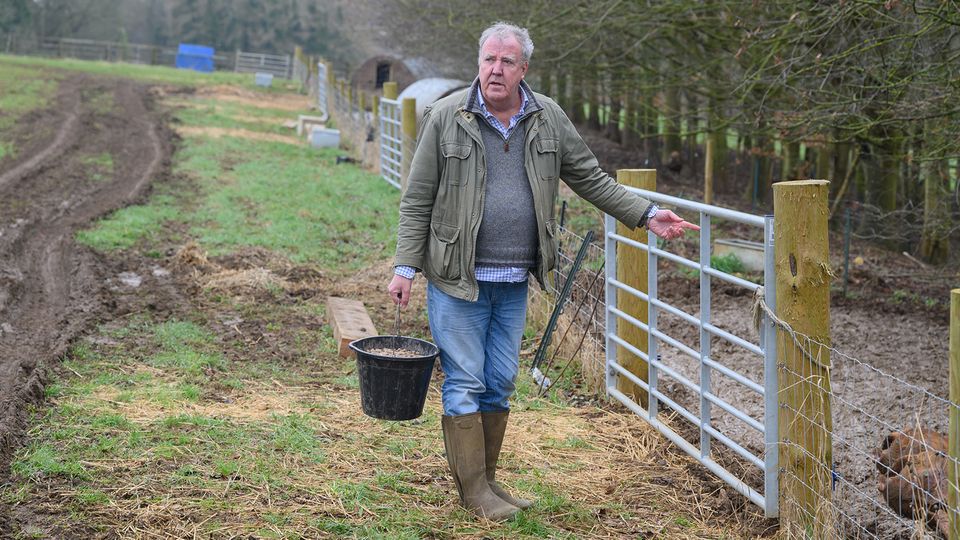
Jeremy Clarkson is “the worst tax dodger in British history”
As I mentioned recently, I’ve been watching episodes of Clarkson’s Farm and thoroughly enjoying them. I’m doing the opposite of binge-ing them, limiting myself to one episode at a time, and not every night. I’m part-way through Season 3 at the moment. The unrelenting hostility of the local government is a thing to behold … it really does seem as if they think that their role is to prevent any sort of economic activity from taking place in their jurisdiction.
Sama Hoole outlines the steps Jeremy Clarkson has taken over the time since he purchased one thousand acres of farmland:
A timeline of one man’s cunning inheritance tax scheme.
2008: Buy a thousand acres in Oxfordshire. Tell The Times that dodging inheritance tax is the critical thing. Scheme live.
2009 to 2018: Do absolutely nothing. A villager farms it on contract. Flawless.
2019: The villager retires. Rather than hire another one, decide to farm a thousand acres yourself, having never grown anything.
Also 2019: Invite a film crew.
2020: Rain for nine weeks. Profit on a thousand acres: £144.
2021: Broadcast the £144 to the largest streaming platform on earth, thereby informing the entire planet that farmland makes nothing.
2021: Open a farm shop. Acquire a queue down a lane and the undivided attention of West Oxfordshire District Council.
2022: Restaurant refused. Enforcement notice. Six weeks to take a barn apart.
2023: Lose the appeal. Lose it again.
May 2024: Accidentally get English planning law rewritten. Lawyers name it Clarkson’s Clause.
August 2024: Open a pub selling only British food. Sell your own sausage at 74p against 18p imported, and eat the difference on every plate.
October 2024: The Chancellor caps agricultural property relief at a million. Scheme dead.
November 2024: Stand on a platform in Westminster in front of thirteen thousand farmers, drawing maximum national attention to the exact tax break you were supposedly hiding behind.
July 2025: Go down with TB. First calf ever born on the farm destroyed, pregnant with twins. Gate padlocked.
23 December 2025: Government retreats. The threshold goes from one million to two and a half. Five million for a couple.
March 2026: Farm declared clear.
July 2026: Drive four hundred miles to Scotland and buy more cows.
Eighteen years.
Planning law changed. Agricultural degree applications climbing. Cited in the Commons more times than most ministers manage. Half the estates that were going to be caught by the tax are no longer caught by it.
He was accused of buying a farm to dodge inheritance tax, and then spent eighteen months getting the relief raised for everybody else’s.
Worst tax dodger in British history.
Best thing to happen to British farming in fifty years.
September 1, 2026
QotD: “Down-line clear …”
On one occasion, noticing us waiting by the gates, the signalman slid open his window and asked us if we’d like to come up and see inside the signal box. I was up those stairs almost before he’d finished his sentence and he treated us both to a conducted tour of a fascinating and beguiling little empire.
When bells started ringing, he explained about the bell code system and announced that there was a cross-country passenger train about to pass through Stanford, without stopping, on its way to Rugby. Suddenly, he asked me: “Would you like to signal this train through the station?”
“Gosh, yes! Of course I would!”
The sequence started by closing the gates on the level crossing. These were the traditional, heavy timber gates, rather than the comparatively minimal lifting-barriers seen today. They were opened and closed by turning a huge ship’s wheel-type contraption in the signal box and it took all my strength, plus more than a little help from the signalman, to turn it sufficiently to get the gates completely closed. This reliance on a direct mechanical linkage is the reason why the signal box had to be immediately adjacent to the gates.
Next, it was the signals, which were operated by a system of wires opposed by counterweights. The signalman showed me which levers to pull. I had to pull with all my might to get that red upper-quadrant signal to rise. Pulling the yellow distant signal “off” took even more effort, because its greater distance from the signal box meant that the wire was very long indeed. All these tasks were completed solely by manual devices without any mechanical assistance. It was a technology which hadn’t changed since Victorian times.
After what seemed like a long wait, the train eventually appeared in the distance and I felt so proud, hearing it whistling a greeting. Actually the whistle is a warning device, but I was only eight and I was convinced that the driver was saying “thank you” as he steamed through the station past the signal box, courtesy of my hard work.
And just as it had been with the farm horses, it would not be long before Dr Beeching would sweep away rural railways, together with the way of life which went with them and make such experiences as this impossible.
Whenever I see a railway these days, with everything surrounded by high steel fences, their vertical pales topped with barbarous triple-spikes and further surmounted with coils of barbed wire, together with notices threatening huge fines for trespass, I’m reminded of just how lucky I was to grow up in a time when a signalman could invite a child and his father to join him and give them a singular experience which they would both remember for the rest of their lives.
Brian Meredith, “A 1950s childhood, Part 2: ‘Down-line clear …'”, The Conservative Woman, 2026-05-31.
August 28, 2026
Orwell’s real-life inspiration for Animal Farm
Although I consider myself a fan of George Orwell’s work, it had never occurred to me that there might be a real Manor Farm that inspired its fictional counterpart in Orwell’s Animal Farm:
One of life’s small pleasures is the uncanny sensation of exploring a place previously encountered only in fiction. Those who have read Howards End by E. M. Forster will remember the vivid descriptions of the old property that Mrs Wilcox so adored. But are they aware that it exists in the real world in the form of Rooks Nest House near Stevenage? Similarly, fans of James Joyce’s Ulysses can step into Buck Mulligan’s shoes by visiting the Martello tower where he lived, still standing today at Sandycove just south of Dublin.
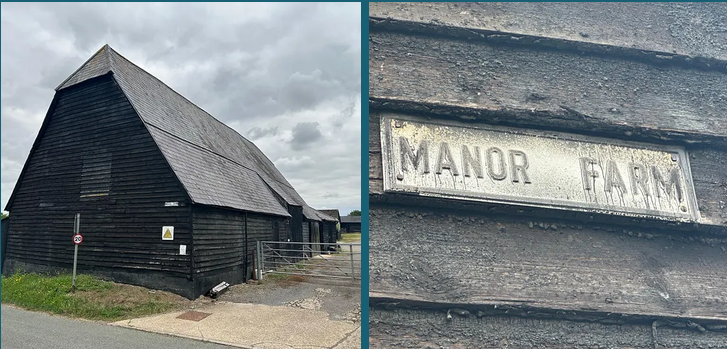
Locations that have been immortalised in novels tend to inspire a chill of familiarity. On a recent trip back to England I took one of my favourite country walks to another literary landmark. My house is not too far from Wallington, the village where George Orwell lived and worked from 1936 to 1940. It was here that he conceived Animal Farm (1945), and it was only by walking there myself that I discovered there is an actual “Manor Farm” – the apparent model for the farm in the novel – just a few hundred metres from where the great man lived.
The story opens with the farmer, Mr. Jones, locking up the hen houses for the night and making his way up to bed. Then the protagonists of our “fairy story” are introduced …
As soon as the light in the bedroom went out there was a stirring and a fluttering all through the farm buildings. Word had gone round during the day that old Major, the prize Middle White boar, had had a strange dream on the previous night and wished to communicate it to the other animals. It had been agreed that they should all meet in the big barn as soon as Mr. Jones was safely out of the way.
There follows Old Major’s famous speech to the animals in which he lays out his dream of revolution. The “big barn” remains to this day and is the first structure of Manor Farm that one sees from the road. The farm is still working, so I was reluctant to risk trespassing to see whether it still contains the raised platform from which the mighty beast – a porcine Lenin – delivered his oration. Still, it’s definitely there. It’s big, it’s a barn, and to settle all ambiguity it bears the sign of “Manor Farm”.
It’s worth a visit. There’s not so much as a pub in the village itself and, with its population of one hundred and fifty, you’ll be noticed if you start taking photographs. But walking along those lanes to the faint trilling of birdsong, it’s easy to find oneself momentarily seeing the village through Orwell’s eyes.
Orwell’s cottage on the corner of Kits Lane has a small plaque to commemorate his time there. This late seventeenth-century property used to be called “The Stores” because it was once a local shop. Orwell and his wife Eileen sold groceries here, as well as sweets and packets of aspirin. The income helped to offset the rent, and afforded him time to write in peace. If you do manage a visit, take note of the low front door. Orwell, being a tall man, would often bang his head against the ceiling.
August 5, 2026
QotD: “This is why English spelling is a disaster”
And somewhere in that collision of accents and dialects, something shifted. Literally. The vowels started moving.
Between roughly 1400 and 1700 every single long vowel in the English language changed how it was pronounced. It’s called the Great Vowel Shift. Before it happened, English vowels worked the way vowels work in Italian or Spanish. The letters did what they looked like they should do. “Bite” was pronounced “beet”. “House” was pronounced “hoos”. “Name” was pronounced “nahm”. “Knight” was pronounced “k-nicht” with a guttural sound at the end like you were clearing your throat. English was phonetic. The spelling matched the sounds. It made SENSE.
And then it didn’t.
All the long vowels began migrating upward in the mouth. The tongue positions shifted higher and higher over the course of about 300 years. And the vowels that were already at the top had nowhere left to go so they broke apart into two sounds. “Ee” became “eye”. “Oo” became “ow”. A 300-year linguistic pileup that nobody voted on and nobody agreed to. It just happened. And it happened during the worst possible window of time.
William Caxton brought the printing press to England in 1476. One of the most important technological developments in the history of communication. And it arrived RIGHT IN THE MIDDLE of the Great Vowel Shift.
Caxton started standardizing English spelling based on how words sounded at that exact moment. Printers needed consistency. They needed to pick a spelling and commit. So they did. But the sounds kept changing after the spelling was already locked in. The vowels were still moving. The consonants were still dropping. And the printed page couldn’t keep up.
We had ONE CHANCE to get English spelling right and we fumbled it at the worst possible moment.
This is why English spelling is a disaster. It’s not random. It’s not lazy. It’s a snapshot of a language mid-transformation that got frozen in place by a new technology and was never corrected. Every word you have ever misspelled, every silent letter that made you feel stupid, every time you stared at “knight” and thought why is there a K in this. You used to pronounce that K. You used to pronounce that GH. Those sounds died 500 years ago and the letters are still standing there like gravestones. English spelling is full of ghosts.
That’s why “food” and “good” and “blood” are spelled almost identically but sound completely different. In Chaucer’s time around the 1390s they all rhymed. In Shakespeare’s time around the 1600s they still rhymed but with a different vowel. And then sometime after that they each went their own separate way and the spelling just stood there watching like it had given up entirely.
And HERE IS THE THING. Other languages went through similar vowel shifts. German had nearly identical changes happen to its long vowels around the same period. And German just updated its spelling. They adjusted the orthography to match the new pronunciation. Like reasonable people. English looked at the same problem and said no. We’re going to keep the old spelling. Everyone will simply have to deal with it. Every person who has ever stared at “though” and “through” and “thorough” and “thought” and wondered why four words that look almost identical are all pronounced differently? Collateral damage. Five hundred years of collateral damage and we just accepted it.
Ok so that’s the vowels. That’s the background. Now we get to the accents and this is where I lost my mind.
The single biggest difference between standard American English and standard British English today is something called rhoticity. This is a real linguistics term even though it sounds completely made up. Rhotic speakers pronounce the R sound in words like “hard” and “car”. Non-rhotic speakers drop it. “Hard” becomes “hahd”. “Car” becomes “cah”. That one feature is doing like 80 percent of the work when your brain hears someone speak and categorizes them as British or American.
Here’s what nobody told you.
In 1776 everybody was rhotic. Americans AND the British. Both sides of the Atlantic pronounced their Rs. The fancy non-rhotic accent that we now think of as THE British accent, the one you hear in your head when someone says “British accent”, the one every villain in every movie has? That accent did not exist yet. It developed in the late 18th and early 19th centuries when the upper classes in southern England started dropping their Rs as a prestige marker. A fashion statement. And then it spread downward through society and outward through the Empire.
The accent we associate with the British Empire is actually newer than the American Revolution.
I need to say that again because it didn’t land the first time I heard it either.
The accent that we think of as “British” is newer than the country that broke away from Britain. Americans didn’t lose the British accent. The British lost the British accent. Americans are the ones who kept it.
Emma, “The Plague That Broke English (And Why the Founding Fathers Didn’t Sound British)”, Past Life, Present Cleavage, 2026-04-03.
July 17, 2026
Eating Like a Victorian Workhouse Inmate – Scouse & Suet Dumplings
Tasting History with Max Miller
Published 20 Jan 2026Thickened vegetable and meat stew with suet dumplings with parsley
City/Region: England
Time Period: 1901The food served in Victorian workhouses could vary widely depending on the time, place, and management of a particular establishment. Operating under the notion that if the food served to the inmates (yes, that’s what they were called) of a workhouse was worse than the average, it would encourage them to choose to not be poor (yes, those in power believed that being poor was a choice), workhouse food tended to be … not great.
The recipes for this stew and dumplings come from actual workhouse cookbooks, and they’re actually quite tasty, though the Victorian reality was often far from what you might make today with fresh ingredients. Meat could be too tough to eat, bugs and rat droppings were not uncommon, vegetables could be rotten, and the stew watered down.
As written, it makes a simple, hearty, thick meat and vegetable stew with dumplings that are rather dense, though they have a bit of fluffiness. It’s quite good, though I’m under no impression that it’s close to what the poor were actually being served.
Meat Stew (or Scouse)
Ingredients.
5 ozs. Raw Beef free from bone (Stickings or similar quality).
1 oz. Flour.
½ oz. Dripping or Fat.
4 ozs. Potatoes.
4 ozs. Carrots and Turnips.
½ oz. Onions
Pepper and Salt to taste.
Water to make 1 pint.
Method. — Cut up the meat and vegetables. Fry the flour in the fat till brown, stir in the water, add pepper and salt; then put in the meat and vegetables. Simmer gently for two hours. To make 1 pint of stew.
— Manual of Workhouse Cookery (1901)Suet Dumplings. 6 oz. flour, 2 oz. chopped suet, 1/16 oz. baking powder, ¾ oz. chopped parsley, salt and pepper. Mix all the dry things, rubbing the suet through the flour; make into a firm paste with the cold water; divide into ten or twelve small pieces, which roll up into balls, having the outsides well floured. Drop the balls into the stew, and cook for half an hour longer; then serve.
— Miss F. A. Merchant in Management and Construction of Poorhouses and Almshouses by George A. Mackay
May 19, 2026
How to Eat Like a Medieval Peasant
Tasting History with Max Miller
Published 25 Nov 2025Boiled carp fillets with a thick garlic-walnut sauce
City/Region: England
Time Period: c. 1450In addition to their regular schedule of backbreaking work, medieval European peasants often had to work extra days for their lord, called boon days. The upside to this was that the peasants were given better food on boon days, which could include cheese, good bread, ale, meat, and fish.
While the medieval cookbooks we have today were written for the wealthy, these seemed like good choices if a lord wanted to feed their serfs: good, but not too good, and fancier than their everyday fare, but not heavily spiced like the nobility’s dishes.
I’d never tried carp before and thought it was quite good, and the garlic is by far the dominant flavor in the sauce. All in all, it’s not amazing, but if I was a medieval peasant, I don’t think I would complain.
Barbell boyled.
Take a barbell, and kutte him, and draw him round; And pike in the nape of the hede and seth him in water and salt, Ale, and parcely. And whan hit bygynneth to boile, skeme hit clene, and caste the barbel there-to, And seth him. And his sauce is garlek or vergesauce, And then serve him forth.
— Harleian MS 4016 (c. 1450)Take kernels of walnuts, and cloves of garlic, and pepper, bread, and salt, and cast all in a mortar; and grind it small, & mix it up with the same broth that the fish was sodden in, and serve it forth.
— Ashmole MS 1439
May 2, 2026
Making Real English Toffee from 1881
Tasting History with Max Miller
Published 5 Dec 2025Rich, sweet pieces of Victorian Era toffee
City/Region: Everton, England
Time Period: 1881Around Christmas, my house is full of candy and baked goods, and for me, toffee is one of the quintessential Christmas treats. Possibly invented by Molly Bushell in 1753 in Everton, just outside of Liverpool, toffee can be hard like the recipe we’re making here or of a softer, chewier variety.
While either option is delicious, this recipe is specifically for the hard style of Everton toffee. It’s a really simple recipe (the hardest part is waiting for it to come up to temperature), and is such a rich, decadent treat. The lemon extract adds a layer of acidic complexity to the toffee, but it doesn’t taste of lemon.
Feel free to dress yours up by adding some nuts to the dish before you pour the toffee over it, or sprinkle some chocolate chips over the toffee while it’s still hot so that they melt.
Everton Toffee.
Put one pound of brown sugar and one tea-cupful of cold water into a pan well rubbed with good fresh butter. Set it over a slow fire, and boil until the sugar has become a smooth, thick syrup, then stir into it half a pound of butter, and boil for half an hour. When sufficiently boiled, it may be tested by dropping some on a plate, and if it dries hard and can easily be removed, the toffee is ready for flavouring. For this purpose, add twenty or thirty drops of essence of lemon. Pour the toffee into a wide well-buttered dish. If liked, vinegar may be substituted for the water, then the lemon may be omitted.
— Cassell’s Dictionary of Cookery, England, 1881
April 20, 2026
QotD: The quality of evidence problem for historians
And yet, you can’t entirely discount them, either. Crecy (along with of course Agincourt) is supposed to be the triumph of the English longbow, and that’s the thing: We’ve reconstructed English longbows, and put them through all kinds of trials. The results, as I understand it — which, again, ain’t much — were highly variable. A very strong, well-fed, highly trained longbowman, firing an ideally constructed and maintained bow under optimal conditions, really can put X number of arrows up a flea’s ass at Y range in Z time.
Or they could miss the broad side of a barn at twenty feet, depending.
So: What was the weather like in Northern France on 26 August 1346? That’s not an idle question. Rather, it’s the central question. Assume perfect shooting conditions, and you’ve got a far, far different picture of the battle than if you assume poor ones. And if that seems to be giving too much credit to the weather, watch a few baseball games — you’ll quickly discover that quite often, the difference between a home run and a long out is just a few percentage points of relative humidity.
Ultimately it comes down to judgment. More importantly, it’s a judgment on how any particular event fits into the larger argument you’re trying to make. In a way, then, the details really don’t matter very much on their own — the mechanics of how the English won are almost irrelevant, except insofar as they feed into an analysis of why they won. Why did the French king attack uphill, in the mud? Was he stupid? Overconfident? Did he feel he had to, because of political problems inside his host? Did he have faulty information? Did he have accurate information, but just made a bad call?
That’s the art of History, and why, despite what the Peter Turchin (and Karl Marx) crowd keeps insisting, it will always be an art, not a science. We can have a high degree of confidence, most times, in what happened — there really was a battle at Crecy, and the English really did win it. It’s the why that is susceptible to radical reinterpretation.
Severian, “Friday Mailbag”, Founding Questions, 2022-06-17.
April 10, 2026
A Brief History of GRAVY
Tweedy Misc
Published 2 Dec 2025For the next instalment of the series of classic British sauces we take a look at the history of gravy.
In this video I look into some of the earliest historical references to gravy, then some 18th Century recipes. I investigate whether gravy might be a derivative of a classic French sauce, and look in some detail into one important component of traditional gravy recipes: the roux, used for thickening.
I also investigate some products which have emerged since the 19th Century to help with the process of making gravy, from gravy salt and gravy browning, through Bisto’s original gravy powder of 1908, and their fully instant product in the form of “gravy granules”, launched in the 1970s.
Also, have you ever wondered why Bisto is called Bisto? We’ll get into that too.
0:00 Introduction
0:32 What is gravy?
1:27 Early history of gravy
2:01 18th Century gravy recipe
2:25 The importance of the roux
3:37 More 18th Century gravy recipes
4:07 Is gravy actually…. French?!?!
5:29 Gravy salt
6:47 Gravy browning
7:31 History of Bisto
9:19 Modern Bisto
10:25 Conclusion
QotD: William Cobbett
Cobbett was a scrapper on the same majestic scale as our Henry V and our Horatio, except he dished it out to Vested Interest rather than Jean-Pierre Foreigner. He is the faded star of the British Awkward Squad (Capt. Jon. Swift; Vice Capt. Geo. Orwell) and he needs a boost. He needs a blue plaque on every place he ever visited. In his long life — he was born in 1763 and died in 1835 — Cobbett was a farmer, Tory, soldier, Radical, MP, agony uncle (his books include Advice to Young Men), and the founder of Hansard.
His obituary in The Times, after categorising him as a “self-taught peasant”, declared Cobbett “by far the most voluminous writer that has ever lived for centuries”. The funniest, too: when some town council somewhere banned his anti-Malthusian play Surplus Population, he riposted with a drama entitled Bastards in High Places.
Above all, though, Cobbett was the champion of the rural poor, the village labourer and the small farmer. He was their one true tribune. He spoke at The King’s Head in 1820 because country folk were suffering a triple wham from agricultural depression, enclosure and the rise of agri-business. Or, to precis, “Hodge” (his name for the generic farm worker) was low-waged or unwaged and deprived of the bits of land he had once enjoyed under commoner’s rights.
Cobbett railed against “The Thing” (the capitalist, manufactory system) and the centrifugal, corrupting force of smoky London (“The Wen”, in Cobbettian). But he was no bloviator: he was a farm boy, and hence entirely empirical and properly pragmatic. He spent a decade travelling around the English sticks to discover the true state of affairs. His descriptions of his horseback journeys were published in 1830 as Rural Rides, the first sociological study of the English countryside.
No dry-as-dust tome by the way, the Rides: it brims with pinned-to-the-specimen-board descriptions of people and places, nature, wit. Cobbett knew beauty and, the proper Englishman that he was, he loved horses:
The finest sight in England is a stage coach ready to start. A great sheep or cattle fair is a beautiful sight; but in the stage coach you see more of what man is capable of performing. The vehicle itself, the harness, all so complete and so neatly arranged; so strong and clean and good. The beautiful horses, impatient to be off. The inside full and the outside covered, in every part with men, women, children, boxes, bags, bundles. The coachman taking his reins in hand and his whip in the other, gives a signal with his foot, and away go, at the rate of seven miles an hour.
One of these coaches coming in, after a long journey is a sight not less interesting. The horses are now all sweat and foam, the reek from their bodies ascending like a cloud. The whole equipage is covered perhaps with dust and dirt. But still, on it comes as steady as the hands on a clock.
Speaking at The King’s Head coaching inn in Monmouth must have been the dream gig for Cobbett the horseman.
John Lewis-Stempel, “Why Britain needs a peasants’ revolt”, UnHerd, 2020-08-06.


