Quotulatiousness

April 11, 2026

The Liberal Party is about pure politics, not principle

Filed under: Cancon, Media, Politics — Tags: , , , — Nicholas @ 03:00

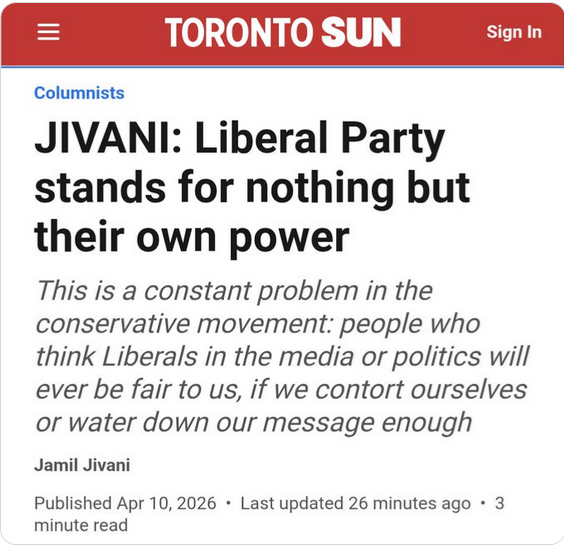
In some ways, you have to admire the Liberal Party of Canada — often described as Canada’s “Natural Governing Party” — for their long-term success at staying in power. They do this because, unlike the Conservatives or the NDP, their raison d’être is gaining and holding power. No Liberal holds firm values in any other area and therefore can switch sides on a given topic at a moment’s notice. As long as believing A keeps them in power, they’ll believe wholeheartedly in A, but if believing B becomes more important, like a shoal of fish, they’ll instantly switch to believing in B. It’s an amazing phenomenon. In the Toronto Sun, Jamil Jivani (my local MP) documents this Liberal talent:

April 9, 2026

Carney gets another MP to defect, drawing ever closer to a Parliamentary majority

Filed under: Cancon, Media, Politics — Tags: , , , , , — Nicholas @ 04:00

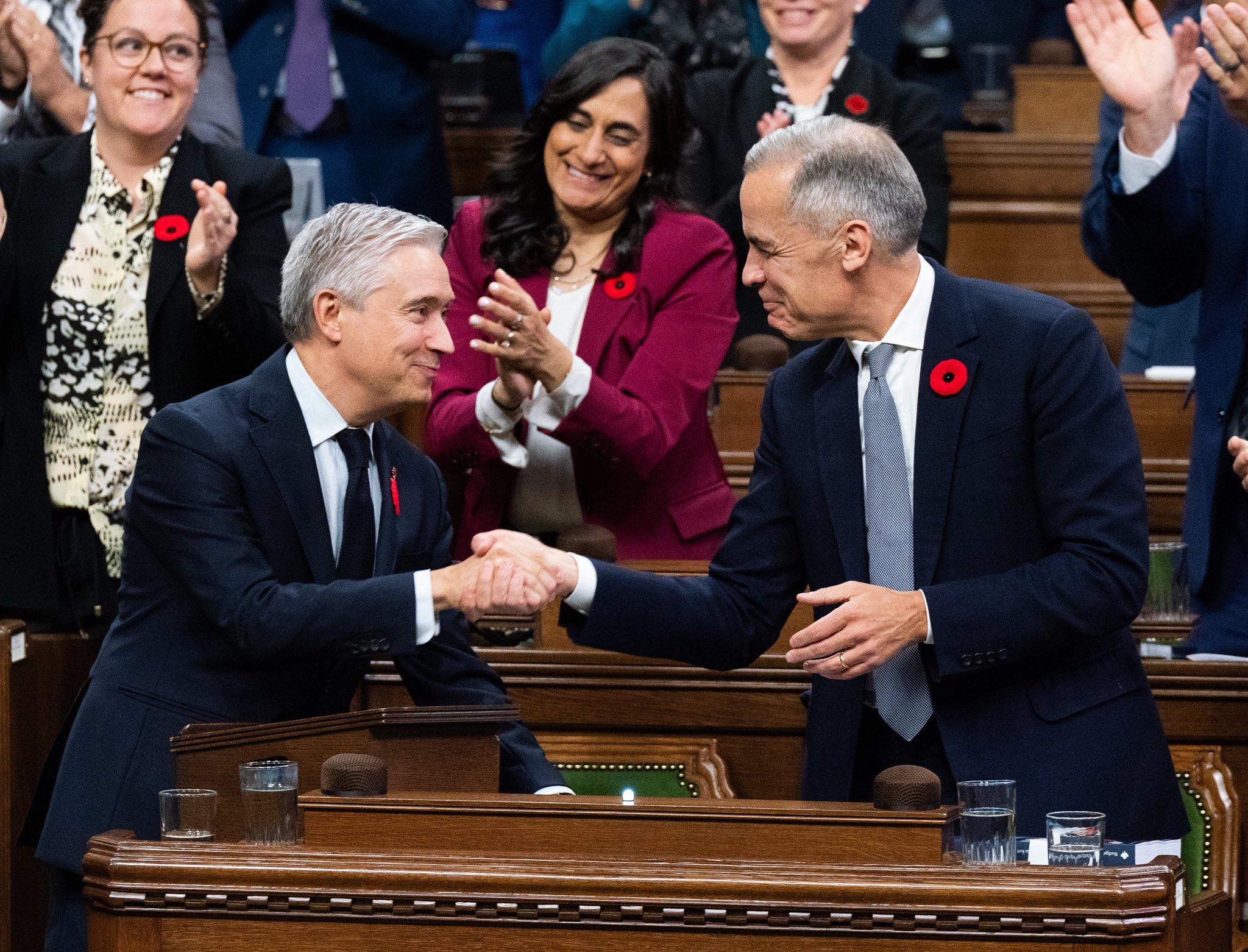
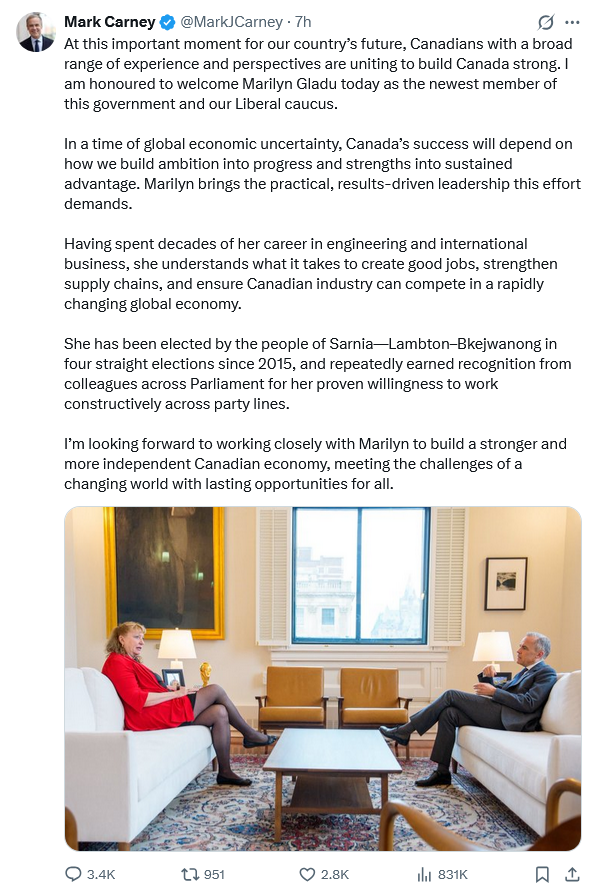
I’m not a Parliamentary history buff, but it strikes me that the number of Canadian Members of Parliament switching parties (always in the direction of the government) over the last year must be close to its historical high-water mark. On Wednesday, Prime Minister Mark Carney welcomed yet another “Conservative” MP to the Liberal caucus in Ottawa:

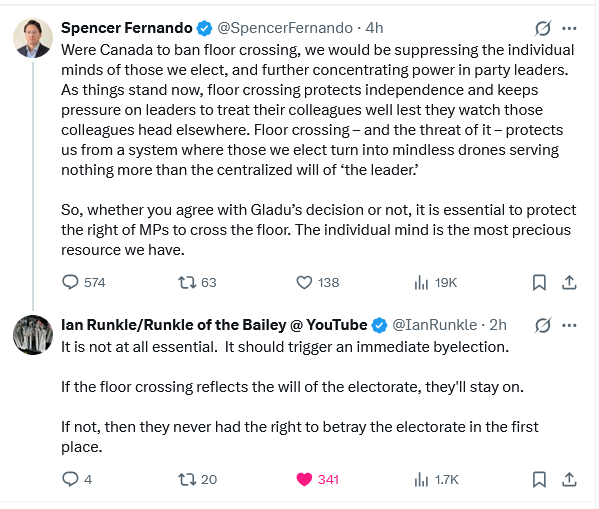
Call me a cynic if you like, but something is fishy about Carney’s talent for drawing turncoats over to his side. It would not surprise me to find that many more MPs have been offered all sorts of incentives to discover that they were really Liberals all along. Once upon a time I’d have been unbothered by this, but I’m coming to believe that an MP elected under a party banner may choose to leave that party but if they switch to a different party (that also ran a candidate in that MP’s riding), a byelection should be called. If the voters in North Bumbleford-Moosehip-Bongwater are happy with the MP’s decision, they’ll re-elect him/her/them. If not, well, shoulda thought longer before turning traitor.

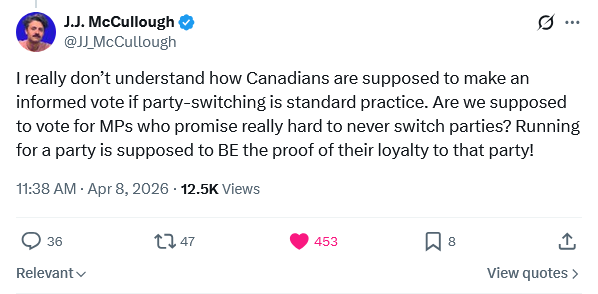
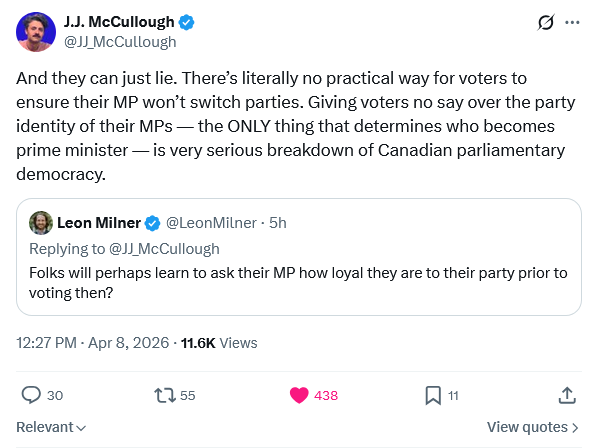
Along with many others on the social media site formerly known as Twitter, J.J. McCullough clearly feels the same way: “This floor crossing BS is out of control. If MPs in this country can just change parties whenever they want, then voters truly have no control over who becomes prime minister and runs our government. The whole Canadian system is based on the premise that parties MATTER.”

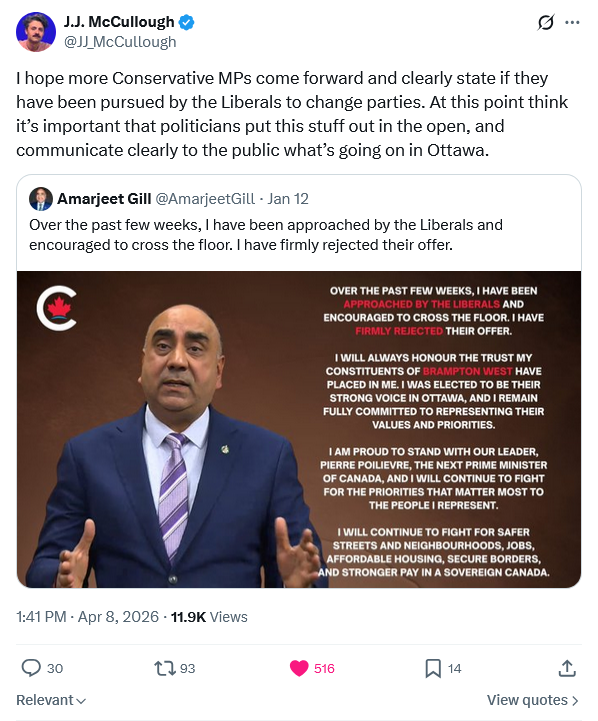
At least one opposition MP did go public about Liberal approaches to switch sides — it’s my belief that he’s one of perhaps dozens:

Ian Runkle (“Runkle of the Bailey”) responds to a typical middle-of-the-Canadian-road take by Spencer Fernando:

L. Wayne Mathison is viscerally against such backroom shenanigans when it comes to Parliament:

I am disgusted, and I am not going to dress it up with polite Ottawa language.

Marilyn Gladu crossed from the Conservatives to Mark Carney’s Liberals on April 8, 2026, saying constituents want “serious leadership” and “a real plan to build a stronger and more independent Canadian economy”. Her move gives the Liberals 171 seats, one short of the 172 needed for a majority.

That is exactly why people do not buy the noble script.

This is how Ottawa usually works. The speech is about conscience.

The reality is about power.

Suddenly the language gets soft, patriotic, and lofty right when the political math gets useful. We are asked to believe an MP was hit by a lightning bolt of principle at the exact moment her switch strengthens the governing party and brings it within one seat of majority control. Convenient does not begin to cover it.

Gladu says this is about leadership and collaboration. Fine. Then let voters decide whether they agree. That is the part these people always skip. They act as if a personal change of heart magically rewrites the contract with the public. It does not. People did not vote only for Marilyn Gladu the individual. They voted for a Conservative MP, a Conservative platform, and a Conservative opposition role. Crossing the floor without first seeking a new mandate may be legal, but it feels like a bait-and-switch because that is exactly what it is.

And spare me the line about “doing the best thing” for the riding. Every floor crosser says some version of that. It is the oldest detergent in the political cupboard. It is meant to wash ambition into service. What it really signals is this: I think my judgment now matters more than the basis on which you elected me.

That is where the anger comes from.

Voters are already drowning in managed language, staged sincerity, and plastic promises. Trust in politics is weak because people keep seeing the same pattern. Politicians campaign one way, govern another, then call the switch “leadership”. They wrap self-interest in national purpose and hope the flag covers the fingerprints.

What makes this worse is the timing. Carney publicly welcomed Gladu into Liberal caucus the same day, and the result is not symbolic. It materially strengthens the government’s position in the House. This is not some minor personal journey. It changes parliamentary leverage. It changes committee numbers, confidence calculations, and the balance of power.

So yes, I’m pissed.

I am pissed because voters are treated like props in a story written after the fact. I am pissed because party labels suddenly matter a great deal during elections and apparently not at all when power is on offer. I am pissed because people who were sent to oppose Liberal policy can simply walk across the aisle and help entrench it, then expect applause for being “constructive.”

And there is another detail that makes this smell even worse. Local reporting says that in January, Gladu had advocated for byelections when MPs switch parties. If that report is accurate, then this is not just opportunism. It is opportunism with a side order of hypocrisy.

That is the real issue here. Not whether floor crossing is technically allowed. Not whether Ottawa insiders can invent a respectable sentence for it. The real issue is whether voters still mean anything once the election is over.

My view is simple. If you want to switch parties, resign and run again. Go back to the people. Make your case honestly. Ask for a fresh mandate under the new banner. Anything less might be lawful, but it is not clean. It tells voters their consent is temporary, conditional, and easily bypassed once the machinery of power starts humming.

That is why this disgusts me.

Because democracy is not only about counting seats. It is about keeping faith with the people who gave you one.

March 14, 2026

Quid pro quo – something that is given in return for something else

Filed under: Cancon, China, Media, Politics — Tags: , , , , , — Nicholas @ 03:00

In the National Post, Tristin Hopper considers what the Parliamentary floor-crossers got in exchange for their loyalty:

Image from Melanie in Saskatchewan

Nunavut MP Lori Idlout has now become the fourth opposition member to join the Liberals in just the last five months, joining three Conservative MPs.

While there have been more than 100 MP floor-crossings since Canada’s 1867 founding, the circumstances have never looked quite like this. In any prior instance where multiple MPs shifted party loyalties in a short period of time, it was almost always because of a seismic political issue such as First World War conscription or Quebec separatism.

But in this case, all four floor-crossers gave vague reasons for the move, if they even tried to explain it at all. Idlout’s statement, issued by the Liberal Party, explained her switch as endorsing “strong and ambitious government that makes decisions with Nunavut — not only about Nunavut”.

Unmentioned is that the four also saw personal benefits for their defection to the government benches. A cursory summary is below.

Thus far, there are no tangible goodies to d’Entremont’s surprise November floor-crossing. He hasn’t received a position in cabinet, a pay raise or any special titles. What he did seem to secure, however, was his job.

When rumours first began to leak out that the Liberals were actively seeking floor-crossers among the Conservatives, one commonality emerged among the MPs being solicited: They all represented tightly contested ridings that were now polling for the Liberals.

This was particularly true of d’Entremont’s Acadie-Annapolis riding in Nova Scotia. He won it for the Conservatives by just 536 votes in 2025. And given a surge in Liberal popularity across the Maritimes in interim months, it now seemed likely to swap back to the Liberals; which it had done as recently as 2015.

D’Entremont’s former Conservative colleagues would allege quite directly that the defection had been done purely to remain as the MP for Acadie-Annapolis.

After the floor-crossing, Conservative MP Rick Perkins would allege that d’Entremont had told him the weekend prior, “If an election is held now, I will lose my seat. I might as well not run.”

“There is nothing in his floor crossing about principles. It was about keeping his job,” Perkins wrote in a Facebook post.

Ma also represents a tightly contested riding. Markham-Unionville had gone Liberal as recently as 2021, and he won in 2025 with just 50.65 per cent of the vote as compared to 47.05 per cent for his Liberal opponent.

But it only took a few days after the floor-crossing before Ma was conspicuously added to Prime Minister Mark Carney’s delegation headed to the People’s Republic of China and Qatar.

As noted by National Post‘s Chris Nardi at the time, Ma was the only member of the delegation who wasn’t a minister or a parliamentary secretary. His highest applicable rank was that he was vice-chair of the Canada-China Legislative Committee, a group comprising 11 other MPs and senators who didn’t similarly receive a seat on the plane.

March 12, 2026

Carney’s Liberals buy gain another seat in Parliament

Filed under: Cancon, Government, Media, Politics — Tags: , , , — Nicholas @ 04:00

What couldn’t be obtained at the ballot box can apparently be constructed through non-electoral methods. After the Liberals fell short of a majority in the 2025 federal election, they’ve now gained four more seats through attracting opposition MPs to join their caucus:

Image from Melanie in Saskatchewan

Consider several ridings from the last election where Conservatives defeated Liberals by extremely small margins. Terra Nova–The Peninsulas was decided by only a handful of votes. Milton East–Halton Hills South by just a few dozen. Windsor–Tecumseh–Lakeshore by fewer than a hundred. In Markham–Unionville and Edmonton Riverbend the margins were still narrow by federal election standards, measured in the low hundreds.

In ridings with tens of thousands of ballots cast, those margins are not ideological fortresses.
They are statistical coin flips.

Now imagine you are a strategist trying to change the parliamentary math without calling another election. Would you target MPs who defeated your party by twenty thousand votes? Or would you look at ridings where the electorate was already split nearly fifty fifty? Where persuading one individual changes everything!?

That is where the Moneyball logic appears.

Instead of persuading fifty thousand voters, you persuade one MP. The scoreboard shifts instantly. No campaign. No election. No voters trudging through snow to mark an X. Just a quiet change of jersey on the House of Commons floor.

Now consider the MPs who have crossed the floor or whose ridings are currently the focus of speculation. Seats like Edmonton Riverbend held by Matt Jeneroux and Markham–Unionville represented by Michael Ma sit squarely in that category of competitive swing ridings. Even Nunavut, represented by Lori Idlout, illustrates how single seats in geographically unique ridings can dramatically affect parliamentary arithmetic.

Notice the pattern.
Not massive strongholds.
Swing ridings.
Seats where the Liberal candidate already came within striking distance.

Which raises an uncomfortable question.

Is this coincidence?
Or strategy?

Because if a riding was decided by one hundred votes, persuading the MP to change parties is dramatically easier than persuading fifty thousand voters to change their minds. The parliamentary math changes instantly.

The voters never get another say.

    Just like Canadians did not get a say when 131,674 votes from Liberal Party members at Mark Carney’s leadership race installed Mark Carney as defacto Prime Minister. He effectively became the Prime Minister of Canada through installation, not election.
    That is 0.33 percent of Canadians.
    Or, put another way, roughly one third of one percent of the country’s population participated in choosing the Liberal leader who then became Prime Minister through the parliamentary system without being elected by the people of the country.
    • 131,674 people chose the leader
    • out of about 41 million Canadians

Of course nobody in Ottawa will describe it this way. Politics prefers softer language. You will hear phrases like cooperation, evolving priorities, responsible leadership, and national unity.

Politics prefers poetry.
Arithmetic prefers patterns.

Individually every floor crossing can be explained. Each one comes with its own “so-called” story, its own “so-called” reasoning, its own “so-called” justification.

But collectively something else begins to emerge.
A seat here.
Another seat there.
Nothing dramatic.
Until one day the standings look different.

Exactly the way Moneyball worked. No blockbuster moves. Just quiet arithmetic accumulating advantage until the outcome changed.

In the past I’ve been comfortable with the Parliamentary tradition that voters elect individuals as their representatives so if that MP leaves the party they were elected for, it doesn’t change the representation of the constituents. Historically, when most MPs were free to vote their conscience except for a minority of “whipped” votes, where they were obligated to vote on party lines, this made sense. I’m becoming less comfortable as this pattern of “recently elected opposition MPs suddenly discovering they’d run for the wrong party” repeats, indicating that it’s not just ordinary politics, but a deliberate strategy on the part of the Liberals.

Some have speculated that a major factor in the latest defection was a recent federal financial benefit to the territory, but it might perhaps have been something more concrete:

March 6, 2026

The “security clearance issue” demonstrated by, of all people, Mark Carney

Filed under: Cancon, Government, Media, Politics — Tags: , , , , — Nicholas @ 05:00

Melanie in Saskatchewan explains why the constant Liberal talking point that refusing to get a particular security clearance “proved” that Pierre Poilievre was next-door to a traitor will probably not be raised any more:

Image from Melanie in Saskatchewan

Open Letter to Canada’s Security Clearance Scolds: Carney Just Proved Pierre Right!

To every Liberal and NDP partisan who has spent the last year yelling “security clearance” like it is a magic spell that turns criticism into treason, congratulations. Mark Carney just demonstrated Pierre Poilievre’s point for him, on camera, in real time.

The moment came on March 3, 2026, during Prime Minister Mark Carney’s Indo-Pacific trip. After meetings in India with Prime Minister Narendra Modi, Carney held a press availability with Canadian media while travelling through the region. The topic journalists wanted clarified was not subtle. They asked about foreign interference linked to India and the 2023 assassination of Sikh activist Hardeep Singh Nijjar in Surrey, British Columbia, the allegation that detonated Canada’s diplomatic crisis with India.

The question came from Dylan Robertson of The Canadian Press during the media scrum. He asked directly whether Carney believed India continued to engage in foreign interference or transnational repression targeting Canadians.

Carney swerved. He was asked again. And again.

Eventually, after the careful circling that seasoned politicians deploy when a straight answer would be inconvenient, he landed on the tell. Not the kind you need a polygraph for. The kind you publish in a civics textbook.

Here is what he said, exactly:

    There will not be consequences for those officials … There are aspects of those briefings that I can’t share in public, and I’m not going to betray them. I will tell you that there is progress on these issues.

Read that again, slowly, with a spoon handy in case you choke on the irony. Because this is the whole debate in one neat little ribbon.

Pierre Poilievre’s argument, from the start, has been that the particular classified briefings being pushed would place him inside a legal box. Once inside it, the rules governing those briefings restrict what he can say publicly and how he can use the information while doing his job as Leader of the Opposition. Global News reported Poilievre’s office saying officials told them the briefing structure could leave him legally prevented from speaking publicly about certain information except in narrow ways, which they argued would “render him unable to effectively use any relevant information he received”.

Now watch what just happened.

Carney, the man with the clearance and the briefings, is asked direct questions about one of the most explosive foreign-interference files in modern Canadian politics.

And his answer, translated into plain English, is simple: I cannot share what I know.

March 1, 2026

The American Revolutionaries – when you don’t want a king, but you do want someone king-ish

Filed under: Britain, Government, History, USA — Tags: , , , , , — Nicholas @ 05:00

On Substack Notes, John Carter shared this post by Theophilus Chilton, saying:

Fascinating. The American founders were explicitly trying to revive a stronger form of monarchical executive authority with the presidency, as a deliberate corrective to the relatively powerless Crown of the British Constitution, which had been effectively neutered by the doctrine of parliamentary supremacy.

Along similar lines, the American Bill of Rights was in most ways simply a restatement of the ancient rights of Englishmen.

So, of course, I had to go read the post:

Too “kingly” but also not “kingly” enough for America’s Founding Fathers.
King George III in his Coronation robes.
Oil painting by Allan Ramsay (1713-1784) circa 1761-1762. From the Royal Collection (RCIN 405307) via Wikimedia Commons.

Recently, I’ve been reading an interesting book about 18th century political philosophy entitled The Royalist Revolution: Monarchy and the American Founding. In this work the author, Eric Nelson, guides the reader through the various aspects of the great inter-whiggish debates that roiled the American colonies prior to independence, and which then continued afterwards. One of the main premises is that a major faction within this debate — and indeed the one which ended up prevailing in the end — understood the relationship between colonies and mother country to be founded upon the king of Britain’s personal proprietorship over the colonies. This Patriot position was opposed by the Loyalist position which saw the colonies as existing under the laws and rule of Parliament.

Now this might seem strange to generations of Americans who grew up learning in school that the American revolutionaries fought against the great tyrant King George III who was set upon grinding the American colonies under his bootheel of oppression. That view would be quite surprising to many of the participants on the Patriot side, many of whom actually appealed to King George, both publicly and in private correspondence, to exercise kingly prerogative and overturn the various duties, laws, and taxes which Parliament had laid upon the colonies. This, indeed, was the crux of the Patriot argument, which is that because the colonies were originally founded under the personal demesne of the British King, they remained so even despite the temporary abolishment of the monarchy after the execution of Charles I in 1649. In the interregnum between that and the Glorious Revolution and restoration of a stable monarchy that was accepted by all classes as legitimate in 1688, Parliament had illegitimately usurped authority over the colonies. Because it was Parliament which was laying the Intolerable Acts and all the other complaints which the Americans had, it was Parliament against whom they wished to be protected.

But these Patriots were pining after a situation which no longer existed. In point of fact, the British kings since the Glorious Revolution had left whatever prerogative powers they might still have had unused. So it was with George III, who rejected the American colonists’ calls for him to intervene, knowing that doing so would have provoked a constitutional crisis in Britain which he would not have won. As a result, the American colonists chose to make their final break with the British monarchy and throw in their lot for independence, buttressed by Thomas Paine’s fleetingly persuasive but ultimately ineffectual pamphlet Common Sense.

However, after independence, the colonists were faced with providing their own governance. Initially, this was attempted under the Articles of Confederation, as well as their state constitutions, all of which were very whiggish in principle. They were also inadequate to the task. As every student who took high school civics knows, the solution to this was the Constitution of 1789.

Typically, students are taught that the new Constitution was designed to strengthen the ability of the federal government to handle the various issues that applied to the confederation of states as a whole. What we don’t generally hear, however, is that much of this included strengthening the roles and powers of the president to include several areas of prerogative powers which exceeded even the powers then available to the kings of Britain. The stock view of the Constitution is that it “was created to prevent anyone from getting too much power!” The actuality is that the Constitution was crafted, in part, to expand presidential power and create what was viewed at the time as a literally monarchical chief executive. Opponents of this described the proposed executive as “the foetus of monarchy”. Supporters often defended it on the basis that parliaments and congresses, if left unchecked by a strong executive whose interest was drawn from the body of the whole people, would themselves become the greatest threats to the liberties of the people.

The Founders who proposed this enhancement of the executive didn’t do this in a vacuum. Indeed, they had a century and a half of history about this very subject to draw from first-hand. Fresh in the collective mind of every Englishmen, both in the home country and in the colonies, were the English Civil Wars of the previous century. Beginning with the revolt of the parliamentarian army in 1642 through the regicide of Charles I in 1649, the protectorate of Oliver Cromwell, the attempted restoration of the House of Stuart under James II, until the final deposition of James and his replacement with William, Prince of Orange in the Glorious Revolution of 1688, Englishmen had a long series of examples from which to draw various conclusions.

So yes, they could see the parliamentarian excesses that took place during the Protectorate. Current in the collective national mind were the overreaches (whether real or imagined) of Parliament both during the interregnum and in the century since the acquisition of the throne by the House of Hanover. As noted above, among these overreaches, at least as viewed by many in the American colonies, was parliamentary interference in the affairs of the colonies, viewed as transgressions into the rightful domain of the king’s purview. Hence, by a strange twist, the Loyalists who opposed American independence before and during the Revolution were generally the more whiggish of the two sides, throwing in their lot with the parliamentary oligarchies. The Patriots, on the other hand, were desperately trying to get the king to reassert his royal prerogatives and intervene by reasserting his perceived rights to directly rule the colonies, something of a modified “high/low vs. the middle” type of scenario.

February 26, 2026

Abolish all Human Rights Tribunals in Canada

Canada’s Free Speech Union has launched a petition to get rid of all our anti-democratic Human Rights Tribunals in the wake of a BC man being penalized three-quarters of a million dollars for not bending the knee to the trans madness:

February 20, 2026

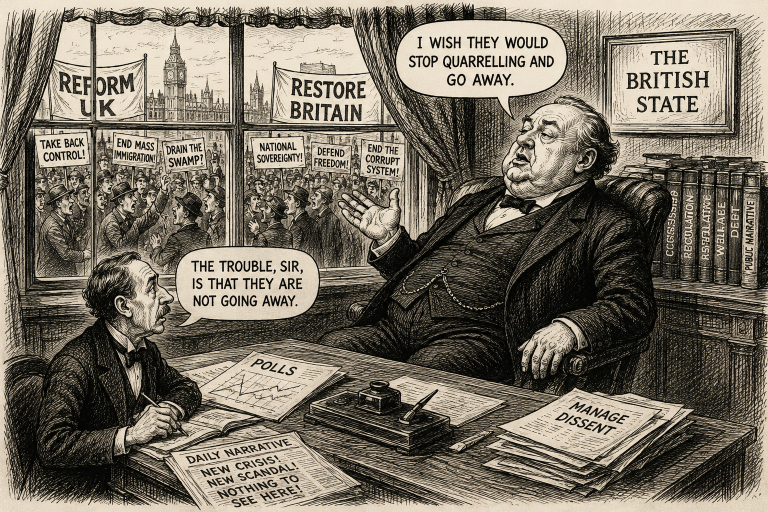
Reform UK falters, but Restore Britain rises to challenge it

Filed under: Britain, Media, Politics — Tags: , , , , , — Nicholas @ 04:00

Since the last general election in Britain, the rising power has been Reform UK under the unsteady leadership of Nigel Farage. A right-wing alternative to the horrifically incompetent Conservative Party, led by the man who kept the fires burning for Brexit? Seems like an obvious winner over the sagging Labour Party under Keir Starmer who just had to be less incompetent than the Conservatives but couldn’t manage even that low bar. But all was not well with Reform UK, despite being likely winners of the next election, and a lot of it comes down to Nigel Farage’s weaknesses. He seems incapable of dealing with strong personalities in his own party and seems to see any disagreement as a form of betrayal. One of the men he exiled from the party has now raised his own banner to much acclaim from the people who once were strong Farage supporters:

On Friday, Rupert Lowe, the independent Member of Parliament formerly of Reform UK, launched his own political party named Restore Britain. At the time of writing, the announcement video has amassed upwards of 30 million views on X, with many of the Western world’s most popular right-wing social media accounts — from Raw Egg Nationalist to Wall Street Mav — cheering him on.

Critics of Lowe argue that few outside of the culture war circles on X have heard of him, but these claims don’t track — Lowe has over 250,000 followers more on Facebook than he does on X, and has stated that he reaches “far more people on Facebook than X”. Still, while Lowe’s popularity has dramatically increased in the short year-and-a-half following his election to Parliament, he does not carry the same name recognition as Nigel Farage, let alone the latter’s proven experience of winning elections, as recent Reform victories have demonstrated, and contentious campaigns, being a key figure in the pro-Brexit campaign.

Restore Britain has the potential to be both very positive and hugely detrimental to Britain’s political future. Lowe’s announcement video was a masterclass in giving his admirers exactly what they want: decisive language promising a rebirth of a pre-Blair Britain, with fewer foreign nationals, fewer people on benefits, and more money to go round. The sober nature of the message was appealing — Lowe made it clear that the challenge facing the party, and the country, is not an easy one, but nor is it insurmountable. With stronger language than we have heard from Reform, Lowe promised to remove all people who arrived in Britain illegally, along with legal foreign nationals who do not meaningfully contribute to society.

Policy proposals like this — from a brand-new party with very little in the way of a party infrastructure as yet — do not have to be fully fleshed out to grab hold of the public imagination. What is likely is that it pushes the Overton window even farther rightward, and we begin hearing traditional centre-right figures like Kemi Badenoch (as she is centre-right in the political landscape of 2026) parroting some of the same points. With much of the online right rallying behind Lowe, we may begin to see a surge in the early stages of the posting to policy pipeline, whereby anonymous meme accounts — the modern politician’s crowdsourced spin doctor — churns out a large volume of pro-Lowe content, driving the narrative as others strive to keep up.

Lowe’s party may inadvertently help Reform, though, this by helping solve one of the main problems it has faced: attracting too many nutcases. Restore is positioning itself further to the right than Reform — and while this is no bad thing in and of itself, it will likely mean that those who believe in the most extreme solutions see Restore as the closest party to what they believe.

In UnHerd, Rob Lownie calls the movement “Lowe’s Powellite revolution”:

Rupert Lowe’s official portrait by Laurie Noble, 10 July, 2024 via Wikimedia Commons

Rupert Lowe deals in the politics of return: illegal immigrants are going back, and so is Britain. The Great Yarmouth MP, formerly of Reform UK, has now launched Restore Britain as a new political party, and on Wednesday evening claimed that it had passed 70,000 members. The launch announcement was marked with a stirring video of Lowe in his farmer’s get-up, as well as a series of semi-ironic nationalist compilations presumably made by Restore’s Zoomer footsoldiers. In one of these, among nostalgic nods to Geoff Hurst and Zulu, 1997 is invoked as the year when everything started to go wrong. Speaking over grainy images of a lost Britain, Lowe sums up his political outlook: “I think the state is bad, and I think the individual is good.

One area where the state has undoubtedly failed, in Lowe’s eyes, is on the matter of immigration. While Reform has pledged to deport all illegal immigrants, Restore wants to go further. Lowe has promised to scrap the asylum system entirely, also stating last week that “legal immigration will almost come to a complete halt”. The goal is not just to halt migrant influxes but to reverse them. “Net zero immigration is weak, weak, weak. It is insufficient and it is too late,” he said in the speech with which he launched the party. “The barbarians are already in the gates.”

The remedy, Lowe warns, will be “incredibly painful”: a characteristically abrasive verdict. It is one thing to criticise quangos, and quite another to say that “we must crush parasitic Britain”. And as for the dissonance between government and individual? “The state has definitively become the enemy of the people.”

In his doom-laden pronouncements, Lowe resembles no British political figure so closely as Enoch Powell, whose 1968 “Rivers of Blood” speech has led a radioactive afterlife in the national consciousness. For Powell, Britain’s willingness to take in tens of thousands of immigrants rendered it “a nation busily engaged in heaping up its own funeral pyre”. And compare Lowe’s talk of necessary pain to that 1968 call for an “extreme urgency of action now, of just that kind of action which is hardest for politicians to take”. For better or worse, Powell presaged contemporary debates over migration and nationhood. The challenge, as Keir Starmer found out with his more milquetoast “island of strangers” line, is to acknowledge voters’ frustrations without sounding like him.

Powell has been a political lodestar of sorts for Nigel Farage, Lowe’s bête noire and former boss who suspended him last year over dubious accusations of bullying. The Reform leader recalled being “dazzled”, as a schoolboy in the Eighties, listening to the former Tory MP speak. Last year, he insisted that Powell was fundamentally right about the scale of “community change” in the country.

On The Podcast of the Lotus Eaters, Carl Benjamin interviews Rupert Lowe:

February 18, 2026

It’s not just Britain that gives asylum-seekers better care than citizens – Canada does too

Filed under: Bureaucracy, Cancon, Government, Health — Tags: , , , — Nicholas @ 05:00

We had a look at how well the British government looks after asylum-seekers yesterday, but other nations are probably doing similarly inequitable things to give money and services to non-citizens than they ever would for the people who pay the taxes for these over-generous programs. In the National Post, Tristin Hopper outlines the findings of a recent analysis from the Parliamentary Budget Office on the costs of supporting huge numbers of foreign nationals in Canada:

An asylum seeker, crossing the US-Canadian border illegally from the end of Roxham Road in Champlain, NY, is directed to the nearby processing center by a Mountie on 14 August, 2017.
Photo by Daniel Case via Wikimedia Commons.

Paying the health-care premiums of refugee claimants will cost Canadians a record $1 billion this year, with some of the beneficiaries continuing to receive free health care despite their claims having already been rejected.

That’s according to a new analysis by the Office of the Parliamentary Budget Officer, and it’s just one of several ballooning costs wrought by the unprecedented number of foreign nationals currently living in Canada by virtue of a claim of refugee status.

The Interim Federal Health Program, which offers premium health benefits to asylum claimants, is soon set to hit $1 billion in annual costs for the first time, according to an analysis last Thursday by the Office of the Parliamentary Budget Officer.

This is a five-fold increase from just six years ago, when the program was costing $211 million per year. The analysis also projects that costs are expected to surge for the foreseeable future, with the annual budget likely to hit $1.5 billion as early as 2029.

All told, between now and 2030, Canadians are on track to spend $6.2 billion on health care for refugees or refugee claimants.

“The rising volume of asylum claims, along with the longer duration of eligibility caused by extended determination times, has been an important growth driver in recent years,” reads the PBO report.

The report was commissioned following a Conservative-led request made at the House of Commons standing committee on health. In a Thursday statement, the Conservative party noted that the Interim Federal Health Program can be accessed even by asylum claimants who have had their case rejected.

It also offers a higher level of care than that enjoyed by the average Canadian citizen. In addition to hospital care and surgical care, the IFHP also covers dental care, vision care, pharmacare and other services not typically covered by public health plans.

“Rejected asylum claimants are now receiving better health care than many Canadians who have paid into a system their entire life,” read a joint statement by Dan Mazier and Michelle Rempel Garner, the shadow ministers of health and immigration, respectively.

It added, “at a time when six million Canadians cannot find a family doctor and are waiting for care, it’s unacceptable that bogus asylum seekers are receiving better health benefits than Canadians”.

February 13, 2026

The selective ability to override any non-criminal law is a “useful tool to have”

Filed under: Cancon, Government, Media, Politics — Tags: , , , — Nicholas @ 03:00

The Canadian government is trying to get even more power to exempt their friends and favoured companies from needing to comply with any federal laws or regulations through a provision in an omnibus bill before Parliament. It may sound like a tool to dispense privileges and favours to politically well-connected individuals and organizations, but that’s only because that’s exactly what it does:

In a little-noticed provision included in the government’s latest omnibus bill, Carney government ministers would be able to override almost any non-criminal law they wanted, and provide special treatment to any person or corporation who requested it.

When pressed about the clause in a House of Commons committee this week, Minister of Canadian Identity Marc Miller called it a “useful tool to have”.

The provision is included in C-15, the 634-page “budget implementation” bill currently before the House of Commons.

Among its hundreds of amendments and orders are new powers allowing ministers to hand out special exemptions from any “Act of Parliament” under their purview.

This means that the minister of health would be able to issue exemptions from the Canada Health Act, the Indigenous services minister could oversee exemptions from the Indian Act and the minister of finance would be able to override the Income Tax Act.

Furthermore, ministers could hand out these exemptions to any “entity” they wanted. Under federal guidelines, an “entity” can mean everything from an individual to “a corporation” to an “unincorporated organization”.

You don’t need to be a conspiracy theorist to see all kinds of ways that this provision could be abused to circumvent the normal rules everyone else is bound by. On the social media site formerly known as Twitter, Wall Street Apes reacts:

I can’t even believe this is real

Canada Minister Marc Miller is questioned about their new bill under the Liberal government led by Prime Minister Mark Carney that would EXEMPT ALL MINISTERS FROM ALL LAWS

Yes, you heard that correctly

Hidden in the omnibus budget implementation bill, section 208 or clause 12 amends the Red Tape Reduction Act to grant federal cabinet ministers broad discretionary powers

Ministers would be able to temporarily exempt any individual, company, organization, or entity from the application of almost any provision of any federal law (or regulations made under those laws) that the minister is responsible for administering or enforcing, with the sole exception of the Criminal Code

They can themselves, and deem anyone they choose exempt from ALL laws. The only exception is the criminal code

He says you can trust them because “Canadians expect us to act reasonably”

(Holy cr*p)

On her Substack, Melanie in Saskatchewan explains why the rule of law is not optional in Canada:

So let us play this forward. A Beijing connected firm establishes operations in Canada. It hires lobbyists. It meets with the appropriate minister. It argues that certain federal regulations are barriers to innovation or economic growth. Under Bill C 15, that minister could grant a temporary exemption. The company does not need to change Canadian law. It does not need to persuade Parliament. It only needs to persuade the right minister.

That is what should alarm Canadians.

When laws become selectively waivable by political discretion, they cease to be stable guardrails and become negotiable privileges. And power, once granted, is never granted because someone intends to leave it unused.

You tell us this is about economic growth amid trade tensions. Yet Canadians were told you were elected to steady the ship on trade and tariffs, to negotiate strength abroad, to stabilize economic uncertainty. Instead, trade tensions persist, tariffs remain contentious, and what advances efficiently is domestic policy architecture that conveniently aligns with the climate finance world you know so well.

Brookfield’s climate investment arm stands to benefit enormously from aggressive climate frameworks. You remain heavily invested. The potential for substantial personal financial gain is not speculation. It is disclosed reality.

You were not elected to refashion Canada into a climate investment thesis calibrated to suit global asset management portfolios. You were elected to manage trade pressures and protect Canadian economic interests.

This exemption clause is not a minor technical detail. It is a structural shift in how power is exercised. If it is so defensible, extract it from the omnibus bill and introduce it as standalone legislation. Let it be debated openly. Let Canadians see it clearly.

Implement a robust foreign agent registry immediately. Answer why a government that acknowledges compromised parliamentarians believes this is the moment to expand ministerial discretion over who must follow federal law.

The rule of law is not optional.

And Canadians did not vote for a system where compliance is mandatory for citizens but negotiable for the well connected.

January 16, 2026

Rapidly declining democracy in the home of the “Mother of Parliaments”

As I’ve mentioned before, it sometimes seems that Australia, Britain, and Canada are in a three-way race to de-democratize themselves as fast as they possibly can. Here’s the free-to-cheapskates portion of Ed West‘s essay on the return of liberal authoritarianism:

“Palace of Westminster” by michaelhenley is licensed under CC BY-NC-SA 2.0

It’s around this time of year that various NGOs give their assessment on the state of democracy and freedom of the world. The Fraser Institute’s Human Freedom Index was published earlier in December and Freedom House’s next report will arrive in February. It was at the start of last year that Romania was downgraded to a “hybrid democracy” by another body, the Economist Intelligence Unit (EIU), while France is now merely a flawed democracy. Sacré bleu!

What about our own beloved island, the mother of Parliaments? It will be interesting to see where Britain features in this year’s reports, and whether recent developments will impact on our rating.

Just recently, for instance, the British government postponed four mayoral elections until 2028, elections they are certain to lose. The Electoral Commission warned that it risked undermining “the legitimacy of local decision making and damaging public confidence”, while the chairwoman of the Labour Party even refused to rule out delaying the next General Election, leading Nigel Farage to accuse her of having “total contempt for democracy”.

Keir Starmer has also taken effective control of the House of Lords and will almost entirely eliminate opposition among peers by 2027, which he is able to do to the second chamber thanks to Tony Blair’s constitutional reforms. While the government extends the franchise to children, and even plans to place voting booths in schools, a clear violation of rules about politicising the education system, they’re also keen to restrict who can stand in elections.

As the i reported, Emily Darlington, Labour MP for Milton Keynes Central, “is seeking to make the Electoral Commission recommend enhanced DBS checks for candidates and then publish whether or not parties have agreed to the vetting. The aim is to ensure political parties justify whether their candidates are fit for office and name and shame those who refuse to participate.”

This is troubling when one considers that DBS (Disclosure and Barring Service) checks include not just criminal history but “non-crime hate incidents“, which may even appear on the records of people who haven’t been contacted by police. These highly-political charges are far more likely to be directed at those with Right-wing opinions.

When western European countries do things like this, I try to gauge whether this is normal by asking the question: what if Hungary did this? In most of these cases, I imagine the assessment would be that it was an assault on liberalism and democratic norms. In which case, what if Britain is undergoing the sort of “democratic backsliding” usually levelled at central European countries with conservative governments? What if Keir Starmer is actually one of these illiberal “strongmen” we read about, just not a very effective one.

There are a number of accepted symptoms of democratic backsliding, among the most commonly listed being rejection of democratic rules, a disregard for constitutional norms, attempts to use legal mechanism to sidestep democracy, which is described as “stealth authoritarianism”, denial of opponents’ legitimacy, and the tendency to characterise them as outsiders or a threat to national security; on top of this, one might consider a willingness to curtail civil liberties, restricting the power of the media, and violating freedom of speech and association. Finally, and worst of all, is the toleration or encouragement of violence against opponents.

Credit: the National Opinion Research Center at the University of Chicago

By these broad definitions, Britain arguably meets many of these criteria (but not, most importantly, the last). There is certainly censorship, which has increased with the Online Safety Act, designed to combat “hate” as well as “misinformation”. Misinformation, of course, is everywhere, but its existence certainly provides a convenient excuse for governments to clamp down on the sort of information they dislike. The Government has also pondered banning Twitter, and while I feel that the widespread disgust at the Grok “deepfake” feature is reasonable, such a ban would completely cripple opposition, returning control of the discourse to the old media.

As for the British state’s definition of “hate”, there is a widespread belief that people motivated by hostility to mass immigration are extreme and dangerous, so the full force of the law must be used to stop them gaining support among a public who are totally guileless when it comes to absorbing information. This belief has grown more entrenched with the rise of populism, and makes western European governments increasingly sceptical of democracy itself.

It’s obvious that many people are concerned about the prospect of Nigel Farage becoming prime minister, and as the election date comes closer, and if he’s still in a position to win, the tone will become more shrill. Starmer admitted to this terror when he said, tellingly, that “If there is a Conservative government I can sleep at night. If there was a right-wing government in the United Kingdom, that would be a different proposition.”

Update, 17 January: Welcome, Instapundit readers! Have a look around at some of my other posts you may find of interest. I send out a daily summary of posts here through my Substackhttps://substack.com/@nicholasrusson that you can subscribe to if you’d like to be informed of new posts in the future.

December 24, 2025

The real agenda

On the social media site formerly known as Twitter, Karl Harrison makes a case for fighting against the key element of the federal government’s all-encompassing drive to control the lives of Canadians because it’s the one that will enable all the other controls to operate:

All Canadians should read this carefully:

“They are flooding Parliament with distraction bills so the public is overwhelmed and cannot see the one bill that makes the entire system possible. More than a dozen federal bills are advancing simultaneously — each attacking a different pillar of Canadian freedom but S206 is the key. They fall into clear clusters:

Bills attacking due process and court rights.
Bill S-206 — Administrative Monetary Penalties (the central pillar) enables penalties without hearings, judges, trials, or common-law protections.
Bill C-63 — Online Harms Act. Undefined “harm”, digital speech penalties, CRTC enforcement authority.
Bill C-27 — Digital Charter Act. Creates federal AI regulators empowered to issue compliance orders without court oversight.
Bill C-52 — Beneficial Ownership Transparency. Expands federal surveillance and administrative enforcement.

Bills attacking parliamentary supremacy (power shift to agencies).
Bill C-26 — Critical Cyber Systems Act. Sweeping regulation by order-in-council, bypassing Parliament.
Bill C-11 — Online Streaming Act. Gives the CRTC unprecedented control over content curation and digital reach.
Bill C-18 — Online News Act. Allows federal regulators to determine access to, and compensation for, digital journalism.

Bills attacking property rights.
Bill C-234 — Agricultural Fuel Restrictions. Expands federal control over farm operations and production.
Bill S-241 — Jane Goodall Act. Sweeping biosafety authority over wildlife, land, and private property.
Bill C-49 — Atlantic Accord Amendments. Expands federal control over offshore land, climate restrictions, and energy development.

Bills attacking freedom of speech and assembly
Bill C-63 — Online Harms Act. Criminalizes undefined “harm”, empowers bureaucrats to judge speech.
Bill C-261 — Misleading Communications Act. Penalties for “misleading” speech — undefined and discretionary.
Bill C-70 — Foreign Interference Act. Mass surveillance powers with vague thresholds.

Bill attacking religion freedom.
Bill C-9 — “Harmful Conduct” Redefinition. Allows the state to regulate spiritual beliefs and pastoral work under “harm”.

The critical pattern. Different bills, different sectors and different rights being attacked. But here is the truth: Every single one of these bills depends on ONE central enforcement pillar, and that pillar is:
Bill S-206 — The Administrative Penalty Switch

Bill S-206, the hub of the entire system, gives federal departments the power to issue penalties without:
▪︎ a hearing
▪︎ a judge
▪︎ a trial
▪︎ due process
▪︎ common-law protections
▪︎ judicial review in practice

It turns federal agencies into their own courts — investigator, prosecutor, judge, and enforcer. No democracy on Earth should tolerate this.

This is the enforcement engine behind:
▪︎ Digital ID
▪︎ CBDCs
▪︎ Carbon allowances
▪︎ Biosafety / One Health rules
▪︎ Smart-meter penalties
▪︎ Travel scoring
▪︎ Online speech controls
▪︎ Zoning & land-use mandates

Data alone cannot control a population. They need the power to punish. S-206 provides it. Remove the keystone → the arch collapses.

Why scatter us with other bills? Because if Canadians focus on S-206, the agenda dies The distraction bills serve one purpose:
▪︎ to scatter attention and exhaust the public.
▪︎ to keep citizens debating side issues
▪︎ to hide the enforcement bill under noise
▪︎ to make resistance impossible to organize
▪︎ to create outrage fatigue
This is how large control systems are built — through distraction around the edges while the core is slipped into place.

What are they building – and why S-206 is the core. Here is the architecture of the planned digital-governance system:
▪︎ Digital ID → who you are
▪︎ CBDCs → what you buy
▪︎ Carbon scoring → how you move & heat your home

December 6, 2025

Canada – a subsidiary of the Brookfield Corporation

Filed under: Cancon, Government — Tags: , , , , — Nicholas @ 03:00

Melanie in Saskatchewan reminds us that Prime Minister Mark Carney’s interests seem to align far more with those of the Brookfield Corporation than with those of ordinary Canadians:

Canadians are tired of being treated like an afterthought. Eight months ago, Mark Carney parachuted into the safe Liberal seat of Nepean, shoved aside a long-serving MP, and promised voters he would be their voice in Ottawa. Today, there is still no constituency office open in the riding. Residents who need help with immigration files, CRA problems, or passports are told to send an email and wait, sometimes for several weeks. That betrayal starts at home, and Nepean is living proof that Carney’s priorities lie somewhere else entirely.

That “somewhere else” has a name: Brookfield Asset Management.

A $500-million federal “green steel” subsidy was rushed through cabinet for Algoma Steel in Sault Ste. Marie. Nothing wrong with helping steelworkers, except the electricity for the project comes almost exclusively from wind farms owned by Brookfield Renewable Partners. Mark Carney still holds roughly $6 million in unexercised Brookfield stock options that vest based on the company’s renewable-energy profits. In other words, every tax dollar sent to Algoma flows through to the bottom-line gains that Carney himself pockets.

The Parliamentary Budget Officer has already flagged the transaction as one of several in Carney’s $78-billion deficit budget that rely on “creative accounting” to hide the true cost.

This isn’t a conspiracy theory; it’s on the public record in Carney’s own ethics disclosure filed with the Conflict of Interest Commissioner Konrad von Finckenstein. The same disclosure that conveniently claims his former advisory role was “exempt” from stricter rules, rules that apply to every other cabinet minister.

While Canadians wait 33 hours in emergency rooms, watch their real wages shrink, and see layoff notices pile up at Stellantis, CAMI, and Algoma itself, the Prime Minister’s old firm is doing just fine. Brookfield’s stock is up 18 per cent since the subsidy was announced. Coincidence?

Hardly.

The hypocrisy runs deeper than one subsidy. Carney spent years on the world stage lecturing banks and governments about “climate risk and the urgent need to phase out fossil fuels”. Yet the same Alberta energy memorandum that triggered Steven Guilbeault’s resignation quietly allows new pipelines and extends oil recovery through carbon-capture tax credits, credits that, once again, flow disproportionately to companies in which Brookfield has major stakes.

Green Party Leader Elizabeth May says Carney personally assured her those provisions would never see the light of day. Nine Liberal MPs are now telling reporters, off the record, that they feel betrayed by the same broken promise.

November 26, 2025

The importance of “a bicycle shop in Bermuda” to Mark Carney’s financial affairs

Filed under: Cancon, Government, Law, Media, Politics — Tags: , , , , , , — Nicholas @ 03:00

It’s no secret that Prime Minister Mark Carney is a rich man. When he entered politics, he put his financial holdings into a blind trust to satisfy the federal government’s ethical and conflict of interest rules. But through this arrangement, he still owns significant positions in companies whose fortunes can (and are) affected by the actions of his government. On Monday, this was discussed at some length by a Parliamentary committee in Ottawa, as reported on his Substack by Dan Knight:

On November 24, in a basement room of West Block, MPs spent two hours asking a very simple question that everyone in Ottawa is suddenly pretending is complicated:

If Mark Carney gets richer when Brookfield does better, and Brookfield is running big climate and infrastructure funds out of what one MP described as a bicycle shop in Bermuda, how on earth is that not a problem for the Prime Minister of Canada?

The man in the hot seat was Justin Beber, Chief Operating Officer of Brookfield Corporation. His job was to calm everyone down. Instead, under oath, he calmly confirmed just about everything the government would rather you didn’t think about too hard.

He started with the corporate biography. Brookfield, he reminded the committee, is a massive global investor headquartered in Toronto. It has more than 600 direct employees in Canada, more than 15,000 workers in its operating businesses, and it paid over $750 million in federal tax last year, not counting provincial and local taxes. All of that is true. None of it changes the basic conflict: the sitting Prime Minister still has long-term compensation that rises when Brookfield, and certain Brookfield funds, succeed.

Conservative MP Michael Barrett went straight there. He asked Beber whether, when Brookfield’s value increases, the value of stock options and deferred share units also increases. Beber said yes. Then Barrett asked whether that changes if those options and units are placed in a blind trust. Beber said no. It does not. The economic reality is exactly the same: if Brookfield’s share price goes up, those instruments are worth more, whether they are in Mark Carney’s brokerage account or parked with a trustee behind frosted glass.

[…]

Cooper spelled out why it matters. Carney, he said, knows what kind of public policy could improve the success of the fund. The fund’s success determines his future bonus pay. Without knowing who the investors are or all of the fund’s positions, Canadians have no way to see where those incentives may line up — or collide — with the national interest. These are not theoretical conflicts. They are simply invisible ones.

Eventually, after some confusion over terminology, Beber did confirm that Transition Fund I has invested in 20 companies and that their names are listed in the ethics annex. Only one of those firms, Entropy, is in Canada. The rest of the portfolio, and the roster of big-money investors behind it, sits offshore, beyond any serious public scrutiny, while the Prime Minister’s upside rides on how well those bets pay off.

The tax side of the story is just as revealing. Bloc MP Luc Thériault put it bluntly: tax avoidance is not a conspiracy theory, it is a business model so widespread that the OECD and G20 built an entire 15 percent global minimum tax regime to deal with it. He cited Canada Revenue Agency estimates of tens of billions of dollars in lost federal revenue each year, including billions attributable specifically to tax avoidance. He asked Beber whether Brookfield engages in tax avoidance. Beber refused to use the term. “We practice tax planning”, he said, like “any other company”. He repeated that Brookfield pays all taxes that are “due and payable” in the jurisdictions where it operates.

That phrase sounds reassuring until you remember who writes the rules that decide what is “due and payable”, and who benefits when the system can be routed through Bermuda via something that, on paper, looks like a bicycle shop.

[…]

At some point, the pattern becomes impossible to ignore. The Prime Minister of Canada left a giant global investor with standard executive incentives, kept his vested long-term instruments, retained a carried interest in a $15 billion Bermuda-run climate fund that will operate into the 2030s, and knows exactly which sectors that firm is betting on. His government is now pouring public money and regulatory support into many of those same sectors. The firm uses structures justified as “tax transparent” that just happen to run through low-tax jurisdictions, including one address a Conservative MP described as a bicycle shop in Bermuda. The man running the firm’s operations will not say the Prime Minister’s potential upside is small. He will not say the global minimum tax is being met in practice. He will not disclose who the fund’s other investors are.

You do not need to be an expert in securities law to see the conflict. You do not need to be an expert in global taxation to see why a bicycle-shop registration in Bermuda is not about cycling. You just need to watch what they are desperate not to talk about directly: the hard link between public power in Ottawa and private profit offshore, wrapped in legal jargon, buried in annexes, and shielded from sunlight by a blind trust and a lot of very careful answers.

November 20, 2025

“Oh my God, the Conservatives support children starving at school”

In the National Post, Chris Selley profiles my local MP, Jamil Jivani:

A screengrab from MP Jamil Jivani’s video that is critical of the Liberals’ national school-lunches program. Photo by Jamil Jivani/X

A few eyebrows raised earlier this year when Toronto-area MP Jamil Jivani, long heralded as an essential younger voice in the Canadian conservative movement, wasn’t offered a critic role by party leader Pierre Poilievre. There are 74 official Opposition critics, which is more than half the Conservative caucus. And if Poilievre and Jivani don’t see eye to eye, one might still have thought Jivani’s relationship with U.S. Vice-President JD Vance would be a useful resource.

There’s also the fact that Jivani is rather good at defending conservative policy, especially on the social side — better, one might argue, than Poilievre. On Monday, Jivani posted a video of himself arguing that Canadian children should go hungry at school. Or at least, that’s how certain hysterics chose to interpret his opposition to the Liberals’ national school-lunches program.

“It should frighten us that there are parents who can’t buy their own kids lunch,” he tells a constituent in the video. “(But) the government shouldn’t be your daddy; the government shouldn’t be your mother. We have families, and families should be strong enough to provide for their children, and when they’re not that should break our hearts. … It should not be used as a justification for the government to have even more influence, even more input, even more control over our lives.”

The program is already underway, with $1 billion in funding over five years committed as transfers to the provinces in 2024 — three years after the Liberals first promised it. And the Liberals recently announced plans for more. “Permanent” funding of more than $200 million is set to kick in in 2029.

The response anywhere to Jivani’s intervention, anywhere to his left, in a nutshell: “Oh my God, the Conservatives support children starving at school”. Even among some conservatives we hear the traditional timid refrain: Is this a “winning issue”? Or is the party just making itself look callous? What will the media think? Jivani, unlike many more seasoned Conservatives, seems not to care so much about the potential blowback.

Lunches served at school — paid or subsidized — are hardly a brand-new statist invention. They’ve been around forever, although they’re more common in certain kinds of schools than others. A 2013 Queen’s University study looked at 436 Canadian schools and found only 53 per cent had a cafeteria. (When I was a kid, many of my friends walked home for lunch and back afterwards.) And Jivani concedes in the video that many Canadians will like the sound of a national school-lunch program. Who would argue against it? It’s obviously far more important that kids eat breakfast and lunch (and dinner) than it is who provides it.

But that assumes a national school-lunch program, or even a provincial or local school-lunch program, is the quickest and easiest way to make sure kids are fed. It obviously isn’t, but trust in government, somehow, is a tough nut to crack in this country. Mass pandemic-era supports like CERB weren’t unalloyed successes, but they proved governments at least know how to shovel money out the door when they feel it absolutely necessary.

Especially since so many Canadian schools don’t have cafeterias — 53 per cent of elementary schools in the Queen’s study, and 82 per cent of combined elementary-secondary schools — it would make much more sense just to mail every parent who needs one a subsidy and let them pack the lunch, or the lunch money, that their kids need.

I’ve mentioned many times that I’m not a Conservative, but I don’t mind Mr. Jivani as my Member of Parliament because he doesn’t seem to me to be a typical Canadian Conservative (I thought it was significant that the PPC chose not to run against him once he became the Conservative candidate). In my YouTube recommendations, this video appeared with some sensible views from the Deputy Leader of His Majesty’s Loyal Opposition, Melissa Lantsman:

The trouble, as always with parties in opposition, is that they can sound like they’ve got great ideas and will energetically address the problems they identify while not in government … but once they go into office, sound remarkably like the government they just defeated and little or nothing actually changes.

Older Posts »

Powered by WordPress