Quotulatiousness

November 18, 2025

Canada’s divide isn’t left versus right, it’s old versus young

Older Canadians seem to be taking joy in sticking up their elbows and robbing younger Canadians of opportunities, jobs, and hope. It’s quite literally un-Canadian, but the Boomers have always been a generation apart and this is merely the latest manifestation of their self-centred worldview. Alexander Brown wonders if this divide can be fixed before the country itself is ruined:

“eLbOwS uP!”

“Talk to your parents,” the host of an event for Pierre Poilievre joked on Saturday in Vancouver — an event I happened to attend. “But be patient. Be kind.” And he’s right.

The cross-talk, the rock’em sock’em robots, the continued slap-fight between warring consultant tribes, it isn’t getting us anywhere, clearly. When the present iteration of the party of the status quo wedges a nation against itself, and denies a reform election after a decade of haphazard redistribution, non-growth, and abject decline, you get a traditional voter-demographic breakdown flipped entirely on its head.

The party of seemingly endless opposition dominated with youth, held strong with the 35-54s, but found itself walloped 52% to 34% among those aged 55+. Since then, those 55+ numbers have only widened, as the “safe” choice, that more stately actor (when he’s not radicalizing those who don’t know any better with claims of false invasion) can do little wrong, even coming out of “middling” budget heading to a vote Monday, and with a nation remaining pessimistic about its future prospects.

If the Liberals are voted down Monday, they would likely relish that opportunity to seize on a majority. The spin is already built in.

    The Conservatives don’t want to stand up against Trump!

    At a time like this, when we should be coming together, it’s un-Canadian …

    We’re supposed to be one Team Canada right now (offer void in British Columbia, Ontario, and Quebec), we can’t afford Pierre Poilievre’s divisive Trumpiness.

On and on. Yada and yada.

Nowhere in that comms exercise, drummed up by those who spend more time in America or the Arab Emirates, or meeting with Chinese proxies than they’d publicly care to admit, would there be a defence of younger Canadians, of those still on the launch pad, worried about, say, supposed ‘fixes’ to immigration riddled with creative accounting and more of the same.

Nowhere would they address housing, set to get much, much worse, under both the federal Liberals and targets they’re admitting they won’t come close to hitting, and Ontario’s ‘Conservative’ premier who leads the galaxy in not getting off his ass to get out of the way on starts and lowering punitive development costs.

Nowhere would one find a stout defence against “deconstruction“, or the daily humiliation ritual of flags flying that aren’t our own, or imagined and inflated woke excess meant to sully the memory of our war dead and marginalize normal people.

Following recent debates sparked by Without Diminishment, where we’ve argued a version of “it’s not just the economy, stupid,” when it comes to what’s animating young people and young conservatives — actually talk to them, and half of them are trending towards fascism with how alienated they feel by a lack of upward social mobility, or a society without rules or those willing to enforce them — it’s been easier for some serving in established camps to mischaracterize these conversations as focusing too much on culture, or, ridiculously, “blood and soil nationalism”. But we’re not. If one is dealing in good faith, it’s plain to see we’re trying to talk about both.

Of course, the Liberals survived Monday’s budget vote … for now:

When I saw Elizabeth May stand up and ask Mark Carney what looks like a completely planted question, I assumed the budget would pass and I was correct. Planted questions normally come from government MPs and are a soft way for the government to push their agenda.

This time, it wasn’t a Liberal MP, well at least not a Liberal MP in name and fact. Instead it was Green leader, or deputy leader, or let’s be honest the lonely lady in the corner who is the only Green MP asking the question.

That statement put the Liberals one vote closer to passing their budget and of course May later confirmed ahead of the vote that she would back the budget. This was after saying couldn’t back the budget, might back the budget, would probably back the budget, definitely wouldn’t back the budget and finally would back the budget.

How anyone can take Elizabeth May seriously is beyond me.

How the other votes went…

Ahead of the vote there were lots of questions about how things would go. Would all MPs show up or be able to vote online? Would people abstain? Would MPs vote for the budget without crossing the floor?

In the end, the budget passed 170 to 168 with two NDPers abstaining. That leaves five votes not accounted for and we will figure out.

Here is how the vote went.

Now, some members who were not in their seats did vote electronically. I didn’t see Matt Jeneroux vote electronically and I’m told that he is in British Columbia with is family. Also not voting, Conservative MP Shannon Stubbs.

Conservatives Andrew Scheer and Scott Reid both voted no but only in the time that is allowed for MPs voted electronically to claim tech problems. They were both in the House, so why were didn’t they vote in person?

Regardless, the NDP rushed out to say they voted against the budget but also made sure that it passed with their two abstensions.

As for all this talk of a Christmas election, had the government lost this vote and the PM gone to see the Governor General tomorrow, the earliest election date would have been December 25.

A Christmas election.

November 12, 2025

The legacy media are still fanatically pushing the “Tories in disarray” line

It’s good to see that sometimes you get good value for your money. In this case, it’s the massive financial subsidies the federal government pay out to most of the Canadian legacy media outlets, so that the media ignores stories that the Liberals look bad but push the living bejesus out of anything that makes the Conservatives look bad … even if they have to distort the story almost out of recognition. Brian Lilley has the details:

I told you this would happen, the legacy media is trying to make this whole floor crossing thing into a PC versus Reform Party thing. As I broke down all of the background information that I could muster and tried to present it in a straightforward way, I said this would be a narrative of the MSM.

The reality is, the frustrations exist for a number of reasons but Pierre being too conservative is not the main issue here, it’s that they didn’t win in April. It all goes back to that and how different people interpret that loss and the leader’s response to the loss.

If you haven’t read that piece, it’s worth your time just to understand some of the nuance that you won’t find from other media.

There is no party divide …

The idea that there is still a schism on the modern Conservative Party between old PC voters or members and those that came from the Canadian Alliance or Reform side is not only false, those pushing it are showing their ignorance. The parties merged more than 20 years ago, they governed as the Conservatives for 10 years, anyone that left over this supposed divide left years ago, but the media can’t give this up and so they play into it with Chris d’Entremont on the weekend.

That was followed by Adam Chambers, the Conservative MP for Simcoe North in Ontario who pushed back against the idea that middle of the road Conservatives like him aren’t welcome in Pierre Poilievre’s party.

A hat tip to CBC Watcher on X who grabs so many of these clips and posts them.

Well done by Adam, not that it will help. This is a narrative some in the media are deciding to run with.

They will ignore that d’Entremont first ran under Andrew Scheer, hardly a Red Tory and in fact a so-con and d’Entremont was comfortable with that. Maybe because as a local French CBC outfit pointed out, d’Entremont is also on the pro-life side, the one the Liberals normally hate.

Oh … and another point on CBC’s reporting here. Remember the claim that a staffer was shoved out of the way … this is at the bottom of the CBC article that made the claim.

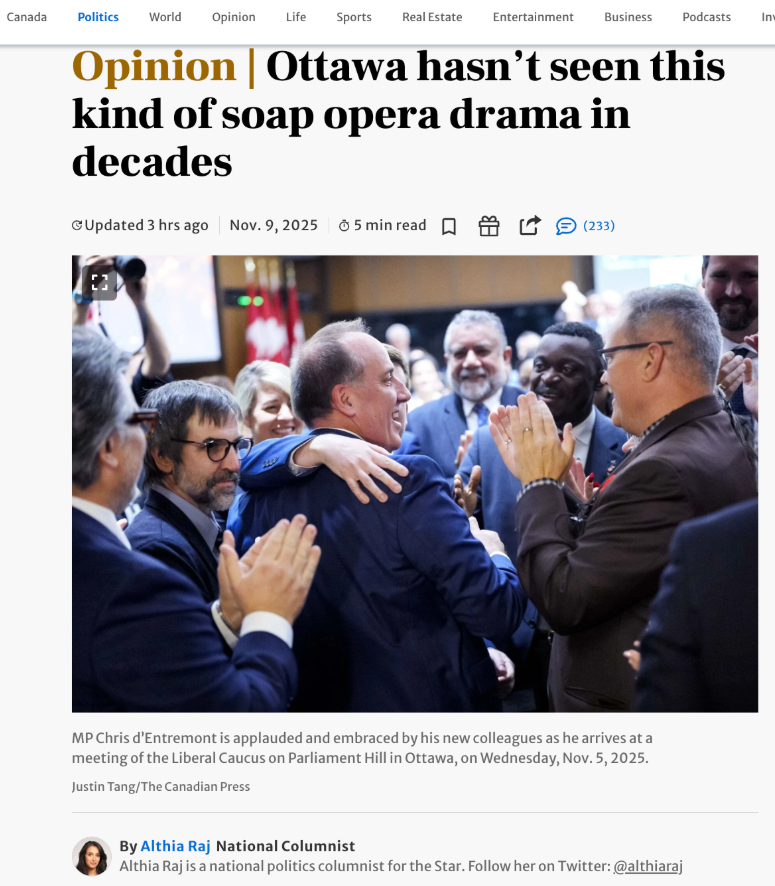
The Toronto Star will not be outdone …

This is a headline that I can’t believe the Toronto Star actually ran.

I’m pretty sure that columnist Althia Raj is old enough to remember all the way back to the morning of December 16, 2024. I know that was a REALLLLLLY long time ago, like, literally decades (please read that with a Valley girl upspeak).

If you don’t know that date, you will know what happened, because that is the day that Chrystia Freeland stabbed Justin Trudeau in the front, not the back. On the day that she was supposed to deliver the federal government’s fall economic statement, she issued a scathing resignation letter instead.

This of course also came after months of Liberal MPs pushing Trudeau to resign. A letter had even circulated among caucus members demanding he stepped down.

Liberal MPs couldn’t make Trudeau leave, Freeland’s resignation couldn’t make Trudeau leave, the 20 point lead the Conservatives then enjoyed couldn’t make Trudeau leave – it was Trump that did it.

All of that was wilder, had more drama than last week, but sure, tell people we haven’t seen this in decades. The column penned by Raj doesn’t mention Trudeau, it doesn’t mention Freeland, but it does want you to believe we haven’t seen this in like, FOREVER!

November 7, 2025

Crossing the floor in Parliament

Filed under: Cancon, Media, Politics — Tags: , , , , — Nicholas @ 03:00

It’s not an everyday thing, but I saw someone mention on social media that there had been over 300 floor-crossings since Confederation. The latest Member of Parliament to switch parties … to literally walk across the floor in Parliament to join Carney’s Liberal party is Nova Scotia’s Chris d’Entremont:

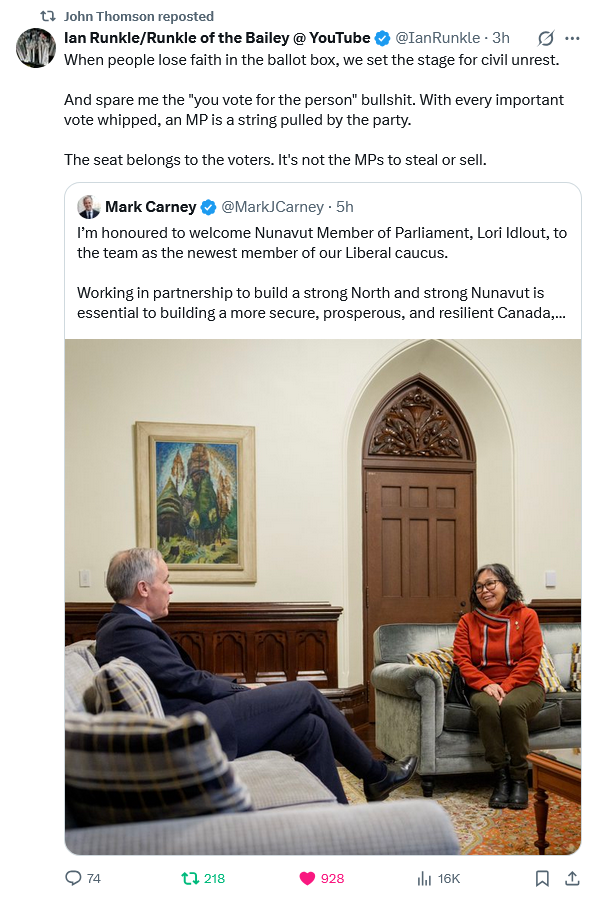
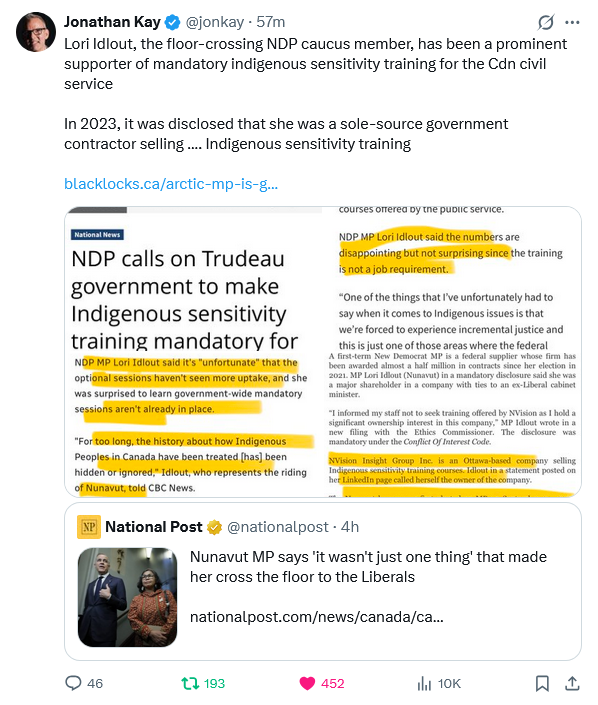
The speculation in Ottawa about floor crossers is getting silly, some of the names being pushed don’t make any sense. Which makes me think that this is really an attempt by the Liberals to try and destabilize the Conservatives.

Sorry, that would be “destablise” in Mark Carney’s new English but more on that shortly.

We have seen Liberals push name after name including Chris d’Entremont who did cross, but others who have said they have no interest in crossing. That was the case for Dominique Vien the Conservative MP from Quebec’s south shore who had to post a video after jerks like me published her name following weeks of speculation.

If you don’t speak French, let me summarize, or sumarise in Carney English. She says that she’s heard the rumours that she would be leaving the Conservative caucus to sit as a Liberal or an independent, but that’s not true. She states clearly that she is and will remain a Conservative and that she doesn’t like Mark Carney’s budget.

Meanwhile, Joël Godin, the MP for Portneuf—Jacques-Cartier a riding northwest of Quebec City, who has been named as a possible floor crosser declined to answer questions entering caucus on Wednesday. Does that mean he’s ready to cross or not just putting up with the BS?

Conservative insiders tell me that he won’t be changing teams anytime soon.

The rumour mill is insane, with Liberals pushing the idea that all kinds of Conservatives are looking to jump ship. I’ve had several Liberals tell me that Michael Chong has been looking to cross the floor, an idea that is so ridiculous that I didn’t even call Chong to ask him because anyone floating that doesn’t know the man or conservative politics.

After I mentioned that on 580 CFRA in Ottawa, Chong called me to assure me that he wasn’t crossing to the Liberals. Michael, I never doubted you.

It’s doubtful that other names Liberals are pushing will come to fruition.

What is clear is that Carney and the Liberals are reaching out to Conservative MPs and making them offers to switch parties. Are they making illegal offers? I’d really like to know what has been put forward.

Is a “comfy landing” being offered for those that will cross? It wouldn’t be the first time that kind of thing has been offered.

As to the particular motivations for d’Entremont decamping to the Liberal benches, discussions on the social media site formerly known as Twitter indicate that he just barely got elected this time around, that he’d been fired by Pierre Poilievre as Deputy Speaker, and he decided he had a better chance of getting back into Parliament as a Liberal in the next election. Quinn Patrick reports that the Liberals had been trying to get d’Entremont to join them for quite some time:

Industry Minister Mélanie Joly said the Liberals had been courting former Conservative MP Chris d’Entremont behind the scenes for five years before he ultimately crossed the aisle.

“We’ve been trying to recruit him for a long time,” Joly told reporters in French on Parliament Hill on Wednesday. “Finally, he saw the light.”

D’Entremont had served as a Conservative MP for six years, after first being elected in the 2019 election.

As several people pointed out, that conveniently meant he’s qualified for the platinum-plated MP pension plan … but I’m sure that’s not why he switched parties.

Liberal MP Kody Blois, who also represents a riding in Nova Scotia, confirmed that he and d’Entremont had been speaking “for a long time about the ways in which we can collaborate.”

“It’s great to see Mr. d’Entremont join. If there’s other members of Parliament feeling the same way, again, I think we’re always welcome to those conversations,” said Blois.

While Blois didn’t explicitly say he had been attempting to enlist d’Entremont, he said the Liberals are a big-tent party with room to accept more “moderate” conservatives.

When asked if the Carney government was actively trying to recruit more MPs, Blois said that “wouldn’t be a conversation I’m going to have right here in front of the media.”

The former Conservative MP met with Prime Minister Mark Carney at a post-budget media conference on Wednesday, saying he didn’t believe his values as a “red Tory” were being “represented.”

“I didn’t find I was represented there … my ideals of an easterner, of a red Tory and quite honestly of trying to find ways to find solutions and help the community rather than trying to oppose everything that’s happening,” said d’Entremont.

He also alluded to the possibility of other Conservative MPs “in the same boat” but stopped short of naming anyone specific, saying he would let them share their stories “if the time comes.”

However, he has been the only one to cross the aisle thus far.

Conservatives and their supporters have accused d’Entremont of betraying his constituents and his values in pursuit of his own ambitions.

October 26, 2025

“Canada’s elections used to mean something. Now they’re a joke”

Filed under: Cancon, Government, Politics — Tags: , , — Nicholas @ 03:00

Dan Knight on the recent presentation by former Elections Canada head Jean-Pierre Kingsley and current Quebec electoral officer Jean-François Blanchet to the Procedure and House Affairs Committee in Parliament:

“2019 Canadian federal election – VOTE” by Indrid__Cold – CC BY-SA 2.0

What we just witnessed in Ottawa last Tuesday wasn’t a hearing, it was a slow-motion autopsy of Canadian democracy. The Procedure and House Affairs Committee gathered to talk about the so-called “Longest Ballot Committee,” a group of self-styled activists who decided to “protest” the electoral system by flooding ridings with hundreds of fake candidates, turning the act of voting into a bureaucratic endurance test. And what did the political class do about it? They shrugged. They nodded solemnly. They said “shared responsibility.”

In other words: nothing.

Former Elections Canada chief Jean-Pierre Kingsley and Quebec’s electoral officer Jean-François Blanchet were the adults in the room, the only people who seemed to understand what’s actually at stake when you weaponize procedure to destroy trust. Kingsley, who’s been overseeing elections since before most MPs had a LinkedIn page, didn’t mince words: “The Long Ballot Initiative is unjustified and exceedingly disruptive“. In other words, a circus.

He called voting the act that “establishes the very legitimacy of Parliament”. That used to mean something in this country. Now? It’s a joke being played on the people who still believe their vote matters.

Blanchet gave the numbers that should have every Canadian furious, 40 candidates in one riding, 91 in another, 214 in a third. Two hundred and fourteen names. That’s not democracy, that’s sabotage. He called it “a movement to challenge the voting system, not to get candidates elected”. Exactly. It’s the bureaucratic version of an online troll farm.

He told MPs what voters already know: “Overly long ballots irritate voters”. You think? Imagine trying to fold a sheet the size of a blueprint just to cast a vote for your MP. And yet, for this — for actively undermining elections — no one’s been charged, fined, or even reprimanded.

Then Conservative MP Blaine Calkins finally asked the question everyone else was too polite to touch: Should there be penalties for those who make a mockery of our electoral system? Kingsley didn’t hesitate: “Yes“. He said it should go to a court of law, not a bureaucrat, not some anonymous commissioner. A judge. A real trial. Because that’s how serious this is.

Meanwhile, the Liberals on the committee did what they always do, changed the subject. Instead of talking about ballot fraud, they went off about “AI misinformation” and “deepfakes”. Liberal MPs Élisabeth Brière and Arielle Kayabaga wrung their hands about artificial intelligence like it was the Terminator coming for democracy. Never mind that the real problem was sitting right in front of them: a political culture that treats fraud as performance art.

October 23, 2025

The Liberal-funded legacy media all chorus that the Conservatives are collapsing

Filed under: Cancon, Media, Politics — Tags: , , , , — Nicholas @ 03:00

On his Substack, Brian Lilley contrasts what the legacy media are all pushing with the actual conversation among Conservatives:

Pierre and Ana Poilievre at a Conservative leadership rally, 21 April, 2022.
Photo by Wikipageedittor099 via Wikimedia Commons.

Pierre Poilievre stood before his caucus Wednesday morning and was contrite. The Conservative leader has caused himself and his party headaches since his comments about Justin Trudeau and the RCMP on the Northern Perspective podcast last week.

Will it be enough?

Time will tell but his Conservative MPs who are upset will have forgiven him long before the media will. The stories about Conservative MPs or supporters being upset have not abated and hours before Poilievre did his mea culpa, Radio-Canada, the French wing of CBC had a story with MPs sniping at Poilievre.

Of course, none of them were on the record.

Later in the day, the rumour mill started that at least one Conservative MP, most likely a Quebec MP, would cross the floor by the end of the day. I’ll tell you from experience that when rumours start on Parliament Hill, they can take on a life of their own.

Will someone cross the floor?

Perhaps, and I’ve been given names of the potential floor crossers by Liberals, but none of them have done it so far.

We wait.

It’s all part of crafting a larger narrative…

If you only consumed legacy media, you might think the Conservative Party was falling apart, that the Conservatives were falling in the polls and that fundraising had dried up. None of that is true no matter how often they tell you it is while the facts tell a different story.

Were Poilievre’s comments helpful with swing voters? Absolutely not, and while he’s not focussed on them yet, he will need to be one day so he needs to be more careful.

As I’ve stated though, Poilievre was right on the RCMP dropping the ball on SNC-Lavalin and someone should have been charged with obstruction of justice in that case.

But none of this means the Conservatives are falling apart at the seams.

Will you get people grumbling, absolutely. Will some of them turn to the media as anonymous sources, considering many turned to me months ago, sure, it’s going to happen.

I also have my own anonymous sources telling me there is no one in caucus organizing against Poilievre. Speaking to veterans of the Scheer and O’Toole palace coups, they say this is a very different feel.

People are tired, they are tired of losing, but they aren’t looking to replace Poilievre. That’s not just because there is no one waiting in the wings, they genuinely want to give him a second chance.

Given the latest Abacus poll, I’d say he’s doing okay. That poll would show a minority government if an election were held today, one that could go Liberal or Conservative.

October 9, 2025

Freedom Convoy 2022 – “… proving once again the Liberal mastery of combining high drama with low farce”

Filed under: Cancon, Government, Media, Politics — Tags: , , , , , — Nicholas @ 05:00

In the National Post, Michael Higgins states the obvious fact that Tamara Lich, Chris Barber, and the rest of the Freedom Convoy protesters were never insurrectionists. Trudeau had decided in advance that the convoy was a maple-flavoured January 6th attempt to overthrow the government — if not an attempt to re-stage the storming of the Winter Palace — and merely waited for the violence to break out and/or the Parliament buildings to be stormed. But nobody other than a few particularly glowy federal provocateurs was interested … because they were there to protest government policy not to start a revolution:

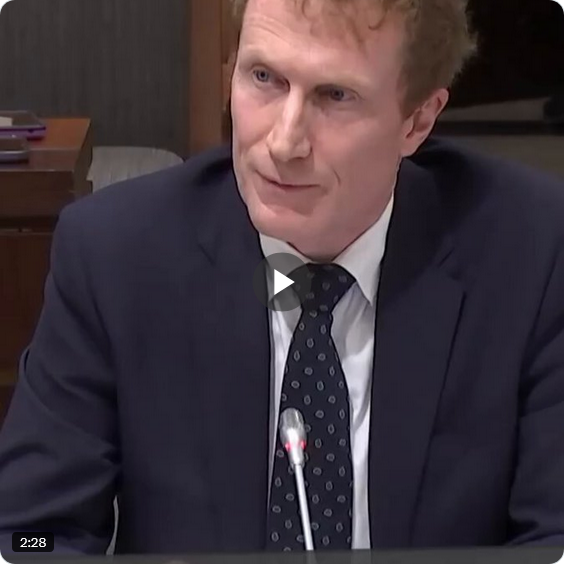
Marco Mendicino, the public safety minister of the day, portrayed them as extremists intent on overthrowing the government.

“This so-called ‘freedom convoy’ called for the overthrow of the government. They called for the Governor General to unilaterally remove the Prime Minister from office,” Mendicino told a Commons parliamentary committee.

Indeed, the Office of the Secretary to the Governor General was inundated with calls and emails by protesters demanding then prime minister Justin Trudeau be fired.

But since the Governor General can’t just decide to sack a prime minister, these email-writing anarchists were particularly inept as well as being constitutionally illiterate.

It was Shakespearean farce, but Liberals like Mendicino were happy to play politics and paint the convoy protesters as lawless subversives bent on destroying democracy.

Although, to be fair, Trudeau only said they were a “small fringe minority” with “unacceptable views” — more retrogrades than revolutionaries.

Meanwhile, Ottawa’s Keystone Kops had all the laws, rules and regulations needed to disband the convoy, they just lacked the leadership.

Days into the occupation, Ottawa Police Services chief, Peter Sloly, appeared to have thrown up his hands in resignation, stating, “There may not be a policing solution” to the crisis. Two weeks later, he quit.

In his report, the public inquiry commissioner Paul Rouleau would later criticize the “serious dysfunction within the OPS’s leadership”.

The government theatrics escalated with the imposition of the Emergencies Act, proving once again the Liberal mastery of combining high drama with low farce. Within days, police had cleared the convoy and several other blockades without incident.

This was less the power of the Emergencies Act and more to do with getting the police to just act.

September 20, 2025

BC Ferries, federal financing and Chinese shipyards

Filed under: Cancon, China, Government — Tags: , , , , , , — Nicholas @ 03:00

As you may have heard, at the same time that Canadian politicians of all parties were thumping the tub about buying Canadian, British Columbia’s provincially owned ferry corporation decided to buy new ships from China … and the federal government not only gave the deal their blessing, they added in a billion dollar underwriting guarantee to boot:

In Ottawa they call it “arm’s-length”. Out in the real world, people call it duck-and-cover. At Meeting No. 6 of the House of Commons transport committee, MPs confronted a simple, damning timeline: Transport Canada’s top non-partisan official was warned six weeks before the public announcement that BC Ferries would award a four-ship contract to a Chinese state-owned yard. Yet the former transport minister, Chrystia Freeland, told Parliament she was “shocked”. Those two facts do not coexist in nature. One is true, or the other is.

There’s an even bigger betrayal hiding in plain sight. In the last election, this Liberal government campaigned on a Canada-first message — jobs here, supply chains here, steel here. And then, when it actually mattered, they watched a billion-dollar ferry order sail to a PRC state yard with no Canadian-content requirement attached to the federal financing. So much for “Canada first”. Turns out it was “Canada … eventually”, after the press release.

Conservatives put the revelation on the record and asked the only question that matters in a democracy: what did the minister know and when did she know it? The documents they cite don’t suggest confusion; they suggest choreography — ministerial staff emailing the Prime Minister’s Office on how to manage the announcement rather than stop the deal that offshored Canadian work to a Chinese state firm.

Follow the money and it gets worse. A federal Crown lender — the Canada Infrastructure Bank — underwrote $1 billion for BC Ferries and attached no Canadian-content requirement to the financing. In plain English: taxpayers took the risk, Beijing got the jobs. The paper trail presented to MPs is smothered in black ink — hundreds of pages of redactions — with one stray breadcrumb: a partially visible BC Hydro analysis suggesting roughly half a billion dollars in B.C. terminal upgrades to make the “green” ferry plan work. You’re not supposed to see that. You almost didn’t.

How did the government side respond? With a jurisdictional shrug. We’re told, over and over, that BC Ferries is a provincial, arm’s-length corporation; the feds didn’t pick the yard, don’t run the procurement, and therefore shouldn’t be blamed. That line is convenient, and in a technical sense it’s tidy. But it wilts under heat. The federal lender is still federal. The money is still public. If “arm’s-length” means “no accountability”, it’s not a governance model — it’s a get-out-of-jail-free card.

The fallback argument is economic fatalism: no Canadian shipyards bid, we’re told; building here would have taken longer and cost “billions” more. Maybe that’s true, maybe it isn’t — but it’s the sort of claim that demands evidence, not condescension. Because the last time Canadians heard this script, the same political class promised that global supply chains were efficient, cheap and safe. Then reality happened. If domestic capacity is too weak to compete, that’s not an argument for outsourcing permanently; it’s an indictment of the people who let that capacity atrophy. And if you swear “Canada first” on the campaign trail, you don’t bankroll “China first” from the Treasury bench.

Dr. Leslyn Lewis on X:

September 19, 2025

Edmund Burke, lawfare, and the East India Company

In The Coolidge Review, Amity Shlaes discusses “the most outrageous campaign of lawfare in the history of the Anglosphere”, as Edmund Burke assailed Warren Hastings, the first governor general of India:

Why do even principled statesmen — and there are some in this administration, too — not dig in their heels and try to arrest the chain of revenge? Why do even cautious, logical men and women succumb to the passion of lawfare?

The most outrageous campaign of lawfare in the history of the Anglosphere, the impeachment and trial of the first governor general of India, Warren Hastings, was mounted by Mr. Incrementalism himself, Edmund Burke. The father of modern conservatism spent nearly a decade of his time in Parliament—from 1787 to 1795—crusading against Hastings, antagonizing allies all around.

Impeaching the “Wicked Wretch”

There were reasons to investigate what was going on in India: Hastings exploited the fact that the East India Company was, at that time, an adjunct of the Crown. That connection between a powerful company and a government — a far more powerful company than, say, Intel — was the trouble, for as Burke would put it, it created “a state in disguise of a merchant“.

Burke chose to prosecute Hastings — and failed. The “wicked wretch”, one of Burke’s slime phrases for Hastings, emerged from the ordeal with a pension, not a conviction. Burke biographer Russell Kirk has argued that the public flaying of Hastings served posterity — in England at least. After Burke’s death, at “every grammar and public school”, the story of Burke and Hastings “impressed upon the boys who would become colonial officers or members of Parliament some part of Burke’s sense of duty and consecration in the civil social order”. That slowed another chain, the chain of abuse by Britons of Indians. After Burke, England recognized that, as Kirk puts it, she had a “duty to her subject peoples in the East”.

Still, even Kirk’s excellent biography leaves readers wondering: Was Hastings truly the archest of the arch villains, as Burke maintained? And is this the right way to go about it all? A book that Burke penned in the same years that he waged his Hastings war, Reflections on the Revolution in France, influenced a far greater number, and in a greater number of lands, than the Hastings story. Burke might have had the same reach with a Reflections on the Abuses of the East India Company.

All the more welcome then is James Grant’s Friends Until the End, which gives the best-yet account of the chain reaction in Burke’s soul that drove him to weaponize government, what his crusade cost him, and what such crusades may cost all of us.

[…]

Next, however, came a challenge that deeply frustrated Burke. Scanning the empire’s horizon for a place to commence a model reform, Fox and Burke settled on the East India Company, which abused the some thirty million Indians it oversaw with the same admixture of plunder, condescension, and cruelty familiar to Catholics of Ireland. The pair put their hearts into the Indian reform: Fox promised a “great and glorious” reform to save “many, many millions of souls”. They also put their minds into the project. To track the East India Company, Burke personally purchased sufficient shares to win him rights to attend and vote at quarterly meetings. He steeped himself in knowledge of a land he’d never seen, learning names of “numerous Indian nawabs, rajas, nizams, subahs, sultans, viziers, and begums“.

Such prep work, as Grant points out, enabled the Whigs to identify the correct solution: de-mercantilization. “Separate the company’s two incompatible missions: sovereign rule and moneymaking”, Grant writes. The compromised statute that emerged from the House of Commons was not as neat: A seven-man commission would rule India, while a board would govern East India’s commercial operations. But the commercial board would be a subsidiary to the commission. And in marshaling their votes for the measure, the pair still confronted the formidable obstacle of East India shareholders in Britain, furious at the threat to their fortunes that such reform represented. Fox might emancipate Hindus, their opponent William Pitt warned, but he must also “take care that he did not destroy the liberties of Englishmen”.

The king and his allies in any case defeated Fox’s India Bill, as it was known, in the House of Lords. The king, who had that prerogative, booted Fox and Burke from paid posts. In the 1784 general election, Burke held on to his seat in Parliament, as did Fox (by a hair), but so many Whigs, now labeled “Fox’s martyrs”, were ousted by voters from Parliament that the Whigs’ opponent, Pitt, became prime minister. Burke’s disillusionment ran deep: “I consider the House of Commons as something worse than extinguishd”, he wrote.

It was thus, at the age of fifty-nine and merely an opposition parliamentarian, that Burke risked his high-stakes lawfare. He commenced impeachment proceedings with a four-day anti-Hastings polemic. Of course, Burke universalized his point: The Hastings trial was “not solely whether the prisoner at the bar be found innocent or guilty, but whether millions of mankind shall be made miserable or happy”. And of course he raised the stakes for fellow lawmakers by appealing to their honor: “Faults this nation may have; but God forbid we should pass judgment upon people who framed their laws and institutions prior to our insect origin of yesterday!” The House must join him in impeachment, the Lords convict Hastings.

The House did join him, handing to the Lords charges that Hastings had “desolated the most flourishing provinces”, “pressed, ruined, and destroyed the natives of those provinces”, and violated “the most solemn treaties”. In thousands of hours of speeches before a jury from the House of Lords, the eager prosecutor, Burke, dwelt on Hastings’s cruelty to the Rohillas, an Afghan tribe from land bordering Nepal. He also charged that Hastings had taken revenge on a crooked tax collector, Nandakumar, for alleging that he — Hastings — had taken a bribe, seeing to it that Nandakumar was convicted and hanged for forgery. Not all of this was proven. And, as the jury of Lords slowly considered the charges, as the months and years passed, Burke found himself more and more isolated. Fox, Burke’s initial ally in the undertaking, faded. By the time the Lords’ jury voted not to convict, eight years on, a full third of their original number had already passed away.

September 16, 2025

A rare thing … Canada’s Parliament in session

Filed under: Cancon, Media, Politics — Tags: , , — Nicholas @ 03:00

On his Substack, Brian Lilley noted on Monday that we’ve had very little chance to see the Canadian Parliament in action so far in 2025:

Parliament returns for the fall sitting today, it’s the first time the House of Commons has met since June 20. What’s remarkable is that in the 257 days that we’ve counted in 2025, the House has only met for 20 of them.

As it stands now, the House has not met in 87 days.

More remarkable, the House didn’t sit between December 17, 2024 and May 2025, all during a time of national crisis. Add to that the fact that between the end of September 2024 and the opening of the new Parliament on May 26, 2025 no government business was conducted due to the green slush fund scandal and the Trudeau government’s refusal to release documents to the House.

To say our democratic institutions haven’t been well served over the last year would be an understatement.

Over the last year, the oversight function of the House of Commons hasn’t been working as it should in our system. We’ve either had inaction by government or for most of this year, government by decree with little to no oversight by the people’s representatives.

Hopefully that changes today with a new sitting.

A change in tone…

One thing we’ve heard lots of chatter about is the need for a new tone, but primarily that’s been aimed at Conservative Leader Pierre Poilievre. Let me point out that Prime Minister Mark Carney is also new to this and we didn’t get the full measure of the man back in the spring.

The relationship between Justin Trudeau and Pierre Poilievre was acrimonious to say the least.

Trudeau towards the end was despised by Canadians and Poilievre couldn’t hit him hard enough in Question Period. Canadians would cheer as Poilievre would use his formidable Parliamentary skills to skewer Trudeau in the House of Commons.

Of course, Trudeau was part of the demise of the relationship and civility in the House as he showed utter contempt for the opposition, for Parliamentary rules and by extension to millions of Canadians.

Well, it’s a new government, a new leader in Carney and so yes, we can expect a new tone coming from both sides. We’ve already seen it from Poilievre in his many media appearances and news conferences over the past several months.

Poilievre has said that he and his party will oppose the government on issues where they disagree, support them on areas where they agree and offer practical solutions to the problems facing the country. That’s exactly what you want from an opposition party, which should in fact operate as a government in waiting.

July 10, 2025

Mandatory online age verification

Michael Geist discusses the rush of the Canadian and other governments in the west to try to impose one-size-fits-all age verification schemes on the internet:

The Day I Knew I Was Old 😉 by artistmac CC BY-SA 2.0

When the intersection of law and technology presents seemingly intractable new challenges, policy makers often bet on technology itself to solve the problem. Whether countering copyright infringement with digital locks, limiting access to unregulated services with website blocking, or deploying artificial intelligence to facilitate content moderation, there is a recurring hope the answer to the policy dilemma lies in better technology. While technology frequently does play a role, experience suggests that the reality is far more complicated as new technologies also create new risks and bring unforeseen consequences. So too with the emphasis on age verification technologies as a magical solution to limiting under-age access to adult content online. These technologies offer some promise, but the significant privacy and accuracy risks that could inhibit freedom of expression are too great to ignore.

The Hub runs a debate today on the mandated use of age verification technologies. I argue against it in a slightly shorter version of this post. Daniel Zekveld of the Association for Reformed Political Action (ARPA) Canada makes the case for it in this post.

The Canadian debate over age verification technologies – which has now expanded to include both age verification and age estimation systems – requires an assessment of both the proposed legislative frameworks and the technologies themselves. The last Parliament featured debate over several contentious Internet-related bills, notably streaming and news laws (Bills C-11 and C-18), online harms (Bill C-63) and Internet age verification and website blocking (Bill S-210). Bill S-210 fell below the radar screen for many months as it started in the Senate and received only cursory review in the House of Commons. The bill faced only a final vote in the House but it died with the election call. Once Parliament resumed, the bill’s sponsor, Senator Julie Miville-Dechêne, wasted no time in bringing it back as Bill S-209.

The bill would create an offence for any organization making available pornographic material to anyone under the age of 18 for commercial purposes. The penalty for doing so is $250,000 for the first offence and up to $500,000 for any subsequent offences. Organizations can rely on three potential defences:

  1. The organization instituted a government-approved “prescribed age-verification or age estimation method” to limit access. There is a major global business of vendors that sell these technologies and who are vocal proponents of this kind of legislation.
  2. The organization can make the case that there is “legitimate purpose related to science, medicine, education or the arts”.
  3. The organization took steps required to limit access after having received a notification from the enforcement agency (likely the CRTC).

Note that Bill S-209 has expanded the scope of available technologies for implementation: while S-210 only included age verification, S-209 adds age estimation technologies. Age estimation may benefit from limiting the amount of data that needs to be collected from an individual, but it also suffers from inaccuracies. For example, using estimation to distinguish between a 17 and 18 year old is difficult for both humans and computers, yet the law depends upon it. Given the standard for highly effective technologies, age estimation technologies may not receive government approvals, leaving only age verification in place.

June 10, 2025

QotD: From Witan to Magna Carta

Filed under: Britain, Government, History, Quotations — Tags: , , , , , , — Nicholas @ 01:00

About 1,500 years ago, in Saxon England, the nobles of the realm, the bishops, abbots (and abbesses) and the ealdormen and thegns and others would gather, fairly regularly, in an assembly to advise and, sometimes, to constrain the king. In a very typically English manner, they hit upon the notion that the kings were not, generally, wicked or stupid, but they did too many dumb things just because they could. The reason that kings could, too often, do whatever they wanted was simple: they had an almost unlimited power to levy taxes.

After a few hundred years of trial and error, and given a king who really was wicked and stupid, too, they, the barons as they were then known, went to war with their king and bent him to their will by forcing him to agree to a great charter of their rights. There was a bit of ringing language about no free man being taken except after a trial by a jury of his peers, but, basically, in very typically English fashion, the rights about which the great charter was most concerned were property rights because the barons had learned, over the centuries that only by controlling the pursestrings could they really control the king.

A few hundred years later, one of liberalism’s and democracy’s greatest voices told us that we have three absolutely fundamental, natural rights: to life, to liberty and to property. These rights were not and still are not unlimited. There were and are ways to lawfully and properly deprive a person of his property and his liberty and, in some countries, even his life.

A few centuries after John Locke another philosopher wanted to do away with the right to property: “From each according to his ability, to each according to his need”, Karl Marx wrote, and many, far too many, believed. The only real problem with Marx’s notion is that it requires that humans are perfect … and most of us know how rare that is. Here in Canada, especially since the early years of the 20th century, we have had far too much Marx and far too little Locke.

Ted Campbell, “Democracy is in peril”, Ted Campbell’s Point of View, 2020-06-12.

June 9, 2025

The federal Minister of Public Safety admits he knows literally nothing about Canadian gun laws

Filed under: Bureaucracy, Cancon, Government, Media, Politics, Weapons — Tags: , , , , , — Nicholas @ 03:00

Prime Minister Mark Carney’s cabinet may actually be worse than any line-up of ministers under Justin Trudeau, with the Minister of Public Safety as a poster child for ignorance and apathy:

[…] Then we have the Minister of Public Safety, Gary Anandasangaree — a Trudeau–Carney loyalist freshly installed under the new Liberal minority regime — who made headlines not for bold leadership, but for a shocking display of ignorance on the very file he’s been assigned to oversee: firearms policy.

During a session of debate on the current spending bill, Conservative MP Andrew Lawton posed a basic question:

    “Do you know what an RPAL is?”

An RPAL, or Restricted Possession and Acquisition Licence, is a standard certification required by law for any Canadian who wants to own restricted firearms, such as handguns or certain rifles. It’s a core element of Canada’s legal firearms framework.

The Minister’s response?

    “I do not.”

Lawton followed up with another foundational question:

    “Do you know what the CFSC is?”

The CFSC, or Canadian Firearms Safety Course, is a mandatory course required for all individuals seeking to obtain a firearms license in Canada — including the RPAL. It’s the very first step every legal gun owner in the country must complete. This is basic civics for anyone involved in firearms policy.

Anandasangaree replied again:

    “I do not know.”

This wasn’t a “gotcha” moment. It was a revealing moment. The Minister of Public Safety, the individual charged with implementing gun bans, overseeing buyback programs, and crafting firearms legislation, has no familiarity with the fundamental licensing and safety processes every Canadian gun owner must follow.

In any other profession, this level of unpreparedness would be disqualifying. If a surgeon couldn’t name a scalpel, he’d be pulled from the operating room. But in Ottawa? It qualifies you to oversee a multi-hundred-million-dollar national gun seizure operation.

And that brings us to the next moment of absurdity.

Lawton asked the minister how much money had already been spent on the federal firearms buyback program, the centerpiece of the Liberal government’s Bill C-21, which targets legally acquired firearms now deemed prohibited.

Anandasangaree’s answer?

    “About $20 million.”

But that doesn’t match the government’s own published data. In a report tabled by Public Safety Canada in September 2023, it was disclosed that $67.2 million had already been spent on the buyback as of that date. The majority of that spending was attributed to “program design and administration” — before a single firearm had even been collected.

So what happened? Did the government refund tens of millions of dollars? Were contracts cancelled? Of course not.

They just reframed the accounting — separating so-called “preparatory costs” and implying they don’t count as part of the buyback, even though they exist entirely to implement it.

It’s not transparency. It’s political bookkeeping — a deliberate attempt to make a costly, unpopular program appear manageable.

And it didn’t end there. When Lawton asked for the number of firearms that had actually been collected under the buyback, the response was yet another dodge. The Minister and his department couldn’t provide a number.

That’s right: after spending over $67 million, the federal government can’t even say how many guns have been retrieved. Yet they’re moving full steam ahead, with the support of a minister who doesn’t understand the system he’s responsible for.

This isn’t policymaking. It’s blind ideology strapped to a blank cheque. And the people paying the price are law-abiding citizens — not criminals, not gangs, and not smugglers.

At this rate, I can’t imagine how he’ll still be in cabinet by the end of summer.

May 31, 2025

Depending on how you read the tea leaves, are all the signed treaties now to be ignored?

Filed under: Cancon, Government, History — Tags: , , , , , — Nicholas @ 04:00

In The Free Press Rupa Subramanya discusses King Charles’s land acknowledgement at the start of the Throne Speech earlier this week:

Mark Carney joins our visiting King in the traditional Making of the Small Talk.
Photo by Paul Wells from his Substack

Canadians have a fondness for land acknowledgments, [NR: while some of us think they’re merely virtue signalling on steriods which will end up causing more mischief in the long run] which have now become common at police press conferences, on Air Canada flights, at hockey games, and even at a Taylor Swift concert.

But nothing has caused more commotion than the spectacle of King Charles III opening the 45th legislative session of Parliament on May 27 with a land acknowledgment, when he declared from his throne: “I would like to acknowledge that we are gathered on the unceded territory of the Algonquin Anishinabe people. This land acknowledgment is a recognition of shared history as a nation.”

People will point out that King Charles’s speech was written by Canadian prime minister Mark Carney’s government (true) and that as the monarch he was being respectful to Canadian traditions (fine). But there is something deeply funny about the literal King of England talking about the lands his predecessors brutally conquered centuries ago like they’re still up grabs.

Kicking off Parliament with a speech is a time-honored tradition, but it’s rare for the monarch to deliver it in person, and is normally delivered by the governor general, Canada’s official stand-in for the king. The reason the king was there was to push back against the idea that Canada is for sale.

“There is no better way to assert Canada’s sovereignty than by inviting the sovereign,” said Philippe Lagassé, a constitutional expert at Carleton University in Ottawa, Ontario. “Carney invited the king as part of his renewed emphasis on Canadian nationalism rooted in our institutions and history.” (Unlike the U.S., which broke from Britain in 1776, Canada remained a colony until 1867, when it became a constitutional monarchy with a British-style parliamentary system and the UK monarch as head of state.)

Lagassé added that Carney’s invite to Charles was also likely done to “leverage President Trump’s affection for the king in Canada’s favor.”

Trump may love the monarchy, but Canadians have traditionally been indifferent towards it. But that’s changing, thanks to Trump’s “51st state” rhetoric.

According to a recent poll, 66 percent of Canadians now believe the monarchy helps set the country apart from the United States, up from 54 percent in April 2023. In 2023, 67 percent thought the royal family should have no formal role in Canadian society; today, that number has dropped to 56 percent.

In his speech, King Charles didn’t mention Trump by name, but the subtext was hard to miss: “Canada faces another critical moment. Democracy, pluralism, the rule of law, self-determination, and freedom are values which Canadians hold dear, and ones which the government is determined to protect.”

May 29, 2025

The King of Canada

Filed under: Britain, Cancon, Government, History — Tags: , , , , , , — Nicholas @ 04:00

In the National Post, Colby Cosh tweaks the berries of the tiny number of dedicated Canadian republicans:

King Charles III and Queen Camilla, official portrait by Millie Pilkington.

The Post and other Canadian organs have been full of conscious praise for our unusual absentee monarchy lately, what with the King being in the capital to give the throne speech in person. But Canadian republicans must be hoping that our people will instinctively reject the spectacle, and at least see the genuine need for that blessing without which no sovereign state can hope to be taken seriously — a president.

There are rumblings about behind-the-scenes diplomatic tensions between Canada and the United Kingdom over the royal visit, rumblings which the Sunday Times (of London) put in print this weekend. The crux of the story is that Canada and the U.K. are not quite using the same playbook in dealing with the volatile and cutthroat Trump administration.

Sir Keir Starmer’s Labour government is applying lots of soft-soap, using Trump’s fondness for the British monarchy and its highly ornamented nature as a means of getting special treatment in trade negotiations. Meanwhile, Canada and its government hope to use the presence in Canada of Canada’s King as a subtle way of asserting independence, determination and strength as we bear the economic blows of Trumpian whim.

And — wait for it — the crazy part is, THOSE TWO KINGS ARE THE SAME EXACT DUDE. WHAAAT?

To a republican, this seems like a mystery concocted to obfuscate a logical weakness in the system. No doubt they see it just the same way an atheist looks at the centuries of early Christian debate over the Holy Trinity. It’s not exactly as though the U.K. and Canada are at war, or as though there is any overt disharmony between the two states. But the monarchists have to concede at least this much: when mutually sovereign countries have a shared head of state, you do in fact end up with the exotic possibility that George XIV of Canada might one day, in theory, have to issue a declaration of war on George XIV of Great Britain and Northern Ireland. This is baked into the improvised post-Imperial ontology of our government and of Britain’s.

This is why Canadian monarchists are so fussy about the independent constitutional footing on which the Canadian Crown rests. We do this, implicitly insisting that our system of government was reinvented in 1931, while at the same time arguing that the advantages of monarchy include antiquity, historical continuity and the preservation of a special bond between Commonwealth realms. Perhaps we are sneaky imperialist (or racist) hypocrites. Perhaps we just feel that those advantages are legitimate and important, and that the Statute of Westminster is an optimum compromise that preserves them while guaranteeing our sovereign freedom of action in the interplay of governments.

May 28, 2025

The Throne Speech

Filed under: Cancon, Media, Politics, USA — Tags: , , , , , — Nicholas @ 03:00

On his Substack, Paul Wells reports on the first Throne Speech delivered by the reigning monarch since the 1970s:

Mark Carney joins our visiting King in the traditional Making of the Small Talk.
Photo by Paul Wells from his Substack

We’re like Charlie Brown with Lucy’s football, or I guess, since the new PM is said to prefer British spellings, Charlye Brownne with Lewsey’s Foote Ball. Each generation of Canadian leadership tries to find a new way to make throne speeches exciting. These attempts are forever doomed, because no generation of Canadian leadership is exciting and because the format — a statement of intent from a dignitary who is forbidden to harbour autonomous intent — tends to short-circuit the delivery.

This time the delivery mechanism was the King of Canada, Charles Philip Arthur George, popping over from his secondary residence at Buckingham. His French tops Mary Simon’s, though his Inuktitut is shaky. He did his best to sound excited, or resolute, about the CBSA’s “new powers to examine goods”.

A quarter-century ago the reliably impish John Fraser told me he was preparing a book called Eminent Canadians that would survey recent developments in four Canadian institutions. The institutions he’d selected were the office of the Prime Minister; the Globe and Mail; the Anglican Church; — and here Fraser urged me to guess the fourth. Canadian institution? I dunno, the armed forces? The NHL? “The Crown”, Fraser said with a twinkle. Thus was I prepped for this week’s extended round of you-know-he’s-really-the-king-of-Canada browbeating.

This throne speech was like many before it, though out of deference for the deliverer it was on the short side, 21 pages tucked inside wide margins. In substance it was a paraphrase of Mark Carney’s already-semi-legendary Single Mandate Letter for cabinet ministers. There were sections on redefining Canada’s relationship with the United States; on internal trade; on crimefighting and national defence; and on “spending less and investing more”, which, I mean, we’ll see.

The mandate letter seems to have supplanted the Liberal election platform as the main blueprint for Carney’s action. The two aren’t wildly incompatible, but the mandate letter/throne speech is streamlined and puts stuff in different order.

I saw two surprises big enough to make me write today, but first I want to point to a few elements that are worth noting in the less-surprising stuff. That’s right, I’m trying to be useful, not just smart-assed, so here’s a way to thank me. […]

First, Carney (through His Majesty) makes claims for the “new economic and security relationship with the United States” that seem unrealistic. He expects “transformational benefits for both sovereign nations”. But surely any cross-border negotiation can only be, at best, an exercise in damage control? Any security costs that would be newly borne by Canada would represent a net cost. Trade arrangements short of the substantially free trade we’ve enjoyed for 40 years will also represent a net cost. The point of seeking “one Canadian economy” and taking relations with third countries more seriously is to offset the cost of a degraded Canada-US relationship, no?

Under “more affordable”, the throne speech repeats campaign promises for income-tax cuts and cuts to GST on new homes. The list of tangible financial benefits to individuals doesn’t go much past that. “The Government will protect the programs that are already saving families thousands of dollars every year. These include child care and pharmacare.” “Protect” is an old Ottawa word meaning “not extend”.

The goals for the “one Canadian economy” now include “free trade across the nation”, at both federal and provincial levels of government, “by Canada Day”. Which is 34 days away. The staffing and mandate of another new entity, a single-wicket “Major Federal Project Office”, may end up mattering more to this government’s success and Canada’s prosperity than the name of the PM’s next chief of staff, so put an asterisk next to that.

The government repeats a mysterious claim I’ve found shaky since Carney became a Liberal leadership candidate. It “will take a series of measures to catalyse new investment to create better jobs and higher incomes for Canadians. The scale of the Government’s initiative will match the challenges of our times and the ambitions of Canadians.” The challenges of our times, at least, are large.

So again: if the Canada Infrastructure Bank, the Canada Growth Fund and the Freeland-Sabia investment tax credits are sufficient to catalyse (British spelling) new investment, why duplicate them?

And if they haven’t worked, why keep them?

« Newer PostsOlder Posts »

Powered by WordPress