Quotulatiousness

May 24, 2025

German democracy trembles as the extremely extreme extreme right AfD aren’t going to be banned

Filed under: Germany, Media, Politics — Tags: , , — Nicholas @ 04:00

eugyppius updates us on the continued shaky state of German democracy, as the scary extremely extreme right Alternative für Deutschland (AfD) party seems to have somehow escaped being banned from participation in politics due to some ridiculous “lack of substantive evidence” excuse:

Last week, a supersecret assessment of Alternative für Deutschland by the Federal Office for the Protection of the Constitution (BfV) leaked to the press. This document was supposed to prove, in excruciating detail, why the AfD are so evil and so fascist and so Nazi and so Hitler, and in this way make a preliminary case for banning the party. In fact its contents turned out to be such an arrant joke that it sapped all remaining momentum within the German political class to prohibit the AfD. I suspect even the “right-wing extremist” classification of the AfD is now in jeopardy and may well be thrown out by the courts, that is how bad this much-heralded supersecret assessment turned out to be.

It took a few days for the full impact of the report’s idiocy to really sink in. That’s how it is with really stupid things – the incredulity they inspire must first dissipate. Finally, though, on Tuesday of this week, Interior Minister Alexander Dobrindt announced that the dubious evidence marshaled by the BfV was “not sufficient” to support ban proceedings. Dobrindt also said that the whole debate had become “counterproductive” and that it was time to begin finding ways to “end social polarisation”, whatever that means. Hours later, it emerged that Chancellor Friedrich Merz had ordered the entire CDU leadership never to say another word about banning the AfD. If everyone will just shut up, Merz believes his party can “avoid further debate” and avoid “giving voters the impression that the CDU is aiming to eliminate a rival party” – which is of course exactly what the CDU were hoping to do until the BfV fucked everything up with their retarded 1,108-page collection of dyspeptic Facebook-grade political takes.

There’s still a few scattered calls for ban proceedings coming from the left, but their heart isn’t in it and they don’t matter anyway. Without Union votes, no ban application will ever get to the Federal Constitutional Court in Karlsruhe. Raed Saleh, an extremely obnoxious politician who heads the SPD faction in the Berlin House of Representatives, whined to the press this morning about how “appalling and disgraceful” it is that outlawing the opposition is no longer on the table and that his party is now being asked to “engage in political debate” with the AfD instead. Federal Justice Minister Stefanie Hubig, also of the SPD, likewise fervently hopes that the AfD might still be banned and she thinks the Interior Ministry should spend more time “evaluating” that BfV dumpster-fire assessment. Since Hubig is Justice Minister and not Interior Minister it doesn’t really matter what she thinks the Interior Ministry should be doing. I don’t understand why so many are citing Hubig’s remarks like they mean anything.

The implosion of this ban-the-AfD arc seems like kind of a big deal to me. Since 2021, the party have been “under suspicion” of right-wing extremism, but despite four years of snooping the BfV have been able to come up with nothing that is not some combination of legally irrelevant, harmless, banal, uninteresting, stupid and a complete waste of government resources. At some point, you have to put the question: If the AfD are so evil and so Nazi and so fascist and so Hitler, why can’t anybody, anywhere, adduce any evidence of their evil Nazi Hitler fascism?

May 22, 2025

Trump, “the American Mussolini”, versus ever-so-democratic Mark Carney

Filed under: Cancon, Government, Media, Politics, USA — Tags: , , , , , — Nicholas @ 03:00

In the National Post, John Robson contrasts the authoritarian dictator at the helm of the American ship of state with our peaceful, democratic, and fully accountable to the voters prime minister:

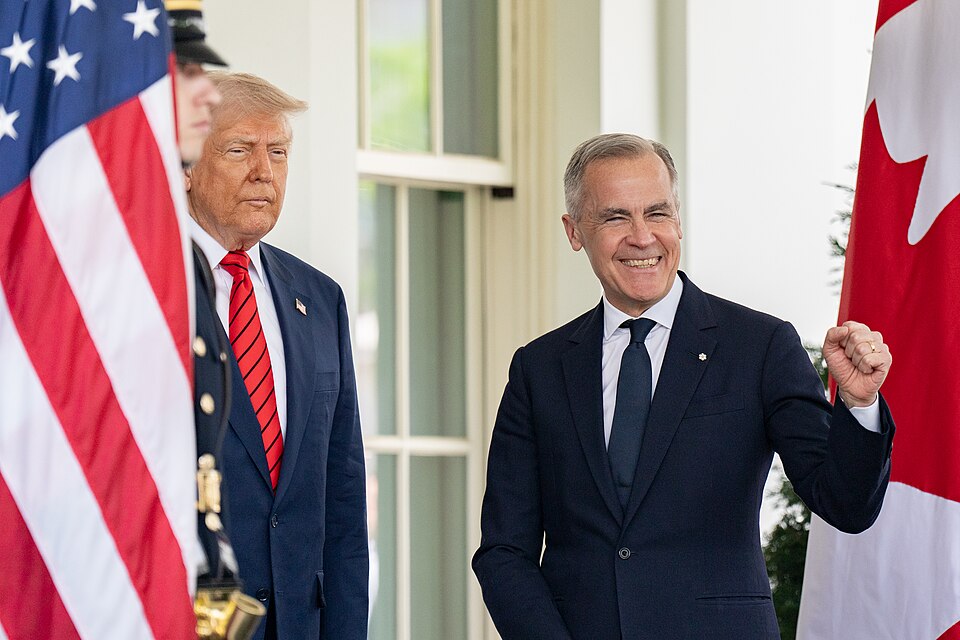
President Donald Trump greets Prime Minister of Canada Mark Carney, Tuesday, May 6, 2025, at the West Wing entrance of the White House.
(Official White House Photo by Gabriel B Kotico)

It was the best of budgets, it was the worst of budgets, it was the age of restraint, it was the age of profligacy, it was the epoch of the legislature, it was the epoch of the executive, it was the season of open debate, it was the season of closed doors, it was the spring of Canada, it was the winter of America. Or possibly the other way around.

The confusion arises because as a patriotic Canadian I keep hearing how U.S. President Donald Trump is an American Mussolini who has abolished the last vestiges of the old Republic, so we should drink rye not bourbon or some other decisive action easily performed while sitting down. Yet the news media mysteriously insist that the Bad Orange Man is having trouble getting his budget through some quaint relic called the United States Congress while Green Mark Carney isn’t bothering to get his spending plans rubber-stamped by some quaint relic called the Canadian Parliament. How can it be?

Tuesday’s the Morning newsletter from the New York Times, which is no MAGA outlet, reads: “Speaker Mike Johnson has a math problem. He wants to pass a megabill before Memorial Day to deliver President Trump’s legislative agenda.” But with only three spare votes in the House, “there are way more than three G.O.P. dissenters, and they don’t agree on what the problem is. Some think the cuts to Medicaid are too large. Others think they’re too small. Some want to purge clean-energy tax breaks. Others want to preserve them because their constituents have used them.”

Likewise The Atlantic, part of the thundering herd of independent liberal American minds, says: “The struggle to pass Donald Trump’s second-term agenda in Congress has never been between Republicans and Democrats … it’s been a battle between the House and Senate GOP, between moderates and hard-liners, and, most salient, between Republicans and reality.”

Egad. What manner of rambunctious folly is this? Open debate within the Maximum Leader’s own party? Dictatorship! By contrast here in decorous Canada can someone remind me which inane or malicious measures from former prime minister Justin Trudeau were ever put at risk by the principled courage, truculence or mere pandering even of his NDP coalition non-partners, let alone the trained seals in red?

Periodically one would bark. But which ever bit? To be sure, as the Canadian Press noted on Sunday, “Prime Minister Mark Carney says the Liberal government will present a federal budget in the fall, allowing time for clarity on some key economic and fiscal issues to emerge”. But if there’s going to be a brawl, it will be inside his office, or head, with his finance minister promising to brush aside Parliament with an “economic statement” before Carney overrode him, saying the government would introduce “a much more comprehensive, effective, ambitious, prudent budget in the fall”.

May 13, 2025

Checking on the parlous state of German democracy this week

Filed under: Germany, Government, Media, Politics — Tags: , , , , , — Nicholas @ 05:00

First, Sabine Beppler-Spahl points out how difficult it was for the new ruling coalition to get their candidate for Chancellor actually installed:

German Chancellor Friedrich Merz, 5 May 2025.
Photo by Sandro Halank for Wikimedia Commons.

The spectacle in the Bundestag this week sent shockwaves through Germany’s political establishment. For the first time in modern German history, a chancellor candidate – Christian Democratic Union (CDU) leader Friedrich Merz – failed to get elected by parliament. In the first round of voting, he received just 310 out of 621 votes – six votes short of the necessary majority. A total of 18 members of his own coalition brazenly refused to support him.

A second round of voting was then called and Merz managed to scrape through with 325 votes. But this was a stinging embarrassment for both Merz himself and the new coalition government more broadly. “Never before has there been a political car crash on such a scale”, wrote Berthold Kohler, editor of the conservative FAZ.

In hindsight, Merz’s failure shouldn’t have been such a surprise. From the beginning, the new government was always going to be in for a rough ride. For a start, it is made up of two parties that both received phenomenally bad results in February’s federal elections. The CDU suffered its second-worst result since its founding. Meanwhile, the CDU’s coalition partner, the Social Democrats (SPD), received its worst result ever.

Worse still, the coalition was losing even more support in the polls in the weeks running up to the chancellor vote. At times, the governing parties barely managed 40 per cent between them. Hermann Binkert, head of the INSA polling institute, described this as a “loss of approval like never before in the period between a federal election and the formation of a new government”.

Many commentators are now questioning whether Merz and his coalition will ever truly recover from this humiliation. The fiasco certainly confirms that Germany is in a deep political crisis, which isn’t going anywhere. It also undermines the smug assertions of Europe’s anti-populist establishment, which has been claiming, against all evidence to the contrary, that German politics is less prone to populist upheavals than those of other Western democracies.

Outside parliamentary machinations, the move to declare the largest opposition party to be a formal threat to German democracy isn’t going smoothly either:

On 2 May, the Federal Office for the Protection of the Constitution (BfV) yielded to intense pressure from their boss, Interior Minister Nancy Faeser, and declared Alternative für Deutschland to be a “confirmed right-wing extremist organisation“. The media filled with hit pieces and leftoids began a new round of shouting and morally hyperventilating about the evil fascist Nazi Hitler party. I thought we might be seeing the beginning of an earnest campaign to prohibit the AfD and that over the coming weeks the momentum would just build and build.

Instead it’s kind of fizzled out.

One thing that went wrong, was the roll-out. The AfD immediately filed suit with the Cologne Administrative Court to have their extremist status lifted, and the BfV ended up temporarily suspending their assessment for tactical reasons – above all, to avoid a temporary court injunction that the AfD could portray as a victory. I’ve said many times that a lot of the media pressure against the AfD seems to be coordinated by the constitutional protectors themselves. Now that they’re no longer agitating behind the scenes, the steady drumbeat of pearl-clutching news stories has ground to a halt.

The second thing that has gone wrong, is the publicity campaign. You may remember that the constitutional protectors have produced a 1,100-page assessment documenting the right-wing extremism of the AfD. This dossier, however, remains entirely secret, and so journalists have been leaking choice passages from its pages instead. Their leaks strongly suggest that this document is little more than a vast assemblage of public statements by AfD politicians and functionaries that people in the BfV find untoward.

First we had the three leaks in Welt, which I covered in my first post on this topic. These featured people saying such benign things as “There is more to being German than simply holding citizenship papers” and “Failed migration policy and asylum abuse have led to the importation of 100,000 people from deeply backward and misogynistic cultures”.

That did not impress anybody, so Der Spiegel rushed out a new round of leaks. This piece tells us, breathlessly, that “politicians from the party have been ‘continuously’ agitating against refugees and migrants”, that “they have made xenophobic and Islamophobic statements” and that they have an “ethnic-ancestral understanding” of human descent groups that “is not compatible with the free democratic basic order”. They particularly deplore the use of terms like “knife migrants” (“Messermigranten“) which “attribute an ‘ethnocultural propensity for violence to entire groups'”. They say that the party does not consider Germans “with a migrant background from Muslim-influenced countries” to be equal citizens and that the AfD thus “devalues entire population groups in Germany”, violating their human dignity.

May 6, 2025

If “a trade imbalance constitutes an American ‘subsidy’ justifying annexation of that country, then the US is going to have to annex most of the planet”

Filed under: Britain, Cancon, Government, Media, Politics, USA — Tags: , , , , , — Nicholas @ 05:00

Despite getting his preferred choice elected as Canadian Prime Minister, US President Donald Trump still seems determined to troll Canadians about becoming the “51st state”. Among his shifting set of justifications for this is the trade imbalance between the US and Canada, which Trump chooses to interpet as a “huge” subsidy the US is providing to Canada. On that basis, there are going to have to be a lot more US states in the future:

So now we have serious commentators gaming out the pros and cons of war with Canada. What started out as a mildly amusing bit of presidential “trolling” is now being discussed as next year’s Donbass.

If, for the purposes of argument, one accepts the President’s line that a trade imbalance constitutes an American “subsidy” justifying annexation of that country, then the US is going to have to annex most of the planet: last year Washington had a one-and-a-quarter trillion-dollar imbalance with the world. It’s not hard to figure out why: over recent decades the uniparty turned a country that used to make things into a crappy low-wage service economy. […] The US now has trade imbalances with — or “subsidies” of — not only the countries that you’d expect (China, Mexico, Germany, Japan, India) but a lot of ones you wouldn’t (Finland, Algeria).

True, Canada is closer than Algeria, so there are national-security implications for Washington: the country and its politicians (Trudeau, Carney) have been entirely hollowed out by Peking, but then so it goes south of the border (Biden, McConnell). And Trump’s plan for a “fifty-first state” will not solve that problem.

The “fifty-first state” shtick can’t ever have been serious, can it? Geographically, the fifty-first state would be bigger than the other fifty combined, and with a bigger population than California’s. Last time they added stars to the flag, both parties got something out of it: the GOP Alaska and the Dems Hawaii. So wouldn’t it make more sense to make Canada’s ten provinces and three territories a baker’s dozen of new American states with a couple of senators apiece? Yeah, sure – if you want Republicans never to win a national election again.

So, aside from last week’s vote, how is the other side reacting? Last Thursday’s print edition of The Spectator contained a curiously phrased squib from my old editor, Charles Moore:

    The President may be only hazily aware that the King, of whom, he says, he has the “honour to be a friend”, is also King of Canada. If, as seems likely, the King follows his mother’s twice-used precedent and opens the new Canadian parliament in person, Trump may come to see that his next-door neighbour is part of a long-standing, legitimate order which Canadian voters are happy to endorse.

Let’s just run that again:

    If, as seems likely, the King follows his mother’s twice-used precedent and opens the new Canadian parliament in person …

The last time his mother opened Parliament in Ottawa was in 1977 — her Silver Jubilee year. Trudeau-wise, Justin’s father Pierre was not keen on it, but didn’t feel he could pick and win a fight with the Palace over it. A quarter-century later, Trudeau’s successor Jean Chrétien, a towering colossus of micro-pettiness, was annoyed at being given a crappy seat at the Queen Mum’s funeral and so scuttled Her Majesty’s Golden Jubilee throne speech.

So why would Charles Moore think it “likely” that the King would be opening Parliament in Ottawa later this month? If, as it was in my day, Speccie columns for Thursday’s magazine have to be filed on Tuesday, that would make Moore the first guy in either the Canadian or UK media to know what was not revealed to the world until Friday […]

The King has travelled far less in the first three years of his reign than his mother did: shortly after her Coronation, the Queen set off on a tour of parts of the Commonwealth that kept her away from London for six months. Her son can’t do that because he’s very sick with cancer. So it’s quite something that he’ll land in Ottawa on Monday May 26th, deliver the throne speech the following day, and then fly out again. Carney wouldn’t be doing this if he weren’t going to take the opportunity to put his view of Canadian sovereignty into the Sovereign’s mouth.

So, if Trump really has the “honour to be a friend” of the King, the only point of this 24-hour flying visit is so His Majesty can send the message that friends don’t let friends threaten to steal each other’s countries. In fact, he has made a point of referring to himself as “King of Canada” quite a bit of late. […] The “King of Canada” bit was done at the instigation of Carney. Which is odd. Especially from a party that has spent half-a-century diminishing and degrading the Crown, and for a monarch who is, unlike his mother, largely unloved and unloveable. Yet Carney seems belatedly to have come around to the old-school monarchist view that, without the Sovereign, there is insufficient to distinguish Canada from its domineering southern neighbour — especially when that neighbour keeps talking about taking it. On the other hand, both the King and his Canadian prime minister are bigtime players at the World Economic Forum, so they’re not the most obvious choice for defenders of national sovereignty. On the other other hand, it’s one thing to surrender it to fellow globalists, quite another to surrender it to Donald Trump.

I have no idea where this is headed, and if anyone can enlighten me I’d be happy to hear it. But Trump has doubled down on it, and Carney is playing the King card to oppose it. As longtime readers know, I have a general preference for smaller nations as happier homes for their people. If Alberta or Quebec voted to secede, why would you take the trouble to do that just to become a minor and inconsequential part of another big country?

But, that aside, why would it be in America’s interest to absorb a hostile population of mostly lefties over a vast and unpoliceable landmass? The history of the last thirty years is that China has shown there are subtler ways of taking over the world without firing a shot, while America has persisted in doing it the old-fashioned way and, in Iraq, Afghanistan, Ukraine and elsewhere, has gotten nowhere. Why add Canada to the list?

May 3, 2025

Carney sets his agenda

Filed under: Cancon, Government — Tags: , , , — Nicholas @ 05:00

On his Substack, Paul Wells says that newly elected Prime Minister Mark Carney had a good opening press conference on Friday morning:

Mark Carney at the National Press Theatre, 2 May, 2025.
Photo By Paul Wells via his Substack

The first news conference is the easiest, because armies of public servants have been working on deliverables for weeks, and because little has had time to go wrong yet. Even by that congenial standard, Mark Carney had a good morning.

He began by noting something few of us had: that there was no serious organized attempt to reject Monday’s election result. “The leader of every party quickly and graciously accepted the results. At a time when democracies around the world are under threat, Canadians can be proud that ours remains strong.”

Canadians want “big changes quickly”. He promised to work “relentlessly” to deliver. He is “committed to working with others, governing as a team in cabinet and caucus … working in real partnership with provinces, territories, and Indigenous people and bringing together labour, business, and civil society”. Everyone always promises to work with the provinces, at first. He seemed to have something specific in mind. “In the coming weeks, I will unveil more of our plans to engage with Canadians as we embark on the biggest transformation of our economy since the end of the Second World War.”

There’ll be a new cabinet in 10 days. A return to Parliament on May 27. The King will read the Throne Speech. Before any of that, Carney will meet Donald Trump in Washington next Tuesday. He’ll remove “federal barriers to internal trade” by July 1. He’ll “identify projects that are in the national interest, projects that will connect Canada, deepen our ties with the world, and grow our economy for generations”. He’ll build a lot of houses. He’ll hire more border-services agents and muster “dog teams, drones and scanners to fight the traffic in guns and drugs”. He’ll “make bail harder to get for those charged with stealing cars, home invasion, human trafficking, and smuggling”.

There was more but you get the gist. Time for questions! What’s he expecting from his Washington trip? “Quite a comprehensive set of meetings,” mostly on tariffs. Does he expect a better reception than Volodomyr Zelensky got? “Look, I go there with the expectation of constructive — difficult but constructive — discussions.”

How’s he going to make Parliament work, with less than a majority? He offered no details at first, except to point out that the Liberals won more votes on Monday than any party ever has, and that it won seats in every province and a majority of the seats in seven provinces. He said he’s already spoken to Yves-François Blanchet and Pierre Poilievre. Speaking of Poilievre, there’ll be a by-election for the currently discomfited Conservative leader “as soon as possible … No games. Nothing. Straight.” Is the prime minister a subscriber? I don’t divulge such things.

I was pleasantly surprised to find that the PM found a way to include the King in his agenda, but JJ is quite right here:

Poilievre to run in Alberta riding when the byelection is set

Filed under: Cancon, Media, Politics — Tags: , , , — Nicholas @ 03:00

After losing the seat he’d held for more than 20 years in this week’s federal election, Pierre Poilievre’s political future was clouded. An Alberta MP-elect, Damien Kurek has volunteered to resign so that Poilievre can run in his riding.

Seatless Conservative leader Pierre Poilievre will run in an Alberta byelection as Conservative MP Damien Kurek “temporarily” steps aside.

In a press release, Kurek, the Battle River—Crowfoot MP-elect, said he was relinquishing his seat for Poilievre because it’s “what’s best for Canada” and the riding. Kurek was first elected in the Alberta riding in 2019.

Poilievre lost his Ottawa-area seat to a Liberal challenger by more than 4,000 votes in Monday’s election.

“The people of Battle River—Crowfoot will be represented well by Pierre for the remainder of this Parliamentary session, and I will keep working with our incredible local team to do everything I can to remain the strong voice for you as I support him in the process, and then run again here in Battle River—Crowfoot in the next general election,” Kurek said in a statement.

At a press conference in Ottawa on Friday, Prime Minister Mark Carney said he would call a byelection as soon as possible and that the government would play “no games” with Poilievre’s quest to win a seat.

Apparently, Carney is going with the less-unfriendly path rather than delaying the call for a byelection for the full allowable period (as Justin Trudeau certainly would have done).

May 2, 2025

Trump’s victory lap after getting his preferred PM elected in Canada

In the National Post, Tristin Hopper rounds up American reactions to the Liberal victory in the Monday election, as many Americans seem to agree that Carney’s win was at least partly their doing:

As the U.S. awoke to a renewed Liberal government on their northern border, Americans of all political persuasions embraced the view that they — for better or worse — had caused it.

“Carney owes his job to President Donald Trump,” was the Tuesday view of the Washington Post editorial board, declaring that the U.S. president had singlehandedly thwarted the election of a populist Conservative government in Canada.

The Centre for American Progress Action Fund — a left-wing Washington, D.C.-based think tank — framed Carney’s win as a model for how anti-Trump rhetoric can win elections.

“Prime Minister Carney’s success demonstrates that resistance to President Trump’s bullying has mass popular appeal,” read a statement.

Actor Billy Baldwin, a perennial backer of progressive causes, cheered Carney’s victory with a viral social media post declaring “Trump singlehandedly delivers the election for the liberals in Canada with his 51st state bullsh-t.”

Even Rolling Stone, which put Justin Trudeau on the magazine’s cover in 2017, opined that Canada’s newest Liberal government was effectively a Trump creation. “Donald Trump single-handedly elected a new Canadian Liberal Government that was down 25 points in January with his endless ’51st State’ bloviation,” wrote the publication.

Conservative podcaster Ben Shapiro broke down the Canadian election in an extended segment on his Tuesday show, framing it as a direct failure of Trump’s foreign policy.

“Let’s be real about this; the rhetorical attacks on Canada have not actually resulted in a net good for the United States,” said Shapiro. A perennial critic of Trump’s tariff policy, Shapiro said that the White House’s habit of “yelling at Canada” had helped install a “far left-leaning internationalist” hostile to U.S. interests.

“All of this started off as a joke, and I think President Trump is so committed to the bit at this point that he couldn’t get off the train,” said Shapiro, in reference to Trump’s repeated pledges to turn Canada into the “51st state”.

A Republican consultant quoted anonymously by Politico on Tuesday was of a similar view, saying the outcome in Canada was a “pretty specific result based on the tariffs and 51st state trolling.”

On his Substack, Paul Wells offers some advice to Mark Carney about his dealings with Pierre Poilievre at this awkward time for the Conservative leader:

Stornoway in the Rockcliffe Park area of Ottawa, Ontario. It has been the official residence of the leader of the Official Opposition in Parliament since 1950.

One danger for Mark Carney is that he will be taught how to be a terrible politician by terrible politicians. A low-stakes test case is at hand. In this as in all things, a decent guiding principle should be: Don’t be like your opponent, and don’t be like your predecessor.

The test at hand is the uncomfortable predicament of Pierre Poilievre, who used to be a Member of Parliament and may want to be one again. In the meantime he is still the leader of the Conservative Party of Canada.

Poilievre lost his seat in Carleton on Monday night. This is not entirely his fault. Liberal campaign teams from neighbouring ridings were invited to spend part of their time door-knocking in Poilievre’s riding. But candidates should try to win even when their opponents work hard to defeat them. I bet this thought has occurred to Poilievre since Monday.

The usual route to the Commons, for a leader who is not yet an MP, is to run in a by-election. Often new leaders find a sitting MP somewhere to vacate their seat and enable a by-election. Brian Mulroney ran in Central Nova in 1983, Jean Chrétien in Beauséjour in New Brunswick in 1990, Stephen Harper in Calgary Southwest in 2002.

Assume Poilievre can find some Conservative MP-elect willing to abandon a seat they just won so Poilievre can try his chance (again). How should Carney react?

It’s really a question in three parts. Should a by-election be held quickly or much later? Should the Liberals run a candidate? Should the Poilievre family keep living at Stornoway, the Opposition leader’s official residence, in the meantime?

I’m hearing from a lot of people who say Carney should wait as long as the law permits — up to a half year after a seat opens — before calling the by-election; that the Liberals should definitely run a candidate; and that Poilievre and his family should be evicted from their current fancy abode.

I spent part of Wednesday debating these questions with readers on Substack Notes. Most of the people offering this advice — let him twist, then hit him hard — pointed out that if Poilievre had a say about an adversary’s career plans, he would do everything in his power to make that adversary hurt.

I think it’s bad advice. It manages to be bad tactics and bad for the soul. The two considerations don’t always line up, but here they do.

Carney should call a by-election as soon as possible after a sitting MP resigns — 11 days after the notice of vacancy is received, the minimum permitted in law. If asked, he should prefer that the Poilievre family stay at Stornoway in the meantime. And while the third question is less clear, I’d argue that the Liberals should refrain from running a candidate in the by-election.

This plan would have Poilievre back in the Commons as soon as possible, with minimal risk and discomfort. He’ll be lucky to receive such generous treatment and, while I’m less confident than ever that I know how he thinks, what he should feel is gratitude. I suspect the feeling would confuse him.

May 1, 2025

Canada’s Conservative Party – every silver lining has a cloud

Filed under: Cancon, Media, Politics — Tags: , , , , , — Nicholas @ 05:00

In the National Post, Colby Cosh considers the state of the party for the federal Conservatives after an election campaign that looked radically different than the one they had prepared to fight for more than a year:

Pierre Poilievre’s riding had an insane number of protest candidates registered for the election. Oddly, the same wasn’t true in any other riding in the country. This was an organized protest for electoral reform, supposedly.

The Conservative opposition is now bound to have a difficult year, with their leader inexplicably, inexcusably ejected from the Commons. Dedicated haters of Pierre Poilievre won’t find anything at all inexplicable about the Carleton disaster, but there will need to be a proper autopsy. Especially since Poilievre’s party gathered more vote share nationally than any right-wing party — or combination thereof! — has achieved since the days of Mulroney.

Even in Ontario, Poilievre’s Conservatives got over a million more votes than the hyper-critical Ford PCs did in a provincial election 60 days earlier, and they are headed toward a higher vote share within the province. So is Poilievre a generational leader potentially on the brink of a dynasty, or an unloved boob who got caught flat-footed by a change in public mood? I promise you that the quarrelling over that question is well underway.

I assume the CPC will keep its unlucky leader, which leaves only the question, “So then what?” The Liberals don’t have to call a by-election until six months after someone decides to resign to make way for Poilievre. And maybe I ought to say “if someone decides”. It’s not essential for a party leader to have a Commons seat, but it would certainly be ideal, especially with the Commons hung.

The Conservatives are bound to find themselves adopting more of a team approach to the Opposition job by default, and maybe this ought to have been considered while it was still optional. Even by Canadian standards, the CPC campaign was very leader-focused, and was obviously predicated on the idea that the people really wanted Poilievre and would like him more as they saw more of him. (And, again, this may actually have happened!) Now there’s a chance the CPC’s House leadership performs well over the next year or so — and then has to fade into the wallpaper behind the guy who already lost.

April 9, 2025

QotD: Legitimacy and revolution

Any revolutionary regime is faced with what you might call a crisis of foundations. Not necessarily a crisis of legitimacy, it’s important to note. “The power of the mighty hath no foundation, but in the opinion and belief of the people,” as Hobbes said, and he put his money where his mouth was — despite writing the firmest possible defense of royal absolutism, he took the Engagement and came home in 1651. Whatever the theoretical rights and wrongs of it, Parliament actually exercised power.

But though the English Civil War produced the first truly revolutionary regime, they were able to effectively co-opt most of the old regime’s symbols …

Let’s back up for a sec: As you recall, a revolution seeks to replace a people’s entire mode of living, whereas rebellions are just attempted changes of government. England had faced many rebellions before 1642, some of them successful, by which I mean they replaced one ruling faction with another. The usurpation of Richard II’s throne by Henry IV was extremely problematic, political theory-wise, but nobody was openly challenging the institution of monarchy as such. So too with the Wars of the Roses, the Peasants’ Revolt, the Pilgrimage of Grace, and so on: Those were all about the person of the king and his methods of rule, not about the legitimacy of his government.

The English Civil War was different. Charles I wasn’t the first English king executed by rebels (the aforementioned Richard II was starved to death; Henry VI died under extremely suspicious circumstances in the Wars of the Roses), but he was the first one found guilty of treason. To the kingdom he was king of. That’s a far different thing than “oopsie, I guess we forgot His Majesty’s lunch for two months running” or “we sent a whole bunch of goons with knives to the Tower, only to find His Majesty dead of melancholy”. A king who is guilty of treason is necessarily somehow inferior to his own kingdom, which forces us to confront the questions of 1) what, exactly, IS the kingdom? and 2) where does its legitimacy come from?

That’s why the rule of first the Council of State, then Lord Protector Cromwell, was a true revolution. In both cases, it was all too obvious where their legitimacy came from: out of the barrel of a gun, as Mao would so pithily put it 300 years later. And thanks to that power, they were free to remake the “lifeways” (as anthropologists say) of the people how they saw fit. Puritan England was as close to a totalitarianism as 17th century technology and information velocity would allow …

… but that wasn’t very close at all, as it turns out, and so most people in most places could get on with their lives pretty much as before. And even for those people directly under the State’s gaze, the Protectorate looked enough like the old monarchy that if you squinted and tilted your head sideways, you couldn’t really see the difference.

Severian, “Repost: National Symbols”, Founding Questions, 2021-10-27.

March 14, 2025

“CDU Chancellor hopeful Friedrich Merz is screwing up”

Filed under: Germany, Government, Media, Politics — Tags: , , , , — Nicholas @ 03:00

I don’t follow German politics closely, so I depend on regular updates from euygppius, like this post from the other day which I’m sure wasn’t popular among CDU voters or personal fans of Friedrich Merz, the likely next German Chancellor:

For some time now, I’ve wanted to catalogue in one place all the ways that CDU Chancellor hopeful Friedrich Merz is screwing up. His strategic failures are really a thing to behold; I’ve never seen anybody screw up this frequently and this dramatically before. Yet I have delayed writing this post, above all because I wanted Merz to reach the end of his present streak and stop screwing up for a while. I wanted to have a complete unit – a full collection of screwups – to present to my readers for analysis. I now accept that this is never going to happen, and that the coming months and years are going to provide nothing but an unending parade of screwups, one after the other, each more inexplicable and baffling than the last. We must begin the tiresome work of trying to understand Merz’s screwing up now, because there will only ever be more of this.

As with all deeply rooted phenomena, it is hard to tell where the present parade of screwing up began. There was the lacklustre CDU election campaign and Merz’s ill-advised flirtations with the Greens that began last autumn, which cost the Union parties precious points in the polls. None of that looked auspicious, but the screwing up did not begin in earnest until January, in the wake of Aschaffenburg – when Merz decided to violate the firewall against Alternative für Deutschland. For the first time in history, the CDU, the CSU and the FDP voted with AfD in the Bundestag, first in a successful attempt to pass a meaningless if sternly worded anti-migration resolution, and then in a failed attempt to pass an actual piece of legislation that would take real steps to stem the influx of asylees from the developing world.

This manoeuvre had the real glimmerings of strategy, and so we would do well to ascribe it to Merz’s underlings rather than to Merz himself. It was only superficially an attempt to stop the tide of voter defections to the AfD. Above all, it was an effort to gain leverage over the Greens and the Social Democrats in any future coalition negotiations. Merz and his CDU, sobered by polls showing a left so weakened that they feared having to govern in a nightmare Kenya coalition with the SPD and the Greens both, wanted to send a clear message: “We’re not afraid to achieve parliamentary majorities with the AfD if you won’t go along with our programme”. Had Merz stuck to this line, he’d be in a far better place than he is today. Alas, the man chose to screw up instead. Spooked by yet another wave of leftist protests “against the right” – a “right” which now included not only the AfD but also the CDU and the CSU – Merz lost himself in a string of disavowals. A minority government with AfD support would be unthinkable, he and his lieutenants said. The Union parties would never work with the AfD, he and his lieutenants said.

In this way, Merz’s firewall gambit succeeded only in outraging and energising his future coalition partners, while achieving nothing for himself or his own party. A lot of CDU voters would like to see some measure of cooperation between the Union parties and the AfD, and for his constant never-again-with-the-AfD rhetoric Merz paid a price. The CDU underperformed the polls, crossing the finish line with a catastrophic 28.5% of the vote on 23 February. The Greens whom Merz had spent months courting – at the cost of alienating his own base! – emerged from the vote too weak to give his party a majority, and so the man was left to deal with the Social Democrats, newly radicalised not only by their own dim showing but also by Merz’s firewall trickery.

Thus it came to be that Merz ceded the high ground in negotiations to the SPD, the biggest losers in the 2025 German elections. That is itself remarkable, the kind of thing you could not be certain of achieving even if you tried. And yet it is only the beginning!

March 8, 2025

The Federal Court of Canada rules in favour of Trudeau’s authoritarian instincts and actions

Filed under: Cancon, Law, Politics — Tags: , , , , — Nicholas @ 05:00

Apparently we’ve all been under a delusion that Parliament was the paramount elected body and therefore that the Prime Minister needed to operate within the rules of Parliament. The Federal Court saw it otherwise, as Dan Knight explains:

Arms of the Federal Court of Canada

If you’ve been following this case, you already know what’s at stake: whether Justin Trudeau — Canada’s most brazenly authoritarian Prime Minister in modern history — can shut down Parliament whenever he finds it politically inconvenient. Well, today, the Federal Court of Canada, in all its wisdom, just gave him the green light.

Chief Justice Paul S. Crampton released his decision, and while he acknowledged that the courts do have the power to review the Prime Minister’s use of prorogation, he ultimately ruled that Trudeau didn’t exceed his constitutional authority. That’s right — according to the Federal Court, it’s perfectly fine for a sitting Prime Minister to shut down Canada’s elected legislature while his party scrambles to pick a new leader. It’s fine to suspend oversight at a time when Canada is facing real, tangible threats, including Trump’s tariff war. It’s fine to use a legal loophole to avoid answering for one of the biggest financial scandals in Canadian history — the SDTC affair, which saw millions of taxpayer dollars funneled into thin air.

Let’s be very clear about what happened here. On January 6, 2025, Justin Trudeau stood at a podium and declared that Parliament — Canada’s most important democratic institution — was “paralyzed”. He said it was no longer working, that it needed a reset, and that in the meantime, he was resigning. Oh, and conveniently, during that time, the Liberal Party would be selecting a new leader.

Pause for a second and consider that. He wasn’t just shutting down debate on a single issue. He wasn’t suspending a single bill. He was shutting down Parliament entirely — the very institution meant to hold his government accountable.

Now, the Justice Centre for Constitutional Freedoms (JCCF) immediately called this out for what it was — an unlawful, undemocratic, and unconstitutional seizure of power. They filed a legal challenge, and in that case, they pointed out some pretty basic, irrefutable facts:

First, Parliament was not paralyzed. In the weeks leading up to prorogation, four separate bills had been passed. Does that sound like a government that isn’t functioning? Or does it sound like a Prime Minister who was simply looking for an excuse to silence his critics?

Second, and more importantly, Trudeau wasn’t shutting down Parliament to “reset” anything — he was doing it to save his own party. His government was crumbling. His ministers were resigning. His own caucus was at war with itself. And just as an election loomed over his head, he pulled the plug on Parliament, giving his party a clean slate while robbing opposition parties of their ability to challenge him.

And here’s the part the mainstream media will never report — this move wasn’t just about Trudeau’s political survival. It was also a blatant attempt to escape scrutiny over his government’s refusal to release documents related to the Sustainable Development Technology Canada (SDTC) scandal. If you don’t know what that is, it’s simple: Parliament ordered the Trudeau government to hand over records about how millions of taxpayer dollars mysteriously disappeared into politically connected environmental companies. The Trudeau government refused, defied Parliament, and then shut Parliament down before anyone could hold them accountable.

March 6, 2025

QotD: Old Etonians

If you’d told somebody in the mid 2000s that David Cameron would become Prime Minister, they would have laughed in your face. If you then told them that a few years later Boris Johnson would be one of his successors, they’d consider you bonkers. This was Blairite Britain – gone were the days of Macmillan, Douglas-Home, and the coterie of other prime ministers educated at that same dusty institution – the hegemony of the Old Etonian was firmly over. Yet Cameron became the 19th Prime Minister educated there, and Boris the 20th, making five out of the fourteen prime ministers elected during Queen Elizabeth II’s reign Old Etonians.

When I first started there, the traditions seemed daunting, and while you had a week of grace period to find your feet, it took a lot longer for the novelty truly to wear off. Dressed in a tailsuit that makes you look like a penguin, and that even the production team of Downton Abbey would question, it’s a complete culture shock. Teachers become “beaks”; homework becomes “EW (short for Extra Work)”, and the threat of “tardy book” (a punishment where you have to get up early to report to the School Office) is ever present. Your life is governed by a tutor, housemaster, and dame (a surrogate mother for your time there, and the most influential person in your day-to-day life), and outside of lessons (known as “schools”) you’re left to your own devices. It’s a sink or swim situation, and some can’t hack the overload of independence.

You’re constantly surrounded by things named after great men who have come before you – whether that be John Maynard Keynes (an economics society) or William Gladstone (a library) – and you can’t help but see yourself as heir to some great dynasty. Sitting in Upper School – a large schoolroom now mainly used for talks by visiting speakers – the walls are lined with marble busts of illustrious Old Etonians past, and it’s not hard to daydream about joining them. In our first ever assembly the head master put it best: “If you know that some interesting people have gone on to do some interesting things, whether it’s George Orwell or the Duke of Wellington, that does implicitly ask the question, why not you?” Success never seems far away, and often you’re regaled with tales about the time your beak caught a famous actor smoking, or how awful a pupil a noted academic once was. Neither does service, particularly when you pass the memorial boards for the First World War (as you do daily on the way to chapel): 1157 Old Etonians died, and 37 Old Etonians have won the Victoria Cross – 17 more than any other school.

In your final years, it’s fun to try and work out who’s going to be most successful after leaving, and – it never seems too outlandish – who among you could be a future prime minister. The people you consider are never confined to a particular group – it’s not “one of the debaters” or “one of the Rugby XV” – in fact, it’s often those who you can’t seem to categorize, or transverse the groups that are most magnetic. To get into Eton, you have to do well in the infamous “List Test”, composed of a computerized assessment and an interview with one of the beaks. For an eleven year old, it can be brutal (one boy left crying midway through our test), particularly as you don’t know what they want: they’re not looking for candidates that fit a particular box. Potential is valued more than current ability, and the greatest asset is that of being interesting. With only one in five getting an offer (odds stiffer than Oxbridge), and after five years of being expected to perform at the highest level, it’s unsurprising that students end up so successful.

Ivo Delingpole, “Boris and the Spirit of Eton”, Die Weltwoche, 2020-01-29.

February 16, 2025

Canada – parliamentary democracy or elected dictatorship?

Filed under: Cancon, Government, Law, Liberty, Politics — Tags: , , , — Nicholas @ 05:00

During the entire dramatic confrontation with Donald Trump, Canada’s parliament has been prorogued … effectively meaning that the opposition can’t hold the government to task for how it is handling Trump’s aggression. In any other western country, parliament would have been in session all the way through this, but because Justin Trudeau was aware that his government might be defeated in the house, he chose to ask the Governor General to prorogue until late March.

Not everyone has been meekly accepting Trudeau’s position, and the Justice Centre for Constitutional Freedoms is challenging the prorogation in Federal Court. Dan Knight updates us on the progress of the hearing:

Arms of the Federal Court of Canada

We are now in Day 2 of the Federal Court hearing, where Justin Trudeau’s government is trying to convince a judge that shutting down Parliament to avoid Well, folks, here we are. Day two of the Federal Court showdown, where the Trudeau government is desperately trying to convince Canadians that shutting down Parliament to protect their own hide was a completely reasonable thing to do. They want you to believe that this is all perfectly normal, that it’s routine, that it’s just a quirk of the system. Nothing to see here, folks!

But the problem with lying is that eventually, you get caught. And on Day 2 of this hearing, Justin Trudeau’s legal team got caught. Over and over again.

If you watched what unfolded in court, you saw the Trudeau government’s lawyers flailing like fish on dry land, fumbling through weak excuses as Chief Justice Paul S. Crampton shredded their arguments one by one. At one point, they actually misrepresented a legal precedent in court, only for the Chief Justice to read the case aloud and reveal that it actually contradicted their argument. Humiliating.

And that was just the start.

This case isn’t just about whether Trudeau technically had the ability to prorogue Parliament. It’s about why he did it — and more importantly, whether Canada is now a country where the Prime Minister can shut down democracy whenever it gets inconvenient for him. Because if the courts let this stand, what’s stopping the next Prime Minister from proroguing indefinitely? What’s stopping the government from suspending Parliament every time there’s a corruption scandal, every time they fear a non-confidence vote, every time they need to cover up a mess of their own making?

And that’s exactly what Trudeau did. His government was facing multiple crises all at once — a massive financial scandal, a looming non-confidence vote, and an economic firestorm caused by Trump’s tariff threats. So rather than actually dealing with it, he shut Parliament down. The question is: Did he have the right to do that?

[…]

The Chief Justice has promised to issue a ruling before Parliament resumes on March 24. That means this case will be decided before Trudeau can walk away and pretend none of this ever happened.

If the court rules against the government, it will mean that future Prime Ministers cannot abuse prorogation to avoid scrutiny. It will send a clear message that shutting down Parliament to protect yourself is unconstitutional and illegal.

But if the government wins, it will mean that the Prime Minister can shut down democracy anytime he wants. It will mean that Canada is no longer a functioning parliamentary system but a country where the executive can do whatever it pleases.

And if that happens, ask yourself this: What’s stopping the next Prime Minister from just shutting down Parliament indefinitely?

Trudeau might be stepping down soon, but his legacy of corruption, incompetence, and political cowardice will haunt this country for years. The question now is whether the courts will allow him to rewrite the rules of democracy on his way out the door.

We’ll find out soon.

Update: Fixed broken link.

January 30, 2025

Hitler Testifies, Brüning Battles On – Rise of Hitler 10, October 1930

World War Two
Published 28 Jan 2025

October 1930 brings more unrest to Weimar Germany. Chancellor Brüning survives no-confidence votes, while Nazi and Communist clashes escalate into chaos. Berlin sees mass protests, Jewish businesses attacked, and rumors of a Nazi-Soviet conspiracy swirl.
(more…)

January 8, 2025

Canada – “Absurd people facing an absurd political crisis”

Filed under: Cancon, Media, Politics — Tags: , , , , — Nicholas @ 03:00

At Reason, Liz Wolfe shows her worldly sophistication and disdain for her inferiors as she takes on the emotional labour of thinking about Canada for a brief moment:

US President-elect Donald Trump successfully trolled Justin Trudeau about Canada becoming the 51st state of the union.

I cannot believe I am being forced to care about Canada right now. They call their cops Mounties you know. Absurd people facing an absurd political crisis. Let’s dig in.

Prime Minister Justin Trudeau has, over his nine-year reign, become terribly unpopular. He resigned yesterday. This was semiexpected because all relevant opposition parties had vowed to mount challenges to his leadership come late January/early February, and because Trudeau’s finance minister quit last month after the two clashed.

Canadians are pissed off, like so many others around the world, with the high cost of living, which they attribute to Trudeau. Earlier in his term, he prioritized climate change–related initiatives (like a costly carbon tax) and catering to Indigenous groups. He’s prioritized letting in lots of immigrants, which many Canadians have soured on. When the pandemic hit, provincial governments imposed economically ruinous lockdowns, and Trudeau himself imposed a vaccine mandate for all those entering the country, as well as the entire federal work force. The vaccine mandate for all border-crossers, which was in place from October 2021 to October 2022, spurred the Canadian trucker convoy, an occupation of Ottawa that attempted to protest the government to change this freedom-trampling policy. Trudeau’s response was to freeze the bank accounts of people involved, in an attempt to suppress the peaceful dissent.

When he first came to power in 2015, the nepo baby (son of another former prime minister) was widely admired due to his purported good looks and charm. When Donald Trump took office in the U.S. in January 2017, Trudeau quickly positioned himself as a foil to Trump, earning adoration from America’s #Resistance left. Now, those people’s opinions don’t really matter (if they ever did at all), and normal Canadians have seen first-hand the impacts of Trudeau’s policies. He sees the writing on the wall and is attempting to minimize the damage to his party.

“This country deserves a real choice in the next election and it has become clear to me that if I’m having to fight internal battles, I cannot be the best option in that election,” he said in a press conference yesterday. In order to do that, he’s prorogued Parliament — suspending it without dissolving it.

“To allow his party’s thousands of members to choose his successor, a lengthy process that will involve campaigning, Mr. Trudeau suspended Parliament until March 24. A general election is expected to follow,” reports The New York Times. “Holding a party leadership election before a general one is par for the course in countries with parliamentary systems like Canada’s. Suspending Parliament to hold such an election is far less common. By doing so, Mr. Trudeau wards off the likely collapse of his minority government and gives the Liberals time to choose a leader unburdened by his dismal poll numbers.” In other words: Suspending Parliament is a political ploy to stop the bleeding and help his allies stay in power.

This final act seems par for the course for a man who prefers playing politics to crafting sound policy. It’s possible someone more freedom-appreciating will replace him (though I’m pretty sure 90 percent of the population qualifies as more freedom-appreciating than Trudeau). But this comes at a difficult time for Canada, as Trump mulls slapping 25 percent tariffs on all Canadian goods, partially blaming our northern neighbors for an influx of migrants and fentanyl. It remains to be seen whether Trudeau will be replaced with someone better and whether Canadians can dig themselves out of this terrible economic hole that’s been wrought by seemingly endless government spending.

On the social media platform formerly known as Twitter, John Carter links to a thread by Julius Ruechel on the Canadian system of governance:

What Julius Ruechel said:

Nothing about [Canada’s] dysfunctional parliamentary system makes a shred of sense (a thread🧵):

1/ Trudeau “resigned” today. And shut down parliament.

So, now we effectively have a kind of custodial govt for the next few months. Run by Trudeau.

2/ Only now, with parliament shut down, Trudeau and his cabinet continues to run the govt, issue govt contracts, control the treasury, and negotiate on the world stage on Canada’s behalf … but without any parliamentary oversight.

How do you hold a govt to account without a parliament? The police won’t do it — they’ve more than proven that over 9 years of rampant govt corruption and abuse.

3/ The Governor General (who is supposed to ensure that Canada has a functioning government) gave Trudeau the green light to shut down (prorogue) parliament without triggering an election. Even as the country continues to unravel and as Canada’s finances continue to spiral towards an inflationary debt and currency crisis … “go ahead, get your party in order, Canada can wait (paraphrasing)”

4/ What a lovely gift from the Governor General … all so that the same party that could have ousted Trudeau for 9 disastrous years, but didn’t, has time to pick a new leader to continue to govern us.

Remember, Trudeau’s resignation does not automatically trigger an election, only a leadership race within the Liberal Party (lasting a minimum of 3 months during which Trudeau still remains as Prime Minister). The winner of that race emerges to govern the country without having to face a general election open to all Canadians.

Throughout all of this fiasco, there has not been a non-confidence vote to trigger the fall of the govt. The Liberal Party retains its mandate to govern Canada (despite their leadership race) because the other left-wing parties (NDP, Greens, and Bloc Quebecois) continue to prop up Trudeau’s Liberal govt.

And now, with parliament prorogued, the other parties couldn’t trigger a non-confidence vote even if they wanted to. Parliament would need to sit again before that can happen.

5/ In other words, the Governor General (the only one who currently has the power to trigger an election) is keeping Canada in crisis in order to accomodate a political party that has lost all its legitimacy to govern.

But guess who appointed the Governor General … yup, Trudeau.

It gets worse …

6/ Voting in the Liberal leadership race is open to children as young as 14. And to foreign nationals living in Canada that don’t even have citizenship or residency. How is that even legal? What could possibly go wrong?

7/ By shutting down parliament, Trudeau has also effectively shut down the ongoing parliamentary investigation into foreign interference. Based on a govt report, there are at least 11 MPs (plus multiple support staff) who have been compromised yet continue to work in our govt. But, the Liberals have refused to release their names. Or to fire them.

And now, thanks to Trudeau’s prorogation stunt, we won’t know their names ahead of the next election.

8/ The Conservative party is likely to challenge the proroguation of parliament to try to trigger an immediate election. But 7 of Canada’s 9 Supreme Court judges were appointed by … you guessed it again … Trudeau.

9/ And if the Conservatives come to power under Pierre Poilievre when we finally do get another election, the legislation they want to pass requires the Senate to sign off on it.

But 90 of Canada’s 105 senators are appointed by Trudeau, with another 8 open seats that will likely also be filled by Trudeau during this “transition” period. Yes, he still has the power to do that … without parliamentary oversight.

10/ At the 1:15:50 mark of his January 2nd YouTube interview with Jordan Peterson, Pierre Poilievre even openly admitted that (because of the Liberal bias in the Senate) the Conservatives need Canadians to help him pass legislation by becoming much more politically active — specifically he needs them to put pressure on their senators to “motivate” them to support his economic reforms.

That might work in the US where senators are elected. But how do Canadians “put pressure on senators” when Canadian senators are appointed by the Prime Minister and serve for life (until age 75)?

11/ Nonetheless, at the 24:35 mark of the same interview with Jordan Peterson (https://youtu.be/Dck8eZCpglc?si=y268pZaYSBG0gPKR&t=1475), the leader of Canada’s official opposition party, Pierre Poilievre, proudly proclaimed that :

we have … the best system of govt in the history of the world — the parliamentary system. Not the best govt, but the best system of govt.”

How reassuring … 🤦‍♂️

In the National Post, Carson Jerema argues for the abolition of the Liberal Party of Canada, the self-imagined “National Governing Party”:

The corrupting influence of the Liberal party has become all encompassing. When this or that cabinet minister gets uppity about being responsible with public money (Bill Morneau), or about interfering in criminal prosecutions (Jody Wilson-Raybould), they are simply replaced with someone more pliant, until that replacement is no longer useful, and is then kicked to the curb (David lametti, Chrystia Freeland). Ministers who had distinguished, or at least not humiliating, careers before politics, say a Bill Blair or a Marc Garneau, have been reduced to the role of yelping sycophant.

The illness radiates outward turning anything even remotely connected to government into a client or an arm of the Liberal party.

The explosion in the size of the federal bureaucracy, the vast expansion of corporate welfare into preferred Liberal businesses (read, green), Ottawa’s aggressive invasion into what’s left of provincial jurisdiction (dental care, pharmacare, energy and natural resources), has all been conducted for the benefit of the party.

Nothing happens in this country unless it benefits the Liberals. No one is hired, no cavity is filled, no money is invested and no child is educated, without partisan approval. And, it is only approved, if there is some electoral gain, however narrow. The rapid increase in immigration over the past decade could, as it has in the past, create a longterm base of Liberal voters. It is hard to believe the Liberals being as enthusiastic about immigration, if it didn’t have this prospect.

As government grows and grows and grows, it isn’t meeting any sort of public service need, or any ideological end, it is simply patronage on a grand scale. The entire state, and everyone in it has been turned into a beneficiary of the Liberals, all of us, part of the machine. Even Sir John A. Macdonald, fresh off the Pacific Scandal, would be embarrassed by this state of affairs.

All governments advance policies for electoral advantage, but there is something otherworldly about what the Liberals have done. Moreover, when what they do is plainly indefensible, such as dismissing Chinese election interference, or subordinating foreign policy to the preferences of Jew hating-pro-Hamas protesters, they can’t understand why anyone would ever question them. Large segments of the news media are always happy to comply and help the government gaslight the electorate.

« Newer PostsOlder Posts »

Powered by WordPress