
Drachinifel
Published 22 Apr 2026Today we look at some of the worst thought out naval strategies and plans of all time, as selected by me.
00:00 – Intro
00:34 – Selection Criteria
02:17 – The 1914 Dardanelles Bombardment
11:38 – Britain’s post-WW2 Carrier Plan
29:01 – Germany’s High Seas Fleet Build-Up
38:43 – French attempts to invade Ireland
44:16 – The US “we don’t need a navy” plan
August 31, 2026
Terrible Naval Plans – Five of the worst ideas of naval history
Comments Off on Terrible Naval Plans – Five of the worst ideas of naval history
June 23, 2026
They don’t do “democracy” in Europe for any important issue: the voters might get it wrong
It used to be a joke that voting never matters because the voters can’t be trusted with that kind of power. Over time, the joke stopped being at all funny, because that’s exactly what has happened in most western countries at the national level, but most blatantly in the European Union, where voters can express their will in a clear majority, yet see exactly the opposite policies implemented by Brussels:
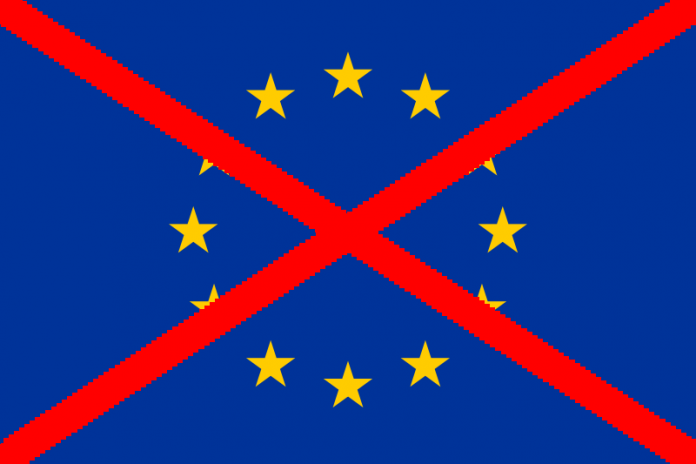
EU delenda est
2005: the day they decided your “no” didn’t count
May 29, 2005. The French vote. Referendum on the European Constitutional Treaty.
Result: 54.68% NO.
Turnout: 69%.
Not a vote of abstainers, not a misunderstanding.
A people speaking out, massively, with full awareness.
Three years later, the same text — or nearly so — came into force. Without asking their opinion again.
Here’s how.
The context.
The Constitutional Treaty was the great federal leap: a text that gave the EU the attributes of a state. A flag, an anthem, a “constitution”, a foreign minister, supremacy written in black and white. Chirac, full of confidence, calls the French to the polls. The “yes” campaign mobilizes everything: the state, the major parties, the media, big business, the institutional unions.
And the French say no. For reasons the elite refused to hear: fear of social dumping (the infamous “Polish plumber”, the Bolkestein directive), a sense of a machine slipping out of their control, rejection of a project decided from on high and ratified by acclamation. Five days later, the Dutch say no in turn. 61%.
The treaty is dead. Officially, it’s called a “period of reflection”. In reality, it’s time to find a workaround.
The workaround has a name: Nicolas Sarkozy.
2007 campaign. Sarkozy proposes a “simplified treaty”. And above all, he lays out the adoption method: it will be the parliamentary route. No referendum. Parliament will vote in place of the people.
That’s his promise. He is elected.
And he keeps it against the people who had already decided.
The sleight of hand: the Lisbon Treaty.
Signed in December 2007.
They remove the symbols that scared people: no more “constitution”, no flag in the text, no “minister”.
They keep the essentials: permanent presidency of the Council, extension of qualified majority voting, retreat from unanimity, the Union’s legal personality, European diplomatic service. The institutional substance of the rejected text, repackaged.
The most cynical part is that they admitted it. Valéry Giscard d’Estaing, the architect of the Constitution, wrote it himself: the tools are the same, we’ve simply changed their order in the box. The stated goal: make the text unreadable so no government would be forced to submit it to a referendum. Technique replacing the popular verdict.
February 2008. Versailles.
Congress convenes to amend the French Constitution and allow ratification. Then Parliament ratifies Lisbon. The government left, which had campaigned for “no”, abstains and lets it pass. The French, they are never consulted again.
The “no” of 2005 has just been converted to “yes” by procedure.
And for those who might doubt the method: Ireland, for its part, was constitutionally required to vote. It says no in June 2008. They make it revote in 2009 until they get the right result. Vote until you get it right.
And that’s where it all connects.
This isn’t a procedural anecdote. It’s the founding act of a legitimacy problem that France has never settled.
Because the question of 2005 is exactly the one today. When Brussels signs 96 billion in development aid, when the NDICI directs billions to foreign “civil societies”, when the Global Gateway promises 300 billion the real question is never “should we do it?”.
It’s: who decided, and with what legitimacy?
The answer, we’ve known it since 2005: an administration that believes the people, when they answer wrong, must be circumvented, not heard. Hayek called it the fatal conceit.
The idea that a center knows better than the peoples what is good for them including against their explicit vote.
The French never accepted Lisbon. They were never asked.
And a structure built by going over the head of a lost referendum doesn’t carry a democratic deficit: it carries a birth defect.
The American Constitution starts with “We the People”.
Ours, the European version, started with a people who said no and an apparatus that decided it didn’t count.
Auto-translated by X from Brivael Le Pogam’s original French post.
Comments Off on They don’t do “democracy” in Europe for any important issue: the voters might get it wrong
April 7, 2026
“The Eight Hundred Years of Oppression”
On Substack, Upper Canadian Cavalier examines “The Irish Question”:
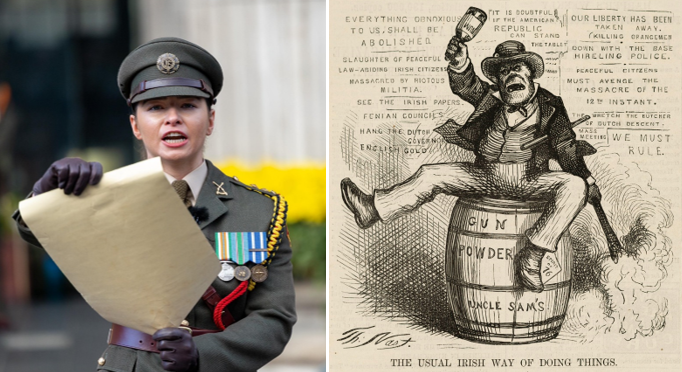
Every confidence scheme requires three things. A mark who is sympathetic. A grievance real enough to be credible. And an operator whose entire livelihood depends on ensuring the grievance is never actually resolved. Resolution ends the game. The operator does not want justice. He wants the next fundraising dinner.
Irish nationalism, in its mature institutional form, is one of the longest-running confidence schemes in the history of democratic politics. This is not to say the underlying grievances were invented. English rule in Ireland produced genuine catastrophes, and anyone who tells you otherwise has not read much history. The point is not that the wounds were fake. The point is that a very specific class of people discovered, sometime in the nineteenth century, that a bleeding wound is worth considerably more than a healed one, and they have been salting it professionally ever since.
The operators of this scheme are not a conspiracy in any tidy sense. They do not meet in a room. They are, rather, an ecosystem: the Sinn Féin political class, the Irish-American fundraising establishment, the Gaelic cultural bureaucracy with its language boards and arts councils and grant committees, and undergirding all of it for most of its history, the Catholic Church, which managed the remarkable trick of positioning itself as the spiritual soul of Irish resistance while simultaneously running the country’s schools, hospitals, orphanages, and laundries with the administrative efficiency of a medium-sized colonial power. They share no common mailing list. They share something considerably more durable: a common interest in a people who define themselves entirely by what was done to them, because such a people will always need someone to explain what it means.
That someone, naturally, has a salary. Sometimes several.
Part One: The Invoice That Never Clears
The foundational text of Irish identity is not a poem or a legal document or a philosophical treatise. It is an invoice. The Eight Hundred Years of Oppression, presented at every available occasion, never stamped paid, accruing interest at a rate that defies actuarial calculation. It is invoked at pub tables and university seminars and Boston fundraisers and Sinn Féin press conferences with the solemn regularity of a liturgical response, which is appropriate, since it has become one.
Eight hundred years. Let us sit with that number for a moment, because it deserves scrutiny rather than reverence.
The Poles were partitioned entirely out of existence for a hundred and twenty-three years, absorbed simultaneously by three empires, had their language banned, their nobility liquidated, their clergy persecuted, and their country removed from the map of Europe with a finality that the Irish situation never approached. They rebuilt it. They were then invaded again from both sides at once within living memory, occupied by The Nazis and Soviets losing somewhere between five and six million citizens in six years. They do not, as a general rule, organize their entire national identity around the experience. They built things instead.
The Armenians experienced something so total it required the coinage of an entirely new word to describe it. The Acadians were physically deported. The Welsh had their language suppressed for centuries by a state apparatus that regarded Welsh-speaking children as candidates for corrective intervention, which is considerably more systematic than anything the Penal Laws produced. The Greeks spent nearly four centuries under actual Ottoman administration, not the notional suzerainty that characterized much of the Anglo-Irish relationship, and emerged and got on with being Greeks.
None of them made Eight Hundred Years into a brand.
What distinguishes the Irish accounting of oppression is not the severity of the oppression, which was real but not historically singular, but the extraordinary care with which it has been packaged, maintained, and exported. The Famine, which ended in the 1850s, is still discussed in certain Irish-American circles as a recent bereavement requiring ongoing condolences and, more usefully, ongoing donations. The emotional statute of limitations has never been permitted to run. Each generation receives the invoice freshly printed, as though the debt were personally owed to them and personally owed by someone who can still be made to feel bad about it.
Comments Off on “The Eight Hundred Years of Oppression”
March 17, 2026
Corned Beef and Cabbage Recipe | St. Patrick’s Meal | Food Wishes
Food Wishes
Published 13 Mar 2009Get the full story! Visit http://foodwishes.com to get the ingredients, and watch over 200 free video recipes. Leave me a comment there. If you have questions, ask on the website. Thanks!!
Full recipe here – https://www.allrecipes.com/Recipe/236601/Chef-Johns-Corned-Beef-and-Cabbage/
Comments Off on Corned Beef and Cabbage Recipe | St. Patrick’s Meal | Food Wishes
December 25, 2025
Repost – “Fairytale of New York”
Time:
“Fairytale of New York” by The Pogues featuring Kirsty MacColl
This song came into being after Elvis Costello bet The Pogues’ lead singer Shane MacGowan that he couldn’t write a decent Christmas duet. The outcome: a call-and-response between a bickering couple that’s just as sweet as it is salty.
Comments Off on Repost – “Fairytale of New York”
November 19, 2025
QotD: Rum Sodomy & the Lash
Released 40 years ago by London Irish legends the Pogues, the album is named not after a decent night in old Soho, as the title would suggest, but an apocryphal quote of Churchill’s. “Don’t talk to me about naval tradition,” he’s purported to have said. “It’s nothing but rum, sodomy, and the lash”. For many years, listening to the album while writing and drinking in this adopted riverside local, I’d no idea it was recorded a stone’s throw away in Elephant Studio, in the basement of Metropolitan Wharf. Or that the pubs of the area, such as this one, were frequented by Pogues musicians: their frontman and chief songwriter Shane MacGowan and the album’s producer Elvis Costello.
The album was even launched on the river, upstream, on board HMS Belfast with the band wearing Nelson-era naval regalia. They’d been ferried to the moored cruiser from Traitor’s Gate, arriving to find the assembled journalists (one of whom ended up, temporarily, in the Thames) already tearing into the drink. After the gig, MacGowan’s admiral’s hat vanished; in one story settling onto the river bed with all that other historical debris. At the time, the album felt like a raucous act of vandalism. Now, it’s viewed almost universally as a stone-cold classic.
The cover, a remade version of Géricault’s The Raft of the Medusa, where the band themselves are among the wretched shipwrecked crew, acts as a framing device. What Rum Sodomy & the Lash does is allow erased, abandoned or sidelined histories to erupt — the piratical and press-ganged, the adventurous and the damned — in a way that gracefully, modestly hides the band’s self-taught virtuosity and the lyricist’s songwriting genius. It was an album that, at that time, socially and politically, shouldn’t have existed, but through courage and sheer force of nature had to.
The Thames may not forget, but society is all too willing to. There are, alas, few signs of gratitude or even recognition of the colossal impact the Irish have had on London. A statue of Oliver Cromwell, the Butcher of Drogheda, stands pride of place outside the House of Commons, but there’s scarce trace of his Hibernian victims. It took the London Irish Centre to erect a plaque in Camden Square, in 2017, to the “Forgotten Irish”, “who left their homes, counties and country … to work and rebuild this city and country, ravaged and destroyed by war … Many would never return to Ireland”.
[…]
Even at the time of the album, in fact, the Pogues ran into opposition, and not just among musical snobs and gatekeepers in England. In Ireland, their adversaries were two-fold — traditionalist embalmers of folk music, and cringe-beset “cosmopolitans” who were mortified with anything too Irish, too plebian, too diasporan. Ironically, it turned out that the Pogues were far more effective custodians of Irish traditional music, and more authentic examples of cosmopolitan hybrid-culture, than their adversaries, exemplifying the maxim that, “Tradition is not the worship of ashes, but the preservation of fire”.
At the heart of Rum Sodomy & the Lash‘s success and legacy is embrace of apparent opposites: high and low culture, Ireland and England, city and rural, home and exile, intellect and soul, sacred and profane, debauchery and dignity, stars and gutter. So you get “Navigator”, a tribute to the Irish workers who built the railways, and MacGowan’s rowdy “Sally MacLennane”, a tribute to his uncle’s Irish pub in Dagenham, the Irish car-making workforce it served and the real-life characters he encountered, some less than salubrious. There’s also a fierce and atmospheric instrumental, “The Wild Cats of Kilkenny”, inspired by Spaghetti Westerns, or else the industrial hangover of Ewan MacColl’s “Dirty Old Town”, especially poignant at a time of deindustrialisation.
The true legacy of the Pogues exists not in print, of course, but in music. Their inheritors include the drone and conscience of the modern band Lankum, the otherworldly transformations of the past in the music of Lisa O’Neill and John Francis Flynn, and the pulse of the new in Fontaines DC. But the album also impels its listeners to articulate discontent, defy the rot, preserve the fire, to genuinely transgress, to face reality in surreal or raw terms, to lament and howl not in the transience of placards or social media, but in an art form that hits far deeper, than rusting plaques, and lasts much longer. It’s all out there, more than ever, out of sight, below decks or at the bottom of the river, waiting to escape.
Darran Anderson, “The Pogues soundtracked Irish London”, The Critic, 2025-08-05.
Comments Off on QotD: Rum Sodomy & the Lash
October 24, 2025
British and Irish media try to hide the crime that triggered Dublin riot
In Spiked, Brendan O’Neill on the complicity of British and Irish media in trying to cover up the reasons behind the violence in Dublin outside a hotel housing migrants:
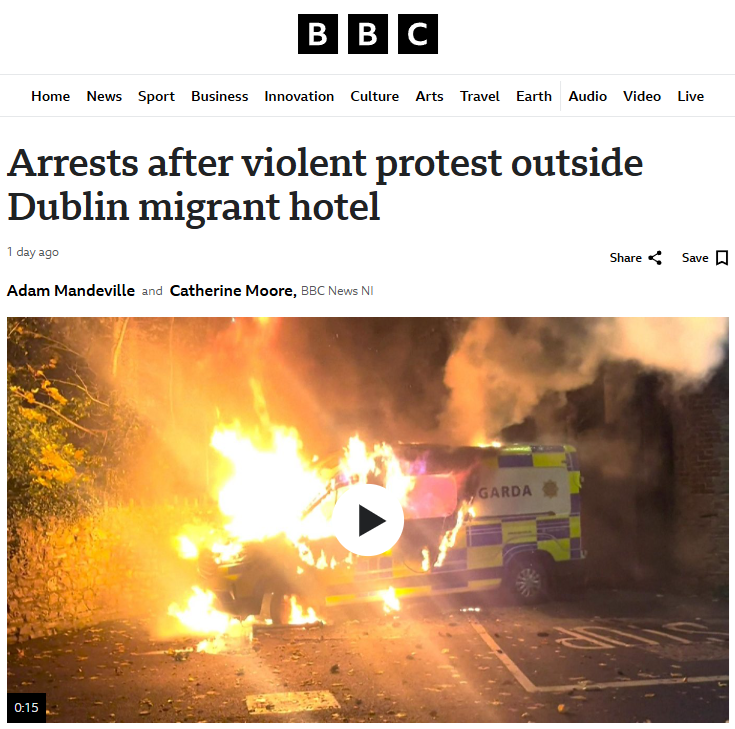
Last night, the BBC told one of the grossest lies of omission I have ever seen in the mainstream media. It published a report about the disturbances outside a migrant hotel in County Dublin and nowhere did it mention what triggered the riotous behaviour. Three hundred and eighty-seven words pumped into the gadgets of the masses, every one of them devoted to damning the “thuggery” of those who assembled at the hotel. Not one of the words – not one – addressed the thing that angered them.
What was that thing? It was the alleged sexual assault of a 10-year-old Irish girl by a failed “asylum seeker” on the grounds of the hotel. An alleged assault so serious that the girl was hospitalised. What’s more, this is a highly vulnerable girl in the care of the state. Maybe none of that matters to the BBC. Perhaps the alleged violation of a defenceless innocent by a man who was meant to have been deported from Ireland is immaterial to the aloof scribes of Britain’s public broadcaster. How else do we explain that they essentially redacted this information, one of the most salient parts of the story, from their initial dispatch on the fury gripping a community across the Irish Sea?
The irony of the BBC’s seeming indifference to the alleged horror that provoked last night’s disturbances is that it will compound the unrest on the streets. Indeed, it will confirm the sense that the media classes, in Dublin and beyond, give not one toss for the safety of people’s children or the validity of their own views on immigration. In so heartlessly erasing that girl from its early reportage, the BBC will have intensified the fiery anger of the very “thugs” it hates.
The disturbances made for unpleasant viewing. They took place outside Citywest Hotel in Saggart, a town in County Dublin about 12 miles from Dublin city. This is a hotel that just last month was sold to the state for €148million for the purposes of housing migrants. Then this week, an assault of the most appalling kind allegedly took place either on its grounds or in its vicinity. A girl was hospitalised, and a man in his thirties was arrested.
The details are distressing. The 10-year-old girl was in the care of the Irish Child and Family Agency. She reportedly absconded from staff during a recreational trip to Dublin city. She was reported missing to An Garda Siochana (the Irish police). She was later found close to Citywest Hotel and reported that she had been assaulted. As part of their investigations, the Gardaí have arrested a man who arrived in Ireland six years ago, who failed in his application for asylum, and who has been the subject of a deportation order since March.
Everyone must let the investigation take its course and the truth be ascertained. The anger of the people of Saggart is wholly understandable but riotous violence is never the answer. Cops outside Citywest were pelted with a volley of bottles. Brick walls were dismantled to turn into projectiles to hurl at the guards. At one point, Irish lads even charged the police lines with horse-drawn sulkies (carts). These were grim scenes, echoing the riot that rocked Dublin city in November 2023 following the stabbing of three children by a man from Algeria.
Not the Bee has some video clips of the scenes outside the Citywest migrant hotel.
Update, 27 October: Welcome, Instapundit readers! Please do have a look around at some of my other posts you may find of interest. I send out a daily summary of posts here through my Substack – https://substack.com/@nicholasrusson that you can subscribe to if you’d like to be informed of new posts in the future.
September 16, 2025
Fenian Needham Conversion: Just the Thing for Invading Canada
Forgotten Weapons
Published 10 May 2025The Fenian Brotherhood was formed in the US in 1858, a partner organization to the Irish Republican Brotherhood. The groups were militant organizations looking to procure Irish independence from the British, and they found significant support among the Irish-American immigrant community. In November 1865 they purchased some 7500 1861- and 1863-pattern muskets left over from Civil War production, and used them to invade Canada in April 1866. The idea was to capture the country and then trade it to the British in exchange for Irish independence … but the invasion went quite badly. The Fenians briefly held Fort Erie, but were pushed out after a few hours and largely arrested by American forces.
The Fenians’ muskets were confiscated, but all returned by the end of 1866 in exchange for promised Irish-American support of embattled President Johnson. By 1868, the group was making plans for another attempt at conquering Canada. This time they would have better arms — they obtained a disused locomotive factory in Trenton NJ and set up the Pioneer Arms Works to convert 5,020 muskets into centerfire Needham Conversion breechloaders. These were given chambers that could fire standard .58 centerfire ammunition, or the .577 Snider ammunition that the Fenians expected to be able to procure once in Canada. Most of the guns also had their stocks cut, to allow them to be packed in shorter crates for transit. These usually have a distinctive “V” cut in the stock, which was spliced back together before use.
When the second invasion came in April 1870, it was again a failure. Only 800-1000 men turned out of the 5,000+ expected. They were scattered among several different muster points on the border, and the Canadians were once again aware of their plans. The most substantial fight was at a place called Eccles Hill, where the Missisiquoi Home Guard was ready and waiting for them with good Ballard rifles. Upon crossing the border, the Fenians were soundly defeated.
This second time, the guns were confiscated and not returned. Instead, the Watervliet Arsenal sold them as surplus in 1871. They were purchased by Schuyler, Hartley & Graham for commercial resale, and thanks to that several hundred remain in collector hands today.
(more…)
Comments Off on Fenian Needham Conversion: Just the Thing for Invading Canada
September 14, 2025
History of Britain VIII: Welsh, Picts, and Irish in the Early Middle Ages
Thersites the Historian
Published 7 Mar 2025In this video, we look at the other major ethnic groups in the British Isles and trace their development, insofar as our limited sources allow.
Comments Off on History of Britain VIII: Welsh, Picts, and Irish in the Early Middle Ages
September 8, 2025
“Down with this sort of thing!”
In the free-to-cheapskates part of Ed West’s post on the Graham Linehan case in Britain, he identifies one of the reasons that Linehan’s Father Ted became so popular in the country it was situated in:

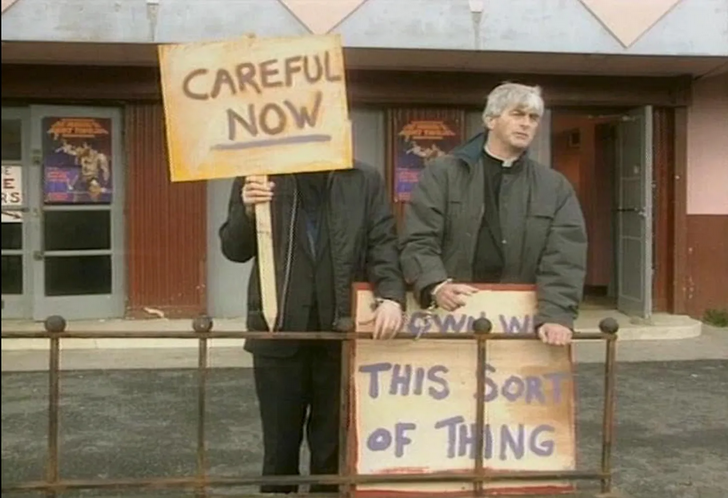
I don’t think I’d seen a “down with this sort of thing” placard in the flesh since I watched the Protest the Pope march back in September 2010. Those were the heady days of New Atheism, before the movement evolved into something more explicitly progressive.
The sign references an episode of the 1990s comedy Father Ted, in which the protagonist and his dim-witted sidekick Fr Dougal are forced to protest the screening of a blasphemous new film called The Passion of Saint Tibulus. Among the many catchphrases popularised by the comedy, back in 2010 this one suggested an ironic and gently mocking attitude to religion; that it was ridiculous, rather than evil.
This week, outside Westminster Magistrates’ Court in Marylebone Road, the sign appeared in a rather different context, carried by supporters of Father Ted co-creator Graham Linehan as he faced charges of harassment and criminal damage in an ongoing trial, following an incident at last year’s Battle of Ideas involving a young transgender activist.
Linehan had been bailed before trial, allowing him to travel to the United States to work on a new comedy project. When he arrived back at Heathrow on Monday, however, he was arrested by five armed police officers over three tweets he had posted back in April. The situation was as absurd and surreal as anything that had emerged from the writer’s fertile imagination.
As Linehan described it on his substack: “When I first saw the cops, I actually laughed. I couldn’t help myself. ‘Don’t tell me! You’ve been sent by trans activists’. The officers gave no reaction and this was the theme throughout most of the day. Among the rank-and-file, there was a sort of polite bafflement. Entirely professional and even kind, but most had absolutely no idea what any of this was about.”
The incident is embarrassing to Britain as it faces increasing scrutiny in the US for its poor record on free speech, especially over the Lucy Connolly case. It was unfortunate timing that this arrest happened just as Nigel Farage was heading in the other direction to talk about this very issue in Washington. But Linehan’s ordeal is also part of a much longer and sadder story about the perils of the political meeting the personal.
Arthur Mathews and Graham Linehan had worked on The Fast Show before renowned comedy producer Geoffrey Perkins had taken to one of their ideas, about a group of priests stuck on a remote Irish island, proposing that it be written as a six-part sitcom. It was brilliant, and hugely loved, and in its timing was significant.
Conor Fitzgerald wrote of Father Ted that, while well-loved in Britain, in Ireland it is more like “the national sitcom, a piece of light entertainment that nevertheless Says Something Meaningful About Us”. It also appeared at a crucial time in history.
Not only was Father Ted one of the few successful TV representations of Ireland, it was made during Ireland’s version of the Swinging Sixties, our flux decade of the Nineties. The accelerating collapse of the Church and the exposure of longstanding political corruption coincided with the dawn of the Celtic Tiger years, lending peripheral Ireland a sense of self-conscious modernity. It was a unique national turning point, where our 19th-century past seemed to co-exist with our 21st-century future. In reflecting this upheaval, Father Ted has become not just a social historical document, but a portent of where Ireland stands today.
When Ted was broadcast, the Church was formally still one of the central pillars of Irish life, but its authority rang hollow. Priests often felt like administrators of a vanished country. And on remote Craggy, Ted, Dougal and Jack mirror this directly. All good sitcoms feature characters who are trapped, but Ted is doubly so: first on his island; and second in an institution people are coming to see as irrelevant. He is still an essential member of the community, more than just a ceremonial functionary for weddings and funerals. But it’s just not clear what the essential thing he does is anymore, beyond being a common reference point that deserves token respect.
Ted and Ted therefore stand at a crossroads, and capture the more fundamental social change in Ireland at this time: the collapse in respect for older establishment hierarchies generally.
Those establishment hierarchies collapsed across the West in the late 20th century, first in more secularised nations such as Britain and France and later, and more quickly, in places like Ireland and Spain where the Catholic Church still held on.
The Church lost its power to patrol its taboos, without which it became a sitting duck for satirists; the Passion of St Tibulus was influenced by the protest against Life of Brian, successfully banned in Ireland until 1987. As a teenager, Linehan had to join a film club to watch it, but such censorship was disappearing everywhere.
Father Ted was a work of genius, employing a surreal style of humour that has often been characteristic of Linehan and Mathews, and later seen in their under-appreciated sketch show Big Train – including the brilliantly bizarre sketch in which Beatles producer George Martin is kidnapped by Hezbollah.
The clerical comedy bequeathed numerous catchphrases. “I hear you’re a racist now, Father”, which features in an episode where Fr Ted is wrongly accused of anti-Chinese prejudice, is still a popular meme. Likewise, “These are small, but the ones out there are far away“, Ted’s explanation of perspective to his idiotic housemate, is still used to mock the gormless.
The show was also charming, and its treatment of religion was far from vicious. Rather than being a vitriolic attack on Church authority, Father Ted poked gentle fun at the absurdity of the old order, a kind of mockery which is perhaps a more dangerous threat to a belief system that relies on awe and fear. It was innocent, and many years later Linehan said he would find writing Father Ted much harder in light of the abuse scandal.
Comments Off on “Down with this sort of thing!”
September 1, 2025
“Britain … has been reduced to a two-letter abbreviation … ‘Yoo-Kay’, and bearing a sad resemblance to ‘Yukky'”
Back when I first set up the blog, it was clear that certain countries would be mentioned frequently enough to merit having their own categories … Canada, obviously, the United States, our gigantic neighbour, and Britain. As I was born in England nearly 65 years ago, events in the old country still have a resonance for me, but I preferred to call the union “Britain” rather than its formal name of “United Kingdom” — and I try to use the proper names of “England”, “Scotland”, “Wales” and “Ireland” as tags when historically appropriate. I don’t regret that decision at all:
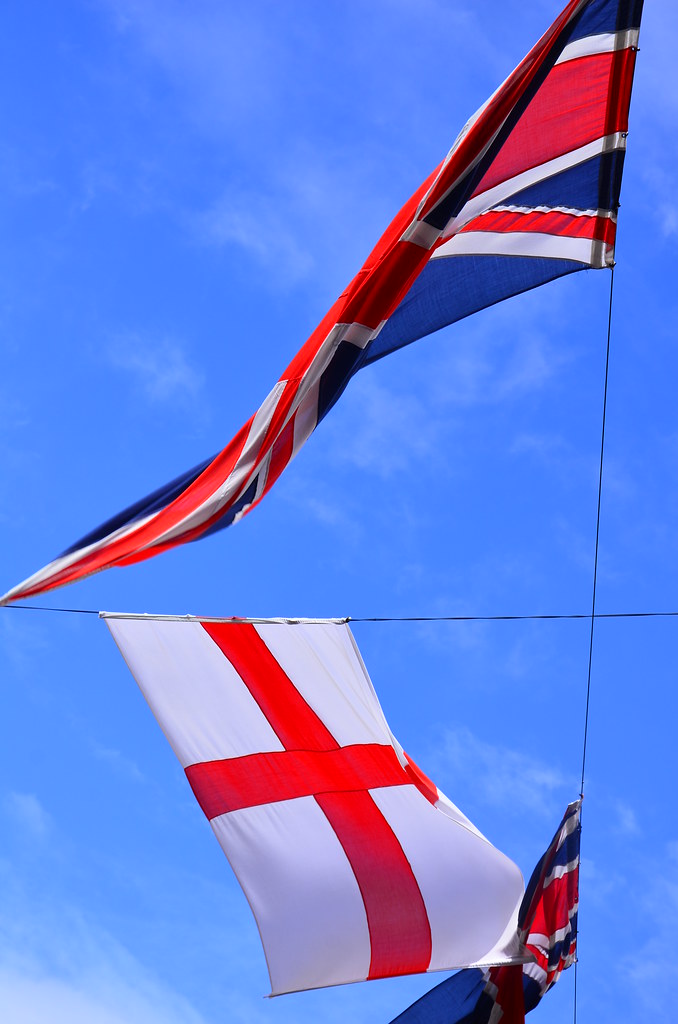
“Union Jacks and crosses of St George” by Ben Sutherland is licensed under CC BY 2.0 
 .
.
The current national flag-waving by the English is hugely gratifying for those of us who feel that our beloved country has been sidelined for too long.
Along with that visible symbol of English patriotism, may I make another plea – for I don’t want to live in an abbreviated country!
That country used to be called Britain, now usually described as “the UK” – and we see “Great Britain” even less.
Britain, the very name of which resonates with history, and of which I am very proud, has been reduced to a two-letter abbreviation – ugly-looking when written, and something akin to a cheerleader’s chant when spoken: “Yoo-Kay”, and bearing a sad resemblance to “Yukky”.
Almost every country in the world has a “real” name that helps its residents feel a sense of identity. But “I live in the UK”? It has a horribly soulless feel about it, like something a faceless quango has drawn up on the spur of the moment – certainly not a name rich in tradition that has been carried down the millennia.
It was not always so. This reduction of the title of our glorious islands has happened insidiously over the past two or three decades without most folk noticing it. One has only to glance through old newspapers and magazines, or listen to old broadcasts on radio and TV, to notice that 30 years ago the term ‘UK’ was rarely used.
It is ironic that our national broadcaster, the BBC, has ‘British’ enshrined in its very name, yet that organisation is among the worst offenders, almost always preferring ‘UK’ over ‘Britain’ or ‘British’!
How has this happened? There are perhaps many reasons; but the most obvious has been the use of .uk as the terminator in website addresses. If .gb had been the standard, as originally proposed, things may now be quite different.
One of the odd things about all this is that foreigners mostly still use the term ‘Britain’ rather than ‘the UK’ – putting us to shame.
Some may ask: ‘Why does this matter?’
It matters greatly, for the very word ‘Britain’ conveys the feeling of being connected to ancient history. It’s a name with centuries of glorious tradition behind it, a history which we should never be ashamed of proclaiming.
And what about England? Perhaps even worse than the reduction of our islands to an abbreviation is the widespread lack of recognition for my homeland, England.
Update, 2 September: Welcome, Instapundit readers! Please do have a look around at some of my other posts you may find of interest. I send out a daily summary of posts here through my Substack – https://substack.com/@nicholasrusson that you can subscribe to if you’d like to be informed of new posts in the future.
June 16, 2025
History of Britain, III: Celtic Britain
Thersites the Historian
Published 21 Jan 2025Although most of our early information about the Celts comes from Greek and Roman writers whose experience was with Celtic tribes on the continent, we can glean some insights into the Celts of Britain. We also introduce the fact that Ireland eventually became the world’s greatest repository of Celtic cultural preservation.
Comments Off on History of Britain, III: Celtic Britain
March 17, 2025
How to Make Irish Shepherd’s Pie | Food Wishes
Food Wishes
Published 5 Mar 2012Learn how to make an Irish Shepherd’s Pie! This recipe is a lovely alternative to the much more common corned beef and cabbage recipe that you may have been planning for dinner. Take things to the next level with some nice Irish cheddar.
St. Patrick’s Day Special: Irish Shepherd’s Pie (the real one, not the stuff they eat in cottages)
I know I may have used a few atypical ingredients in this, but as far as I’m concerned, the only two things that are mandatory to make a “real” Shepherd’s Pie are potatoes and lamb. While the ground beef version is also very delicious, it’s not considered a “Shepherd’s Pie”, since shepherds raise sheep, not cows.
The real mystery is why the beef version is called “Cottage Pie”, and not “Cowboy Pie”, or “Rancher’s Pie”. When I think about cattle, many things come to mind, but cottages aren’t one of them. Okay, now that we have all those search keywords inserted, we can moooo’ve on.
By the way, I know it’s something of a Food Wishes tradition that I do a cheap, culturally insensitive joke about Irish-Americans drinking too much in our St. Patrick’s Day video, but this year I decided not to do any. In fairness, I know hundreds of Irish people, and several of them have no drinking problem whatsoever, so it just didn’t seem inappropriate.
Anyway, as I say in the video, this would make a lovely alternative to the much more common corned beef and cabbage that you may have been planning for dinner. Also, I really hope you find some nice Irish cheddar. I used one called “Dubliner” by Kerrygold, which can be found in most large grocery stores.
If you’re curious about beverage pairings, may I go out on a limb and suggest a nice Guinness, or other Irish beer … just hold the green food coloring, please. Erin go bragh, and as always, enjoy!
(more…)
Comments Off on How to Make Irish Shepherd’s Pie | Food Wishes
December 25, 2024
Repost – “Fairytale of New York”
Time:
“Fairytale of New York” by The Pogues featuring Kirsty MacColl
This song came into being after Elvis Costello bet The Pogues’ lead singer Shane MacGowan that he couldn’t write a decent Christmas duet. The outcome: a call-and-response between a bickering couple that’s just as sweet as it is salty.
Comments Off on Repost – “Fairytale of New York”
November 9, 2024
QotD: George Bernard Shaw
H.L. Mencken, “Shaw as Platitudinarian”, The Smart Set, 1916-08.
Comments Off on QotD: George Bernard Shaw


