Quotulatiousness

April 24, 2026

Britain’s Green Party … not your weird cousin’s old Green Party

The Green Party have been more of a punchline than a party for decades in British politics, but the Green Party of today shares only a name with its earlier incarnations (the old UK party is now split into three separate Green Parties for England and Wales, Scotland, and Northern Ireland). Now, it’s become a significant threat to the Labour Party thanks to its unlikely fusion of socialist and green policies with strong support from Britain’s growing Muslim community:

The Green Party is a growing force in British politics. In February, they gained the Parliamentary constituency of Gorton and Denton in a by-election — a supposedly “safe” seat for the Labour Party. Local elections in May see them set to make big gains — perhaps sweeping to power in several town halls in London, perhaps including Camden, where Sir Keir Starmer is one of the local MPs. Opinion polls often show them roughly level with Labour and the Conservatives.

This is quite a change from previous decades when they were indulged as eccentrics on the political fringe. The Green Party (or the Ecology Party, as it was earlier named) were the sandal-wearing, muesli-munching environmentalists who wanted to go back to nature. They opposed economic growth — but their supporters tended to be affluent enough that they could afford to do so. Its leader was the aristocrat Sir Jonathon Porritt.

They were the breed George Orwell was thinking of when he wrote: “One sometimes gets the impression that the mere words ‘Socialism’ and ‘Communism’ draw towards them with magnetic force every fruit-juice drinker, nudist, sandal-wearer, sex-maniac, Quaker, ‘Nature Cure’ quack, pacifist, and feminist in England”.

Great fun. But there was a darker side to the quackery then and now. A totalitarian mentality which, as Orwell also vividly described, proves horrific when it prevails.

Increasingly, the Green Party has shifted its focus away from the environment. In the few towns and cities where it has gained power locally, such as in Bristol and Brighton, it has proved ineffective at practical work in this respect. Typical behaviour would be to pass a motion declaring a “climate emergency” but then perform lamentably when it comes to recycling or tree planting or any of the relevant matters they have the power to deal with.

There was always a distortion in its supposed concern for sustainability in that it was really an excuse to denounce capitalism. The Property and Environment Research Center, a US think tank which champions free-market environmentalism, has shown a more enlightened approach. Their work has included a comparison of privately-owned and state-owned forests. Another applies property rights to marine assets. But the role of property rights as a means of good stewardship of our planet is dismissed by the Green Party out of hand.

In any case, much of the campaigning by the Green Party now is on non-green issues. Its leadership talks a lot about foreign policy and a broader economic pitch focusing on class war rhetoric and an extreme programme of state control. Taxing the rich is always seen as the panacea, despite the reality that many entrepreneurs are already fleeing the United Kingdom due to its hostile fiscal environment.

Its Manifesto for the last election two years ago proposed a Wealth Tax, a pensions tax, and a big increase in Capital Gains Tax. A £90 billion carbon tax would have closed down much of British industry, which was probably the idea.

April 20, 2026

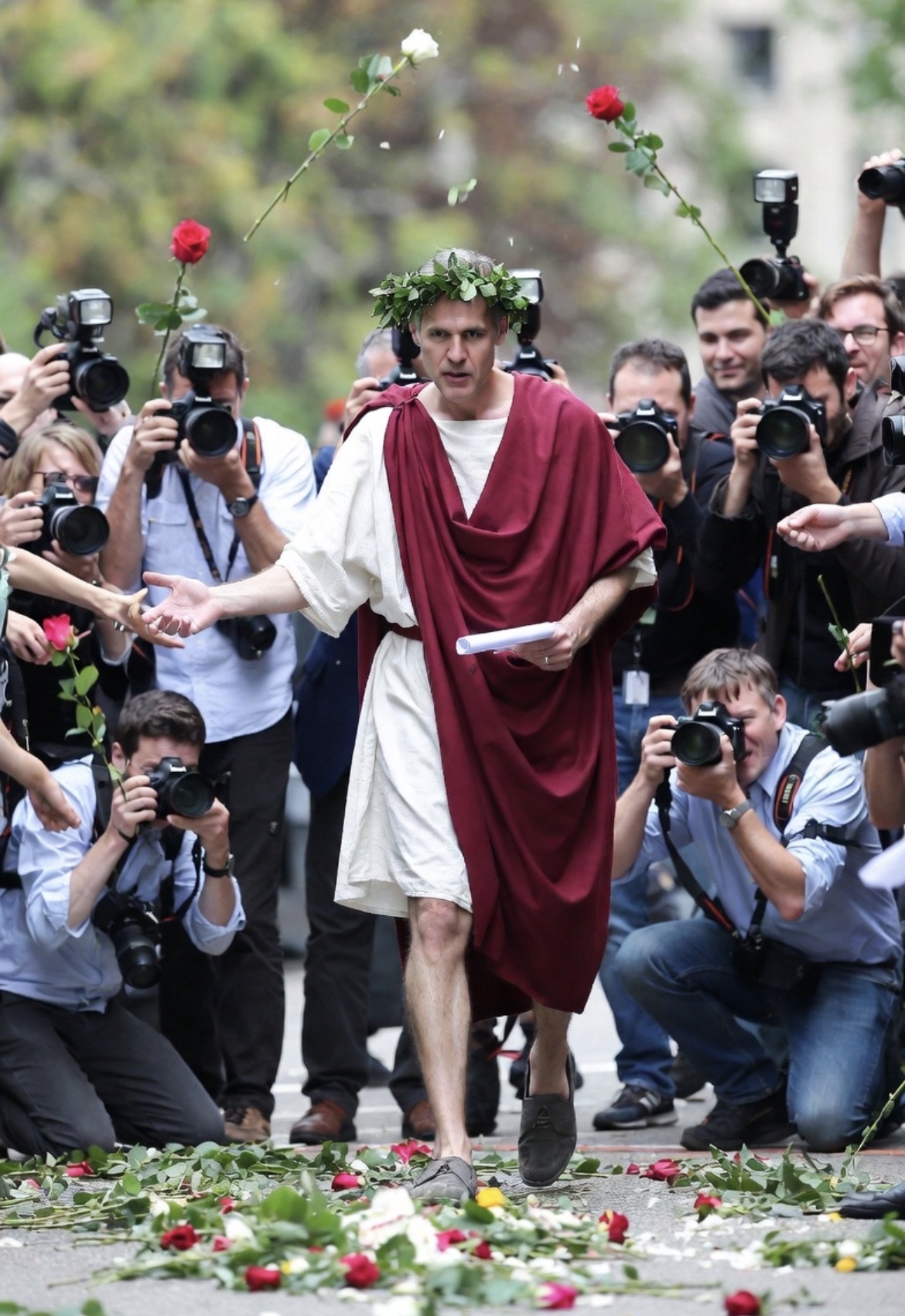
“Hail, Caesar!” oops we meant “Hail, Carney!”

Filed under: Cancon, Media, Politics — Tags: , , , , , , — Nicholas @ 04:00

At The Rewrite, Peter Menzies discusses the unseemly media adulation1 for Caesar Prime Minister Mark Carney after more than a year in power:

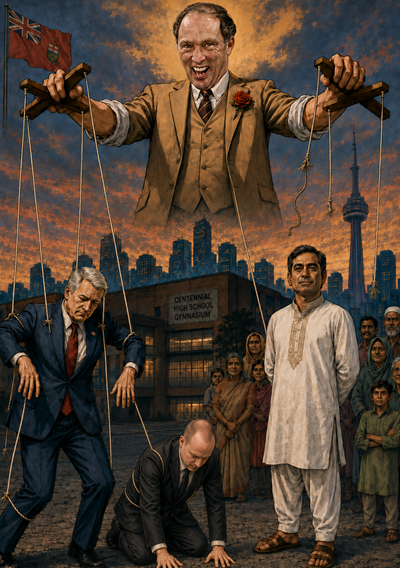
Grok illustration of PM Carney as Caesar
Image from The Rewrite.

Thirteen months into his reign as prime minister, we still don’t know who Mark Carney is or how he engineered the removal of Justin Trudeau from office.

Nor do we know what really happened behind the scenes to convince five Members of Parliament to betray their constituents’ democratic decisions and, for the first time in the nation’s history, give Canadians a majority government they didn’t elect.

What we do know is that none of that seems of great interest to most of our media or, as they like to describe themselves when seeking federal subsidies, “defenders of democracy”.

As The Rewrite noted a year ago, the moves behind the scenes to effect the abrupt ouster of Trudeau remain a mystery. And, unlike with other PMs, there have been no Carney family magazine profiles. (Who can forget Justin and Sophie Trudeau‘s sexy Vogue cover?) Yes, there are the books, Values and The Hinge. We have learned he likes hockey, runs, won’t criticize China and is ruthless. But there is a tangible paucity of efforts within MSM to get beyond what is permitted to be known. We don’t even know if he watches Heated Rivalry or why the Brits called him “the unreliable boyfriend”. And yet, as Stephen Maher wrote for Time magazine last week, Canadians adore him.

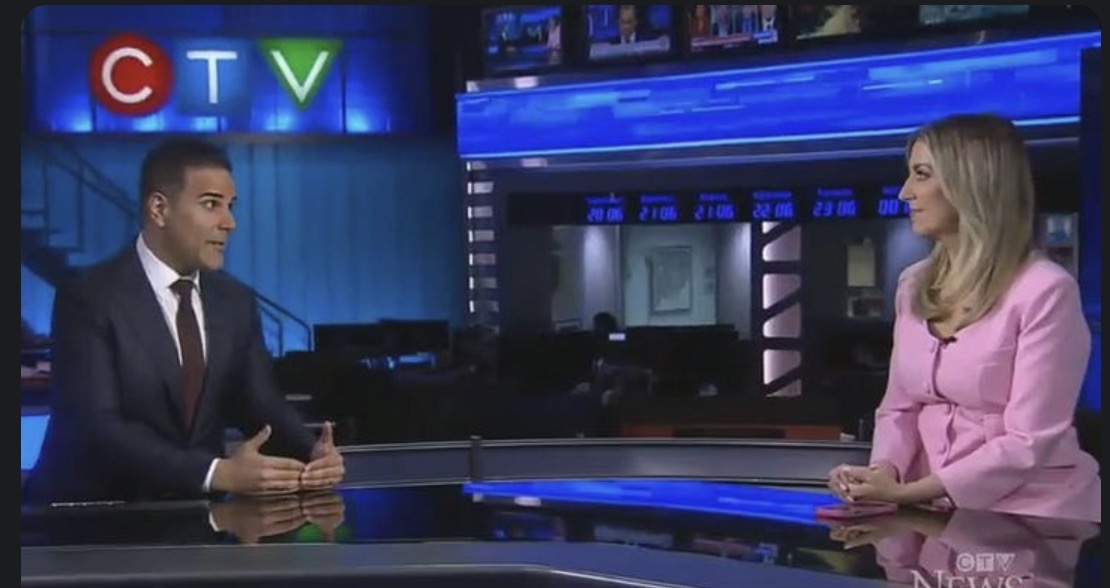
As for how he has seized power in excess of that granted by the electorate 11 months ago, there wasn’t a hint of concern on the part of CTV News anchor Omar Sachedina when Carney’s majority was confirmed in a couple of “gimme” by-election victories.

The leading voice on Canada’s most-watched newscast, Sachedina appeared awestruck by the “historic” moment and “what the Liberals have been able to achieve in the past year”. When his sidekick, Vassy Kapelos, noted Carney was now out of excuses for not fulfilling the promises that won him a minority government in 2025, Sachedina suggested soothingly that Canadians remember “sometimes ambition does take time, sometimes several election cycles”.

Screencap of CTV News from The Rewrite

The message to Canadians? The Liberals have accomplished great things in the past year, the greatest of which was to do what no one in the nation’s history had ever done before — manufacture a majority without the public’s consent. Oh, and be patient. PMMC’s agenda could take a few more elections. Sit tight and trust.

The next morning, questions were not, as one might expect from defenders of democracy, about whether the PM felt a tad greasy for the way in which he had won unfettered power. Like, in some countries — many actually — that might be considered kind of scary. Here? If you watch the news, it’s dreamy.

The preferred line of inquiry was to ask Carney whether, if he was the Opposition Leader, Pierre Poilievre, he would quit. And so it went for the rest of the week. PMMC wasn’t asked if he worried that his majority would undermine the public’s faith in its institutions. Nor did the press corps pursue their sources to discover what inducements may have been offered to create his Judas Gang of Five.


  1. Yes, I know … the presstitutes will “love him long time” as long as the government subsidies keep rolling in.

April 17, 2026

Hungary in the news

Filed under: Europe, Media, Politics — Tags: , , , , — Nicholas @ 05:00

The way the mainstream media reacted to the recent Hungarian election results, you’d think it was the 2020s equivalent to the fall of the Iron Curtain. Outgoing leader Viktor Orbán has been portrayed as Hungary’s Trump when he hasn’t been discussed as Hungary’s Mussolini. His successor, Péter Magyar is largely unknown outside Hungary where he had been a member of Orbán’s Fidesz party before leaving to join his current party, Tisza. In The Critic, Ben Sixsmith provides some useful background on the state of politics in Hungary today:

Hungarian Prime Minister-elect Péter Magyar, on 15 March 2026 during a national day demonstration at Heroes’ Square in Budapest. Magyar is wearing a traditional bocskai jacket and a national cockade.
Photo by Norbert Banhalmi and released under CC BY-SA 4.0 via Wikimedia Commons.

Tisza — the name being a portmanteau of the Hungarian words tisztelet (respect) and szabadság (freedom), and a reference to the nation’s second largest river — was founded in 2020 and registered in 2022. It was a very marginal conservative party with policies like “raise the minimum pension” and “stop migration”.

In the 2022 parliamentary elections, the party fielded no candidates at all.

Tisza became a major force in Hungarian elections when Péter Magyar joined the party. Magyar, who has a legal background, had been a member of Viktor Orbán’s party Fidesz. More significantly, he had been married to the Hungarian Minister of Justice, Judit Varga, from 2006 to 2023.

In 2024, Varga resigned, along with Hungarian president Katalin Novák, after both were exposed as having signed a pardon for a convicted paedophile who had been a director of a state-run children’s home. Magyar resigned from Fidesz, accusing Orbán of “hiding behind women’s skirts”.

“For a long time I believed in an idea, a national, sovereign, civic Hungary,” wrote Magyar in a much-quoted statement, “But in recent years, I have slowly and finally realized that all of this is really just a political product.”

Magyar became a ferocious critic of alleged government corruption. His ex-wife responded to his anti-Orbán activities by accusing him of domestic abuse. Magyar denied this. Undaunted, he led various anti-government demonstrations, which attracted tens of thousands of Hungarians. He was also chosen to lead Tisza.

Magyar has profited from good timing. He is also a photogenic man who has performed well on social media. His politics are more mysterious. He has called himself a “critical pro-European and a conservative liberal”.

He is not the sort of liberal that anti-Orbán Westerners might want him to be. While he has said that he will “move away from the current, uncritically friendly approach towards Russia”, he has also said that it will take time to stop buying Russian fuel, and he has criticised the Ukrainian approach to Hungarian minorities. He has sometimes tried to outflank Orbán on sovereignty, saying that Fidesz have brought in too many guest workers, and even questionably saying that migrants have been stealing ducks from Hungarian ponds. Still, it remains to be seen if the pro-EU Magyar will maintain his more right-wing opinions or be swept along by European orthodoxy — not least when he has emphasised the importance of unlocking EU funds.

At The Sceptic, James Alexander says that the situation is more complicated than a split between Orbán and what he terms “the Roral Response”:

President Donald Trump and Hungarian Prime Minister Viktor Orban pose for a photo in the Oval Office, Friday, November 7, 2025.
Official White House photo by Daniel Torok via Wikimedia Commons.

What is the Orbán-Roral Divide? It is the Manichaean yin-yang binary of the simplistic political imagination, which supposes that, on one side, we have Orbán, Putin, Trump etc., and that, on the other side, we have von der Leyen, Merz, Starmer, Carney, Zelensky and of course the man after whom I name the category: Rory Stewart.

It has some truth in it, but it is bewildering when we see the binary exalted as if it is the only truth of politics. The downfall of Orbán illustrates this almost perfectly.

The subject today is Orbán Developments. And the Roral Response.

News.

As you all know, Orbán, after 16 years of power, fell in the recent election.

  • Viktor Orbán = Fidezs = 37.8% = 55 seats
  • Peter Magyar = Tisza = 53.6% = 138 seats

“Who loses and who wins, who’s in, who’s out,” quoth King Lear.

Orbán lost.

Now, I like Orbán, symbolically. I don’t know about actually: never studied him. I read one of his speeches once, and it read as more intelligent than any equivalent political speech. I have one thing in common with him, which is that he was present at the funeral of Norman Stone. Anyhow, like him or loathe him, we have to be philosophical. And we have to respect him, even if he is an Oxford man.

  • Oxford: Obsessed with power. Corrupt. Cecil Rhodes, Lord Milner, Tony Blair, David Cameron, Boris Johnson, Dominic Cummings, Viktor Orbán etc.
  • Cambridge: Lord Acton: “Power corrupts and absolute power corrupts absolutely.”

So let us look at what people say. The amusing thing is that people immediately editorialise. Twitter, X, Whatyouwill.com, turns everyone into William Rees-Mogg. Look at all these Editors.

Here is Ferenc Horcher, a very important Hungarian scholar:

    Time to face reality: the Hungarian electorate ousted the ruling power. The electoral system Fidesz introduced gave its opponent a two-thirds majority. Orbán established a one-man rule, tailored the campaign to himself, he is responsible for the defeat, he has to resign.

That’s grim talk from a conservative. So here on the jolly side is Sam Moyn, a very important Yale Law School professor:

    Yay for Hungary. What if the answer to illiberalism is democracy?

Ho hum. I sigh a bit over the innocence of making a contrast between illiberalism and democracy, as if liberalism = democracy.

(more…)

April 14, 2026

Britain’s Green Party stakes out bold new immigration policies

Filed under: Britain, Government, Media, Politics — Tags: , , — Nicholas @ 03:00

With the ongoing shake-up in British politics — long-established “mainstream” parties losing support across the board — once-fringe parties are becoming electorally viable at least in the short term. On Substack Notes, Donna-Louise Flowers talks about the Green Party’s amazingly generous plans for immigrants to Britain should they be elected:

Someone on X just called me a scaremonger. 🙄

For quoting the Green Party’s own published immigration policy.

I’m a former Detective Constable. Serious sexual violence. CSE. I didn’t scaremonger for a living.

So let me be VERY clear about what the Green Party are actually proposing. In their own words. From their own published, member-voted policy document.

Every illegal arrival gets an automatic visa. No questions. No country of origin checks. Free legal advice to regularise their status. No penalty for being here unlawfully.

Guaranteed accommodation. Families get a house or flat with exclusive use. Free Universal Basic Income. No work required. Full NHS access from the moment they arrive — and their policy explicitly states these rights remain even if their asylum case is rejected.

And then — and I need you to read this carefully — they want to give every visa resident the right to vote in all elections and referendums.

All of this while our welfare bill has just exceeded our income tax revenue for the first time in British history.

All of this while we have a shortage of 6.5 million homes.

All of this while foreign nationals account for up to a quarter of all rape convictions in England and Wales. Up to 34% of sexual assault on a female convictions. Ministry of Justice data. Freedom of Information. Not opinion.

Not scaremongering.

Facts.

I’ve written a full thread on X breaking down every single point with sources. Link below.

Read it. Share it. Because this is what 18% of the country is apparently voting for.

x.com/nolongerthefuzz/s…

April 9, 2026

Carney gets another MP to defect, drawing ever closer to a Parliamentary majority

Filed under: Cancon, Media, Politics — Tags: , , , , , — Nicholas @ 04:00

I’m not a Parliamentary history buff, but it strikes me that the number of Canadian Members of Parliament switching parties (always in the direction of the government) over the last year must be close to its historical high-water mark. On Wednesday, Prime Minister Mark Carney welcomed yet another “Conservative” MP to the Liberal caucus in Ottawa:

Call me a cynic if you like, but something is fishy about Carney’s talent for drawing turncoats over to his side. It would not surprise me to find that many more MPs have been offered all sorts of incentives to discover that they were really Liberals all along. Once upon a time I’d have been unbothered by this, but I’m coming to believe that an MP elected under a party banner may choose to leave that party but if they switch to a different party (that also ran a candidate in that MP’s riding), a byelection should be called. If the voters in North Bumbleford-Moosehip-Bongwater are happy with the MP’s decision, they’ll re-elect him/her/them. If not, well, shoulda thought longer before turning traitor.

Along with many others on the social media site formerly known as Twitter, J.J. McCullough clearly feels the same way: “This floor crossing BS is out of control. If MPs in this country can just change parties whenever they want, then voters truly have no control over who becomes prime minister and runs our government. The whole Canadian system is based on the premise that parties MATTER.”

At least one opposition MP did go public about Liberal approaches to switch sides — it’s my belief that he’s one of perhaps dozens:

Ian Runkle (“Runkle of the Bailey”) responds to a typical middle-of-the-Canadian-road take by Spencer Fernando:

L. Wayne Mathison is viscerally against such backroom shenanigans when it comes to Parliament:

I am disgusted, and I am not going to dress it up with polite Ottawa language.

Marilyn Gladu crossed from the Conservatives to Mark Carney’s Liberals on April 8, 2026, saying constituents want “serious leadership” and “a real plan to build a stronger and more independent Canadian economy”. Her move gives the Liberals 171 seats, one short of the 172 needed for a majority.

That is exactly why people do not buy the noble script.

This is how Ottawa usually works. The speech is about conscience.

The reality is about power.

Suddenly the language gets soft, patriotic, and lofty right when the political math gets useful. We are asked to believe an MP was hit by a lightning bolt of principle at the exact moment her switch strengthens the governing party and brings it within one seat of majority control. Convenient does not begin to cover it.

Gladu says this is about leadership and collaboration. Fine. Then let voters decide whether they agree. That is the part these people always skip. They act as if a personal change of heart magically rewrites the contract with the public. It does not. People did not vote only for Marilyn Gladu the individual. They voted for a Conservative MP, a Conservative platform, and a Conservative opposition role. Crossing the floor without first seeking a new mandate may be legal, but it feels like a bait-and-switch because that is exactly what it is.

And spare me the line about “doing the best thing” for the riding. Every floor crosser says some version of that. It is the oldest detergent in the political cupboard. It is meant to wash ambition into service. What it really signals is this: I think my judgment now matters more than the basis on which you elected me.

That is where the anger comes from.

Voters are already drowning in managed language, staged sincerity, and plastic promises. Trust in politics is weak because people keep seeing the same pattern. Politicians campaign one way, govern another, then call the switch “leadership”. They wrap self-interest in national purpose and hope the flag covers the fingerprints.

What makes this worse is the timing. Carney publicly welcomed Gladu into Liberal caucus the same day, and the result is not symbolic. It materially strengthens the government’s position in the House. This is not some minor personal journey. It changes parliamentary leverage. It changes committee numbers, confidence calculations, and the balance of power.

So yes, I’m pissed.

I am pissed because voters are treated like props in a story written after the fact. I am pissed because party labels suddenly matter a great deal during elections and apparently not at all when power is on offer. I am pissed because people who were sent to oppose Liberal policy can simply walk across the aisle and help entrench it, then expect applause for being “constructive.”

And there is another detail that makes this smell even worse. Local reporting says that in January, Gladu had advocated for byelections when MPs switch parties. If that report is accurate, then this is not just opportunism. It is opportunism with a side order of hypocrisy.

That is the real issue here. Not whether floor crossing is technically allowed. Not whether Ottawa insiders can invent a respectable sentence for it. The real issue is whether voters still mean anything once the election is over.

My view is simple. If you want to switch parties, resign and run again. Go back to the people. Make your case honestly. Ask for a fresh mandate under the new banner. Anything less might be lawful, but it is not clean. It tells voters their consent is temporary, conditional, and easily bypassed once the machinery of power starts humming.

That is why this disgusts me.

Because democracy is not only about counting seats. It is about keeping faith with the people who gave you one.

April 6, 2026

Coolidge “does not deserve credit for winning the 1924 election … it just happened to him”

Filed under: Economics, History, Politics, USA — Tags: , , , , , — Nicholas @ 03:00

While I wouldn’t agree with the statement in the title of this post, it has been a common enough reading of the US 1924 presidential election — that it wasn’t an endorsement of Coolidge and his policies but merely a reflection of voters’ overall satisfaction with the economy. The editors of the Coolidge Review would beg to differ:

From the distance of more than a century, a political scientist has taken a fresh look at the 1924 presidential election.

In an article published last year in Presidential Studies Quarterly, Christopher Devine questions the conventional wisdom about how and why the incumbent, Calvin Coolidge, won that election in a landslide. Coolidge had assumed the presidency little more than a year earlier, after the unexpected death of Warren Harding. In 1924’s three-way race, he received more votes than the other two candidates combined and carried thirty-five of the forty-eight states.

As Devine points out, most historians say that a robust economy was by far the biggest reason Coolidge won. Strong economic conditions did work in the president’s favor. But Devine notes that many historians adopt a form of economic “determinism”. In this very common view, Coolidge “does not deserve credit for winning the 1924 election”. Rather, “thanks mostly to the economy, it just happened to him”.

That argument is too simplistic, Devine suggests. He presents both qualitative and quantitative evidence to challenge the standard narrative of the 1924 campaign.

Old Assumptions, New Data

For his empirical analysis, Devine examines “county-level political, economic, and demographic data” alongside county-by-county voting results. Using these data, he tests three common explanations for the election’s outcome:

Did Coolidge win primarily because of the economy? Scraping the data, Devine concludes that the answer is largely yes. And he shows it’s misleading to claim that — as one history textbook put it — Coolidge merely rode “the crest of a wave of economic prosperity for which he was given undeserved credit”. Devine demonstrates that from behind the scenes, Coolidge “took an active role in coordinating campaign messaging” that showcased the administration’s and Republicans’ achievements. For example, Coolidge worked closely with his running mate, Charles Dawes, to keep the famously free-range vice-presidential candidate focused on the economic message. “In the matter of economy and tax reduction”, Dawes declared, “the Federal Government is headed in the right direction”. Moreover, as Devine reports, Dawes argued that the administration’s work to stabilize Europe via the Dawes Plan spared America from “the depths of an inevitable and great depression” while also ensuring that “the whole world enters upon a period of peace and prosperity”.

Did third-party candidate Robert M. La Follette hurt Democratic nominee John W. Davis more than Coolidge? Devine concludes that this effect appeared only in the Great Plains and the Mountain West. It probably wasn’t large enough to change the election’s outcome.

Did internal divisions cost the Democratic Party votes in 1924? The Democrats were so fractured that they needed 103 ballots to choose a nominee at their convention. Devine says it would be hard to imagine that such disarray did not hurt Democrats in the election. Yet he notes that quantitative evidence on the reasons for Democratic losses in 1924 is hard to find because “scientific polling did not exist in the 1920s”.

Seeking an alternative approach, Devine looks at patterns of defection from the Democratic Party by state. He finds that northern states that voted to defeat the anti-Ku-Klux-Klan plank at that year’s Democratic National Convention — in other words, states whose delegations supported the Klan — saw heavier defections in the general election. From that, Devine extrapolates to suggest that Coolidge “benefited from the resurgence of the Ku Klux Klan — or, perhaps one might say, Democrats lost ground because of it”.

March 28, 2026

“Avi Lewis isn’t just left-wing … He’s the Leap Manifesto come to life”

Filed under: Cancon, Media, Politics — Tags: , , , , — Nicholas @ 03:00

The federal New Democratic Party is having a leadership contest with the voting to be tallied this weekend. Avi Lewis is apparently the overwhelmingly odds-on candidate to take it on the first ballot, and as Fred DeLorey explains, it’s likely to be very bad news indeed … for the NDP’s provincial counterparts:

Maclean’s called it a decade ago. (Cover image: Maclean’s, April 25, 2016)

Pundits love to overcomplicate politics, but the math for this Sunday’s NDP leadership vote is painfully simple. For Avi Lewis to be denied a first-ballot victory, the other four candidates on the ballot need to somehow scrape together 50% plus one of the vote.

Let’s be brutally honest: that ain’t happening.

[…]

So, what does this imminent coronation mean for the NDP?

My gut tells me it’s an unmitigated disaster. Avi Lewis isn’t just left-wing; he’s arguably the most radical, far-left extremist to ever take the helm of a major Canadian political party. We’re talking about a guy who literally wants to nationalize our grocery stores, completely defund the Canadian military, and aggressively shut down our entire energy sector by next Tuesday. He’s the Leap Manifesto [Wiki] come to life.

And here is why this is a catastrophic problem for the broader NDP movement. Unlike the federal Liberals or Conservatives, the NDP is one highly integrated entity. There is no structural separation between their federal and provincial wings. Right now, the federal party is a broke, 6-seat laughingstock without official party status in the House of Commons. But provincially? The NDP is a powerhouse, currently sitting as the government or the Official Opposition in 6 of Canada’s 7 largest provinces.

Those provincial machines weren’t built on Leap Manifesto radicalism. Leaders like John Horgan, Wab Kinew, and Rachel Notley found massive success by dragging their parties to the pragmatic, business-friendly middle. Back in my home province of Nova Scotia, Darrell Dexter famously secured his historic majority by literally branding himself a “conservative progressive”.

Avi Lewis wouldn’t be caught dead anywhere near that kind of pragmatism. As federal leader, his extreme views will instantly infect the brand of the entire integrated party. Every time he attacks the resource sector or champions a fringe socialist policy in Ottawa, Conservative and Liberal premiers are going to gleefully hang those quotes around the necks of every provincial NDP leader in the country. He isn’t just going to sink the federal party; he is going to drag the successful provincial wings down with him.

But then again, the world is changing rapidly, and usually in crazy ways. Maybe Canadians can be convinced that they desperately want Canada Post managing their produce aisles. Maybe the electorate is finally ready for a platform where your weekly ration of locally sourced lentils is delivered by a government-appointed bicycle courier.

I remain deeply unconvinced. But these days? Who knows.

March 9, 2026

QotD: Why they’re called “The Stupid Party”

Filed under: Media, Politics, Quotations, USA — Tags: , , , , — Nicholas @ 01:00

    Yes, it’s real: Trump is collapsing. Can the MAGA faithful save him?

How do you know it’s all wishcasting? When they start with “Yes, it’s real”. They’re pushing that Narrative hard; I guess the faithful really need a pick-me-up.

    Even Republicans are unhappy with Trump’s vicious, failing agenda. That doesn’t mean they’re ready to bail

Or, Karen discovers why they’re called “The Stupid Party”. Being unhappy with the GOP’s “vicious, failing agenda” is just what Republican voters do. Here’s a partial list of non-Trump Presidential candidates the GOP faithful have supported this century: George W. Bush (twice). Jeb Bush. John McCain (twice). Mitt fucking Romney. Herman “Godfather’s Pizza” Cain. Ted Cruz. Ben Carson. Marco Rubio. And I’m just talking about the guys who won enough primaries to get noticed. And I’m deliberately not talking about the girls, although The Media rushed to inform us that Republicans took the likes of Carly Fiorina and Nikki “War Karen” Haley very, very seriously (and for the sake of our collective sanity, let us not discuss Sarah Palin’s impact on the McCain campaign).

Notice a pattern there, Chauncey? Milquetoasts at best, obvious fucking Judases at worst. I guess you can’t really say that the likes of Mitt Romney “sold out” his voters, because that would imply Mitt Romney is capable of “selling out”. You have to have a baseline of integrity for that phrase to apply. Metallica can “sell out” (oh boy, can they!); the Backstreet Boys, by definition, cannot. Mitt, Jeb Bush, George W. Bush, Paul Ryan (can’t forget him! he was Mittens’ veep choice), Marco Rubio … that’s the shittiest boy band of all time, and like shitty boy bands they had their moments in the sun, but if that’s not enough to convince you that GOP loyalists simply don’t know when to fold ’em, I don’t know what possibly could.

    Trump’s softening support is amplified by growing rumors about his health and reports on his reduced public schedule. Even the mainstream media noticed that he repeatedly appeared to fall asleep during Tuesday’s Cabinet meeting. While he sends out numerous social media posts in the middle of the night, he seems increasingly disconnected from real-world events by daylight. Any appearance of physical weakness or frailty in a man who is nearly 80 years old, threatens to undermine his carefully constructed persona as a vital and dynamic political strongman.

See what I mean about The Stupid Party? We’ve seen this before. We’ve seen it for the entirety of the 21st century, in fact. It’s the “I’m rubber and you’re glue, whatever you say bounces off me, and sticks to you!” theory of political discourse. Like kindergartners on the playground, the Left simply cannot let anything go. They must respond by flipping the accusation. “Nah-AH, I’m not stinky, you’re stinky!” is tedious coming from five year olds, and putative adults should never do it, but that’s where we are here in AINO. Knowing that … I mean, Jesus, guys, it’s not hard. All you had to do is accuse Joe Biden of being too vigorous, too competent, stuff like that, and you’d have The Media inadvertently singing Trump’s praises …

But, of course, see above, about “all they ever do is sell out”. Thus landing us in the most hilarious situation of The Current Year, in which the GOP never fails to fail, even when they’re trying to fail. It’s what an intra-squad scrimmage must look like for the Washington Generals — everyone’s trying so hard to lose, but somebody has to be ahead when the buzzer sounds …

    When voters are asked which party they will vote for in the 2026 midterm elections, Democrats now lead Republicans by 14 percentage points. That historically large gap suggests that Democrats are well-positioned to win a House majority, and perhaps even the Senate (although the latter is less likely for structural reasons). Democratic voters are also more enthusiastic than Republican voters; if we view November’s off-year elections as a de facto referendum on Trump’s presidency, the results were almost unanimous.

No, that’s backwards. The problem isn’t Trump. The problem is that Trump, personally, pulls voters, but the Republican Party in general does not. “MAGA” will enthusiastically pull the lever for the Orange Man; they can’t be arsed to do it for some generic GOP shitweasel, and do you see why, Chauncey? You’re stupid — so, so stupid — so I’ll spell it out for you: It has to do with the fact that when you’re asked to pull the lever for some generic GOP shitweasel, you are, in actual fact, voting for a generic GOP shitweasel. See how that works?

And again, I know you’re stupid — so very, very stupid — but those of us who don’t enjoy making shapes with pudding have to wonder: If the GOP is so bad, and they’re failing so much, if their agenda is so obviously “vicious”, and whatever else, why do you keep losing to them? I’ll give you a hint. Here’s a far from exhaustive list of major Democrat Presidential candidates in the 21st century:

Joe Biden. Kamala Harris. John “the Silky Pony” Edwards. Howard Dean. Bernie Sanders (twice). Barack Obama (twice). Hillary Clinton (twice). Dennis Kucinich. Al Gore. John Kerry. Pete Buttigieg (we’ll go ahead and say twice, because you know he’s running in 2028). Again, we’re only talking guys gals persyns who won a primary or three. Notice a pattern there? If the GOP runs only milquetoasts and Judases, you guys always manage to top them by running the most ludicrous, unfathomably corrupt people you can find. Frankly I don’t know how the world survived the contest of George W. Bush vs. John Kerry; the planet’s collective IQ must’ve dropped ten, fifteen points. If the Fake and Gay Singularity were real, instead of a theoretical construct posited by our most jaded astrophysicists, the faceoff between Barack Obama and Mitt Romney would’ve caused our universe to disappear up its own vajazzled asshole, and prolapse into another.

Ponder that: Barack Obama was, somehow, the least ridiculous person on that debate stage.

Severian, “The Year-End Blues”, Founding Questions, 2025-12-08.

February 28, 2026

The by-election in the British riding of Gorton and Denton

Filed under: Britain, Media, Politics — Tags: , , , , — Nicholas @ 03:00

A few surprises in the outcome, although the expected winner — the Green Party — did manage to pick up the seat by pandering harder than anyone else for the Muslim vote (according to multiple sources). And, as Francis Turner points out, this may be a problem:

The Gorton and Denton by-election has happened, and as I predicted, Labour came third.

Though more people voted Labour than I expected (25% actual vs 10-15% prediction) and sadly not enough people were convinced to vote Reform so the Greens won. But, while turnout was lower than one might have hoped, there’s a real humdinger of an allegation that makes the Green victory very iffy.

    Today we have seen concerningly high levels of family voting in Gorton and Denton. Based on our assessment of today’s observations, we have seen the highest levels of family voting at any election in our 10 year history of observing elections in the UK.

Family voting is not a term I’ve heard of before, but it is the situation where two voters either confer, collude or direct each other on voting. And obviously cases where one voter oversees the votes of more than one other person as well.

Democracy Volunteers, the organization making the allegation, is a reputable decade plus old organization and not a partisan one.

    Democracy Volunteers is run by Dr John Ault, a former Liberal Democrat politician who has observed elections in countries including Britain, Sweden, Norway and Finland.

They give more detail on their webpage

    2023 saw the enactment of the Ballot Secrecy Act, which made the practice of family voting more clearly a breach of the secret ballot, making it more enforceable by staff in polling stations. Signage is now available to discourage the practice. Signage was only seen in 45% of the polling stations observed.

    The observer team saw family voting in 15 of the 22 polling stations observed, some 32 cases in total, nine cases in one polling station alone. The team observed a sample of 545 voters casting their vote – meaning 12% of those voters observed either caused or were affected by family voting.

    Commenting John Ault, Director of Democracy Volunteers said;

    “Today we have seen concerningly high levels of family voting in Gorton and Denton. Based on our assessment of today’s observations, we have seen the highest levels of family voting at any election in our 10 year history of observing elections in the UK.”

    “We rarely issue a report on the night of an election, but the data we have collected today on family voting, when compared to other recent by-elections, is extremely high.”

    “In the other recent Westminster parliamentary by-election in Runcorn and Helsby we saw family voting in 12% of polling stations, affecting 1% of voters. In Gorton and Denton, we observed family voting in 68% of polling stations, affecting 12% of those voters observed.”

    […]

    The team also saw a number of voters taking photographs of their ballot papers and one voter being authorised to vote despite them already having been marked as voted earlier in the day.

What they do not say, unfortunately, is which polling stations they observed this in. We can guess. In fact the Torygraph reports that Reform has explicitly made the obvious accusation:

    Nigel Farage, the Reform leader, said allegations of family voting raised “serious questions about the integrity of the democratic process in predominantly Muslim areas”.

I would imagine such things are happening all over the Anglosphere with the large increase in Muslim voters in recent years — many of whom may be voting for the first time, depending on their national origin. In the free-to-cheapskates portion of this post, Ed West considers the evolution of the UK Green Party from granola-eating no-nukes freaks into a consciously sectarian party aiming to leverage the rising Muslim vote:

A good pub quiz question in the year 2050 will go something like this: “True or false, the ‘green’ in the ‘Green Party’ originally referred to the environment”. By this point, the etymological origins of Britain’s sectional Islamic party will be as obscure as the relationship between British Conservatives and 17th century Irish bandits.

A key milestone, our mid-century quiz regular will inform his teammates, was the 2026 Gorton and Denton by-election in which the Greens stood neck and neck in a three-way race with Labour and Reform.

Eagle-eyed observers these past weeks will have noted how the once environment-focused party have been pitching at particular sections of “the community”, with campaign leaflets featuring candidate Hannah Spencer wearing a red and black keffiyeh while posing in front of a mosque.

Written in Urdu, the pamphlet calls for voters to: “Push the falling walls one more time. Labour must be punished for Gaza. Reform must be defeated and Green must be voted for. Vote for the Green Party for a strong Muslims voice.” Then it adds, in English, “Stop Islamophobia. Stop Reform.”

There was also an Urdu-language video linking Reform Party candidate Matt Goodwin and leader Nigel Farage with Donald Trump and ICE deportation raids. The video then cuts to Gaza, before showing Keir Starmer beside India’s Narendra Modi. Subtle stuff.

The video states in Urdu: “A cruel politician can win if we don’t vote Green to stop the Reforms … Workers, cleaners, drivers, mothers – it’s us who keep this area running. But the politicians are not working for us … The Reforms want to break up our communities. They want to deport families who have lived here for years, and they want to tax people born abroad even more. They give air to Islamophobia, and they put our safety and dignity at risk.”

[…]

Britain’s Green Party has historically been a thing of amusement to many, a bunch of harmless hippies and Quakers with wacky beliefs; at the time of their first breakthrough in the early 1990s their most high-profile figure was David Icke, then seen as an amusing crank with interests in new age mysticism and alternative medicine.

As traditional politics fractured, the Greens came to fill the space inhabited by high-education, low-income graduates, the group who most favour redistributive economics and highly progressive social policies. Yet political parties have no souls, as such, being merely vote-seeking businesses, and they go where the market is — and now they find the lowest hanging fruit in appealing to sectarian interests.

If decades of generous immigration policies have created constituencies where people vote along religious lines, and are more comfortable with the national language of Pakistan than English, there is nothing to stop someone appealing to that market. It’s within the rules of democracy, if not the spirit.

Gorton and Denton is among the increasing number of constituencies in which a candidate can win by appealing overtly to the Islamic vote; “Gaza independents” won 5 seats in 2024 and could win 10 or 12 by 2029 and 20 or 30 by the election that follows; after that, the ceiling is limited by high levels of segregation. This could be good news for the Green Party, if that’s the path they want to go down, and they certainly don’t seem to shy away from the prospect.

Polanski has welcomed the endorsement of the Muslim Vote, an organisation which instructs people how to cast their ballot along religious lines, even if adding the caveat that people should vote as individuals. In February he told PoliticsHome that “I think any organisation that wants to back the Green Party because they align with our values is something that I applaud and welcome”.

February 20, 2026

Stephen A. Smith as a Democratic Trump

Filed under: Media, Politics, Sports, USA — Tags: , , , — Nicholas @ 05:00

It’s been noted many times that the Democratic Party has had a logjam of aged boomers at the top of their “bench” for future leadership positions. This is a serious problem for the self-described “Party of Youth”, that they have remarkably few viable Gen X, Millennial or Gen Z rising stars who might be future presidential candidates. Donald Trump took the political insiders by surprise in 2015/16, because he was an outsider with no political track record but a huge media profile. He may be the template that Stephen A. Smith hopes to follow on the Democratic side:

Stephen A. Smith at The Moody College of Communications, 23 January 2021.
Wikimedia Commons.

Stephen A. Smith is flirting with a run for president. In a recent CBS News interview, the telegenic ESPN commentator openly entertained the possibility of seeking the Democratic nomination in 2028. He offered additional comments on policy that were striking in their normalcy. He dismissed the idea that racism defines contemporary American life, rejected “defund the police”, and emphasized economic flourishing as the surest path to social stability.

Smith has a gift for performance, a fondness for hyperbole, and a resume devoid of elective office. Historically, that would have made him an unorthodox fit for the White House. But since Donald Trump’s 2016 election, those facts do less to disqualify a figure than to clarify his potential appeal.

And Smith seems to be taking the possibility seriously. His CBS interview builds on previous comments criticizing politicians who support income caps or engage in class-war rhetoric, framing prosperity as a moral and civic good, and condemning the Democratic Party’s excesses on cultural matters like transgenderism. In these comments, Smith captured the sensibility of millions of voters who feel alienated by the ideological vocabulary of contemporary Democratic politics.

While it’s tempting to write off Smith’s flirtation as unserious celebrity theater, that impulse overlooks the weakness of the Democratic field. Kamala Harris enters the cycle as the nominal frontrunner, but her standing reflects name recognition more than enthusiasm. Gavin Newsom commands attention through media savvy and partisan combativeness but carries the burden of California’s abysmal policy record. Other prospective contenders — none of whom have managed to crack double-digit support — may offer competence without excitement or excitement without coalitional appeal.

A primary defined by such choices creates space for an outsider, especially one who can command attention and articulate a distinct political persona. Smith lacks the accumulated baggage of conventional politicians. Even more importantly, he speaks like someone accustomed to unscripted confrontation. Two decades of live television have trained him to think quickly, read audiences, and project conviction. While such skills cannot substitute for governing experience, they matter a great deal in an era where voters evaluate authenticity and affect alongside ideology.

In fact, Donald Trump demonstrates that a candidate who pairs ideological flexibility with rhetorical aggression can reshape a party. Trump softened Republican orthodoxy on entitlement reform, health care, and even social issues — like gay marriage, guns, and abortion — at various points. Yet he maintained the loyalty of a base that valued his willingness to fight. That in turn forced GOP insiders to capitulate to many of his views. Smith shares Trump’s intensity, and could by the same method push the Democrats to moderate.

At the same time, his nascent platform could complicate Democratic coalition politics. The party’s donor and activist classes exert powerful pressure against moderation. These interests remain influential in candidate recruitment, messaging, and resource allocation. That influence often produces nominees who align with activist priorities even when those priorities diverge from median Democratic voter preferences.

February 13, 2026

QotD: The Democrats re-focus on the youth vote

Filed under: History, Media, Politics, Quotations, USA — Tags: , , , , , , , — Nicholas @ 01:00

That’s why it might work. Young people’s lives are simpler; it’s one of the great things about being young. That’s not me, the old guy, knocking the kids; it’s just the way it is. If that’s the way they decide to go — Jungvolk uber Alles — then that’s how they’re going to have to do it. Mamdani, the young, vigorous, exotic, foreign-born socialist weirdo — you know, a Barack Obama for The New Generation.

Which is why I’m tempted to write it off. After all, Obama was just a Bill Clinton for The New Generation. Who was just a JFK for The New Generation. Who — we forget this — was just FDR for The New Generation. Most of the idiot Boomers who voted for Bill Clinton as “the New JFK” barely remembered JFK. Nor did JFK himself win “the youth vote” by all that much — or at all — because “the youth vote” wasn’t a thing back then. For one thing, the voting age was still 21. I’m in History, not math, but even I can do Historian math, and 1960 – 21 = 1939. Most of JFK’s voters had clear memories of The Depression; even his youngest voters remembered the tail end of WWII. JFK sounded like an East Coast patrician, just like FDR did, and as opposed to that young parvenu from California, Richard Nixon.

That’s just a wee bit different from “the Youth Vote” Bill Clinton appealed to. To say nothing of the later freaks.

I’m tempted to write it off, but I’m not going to. For one thing, Obama, Clinton … they all won, and look at the incalculable damage they did. More importantly, I want to return to an issue we tabled earlier: The fact that there’s no “middle age” cohort in the Donk Party. They really are the Volkssturm — kids and oldsters. Or, if you prefer, they’re the Bolsheviks — having shot all their “technical intelligentsia” during The Revolution, they have to go out there and reinvent everything. All their accumulated experience is gone, so their rookies don’t just make rookie mistakes, they make the kind of mistakes that anyone with the tiniest shred of experience could see coming.

You know, those “hmmmm, I wonder what this big red button does?” types of mistakes.

You see it in the business world. Z Man, may he rest in peace, used to talk about this all the time. The Boomers were retiring, the kids were just so epically clueless, and all the thousands of workarounds and jimmy-rigged stuff that makes any operation go were seizing up, for lack of maintenance. And even the smart, ambitious kids were having a hell of a time getting up to speed, because they were looking for a Policies and Procedures manual that simply doesn’t exist. There’s no Official Manual for jimmy-rigged workarounds.

Say what you will about the Boomers, they’re competent. They might well be the last competent generation …

… maybe the older, smarter half of Gen X, but a) there were never that many of us, and b) in politics, as in so much else, the Groovy Fossils just would. NOT. leave, and so the competent among Gen X had to go do their own thing, if they ever wanted a chance to move up. This leaves your big Legacy Systems — you know, like the Apparat — in one hell of a bind. The Groovy Fossils don’t want to leave, but eventually they have to — 90 may be the new 30, but dead is dead. And they’re the only ones who know how to operate the Legacy Systems, because there are two, three “generations” of people who, if they had anything on the ball, had to go their own way.

Those who stayed had no choice, and all they know how to do is push buttons and fill in blanks. Look at Alexandria Ocasio-Cortez. Anyone 50 or older looks at her with horror, because we’ve all had to deal with that kind of kid. That’s the kind of person who has filled up every layer of the Apparat below Top Management. If they had anything at all on the ball, they’d be somewhere else … but they don’t, so now they’re all in Senior Management, because somebody’s got to do it, and they were better at pushing buttons and filling in blanks than anyone else who was available at the time.

But note that I’ve just been talking about candidates, politicians. The VOTERS are like that, too. See what I mean? That’s why it’s so dangerous … and very likely to succeed.

Severian, “Groovy, Baby!!”, Founding Questions, 2025-11-10.

January 16, 2026

Rapidly declining democracy in the home of the “Mother of Parliaments”

As I’ve mentioned before, it sometimes seems that Australia, Britain, and Canada are in a three-way race to de-democratize themselves as fast as they possibly can. Here’s the free-to-cheapskates portion of Ed West‘s essay on the return of liberal authoritarianism:

“Palace of Westminster” by michaelhenley is licensed under CC BY-NC-SA 2.0

It’s around this time of year that various NGOs give their assessment on the state of democracy and freedom of the world. The Fraser Institute’s Human Freedom Index was published earlier in December and Freedom House’s next report will arrive in February. It was at the start of last year that Romania was downgraded to a “hybrid democracy” by another body, the Economist Intelligence Unit (EIU), while France is now merely a flawed democracy. Sacré bleu!

What about our own beloved island, the mother of Parliaments? It will be interesting to see where Britain features in this year’s reports, and whether recent developments will impact on our rating.

Just recently, for instance, the British government postponed four mayoral elections until 2028, elections they are certain to lose. The Electoral Commission warned that it risked undermining “the legitimacy of local decision making and damaging public confidence”, while the chairwoman of the Labour Party even refused to rule out delaying the next General Election, leading Nigel Farage to accuse her of having “total contempt for democracy”.

Keir Starmer has also taken effective control of the House of Lords and will almost entirely eliminate opposition among peers by 2027, which he is able to do to the second chamber thanks to Tony Blair’s constitutional reforms. While the government extends the franchise to children, and even plans to place voting booths in schools, a clear violation of rules about politicising the education system, they’re also keen to restrict who can stand in elections.

As the i reported, Emily Darlington, Labour MP for Milton Keynes Central, “is seeking to make the Electoral Commission recommend enhanced DBS checks for candidates and then publish whether or not parties have agreed to the vetting. The aim is to ensure political parties justify whether their candidates are fit for office and name and shame those who refuse to participate.”

This is troubling when one considers that DBS (Disclosure and Barring Service) checks include not just criminal history but “non-crime hate incidents“, which may even appear on the records of people who haven’t been contacted by police. These highly-political charges are far more likely to be directed at those with Right-wing opinions.

When western European countries do things like this, I try to gauge whether this is normal by asking the question: what if Hungary did this? In most of these cases, I imagine the assessment would be that it was an assault on liberalism and democratic norms. In which case, what if Britain is undergoing the sort of “democratic backsliding” usually levelled at central European countries with conservative governments? What if Keir Starmer is actually one of these illiberal “strongmen” we read about, just not a very effective one.

There are a number of accepted symptoms of democratic backsliding, among the most commonly listed being rejection of democratic rules, a disregard for constitutional norms, attempts to use legal mechanism to sidestep democracy, which is described as “stealth authoritarianism”, denial of opponents’ legitimacy, and the tendency to characterise them as outsiders or a threat to national security; on top of this, one might consider a willingness to curtail civil liberties, restricting the power of the media, and violating freedom of speech and association. Finally, and worst of all, is the toleration or encouragement of violence against opponents.

Credit: the National Opinion Research Center at the University of Chicago

By these broad definitions, Britain arguably meets many of these criteria (but not, most importantly, the last). There is certainly censorship, which has increased with the Online Safety Act, designed to combat “hate” as well as “misinformation”. Misinformation, of course, is everywhere, but its existence certainly provides a convenient excuse for governments to clamp down on the sort of information they dislike. The Government has also pondered banning Twitter, and while I feel that the widespread disgust at the Grok “deepfake” feature is reasonable, such a ban would completely cripple opposition, returning control of the discourse to the old media.

As for the British state’s definition of “hate”, there is a widespread belief that people motivated by hostility to mass immigration are extreme and dangerous, so the full force of the law must be used to stop them gaining support among a public who are totally guileless when it comes to absorbing information. This belief has grown more entrenched with the rise of populism, and makes western European governments increasingly sceptical of democracy itself.

It’s obvious that many people are concerned about the prospect of Nigel Farage becoming prime minister, and as the election date comes closer, and if he’s still in a position to win, the tone will become more shrill. Starmer admitted to this terror when he said, tellingly, that “If there is a Conservative government I can sleep at night. If there was a right-wing government in the United Kingdom, that would be a different proposition.”

Update, 17 January: Welcome, Instapundit readers! Have a look around at some of my other posts you may find of interest. I send out a daily summary of posts here through my Substackhttps://substack.com/@nicholasrusson that you can subscribe to if you’d like to be informed of new posts in the future.

January 11, 2026

Nazis Are the Big Losers – Rise of Hitler 26, October-December 1932

Filed under: Germany, History — Tags: , , , , — Nicholas @ 04:00

World War Two
Published Jan 10, 2026

Adolf Hitler and the Nazi Party are forced to hit the campaign trail yet again for yet another round of elections. All this campaigning has seriously drained their finances, so they expect it to do some real good. Unfortunately for them, the November elections are very disappointing for the Nazi Party, and they lose a lot of seats in the Reichstag. Adolf Hitler is still demanding that President Hindenburg make him Chancellor, but the President still refuses time and again, although Hindenburg does have his hands full with two other Chancellors — Franz von Papen and Kurt von Schleicher, and their endless political intriguing.
(more…)

November 7, 2025

Milei – “If we don’t have [power], then the left will have it”

Filed under: Americas, Economics, Government — Tags: , , , , — Nicholas @ 05:00

In Without Diminishment, Geoff Russ discusses Javier Milei’s recent podcast appearance and his demonstration that unlike a lot of theoretical libertarians, he understands the dynamics of political power:

    There are many liberals, libertarians and anarcho-capitalists who are really useless because all they do is criticise, let’s say, those of us who want to lead the world toward the ideas of freedom. And what they don’t realise is that power is a zero-sum game, and if we don’t have it, then the left will have it. Therefore, if you level your harshest criticism at those in your own ranks, you end up being subservient.

Have truer words ever been spoken by an English-speaking politician?

Argentine President Javier Milei’s words on the Lex Fridman podcast were a blunt reminder of something that many conservatives, particularly those in Canada, have chosen to forget.

Politics is the pursuit of political power and the chance to use it before your opponents can. Debates can be won, superb essays published, and quotes recycled from deceased politicians. Without power, however, it all amounts to nothing more than a glorified brainstorming session.

The thoughtful ideas and proposals go to waste if they lie stagnant in perpetual bickering opposition.

On October 26, Milei won a resounding victory in the legislative elections. His party, Liberty Advances, gained forty-two seats and smashed the hard-left Peronists who have dominated Argentina’s politics for more than half a century.

Milei is a fanatical believer in libertarian ideas, and has never pretended to be a moderate or incrementalist. He famously brandishes a chainsaw to represent his willingness to destroy the broken socialist status quo of Argentina.

Javier Milei at CPAC in National Harbor, Maryland 20 February, 2025.
Photo by Gage Skidmore via Wikimedia Commons.

The rise of Milei has been a cultural battle for the soul of the country, and he is not shy about it. Milei leads a fresh, winning anti-Peronist coalition of forgotten and angry Argentines who want permanent, radical change.

It may be tempting to view Milei’s success as a pure affirmation of the appeal of libertarian ideology, but he is hardly Argentina’s first advocate of economic freedom. He succeeds because he is the opposite of a polite, centre-right reformer. Milei unapologetically embraces his place as a culture warrior seeking to remake the nation.

One of his targets is the institutional decadence and incompetence of the Peronist political machine. By swearing to snuff it out, Milei swept through traditional Peronist strongholds, whose voters had never considered voting for the formerly toothless Argentine opposition.

In Reason, Peter Suderman considers some of the lessons North Americans can learn from Milei’s stunning election victory:

To understand why Democrats overperformed in this week’s elections, look to Argentina.

Last month, Argentinian president Javier Milei won an unexpectedly large electoral affirmation, as his party significantly outperformed expectations by more than doubling its congressional representation in what was widely seen as a referendum on his agenda.

Over the past two years, Milei, the world’s most libertarian national leader, has slashed spending, cut red tape, and made his top priority restoring economic order and prosperity to a country that has long been a socialist basket case. Critics warned that his policies would be destructive, destabilizing, and unpopular. But not only did he deliver the country’s first balanced budget in over a decade, he oversaw a radical decline in inflation — from 200 percent when he entered office down to 32 percent last month.

Despite warnings that the country would reject Milei’s brand of austerity, the country responded with a strong vindication of his policies. In a post-election analysis, The New York Times noted that Milei’s message was that only he offered a “path for a country that has undergone years of runaway inflation under high-spending populist governments”. The report pointed to Milei’s economic record to explain his party’s win: “Many Argentines had grown tired of prices swinging wildly from day to day and of a ruling class they considered to be corrupt and irresponsible”.

The same report said Milei’s outsized victory was “unexpected”. But perhaps it shouldn’t have been, because economic stability and low inflation are what voters the world over clearly want.

When voters swept President Donald Trump into office for the second time last fall, large majorities of his voters gave the economy poor marks and said their own family finances had worsened over the years. Under President Joe Biden, the American economy had been wracked by the biggest surge in inflation in forty years. American voters punished the party that was in power when that happened.

This was true all over the world. After the pandemic, inflation skyrocketed globally, and in election after election, voters rejected ruling parties.

Inflation and economic instability have long been political losers: Look at Ronald Reagan’s victory over Jimmy Carter in 1980, and his ensuing near-sweep of states in 1984 after taming a decade of out of control price hikes. The post-pandemic years have further reinforced this lesson.

Update: Undoctrination looks at Milei’s time in office so far.

Undoctrination
Published 6 Nov 2025

Javier Milei just pulled off the impossible … again.

In Argentina”s 2025 “midterm” elections, Milei’s 4-year-old party, La Libertad Avanza, went from a tiny minority to the largest party in the lower house, ending socialist dominance in Congress. The election was widely viewed as a referendum on Milei’s shock therapy plan for Argentina. The results are in: Argentines want more freedom.

In this video we cover:
How Milei slashed inflation from 211% to 31.8% in just 2 years
The 34,000 government jobs cut, 10 agencies eliminated, and 672 deregulations that freed the economy during Milei’s first year in office
How the Buenos Aires rental market exploded after lifting controls
How Peronists lost their veto-proof majority — and what it means for the future

And we feature expert analysis from Marcos Falcone, Policy Analyst, Center for Global Liberal and Prosperity.

November 6, 2025

Mamdanimentum – NYC gets its very own Justin Trudeau clone

Filed under: Media, Politics, USA — Tags: , , , , — Nicholas @ 05:00

It’s been decades since I last visited New York City, so I don’t know if they really deserve what they’ve just voted for, but I guess we’ll all get to find out over the next few years. On the City Journal substack, Reihan Salam weighs in on the newly elected mayor and what to watch for:

New York State Assemblymember Zohran Mamdani photographed in Assembly District 36, 10 February 2024.
Photo by Kara McCurdy via Wikimedia Commons.

A year ago, not even the most perfervid Astoria leftist would have thought that Zohran Mamdani would soon be elected mayor of New York City. Back then, it was easier to imagine Eric Adams coasting to reelection on the strength of declining crime, or state attorney general Tish James, who came close to running for mayor in 2021, swooping in to unite a fractious Democratic coalition. With Adams badly damaged by a federal indictment and James anxious about what a mayoral bid would mean for her ongoing battle with President Donald Trump, however, the path was seemingly clear for Andrew Cuomo to make a dramatic comeback.

Though it was no secret that Cuomo had real weaknesses, thanks to his polarizing tenure as governor, his name recognition and formidable fundraising machine were enough to freeze out other serious contenders. As a result, the Democratic mayoral field was so bereft of talent that Mamdani — an obscure, hard-left state assemblymember with no legislative or professional accomplishments to speak of — was able to cut through, buoyed by surging anti-Israel sentiment and a series of half-baked pseudo-solutions to the city’s very real affordability crisis.

From one vantage point, then, Mamdani is best understood as an accidental mayor. If federal prosecutors had declined to prosecute Adams, if James had jumped in and Cuomo had stayed out, if Hamas had surrendered its hostages a few months sooner, if moderates and conservatives had consolidated behind a single candidate in the general election, or if any of a number of other possibilities had obtained — the outcome of New York City’s 2025 mayoral race would have been quite different.

In another sense, however, Mamdani’s victory represents the culmination of New York’s larger leftward turn. The shift started in 2018 with the dissolution, at Cuomo’s behest, of the state’s Independent Democratic Conference, an eight-member coalition of centrist Democratic senators who caucused with the Republicans. Their subsequent replacement heralded a broader takeover of Albany by progressives who — again, with Cuomo’s assent — passed a series of ideologically inflected bills: bail reform, the “most aggressive climate change legislation in the nation“, and a major overhaul of tenant protection statutes, to name only a few.

The Mamdani revolution was led by downwardly mobile elites — children of the professional class struggling to make ends meet and entranced by the promises of frozen rent and fare-free buses. They were fired by the same ideas that animated those Albany progressives: that some New Yorkers have been handed the short straw, that soak-the-rich policies can correct these imbalances, and that New York’s private sector was resilient enough to sustain a further ratcheting up of punitive taxation and regulation.

The voters of NYC are not the same demographic distribution as of old … among other things, the Jewish population has shrunk while the Muslim population has grown to nearly the same over the last 25 years, although Jewish women probably voted more similarly to women generally in this election:

Older Posts »

Powered by WordPress