Quotulatiousness

May 15, 2026

Sweden – “We’re actually trying to get rid of screens as much as possible”

Filed under: Education, Europe, Health, Technology — Tags: , , , , , , — Nicholas @ 06:00

Back in the early days of the internet, a lot of us were enthusiastic about schools adopting digital technology, as it seemed to be the way of the future for kids to be fully immersed in the online world as part of their education. Reality has harshed the mellow for a lot of us misguided techno-fossils, as there seems to be a very strong correlation between childrens’ (computer) screen use and lower educational achievements. Sweden is trying to reverse this pattern:

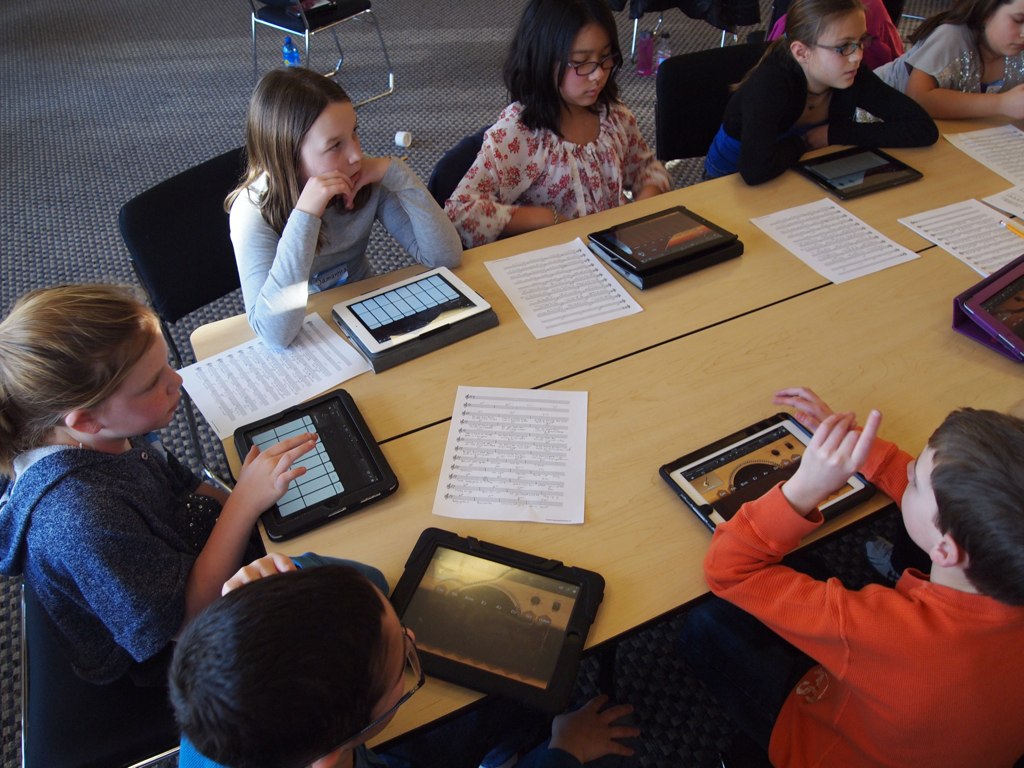
“student_ipad_school – 038” by flickingerbrad is licensed under CC BY 2.0 .

According to primary school teachers, many children shamble through the doors today zombified and crying out for their iPads.

Their parents, lined at the school gates, barely say goodbye, what with the hypnotic drivel spewing from their iPhones.

The kids greet their teachers with the YouTube vernacular: “Hi, guys!” When handed a book, they swipe and tear at the unfamiliar paper. They greet each other with: “Welcome to my channel!”

Finally, when they leave, they don’t say goodbye. They say: “Remember to like and subscribe!”

I’m not taking the piss. A friend of mine, tasked with civilising these screen-addled sprogs, confirms what one reads in the newspapers. These chirpy little addicts ransack classrooms crying out for more iPad with the fanatical calculation of tweaking crackheads.

Wherever you may sit on the political spectrum, I hope you agree that a functioning democracy might one day need citizens who can read and write, and who can concentrate beyond a ten-second video clip.

At least one functioning democracy agrees. Recently, Swedish politicians reversed their digital-first obsession by announcing a return to paper and pen. The sensible Swedes have gone analogue. Why? Literacy rates in the cosy Nordic social democracy have collapsed.

“We’re actually trying to get rid of screens as much as possible,” said the Liberal party’s Joar Forsell.

Since 2025, pre-schools are no longer obliged to employ digital ‘tools’ and teachers no longer dole out tablets to kids under two. According to Mr Forsell, reading real books on paper does what schools have for decades avoided: it teaches kids to think. Tablets for toddlers is now från skärm till pärm (from screen to paper.)

High school students now drag their textbooks and notepads to classrooms stripped of screens.


The evidence piles up. Researchers found that hyper-digital tablets-for-toddlers eroded basic skills. Writing by hand, Swedish students learned more and retained more. Wiping away digital mandates, Swedish lawmakers promise more handwriting and books, fewer devices, and quiet reading time.

But it’s not just the Swedes.

Psychologists Pam A. Mueller (Princeton University) and Daniel M. Oppenheimer (UCLA) found handwriting beats typing — at least if learning something is your thing. Students who pecked down verbatim notes on their laptops wrote twice as many words as their pen-and-paper classmates. Who learned and remembered more? Take a guess.

How could this be? Writing by hand is slower. You’re forced to process and reframe information in your own words — the art of thinking. Screens hamper this essential process. When we write by hand, there’s a greater connection between the brain and the finger. This act, they say, cements the information in one’s brain. Essentially, the typists transcribed much. They absorbed little. It’s like paying someone else to have sex for you.

Researchers claim that writing on paper improves everything from recalling a random series of words to grasping and understanding complicated or conceptual ideas. Writing by hand ties down the balloons of motor, visual, and sensory memory.

When studying from their notes, the longhand writers did better on tests. This persisted even when the typists were told to rephrase the material into their own words. They didn’t absorb the material. They parroted it, much like ChatGPT doesn’t know that flipping a glass spills water. It merely knows that the words “flip” and “glass of water” are statistically related to the word “spill”.

And yet, British schools continue marching to the drumbeat of post-literate doom.

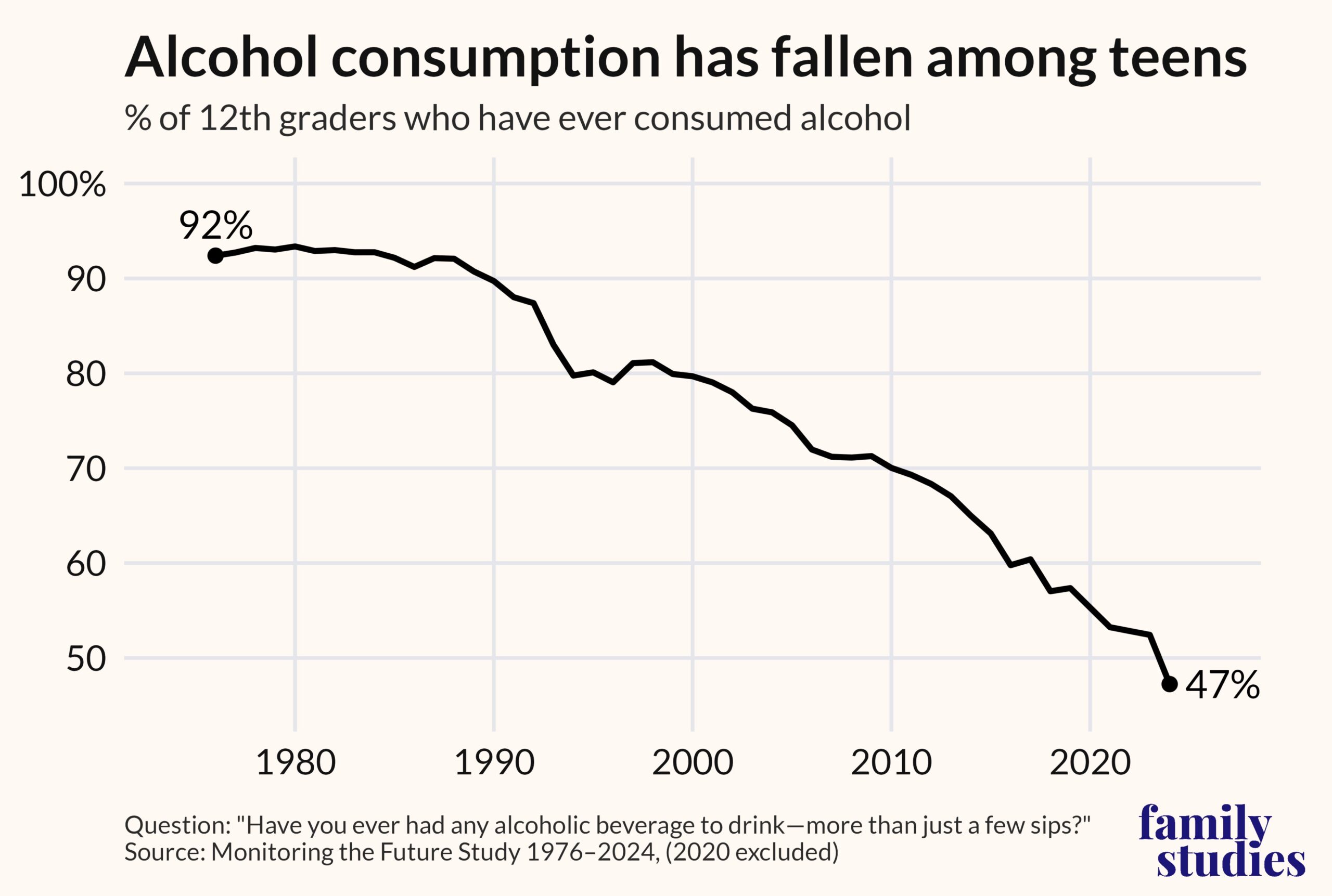
The good news: kids are drinking a lot less! But there’s also bad news …

Filed under: Health, USA — Tags: , , , , , , — Nicholas @ 05:00

The good news seemed to be that teenage drinking was dropping fast. Fewer underage drinkers, happier teenagers, right? Not so fast …

⚡️The deeper signal is youth risk did not disappear.

It migrated inward.

Teen drinking fell because the old physical world of adolescence got dismantled. Alcohol belonged to a social ecosystem: unsupervised time, cars, parties, local jobs, malls, basements, boredom, flirting, older siblings, house gatherings, and the chaotic peer world where teenagers learned who they were by colliding with other people in real space.

That ecosystem was replaced by phones, surveillance, parental tracking, algorithmic entertainment, social anxiety, online status games, and a much thinner physical commons.

So the surface looks healthier. Fewer kids drinking. Fewer kids using weed. Fewer kids doing reckless things in public.

The hidden layer looks worse. The young are less reckless because they are less socially embodied. Less initiation. Less unsupervised friction. Less courage-building. Less embarrassment and recovery. Less real dating. Less independence. Less contact with the physical world before adulthood demands it.

The old teenage world produced damage, stupidity, alcohol abuse, pregnancy risk, fights, accidents, and bad decisions. No need to romanticize it. But it also produced social reps. It forced young people through discomfort. It made them practice attraction, rejection, conflict, reputation, risk, repair, and status in the open.

The new world suppresses visible risk while increasing invisible fragility.

That is the trade.

A teenager can avoid drinking, avoid parties, avoid sex, avoid driving, avoid real confrontation, avoid rejection, avoid shame, avoid danger, and still arrive at 23 emotionally underbuilt. Cleaner behavior does not automatically mean stronger formation.

This is why the marriage chart and the teen drinking chart are the same story at different stages. People are not suddenly failing to pair in adulthood. The whole pathway into embodied adulthood has been slowing for years before marriage even becomes the question.

The real truth: society solved part of the teen vice problem by shrinking the arena where teenagers become adults.

It took away the dangerous commons and replaced it with controlled isolation.

The result is safer kids with weaker initiation into real life.

“One of the most iconic pictures of WWII” – the seen and the unseen, USN edition

Filed under: History, Military, Pacific, USA, WW2 — Tags: , , , — Nicholas @ 04:00

CDR Salamander posts an iconic US Navy photo from late 1944, showing the unparalleled naval might of the American efforts against Japan. But, as with Bastiat’s famous economic essay, there are the obvious things we see and the important but unseen things that matter just as much:

Murderers’ Row. Ulithi anchorage, December 8th, 1944. Just three years after the attack on Pearl Harbor.

One of the most iconic pictures of WWII.

The carriers are (from front to back): USS Wasp (CV-18), USS Yorktown (CV-10), USS Hornet (CV-12), USS Hancock (CV-19) and USS Ticonderoga (CV-14).

The oldest of those ships, Yorktown, was only 19 months old. The youngest, Hancock, was commissioned only a little under eight months earlier. All were laid down and took from a bit under three to a bit under four years to build.

Just a year prior, the US Navy was so short of aircraft carriers, it had to borrow a carrier from the Royal Navy.

At first glance, it appears to be a flex of American naval power at flood tide — the aircraft carrier’s unassailable invincibility manifest — and it is. However, when you dig deeper, it has a more important story. It gives a warning. It informs us today, if we are willing to listen.

It isn’t about the power of being the world’s greatest shipbuider, that we were. It isn’t about an unequalled ability to project national will across the Pacific like no nation ever has in human history, which it is.

No. That isn’t what it tells us that is most important.

As we have done more than once over the last two decades, we’re taking a holder of a front row seat on the Front Porch and CDR Salamander Plank Owner Sid’s comments, in this case from yesterday, and bringing it to a standalone post.

Most of this post is his. The insight certainly is.

The actual story this picture tells is much more sobering, right there in plain sight, but you can’t see it.

The reality is that on the day this picture was taken, the Fast Carrier Task Force (TF 38/58) was down an entire Task Group from where it started two months earlier.

USS Franklin (CV-13) was severely damaged on 27 OCT by kamikaze and had to return [to] CONUS for repairs.

USS Belleau Wood (CVL-24) was severely damaged in the same attack.

USS Princeton (CVL-23) was sunk on 24 OCT by a Judy dive bomber.

USS Essex (CV-9) had a devastating hit by a kamikaze on 24 NOV followed by a disabling machinery casualty requiring a trip back to CONUS for repairs.

USS Enterprise (CV-6) departed a few days earlier for repairs in Pearl Harbor.

All the carriers in this picture had been damaged to varying degrees. Damage that today would require a trip to the yard to fix, like the absent Enterprise and Essex.

For example Ticonderoga (fourth Essex in the line from the bottom) would take damage to her radar waveguides in January. That could not be repaired forward and she would have to return to Bremerton as well.

“This is what luxury-belief failure looks like”

Filed under: Cancon, Media, Politics — Tags: , , , — Nicholas @ 03:00

L. Wayne Mathison reacts to a pair of smarmy politicians congratulating one another in the House of Commons to the echoes of the trained seals clapping in the background:

This photo has the stink of Ottawa self-congratulation all over it.

Two suited insiders shaking hands while the room applauds, as if Canadians are supposed to mistake ceremony for competence. The whole scene screams managed success: the smiles, the poppies, the polished wood, the clapping loyalists in the background. Very official. Very staged. Very pleased with itself.

And that is the problem.

This is what luxury-belief failure looks like in picture form: people with secure salaries, protected pensions, communications teams, and zero personal exposure to the damage their policies create, congratulating each other for “building Canada” while ordinary Canadians are buried under housing costs, taxes, debt, inflation, weak productivity, and a government that thinks another announcement is the same thing as a result.

The photo says: “We are proud of what we’ve done.”

The Canadians with a brain say: “That’s exactly the problem.”

For over a decade now, the Canadian government has devoutly believed that appearances matter far more than reality, and conducts all of its operations with PR at the very tip-top of the priority list. If it will look really good on camera, it’s much more likely to get done … for Ottawa values of “done”. That usually means a big flashy announcement with whatever quick background props can be conjured up, followed by little or no actual work. Often the same thing will be re-announced multiple times in different places over an extended period of time, still with little else taking place. This is how Canada’s lost decade (and counting) has gone. And Liberal boomer voters love every performative second of it.

Bloodier Than Verdun? Winter Battles on the Eastern Front 1915

Filed under: Germany, History, Military, Russia, WW1 — Tags: , , , — Nicholas @ 02:00

The Great War
Published 16 Jan 2026

The first four months of 1915 witnessed a titanic struggle on the Eastern Front, in East Prussia, the Carpathians, Bukovina, and at Przemysl. Both sides suffered staggering casualties that surpass those of the Somme or Verdun the following year. Ironically, the Austro-Hungarians lost far more men trying to save Przemysl than there were in the fortress.
(more…)

QotD: Rediscovering Cræft

Filed under: Books, History, Quotations, Technology, Tools — Tags: , , , — Nicholas @ 01:00

Of course this isn’t just a book about hedging, that would be silly. There’s also haymaking, shepherding, walling, beekeeping, weaving, tanning, basketry, thatching, plowing, and the making of everything from ponds to quicklime, because Alex Langlands is obsessed with preserving (and if necessary recovering) the skills of the rural past. He wants you to understand what’s been lost to industrialization, and how our contact area with the world has shrunk, and why doing things with your body is part of being human, and … oh wait I’m sorry I nodded off, because I’ve written this all like twelve times already.

So why am I telling you about a book on how to do things by hand that you can do far more quickly and efficiently with a machine?

Well.

Langlands frames his book around the concept of cræft, which (as you can probably guess from that æsc) is the Old English origin of our modern “craft”. The ancestral word is richer and more complicated than the modern one, though, pointing to far more than handmade tchotchkes and beer with too much hops. The Dictionary of Old English explains:

    “Skill” may be the single most useful translation for cræft, but the senses of the word reach out to “strength”, “resources”, “virtue”, and other meanings in such a way that it is often not possible to assign an occurrence to one sense in [modern English] without arbitrariness and loss of semantic richness.

Like the modern “craft”, it does convey a sense of ability, especially when it comes to one’s livelihood: the students in Ælfric’s Colloquy use cræft as well as weorc when discussing what they do all day. But it can also mean might or power: when the Old English Orosius tells us that the strength of the Medes failed them in battle, for example, it’s Meða cræft that gefeoll,1 and when Judah Maccabee’s foes join the fray, they begin to fight mid cræfte. Of course, there are semantic connections among these varied meanings: the ideas of physical strength and physical skill blend into one another at the edges, and a word for a thing you’re good at doing with your hands can also be used for a thing you’re good at doing with your mind. (After all, we still refer to writing as a “craft”.) And ideally you’re fairly talented at whatever set of things provide your livelihood! So we can say that Old English cræft broadly means something like “a person’s ability to bring his will to bear on the world, and his skill in doing so”.

There’s one more meaning, though, and it appears more or less exclusively in the writings of Alfred the Great: cræft as spiritual or mental excellence.2 Anglo-Saxon scholars had mostly used cræft as a way of rendering Latin ars, but when King Alfred translated Boethius into Old English he used cræft for Latin virtus, virtue as in moral excellence.3 A contemporary reader might be tempted to see this as merely an extension of the “mental skill” sense of the word (a virtuous person is one who is good at being good), but that would be misleading; the general meaning of cræft leaves the word freighted with powerful and inescapably physical implications. (Remember, too, that before the Reformation the Christian image of spiritual excellence universally emphasized asceticism, which necessarily involves the body a great deal.) Cræft as virtue is not an internal moral condition, it’s an internal activity, a kind of doing or making of the soul.

Or, as Langlands glosses his title, cræft is “a hand-eye-head-heart-body coordination that furnishes us with a meaningful understanding of the materiality of our world”.

Langlands is now a professor of archaeology at Swansea University, but he got his professional start as a circuit digger, the kind of “hired trowel” real estate developers pay to quickly catalog all the ancient remains they’re about to turn into the foundation of a new Tesco. It was not a fulfilling job — “crude and expedient” is the line he uses for his commercial excavations — and he was beginning to grow disillusioned with archaeology as a field. So naturally he did what any sensible person would do if he didn’t like his job: he applied to be on a TV show. This was in 2003, and BBC Two was advertising for people to spend a year in 1620, living on and running a historical farm using reconstructed period techniques and equipment. Langlands got the gig (along with Ruth Goodman and another archaeologist whose book I haven’t read), and had a wild year in the Stuart era and then a few more in the Victorian and Edwardian periods.

The shift from examining the archaeological record to experiencing how it was made was an eye-opener, and the success of that first program took him by surprise: “I’d often wondered to myself who on earth would want to watch a bunch of cranky, oddball re-enactors and archaeologists bimbling around in costume, pretending to be in the past”, he writes. “But I didn’t care too much because I was spending nearly every single hour of every day immersed in historical farming. I was tending, ploughing, scything, chopping, sweeping, hedging, sowing, walling, slicing, chiselling, digging, sharpening, thatching, shoveling; the list was almost endless.” And the longer he spent doing all these things (he was on three more shows), the more he realized that the skills, and the knowledge they required, were slipping away.

True cræft, in Langlands’s version, is a combination of know-how and make-do. It’s when you live on the Outer Hebrides and don’t have any trees, so you use whatever driftwood washes up as the ridgebeam for your roof. No timber for the rafters? No problem — a sufficiently strong rope, drawn tightly enough over the ridgeline and secured on both sides, makes something like a giant net on which you can lay your thatch. The straw left in the fields after harvest will do nicely for making both rope and thatch, but if (say) it’s the early twentieth century and you’ve abandoned cereal crops because cheap North American grain knocked the bottom out of the market, then you can make rope from heather and thatch with bunches of bracken. (On the Danish coast, they use seaweed.)

Or it’s when you’re an early Anglo-Saxon who wants to boil some water. A few generations ago, some Romano-Briton on the same spot would simply have bought a beautifully thrown pot from any one of a dozen proto-industrial centers across the Empire, but these days that production has slowed or stopped and the trade networks that would’ve brought them to you are kaput anyway. All you’ve got is some lousy local clay, too weathered to be easily worked. You don’t even have the fuel to fire it hot. So you add organic tempers like grass or chaff (or even dung) to make the clay more plastic, you shape it by hand without a wheel, and when you fire your pot the chaff burns away and leaves tiny voids in the ceramic. Your pot is soft, it’s brittle, it’s kind of lumpy, and fifteen hundred years from now Bryan Ward-Perkins is going to point to it as evidence that civilization collapsed when Rome fell — but it’s still a pot, and it still holds water. You’ve made ingenious use of the world around you to solve your problem. You are, in a word, cræfty.

So when Langlands says cræft, he means the way people behave under conditions of scarcity and resource constraint. And when you’re in that kind of situation, of course you have to be intimately familiar with all your materials — you have to squeeze every last drop of performance out of them! And while Langlands is interested in preindustrial techniques, this isn’t just a matter for drystone wallers and skep-making beekeepers; you can also be cræfty with machines or computers. Cræft is the Havana mechanics who keep 1950s cars running on an income of $40/month, or the engineers who fit all the computer code for the Apollo Guidance Computer into 80 kilobytes. It’s the defining feature of the Real Programmer who “tuck[ed] a pattern matching program into a few hundred bytes of unused memory in a Voyager spacecraft that searched for, located, and photographed a new moon of Jupiter”. We rightly admire these cræfty solutions for their elegance and their makers’ skills, but aside from a few weird hobbyists we don’t imitate them. You don’t spend days hauling rocks and building a wall to keep your sheep in when you have wire fencing. You don’t learn the skies so you can time your haymaking for clement weather when you can just wrap your machine-mown grass in plastic and make silage instead. And you don’t work in unreal mode when you have 64-bit processor. Technological advances have freed up our time precisely because they’ve freed us from the need for clever, thoughtful, material-aware solutions to our problems. No one is cræfty in the midst of abundance, because they don’t have to be.

Your reaction to that last paragraph reveals where you fall in the Wizard/Prophet divide: are you pumping your fist for humanity, or are you a little sad that a kind of mastery has been lost? Is our ability to simply throw more resources at the problem and go on with our day a blessed liberation from the bonds of brute necessity, or is it a tragic separation of our thinking, making, doing selves from our world? Are our practical limitations something to be defeated or innovated around, or are they something to embrace because they are, in some sense, good for us?

Langlands is, unsurprisingly, well over on the Prophet side. He warns that “while some machines are clever, the net result of our using them is that we become lazy, stupid, desensitized, and disengaged” — it’s not that a thing made by hand is better as an object than its mass-produced counterpart (although in some cases it is, and a stone wall does last longer than a wire fence), it’s that the making changes the maker. And while he likes to warn that climate change or Peak Oil or the fragility of international supply chains make our uncræftiness a serious survival risk (think of those poor imported-pot-dependent Britons when Rome withdrew!), that’s not really the point. Even if our technological society never falters — even if we soar to greater and greater heights of prosperity and can afford to automate and mechanize more and more of our interface with the world — Langlands argues that would just mean more missing out.

Jane Psmith, “REVIEW: Cræft, by Alexander Langlands”, Mr. and Mrs. Psmith’s Bookshelf, 2025-03-24.


  1. As in modern German and Dutch, Old English used the ge– prefix for past participles.
  2. For more on Old English cræft, especially in the Alfredian corpus, see here. Langlands quotes from the late Peter Clemoes, who wrote extensively on the topic, but no obliging Kazakh has put that online for me.
  3. This is a fascinating word choice, because virtus is also a complicated and interesting word; it’s derived from the Latin word for man, vir, and means things like “force” but also “manliness” or “bravery” (like Greek ἀνδρεία). In the classical world, it came to mean something like moral worth or excellence in a particularly masculine way, and though it was adopted as a western Christian term for something like spiritual ἀρετή, it retained some of those echoes.

Powered by WordPress