Quotulatiousness

May 25, 2026

Enoch Powell, in person

Filed under: Britain, History, Politics — Tags: , , , , , — Nicholas @ 06:00

I posted an excerpt from Niccolo Soldo’s post on Enoch Powell last week, which might be why Substack called my attention to this post from Francis Turner, which includes some memories of personal interaction with Powell during a visit Powell paid to Turner’s father in the early 1980s:

No wonder he was vilified for telling the truth … he was completely correct.

As I commented on Niccolo’s post I had the fortune to meet Enoch Powell in the early 1980s. I think it would have been about April 1983 but I could be wrong. I don’t recall the reason Powell came, it could have been something to do with the Bible or Greek Patristics, it could have been theology, it could have been Gladstone or it could have been something totally different that I can’t guess. Anyway he spent a few days with my father for some reason and the two of them got on like a house on fire.

Both were Cambridge educated classicists, though my father was there a decade after Powell, and they had a number of other things in common. They were of essentially the same social class and similar background. Both had been in intelligence in WW2 and concentrated on the Japanese front. Both had been to India — my father as missionary, Powell as soldier in WW2. Both had learned Indian languages — Powell learned Urdu, my father Tamil. Both had worked with “working class” people — my father as a vicar in Rochdale, Powell as MP in Wolverhampton. They also shared a similar political outlook, though I don’t think they discussed politics much beyond sharing their distaste for Europe.

What I recall of those few days was what a nice man Enoch Powell was. As I mentioned in the comment, he helped me with my homework, which was Herodotus. I recall him, in addition to giving me specific advice, discussing with me and my father the various dialects of ancient Greek and how remarkable it was that an educated Greek in Constantinople could have read Herodotus written a thousand years or more earlier without much difficulty. I also recall him encouraging my father to learn German and even Russian because “you’ve learned two non Indo-European languages already, so both will be easy for you as a classicist”.1 Since Powell spoke (or at least read and wrote) multiple Indo-European languages, including both of those, he may have been optimistic but his encouragement undoubtedly helped.

He entirely failed to mention to me that he’d spent years as an academic studying Herodotus and had actually published a well known book about his work. But that did explain how he could know precisely what passage I was having trouble with from just the first few words.

One thing that stood out was his intellect. He wasn’t in any way patronizing but he made little attempt to disguise his brains. He started off assuming you could more or less keep up and would adjust down until you did. He was also curious about new things. I don’t think he was faking it when he asked me about home computers and what good they were for. I’m not entirely sure I gave him a good answers but the questions he asked helped me realize that I really enjoyed programming them and that therefore a computer programmer might be a good career.

The other main thing that he taught me was to distrust the media. He gave some specific examples regarding the IRA and Northern Ireland and how the BBC and the newspapers had exaggerated certain events. He also pointed out that the media had to pick and choose what to report on and that they could prioritize some events over others.

One other thing. Part of his background was (Anglican) Christianity. He might not have gone to church every day, but he certainly did go on Sundays and if the opportunity presented itself he would attend Matins or Evensong. It was just the sort of thing one did. And one behaved accordingly.


  1. Quote not exact because it was 45 years ago
George Washington “basically started the world’s first global war”

On his Substack, Ed West talks about a book he had intended to write, but “put it on the back burner” for too long and the moment has passed:

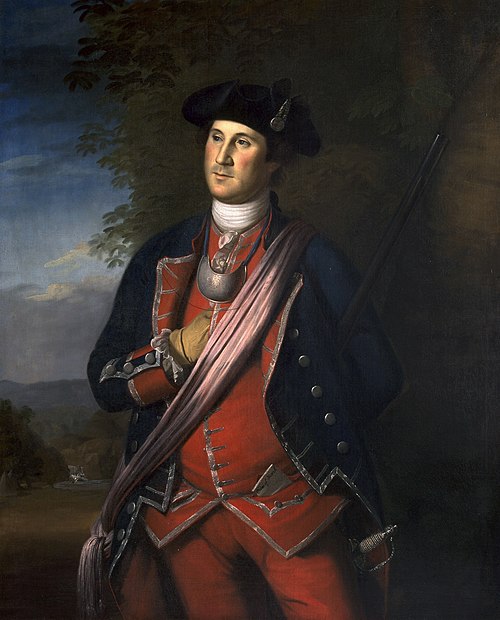
George Washington in the uniform of the Virginia Regiment, 1772.
Portrait by Charles Willson Peale (1741-1827) from the Washington and Lee University collection via Wikimedia Commons.

The story would start in the 1750s. The first truly world war is in full flow, as Britain and France battle for supremacy of the continent and the oceans. In North America, British colonial troops fight side by side with soldiers from the old country, who mock the bumpkin locals with their ditty “Yankee Doodle“. But, rivalries aside, they both know what they’re fighting for: if Louis XV’s absolute monarchy wins, all their liberties will be gone.

In a heroic battle the British regular and colonial forces take the French stronghold of Fort Duquesne and rename it Fort Pitt, after cabinet minister William Pitt “the elder” – it later becomes Pittsburgh. By 1763 the French are driven out of North America altogether. The British colonies are safe. One officer particularly shines during this war, and diarist Horace Walpole writes how “The volley fired by a young Virginian in the backwoods of America set the world on fire”.

That Virginian was George Washington. Born in Wakefield in Westmoreland County, this British hero was the great-grandson of an Essex clergyman thrown out of the church for drunkenness, and who had landed in that colony in 1657. Washington was an impressive man in every way – standing at 6’2″, with enormous hands and feet and a massive nose, he was notably strong and able to throw objects immense distances (although many of these accounts improved in the telling).

Despite having almost no teeth, like any good British patriot, Washington was very proper about his appearance, insisting on bringing a selection of fine linen shirts even into the backwoods. A conservative by nature and with ambitions to serve as an officer in His Majesty’s forces, he didn’t like the new fashion for shaking hands, preferring the more formal bow.

A major at 21, Washington’s first job was to lead his men into the Ohio Valley to warn away any Frenchmen they found there. The following year, 1754, and now a lieutenant-colonel, he went back and built Fort Necessity close to Fort Duquesne, where he stumbled upon a contingent of enemy troops. They ran for their muskets and Washington ordered his company to fire. Ten Frenchmen were killed, including their lieutenant, and the incident would spark a war in North America between the two great powers, which in 1756 linked up with a Europe-wide conflict later known as the Seven Years’ War. It’s strange to think that, as well as being the first president of a future global superpower, Washington basically started the world’s first global war.

But what if France had won that struggle? Would French-controlled colonies in North America have formed constitutions centred on the rights to life, liberty and the pursuit of happiness, not to mention the often-overlooked right to property? Would they have enshrined religious tolerance or the right to free speech? Trial by jury? Innocence until proven guilty? Hell, no! And if it wasn’t for us, my thesis went, you’d be speaking French.

Without England’s history of Parliamentary freedom, habeas corpus, Magna Carta and the jury system, the colonies would never have developed as they did. Neither would they have the same commercial spirit, downstream of their Puritan and Quaker inheritance.

I think I came up with the proposal after reading David Hackett Fischer’s Albion’s Seed, one of the most discussed and popular analyses of American culture. This great work of history and anthropology charts the foundation of the country’s cultural folkways through four migrations – East Anglian Puritans to New England, Cavaliers from England’s south and south-west to Virginia, the mostly northern Quakers to the middle colonies, and Borderers from Ulster to the Appalachians.

I was always very interested in founder effects, whereby colonies come to take on aspects of the mother country which subsequently disappear back home. This is reflected in the fact that many “Americanisms” are actually old English words, like fall, trash and garbage, even “gotten”. It’s also true to some extent of the American accent, developing out of various regional dialects which have since been flattened by the dominance of London. This is especially the case with Ocracoke Island in North Carolina, which apparently is the closest thing to Shakespearean English, although I fear that if I went there this would no longer be true, and they’d all say “like” four times in every sentence and tell you they’re “reaching out”.

Did The Taranto Raid Inspire Pearl Harbor?

Filed under: Britain, History, Italy, Japan, Military, USA, Weapons, WW2 — Tags: , , , — Nicholas @ 04:00

TimeGhost Cartographic
Published 24 May 2026

In November 1940, the British Royal Navy launched a daring carrier strike against the Italian fleet at Taranto. The attack shocked the world, crippled Italian naval power in the Mediterranean, and demonstrated just how devastating naval air power could be against battleships at anchor. But the consequences of Taranto didn’t end in Italy.

In this episode, we explore the aftermath of the raid, the race to understand how it had been achieved, and why military observers around the world paid such close attention to what happened there. From British convoy operations in the Mediterranean to Japanese investigations into shallow-water torpedo attacks, this episode examines how one raid would echo far beyond the harbor at Taranto.

How did the British make the attack possible? What lessons did foreign observers take away from it? And why did some nations react to the raid very differently than others?

“When I was in high school, I was taught that every single Canadian adored Pierre Elliott Trudeau”

Filed under: Cancon, Education, Media, Politics — Tags: , , , , , , — Nicholas @ 03:00

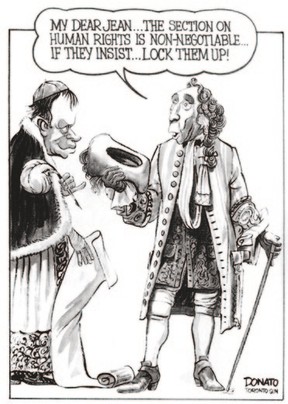
My family arrived in Canada in October 1967, just as the last of the Centennial events were shutting down. Pierre Trudeau became Liberal leader and Prime Minister not long afterwards. I think the “Trudeaumania” of 1968 was nearly 100% media generated, but it was new to Canadian voters who liked the idea of Canada being led by a sophisticated international playboy rather than the stolid, rather unfashionable men who preceded Trudeau. The media continued to “love him long time”, which definitely helped keep him in power and then back into power after the brief Joe Clark experiment. Since he left office, his reputation has been cherished and burnished by progressives in the educational system, as Harrison Lowman relates:

A Toronto Sun editorial cartoon by Andy Donato during Pierre Trudeau’s efforts to pass the Canadian Charter of Rights and Freedoms. You can certainly see where Justin Trudeau learned his approach to human rights.

“When I was in high school, I was taught that every single Canadian adored Pierre Elliott Trudeau. I learned that when the rose-pinned prime minister winked and pirouetted, the whole nation swooned.

It wasn’t until first-year university that I was first exposed to the fierce Western backlash to his National Energy Program.

It wasn’t until I graduated that I learned about any opposition to his Charter of Rights and Freedoms, his policy of national bilingualism, and official multiculturalism.

It was my Ontario high school civics teacher’s fault. While she was a great educator in other ways, the politics lessons she taught us were clearly slanted in the Liberal direction; a direction she supported.

My experience as a young person 20 years ago demonstrates the immense power teachers hold in moulding young minds. It’s a power that concerns me when I imagine dropping off my eight-month-old son at school in three years. Today, that teaching slant has become even steeper, with too many educators unwilling or unable to provide political or ideological balance in their classes.

This week, I interviewed Stephen Reich, a PhD student at The Ontario Institute for Studies in Education (OISE) who researches the proliferation of critical theory in kindergarten to Grade 12 policymaking.

Reich told me I should be concerned—that the educational leaders in this country have all but abandoned what should be the true purpose of education: imparting civilizational knowledge to the next generation. Instead, they’ve replaced it with seeking multiple “truths” and a narcissistic obsession with oppression narratives. Never mind that 92 percent of Canadians polled say they don’t want their children separated by race: taught to see themselves as “privileged” vs. “oppressed”. Reich says certain teachers are far less interested in producing independent thinkers and far more interested in producing activists.

“I have a feeling that success [for them] is ideological conformity,” he explained. That they aim to help foment some sort of “liberation.”

CP-121 Tracker; carrier-borne ASW powerhouse turned aerial firefighter

Filed under: Cancon, France, History, Military, Technology, Weapons — Tags: , , , , , , — Nicholas @ 02:00

Polyus
Published 31 Jan 2026

This is an aircraft carrier borne submarine hunter, dressed up like a firefighter. Its story is one of Cold war posturing, coastal policing, and aerial firefighting. Quite the career for such an unassuming looking aircraft. It was the de Havilland Canada CP-121 Tracker, an icon of Canadian aviation for almost 60 Years.

0:00 Introduction
0:30 Historical Context
1:58 Tracker or Gannet?
4:26 Canadian built CS2F-1 Trackers
9:06 CS2F-2
10:23 CS2F-3
13:12 New roles
15:14 Marine Reconnaissance
16:10 Conair Firecat/Turbo Firecat
17:48 Conclusion
(more…)

QotD: Modern movie casting

Filed under: Media, Politics, Quotations, USA — Tags: , , , — Nicholas @ 01:00

In the English speaking world, it has become common to “blackwash” movies and television shows. This is the process of removing white characters and replacing them with non-white characters. The stated claim is that popular entertainment needs to reflect the changing nature of the audience. Of course, the reason the audience is changing is that the same people blackwashing films and television shows are ethnically cleansing white societies with mass immigration.

For a long time now, Hollywood has been taking great care to make the good characters black and the bad ones white. For a short while, the bad guys could be Arab terrorists, but now bad guys are white again. If they need to be foreign baddies, then they are neo-Nazis from eastern Europe or Russian gangsters. Of course, the smartest characters are black or female. If we’re lucky, the brainiac is a black lesbian. Every computer hacker is now non-white or female.

On occasion the blackwashing gets ridiculous. Some figure from white history is played by a black actor. A black guy in a show about medieval Europe could be amusing, but that’s not how it is done. Instead, we get black cowboys saving a white town or a black playing King Lear. It will not be long before we have historical dramas in which well-known figures from white history are played by black actors as black people. Imagine Ben Franklin played by Morgan Freeman.

The Z Man, “Blackwashing”, The Z Blog, 2020-10-02.

Powered by WordPress