
Quotulatiousness

May 30, 2026

Unlike Canada, Sweden can have a sensible, rational public discussion on indigenous issues

Filed under: Cancon, Europe, Government, Media, Politics — Tags: , , — Nicholas @ 04:00

Yeah, I know. I’m just as shocked as you are, but Warren Mirko and Laurisa Dohm have the receipts:
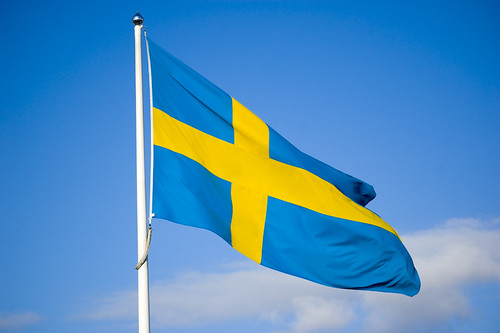
“Swedish flag” by JSolomon is licensed under CC BY 2.0 .

Something happened in Sweden recently that would be nearly unthinkable in Canada.

There was a substantive public discourse about the tension between Indigenous rights, the broader public interest, and the state’s jurisdiction, in prominent newspapers and on television.

Ebba Busch, Deputy Prime Minister of Sweden, stood at a press conference in Luleå and argued that reindeer herding should no longer be classified as a riksintresse, a formal national interest designation that grants legal protection in land-use planning. She proposed that reindeer stocks should be cut and subsidies re-allocated to other cultural programs in order to ease tensions between competing land-use interests in northern Sweden. Her reasoning: reindeer herding affects very large areas of Sweden’s land mass but carries limited economic significance.

The response was immediate. Indigenous Sámi groups called it election propaganda. The chairman of Girjas Sámi village published a rebuttal arguing that Sámi rights to hunt and fish are grounded in ancient tradition, and that her party’s framing mischaracterizes those rights as economic interest rather than constitutionally recognized Indigenous rights. The Swedish public broadcaster’s own reporter called the debate “a hornet’s nest“.

And yet the debate actually took place. On the nightly news, no less.

Deputy Prime Minister Busch made a substantive argument about how she thinks the state should weigh competing interests in its northern regions, with her reasoning stated plainly, and Sámi leaders answered in kind. That is democratic governance.

Canada’s political class has spent decades avoiding exactly this kind of clarity and honest intellectual engagement. It has been sacrificed at the altar of conflict avoidance and by the acceptance of canned platitudes carefully crafted to say precisely nothing at all.

Sweden ranks fourth in the world on the Economist Intelligence Unit’s Democracy Index, with a near perfect score of 9.4/10 for political culture. It also takes Indigenous rights seriously, having established an independent truth commission in 2020 to study historical abuses against the Sámi.

And yet Sweden’s Supreme Administrative Court upheld the government’s decision in June 2024 to grant an iron ore mining concession at Kallak in northern Lapland, despite contentious opposition and legal arguments that insufficient consultation had violated Sámi’s rights to free, prior, and informed consent. Now, its Deputy Prime Minister is arguing publicly that the state must regain clearer authority to make decisions across its entire territory, and that the interests of reindeer herding cannot be allowed to dominate and block decision making processes as they do today.

Sadly, Canada does not seem to take lessons from more mature nations. Or any lessons, really. Our politicians are so afraid of “third rail” issues and controversy that they avoid any hint of actually addressing real problems in favour of performative announcements, repeated endlessly with no attempt to actually perform actions.


“Bullying”

Filed under: Health, Military, Politics, USA — Tags: , , — Nicholas @ 03:00

I was bullied as a kid. I hated it. Most kids experience it, and either hate it or embrace it as “how things are done” (most likely both). This is basic human nature across all cultures. It’s how we learn how to conform, or appear to conform, to cultural expectations. In a pre-urban environment, the community could only handle so many non-conformists — that is: close to zero — so nipping it in the bud with the children was a pro-survival/pro-communitarian mechanism. In modern urban environments, bullying still happens because it’s part of human nature rather than being how children learn how to cope with social situations.

We’ve even migrated the notion of suppressing “bullying” to the military, as InfantryDort explains:

Any man who thinks bullying is ubiquitously inappropriate has the survival instincts of a deer gazing longingly at headlights.

For most of human history, communities had weak formal institutions. Public ridicule, shaming, and ostracism were used to enforce norms.

Examples:

> Villages mocking chronic thieves.
> Military units humiliating cowards.
> Tradesmen ridiculing apprentices who refused to learn.

The positive effect was often:

> Greater conformity to community standards.
> Faster correction of disruptive behavior.
> Stronger group cohesion.

It hardens individuals to harsh environments when properly applied. And enforces societal norms we want and dissuades the ones we don’t.

The lack of bullying is how people grow up to adulthood and say things like “I’m gonna kill you and your whole family” at some political protest. And have it come out of their mouth as normal as breathing.

Because nobody ever stood them down in their formative years.

You’re a JAG. You think every problem has a legal solution. It doesn’t. You don’t understand the way the world works outside of the one the law has carefully curated for you. Made possible by people who’ve been using strength to coerce others for all of human history.

Let me spank the kids while you do the dishes.

Buying W.W. Greener: Tales from the Golden Age of Surplus

Filed under: Britain, Business, Cancon, History, USA, Weapons, WW1 — Tags: , , , , — Nicholas @ 02:00

Forgotten Weapons
Published 7 Jan 2026

I am joined today by Val Forgett III of Navy Arms for the first in a series of videos telling some of his stories form growing up in the golden age of surplus, with a father who was one of the largest arms dealers in the US. Today, we are talking about how his father ended up owning the W.W. Greener company for five days, and taking a look at a sniper rifle from the Greener museum collection — a .280 Ross fitted with a Zeiss optic used by Greener’s nephew to significant effect in the First World War.

Minor correction: The guns Val still has were duplicates for Edward VII, not Edward VI.

In addition, Mr Bailey’s story has a happy ending. Val’s father gave him the machine tools from the Greener shop and prepaid for six months lease on a nearby building for him to start his own business. He eventually partnered with a former Greener employee named Leonard Onions and they formed Bailons Gunmakers Ltd, which was in business for many years.
(more…)

QotD: Winnipeg

Filed under: Cancon, Quotations — Tags: , — Nicholas @ 01:00

Winnipeg is in the geographic centre of Canada and perhaps our cultural centre in terms of defining what is really Canadian — not just because it’s called Winterpeg. Vancouver culturally associates with San Francisco or Seattle, Calgary with Dallas, Toronto with New York, and Montreal with Paris.

But Winnipeg is a place unto itself, a place that reflects the vast space and isolation one feels in countless Canadian communities from the Maritimes to northern Ontario to the interior of B.C.

In such communities, the glue is neighbourliness, a thirst to find a middle ground, a place where everyone has something in common.

David Lawrason, “Canada’s Middle Ground”, Wine Access, September, 2005.

Powered by WordPress


