Quotulatiousness

May 1, 2026

We are much more Brave New World than 1984

Filed under: Books, Education, Media, Politics — Tags: , , , , — Nicholas @ 04:00

Culturally, we had lots of warning from George Orwell and Aldous Huxley about their future — our present — and while we have had some success avoiding what Orwell feared for us, we’ve had much less success avoiding a Brave New World culture:

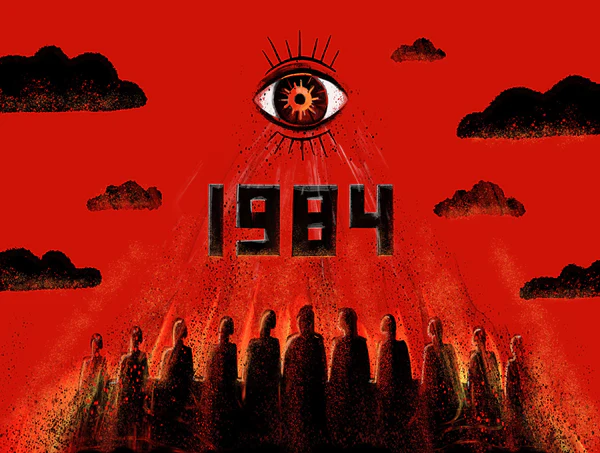
As the curtain of totalitarianism descended across much of the globe, in the mid-twentieth century, the Western intellectual class pointed to George Orwell’s 1984 as a blueprint for societal ruin.

I’m sure many of you are familiar with Orwell’s magnum opus, but for those who don’t know the gist: Orwell envisioned a dystopian future governed by a panoptic state, where an externally imposed oppression would ruthlessly strip humanity of its autonomy, its history, and its capacity for critical thought.

It is a great novel and many believe it was prophetic (I certainly believe parts of it ring true), but, as the cultural critic Neil Postman astutely observed in his foreword to Amusing Ourselves to Death, it was not Orwell but Aldous Huxley, author of Brave New World, who accurately mapped the specific destiny of the modern collapse.

Huxley recognised a far more insidious threat:

    What Orwell feared were those who would ban books. What Huxley feared was that there would be no reason to ban a book because there would be no one who wanted to read one.

No “Big Brother” is required to deprive a populace of its cognitive liberty. He foresaw a society that would come to adore the very technologies that undid its capacity to think.

Where Orwell feared those who would ban books, Huxley feared there would eventually be no reason to ban a book, for there would be no one left who wanted to read one. Where Orwell feared the truth would be actively concealed, Huxley feared it would be drowned in an endless sea of irrelevance. Ultimately, Orwell feared that what we hate will ruin us, while Huxley feared that what we love will ruin us.

[…]

The Collapse of Literacy in the Intellectual Elite

The symptoms of this cognitive counter-revolution are visible not only in the general populace but at the very apex of the educational system, signalling a crisis that threatens the reproduction of the intellectual class itself. Over the past decade, professors at elite academic institutions have sounded the alarm regarding a precipitous and bewildering decline in student literacy. In a widely discussed exposition in The Atlantic, Nicholas Dames, a professor of Columbia University’s required Literature Humanities course since 1998, noted that his undergraduate students, the supposed academic elite of the nation are now “bewildered by the thought of finishing multiple books a semester“.1

Two decades ago, Dames’s classes effortlessly engaged in sophisticated, week-to-week analyses of lengthy texts like Jane Austen’s Pride and Prejudice and Fyodor Dostoevsky’s Crime and Punishment. Today, the landscape is unrecognisable. In 2022, a first-year student confessed to Dames that during her entire tenure at a public high school, she had never been required to read a single book cover-to-cover.2 Instead, her education consisted of excerpts, isolated poems, and fragmented news articles. This is a systemic failure; middle and high schools have largely ceased assigning whole books, breaking them down into easily digestible, context-free fragments to accommodate dwindling attention spans. High-achieving students can still decode words, but they struggle to muster the sustained attention or cognitive ambition required to immerse themselves in substantial texts. As technology provides instant gratification, the sustained labor of reading feels deeply unnatural to a generation raised on screens.

This anecdotal evidence from the highest echelons of the academy is overwhelmingly corroborated by a mountain of empirical data. The decline in sustained reading and linguistic proficiency is measurable and accelerating.


  1. https://www.theatlantic.com/magazine/archive/2024/11/the-elite-college-students-who-cant-read-books/679945/
  2. Ibid

Spain joins the awkward squad

Filed under: Europe, Government, Media, Politics, Russia — Tags: , , , , , , — Nicholas @ 03:00

At The Conservative Woman, Bepi Pezzulli outlines a few ways that the Spanish government is moving in quite different directions than their NATO allies and fellow EU members:

Torre del Oro (Tower of Gold) – Calle Almirante Lobo, Seville – Spanish flag” by ell brown is licensed under CC BY-SA 2.0 .

Spain’s Prime Minister Pedro Sánchez wants the privileges of alliance without the duties of one. Madrid remains in Nato, hosts critical American military infrastructure, and speaks the language of Atlantic solidarity – but only when convenient. On the central strategic questions of the age – Russia, Israel, and the wider Western posture in the Mediterranean – it increasingly behaves like a spoiler. What is troubling is that Spain is not merely posturing: it is rewriting its entire conception of statecraft, treating alliance as a shield, hostility as leverage, and strategic ambiguity as a governing doctrine.

When Washington needed alignment, Sánchez offered obstruction. When Israel faced existential war, Madrid offered moral lectures. When the West sought energy discipline against Moscow, Spain found room for Russian gas. All while preserving the old imperial obsession with Gibraltar and extracting advantages from London over the Rock.

Spain has discovered the pleasures of consequence-free hostility. That needs to end.

Anti-Americanism with diplomatic immunity

Sánchez has carefully cultivated the old European left’s anti-American reflexes: Nato when subsidised, moral neutrality when sacrifice is required. His government publicly resisted support for American military operations linked to Iran escalation and signalled clear reluctance to facilitate use of Spanish bases such as Rota and Morón for operations that might implicate Madrid politically. The message was unmistakable: American security guarantees are welcome but strategic co-operation is negotiable. The rhetoric matched the policy. “No to war” was not merely a slogan for domestic consumption. Sánchez is deliberately positioning Spain as the righteous dissenter against Washington’s harder strategic line.

At the same time, Spain maintained substantial imports of Russian gas well into the European sanctions era. While pipeline politics consumed Brussels, Madrid benefited from a convenient moral distinction: condemning Moscow loudly while continuing commercial accommodation where useful. The formal sanctions architecture left open some loopholes, and Spain was happy to live inside them.

An ally that profits from ambiguity while others bear the strategic burden is not an ally in the full sense. As US War Secretary Pete Hegseth noted, “An alliance cannot be ironclad if in reality or perception it is seen as one-sided”.

From criticism of Israel to open diplomatic hostility

On Israel, Sánchez has moved beyond criticism into active diplomatic confrontation. Recognition of Palestine was presented as humanitarian principle. In practice, it rewarded maximalism at the worst possible moment. Madrid helped transform October 7 from a terrorist massacre demanding strategic clarity into another European seminar on Israeli restraint. Spain became one of the loudest governmental amplifiers of the anti-Zionist campaign in Western Europe. Ministers normalised rhetoric that blurred the distinction between criticism of Israeli policy and systematic delegitimisation of the Jewish state itself. Arms restrictions followed. Then diplomatic actions. Symbolism became policy.

Gibraltar: Madrid’s imperial nostalgia

Spain’s sanctimony would be easier to tolerate if it were not paired with its own colonial fixation. For decades, Madrid has pursued sovereignty claims over Gibraltar with theological persistence. Brexit offered a fresh opening. With Brussels behind it, Spain extracted a remarkably favourable negotiating posture over the future relationship of the Rock with both the European Union and the United Kingdom. London, in the hands of the most Europhile government in recent history, conceded far more than many British voters imagined when they heard the word “sovereignty”. Spain never abandoned the long game. It simply learned to play it through institutions until a weaker opponent appeared. Madrid insists Gibraltar is unfinished history. Fair enough: is it not time then to conclude the same about Ceuta and Melilla?

“Second Dawn”, Childhood’s End, and the Nuclear Age

Filed under: Books, Media — Tags: , , , — Nicholas @ 02:00

Feral Historian
Published 5 Dec 2025

A quick look at two Arthur C. Clarke stories from the early 1950s that pair well as allegories for the still-new Cold War fears of the time.

00:00 Intro
03:03 Psychics and Nukes
03:37 “Second Dawn”
09:13 The Phileni
11:50 New World, New Dangers

Audio note: On the previous vid (Riddick) I used some new tools for post-processing the audio. It was much cleaner, removed almost all the noise … and the response has been entirely negative. It seems people don’t miss the wind and the birds until they’re gone. So I’m back to the old approach of using essentially raw sound.

EDIT: If you’re not seeing a link to the old Childhood’s End video on the pop-up card or the end screen, here’s the link. • Childhood’s End (Youtube Copyright Edit)

🔹 Patreon | patreon.com/FeralHistorian
🔹 Ko-Fi | ko-fi.com/feralhistorian
🔹 and Merch! | feral-shop.fourthwall.com
Still plugging Ninti’s Gate
🔹 amazon.com/dp/B0CYXH9BWD

QotD: Socialism

Filed under: Economics, Government, Quotations — Tags: , — Nicholas @ 01:00

The prime fact of human nature which the wise statesman must take into account is that men will exert themselves for their own benefit, or for that of their families, regarded as an extension of themselves, as they will exert themselves for no one else; and, in particular, men are not prepared to work for the state or for any other collectivity as they will work for themselves or for their families … If it is made impossible for him to advance himself or his family by his exertions, the average man will cease to exert himself. No motive comparable in its effects … has yet been known in the history of the human race … Because socialism expects the average man to exert himself for the state as he would for himself, … the socialist is doomed to disappointment when he comes to put his ideas into practice.

Ivor Thomas, The Socialist Tragedy, 1951.

Powered by WordPress