Quotulatiousness

May 20, 2026

The seax as an English ethno-national equivalent to the kirpan

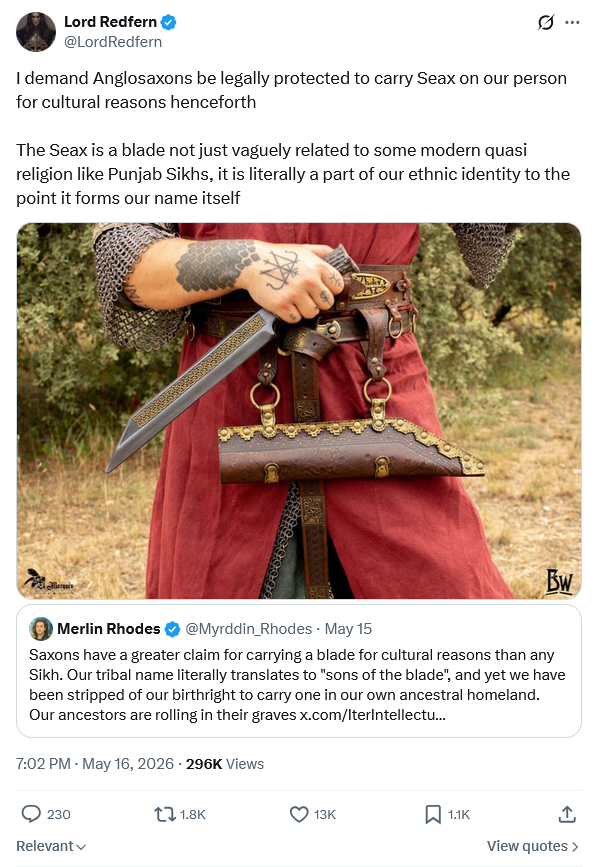
As most will know, the UK government has been steadily working to prevent UK citizens from carrying weapons of any time … except the religious exception for Sikhs to carry the kirpan, which is part of their faith. John Carter claims that the case for the Saxons to carry the seax is at least as strong:
Infamously, as one of its many assaults upon British tradition – the latest of which is the end of jury trials, a right Englishmen have enjoyed since the Magna Carta – the decline’s managers disarmed the British people. The right of (Protestant) Englishmen to keep and bear arms was enshrined in the Glorious Revolution’s 1689 Bill of Rights. The Second Amendment of the American Constitution’s Bill of Rights is essentially a reiteration of this ancient right of Englishmen; indeed, one of the complaints of the revolutionary colonists was that their rights as Englishmen were not being respected by the English crown. The right to bear arms was first expressed in the 1689 Bill of Rights, but its origin is much older, in the ancient Germanic understanding that a free man is an armed man, and that only slaves are prohibited the means of assuring their personal security. Britain’s managerial regime spent the twentieth century patiently gnawing away at the right to bear arms. It began its assault with licensing requirements in 1920, finally escalating to absolute bans following the 1988 Hungerford massacre and the 1996 Dunblane massacre.

As with all of its petty oppressions, the excuse for banning firearms has always been public safety, which the Yookish regime claims to prize much more highly than public liberty, which it does not claim to prize at all, that being the only honest thing about it. The sincerity of these invocations of safety is rendered dubious by the simultaneous premium Westminster, Whitehall, Number 10 Downing, and Buckingham Palace place upon the uninterrupted mass importation of humanoid dross from the most violently dysfunctional countries on the planet, which (notably) started in earnest at almost exactly the same time that the British people were disarmed.

It was not enough to take away the tools of self-defence. The principle of self-defence was also effectively eliminated: if a private citizen injures or kills a criminal in the course of defending himself against criminal predation, he will be charged as a criminal himself. The British people are expected to outsource their personal defence to police who refuse to defend them, in a country to which their government deliberately imports as many dangerous men as it can. Notably, defence against dangerous men of diversity is particularly frowned upon, because this is racist; indeed, even to complain about diversity danger is treated as a worse crime than rape, robbery, assault, or murder. The Yookay arrests more people for speechcrime than any other country on the planet.

Since firearms are banned, Britain’s criminal element has turned to knives, leading to a long-standing hysteria over knife crime. “Zombie-style knives” and “ninja swords” were banned in 2024 and 2025, while online knife sales now require 2-step age verification. There have even been calls to ban knives with sharp points, which would present certain challenges to the culinary arts. Meanwhile the stop-and-search policies intended to control knife crime on the streets are routinely derided as racist, as it is (surprise!) overwhelmingly young black men who are caught with concealed knives, which of course they conceal because their intent is to use them in the commission of robbery, assault, and murder. Which the British people are not permitted to defend themselves from, and which the Yookish police refuse to do anything about.

All of this raises the question of why, precisely, Digwa was walking around with a big knife.

The answer to this is that Digwa is a Sikh, and Sikhs have a special carve-out for the kirpan, a ceremonial knife which their religion mandates they carry with them at all times, as (if I understand correctly) a symbol of resistance to oppression and their readiness to always be prepared to defend the weak from injustice. Symbolic or not, the kirpan is a very real knife, with a very real edge.

The special religious dispensation granted Britain’s Sikhs is merely the most visible double-standard when it comes to keeping weapons. We saw another example during the Southport riots, when large numbers of Muslims turned out on the streets with machetes. Rather than arresting the lot of them (which the Yookish authorities couldn’t do, as they were busy filling the prisons with British protesters), the law enforcement officers on the scene advised them to hide their weapons in their mosque, which out of respect for the delicate sensibilities of the vibrant Islamic community the police would certainly never even dream of searching. One wonders just how many mosques are hiding caches of weapons.

Unlike the benevolently blind eye the Yookish authorities cast upon their treasured Muslims, however, the Sikh exemption is actually written into law.

As the Nowak case broke across social media a few days ago, a lot of people called for an end to this double standard. If whites are disarmed, then everyone else should be as well. There should be no special treatment on account of their heathen gods.

This is an understandable position, but I think it’s the wrong one. It is the thought pattern of The Raped.

Rather than wanting to drag Sikhs down to the subbasement of slavish cuckery into which they’ve been pressed, Anglo-Saxons should instead demand that they, too, be allowed to arm themselves.

The Sikh argument is that their faith requires that they be armed at all time.

The Saxon argument is similar to the Sikh, but if anything it is even more fundamental.

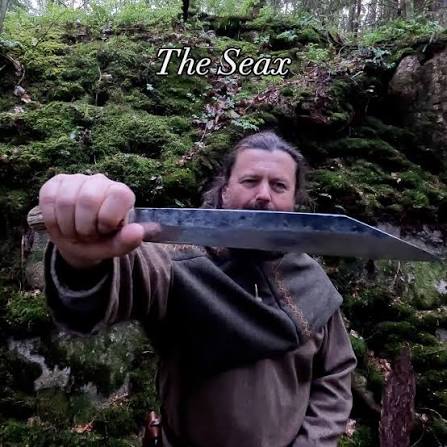
The name Saxon derives from the seax, the characteristic short sword carried by the Germanic invaders who made England their home in the 5th century. “Saxon” literally means “the sons of the knife”, “the people of the blade”, or “the swordsmen”.

The very identity of our tribe is intertwined with privately held armaments. This is pre-political; it’s pre-religious; for the Saxon, armaments are an identitarian symbol that goes to the very core of what a Saxon is. To remove the seax from the Saxon is to strip him of his identity. Which, of course, is the avowed goal of the Fabian social engineers who have laboured for generations to reconstitute the definite form of the Anglo-Saxon into a pliable mush of generic, vaguely-defined, ahistorical, and universally extensible “values” that no Anglo-Saxon had even heard of until five minutes ago.

The same principle obviously applies to knife crime. Criminals are opportunistic predators. They avoid hard prey. There’s profit in jacking up easy meat to get a free iPhone, but not so much in getting stabbed into fresh meat yourself. If every Saxon wore a seax, street crime would very rapidly become a non-issue.

Of course, from the perspective of the Yookish governing apparat, the powerlessness of its subjects against criminal predation is quite an insignificant price to pay in exchange for ensuring the powerlessness of the autochthonous helotry against the apparat itself. If anything it’s a bonus. The regular humiliation of being forced to endure low-level criminality encourages a feeling of helplessness. The rainbow communists will therefore never “allow” the Saxon to rearm himself.

But what if the Saxon wore the seax without permission?
The Korean War Week 100: Mark Clark in Command – May 19, 1952

Filed under: China, History, Military, USA — Tags: , , , , , , , — Nicholas @ 04:00

The Korean War by Indy Neidell
Published 19 May 2026

Mark Clark is the new UN Commander and will run the war in Korea, replacing Matt Ridgway, who leaves for Europe to take over NATO Command. The Koje-Do POW camp situation is resolved, but is a black eye for the UN, as are the allegations that the US has been practicing germ warfare in Korea and Manchuria, backed up by “confessions” from captured American airmen.

00:00 Intro
01:13 Recap
01:29 Demand and Response
05:35 What Went Wrong at Koje-Do?
12:06 Germ Warfare?
13:55 Mark Clark
15:45 ROK and Ammunition
19:53 Philippine Raids
21:16 Summary
21:28 Conclusion
22:09 Call to Action

Canadian politics can be bad for your mental health

Filed under: Cancon, Health, USA — Tags: , , , — Nicholas @ 03:00

As a rule of thumb, the more you pay attention to Canada’s political circus, the worse your state of mental health becomes, IMO anyway. On a more serious note, David Clinton got curious about a recent Manhattan Institute project tracing American mental health trends:

Image from The Audit

The Manhattan Institute’s research into the confluence of mental health trends and political leanings in the U.S. generated buzz a while back. Among other things, they discovered that, as of the 2021-22 school year, liberal students were 13-17 percent more likely to seek mental health treatment than their conservative peers. That’s a frightening gap.

I was curious to know if there’s anything like that going on here in Canada. And it turns out that there’s excellent public-facing data waiting for us to drop by and help ourselves. The most recent published version of the Canadian Election Study (CES) dates back to the period around the 2021 federal election — the full dataset from 2025 isn’t yet available.

There were 20,968 respondents in total in the CES survey data from 2021. Having now spent a couple of happy hours with the results, this looks like an excellent representation of Canadian society. The questions go both deep and wide.1

I was able to directly address the political angle to all this using responses to one core question. Participants were asked to situate themselves on a political “scale where 0 means the left and 10 means the right”.

I classified anyone who responded with a number higher than 6 as “far right”, and responses less than 4 were tagged “far left”. The far left cohort had 4,927 members, while there were just 3,891 people in the far right. Those numbers are easily large enough to make distinctions potentially statistically meaningful.

Anxiety

I explored both far right and far left cohorts for how accurately the words “anxious” and “easily upset” applied to them. A response of seven indicates a self-assessment of extreme anxiety, while zero would be Big-Lebowski-level calm.

The average for the right-coded group was 3.47, while those on the left rated themselves 3.88.

Overall Mental Health

Respondents were asked to rate their mental health in relation to their peers where “1” indicates excellent mental health and “5” indicates poor mental health. A total of 3,878 from the far right responded and 3,263 from the far left. The average of all responses on the right was 2.02 (standard deviation: 0.876859) and from the left, 2.32 (0.926268).


  1. In fact, the average survey took two hours and twenty five minutes to complete! I’m definitely glad they didn’t ask me.

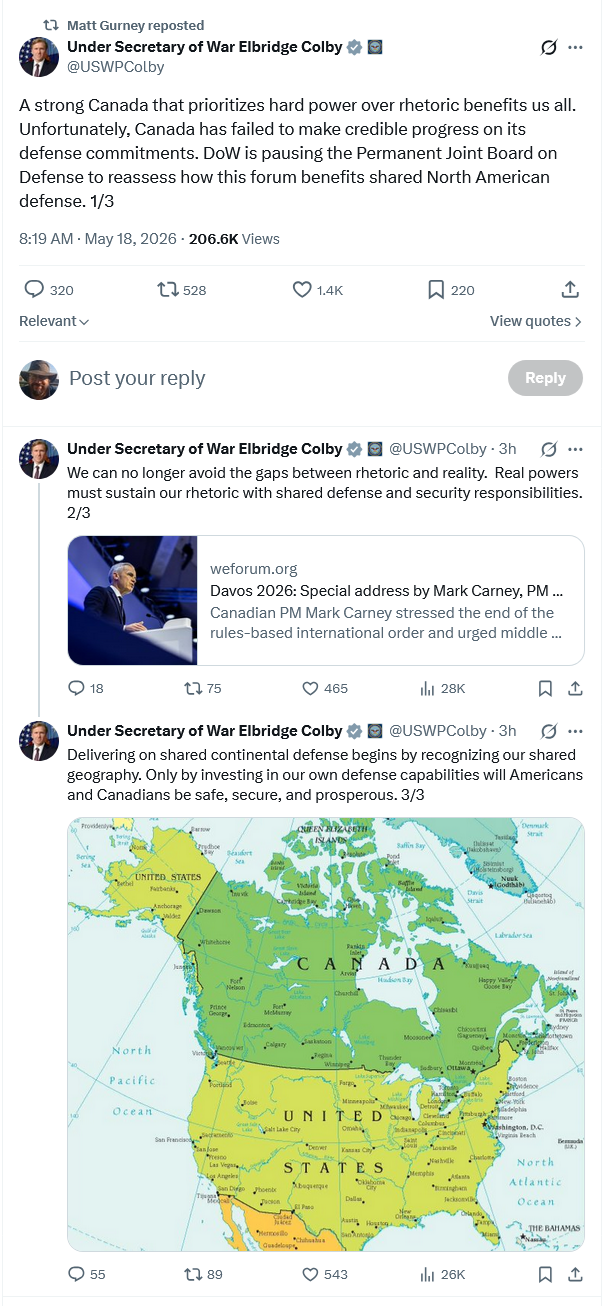
I mentioned the other day that the US was fully justified in “pausing” their participation in the Permanent Joint Board on Defence due to the Canadian government’s continued delinquence on military matters (and Prime Minister Carney’s blatant desire to tweak American noses while neglecting joint interests with the United States. At The Line, Matt Gurney says this won’t be the only tangible sign of American impatience with our ongoing fecklessness:

As I posted on social media when sharing this: “This is another gentle reminder to the f*ckwits in the Canadian government that they are playing with existential fire when they work to actively piss off our American allies.”

First of all, and this will annoy the Elbows Uppers to no end, the undersecretary’s comments are, fundamentally, accurate. Canada has indeed massively underinvested in defence and has also prioritized rhetoric over reality. I completely understand why Canadians hate admitting this — I hate admitting this. Having your flaws pointed out to you by someone you dislike is always a mortifying experience. But I’ve spent almost two decades writing about the very things Colby is pointing out — Canada has allowed its military capability to atrophy to a point, as I noted just a week ago in an episode of On The Line, where we’ll need many years and untold billions of dollars just to rehabilitate the armed forces. Expanding them and adding capabilities will be a whole other level of investment. This is why Canada’s recent major announcements on defence, though good and welcome, are also not enough — it will take a long time and even more money to actually repair what we have allowed to rot.

The other half of what Colby identified is also, alas, accurate. While we were massively underfunding defence and allowing core capabilities to wither and die, or while just totally missing the bus on transformational military developments (hello, drones!), Canada did indeed talk a lot about the rules-based international order and the role of middle powers and punching above our weight and all the rest. Canada focusing on rhetoric instead of reality is, alas, a fair criticism.

Many U.S. administrations called us out on this. We ignored them. Donald Trump is unique in how viciously he is prepared to exploit our weakness, but he’s hardly the first to have noticed it and called us out on it. I carry no water for MAGA or Trump, but they’ve got us dead to rights on this one. The bad orange man didn’t let the navy rust out, repeatedly defer the fighter jet replacement and hobble the army with non-serviceable equipment and recruiting and procurement systems that were actually quite awful at both those things.

We did those things. We did it to ourselves. Colby is simply possessed of the gall to bluntly call us out on our failures, in a way that Canadians aren’t accustomed to and aren’t going to enjoy.

So that’s part of it. But it’s also worth asking why the U.S. is doing this, and especially why they’re doing it now.

Part of it, probably, is just sincere frustration with us. As noted above, Colby’s remarks are accurate. But the timing is interesting. The CUSMA renegotiation deadline looms in early July And in Colby’s remarks, do I detect a whiff of the art of the deal?

The Carney government has made, and continues to make, plenty of announcements about plans, and potential deals, and future capabilities, and so on … but the Americans can’t help but notice that little is actually being done despite all the sound and fury on the PR side. Canada belatedly reached the long-agreed-upon 2% of GDP target for military spending, but most of it was a bookkeeping exercise of moving existing costs onto the Department of National Defence budget (the Canadian Coast Guard and parts of Veterans Affairs) but not much improved in Canada’s actual defence capabilities.

LMG-25: The Swiss Toggle-Locked Light Machine Gun

Forgotten Weapons
Published 29 Dec 2025

The LMG-25 was designed by Adolph Furrer at Waffenfabrik Bern in the 1920s. Furrer was a devoted fan of the toggle locking system, and also designed a toggle-locked submachine gun that Switzerland (unwisely) adopted in 1941. The LMG-25 was first produced in 1924, adopted in 1925, and remained in production until 1946 with a total of 23,045 standard models and 1,742 optics-equipped fortress models made.

It is chambered for the standard 7.5x55mm Swiss cartridge with a 30-round side-mounted magazine (interchangeable with the later Stgw 57 magazine, incidentally). It is an effective design, if expensive to produce, and served Switzerland well for several decades.
(more…)

QotD: “Gilded Age” Robber Barons didn’t have access to what even working-class Americans have now

Filed under: Business, Economics, History, Quotations, USA — Tags: , , , , , , , — Nicholas @ 01:00

Where Marx really went wrong was — and I know this sounds flip, but I’m as serious as cancer — being born in 1818. He lived his entire miserable life in a world where “labor” really was a physical thing. The richest robber baron of the Gilded Age lived a far different life, materially, than the poorest serf-in-all-but-name working in his factories …

… but the robber baron knew he needed the serfs. Their relationship was purely dialectical. Without his factory hands, no robber baron. And in a strange but very real way, the higher up the food chain your Gilded Age robber baron went, the more he was dependent on his serfs for his lifestyle. J.P. Morgan is usually credited as being the first guy to become a Robber Baron purely through finance. Carnegie, Rockefeller, all those guys had most of their wealth in financial instruments, of course, but those financial instruments rested on control of a physical product — Carnegie Steel, Standard Oil.

I’m probably being unfair to Jay Cooke, the Michael Milken of his day, but since more people have heard of J.P. Morgan let’s roll with it. Even though Morgan’s wealth was entirely on paper — he was nothing but a securities trader — his lifestyle utterly depended on a battalion of servants. In a very real way, you yourself, right now, live much better than J.P. Morgan did in his heyday. And not just because you have aspirin, antibiotics, and air conditioning, three taken-for-granted things ol’ J.P. would’ve given half his kingdom for. But because you have more time. If you’re hungry, you can open the fridge or the microwave and have all the food you need in a matter of minutes.

J.P. couldn’t. J.P. had to deploy an army of servants every time he wanted a snack, and those servants were constrained by things like “availability of ice” and “when is the fishmonger at his stall”. You’re hungry at 2am, you jump in your car and get some Taco Bell. It takes ten minutes. J.P.’s hungry at 2am and it’s tough titty, J.P., your ass is going hungry. Because even though you’re the richest man in the world and have legions of manservants at your beck and call, Taco Bell just isn’t there. Even if someone had had the brilliant idea to create a Gilded Age Taco Bell, it still would’ve taken hours:

Wake up the manservant. Wake up the groom and stableboy. Hell, wake up the horse, then saddle the horse, ride to the drive thru window … which in this case means “the house of the guy who runs Gilded Age Taco Bell”. At which point he has to fire up the oven, start pounding the tortillas, send his own legion of valets and stableboys and whatnot out to get the refried beans …

And that’s the other thing, J.P. — you’d best not pull that shit too often, because those people know where you live. Not only do they know where you live, they live with you. Literally under the same roof. You want to sleep easy? You’d best not beat the servants too often, buddy.

There’s only so much “class consciousness” one can develop in that world. Oh yeah, J.P. thought of himself as one of the Masters of the Universe, there’s no denying that. But J.P. lived in what was still a brutally physical world, in a way we PoMo people really can’t grasp. If you can’t imagine what it would take to get some Gilded Age Taco Bell, maybe geography will do the trick. Ever seen Gangs of New York? Even if you haven’t, you’ve probably heard the name “Five Points”. The worst slum in America in the 19th century, and 19th century American slums were world class …

That was right down the street from Wall Street. Literally. I am not in any way joking, and if I’m exaggerating a little for effect when I say “J.P. could’ve hit Five Points with a five iron from his swanky digs on Central Park West”, I promise you I’m not exaggerating much. You can look it up for yourself. The main reason the Union rushed troops straight from the Gettysburg battlefield, and no-shit shelled parts of the city with gunboats, during the Draft Riots was because Five Points (et al) was right fucking there, and they might’ve gotten it into their heads to lynch a few Masters of the Universe. Rich man’s war, poor man’s fight, right? Let’s see how you like it, you bankster bastards …

The PoMo “information economy” removes all that. The other day I joked about colleges like Bennington and Goucher. I cracked some jokes, yeah, but I wasn’t really joking. Those places aren’t for us. Wall Street is still a physical location, but it might as well be on the dark side of the moon for all any of us have access to it. J.P. couldn’t beat the servants too hard, or too often. The modern equivalent of J.P. isn’t even aware that he has servants. He just clicks on a website, and stuff appears at his door. Like magic. Hell, it IS magic for all he knows, and he surely doesn’t care, because all that shit is his by right. He went to Bennington, after all. He has achieved full class consciousness.

All of which suggests, of course, that while Marx was wrong about the end state — the State will not, in fact, wither away — he might well have been right about the solution to the “contradictions of capitalism”, if you follow me. And if that makes me some kind of godless pinko Commie subversive, well … I’ve been called worse by better.

Anybody got the lyrics to La Marseillaise in English?

Severian, “On Losing the Cold War”, Founding Questions, 2022-07-02.

Update, 21 May: Welcome, Instapundit readers! Have a look around at some of my other posts you may find of interest. I send out a daily summary of posts here through my Substackhttps://substack.com/@nicholasrusson that you can subscribe to if you’d like to be informed of new posts in the future.

Powered by WordPress