
Forgotten Weapons
Published 23 May 2026SIG introduced the 540 series of rifles in 1973, which included the full-length 540 in 5.56mm, the 541 in a number of experimental calibers for the Swiss military, the 542 in 7.62mm NATO, and the 543 carbine with an 11.8″ (300mm) barrel in 5.56mm. In 1978 they licensed production of the 540, 542, and 543 to Manurhin in France, to sidestep Swiss export laws. The rifles were sold to a wide variety of small nations in Africa, South America, Asia, and the Middle East — including Lebanon, where this example came from. A batch of 542 and 543 kits came into the US from Lebanon recently, and Troy Ess at TTE Precision Metalwerks developed semiauto receivers for them.
(more…)
September 26, 2026
SIG Manurhin 543 Semiauto: I Really Like This Rifle
Comments Off on SIG Manurhin 543 Semiauto: I Really Like This Rifle
September 15, 2026
The First Military Luger: Swiss Model 1900 s/n 01
Forgotten Weapons
Published 27 Apr 2026The first nation to adopt the Luger was Switzerland, which began testing in late 1898 and formally accepted the Luger in May 1900. Their guns were the first Lugers to be mass produced, as they were the first order received by DWM. The first batch of 600 arrived in Switzerland in May 1901, and today we are taking a look at the very first of that batch — serial number 01. It is the first production military Luger, and that’s a pretty cool landmark.
C&Rsenal Swiss Model 1900 video: • History of WWI Primer 145: Swiss Luger 19…
Comments Off on The First Military Luger: Swiss Model 1900 s/n 01
August 22, 2026
The WEF – first up against the wall come the revolution
On the social media site formerly known as Twitter, Krzysztof Szczawinski considers just how the lizard people of the World Economic Forum came to be “The People Who Decided They Should Run Everything”:

Every year in January, the most important people in the world travel to Davos, Switzerland — a ski resort — to discuss the problems facing humanity. They arrive on private jets. They stay in five-star hotels. They are protected by five thousand soldiers and police. They eat very well. They talk about inequality, climate change, and the need for ordinary people to consume less. Then they fly home on private jets.
This is not satire. This is the schedule.
1. Klaus Schwab founded the World Economic Forum in 1971 – a German professor who decided that the solution to the world’s problems was to get the people who ran the world’s largest corporations into a room with the people who ran the world’s governments, and have them agree on things before anyone elected them to agree on things. If you control the conversation before the democratic process begins, you control the outcome without being subject to it. Davos is where the agenda is set. Everything after is implementation.
2. The Young Global Leaders program is the masterpiece. Founded in 2004, with its predecessor, Global Leaders for Tomorrow, running since 1993. Together the programs have formed: Justin Trudeau, Emmanuel Macron, Jacinda Ardern, Mark Zuckerberg, Tony Blair, Gordon Brown, Angela Merkel, and the health ministers who designed most of the Western world’s COVID response. The pipeline runs continuously. The list is published on the WEF website. This is not a conspiracy theory. It is an alumni directory.
3. The program works because it operates before power, not after. By the time a Young Global Leader becomes a prime minister or finance minister, they have already spent years in the same rooms, sharing the same assumptions, networking with the same people. They don’t need to be told what to do. They already know – because they were formed together, in Davos, before anyone gave them the job. The Fabian Society permeates institutions over generations. The WEF does it in a long weekend, with better catering.
4. The Great Reset — announced in 2020 with timing that should give everyone pause — is the program stated plainly. “You will own nothing and you will be happy.” Build Back Better. The Fourth Industrial Revolution. The language is always the language of inevitability: this is happening, the question is only how to manage it. The managed future, designed by the people in the ski resort, for the people who were not invited.
5. The irony is structural. The people most loudly “concerned about inequality” meet in one of the most expensive places on earth. Those most “concerned about climate change” arrive by private jet. Those most “concerned about democracy” design systems insulating them from democratic accountability. The gap between the speech and the life is visible from orbit. They don’t notice it. Or they notice and calculate, correctly, that nobody who matters will say so.
6. What Davos actually produces is “consensus” – the consensus of people who have implicitly agreed before arriving, because people who disagree don’t get invited. Climate policy, AI regulation, tax harmonization, digital currency – these are not debated at Davos. They are shaped there. The debate happens later, when implementation is already underway.
7. The Young Global Leaders are the tell. A program that identifies, selects, and forms the next generation of leaders before they become leaders is not a networking event. It is a formation pipeline. The Jesuits understood that if you form a person before they have power, you own what they do with the power. The WEF understood the same thing and built it into a global institution.
The question is simple:
Who decided Klaus Schwab should select the world’s next generation of leaders?
Nobody.
He just started doing it.
And the people who run things let him – because increasingly, the people who run things were people he had already formed.
Did you choose them?
June 22, 2026
ADATS – Air Defense Anti-Tank System; Canada’s high tech cold warrior
Polyus
Published 19 Jun 2026While designed mainly in Switzerland, over the years its identity became distinctly Canadian. It was produced in Toronto by Oerlikon Aerospace Canada and was operated by Canadian forces from 1988 to 2011. This is the story of the Air Defense Anti-Tank System, or ADATS
ADATS was a very interesting and highly advanced air defense system designed to fight a cold war that never materialized. It was operated for a little over 20 years, so it was by no means a flash-in-the-pan. Unfortunately, Canada has since given up its short ranged air defense capability and all of the human expertise that was built up over the years. Hopefully in the future a new system can be acquired and Canada can again expand its sovereign air defense capabilities.
This video was made without the use of Artificial Intelligence (No AI). Long live people power!
0:00 Introduction
0:29 European Background
2:09 Technical Details
4:05 Engagement Sequence
5:38 Comparison to other Systems
6:06 Canadian Adoption
7:48 American Testing
8:32 Thai Adoption
8:57 Advanced Variants
10:23 ConclusionMusic:
“Denmark” – Portland Cello Project
“Your Suggestions” – Unicorn Heads
Comments Off on ADATS – Air Defense Anti-Tank System; Canada’s high tech cold warrior
May 20, 2026
LMG-25: The Swiss Toggle-Locked Light Machine Gun
Forgotten Weapons
Published 29 Dec 2025The LMG-25 was designed by Adolph Furrer at Waffenfabrik Bern in the 1920s. Furrer was a devoted fan of the toggle locking system, and also designed a toggle-locked submachine gun that Switzerland (unwisely) adopted in 1941. The LMG-25 was first produced in 1924, adopted in 1925, and remained in production until 1946 with a total of 23,045 standard models and 1,742 optics-equipped fortress models made.
It is chambered for the standard 7.5x55mm Swiss cartridge with a 30-round side-mounted magazine (interchangeable with the later Stgw 57 magazine, incidentally). It is an effective design, if expensive to produce, and served Switzerland well for several decades.
(more…)
Comments Off on LMG-25: The Swiss Toggle-Locked Light Machine Gun
February 14, 2026
Voltaire & Rousseau’s Best Friend Breakup – Valentine’s Day Special
Overly Sarcastic Productions
Published 14 Feb 2025Watch as two of the smartest men in French history bravely push the bounds of being the pettiest, most toxic idiots possible.
(more…)
Comments Off on Voltaire & Rousseau’s Best Friend Breakup – Valentine’s Day Special
January 22, 2026
Carney in Davos … “the mismatch between message and messenger is … very special”
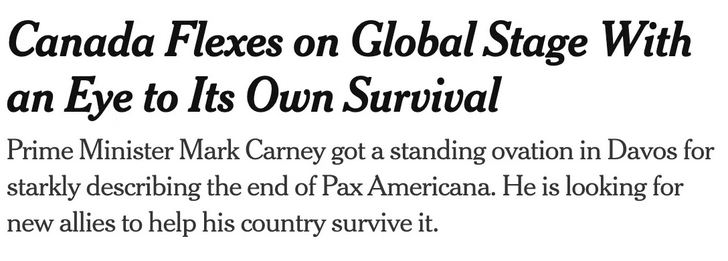
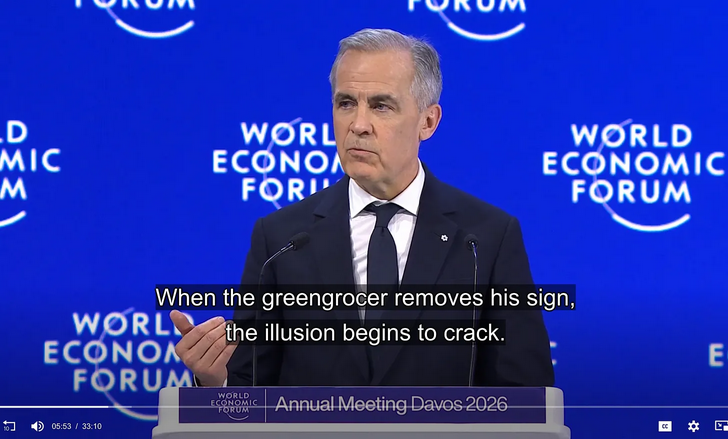
I make it a point not to listen to politicans’ speeches, as I need to keep my blood pressure within safe ranges for health reasons. A lot of Canadian commentators have been gushing with praise for Prime Minister Mark Carney’s bloviations at the WEF gabathon in Davos, because of course they have. Brave Mr. Carney standing up to the Bad Orange Man and getting ovations from the kind of people he’s most comfortable dealing with. How very nice for him. But as Chris Bray explains, it didn’t play quite as well with the rest of the non-Davos-attending world:
Mark Carney gave a speech in Davos, that fortress of democratic pluralism where hotel rooms inside the security zone cost thousands of dollars a night and no one with an expense account has to be lonely because the massive security forces don’t try to interfere with all the sex trafficking, which is very democratic. Anyway, the speech was stunning and brave, and everybody clapped a lot.
Someone put the word “flexes” next to the word “Canada”, apparently not intending to cause laughter, but yes: Mark Carney flexed and warned and puffed himself up like a man who’d just eaten the wrong part of the fugu.
You should watch it. Don’t try to eat or drink during the speech, because you’ll choke, and push any breakable household goods away from the reach of what will soon be your flailing arms, but you should watch him perform this extraordinary set of stranded symbols. The mismatch between message and messenger is … very special.
I was physically paralyzed as an effect of hearing this sentence from this face for a full ten seconds, and then I spasmed. It’s like watching Erich Honecker stand up to the East German regime. “We cannot tolerate misogyny, warns Jack the Ripper.”
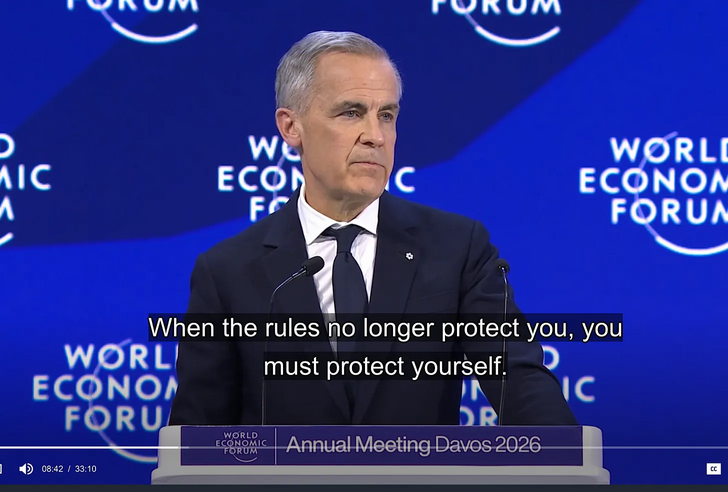
Carney hinted broadly that the rules are breaking down in international relationships …
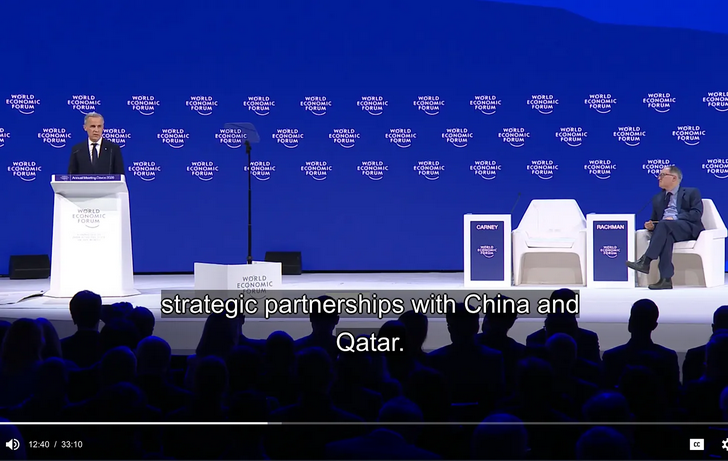
… which for the first time in a long time are being reshaped by mere power, a rare thing on the global stage, because there’s meanness and bullying and a rejection of friendly norms and restraint from … someone very bad, not that he was naming names, and so Canada is turning to new partners, extending the hand of friendship to nations and leaders that still care about rules and values and democracy.
The central banker who was selected as his country’s head of government before he’d ever stood for election to any office anywhere ever, the prime minister of a country where the government had just been rebuked by its courts for faking a national security emergency so it could suspend the rule of law and crush dissent, gave a real tubthumper about democracy and the rule of law.
The total absence of connection between “things being said” and “things being done” sets a record, here.

Comments Off on Carney in Davos … “the mismatch between message and messenger is … very special”
December 6, 2025
G150: Swiss Silenced Guerrilla Anti-Materiel Rifle
Forgotten Weapons
Published 21 Jul 2025The G150 is a rifle specifically assembled by and for the Swiss P-26 organization: a very secretive stay-behind group intended to fight foreign occupiers of Switzerland. It was one of a series of such organizations that began with a concern during World War Two the Germany might invade, and continued during the Cold War with the threat of Soviet occupation in the aftermath of nuclear war. The P-26 group specifically was formed in 1981, and disbanded in 1991 under a cloud of controversy over its political leanings.
P-26 was armed with an assortment of weapons ideal for guerrilla warfare, including P210 pistols and suppressed MP5 submachine guns. The G150 rifle was intended to be a very quiet rifle for destroying enemy materiel like radar systems, fuel tanks, parked aircraft, and the like. About 250 were made using commercial JP Sauer actions, SIG 540 like pistol grips and folding stocks, and very large two-part suppressors. They were chambered for the .41 Remington Magnum revolver cartridge, loaded with a 408-grain subsonic bullet. The scopes were adjustable from 4-6 power (yes, 4-6: it;s a weird choice) and had BDC elevation turrets adjustable out to 200 meters.
Only three G150 rifles are known today, although the remainder may still be in some deep military storage in Switzerland. Many thanks to the anonymous viewer who arranged access to this one for me to film! To see another perspective on one of the other known examples, I recommend Bloke on the Range’s video:
• BotR Exclusive! Swiss 10.4mm G150 subsonic…
(more…)
Comments Off on G150: Swiss Silenced Guerrilla Anti-Materiel Rifle
December 4, 2025
The Swiss vote overwhelmingly against a new wealth tax
As the California government wants to impose a new wealth tax, it’s worth checking how similar schemes are viewed in other jurisdictions. The Swiss voters were given an opportunity to scalp their very richest citizens and permanent residents with a proposed wealth tax, but it went down with 78% voting against it:

“Switzerland on Sunday overwhelmingly rejected a proposed 50% tax on inherited fortunes of 50 million Swiss francs ($62 million) or more, with 78% of votes against the plan, an outcome that even exceeded the two-thirds opposition indicated in polls,” Reuters reported this week.
All Swiss cantons already tax assessed gross worldwide assets, minus debts and with exceptions, making it one of the few countries in the world to retain a wealth tax. But competition among cantons keeps the tax burden relatively low and, as the Tax Foundation notes, “the Swiss wealth tax acts as a substitute for a capital gains tax and an estate tax, which are common in other countries”. The referendum would have imposed an additional and very steep national tax.
This was actually the second recent failed attempt to impose a national wealth tax on inheritances. Seventy-one percent of Swiss voters rejected a 2015 proposal for a 20 percent tax on estates and gifts of over 2 million francs. The revenues would have been earmarked for old-age pensions.
‘Inequality in Opulence is Better than Equality in Poverty’
The 2025 tax scheme openly played to envy. It was targeted at combating “inequality” by seizing half the assets of the rich and allocating proceeds to offset the climate damage they allegedly cause.
Finance Minister Karin Keller-Sutter opposed the proposal, warning that “many wealthy people would simply emigrate to avoid the tax and keep their wealth”. She also pointed out that while all but two of the country’s 26 cantons tax inheritances, “the people have abolished inheritance tax for children and spouses in many cantons”. She added, “I think it is right that what was developed in the nuclear family can be passed on”.
Philosopher Olivier Massin, a professor at the University of Neuchâtel, criticized the motivation driving much of the campaign for the tax. He wrote that “inequality is by nature neither good nor bad” and that envy is the main driver of egalitarianism. “Envy being inglorious, we grimace in indignation, making what is ultimately only the expression of resentment a moral cause.”
Massin added that “inequality in opulence is better than equality in poverty”.
And Switzerland is undoubtedly “opulent” — or, at least, prosperous — with a per capita gross domestic product of $103,669 as compared to $85,809 for the U.S., according to the World Bank. It builds that wealth with a second-place score in the current Index of Economic Freedom (the U.S. is now ranked at 26), suggesting that less government meddling in economic matters is the best way to increase prosperity.
Comments Off on The Swiss vote overwhelmingly against a new wealth tax
October 25, 2025
A Modern Stocked Pistol: B&T’s Universal Service Weapon (USW)
Forgotten Weapons
Published 9 Jun 2025The genesis of the B&T USW was a two and a half hour car ride home from a youth hockey game, when Karl Brugger and a friend were thinking about how to improve police effectiveness with handguns. What would make a handgun more accurate in practice? Clearly a red for and a shoulder stock. So how does one add those elements to a pistol while maintaining easy carry in a service holster? The answer was the USW.
The first prototypes were built on AT-84 Sphinx pistols (a Swiss-made copy of the CZ75). The first production run used Sphinx components, but with newly made frames and slide that incorporated cocking surfaces forward on the slide and an extension off the frame to mount the side-folding stock and Aimpoint Nano optic. Only a few of these were made, as the project was never all that popular.
Other experiments included conversions for other pistol models, with the SIG P320 being the most practical. Clamp-on conversion kits were made for guns like the CZ P10, Walther PPQ, and Glock.
Perhaps the most influential outcome of the project was the optic. Aimpoint originally developed the Nano as B&T’s request, but in the original form is was not nearly as reliable as Aimpoint desired. It was iterated and ruggedized (and renamed to avoid a lawsuit over the Beretta Nano pistol) and became the very successful Aimpoint Acro.
My 2022 Desert Brutality match with a USW-320:
• Evaluating the Modern Stocked Pistol: USW-…
(more…)
Comments Off on A Modern Stocked Pistol: B&T’s Universal Service Weapon (USW)
September 30, 2025
Stamm-Saurer Model 1913 Long-Recoil Prototype Rifle
Forgotten Weapons
Published 21 May 2025Hans Stamm developed a series of firearms in Switzerland in the early 1900s, and today we are looking at a second-pattern Model 1913 semiauto rifle. This was developed while Stamm was working for the Saurer company, where he headed its small arms division. Stamm’s Model 1907 straight pull rifle failed to win military adoption, and so in 1910 he began working on a quite complex long recoil system. The first prototype was finished in 1912, and by 1913 another seven examples were made.
These are sent to the Swiss and Belgian militaries for consideration, but neither are interested — and the outbreak of World War One ends possibilities for other adoption.
Previous Stamm designs:
1902 Gas-Operated Semiauto: • Stamm-Zeller 1902: A Swiss Straight-P…
1907 Straight-Pull: • Stamm-Saurer Model 1907: A New Swiss …Many thanks to the Swiss Shooting Museum in Bern for giving me access to these two very rare rifles to film for you! The museum is free to the public, and definitely worth visiting if you are in Bern — although it is closed for renovation until autumn 2025:
https://www.schuetzenmuseum.ch/en/
(more…)
Comments Off on Stamm-Saurer Model 1913 Long-Recoil Prototype Rifle
September 21, 2025
Why Didn’t Hitler Invade Switzerland? – OOTF Community Questions
World War Two
Published 20 Sept 2025In this Out of the Foxholes Q&A, Indy and Sparty dive into some of the most intriguing questions about World War Two. Why didn’t Hitler invade Switzerland, what was going through the minds of the German High Command as defeat loomed, and why didn’t the Germans use the Vichy French Army in Operation Barbarossa? Three questions that shed light on the strategies, choices, and mysteries of the war.
(more…)
Comments Off on Why Didn’t Hitler Invade Switzerland? – OOTF Community Questions
August 23, 2025
KH-9: B&T Remakes the SITES Spectre Just Because It’s Cool
Forgotten Weapons
Published 9 Apr 2025Karl Brügger, CEO of B&T, is a true gun nerd and avid competitive shooter. When he got his hands on the Spectre SMG with its quad-stack magazine and weird DA/decocker fire control system, he thought it was really neat. So neat that he decided to buy the project from its Italian creators and put it back into production. But they had thrown out all the drawings and tooling when the gun wasn’t successful, and so Brügger had to recreate it from scratch on his own. Cue the Karl’s Hobby 9!
Without Spectre magazines to use, or the tooling to make them, B&T instead found a batch of quad-stack Suomi magazines and used those. They faithfully recreated the DA firing system and decocker, and decided to make a limited back of 222, because this was just a fun side project and not something that would be commercially popular. Except that they sold out really fast. And so another batch was done, this time using APC-9 magazines, since the supply of Suomi mags had been exhausted. Then when they found some Suomi drums, they did another limited batch for those. All of these sold out rapidly, and so the project grew legs. Next up, it became the KH-9 Covert, because what makes a gun cooler than adding folding bits to it?
It remains a limited-production item made in both Switzerland and in the US. Turns out that Karl Brügger isn’t the only guy who thinks they are really neat …
(more…)
Comments Off on KH-9: B&T Remakes the SITES Spectre Just Because It’s Cool
July 31, 2025
Stamm-Zeller 1902: A Swiss Straight-Pull Converted to Semiauto
Forgotten Weapons
Published 8 Mar 2025Today’s rifle was designed by a Swiss inventor named Hans Stamm while working for the Zeller et Cie company in Appenzell Switzerland. The company originally made embroidering machinery, but turned to military rifle parts subcontracting to bring in additional revenue in the early 1890s. Stamm had shown a good aptitude and interest for this work, and when the company decided to lean into the small arms business he was put in charge of its new weapons division.
There, Stamm spent several years developing a self-loading rifle for the Swiss military. It was not something specifically requested by the government, but rather an opportunistic risk by the company. Stamm’s resulting gun, the Model 1902, was expensive to produce, but quite elegant in design. It is a long-stroke gas pistol system with a rotating bolt, which was made from the ground up but could easily be adapted as a conversion of existing straight-pull bolt action rifles like the Swiss G96.
Unfortunately, the Swiss military declined the rifle, and Zeller was unable to find any other interested clients among the European states. By 1906, tired of dumping money into what is clearly a losing proposition, Zeller shuts down its weapons division. Stamm leaves the company, but he is not done with small arms design — we will see several more of his designs in future videos!
Many thanks to the Swiss Shooting Museum in Bern for giving me access to this visually one of a kind rifle to film for you! The museum is free to the public, and definitely worth visiting if you are in Bern — although it is closed for renovation until autumn 2025: https://www.schuetzenmuseum.ch/en/
(more…)
Comments Off on Stamm-Zeller 1902: A Swiss Straight-Pull Converted to Semiauto
July 9, 2025
WF-54: The Swiss FG-42 Scaled up to 7.5×55
Forgotten Weapons
Published 19 Aug 2024After World War Two the Swiss needed a new self-loading military rifle to replace their K-31 bolt actions. Two major design tracks followed; one being a roller-delayed system based on the G3 at SIG and the other being a derivative of the German FG-42 at Waffenfabrik Bern. Bern, under the direction of Adolph Furrer, had been experimenting with intermediate cartridges since the 1920s, and they used this as a basis to develop an improved FG-42 using an intermediate cartridge (7.5x38mm). The program began in 1951 and went through about a half dozen major iterations until it ultimately lost to the SIG program (which produced the Stgw-57).
Today we are looking at one of the later steps in the Bern program, the WF-54. By this point the intermediate cartridge had been discarded in favor of using the standard Swiss GP11 (7.5x55mm). The overall design was a bit simplified as well. The Bern program would continue for two more years after this rifle before ultimately losing out to the SIG 510 for Swiss military adoption.
(more…)
Comments Off on WF-54: The Swiss FG-42 Scaled up to 7.5×55


