Quotulatiousness

November 6, 2026

The Senate, from the monarchy to after the empire

Filed under: Europe, Government, History — Tags: , , , , , — Nicholas @ 05:00

The Roman Senate had been created very early in Rome’s history, served under the kings, ruled under the Republic, served again under the emperors, only to fade away after the fall of the western empire, be briefly revived, then to disappear again by the early seventh century, this time for good:
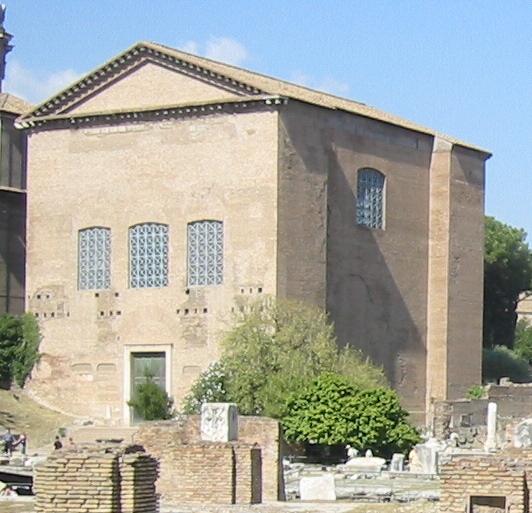
The Curia Iulia at Forum Romanum in Rome, one of the traditional meeting places for the Roman Senate. The building was reconstructed under the Fascists between 1930 and 1936, based on an earlier reconstruction in the reign of Diocletian.
Wikimedia Commons.

It was members of this very assembly — which was soon to become the Senate of the future Republic — who staged a coup and expelled the last of Rome’s kings, the Etruscan Tarquinius Superbus. From that point on, the Senate became the undisputed center of power in Rome until the end of the 2nd century BC, when the socio-demographic crisis facing Italy led to a search for change and reform through other institutions, such as the tribunes of the plebs. The failure to resolve the conflict led to the rise of warlords such as Sulla and Julius Caesar, each waging their own civil wars. These wars deeply divided the Senate, solidifying two diametrically opposed factions: the Optimates and Populares.

The future split between the Republic of the Senate and the Empire of the prince or emperor is, in part, an artificial one that has given rise to a narrative in which the Senate is seen as increasingly diminished in the face of the emperor’s authority, to the point of becoming practically irrelevant and invisible. It is still there, but merely as another monument to Republican Rome. The truth is that Rome began to be an empire long before Augustus was proclaimed emperor, just as it did not cease to be a republic during the imperial era, with a Senate that remained a political actor, wielding more informal power than formal power.

I understand the periodization that divides the history of ancient Rome into the Monarchy, the Republic, and the Empire, but I believe that, above all, it serves pedagogical purposes rather than the actual objectives of historiography. The Romans themselves, even though they were ruled by an emperor, understood that theirs was a republic, and they never ceased to describe it as such.

The issue of the figure and concept of the emperor is one that may have a great deal to do with the marginalization suffered by the Senate during the so-called Imperial era. The Romans’ concept of an emperor is quite different from our modern one. To begin with, the title imperator, from which the modern word emperor derives, was not used by the Romans when addressing their emperors. Imperator was a title bestowed by the legions upon their commanders as a form of recognition, granting them imperium — that is, the authority to command and lead — over their soldiers. The Roman emperor was called princeps (the first citizen), and this recognition meant that he was the first among the senators, holding primacy over the rest. Logically, this implies that for there to be a princeps or prince, there must be a senate; and in that sense, the Roman Senate was an integral part of the political structure of what we classify as the Imperial era until the fall of the Western Empire in 476 AD.

The Roman Senate survived the deposition of its emperor, Romulus Augustulus, the total disintegration of the Empire’s western provinces, and the imposition of two barbarian kings: first Odoacer of the Heruli, and then Theodoric the Great, king of the Ostrogoths. Throughout that entire period, the Roman Senate continued to function. It had already gained some independence in dealing with local affairs following the permanent establishment of the emperor’s court in Ravenna, in northern Italy, and under the new barbarian rulers — who sought to maintain the imperial structure and institutions for the purpose of governing — the Roman Senate experienced a modest political resurgence.

Links added to my Roman glossary.

“[E]lections are the inchoate expression of collective emotional reactions”

Filed under: Media, Politics, USA — Tags: , , , , , , — Nicholas @ 04:00

The Librarian of Celaeno offers an analysis of the midterm results from a monarchist perspective (I didn’t think there were many monarchists left in the US, honestly):

Analysis shows the real reason the Republicans lost so badly in the 2026 midterm elections.

As a reactionary monarchist, my approach to electoral politics is generally hands off. I find individual races and aspects of the system interesting, but only in terms of what they reveal about human psychology. I’ve written about this in the past, explorations of Trump and Vivek Ramaswamy (for some reason, my most popular post ever) with the goal of understanding what they and others mean. And having examined the fortunes of various candidates and factions over the years, as a matter of academic study and personal interest, I continually come to the same conclusion: liberal democracy is insane.

This to me seems the parsimonious conclusion for any theories of this (last) night’s election, with Democrats sweeping into power in former Republican bastions like Texas and Georgia. People online, people I respect, have advanced a number of theories as to why they were able to do so, generally based on something to with President Trump. But while there is something to that line of reasoning, I think the answer is more basic. I believe the evidence shows that “the people” however conceptualized, have no coherent sense of ideology or even self-interest. I wouldn’t even say they’re guided by residual inertia of inherited beliefs. Rather, elections are the inchoate expression of collective emotional reactions to an ever shifting and polarized mediated reality. In other words, madness.

I have heard, for example, that people are angry about high gas prices and so turned on Donald Trump and his Iran War in favor of the Democrats. But does anyone seriously think that the latter even intend to make fuel costs cheaper? Whose gas prices would you rather have- those of California, or Georgia? Well, if you live in Georgia, the answer seems to be California. Democrats are not shy about their aversion to fossil fuels and eagerness to tax their way to a German-style Green regulatory utopia. Voting for Democrats because gas prices are high is like giving yourself malaria in order to sicken the mosquitos who keep biting you. That’ll show ’em.

Then there’s the fact that the youth vote swung heavily to the Democrats. Many are suggesting that this is driven by young white men frustrated at being shut out of the economy, unable to get the jobs they want or afford a house. But again, in what universe is voting for Democrats the viable solution to that problem? These are the people who have flooded the country with foreigners meant to undercut those same native-born white men (and everyone else) and this election enables them to cement control over far more space to do that. The young people of Georgia, to return to my example, just voted for California’s taxes, regulatory environment, housing policies, and most importantly, its demographics. Everyone upset at his current situation pulled the lever to make it worse.

The rejoinder to this is, “well, Trump didn’t reach out enough! The young men were angry!” Of course they were. But then, everyone was angry. The blue hairs were angry. Black people were angry. Boomers were angry. At the heart of the anger is a continuously changing but relentlessly prolific barrage of propaganda, a kind of anti-myth, for while myth is timeless and transcendent and unifying, the words and images that comprise anti-myth are ephemeral and tendentious and discordant — inciteful rather than insightful. This propaganda comes from everywhere and nowhere all at once, subtle and overwhelming, but ever omnipresent. It keeps the masses running through cycles of elation and dooming, smug triumphalism and black rage. It is the context through which the people view politics, whether from the shallows or the depths, they all swim in it

And the whole of the mad masses, broken down into sub-mobs of conflicting interest groups, are all driven to the polls to vote against whatever happens to be there at the moment. They were all mad for different reasons, but the results were all the same, the empowerment of the sort of people who can only be elevated by an irrational horde.

Few seem to grasp that this wipeout is but the latest iteration of a now perfectly normal phenomenon, something that’s been going on since the 1930s. The president’s party nearly always sees losses in the midterms, sometimes enormous. It happened to Bill Clinton; it happened to George W. Bush. Barack Obama referred to his midterm losses as a “shellacking”. Every time it happens it’s declared the end of whoever is in power and birth of a new order for the ages, only for the script to flip some time in the next 2-4 years. Obama was the repudiation of Bush-Era Republicanism. Trump was the end of technocratic liberalism. Biden was the doom of Trump and Trump was the doom of Biden. And at the halfway point of each administration the other party was was given control of Congress in order to thwart the will of the man the electorate had just put in office.

Mark Steyn:

It is two days after the election and they still cannot tell us who won Mississippi.

Mississippi! A state Trump won by twenty-three points just two years ago.

So why can’t they call it for the Republican? Er, because it’s the Democrat who’s ahead, but only by a hundred votes. That’s how thoroughly Mark Levin and Lindsey Graham have bollocksed the Republican Party. If Mississippi is suddenly a purple state, New Hampshire is now bluer than, er, South Carolina: the Granite State legislature flipped from a 43-seat GOP majority to a 200-seat Dem supermajority. On Tuesday, nationwide, men went +11 for Democrats, and so did rural voters. There are no takers for what the Lindsey-Levin crowd are selling. The President displayed appalling judgment in ever listening to them. Me channelling Megyn Kelly back in March:

    The Micropenis That Ate MAGA

And so it has proved — from Maine to Texas.

Nevertheless, those who destroyed the forty-seventh presidency are now doubling down:

Yeah, baby. Nuke the world! That’ll show ’em …

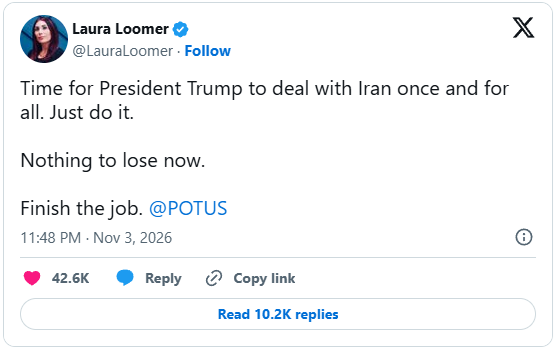
I don’t really know who Laura Loozer is, but evidently she has the President’s personal cell and I don’t. And she is not alone. The slogan du jour is “finish the job”. Former Bush speechwriter Marc Thiessen:

    We should go back to war and we should finish the job.

My old pal from Fox News, Brian Kilmeade:

Finish the job? It’s not clear that the Pentagon, in a strategic sense, has even started it. Nevertheless, another former comrade, Duane Patterson from The Hugh Hewitt Show, is on board:

    Trump has a window of about three months … He has to finish the job. Topple the regime. Hang a W. Then, after oil comes down, affordability returns as the cost of energy stabilizes, and the rest of the economic engine he jump started revs up, whoever comes next can ride prosperity in 2028.

Good luck with that. For one thing, the corrupt and dysfunctional US military has demonstrated, for three-quarters of a century, no capability whatsoever to “finish” any job. What part of “Dollar for dollar, you’re the most expensively crap warmonger in the history of the world” don’t you understand?

As for “Nothing to lose now”: America is supposed to be a self-governing republic, and its citizens have just told you they don’t want this. Yet you’re still proposing that their chief magistrate should go ahead anyway and MOAB (or worse) those lousy mullahs?

Vice President Vance — who, unlike Pete Hegseth, cannot be fired by Trump — yesterday wrote a very long tweet, including the following:

    The reason we lost is the war. The president himself said so last night.

    If you’d like to argue it was worth it, that losing the Senate for the next 6 years was worth it, then do so.

AI and open-source software

Filed under: Technology — Tags: , , , — Nicholas @ 03:00

ESR has become a big fan of AI-assisted code writing, and as a result I’m a bit less “doom-y” about the potential uses of AI because ESR is a living legend in the software world. If he thinks it’s a good thing, then I’m inclined to believe him. That said, as he illustrates here, not everyone in the OS community agrees with him about code-writing clankers:

I find it bizarre that so many open-source projects have posted policies against AI-assisted contributions.

This will not last, because they’ll be outcompeted by projects not afraid to use power tools to debug the code and and features. In crucial cases, AI-hostile projects will be forked to remove that restriction.

How can anybody not see this coming?

This dynamic is so obvious – and anti-AI rules so patently futile and doomed – that I have to conclude there is something like a religious frenzy going on.

I’m going to bend over backwards to be fair about this. There was a point earlier in the development of AI at which such restrictions might have made temporary sense, because model outputs were prone to enough noise and hallucination to be a net drag on productivity.

We’re long past that now. And the obvious solution to merge-request queues flooded with AI-generated slop is to use AI to filter them so exercising human judgment on the remainder remains practical.

I’m not going to argue rights and wrongs here. One might just as well argue that it’s wrong for sandcastles to collapse when the tide comes in.

The religious frenzy does bother me, though. Maybe less than it did 5 minutes ago when the mind infection was “wokeness”, but a mob of crazies is never an edifying or reassuring sight.

I guess the most positive thing I can observe is that this phase of nuttery won’t last long, because it can’t. The selective pressure against it is too brutal.

It does leave me wondering what cause the nutters will attach themselves to next. Alas.

Train Company Makes Guns: Union Switch & Signal M1911A1

Filed under: History, Military, Railways, USA, Weapons, WW2 — Tags: , , — Nicholas @ 02:00

Forgotten Weapons
Published 11 Jul 2026

Of the five companies that made 1911 pistols during World War Two, Union Switch & Signal was the last to be awarded a contract and the smallest mass production producer. A subsidiary of the Westinghouse Air Brake Company, US&S produced a variety of ordnance material during the war (and during World War One as well). They received a contract for 200,000 M1911A1 pistols on May 5, 1942, which was subsequently reduced to 30,000 in March 1943 and then upped to 55,000 in June 1943. Those 55,000 pistols were delivered between January and October 1943 and had an excellent reputation for quality.

Union Switch & Signal actually only produced eleven parts for the 1911 plus frames, with the balance of the components subcontracted (mostly to Yawman Metal Products of Rochester NY). Their serial number block was 1041405 – 1096404.
(more…)

QotD: Pining for the fjords old social media

Filed under: Media, Quotations, Technology — Tags: , , — Nicholas @ 01:00

Oh, how I miss the old social media. The one that claimed, with a straight face, to be “social”. Connecting people, it said. A lofty ideal, sure. But one worth at least paying lip service towards.

But what I really miss about the old Facebook is the wisdom one imbibed with each visit. You’d log on breathless, quivering in wonderment at the mere prospect of a day enriched forever.


I’m referring to the now defunct staple of those quixotic days. The Thirst Trap with Inspirational Quote — a mode of intellectual smuggling so elegant it deserved a Royal Charter. First came the sugar: a lithe young woman — preferably your best friend’s inamorata — in a bikini engineered to defy both gravity and modesty. Then came the medicine: quotes from Gandhi or Rosa Parks. Occasionally, for the more intellectually inclined, a dose of that mad French pederast, Michel Foucault.

For the unadorned, Facebook’s philanthropy once possessed lofty intention. It worked like KGB subterfuge, apparent only years after the fact. Peppered across the old Facebook were photos related to friends, acquaintances, and people you might have once spied groping the wonky lemons in Aldi. It was a community. On Sundays, you’d play a Masterchef host, picking apart your old English teacher’s gravy-sodden roast beef and questioning the sad pallor of his limp, insipid broccoli. The poor fool might know a bit about The Tempest, but he knows nothing about salting his cruciferous vegetables.


That was the old social media. Now Hell is empty and all the devils are here.

Life in that prelapsarian idyll was dreamy. A friend request spiked a syringe full of dopamine right between one’s ears. Ahhh. Unearned reward bounced along one’s veins.

But what I miss most is the intellectual life of the old Facebook. Somewhere in Silicon Valley, an asocial oddball tapping keys for Facebook realised that humans, okay — men — enjoy photographs of lissome and radiant females wearing a minimum of organic cotton across their chests and torsos. The conceit: trick them with this tantalising photo. Once they’re hypnotised, slap them with a brain-edifying quote from a great mind.

I must admit. I learned a great deal from such cunning little photos. But this intellectual subterfuge was like learning to read under the cover of night and the threat of beating. You know, the situation women face in those backwards countries which the far-left cannot help but celebrate.


A friend of mine dated one of these cultural benefactors. Each post triggered a small industrial ritual. Phones emerged. Men disappeared around the back of the warehouse for a sly peek.

“I told her not to post that stuff,” he’d mutter.

We, of course, were less concerned with the flagrant déshabillé than the curriculum. Would it be Gandhi? Rosa? A daring turn toward French theory? The race was on. Thumbs scrambled across screens, each one determined to be the first to reveal today’s pixelated prize. On the screen was my friend’s girlfriend, her body sculpted with hours of gym work, wearing one of those bikinis which render the wearer less than naked. In the curious greeting of her tribe, she expertly angled her glossy behind toward the waiting camera.

And then, the crunch of gravel under a boot. Our mate would appear:

“What the fuck are you all looking at — I bet — I swear — I told her not to post that stuff.”

It was absurd. It was undignified. It was what terrific bores would today call problematic. But it was, in its own way, social. And then it disappeared. Social media stopped being about people and became about attention.

The roast dinners vanished. The girlfriends remained — but now they belonged to strangers paying £9.99 per month for a daily update of smut. The quotes disappeared entirely. There was no need for them. The tech bros had threaded a barbed hook down your throat.

Christopher Gage, “Social Contract”, Oxford Sour, 2026-08-04.

Powered by WordPress