
Quotulatiousness

November 13, 2026

Books for boys

Filed under: Books, Health, Media, Politics — Tags: , , , , — Nicholas @ 03:00

A few days ago, I posted a meme on social media from Hopalong Ginsberg which I thought was a useful encapsulation of a long-standing problem in the publishing world — that publishers have been consciously neglecting the male reader, especially the young male reader, in favour of the female audience — and the often noted lack of interest among male students for reading assignments in school. I commented “It’s amazing to consider the power (mostly female) school teachers have to utterly destroy young males’ interest in reading anything“:
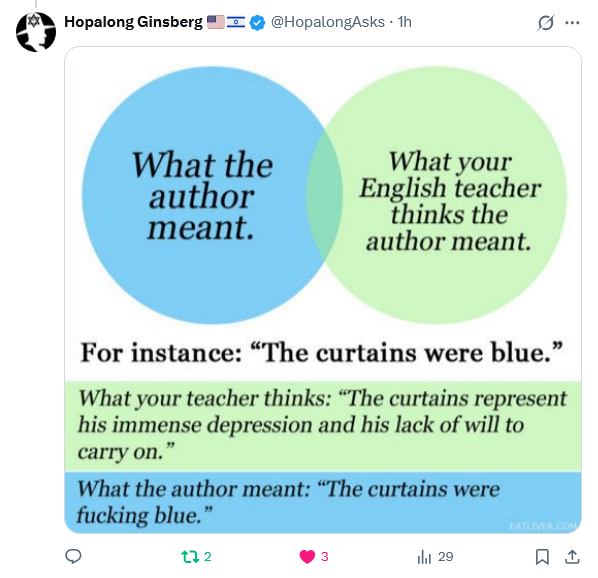
On X, MeWe, and Gab, it got a few likes and that was it. On Substack Notes, however, it got a lot of attention and commentary (mostly positive) and a few who took it as a personal attack or proof that there’s no anti-male bias in publishing today. It’s always eye-opening when audiences can get radically different interpretations from the same source.

All that said, here’s something vittorio posted to X which I think is also relevant:
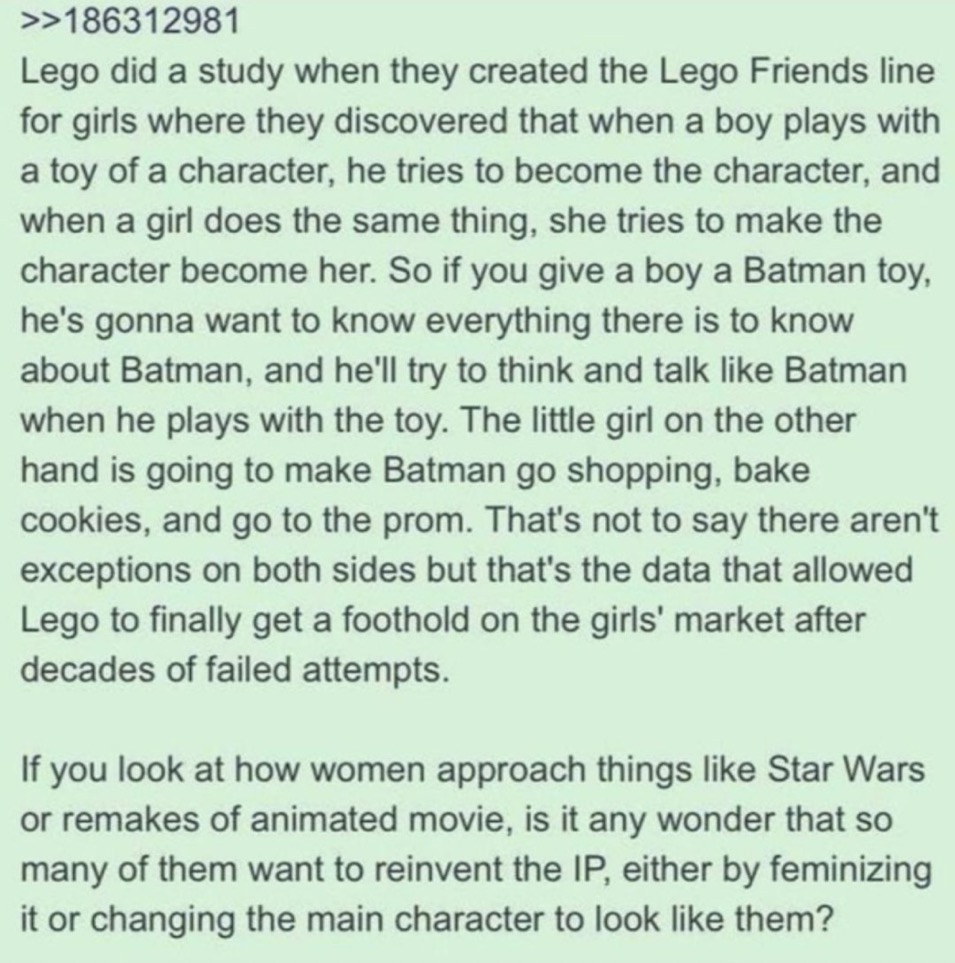
this is also why boys are reading so much less now that children’s publishing has become female dominated

men write archetypes. women write about themselves.

men write about heroes, villains, gods, monsters, extraordinary characters who embody something greater than themselves, heroes that boys can admire and aspire to become

women write characters who look like them, think like them, have their problems and insecurities, characters they can identify with and project themselves onto

men use writing as a vehicle for self-transcendence while women use it as a vehicle for self-recognition

it’s the difference between wanting to become Batman and wanting Batman to become you

it’s then obvious why boys craving the hero’s journey would rather retreat into video games than read yet another piece of autobiographical, gossip-filled, moralizing turboslop

if you want boys to start reading again you need to let men write again

How the USS New Jersey‘s 16-Inch Guns Work: Top to Bottom

Filed under: History, Military, USA, Weapons — Tags: , , , , — Nicholas @ 02:00

Forgotten Weapons and Battleship New Jersey
Published 13 Jul 2026

I had a chance to spend some time on the USS New Jersey, today docked in Camden NJ as a public museum ship. Today we are looking at the main armament of the ship, the absolutely massive Mk7 16-inch guns. These are the largest guns ever used by the United States Navy, and they are really very complex systems requiring dozens of men each to operate. We are going to start at the very bottom of the ship and explore how the guns are loaded, aimed, and fired, going all the way up to the spotting Director 15 stories high on the very top of the vessel.
(more…)

QotD: Occupational licensing, regulation and economic slowdown

Filed under: Bureaucracy, Business, Government, Quotations, USA — Tags: , , , — Nicholas @ 01:00

One of the most egregious ways that government favors insiders is occupational licensing, typically presented as a way to protect consumers. Economists Morris Kleiner and Alan Krueger documented that, in the late 1950s, less than five percent of American workers needed some form of occupational license. Licensing in fields with a real public-health impact — pharmacy, say — may protect some consumers, but it’s hard to see why the person selling you flowers or your eyeglass frames needs certification.

Licensing can deter someone from starting a new job or experimenting with new occupations. If you think that you might like to be a florist, you could just try it out, in a free environment. If floristry requires a long process of certification, though, you’re more likely to stick with your current job. Occupational licensing also makes it harder to move across states to seek work, since licensing requirements vary.

[…]

Government rules also deter job creation by mandating extensive employee benefits. The most obvious costs come from Social Security, workers’ compensation, and Medicare, which cumulatively average $2.85 per hour — increasing the effective hourly minimum wage from $7.25 to more than $10. The Fair Labor Standards Act also requires overtime pay for nonexempt workers. Other rules have made it easier for workers to sue their employers, adding a further potential cost to hiring.

Individual states and localities impose rules that drive up employment costs, too, such as Oregon’s $12 minimum wage or the $16 minimum wage in Seattle. The national minimum remains too low typically to have much impact on older workers, but it does matter for the employment prospects of younger workers with fewer skills. Economist Jeffrey Clemens found that Congress’s 2007–09 increases in the national minimum wage decreased the probability of being employed by about 5 percentage points for workers between the ages of 16 and 30 who lacked a high school diploma, in states that had previously kept their minimums low. In other research, Clemens and Michael Wither found that minimum-wage hikes led to similarly substantial reductions in the probability that minimum-wage workers would rise to monthly earnings levels over $1,500.

Edward L. Glaeser, “How to Fix American Capitalism”, City Journal, 2020-12-13.

Powered by WordPress


