
World War Two
Published 10 Oct 2026The StuG III was built to support infantry. It became one of Germany’s most important tank killers. How did the Sturmgeschütz III go from mobile artillery to a mainstay of German armored warfare?
Built on the Panzer III chassis, the StuG traded a revolving turret for a low silhouette, strong frontal protection, and a fixed gun. Originally designed to destroy machine-gun nests and fortifications, it gained a long-barreled 75 mm gun as Germany confronted the T-34 and other Soviet tanks.
In “One Artillery Piece for the Road”, Spartacus Olsson follows the StuG III from Manstein’s assault-artillery concept through its development, production, and combat service. We examine its strengths, mechanical limitations, and the struggle between the artillery and Panzer branches over its expanding role.
Germany’s most numerous fully tracked armored fighting vehicle also exposes a larger contradiction: Nazi Germany could build practical, economical weapons, yet repeatedly burdened its war effort with costly complexity. What made the StuG different, and why could its battlefield successes never solve Germany’s strategic problems?
October 11, 2026
One Artillery Piece for the Road! – StuG III – Nazi Rearmament 09
October 3, 2026
QotD: How to besiege a trace italienne fortress
Areas that became densely set with trace italienne fortresses [Wiki] – particularly the towns of the Low Countries – became almost impossible to conquer. The Army of Flanders [Wiki], then arguably the finest in Europe, tried for eighty years to subdue the Dutch and largely failed: the cost of endless sieges of trace italienne fortified towns made the task effectively hopeless. Once again, I don’t want to imply that this is the only factor (it isn’t, by any means), but after the long series of remarkably decisive wars from 1450 to 1550, the trace italienne contributed to the frustratingly inconclusive (but expensive and bloody) wars of the following century.
At the same time, this shift back towards defensive stalemate didn’t lead towards more fragmentation – as the castle had – because trace italienne fortresses were too expensive for any individual aristocrat to build merely to protect his house. Not merely because of the massive fortifications themselves, but the large garrisons they required, either of full-time soldiers or town militia, which were simply beyond the resources of what was left of the old medieval aristocracy. Indeed, warfare in this period (both offensive and defensive) largely proved to be beyond the resources of Europe’s newly centralizing states; the Spanish crown, for instance, went bankrupt, primarily from military expenses, in 1557, 1560, 1575, 1596, 1607, 1627, 1647 and 1653.
It is part and parcel of the era that as much as building and defending a trace italienne fortress was an exercise in mathematics, so was attacking one. Because the entire point of the fortress is to project firepower – often at great distances (with cannon) – the attacker cannot simply form up outside or just set up their artillery in an open field and begin firing; they’d be cut up by counter-battery fire before they had gotten very far. So the attacker had to set up their own earthworks, which naturally being based on the same principles and weapons as the defender’s, would resemble them.
First, the attacking army would generally set up its own fortified camp, outside of cannon-shot. Because that camp needed to be resistant to enemy attack either from the garrison of a relieving army, it was likely to be built in the same style as a trace italienne fortification, albeit with earthworks and gabions (wicker baskets filled with earth) in place of the heavier stonework of the fort. The attacker then has to isolate their target from help, preventing the defenders from leaving, or supplies or reinforcements from arriving. The act of enclosing a besieged settlement in a wall is called circumvallation (recall our word vallum there; this is “walling around”). The act of constructing a line of outward facing defenses to defend that line from attack by a relieving army from behind is called contravallation. Armies in this period would do both.
The first such line of defenses was often started from the fortified camps and was built effectively out of range of the fort; this was the “first parallel”. Now, by the time this project was well along, both the defenders and the attackers could do some basic calculations. They both might have a sense of how quickly reinforcements could arrive and if they were likely to be large enough to give battle or lift the siege. Both sides also know how long their supplies will last and can probably have a decent guess of how long their opponent’s supplies will last. And at this point, they can both calculate fairly well how many meters of earthwork and trench the attackers can dig per day and how many they need to dig to complete their siege operations.
But – and this is important – no one wants this siege to come down to its conclusive, final assault. The attackers don’t want this: every day their siege army sits out here, it is eating money such that each day wasted besieging this town limits what this army can accomplish overall before supplies and money run out. Moreover, the actual assault is likely to incur very high losses on the attackers, because even with a breach, they have to cross all of that open, fire-swept ground and then force the breach in close combat – and the defenders will know exactly where they are going days in advance. On the other hand, if the defenders make the attackers go through all of that effort, danger and death and lose – and they must assume the attackers wouldn’t have laid siege if they weren’t confident they had enough men to take the breach when it comes to it – then the city would be looted, its populace raped or massacred as the attackers vent their rage on the city. This was, at the time, considered the normal result of holding out, to the point that it seems to have been general practice that it was appropriate to wait something like three days before beginning the process of getting control of an army that had breached a city in this fashion.
So once the attacker has completed that first parallel, he is going to send a message to the garrison, announcing that he has done so and offering them the chance to surrender. The standard terms for such surrender was called the “honors of war” – normally the defenders would be permitted to march out, with its flags flying, bayonets fixed, matches (for their matchlock muskets) lot on both ends and “ball in mouth” (that is, a musketball held in their mouth ready to be swiftly loaded as protection against treachery). The defeated army was generally required to turn over its arms, but generally allowed to march back to their own territory. And finally, a town that surrenders like this might have to pay a ransom, but ought to be immune from pillage. To modern readers, these sorts of rituals seem quaint, like having a battle break for tea in the midafternoon (a thing that, to be clear, did not happen), but in fact these were fairly hard-nosed considerations: generous surrender terms aimed to induce a garrison or town to surrender and so spare the attacker both the time but also the blood of storming the place, because after all the goal here isn’t to destroy the enemy garrison but to get control of the town.
One that first parallel is completed, assuming the defender, upon doing the math, doesn’t decide the matter is hopeless and just give up, the attacker now proceeds to begin digging his works forward to set up advanced firing positions (most of the digging was done at night when enemy artillery couldn’t accurately fire at the work parties); there were typically three parallels, the first two providing protection to the digging works and the third parallel, dug into the glacis, providing the firing position directly into the structure of the fort. Once the cannon were emplaced, the attacker might again report that he was prepared to begin firing but if the defenders would just surrender, we could all skip that nasty business. If not, the attacker’s cannon – now secured in their own trace italienne-style firing positions – would start working on the enemy fortifications in a gunnery duel (since the defender’s guns are firing back). Progress here would mean both demolishing ravelins and other outworks which shielded the main curtain wall, as well as storming assaults on various outworks to take them and deny them to the enemy (Americans may note effectively all of these steps in the Siege of Yorktown (1781), albeit on fast-forward since this was a siege of a fairly small town defended merely by field fortifications rather than a large trace italienne fortress complex). The final option to surrender came once the curtain wall had been breached (there was little use in trying to “rush” the breach since it would take days to produce so everyone knew where the final fight would be). The defender then had the terrible choice of either surrendering or risking the terrible slaughter that would follow if the breach was forced (as it was very likely to be).
This whole process could take a really long time and it involved a lot of digging, but it was almost mechanistic in its push towards success. In a sense, those demands forced European states to develop the sort of state capacity that had been the norm under Rome or in China in order to run this new version of the “big army” siege playbook which demanded such tremendous amounts of work. As I’ve noted elsewhere, sieges of these sorts against large trace italienne complexes could last a long time; Parker (Military Revolution, 13) notes the siege of Breda in 1624 lasted nine months and was fairly short while the siege at Ostend in Flanders in 1601 lasted three years and was fairly long, to give a sense of the range.
Bret Devereaux, “Collections: Fortification, Part IV: French Guns and Italian Lines”, A Collection of Unmitigated Pedantry, 2021-12-17.
September 27, 2026
The 88 – Foe of Tanks and Planes Alike – Nazi Rearmament 07
World War Two
Published 26 Sep 2026The German 8.8-centimeter Flak began as a heavy anti-aircraft gun, but war repeatedly dragged it into new roles. It shot at bombers, destroyed tanks, smashed bunkers, supported infantry, and eventually defended the collapsing Reich from Allied armies advancing into Germany.
Its origins, however, predated the Nazis. Developed through clandestine cooperation between Krupp and the Swedish firm Bofors, the Flak 18 emerged from Weimar Germany’s efforts to evade the military restrictions imposed after the First World War. The Nazis inherited that expertise, expanded production enormously, and turned the “Eighty-Eight” into one of the most famous weapons of the Second World War.
From Spain and France to North Africa, the Eastern Front, and the air defense of German cities, the 88 earned a formidable reputation. But how much of that reputation was deserved? Was it really an unparalleled anti-tank weapon, or has later mythology exaggerated its contribution?
In this German rearmament special, we examine the development, production, deployment, capabilities, limitations, and strategic effect of the Flak 18, Flak 36, Flak 37, and the substantially redesigned Flak 41. This is the history behind the legend: an impressive piece of engineering employed in support of Nazi Germany’s war of conquest and genocide.
September 18, 2026
Guatemalan Contract St Chamond 70mm Mountain Gun
Forgotten Weapons
Published 2 May 2026Despite the French Army adopting a 65mm mountain gun in 1906, several French companies — including St Chamond and Schneider — developed their own mountain gun designs in the years before World War One. These were popular guns for foreign export, being relatively small, light, and inexpensive. St Chamond’s 70mm gun was built on the same breech design as their previous 75mm field gun, at the request of the Mexican military and famous small arms designer Manuel Mondragon. Quantities were sold to Mexico, Guatemala, and Belgium (for use in the Belgian Congo). This example is a Guatemalan one, now in the United States as a live, registered, transferrable Destructive Device.
(more…)
September 11, 2026
QotD: Sherman on some military lessons learned during the American Civil War
Rarely did the opposing lines in compact order come into actual contact, but when, as at Peach-Tree Creek and Atlanta, the lines did become commingled, the men fought individually in every possible style, more frequently with the musket clubbed than with the bayonet, and in some instances the men clinched like wrestlers, and went to the ground together. Europeans frequently criticized our war, because we did not always take full advantage of a victory; the true reason was, that habitually the woods served as a screen, and we often did not realize the fact that our enemy had retreated till he was already miles away and was again intrenched, having left a mere shirmish-line to cover the movement, in turn to fall back to the new position.
Our war was fought with the muzzle-loading rifle. Toward the close I had one brigade (Walcutt’s) armed with breech-loading “Spencer’s”. The cavalry generally had breach-loading carbines: “Spencer’s” and “Sharp’s”, both of which were good arms.
The only change that breech-loading arms will probably make in the art and practice of war will be to increase the amount of ammunition to be expended, and necessarily to be carried along; to still further “thin out” the lines of attack, and to reduce battles to short, quick, decisive conflicts. It does not in the least affect the grand strategy, or the necessity for perfect organization, drill, and discipline. The companies and battalions will be more dispersed, and the men will be less under the immediate eye of their officers, and therefore a higher order of intelligence and courage on the part of the individual soldier will be an element of strength.
When a regiment is deployed as skirmishers, and crosses an open field or woods, under heavy fire, if each man runs forward from tree to tree, or stump to stump, and yet preserves a good general alignment, it gives great confidence to the men themselves, for they always keep their eyes well to the right and left, and watch their comrades; but when some few hold back, stick too close or too long to a comfortable log, it often stops the line and defeats the whole object. Therefore, the more we improve the fire-arm the more will be the necessity for good organization, good discipline and intelligence on the part of the individual soldier and officer.
There is, of course, such a thing as individual courage, which has a value in war, but familiarity with danger, experience in war and its common attendants, and personal habit, are equally valuable traits, and these are the qualities with which we usually have to deal in war. All men naturally shrink from pain and danger, and only incur their risk from some higher motive, or from habit; so that I would define true courage to be a perfect sensibility of the measure of danger, and a mental willingness to incur it, rather than that insensibility to danger of which I have heard far more than I have seen.
The most courageous men are generally unconscious of possessing the quality; therefore, when one professes it too openly, by words or bearing, there is reason to mistrust it. I would further illustrate my meaning by describing a man of true courage to be one who possesses all his faculties and senses perfectly when serious danger is actually present.
Modern wars have not materially changed the relative values or proportions of the several arms of service: infantry, artillery, cavalry, and engineers. If any thing, the infantry has been increased in value. The danger of cavalry attempting to charge infantry armed with breech-loading rifles was fully illustrated at Sedan, and with us very frequently.
So improbable has such a thing become that we have omitted the infantry-square from our recent tactics. Still, cavalry against cavalry, and as auxiliary to infantry, will always be valuable, while all great wars will, as heretofore, depend chiefly on the infantry. Artillery is more valuable with new and inexperienced troops than with veterans. In the early stages of the war the field-guns often bore the proportion of six to a thousand men; but toward the close of the war one gun, or at most two, to a thousand men, was deemed enough.
[…]
It was one of Professor (Dennis Hart) Mahan’s maxims that the spade was as useful in war as the musket, and to this I will add the axe. The habit of intrenching certainly does have the effect of making new troops timid. When a line of battle is once covered by a good parapet, made by the engineers or by the labor of the men themselves, it does require an effort to make them leave it in the face of danger; but when the enemy is intrenched, it becomes absolutely necessary to permit each brigade and division of the troops immediately opposed to throw up a corresponding trench for their own protection in case of a sudden sally. We invariably did this in all our recent campaigns, and it had no ill effect, though sometimes our troops were a little too slow in leaving their well-covered lines to assail the enemy in position or on retreat.
Even our skirmishers were in the habit of rolling logs together, or of making a lunette of rails, with dirt in front, to cover their bodies; and, though it revealed their position, I cannot say that it worked a bad effect; so that, as a rule, it may safely be left to the men themselves. On the “defensive”, there is no doubt of the propriety of fortifying; but in the assailing army the general must watch closely to see that his men do not neglect an opportunity to drop his precautionary defenses, and act promptly on the “offensive” at every chance.
I have many a time crept forward to the skirmish line to avail myself of the cover of the pickets’ “little fort”, to observe more closely some expected result; and always talked familiarly with the men, and was astonished to see how well they comprehended the general object, and how accurately they were informed of the state of facts existing miles away from their particular corps. Soldiers are very quick to catch the general drift and purpose of a campaign, and are always sensible when they are well commanded or well cared for. Once impressed with this fact, and that they are making progress, they bear cheerfully any amount of labor and privation.
William Tecumseh Sherman, “Sherman on Tactics”, Tactical Notebook, 2026-06-10. (Selection from Memoirs of William T. Sherman (1875) by Bruce Ivar Gudmundsson, minus an observation that sieges were now unimportant which was disproved in 1914.)
September 3, 2026
QotD: Combined arms
Bret Devereaux, “Miscellanea: A Very Short Glossary of Military Terminology”, A Collection of Unmitigated Pedantry, 2022-03-25.
September 1, 2026
St. Chamond 75mm field gun: From Mondragon to WW1 tanks to Israel
Forgotten Weapons
Published 13 Apr 2026The design for the St Chamond 75mm field gun was initially created by Mexican small arms designer Manual Mondragon, who worked extensively in artillery as well as small arms. As Mexico had no domestic artillery production capability, he worked with the engineering team at St Chamond under Emile Rimailho to complete the design, and Mexico purchased 100 of these guns by 1910, forming the backbone of Mexican Army artillery during the period. The gun is a screw breech rapid fire piece, using fully self-contained ammunition (both shrapnel and HE projectiles). It fires a 12-16 pound shell at about 1650 fps, with a range of about 6500 meters.
In September 1914 the French government panic-ordered a batch of these guns, but then reconsidered and cancelled its order in favor of simplifying logistics with just the more common Mle 1897 75mm guns. That decision changed again in 1915, with an order for 200. These were not formally classified by the French Army, but St Chamond called them the Mle 1915. The gun was identical to the original Mexican pattern except revised to use the same ammunition as the Mle 1897 (the classic “French 75”) instead of its original slightly different cartridge. These guns were initially used for general field service, but pulled off the line when it became apparent that their recoil systems were not really able to handle the stresses of the constant firing required. Instead, they were used as the main armament for the initial 210 St Chamond heavy tanks (less the first 48 that did not receive main guns). After these were used up, the Mle 1897 was used instead.
One final element of combat service for the guns took place in 1948, when Mexico sold 32 of them to Israel, where they were used in Israel’s war of independence. Three examples remain on display in Israeli museums today, more than anywhere else. The one I am looking at today is a Mexican contract piece made in 1904, registered in the US as a live and transferrable Destructive Device.
(more…)
August 19, 2026
Why The Allied Western Front Offensives in 1915 Failed
The Great War
Published 13 Mar 2026By the spring of 1915, the Western Front had bogged down into trench warfare. Allied offensives tried to break the deadlock in spring and fall 1915. The fall offensives were among the bloodiest of the war. After unprecedented bloodletting and use of munitions, the Western Front was still locked in a stalemate at the end of 1915.
(more…)
July 17, 2026
QotD: Catapults in pre-gunpowder armies
The very oldest catapults, first invented by the Greeks were tension catapults (the gastrophetes and oxybeles), which functioned like large bows, with a bow-staff being bent backwards to store and then release the launching energy. This sort of design, common in pop-cultural depictions of catapults, is actually quite limited as with the materials available, there is a real limit to how much energy can be stored via tension. Fortunately for the Greeks, by the early fourth century, they had developed a better method.
Instead, the Greeks, Macedonians and Romans began using torsion catapults (where the energy is stored in wound-up sinews like a spring). While the devices used in field battles (and for city defense) were often smaller, arrow-launching devices, siege catapults could be very large; the standard engine for the purpose could fling a 1 talent stone (26.2kg) about 400m (though effectiveness was far higher if you could get closer to the wall, which as we’ll see will be a trend for most of this post); much larger engines did exist as well. That said, Roman catapults were mostly not for collapsing walls but for destroying towers and suppressing defenders in order to aid in escalade (usually by mole, rather than ladders or towers, though the Romans used those too).
And here once again the distinction between the “big army siege package” and the “small army siege package” matters quite a bit. Roman torsion artillery was complex, expensive and required lots of technical skill, and so sees far diminished use in the early Middle Ages where that technical skill is hard to come by. Vespasian, we are told, brought 160 torsion catapults to besiege Jotapata in 67 (Josephus BJ 3.166) while Titus brings a stunning 340 to besiege Jerusalem in 70 (Josephus BJ 5.356). By contrast, the construction of a single catapult is often a major event in a medieval siege (see Rogers, op. cit. 121-3 for some examples) and while later medieval catapults were often more powerful than the earlier Roman torsion devices, they were not that much more powerful.
Consequently, Hellenistic and Roman fortifications (especially city walls, like the Theodosian Walls we discussed last time) were designed with massed catapults in mind. As noted, the multiple walls ensured that the main curtain wall, the inner wall, was extremely difficult to target with catapults or indeed any kind of artillery: even if you knocked down the low wall and the outer wall, their rubble would mostly block shots at the base of the inner wall. Meanwhile, the inner wall was built to be practically immune to catapult fire anyway: up to 6m thick without any internal passages (the outer wall was much thinner, only 2m). That was more than enough to render the walls effectively immune to anything catapults can do; the walls in many places still stood up to Ottoman cannon in 1453. Finally, ancient city defenses were built assuming they’d often have their own stone and arrow throwing torsion artillery set up on the towers to return “counter-battery” fire. Not every city had the “complete package” that Constantinople, as the imperial capital head, of course, but some mix of thick walls, low out-walls and catapults designed for counter-battery fire were fairly standard defensive arrangements for Roman cities that could afford them and felt sufficiently threatened to invest the resources.
As we move into the Middle Ages, two paradoxical things happen. On the one hand, the ability for societies in Europe to deploy large numbers of finicky, high-tech torsion artillery decreases dramatically (and the machines that we do see tend to be the simpler, less accurate single-armed variety, what the Romans called the onager or “wild ass” because it kicked like one when it fired). On the other hand, by the sixth century, we start to see a clever new design of catapult, the traction trebuchet.
Originating in China in the 4th century BC, the traction catapult used muscle power directly to swing a long pole around a central frame. In terms of engineering complexity, it was a simpler device, and could be scaled up quite large so long as one could add more pullers (around 100 seems to have been normal for a large engine), but the range and power it offered as a result of the mechanical advantage offered by the long throwing arm were considerable. Given the number of pullers required, it is little surprise these were generally only used in small numbers in medieval Europe (again, often in reports it is merely a single device, described as a mangonel or a fenevol), but on the other hand, as I understand the physics, the range and striking power had the potential to be superior to a torsion catapult. Nevertheless, if we look at the kinds of fortifications emerging during this period, it certainly seems like in Europe, the concern that artillery might produce a breach in the wall (as opposed to merely degrading towers and the wall-walk) was fairly low.
Just to throw down a note here because we’ll come back to it, it is striking that while the small numbers of traction trebuchets in Europe seem to have represented a decline in the “catapult threat” to walls (recall last week’s contrast between castle walls and the much older Theodosian Walls), that was not the case in China, where walls continued to be made very thick – a design quirk that will matter quite a lot in a moment. I am not an expert on ancient and medieval Chinese siege tactics, alas, but my brief encounters with accounts of them often seem to describe traction catapults used en masse, in dozens or even hundreds, much more the way that the Romans used massed siege artillery. Likewise, Michael Fulton (Artillery in the Era of the Crusades (2018)) notes nearly a hundred Mamluk trebuchets (a mix of counter-weight and traction) at the Siege of Acre (1291); my sense is that such large siege trains were very rare within Europe. Presumably the ability to deploy so many engines was a consequence of greater state capacity in China and the Near East during this period as compared to fragmented, decentralized medieval Europe.
The late 12th century sees a major variation on the trebuchet design: the use of a counter-weight, instead of traction to provide the force; this innovation seems to have emerged in the West broadly defined, though it isn’t clear if that means in Europe or the Middle East (in any event both Christian and Muslim armies start using them at almost exactly the same time). This allows for much more energy to put into the shot, as the counter-weight can be very heavy and only slowly winched into place, allowing the work crew to spend more time “storing” energy in the counter-weight than they could with the quick pull of a traction trebuchet. Larger counter-weight trebuchets could also make use of animals to provide the power, or large wheels to make it easier to raise the counter-weight. The upper-limits on the size of projectiles were very high: Warwolf is thought to be the largest such trebuchet known, and threw a nearly 300lbs shot. That said, while counter-weight trebuchets hit harder (but fired slower), in function they do not seem to have been meaningfully different from traction trebuchets; they were used the same way in sieges.
What’s really striking is not the vast impact of catapults, but the muted impact of catapults. The counter-weight trebuchet was clearly good: the innovation makes its way all the way back to China, carried by the Mongols who presumably picked it up in the Middle East (ironically moving the opposite direction but at the same time as gunpowder, suggesting that at this point in the 13th century the two technologies were not considered mutually exclusive). Castle design does respond to catapults, but only in relatively modest ways: walls get somewhat thicker, but as Fulton (op cit.) notes, only by about half a meter or so (leaving even the newly thickened medieval castle walls somewhat thinner than the best old Roman defenses). In at least some areas, towers and keeps become more frequently rounded in shape, to resist catapult fire.
Certainly it was possible for catapults to open breaches in weaker walls to enable assault. The aforementioned Warwolf opened large breaches in the stone walls of Stirling Castle in 1304. But I note both Rogers (op. cit.) and Fulton (op. cit.) seem to confirm that while true breaches from trebuchets could happen, it was far more common that walls resisted trebuchet strikes and that the real work of the machines was degrading the wall defenses by striking off battlements and smashing towers, in order to enable escalade. Which is little surprise: that’s precisely what the Romans used catapults for too. While there is still some argument about the degree to which the counter-weight trebuchet was a revolutionary military technology, on the balance, the siege playbook changed only modestly to accommodate it, and castle design likewise shifted only in degrees.
And then Charles VIII of France (r. 1483-1498) decided to take a holiday on the Bay of Naples.
Bret Devereaux, “Collections: Fortification, Part IV: French Guns and Italian Lines”, A Collection of Unmitigated Pedantry, 2021-12-17.
June 17, 2026
QotD: The artillery
Combat Boot, “So, ‘capbadges’, what’s that all about then?”, combatboot.co.uk, 2020-11-13.
June 8, 2026
A Brief History of Nuclear Weapons in Canada
Polyus
Published 6 Jun 2026 #aviationlovers #canadianaerospace #PolyusStudiosCanadians themselves were largely opposed to nuclear weapons but their utility in a full out conflict was impossible to ignore. And so up until fairly recently the Canadian government’s position on the matter was deliberately ambiguous. Promoting peace while supplying the means of war. Now with the luxury of hindsight we can see the true extent to which these weapons played a central role in the defense of this country during the Cold War.
Like it or not, Canada was a threatening and potent nuclear-armed force during a 9 year period between 1963 and 1972. The posturing was offensive in Europe, and defensive on Canadian soil. The last defensive weapons were relinquished in 1984. Nuclear weapons were adopted as part of its network of alliances, when it became obvious that the Soviet missile threat could only be defeated by deterrence. Politically the nuclear question was a hot potato, John Diefenbaker tried to keep the weapons out, Lester Pearson let them in, and Pierre Trudeau kicked them back out again.
This video was made without the use of Artificial Intelligence (No AI). Long live people power!
0:00 Introduction
1:20 Uranium mining in the North
2:31 Tube Alloys and the Manhattan Project
4:10 Post war fears of Soviet army and Canadian build up in Europe
6:04 Air threat from Soviet bombers
8:05 The case for nuclear weapons
9:28 Cancellation of the Arrow in favour of nuclear weapons
10:55 Defensive nukes
13:39 Offensive nukes
16:15 Nuclear capable platforms
16:59 Types and numbers of deployed weapons
18:30 Legacy and impact of these weapons
19:55 ConclusionSupport me on Patreon – / polyusstudios
Music:
Denmark – Portland Cello Project
Your Suggestions – Unicorn Heads
February 19, 2026
Hotchkiss Model 1886 3-pounder Quick Firing Gun
Forgotten Weapons
Published 26 Sept 2025Small fast boats with torpedos (or other explosives) have always been a threat to large warships. One of the weapons the British Royal Navy adopted to counter that threat was the Hotchkiss Model 1886 “Quick Fire” gun. This meant that it was a breech-loaded gun that used self-contained cartridge ammunition, instead of separate powder bags and projectiles. Mounted on a recoil-adsorbing soft mount with a wide range of movement and steep depression angle, guns like this could fire at small mobile torpedo boats that a capital ship’s main armament couldn’t handle.
This particular model is a 47mm bore, or 3-pounder as described in British service. It uses a vertically-traveling breech block, and more than 3,000 or them were acquired by the British. Two of them were employed as part of the Falkland Islands coastal defenses at one time. This example is one of two brought down from Gibraltar fairly recently and refurbished for ceremonial use on the Islands. Thanks to the FIDF for setting it up on its mount so I could film it for you!
(more…)
November 15, 2025
QotD: The innovation of infiltration tactics in trench warfare
The mature form of this tactical framework is often called “Hutier” tactics, after German general Oskar Emil von Hutier, though he was hardly the sole or even chief inventor of the method. In its mature form, the technique went thusly: instead of attacking with large waves of infantry which cleared each objective in sequential order, attacks ought to be proceeded by smaller units, carefully trained with the layout of the enemy positions. Those units, rather than having a very rigid plan of attack, would be given those general objectives and left to figure for themselves how to accomplish them (“mission tactics” or Auftragstaktik)1, giving them more freedom to make decisions based on local conditions and the ground.
These elite spearhead units, called Stoßtruppen or “Stormtroopers” were well equipped (in particular with a higher amount of automatic firearms and hand grenades, along with flamethrowers). Importantly, they were directed to bypass enemy strong-points and keep moving forward to meet their objectives. The idea here was that the follow-up waves of normal infantry could do the slow work of clearing out points where enemy resistance was strong, but the stormtroopers should aim to push as deeply as possible as rapidly as possible to disorient the defenders and rapidly envelop what defenses remained.2
These sets of infantry tactics were in turn combined with the hurricane barrage, a style of artillery use which focused on much shorter but more intense artillery barrages, particularly associated with Colonel Georg “Breakthrough” Bruchmüller. Rather than attempting to pulverize defenses out of existence, the hurricane barrage was designed merely to force enemies into their dugouts and disorient the defenders; much of the fire was directed at longer ranges to disrupt roads and artillery in the enemy rear. The short barrage left the ground relatively more intact. Meanwhile, those elite infiltration units could be trained to follow the creeping barrage very closely (being instructed, for instance, to run into the shell explosions, since as the barrage advantages, no gun should ever strike the same spot twice; a fresh shell-hole was, in theory, safe). Attentive readers will recognize the basic foundations of the “move fast, disorient the enemy” methods of the “modern system” here.
So did infiltration tactics break the trench stalemate? No.
First, it is necessary to note that while infiltration tactics were perhaps most fully developed by the Germans, they were not unique to them. The French were experimenting with many of the same ideas at the same time. For instance, basic principles of infiltration were being published by the French General Headquarters as early as April, 1915. André Laffargue, a French infantry captain, actually published a pamphlet, which was fairly widely distributed in both the French and British armies by the end of 1915 and in the American army in 1916, on exactly this sort of method. In many cases, like at the Second Battle of Artois, these French tactics bore significant fruit with big advances, but ran into the problem that the gains were almost invariably lost in the face of German counter-attacks. The Russians, particularly under Aleksei Brusilov, also started using some of these techniques, although Brusilov was as much making a virtue of necessity as the Russians just didn’t have that much artillery or shells and had to make do with less and Russian commanders (including Brusilov!) seem to have only unevenly taken the lessons of his successes.
The problem here is speed: infiltration tactics could absolutely more efficiently overrun the front enemy lines and even potentially defeat multiple layers of a defense-in-depth. But after that was done and the shock of the initial push wore off, you were still facing the same calculus: the attacker’s reinforcements, shells, artillery and supplies had to cross broken ground to reach the new front lines, while the defender’s counter-attack could ride railways, move over undamaged roads and then through prepared communications trenches. In the race between leg infantry and trains, the trains always won. On the Eastern Front or against the Italians fighting under the Worst General In History at Caporetto (1917), the already badly weakened enemy might simply collapse, producing massive gains (but even at Caporetto, no breakthrough – shoving the enemy is not a breakthrough, to qualify as a breakthrough, you need to get to the “green fields beyond” that is open ground undefended by the enemy), but against a determined foe, as with the 1918 Spring Offensives, these tactics, absent any other factor, simply knocked big salients3 in the line. Salients which were, in the event, harder to defend and brought the Germans no closer to victory. Eventually – often quite rapidly – the front stabilized again and the deadlock reasserted itself. Restoring maneuver, the actual end-goal of these tactics, remained out of reach.
None of this is to say that infiltration tactics were useless. They represented a real improvement on pre-war infantry tactics and continue to serve as the basis for modern infantry tactics. But they could not break the trench stalemate or restore maneuver.
Bret Devereaux, “Collections: No Man’s Land, Part II: Breaking the Stalemate”, A Collection of Unmitigated Pedantry, 2021-09-24.
- Because it doesn’t fit anywhere else, I want to make a rather long note here. There is an odd tendency which I find quite frustrating, in which military concepts, unit designations and terminology from other languages are all translated into English when used, except for German terms. I suspect this has to do with the high reputation German military thinking holds in among the general public and some military practitioners. I do not share this view; both the German Imperial Army and the Nazi Wehrmacht (another term we never translated yet we feel no need to call the French army l’armée de terre) managed to lose the only major wars they were in, leading to the end of the states they served. Both armies were capable at some things and failed at others; their record certainly does not make German some sort of Holy Language of War. Nevertheless, where German technical terms are notable, I will include them so that the reader will know, should they encounter them elsewhere, that this is a term they are already familiar with, albeit in translation.
- It should be noted that the emphasis here remained on envelopment and destruction rather than on disorientation. The latter is a feature of subsequent systems based on German maneuver warfare, but was not a goal of the doctrine itself initially.
- A salient is a bulge in the line such that your position is bordered by the enemy on three sides. Such positions are very vulnerable, since they can be attacked from multiple directions and potentially “pinched off” at the base.
November 11, 2025
Four battles of the Canadian Corps
Following on from part one (excerpted here), The Black Horse outlines four major battles that the Canadians fought on the western front during the First World War:
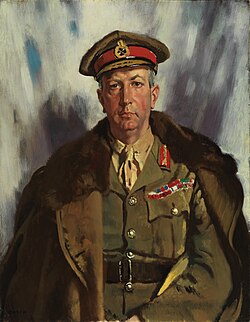
Sir Arthur Currie
Portrait by William Orpen, 1919.
The first part of the series was a political biography of Currie; the second part attempts to tell the story of the Canadian Corps at war through somewhat detailed account of four important battles. The piece is only partly biographical, it partly tells the story of Currie’s war, and partly tells the story the Canadian men who fought for the British Empire in the Great War. It’s a story of incredible martial prowess, but the careful reader will also observe a story of warring duties placed upon the leader of a colonial army; duty to his men, duty to the political leadership of his colonial people and the future of that nation, duty to the objectives of the imperial power on whose behalf he fought, and finally duty to glorious Victory. Currie ended his life understood by those with eyes to see as a great warrior and a military genius; but disliked by his men and hated by the leadership of his people because he prioritized the needs to the Empire and of Victory; but after the war the Empire was of limited service to Currie and to the Canadian people. I leave to the reader, to history, and to God, to decide the value of Victory.
[…]
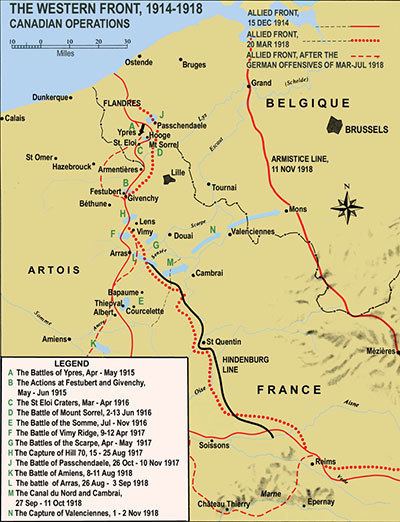
2nd Battle of Ypres
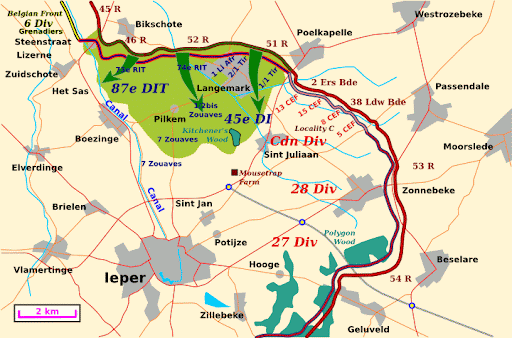
In the spring of 1915 the early dynamic advances of the German army were a distant memory faded behind the great defeat at the First Battle of the Marne. Through the winter both sides had dug in; and many German troops were redeployed to the Russian front. German chemists Walther Nernst and Fritz Haber brought forward the idea of using heavier-than-air Chlorine gas, carried on the wind, to overcome the mathematical impossibility of conventional attack. On April 22, 1915, Albrecht of Württemberg led 7 German divisions to attack 8 Allied divisions, including the 1st Canadian Division under the command of Sir Edwin Alfred Hervey Alderson. The attack began with the release of 168 tons of chlorine gas at about 1700h along a 4 mile stretch of the front around Langemark.
[…]
Vimy Ridge
For a year and a half after Ypres, Currie & the Canadian Corps continued to fight desperate engagements along the Western front with no clear strategic conclusion. After heavy losses and a lot of hard-learned lessons at the Somme from Sept 1915-Sept 1916, the Canadian Corps and Currie with them had become both hardened by bitter experience, and desperate to find better ways to prosecute the war. In September 1915 he was recorded to have said “I did not care what happened to me, but to my men, to their wives, their mothers, their children and to Canada I owed a duty which I wanted to fulfill to the very best of my ability”. Later that year as the division struggled with desertion, he ordered the execution of a deserter despite a three hour plea for clemency by the divisional cleric. The decision restored discipline, but haunted Currie’s dreams long afterwards.
In May 1916 Julian Byng took command of the Canadian Corps, replacing Sir Edwin Alderson. In the fall of that year, after heavy losses in a series of engagements at the Somme, Byng was given the opportunity to reorganize and refit the Canadian Corps; he looked to Currie as a key partner in the effort. They replaced the ineffective Ross Rifle with the Lee Enfield, reorganized the platoon structure to include heavy weapons within each platoon [machine guns, mortars, etc.], and implemented new training and tactics like rehearsals for advances, and the “creeping barrage”, carefully coordinated intended to keep artillery shells landing slightly ahead of advancing men.
[…]
Hill 70
After Vimy, Julian Byng was promoted. Currie was promoted in turn to lead the Canadian Corps. He would lead the Corps that he and Byng had made into one of the most effective fighting forces on any side of the conflict and lead it to bloody victory again and again. There is perhaps no better example of the mastery of the Canadian Corps, from top to bottom, than the battle of Hill 70. “Hill 70 was as close to a perfect battle as was ever fought on the Western Front” wrote historian Tim Cook.
[…]
The Hundred Days Offensive & the Pursuit to Mons
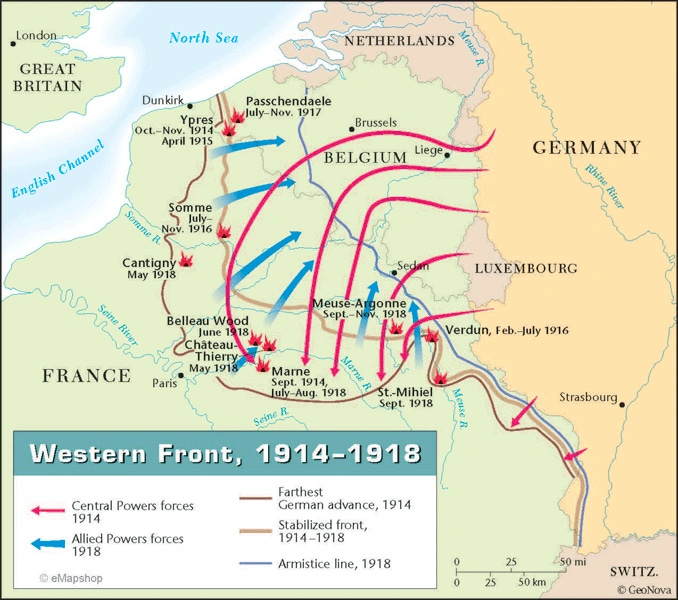
As the winter of 1917-18 passed, a new set of highly political decisions concerning whether and how to reorganize the Canadian Corps for the next round of fighting were taken. As noted in part one, Currie opted to split up the newly formed 5th division to reinforce the four divisions of the Canadian Corps and triple the size of the field engineering element. The decision optimized the Canadian Corps as an attacking force; and when they returned to the front that’s exactly how they would be used. Between August 8th and November 11th, 1918, the Canadian Corps fought nine major battles advancing 86 miles, and suffering 45,835 casualties [The force that began the offensive was ~100,000]. By comparison, the substantially larger American Expeditionary Force, over this same period, advanced only 34 miles while capturing only half the number of prisoners, suffering roughly twice the casualties per German division defeated.
November 9, 2025
Sir Arthur Currie, commander of the famous Canadian Corps in WW1
As a counterpoint to the OTT summary of Sir Arthur posted last week, here’s The Black Horse with part one of a two-part look at the man’s early career before joining the Canadian Expeditionary Force in Europe:
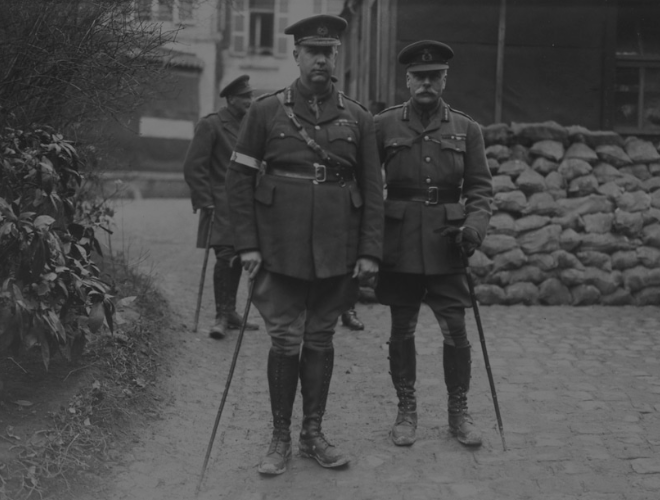
Sir Arthur Currie with Field Marshal Sir Douglas Haig, February 1918.
Libraries and Archives Canada item ID number 3404878.
The Red Ensign is a publication deeply interested in leadership; the good, the bad, and the ugly. For this reason, this Remembrance Day, I have chosen to draw the audience’s attention to the life and times of Sir Arthur Currie, the first Canadian commander of the Canadian Corps during the Great War. This presents an opportunity to both on honour and reflect upon the courage and sacrifice of the men who have fought under the flag of this great nation, but also offers the language to articulate the task facing any who would attempt to lead Canada today. As Currie’s war was defined by the challenge [of] leadership of Canadians in the context of the shifting priorities of the late British Empire, any who would seek to lead Canadians today face will struggle to harmonize efforts on behalf of the Canadian people and the priorities and policies of the American power block which he cannot eschew.
Dulce et decorum est pro patria mori; but when your country is an Imperial Dominion, who and what is “pro patria“, and how can one spend their life for them?
The Man Before the Great Man:
Arthur Currie was born in 1875 in Napperton, Ontario [50 km West of London], the third of eight children living on a homestead belonging to his grandfather. Raised with a the vigorous discipline of a Methodist home, Currie would remain a convicted Christian for his entire life, though he converted to Anglicanism as an adult. Currie was a good student, intending to pursue a career in law or medicine but dropped out of school twice, first temporarily because of the financial constraints brought on by the death of his father, and then for a second time at 19 because of a quarrel with one of his teachers. After leaving school he went West; after a string of failed efforts to establish himself via entrepreneurship and real-estate speculation he joined the Canadian militia as a gunner in 1897 in Victoria B.C. at the age of 23. A giant man (6’3″ at a time when the average Canadian height was 5’7″) with a noted eye for technical detail and, in the words of his son, a “tremendous command of profanity”, he quickly distinguished himself and was promoted to corporal before earning a commission as an officer in 1900. As an officer in peace time Currie was noted for his detailed inspections and his rapid transformation from “one of the boys”, into a rigid disciplinarian. This duality, an officer raised from the ranks, who could both embody the rigid tradition of the British military and who had an intimate familiarity with the life and ways of the enlisted men would become a defining feature of his career.
During Currie’s peace-time career as an officer he maintained a second career as a real-estate [agent]. After becoming head of Matson Insurance Firm 1904, he and the firm invested aggressively in the Victoria real-estate market. In 1913 Currie’s financial situation began to rapidly deteriorate as a consequence of price declines in the real-estate market. Currie’s financial problems nearly led him to refuse to stand up the 50th Regiment Gordon Highlanders of Canada in 1913. In July 1914 Curry used $10,833.34 of regimental funds intended for the purchase of uniforms and kit to pay his personal debts, and found himself facing forcible retirement just as the Canadian Army was being mobilized for war. At the intervention of one of his subordinates, Major Garnet Hughes, he instead accepted promotion as brigadier-general of the 2nd Brigade of the 1st Canadian Division, and ignored correspondence from the new commander of the 50th regiment, Major Cecil Roberts, about the missing funds until he was overseas.
Currie arrived at camp Valcartier on September 1st, 1914 to find himself charged with 10x as many men as he had ever led before, no staff, a shared tent as a command center, and the duty to prepare these men for one of the most difficult theatres of war the world has ever seen. The six months between taking command and the arrival of his brigade in the trenches near Ypres were marked by two mud besotted poorly supplied training camps, shoddy kit, rampant disease, and the company of a certain bear that was to become beloved by children around the world. Through this period Currie was well liked by the men, but known as a disciplinarian with an eye for technical detail. In March 1915 the brigade was deployed to what was expected to be a quiet part of the front with the intent of allowing the men to gain some experience with trench warfare before they were relied upon for action. Nobody anticipated what would happen next.


