
World War Two
Published 10 Oct 2026The StuG III was built to support infantry. It became one of Germany’s most important tank killers. How did the Sturmgeschütz III go from mobile artillery to a mainstay of German armored warfare?
Built on the Panzer III chassis, the StuG traded a revolving turret for a low silhouette, strong frontal protection, and a fixed gun. Originally designed to destroy machine-gun nests and fortifications, it gained a long-barreled 75 mm gun as Germany confronted the T-34 and other Soviet tanks.
In “One Artillery Piece for the Road”, Spartacus Olsson follows the StuG III from Manstein’s assault-artillery concept through its development, production, and combat service. We examine its strengths, mechanical limitations, and the struggle between the artillery and Panzer branches over its expanding role.
Germany’s most numerous fully tracked armored fighting vehicle also exposes a larger contradiction: Nazi Germany could build practical, economical weapons, yet repeatedly burdened its war effort with costly complexity. What made the StuG different, and why could its battlefield successes never solve Germany’s strategic problems?
October 11, 2026
One Artillery Piece for the Road! – StuG III – Nazi Rearmament 09
October 9, 2026
Conrad Black on Tucker Carlson
On his (new-ish) Substack, Conrad Black discusses Tucker Carlson’s media career before he unceremoniously left Fox News and what he has been doing since then:

Tucker Carlson talking to Mike Pence, July 2023.
This became a dangerous cycle because the more Tucker forayed into the fringe, the harder he struck a vein of malformed but popular sentiment. Meanwhile, censorship of his relatively tame views only handed him a bigger megaphone and more incentive to go further. His sensible opposition to the Iraq and Afghanistan disasters, and his wariness of another quagmire emerging in Ukraine, curdled into progressively more unhinged forms of isolationism. His legitimate concerns about demographic trends and failed immigration policy curdled into belief in a coordinated conspiracy to erase white people from Europe and North America. Reasonable criticism of Israel and the American role in the Middle East curdled into the quasi-antisemitic trope of AIPAC as the hidden hand controlling U.S. foreign policy. His well-earned distrust of government curdled into various conspiracies involving some mix of extra-terrestrials, the CIA, and the Jews.
The pattern has become so predictable that if there was an effort to block him from praising Brussels sprouts as his favourite vegetable, at least three of his next five interview guests would spend two hours apiece insisting the maligned little cabbage is the victim of a coordinated smear campaign bankrolled by Big Salad. The attempted prohibition becomes the proof.
As a free-speech and free-market advocate, I think Tucker is entitled to say what he wants, and I congratulate him on his commercial success, even while finding many of his views idiotic. What troubles me is not so much the outlandish claims, but the skill atrophy — the phenomenon whereby any skill sharpened by adversarial pressure dulls without resistance. In boxing, the term “ring rust” is sometimes used to describe the way a boxer who stops facing strong opponents loses their timing, power, and urgency, until nothing’s left but a shell of their former selves. Looking back over his podcast guest list, with the exception of this Rees-Mogg segment, Ted Cruz last year, and perhaps a handful of others, it has been a long procession of hundreds of people brought on to confirm his own worldview back to him, in their own words. And the ring rust has set in.
I first noticed it at an event in Edmonton in January 2024, where I sat on a panel with Tucker and Jordan Peterson. I found myself in the awkward position of feeling the need to defend then-Finance Minister Chrystia Freeland in front of a packed arena of anti-Liberal partisans (with whom I would have considered myself somewhat of a kindred spirit). I was booed by parts of the audience for pointing out the fact that while Freeland, whom I know slightly and like personally, was politically hopeless, she was not, as Tucker had claimed, a fascist. The typically leftist habit of reducing every political opponent to a Hitler or Mussolini analog is lazy and obnoxious — not adjectives I would have used to describe the old Tucker. His justification was that he had recently seen a video of reporter David Menzies being detained by the RCMP after a collision with an officer while trying to get his microphone close enough to pick up Freeland’s response (or lack thereof). It was an outrageous overreaction by the officer, but there was no suggestion that Freeland had ordered the arrest. Ironically, Menzies’ question that Freeland was trying to dodge had been about why the Liberal government had gone soft on Iran’s terrorist regime — a question one might well put to Tucker.
The signs of atrophy continued to show up and in ways that, as a former admirer of Tucker’s, became progressively more alarming. At the memorial following the tragic murder of Charlie Kirk, Tucker gave an odd speech in which he claimed that the assassination was reminiscent of his “favourite story”, in which Jesus Christ was killed for telling the truth by a group of shadowy figures “in a lamp-lit room” in Jerusalem, “sitting around eating hummus”. When asked about it a few days later, Tucker employed a variation of the Jon Stewart technique of backing away from his own words to avoid serious scrutiny. With his characteristic forced laugh, he denied any implication that he had echoed the nascent conspiracy theory that Israel had murdered Charlie Kirk. His defense: hummus is a traditional Arab (rather than Jewish) food.
The evident decline grew even more pronounced in his May 2026 New York Times sit-down, when Lulu Garcia-Navarro asked why he had suggested that Donald Trump might be the Antichrist. Tucker insisted he had never said that, wasn’t even sure what the Antichrist was and insisted “those words never left my lips” — then, after he was shown a clip from his own show of the words leaving his lips, he apologized that his remarks from the clip implied “a precision I haven’t arrived at”. In other words, the jury is still out about whether Trump is the Antichrist, and he regretted jumping the gun on the verdict.
Which brings us to the latest instalment. After roughly 200 interviews, each amounting to hours-long sessions of Tucker and his guests regurgitating the same pablum into each other’s mouths, the transformation into a shell of his former self appears to be complete. In this conversation, moments after declaring that killing the innocent is “never justified under any circumstances”, he pivoted almost in the same breath into a full-throated defence of Hitler — history’s single greatest killer of innocents. He argued the invasion of Poland was understandable given that 15% of the country had been German before the Treaty of Versailles. While absurd, at least it is consistent with his position on Russia’s invasion of Ukraine. But even if, for argument’s sake, that justified Poland, Hitler didn’t stop there. What justified the invasions of Belgium and France? After all, France was faithfully adhering to the Tuckerite foreign policy of reluctant rearmament, appeasement, and assuming an entirely defensive posture (behind the Maginot Line). Stretching the flimsy logic further one could argue (feebly) that France had it coming too, since 6% of France (Alsace-Lorraine) was also German before Versailles. But there’s still no justification for the invasions of Denmark, Norway, the Netherlands, Yugoslavia, Greece, or the Soviet Union — with whom Hitler had a signed non-aggression pact. None of those countries were ever German, let alone Libya, Tunisia, and Egypt.
What’s clear is that Hitler used his early invasions to test whether anyone would stop him — and the feedback he got was a green light for more. History keeps teaching the same lesson: appeasement is just expansionism outsourced to your enemies.
Small wonder Tucker hasn’t learned this lesson from history, given that he called Darryl Cooper — a man with zero historical credentials — “the best and most honest popular historian in the United States.” Cooper spent two hours on Tucker’s show in September 2024, arguing Churchill, not Hitler, was the “chief villain” of the war, and that the deaths of millions in Nazi camps owed more to German logistical incompetence than deliberate extermination.
October 5, 2026
QotD: Socialism and the world wars
What gave socialism a shot was that the hypertrophic nationalism of the first half of the twentieth century plunged the world into not just one but two world wars. Without these catastrophes, it is inconceivable that so many devotees of Marx would have come to power in the seventy years after 1917. The world wars made the case for socialism in multiple ways. First, they seemed to confirm the destructive tendencies of “imperialism, the highest form of capitalism”, in Vladimir Lenin’s words. Second, they greatly expanded the role of the state, which became the principal purchaser of goods and services in most combatant countries, creating precisely the kind of state-controlled economy that socialist theory claimed would perform better than free markets. Third, the wars acted as a great leveler, imposing very high marginal rates of taxation, wage controls, and price controls in ways that tended to reduce wealth and income disparities. Fourth, in 1917 the German government financed the Bolshevik coup in Russia that brought Lenin to power.
The tragedy was that those who promised utopia generally delivered hell on earth. According to the estimates in the Black Book of Communism, the “grand total of victims of Communism was between 85 and 100 million” for the twentieth century as a whole. The lowest estimate for the total number of Soviet citizens who lost their lives as a direct result of Stalin’s policies was more than 20 million, a quarter of them in the years after World War II. Mao alone, as Frank Dikötter has shown, accounted for tens of millions: two million between 1949 and 1951, another three million by the end of the 1950s, a staggering 45 million in the man-made famine known as the Great Leap Forward, yet more in the mayhem of the Cultural Revolution. Even the less bloodthirsty regimes of Eastern Europe killed and imprisoned their citizens on a shocking scale. In the Soviet Union, 2.75 million people were in the Gulag at Stalin’s death. The numbers were greatly reduced thereafter, but until the very end of the Soviet system its inhabitants lived in the knowledge that there was nothing but their own guile to protect them from an arbitrary and corrupt state. Other communist regimes around the world, including the very durable dictatorships in North Korea and Cuba, were strikingly similar in the miseries they inflicted on their own citizens.
The various socialist regimes could not even justify their murderous behavior by providing those they spared with higher living standards than their counterparts living under capitalism. On the contrary, they were economically disastrous. The collectivization of agriculture invariably reduced farming productivity. A substantial proportion of the victims of communism lost their lives because of the famines that resulted from collectivization in the Soviet Union and China. North Korea had a similarly disastrous experience. Central planning was a miserable failure for reasons long ago identified by Ludwig von Mises, Friedrich Hayek, and Janos Kornai, amongst others. Indeed, the economic performance of strictly socialist countries got worse over time because of rigidities and perverse incentives institutionalized by planning.
Moreover, the evidence is clear that, as countries moved away from socialist policies of state ownership and toward a greater reliance on market forces, they did better economically. The most striking example — but one of many — is that of China, which achieved a true great leap forward in economic output after beginning to dismantle restrictions on private initiative in 1978. After the collapse of “real existing socialism” in Central and Eastern Europe in 1989 and the dissolution of the Soviet Union in 1991, there was widespread recognition (the “Washington consensus”) that all countries would benefit from reducing state ownership of the economy through privatization and from lowering marginal tax rates. […] the highest marginal personal income tax rate was reduced in nearly all Organisation for Economic Co-operation and Development (OECD) countries between the mid-1970s and mid-2000s.
Niall Ferguson, “Capitalism, Socialism and Nationalism: Lessons from History”, 2020-02.
October 4, 2026
From MG 34 to MG 42: Building Hitler’s Buzzsaw – Nazi Rearmament 08
World War Two
Published 3 Oct 2026The MG 34 pioneered the modern general-purpose machine gun. The MG 42 preserved that battlefield versatility while cutting manufacturing labor roughly in half and producing the terrifying sound remembered as “Hitler’s Buzzsaw”.
In this Nazi Rearmament episode, Spartacus traces the development of the MG 34 and MG 42 from clandestine German weapons programs during the 1930s through mass production and combat in World War II.
We examine how one basic weapon could accompany an infantry squad, deliver sustained long-range fire, engage low-flying aircraft, and serve inside tanks and fortifications. We also explore why the beautifully machined MG 34 became an industrial problem, and how stamped steel, roller locking, rapid barrel changes, and a cyclic rate reaching 1,500 rounds per minute transformed its successor.
But this is more than the story of two famous German machine guns. It is also a study of Nazi Germany’s war economy: technically ambitious and capable of remarkable innovation, yet ultimately unable to overcome the manpower and industrial resources of the coalition it chose to fight.
Finally, we follow the weapons beyond 1945, from the continued foreign service of the MG 34 to the MG 42’s postwar descendants, the MG 1, MG 2, and MG 3.
Which small arm should we cover next: the MP 40, FG 42, or StG 44?
October 3, 2026
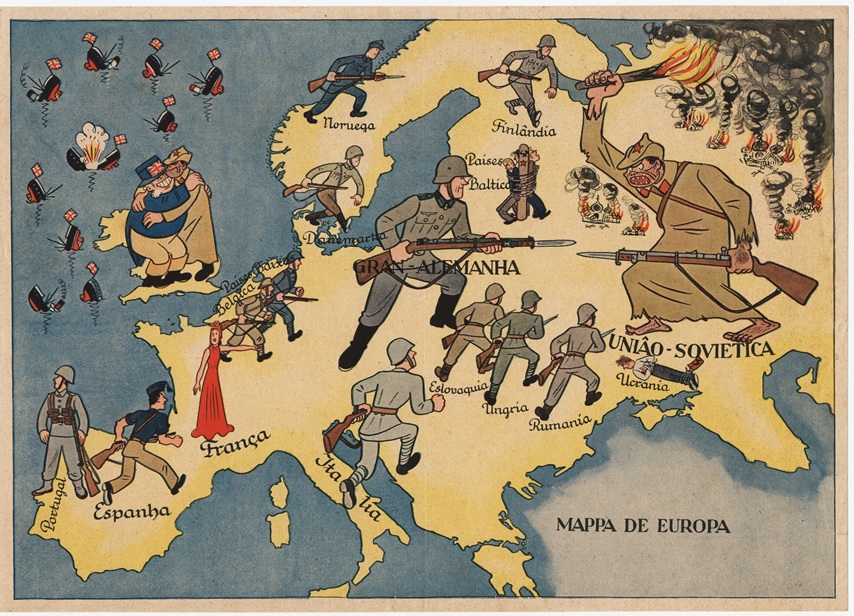
Portuguese propaganda maps
I swear this isn’t a deliberate ploy to attract Sarah Hoyt’s attention … although her links from Instapundit are always a welcome boost to daily readership. This is a post from Merryn Walters’ Mapping History Substack trying to determine the origins and intent of a map created for Portuguese use in WW2:
Maps are a weapon – a powerful weapon – because maps look, simply, like facts. A map says, “this is how things are”, and a mapmaker can change the world … so it’s no surprise, mapping had its run as a propaganda tool during the Second World War.
Our main map in this article, for example, begs the question: is it a propaganda map of Portugal or a Portuguese propaganda map? The two are very different, and between 1939 and 1945 the difference mattered. A Portuguese propaganda map was one made by Portugal, for Portuguese purposes. A propaganda map of Portugal – or, more often, one dressed up in Portuguese – was made by someone else entirely, and slipped under Lisbon’s door. Portugal was neutral, you see, which made it one of the few places left in Europe where both sides could still advertise their intentions: British and German propagandists worked the same streets targeting the same people, each assuring the Portuguese that the other lot were dastardly fellows.
A map was ideal for this. There’s a snag though, in this propaganda metier, and it’s worth keeping at the back of our minds as we admire the pretty pictures; no matter how good the mapmaking, the actual map can only inform and persuade a person who’s able to read it.
THIS IS NOT A SMALL COUNTRY
Portugal não é um país pequeno
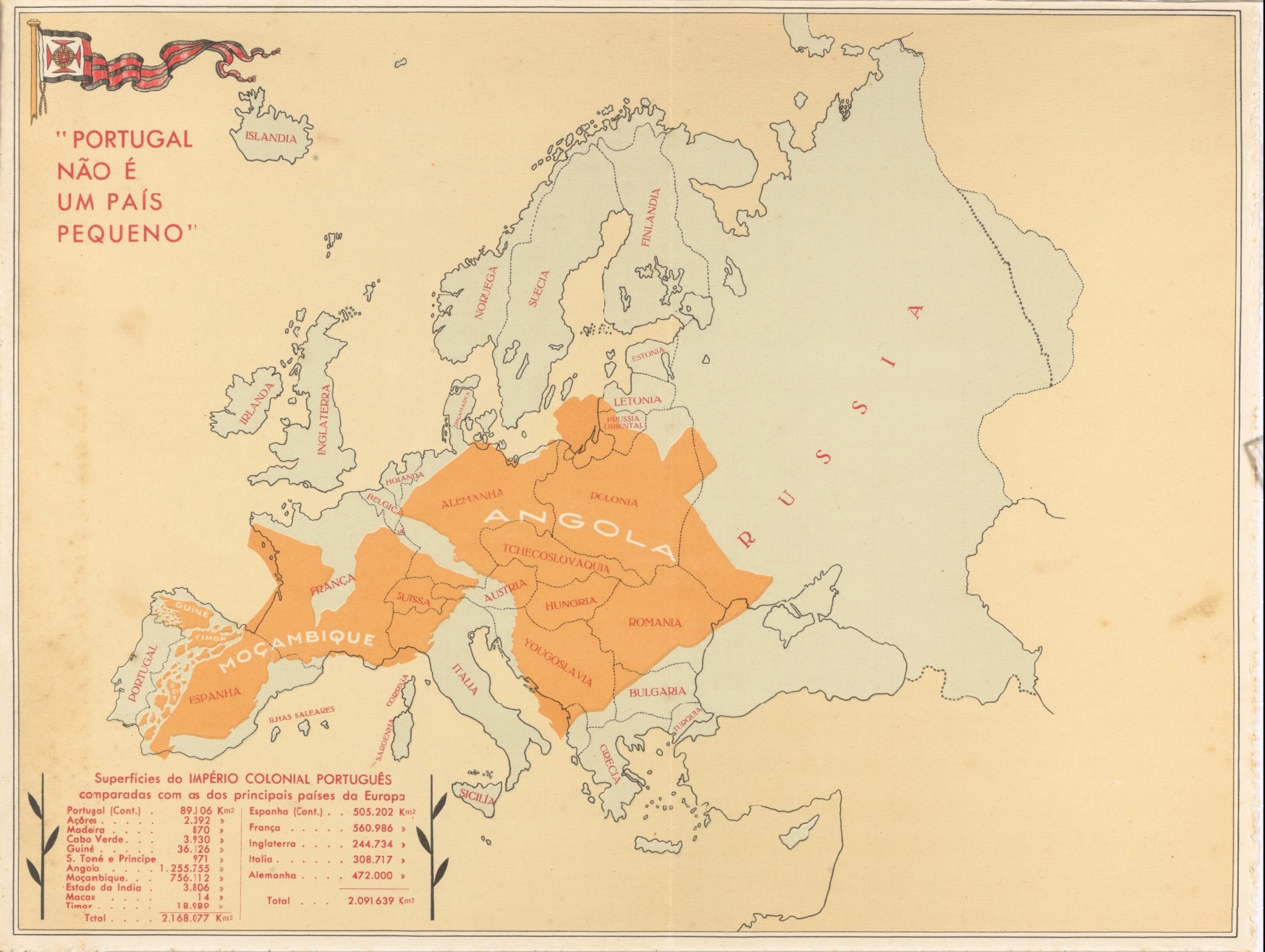
Let’s start with the real thing. Portugal não é um país pequeno – “Portugal is not a small country” – was produced in 1934 by Henrique Galvão, an army officer and colonial administrator, for the First Portuguese Colonial Exhibition in Porto; an exhibition he also happened to be directing, which does rather simplify the commissioning process somewhat. The map was printed by Litografia Nacional, of Porto, and uses a simple trick that’s mirrored today by online whizzymajigs. thetruesize.com is one such.
Take Angola, Mozambique and the rest of the empire; colour them brightly; and lay them down, right across Europe, as if you’re floofing a blanket. Add a table of figures proving that Portugal and its colonies, together, outsize Spain, France, England, Italy and Germany combined. Small country? Certainly not, mon ami. Just badly folded.
This map worked so well, Salazar’s regime reprinted it for decades: postcards in Portuguese for home consumption; French and English versions for visitors; and — by 1951 — an edition from the Secretariado da Propaganda Nacional laid the whole lot over the United States instead – for the benefit of American tourists, who presumably needed a unit of measurement they could relate to. People ask where Brazil has gone. Independent since 1822, I’m afraid – a century too late to help with the arithmetic.
Galvão himself deserves more than a footnote. Post-war, in 1947, he reported on forced labour in those same colonies, concluding only the dead were truly exempt; he fell out with Salazar, was arrested in 1952, escaped – and in 1961 hijacked a liner, the Santa Maria, to make his point. Not many mapmakers manage a second act like that.
October 2, 2026
Britain’s best general in World War II
If you’ve been following for a while, you’ll know that I’m a big fan of Field Marshal Bill Slim, the best but also least well known British general of the Second World War. His achievements in Burma and India are overshadowed in popular memory by the struggle against the Nazis in Europe and the vast Pacific campaigns against the Japanese by primarily American forces. In recent years, there’s been a bit more attention paid to the XIV Army’s long and bitter fight, but there’s always more to discover about that incredible struggle:
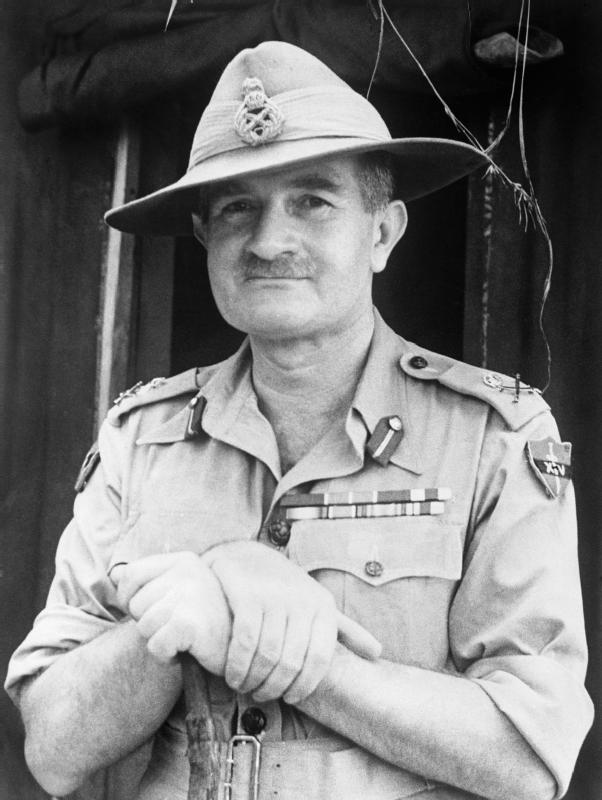
Field Marshal Sir William Slim (1891-1970), during his time as GOC XIVth Army.
Portrait by No. 9 Army Film & Photographic Unit via Wikimedia Commons.
But I see him clear, with that robber-baron face under the Gurkha hat … looking like a rather scruffy private with a general’s tab — which of course is what he was.
– one of General Slim’s soldiers remembers
A search on Amazon using the term “military memoir” yields more than forty thousand results. With so many choices, why read Field Marshal William Slim’s World War II memoir entitled Defeat into Victory? Interestingly enough, there are two answers. The short answer was revealed in 2011 when the National Army Museum in London held a debate and a public poll to answer the question — Who is Britain’s greatest general? Great Britain, of course, has a long and distinguished military history with a great many famous military commanders who could all vie for this honor. In what turned out to be a surprise to many, Field Marshal Slim tied with the Duke of Wellington as the winner. So, if you are considering whether to read Slim’s memoir, ask yourself — how much do you know about someone who might be one of the greatest generals in history?
Before continuing this essay with a longer, more structured answer about the value of Slim’s memoir, a few words about William Slim himself. He began his military career as a temporary lieutenant at the beginning of World War I, without the benefit of a university education or Sandhurst training. By the end of World War I, he had achieved a sterling military record — wounded twice, awarded the Military Cross and temporarily promoted to major. He spent the inter-war years assigned to the Indian Army and was notably associated with the 6th and 7th Gurkha Rifles. At the beginning of World War II, he was given brigade command in East Africa and then command of the 10th Indian Division in the Middle East. His memoir begins in early 1942 when Slim is suddenly and unexpectedly told to leave his command and report immediately to Army Headquarters in India. The summons was so abrupt that Slim thought he was being relieved of command. He didn’t know it at the time but he was about to spend the rest of the war in India and Burma.
A distinct three-act narrative arc forms the structure of his book. In Act I (1942), Slim takes command of Burma Corps. This was an ad hoc two-division force that was in the middle of conducting a fighting retreat while being overwhelmed by the surging Japanese Army. Slim and his men end up suffering through a one hundred day, nine-hundred-mile retreat back to India in what historians have called the longest retreat ever conducted by a British army. By May 1942, the remnants of his Corps finally reached safe haven in India.
In Act II (1943), Slim regroups, retrains and resupplies his forces in preparation for his reconquest of Burma. This was not as straightforward a task as it sounds. Slim now commands the Fourteenth Army which, at its height, consisted of nearly one million soldiers and was one of the largest armies in the world. But the size of the Fourteenth Army was not as striking as the diversity of its composition. Slim had to make a disciplined, cohesive and effective fighting force using regiments from England, Scotland, South Africa, Nigeria, Kenya and a vast array of Indian units including Sikhs, Rajputs, Pathans and Gurkhas from Nepal. Later in the war, Slim described a routine tactical operation: “The Japanese had for some time been harassing 28 East African Brigade Group … and a Punjabi battalion had been sent in to stiffen it”. The Japanese counterattacked “and a British battalion was hurriedly transferred from the east bank and joined them”. One routine tactical operation — involving allied soldiers from three continents.
In Act III, (1944-45), Slim and his army return to Burma and achieve triumph after triumph. The first triumph is the battle of Imphal (March-July 1944). The famed novelist George MacDonald Fraser was a young Scottish soldier in Slim’s Fourteenth Army and he later wrote; “I imagine that every teenager today has heard of Stalingrad and Alamein and D-Day but I wonder how many know the name of Imphal … where Japan suffered the greatest catastrophe in its military history”. The subsequent battle of Meiktila (February- March 1945) was equally significant and has been characterized by British military historian Corelli Barnett as, “the cleverest, boldest and most brilliant single British victory in World War II”. By mid-1945, Slim’s victorious Fourteenth Army had retaken Rangoon and destroyed the Japanese army in Burma.
There are three dimensions to Slim’s memoir that make it so memorable. It is a tale well-written, it is a tale of wonder and it is a tale filled with wisdom.
September 30, 2026
What’s the Point of Armoured Cars?
The Tank Museum
Published 29 May 2026Even though we call ourselves The Tank Museum, at heart we are the museum of the Royal Armoured Corps. That means we don’t just have tanks — we have a wide range of armoured fighting vehicles that tell the story of the Corps. Within that collection sits the armoured car.
On the surface it can seem redundant: tanks are better armoured, have superior cross-country mobility and usually carry bigger guns. So why do armoured cars — a concept that predates the tank — remain in service today? After all, a Ferret doesn’t sound nearly as intimidating when up against the likes of the Chieftain.
00:00 | Introduction
01:25 | Starting Small
02:49 | Speed Demons
09:40 | Going Global
13:13 | Only the Enemy in Front
19:28 | Go Big or Go Home
(more…)
September 27, 2026
The 88 – Foe of Tanks and Planes Alike – Nazi Rearmament 07
World War Two
Published 26 Sep 2026The German 8.8-centimeter Flak began as a heavy anti-aircraft gun, but war repeatedly dragged it into new roles. It shot at bombers, destroyed tanks, smashed bunkers, supported infantry, and eventually defended the collapsing Reich from Allied armies advancing into Germany.
Its origins, however, predated the Nazis. Developed through clandestine cooperation between Krupp and the Swedish firm Bofors, the Flak 18 emerged from Weimar Germany’s efforts to evade the military restrictions imposed after the First World War. The Nazis inherited that expertise, expanded production enormously, and turned the “Eighty-Eight” into one of the most famous weapons of the Second World War.
From Spain and France to North Africa, the Eastern Front, and the air defense of German cities, the 88 earned a formidable reputation. But how much of that reputation was deserved? Was it really an unparalleled anti-tank weapon, or has later mythology exaggerated its contribution?
In this German rearmament special, we examine the development, production, deployment, capabilities, limitations, and strategic effect of the Flak 18, Flak 36, Flak 37, and the substantially redesigned Flak 41. This is the history behind the legend: an impressive piece of engineering employed in support of Nazi Germany’s war of conquest and genocide.
September 21, 2026
Price controls work … but not the way they’re intended to
Politicians love to intervene in markets, trying to impose their preferred solution to “problems” like high prices. But markets don’t work the way politicians think they do:
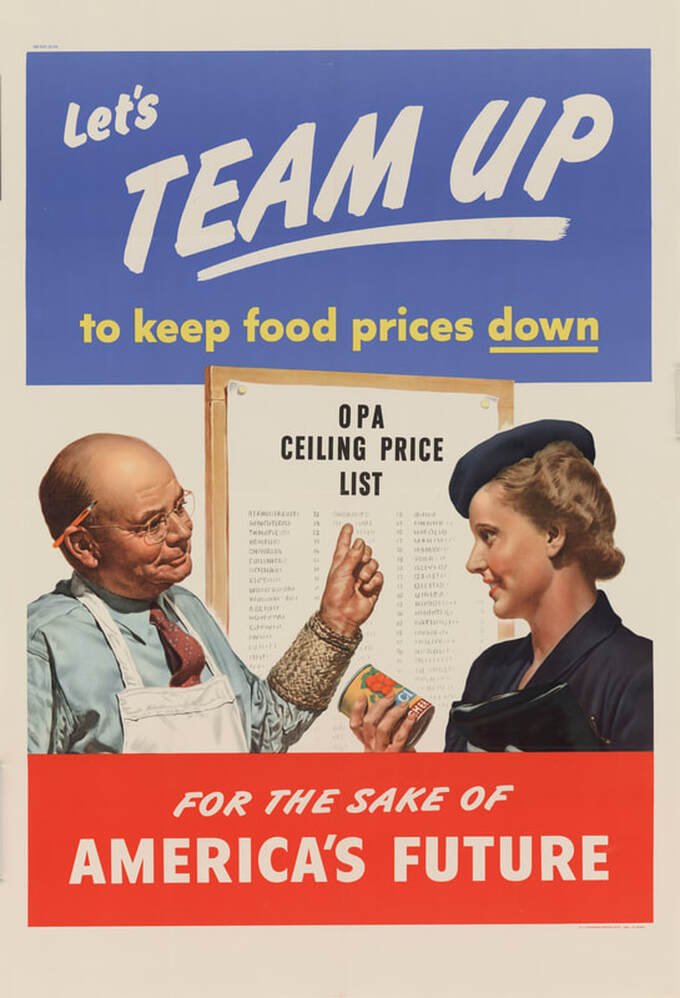
Price ceilings don’t manage markets, they destroy them. In 1946 the US meat market collapsed because of it.
The Office of Price Administration set beef ceiling prices during World War II. Ranchers and meatpackers adapted: some held cattle rather than sell at a loss, others shifted product to black markets, and slaughter volumes dropped. The OPA briefly lifted controls in mid-1946 under pressure. Beef flooded back into stores almost immediately.
Then Congress, drowning in constituent complaints about inflation, reimposed ceilings in August 1946. Slaughter collapsed within weeks. By October 1946, beef virtually disappeared from American grocery store shelves. You could walk into a butcher shop in Chicago or New York and find nothing. Scarcity was manufactured entirely by Washington bureaucrats setting prices below what producers needed to cover costs.
Mises explained the mechanism precisely: a price ceiling creates a shortage, which produces political pressure for rationing and further controls, spiraling into comprehensive economic disorganization. The OPA ran that experiment in real time on the American food supply.
President Truman ended meat controls on November 9, 1946. Beef returned within days. The supply existed the entire time. Ranchers and packers simply refused to sell at confiscatory prices, and they were correct to refuse. Coercive price suppression causes economic destruction, and 1946 proved it at the grocery counter.
Custom-Order Walthers: Model HP and P38 in 7.65mm Parabellum
Forgotten Weapons
Published 8 May 2026When Walther first developed the P38, it was designated the Heerespistole — “Army Pistol”. Only after getting official Wehrmacht adoption did it get the designation P38. Walther offered models with both designations for commercial sale, albeit not to just anyone. Army officers, Party members, and other high-placed individuals could get pistols from Walther outside military orders. About 20,000 such guns were made during the war, and a tiny subset of them — just 225 — were made specifically in 7.65mm Parabellum instead of 9mm Parabellum. Today we are looking at two examples of those.
(more…)
September 20, 2026
September 18, 2026
“The destruction of the European Civil War traumatized us”
On Substack Notes, John Carter points out the vast chasm between the capabilities of western nations and their timid aspirations for the future:
LeMO Erster Weltkrieg – Kriegsverlauf – Frühjahrsoffensive 1918
Photo from dhm.deWestern civilization is terrified of itself. The destructive power of our militaries is unparalleled in history. We can devastate continents in minutes. We can annihilate entire populations. We can reduce cities to rubble.
But we don’t.
The same is true of our industrial capability. We can erase mountains, redirect rivers, carve tunnels deep into bedrock, reshape entire landscapes as we please.
But we don’t.
The destruction of the European Civil War traumatized us. Meanwhile, the unintended consequences of unrestricted development — air pollution, water pollution, soil erosion, habitat destruction, even the sheer rampant ugliness of so much of postwar industry — has left us leery of just doing things.
In the postwar era we began binding ourselves ever more tightly with laws. International law to restrict the use of military force; environmental laws, labour laws, indigenous rights laws, and so on to govern the use of our industrial capacity. We did this for good reason. No one wants nuclear war, or even a repeat of World War Two. No one wants another Three Mile Island, another Chernobyl. With great power comes great responsibility, and no civilization has ever been more powerful.
But the result has been to paralyze us.
Our militaries watch helplessly as supplicants invade us with begging bowls held up as their battle standards, prohibited from shooting the unarmed boats by governments bound by international treaties to respect the human rights of anyone who claims to be seeking asylum. Meanwhile we find that it is almost impossible to build anything. High-speed rail, bridges, highways, housing — all of it is slowed to an imperceptible crawl by a regulatory overburden designed to do precisely that. Gulliver held down by Lilliputian strings of his own design, his flesh swarming with hungry ants.
The emerging political coalition of the right is largely comprised of those factions who have grown impatient with this artificial paralysis of the will. Why shouldn’t we use our military to assert ourselves abroad, and defend our borders at home? Why shouldn’t we turn loose the incredible power of modern, heavily automated, high-tech industry to build wonders on a scale never before known? Why shouldn’t we conquer space? Why shouldn’t we use biomedical science to make ourselves beautiful, brilliant, healthy and fit? Why shouldn’t we allow ourselves to be powerful? Why shouldn’t we allow ourselves to be strong? We shouldn’t we reach for greatness?
The opposition consists of all those factions who are horrified by this, terrified of the strength of Western civilization, intent on slowing it, stopping its engine, dismantling the machine, and salting the biocultural soil from which it grew. Third worldists, climatists, AI safetyists, pacifists, open-borders activists, misinformation censors, DEI ideologues, international human rights NGOs, all of these cooperate to throw sand in the gears, to sabotage the West, to subordinate it and ultimately to destroy it.
September 16, 2026
WWII British Tank Tech Tree
The Tank Museum
Published 8 May 2026In 1939, the Vickers Light Mark VI formed the backbone of the British tank force. It’s hard to believe that in six years technology evolved from this to the mighty Centurion.
But this journey was no walk in the park. It took blood, sweat, lots of tea and various wrong turns. So, in this video we’re going to walk you through the entire British tank family tree to reveal this process.
This is a family tree organised by type not by chronology. That means Light Tanks, Cruiser tanks, Infantry tanks and Assault tanks.
So, without further ado, this is every British tank of World War II.
00:00 | Intro
01:14 | Light Tanks
03:21 | Cruiser Tanks
12:37 | Infantry Tanks
16:08 | Assault TanksThis video features archive footage courtesy of British Pathé.
In this film, join Paul Famojuro for the ultimate deep dive into British tanks of WWII. Over six years Britain’s tanks evolved in a number of curious directions. From the light tanks of the early war to the troubled development of the cruiser tanks concept, the slow-moving infantry tank to the hard-hitting assault tanks, each branch of this tech tree was designed to solve specific problems on the battlefield. There were some successes, just as many failures, and a whole lot of weird and wonderful tanks along the way.
Want to learn more about the British tanks of WWII? Here are some of the sources we used to make this film:
British Tanks and Fighting Vehicles 1914-1945, B.T. White. 1970
British Cruiser Tank A13 Mk I & Mk II, Peter Brown. 2015
British Infantry Tank Mk III Valentine, Parts 1 & 2 Dick Taylor. 2010
The Great Tank Scandal, David Fletcher. 2021
The Universal Tank, David Fletcher. 2021
Centurion Owner’s Workshop Manual, Simon Dunstan. 2017
The Tank Museum Guide to Matilda, Dick Taylor. 2024
The Tank Museum Guide to Comet, Dick Taylor. 2025
A13 Cruiser Mk. V Covenanter Tank. A Technical History, P.M. Knight. 2018
A38, Infantry Tank, Valiant, https://tanks-encyclopedia.com/ww2/gb…#tankmuseum #veday
September 13, 2026
September 7, 2026
The Backbone of the Nazi Panzer War – Panzer III
World War Two
Published 5 Sep 2026The Panzer III was intended to become the backbone of Nazi Germany’s panzer divisions. Emerging from clandestine Weimar-era experimentation and formally developed from 1934, it combined mobility, a five-man crew, a three-man turret, and comprehensive radio communication in one highly effective prewar design.
In this episode, Spartacus follows the Panzerkampfwagen III from secret German-Soviet tank trials at Kama through its production and deployment in Poland, France, North Africa, and Operation Barbarossa. We examine its evolution from the 3.7 cm gun to increasingly powerful 5 cm weapons, the advantages provided by crew specialization and radio-coordinated warfare, and why the Soviet T-34 and KV-1 exposed its diminishing margins in armor and firepower.
By 1943, the Panzer III had been displaced as Germany’s principal gun tank by the more adaptable Panzer IV. Its chassis, however, found an extraordinarily productive second life beneath the Sturmgeschütz III. The Panzer III was not a failed tank. It was an effective prewar design overtaken by an armored arms race it lacked the capacity to survive. Its fate also reflected Nazi Germany’s wider strategic failure: it had built weapons for short campaigns, then unleashed a coalition war whose demands exceeded Germany’s resources.
Watch our episode on the Sd.Kfz. 251: • The Halftrack That Made Blitzkrieg Possibl…
Watch Ten Days in Sedan: • Ten Days in Sedan


