At Dead Carl and You, Kiran Pfitzner reviews The War People: A Social History of Common Soldiers during the Era of the Thirty Years War and finds it has value in bringing to life some of the ordinary people involved in that bloody, interconnected series of wars that we group together as the Thirty Years’ War:
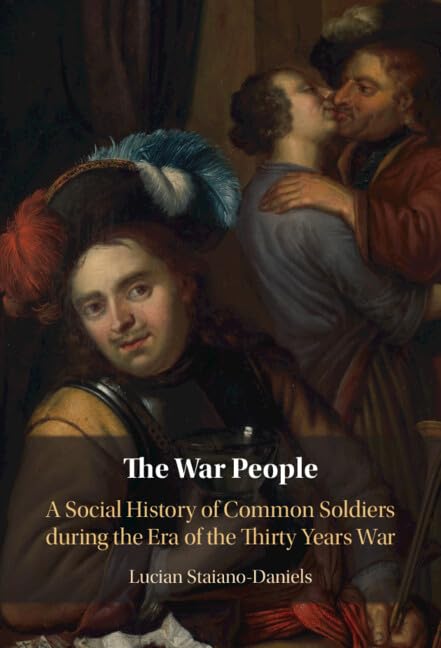
“Their word for themselves was People. Early seventeenth-century common soldiers were Die Leute, Das Volk, les gens, or la gente. They were Das Kriegsvolk, Die Kriegsleute, les gens de guerre, the War People.” So begins Lucian Staiano-Daniels’s aptly titled The War People: A Social History of Common Soldiers during the Era of the Thirty Years War. Using the technique of micro-history, Staiano-Daniels follows the Mansfeld regiment from its raising in 1625 to its unhappy dissolution in 1627. This unexceptional regiment is notable because of the primary source documentation that survives, specifically its original internal legal records — investigations, debts, trials, and last testaments. Through this unusually immediate resource, we gain glimpses of the reality of the 17th century common soldier and so a clearer view of the social conditions he lived within.
One way Staiano-Daniels situates this investigation is in terms of the relationship between military organization and state-building. Describing the existing historiography, he writes: “In this argument, early-modern states increased their control over their civilian populations in part to raise tax money for larger armies that were inhabited by soldiers who were themselves increasingly well-disciplined”. He instead finds, “neither an intensification of military discipline nor unadulterated thuggishness. The military community was made up of systems of relationships that were subtle, intricate, and disorganized.” (7). These findings are well evidenced, and significant, as earlier literature (drawing on more normative sources like manuals and regulations) asserted the intensification of discipline as part of the emergence of the modern state. Instead, we see states forced to engage in the paradoxically complexly and loosely organized world of the mercenary, unable in this time of crisis and state-emergence to fully subordinate the armed forces they employed.
The 17th century and the Thirty Years’ War serve as an important benchmark in understanding the development of war. In witnessing the lives of the kind of men with which wars of the 17th century were fought, we gain a greater understanding of the society that they moved in. In so doing, we can more easily conceptualize the forces that both constrained and enabled war in the 17th century, producing its particular form. This conception provides the opportunity to more easily understand war in other places and times and what conditions reduced or intensified its violence.
Reading this work as a Clausewitz scholar, I could also not help but see a connection between the culture of the war people and Clausewitz’s support for a national militia or Landwehr as a step towards more inclusive governance. There is, of course, a great distance between the unruly mercenaries of the Thirty Years’ War and the “nation in arms” envisioned by Clausewitz and the other Prussian reformers, but at its core we find a common phenomenon: the connection between military service and rights, personal and political.
This book demonstrates well the value of microhistory; in looking closely at the practices and prevalent attitudes of these soldiers of the 17th century, we gain a more concrete view of the prevailing social conditions. This is not just of interest for its own sake (as social history), but because social conditions greatly shape the practice of war, as Clausewitz tells us. This is so because social conditions both reflect and affect the political conditions that create war, as well as the political purpose that exercises a continuous influence upon it.