Quotulatiousness

April 20, 2026

“Hail, Caesar!” oops we meant “Hail, Carney!”

Filed under: Cancon, Media, Politics — Tags: , , , , , , — Nicholas @ 04:00

At The Rewrite, Peter Menzies discusses the unseemly media adulation1 for Caesar Prime Minister Mark Carney after more than a year in power:

Grok illustration of PM Carney as Caesar
Image from The Rewrite.

Thirteen months into his reign as prime minister, we still don’t know who Mark Carney is or how he engineered the removal of Justin Trudeau from office.

Nor do we know what really happened behind the scenes to convince five Members of Parliament to betray their constituents’ democratic decisions and, for the first time in the nation’s history, give Canadians a majority government they didn’t elect.

What we do know is that none of that seems of great interest to most of our media or, as they like to describe themselves when seeking federal subsidies, “defenders of democracy”.

As The Rewrite noted a year ago, the moves behind the scenes to effect the abrupt ouster of Trudeau remain a mystery. And, unlike with other PMs, there have been no Carney family magazine profiles. (Who can forget Justin and Sophie Trudeau‘s sexy Vogue cover?) Yes, there are the books, Values and The Hinge. We have learned he likes hockey, runs, won’t criticize China and is ruthless. But there is a tangible paucity of efforts within MSM to get beyond what is permitted to be known. We don’t even know if he watches Heated Rivalry or why the Brits called him “the unreliable boyfriend”. And yet, as Stephen Maher wrote for Time magazine last week, Canadians adore him.

As for how he has seized power in excess of that granted by the electorate 11 months ago, there wasn’t a hint of concern on the part of CTV News anchor Omar Sachedina when Carney’s majority was confirmed in a couple of “gimme” by-election victories.

The leading voice on Canada’s most-watched newscast, Sachedina appeared awestruck by the “historic” moment and “what the Liberals have been able to achieve in the past year”. When his sidekick, Vassy Kapelos, noted Carney was now out of excuses for not fulfilling the promises that won him a minority government in 2025, Sachedina suggested soothingly that Canadians remember “sometimes ambition does take time, sometimes several election cycles”.

Screencap of CTV News from The Rewrite

The message to Canadians? The Liberals have accomplished great things in the past year, the greatest of which was to do what no one in the nation’s history had ever done before — manufacture a majority without the public’s consent. Oh, and be patient. PMMC’s agenda could take a few more elections. Sit tight and trust.

The next morning, questions were not, as one might expect from defenders of democracy, about whether the PM felt a tad greasy for the way in which he had won unfettered power. Like, in some countries — many actually — that might be considered kind of scary. Here? If you watch the news, it’s dreamy.

The preferred line of inquiry was to ask Carney whether, if he was the Opposition Leader, Pierre Poilievre, he would quit. And so it went for the rest of the week. PMMC wasn’t asked if he worried that his majority would undermine the public’s faith in its institutions. Nor did the press corps pursue their sources to discover what inducements may have been offered to create his Judas Gang of Five.


  1. Yes, I know … the presstitutes will “love him long time” as long as the government subsidies keep rolling in.

April 11, 2026

The Liberal Party is about pure politics, not principle

Filed under: Cancon, Media, Politics — Tags: , , , — Nicholas @ 03:00

In some ways, you have to admire the Liberal Party of Canada — often described as Canada’s “Natural Governing Party” — for their long-term success at staying in power. They do this because, unlike the Conservatives or the NDP, their raison d’être is gaining and holding power. No Liberal holds firm values in any other area and therefore can switch sides on a given topic at a moment’s notice. As long as believing A keeps them in power, they’ll believe wholeheartedly in A, but if believing B becomes more important, like a shoal of fish, they’ll instantly switch to believing in B. It’s an amazing phenomenon. In the Toronto Sun, Jamil Jivani (my local MP) documents this Liberal talent:

April 9, 2026

Carney gets another MP to defect, drawing ever closer to a Parliamentary majority

Filed under: Cancon, Media, Politics — Tags: , , , , , — Nicholas @ 04:00

I’m not a Parliamentary history buff, but it strikes me that the number of Canadian Members of Parliament switching parties (always in the direction of the government) over the last year must be close to its historical high-water mark. On Wednesday, Prime Minister Mark Carney welcomed yet another “Conservative” MP to the Liberal caucus in Ottawa:

Call me a cynic if you like, but something is fishy about Carney’s talent for drawing turncoats over to his side. It would not surprise me to find that many more MPs have been offered all sorts of incentives to discover that they were really Liberals all along. Once upon a time I’d have been unbothered by this, but I’m coming to believe that an MP elected under a party banner may choose to leave that party but if they switch to a different party (that also ran a candidate in that MP’s riding), a byelection should be called. If the voters in North Bumbleford-Moosehip-Bongwater are happy with the MP’s decision, they’ll re-elect him/her/them. If not, well, shoulda thought longer before turning traitor.

Along with many others on the social media site formerly known as Twitter, J.J. McCullough clearly feels the same way: “This floor crossing BS is out of control. If MPs in this country can just change parties whenever they want, then voters truly have no control over who becomes prime minister and runs our government. The whole Canadian system is based on the premise that parties MATTER.”

At least one opposition MP did go public about Liberal approaches to switch sides — it’s my belief that he’s one of perhaps dozens:

Ian Runkle (“Runkle of the Bailey”) responds to a typical middle-of-the-Canadian-road take by Spencer Fernando:

L. Wayne Mathison is viscerally against such backroom shenanigans when it comes to Parliament:

I am disgusted, and I am not going to dress it up with polite Ottawa language.

Marilyn Gladu crossed from the Conservatives to Mark Carney’s Liberals on April 8, 2026, saying constituents want “serious leadership” and “a real plan to build a stronger and more independent Canadian economy”. Her move gives the Liberals 171 seats, one short of the 172 needed for a majority.

That is exactly why people do not buy the noble script.

This is how Ottawa usually works. The speech is about conscience.

The reality is about power.

Suddenly the language gets soft, patriotic, and lofty right when the political math gets useful. We are asked to believe an MP was hit by a lightning bolt of principle at the exact moment her switch strengthens the governing party and brings it within one seat of majority control. Convenient does not begin to cover it.

Gladu says this is about leadership and collaboration. Fine. Then let voters decide whether they agree. That is the part these people always skip. They act as if a personal change of heart magically rewrites the contract with the public. It does not. People did not vote only for Marilyn Gladu the individual. They voted for a Conservative MP, a Conservative platform, and a Conservative opposition role. Crossing the floor without first seeking a new mandate may be legal, but it feels like a bait-and-switch because that is exactly what it is.

And spare me the line about “doing the best thing” for the riding. Every floor crosser says some version of that. It is the oldest detergent in the political cupboard. It is meant to wash ambition into service. What it really signals is this: I think my judgment now matters more than the basis on which you elected me.

That is where the anger comes from.

Voters are already drowning in managed language, staged sincerity, and plastic promises. Trust in politics is weak because people keep seeing the same pattern. Politicians campaign one way, govern another, then call the switch “leadership”. They wrap self-interest in national purpose and hope the flag covers the fingerprints.

What makes this worse is the timing. Carney publicly welcomed Gladu into Liberal caucus the same day, and the result is not symbolic. It materially strengthens the government’s position in the House. This is not some minor personal journey. It changes parliamentary leverage. It changes committee numbers, confidence calculations, and the balance of power.

So yes, I’m pissed.

I am pissed because voters are treated like props in a story written after the fact. I am pissed because party labels suddenly matter a great deal during elections and apparently not at all when power is on offer. I am pissed because people who were sent to oppose Liberal policy can simply walk across the aisle and help entrench it, then expect applause for being “constructive.”

And there is another detail that makes this smell even worse. Local reporting says that in January, Gladu had advocated for byelections when MPs switch parties. If that report is accurate, then this is not just opportunism. It is opportunism with a side order of hypocrisy.

That is the real issue here. Not whether floor crossing is technically allowed. Not whether Ottawa insiders can invent a respectable sentence for it. The real issue is whether voters still mean anything once the election is over.

My view is simple. If you want to switch parties, resign and run again. Go back to the people. Make your case honestly. Ask for a fresh mandate under the new banner. Anything less might be lawful, but it is not clean. It tells voters their consent is temporary, conditional, and easily bypassed once the machinery of power starts humming.

That is why this disgusts me.

Because democracy is not only about counting seats. It is about keeping faith with the people who gave you one.

“Trump … scared us into doing the right thing”

Filed under: Cancon, Government, Media, Politics, USA — Tags: , , — Nicholas @ 03:00

Canada got into the incredibly bad habit of freeloading on national defence under Pierre Trudeau, and from 1968 onward, we’ve been leaning ever more heavily on US military power to fill in the gaps we’ve chosen not to invest in ourselves. At the same time, we’ve almost dislocated our arm in patting ourselves on the back for our “soft power” on the international diplomatic scene. The Americans, for reasons known only to themselves, rarely pushed back or called us out for our perpetual slacking … until Donald Trump came along. Now, as Matt Gurney regretfully points out, Trump seems to be the only accountability mechanism on the Canadian government:

Coming soon to a Jewish daycare centre near you, sadly.
Image from The Line

Every well-functioning society needs effective accountability mechanisms. It needs something that can reliably deter bad guys from doing bad things, or at least catch them and stop them when they try. Hell, it also needs some sort of immune system that simply prevents the good ones from getting flaky and lazy, and to prune out the soft corruption that can easily settle in in comfortable and generally affluent societies.

“Accountability mechanism” is a broad term, but it has to be. It can be many things. It can be as basic as a strict moral or religious code, enforced by a priestly caste or even simple scolds. Or, ahem, a thriving press, with reporters and columnists poring over all the information they can find for examples of bad things that need fixing and then making a lot of noise about them. In democracies, effective opposition parties are a key part of this; so are government accountability officers, like auditors and ombudsmen. In a pinch, even just a healthy sense of personal honour and shame can work.

In a perfect world, you’ll have many or all of these, and they’ll be mutually reinforcing. Does Canada have any? Or, as I’m increasingly worried, have we basically outsourced this key democratic function entirely to the United States, and specifically, Donald Trump?

This bleak thought occurred to me after I watched, with equal parts horror and relief, a recent video put out by the Toronto Police Service. You can see it for yourself here, but, in short, it’s a promotional video for the new public order mission that is putting heavily armed and armoured officers onto the streets of Toronto to secure sites at risk of attack. The video has an intensely martial vibe; the deployment looks much more like a military operation than a police patrol. Though the video doesn’t say so directly, the intended purpose is clearly stopping the sustained attacks we’ve seen on Jewish religious, commercial and cultural sites in Toronto since Oct. 7, 2023.

[…]

There was also border security and fentanyl. I’m fully aware that the White House exaggerated both issues so they could use them against us. But I’m equally aware that Canada tends to ignore issues even slightly related to national security. A few tweets from Trump changed that. Some of our initial responses, like a czar and a pair of leased Blackhawks, were symbolic, clearly intended for Trump’s consumption. But Mark Carney has continued to ramp up our border security, and make a point of saying so. Again, we did this to avoid Trump’s wrath.

The biggest example, though, is clearly defence spending and rearming the Canadian military. Canada had long pledged to hit the NATO target, but never did; indeed, the former PM reportedly told our allies he had no plans to even try, as it wasn’t a domestic priority. But then Trump comes along and scares the crap out of us and, voilà, we’re hitting the target. Some of that is creative accounting, but not all of it.

Again, Trump did this. He scared us into doing the right thing.

March 26, 2026

Canada’s “national broadcaster” has become an expensive irrelevance

Filed under: Business, Cancon, Government, Media — Tags: , , , , , , — Nicholas @ 03:00

The Canadian Broadcasting Corporation was set up to provide Canadians across the vast heartland of the country with quality news and entertainment options. Some would say it was able to achieve those goals well enough for decades, but with the rise of the internet, fewer and fewer people are watching, listening to, or reading CBC content. In some major cities, the CBC’s share of attention is a rounding error, despite the federal government subsidizing their effort on top of the annual budget they already receive from the taxpayers.

On the social media site formerly known as Twitter, L. Wayne Mathison makes the case for letting the CBC shut down:

CBC Isn’t Being Attacked. It’s Being Ignored. And That’s Worse.

There’s an old business rule most people learn the hard way: if your customers quietly leave, you’re already finished. No protest. No boycott. Just silence.

That’s where the CBC is right now.

You can spin it. You can defend it. You can fund it.
But you can’t fake attention.

We’re looking at a public broadcaster that calls itself the “voice of Canada” while pulling audiences so small they’d embarrass a local radio host. In some cases, tens of thousands of viewers in major cities. That’s not a dip. That’s a collapse.

And here’s the uncomfortable part:

Canadians didn’t lose interest in news. They lost interest in that version of news.

Because when reporting turns into messaging, people notice. When coverage feels selective, people adjust. When tone replaces trust, people leave.

Quietly.

Now layer in Mark Carney.

Carney’s entire pitch rests on a simple belief: that complex societies should be guided by centralized expertise. Managed from the top. Coordinated. Directed. Calibrated.

Sounds efficient. Sounds smart. Sounds like it belongs in a white paper.

But we already have a working example of that model in action.
It’s called CBC.

Centralized control

Institutional messaging

Weak accountability to audience demand

Heavy public funding

And the result?

A broadcaster Canadians are walking away from in real time.

That’s not a coincidence. That’s a signal.

Here’s the reframe nobody wants to touch:

CBC isn’t failing because it lacks resources.
It’s failing because it lost the discipline of needing to be chosen.

When your funding doesn’t depend on your audience, your audience eventually stops depending on you.

That’s not ideological. That’s behavioural economics.

Carney’s model doubles down on that exact structure. More planning. More coordination. More reliance on expert systems that assume compliance instead of earning trust.

But trust doesn’t scale through authority.
It scales through responsiveness.

And that’s the part that’s missing.

This is where the conversation usually derails into tribal nonsense. “Defund”. “Protect”. “Save public media”.

Misses the point.

The real question is simpler and harsher:

What happens when institutions stop adapting because they don’t have to?

You don’t get stability.
You get drift.

You don’t get unity.
You get quiet disengagement.

And you don’t get better outcomes by expanding that model across the country.

You get more of the same, just bigger.

I’ve run businesses. You learn this fast or you go broke:

If people stop showing up, it’s not because they suddenly became irrational. It’s because you stopped giving them a reason.

CBC stopped giving people a reason.
Carney’s approach assumes the reason doesn’t matter.

That’s the disconnect.

Hard line:
If an institution can’t earn attention, it shouldn’t demand trust.

March 24, 2026

“We will no longer rely on others to defend our Arctic security”

Filed under: Cancon, Government, Military — Tags: , , , — Nicholas @ 03:00

In The Line, Matt Gurney reacts to Prime Minister Mark Carney’s unforced confession that Canada has been freeloading on US military protection for generations and yet is only now making the beginnings of moves to address it:

Rough transit routes to Canada’s Arctic from Esquimalt BC and Halifax NS

There is a fascinating if glum confession buried inside Prime Minister Mark Carney’s recent announcement, given in the company of Canadian Armed Forces personnel in Yellowknife, of how Canada will spend $35 billion to build and upgrade existing military infrastructure. The major spending announcement was augmented by Carney’s promise to submit four northern road, electricity and port projects to the Major Projects Office for expedited (we hope) approval and completion.

The announcements are interesting, even if the bulk of the military spending was actually just re-announcing stuff Justin Trudeau had announced years ago. Nothing new there, alas. Even so, it was the phrasing of the PM’s remarks that jumped out at me. Striking a familiar tone, Carney said, “We will no longer rely on others to defend our Arctic security or to fuel our economy. We are taking full responsibility for defending our sovereignty.”

I like it! I’m glad we’re doing it.

What the hell were we waiting for? How did we ever get to a place where no longer relying on others to defend our security and fuel our economy became a decisive shift in policy worth highlighting in an announcement?

What was wrong with us?

This is not a column aimed at Carney. I’ve been dismayed and discouraged by a lack of progress on some key files so far, but I will grant that we won’t be able to truly judge this announcement for some time, and that he does at least seem more interested than other recent PMs in getting Canada’s military capability back to where it must be. So, for all the Carney fans out there, you can sheath your swords. I get it. I’ll keep watching and waiting, but my impatience is growing.

But I still think the broader question is still worth asking, even if we agree, for now, to leave Carney himself out of it. Why were we relying on others to defend our own territory? Or fuel our economy? Why were we not taking full responsibility for defending our sovereignty? How did that even happen?

There are some admitted historical factors here, including the fact that Canada was spun up as an independent state out of the British Empire, and obviously counted on the support of that empire for much of our early history. That set a tone, clearly. In more recent generations, there was also the obvious reality that the United States’s desire for continental security was always going to involve a lopsidedly large U.S. commitment, just due to the massive disparity between our populations and economies.

Let’s grant that at the outset. Our history and geography have conditioned us to view domestic defence as a collaborative effort where we are a junior partner even in our own territory — maybe not in a legal sense, but in practical one.

The point here isn’t to lament that Canada never had a fleet as large as the Royal Navy in the 1910s, nor an air force as large as the U.S. Air Force in the 1950s. We can all agree and understand that Canada’s contribution was always going to be more modest and given our massive landmass and air and sea approaches, Canadian defence was always going to be made much simpler with the cooperation of a friendly larger ally or benefactor.

But gosh, we really leaned into the helplessness, didn’t we?

Matt is happy that the PM seems more involved in taking Canadian territorial defence seriously, and there’s no dispute that this is a national concern that has been neglected for … well … decades, generations even. I’ve heard some attribute the withering of Canada’s defence establishment to the “peace dividend” after the collapse of the Soviet Union, but it actually began in 1968 with the first Trudeau era. We’re not going to be able to rectify six decades of neglect in a couple of years, no matter how many new programs and purchases are announced.

And not to be a Debbie Downer, but remember that the federal government has been addicted to the sugar high of making announcements and getting tongue-bathed by the tame media enough that the same project would get announced and re-announced for sometimes years before anything tangible resulted. The new Arctic defence announcements were, as Matt noted, already stated government policy before Carney entered politics. How many more dips in the PR bath will it take before anything real is implemented?

March 14, 2026

Quid pro quo – something that is given in return for something else

Filed under: Cancon, China, Media, Politics — Tags: , , , , , — Nicholas @ 03:00

In the National Post, Tristin Hopper considers what the Parliamentary floor-crossers got in exchange for their loyalty:

Image from Melanie in Saskatchewan

Nunavut MP Lori Idlout has now become the fourth opposition member to join the Liberals in just the last five months, joining three Conservative MPs.

While there have been more than 100 MP floor-crossings since Canada’s 1867 founding, the circumstances have never looked quite like this. In any prior instance where multiple MPs shifted party loyalties in a short period of time, it was almost always because of a seismic political issue such as First World War conscription or Quebec separatism.

But in this case, all four floor-crossers gave vague reasons for the move, if they even tried to explain it at all. Idlout’s statement, issued by the Liberal Party, explained her switch as endorsing “strong and ambitious government that makes decisions with Nunavut — not only about Nunavut”.

Unmentioned is that the four also saw personal benefits for their defection to the government benches. A cursory summary is below.

Thus far, there are no tangible goodies to d’Entremont’s surprise November floor-crossing. He hasn’t received a position in cabinet, a pay raise or any special titles. What he did seem to secure, however, was his job.

When rumours first began to leak out that the Liberals were actively seeking floor-crossers among the Conservatives, one commonality emerged among the MPs being solicited: They all represented tightly contested ridings that were now polling for the Liberals.

This was particularly true of d’Entremont’s Acadie-Annapolis riding in Nova Scotia. He won it for the Conservatives by just 536 votes in 2025. And given a surge in Liberal popularity across the Maritimes in interim months, it now seemed likely to swap back to the Liberals; which it had done as recently as 2015.

D’Entremont’s former Conservative colleagues would allege quite directly that the defection had been done purely to remain as the MP for Acadie-Annapolis.

After the floor-crossing, Conservative MP Rick Perkins would allege that d’Entremont had told him the weekend prior, “If an election is held now, I will lose my seat. I might as well not run.”

“There is nothing in his floor crossing about principles. It was about keeping his job,” Perkins wrote in a Facebook post.

Ma also represents a tightly contested riding. Markham-Unionville had gone Liberal as recently as 2021, and he won in 2025 with just 50.65 per cent of the vote as compared to 47.05 per cent for his Liberal opponent.

But it only took a few days after the floor-crossing before Ma was conspicuously added to Prime Minister Mark Carney’s delegation headed to the People’s Republic of China and Qatar.

As noted by National Post‘s Chris Nardi at the time, Ma was the only member of the delegation who wasn’t a minister or a parliamentary secretary. His highest applicable rank was that he was vice-chair of the Canada-China Legislative Committee, a group comprising 11 other MPs and senators who didn’t similarly receive a seat on the plane.

March 12, 2026

Carney’s Liberals buy gain another seat in Parliament

Filed under: Cancon, Government, Media, Politics — Tags: , , , — Nicholas @ 04:00

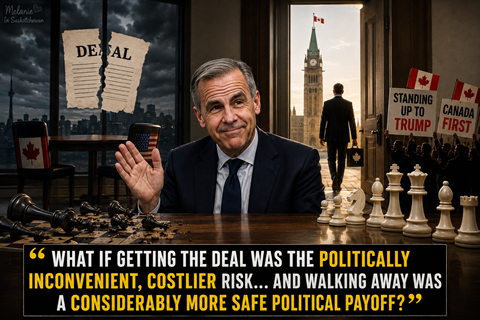
What couldn’t be obtained at the ballot box can apparently be constructed through non-electoral methods. After the Liberals fell short of a majority in the 2025 federal election, they’ve now gained four more seats through attracting opposition MPs to join their caucus:

Image from Melanie in Saskatchewan

Consider several ridings from the last election where Conservatives defeated Liberals by extremely small margins. Terra Nova–The Peninsulas was decided by only a handful of votes. Milton East–Halton Hills South by just a few dozen. Windsor–Tecumseh–Lakeshore by fewer than a hundred. In Markham–Unionville and Edmonton Riverbend the margins were still narrow by federal election standards, measured in the low hundreds.

In ridings with tens of thousands of ballots cast, those margins are not ideological fortresses.
They are statistical coin flips.

Now imagine you are a strategist trying to change the parliamentary math without calling another election. Would you target MPs who defeated your party by twenty thousand votes? Or would you look at ridings where the electorate was already split nearly fifty fifty? Where persuading one individual changes everything!?

That is where the Moneyball logic appears.

Instead of persuading fifty thousand voters, you persuade one MP. The scoreboard shifts instantly. No campaign. No election. No voters trudging through snow to mark an X. Just a quiet change of jersey on the House of Commons floor.

Now consider the MPs who have crossed the floor or whose ridings are currently the focus of speculation. Seats like Edmonton Riverbend held by Matt Jeneroux and Markham–Unionville represented by Michael Ma sit squarely in that category of competitive swing ridings. Even Nunavut, represented by Lori Idlout, illustrates how single seats in geographically unique ridings can dramatically affect parliamentary arithmetic.

Notice the pattern.
Not massive strongholds.
Swing ridings.
Seats where the Liberal candidate already came within striking distance.

Which raises an uncomfortable question.

Is this coincidence?
Or strategy?

Because if a riding was decided by one hundred votes, persuading the MP to change parties is dramatically easier than persuading fifty thousand voters to change their minds. The parliamentary math changes instantly.

The voters never get another say.

    Just like Canadians did not get a say when 131,674 votes from Liberal Party members at Mark Carney’s leadership race installed Mark Carney as defacto Prime Minister. He effectively became the Prime Minister of Canada through installation, not election.
    That is 0.33 percent of Canadians.
    Or, put another way, roughly one third of one percent of the country’s population participated in choosing the Liberal leader who then became Prime Minister through the parliamentary system without being elected by the people of the country.
    • 131,674 people chose the leader
    • out of about 41 million Canadians

Of course nobody in Ottawa will describe it this way. Politics prefers softer language. You will hear phrases like cooperation, evolving priorities, responsible leadership, and national unity.

Politics prefers poetry.
Arithmetic prefers patterns.

Individually every floor crossing can be explained. Each one comes with its own “so-called” story, its own “so-called” reasoning, its own “so-called” justification.

But collectively something else begins to emerge.
A seat here.
Another seat there.
Nothing dramatic.
Until one day the standings look different.

Exactly the way Moneyball worked. No blockbuster moves. Just quiet arithmetic accumulating advantage until the outcome changed.

In the past I’ve been comfortable with the Parliamentary tradition that voters elect individuals as their representatives so if that MP leaves the party they were elected for, it doesn’t change the representation of the constituents. Historically, when most MPs were free to vote their conscience except for a minority of “whipped” votes, where they were obligated to vote on party lines, this made sense. I’m becoming less comfortable as this pattern of “recently elected opposition MPs suddenly discovering they’d run for the wrong party” repeats, indicating that it’s not just ordinary politics, but a deliberate strategy on the part of the Liberals.

Some have speculated that a major factor in the latest defection was a recent federal financial benefit to the territory, but it might perhaps have been something more concrete:

March 6, 2026

The “security clearance issue” demonstrated by, of all people, Mark Carney

Filed under: Cancon, Government, Media, Politics — Tags: , , , , — Nicholas @ 05:00

Melanie in Saskatchewan explains why the constant Liberal talking point that refusing to get a particular security clearance “proved” that Pierre Poilievre was next-door to a traitor will probably not be raised any more:

Image from Melanie in Saskatchewan

Open Letter to Canada’s Security Clearance Scolds: Carney Just Proved Pierre Right!

To every Liberal and NDP partisan who has spent the last year yelling “security clearance” like it is a magic spell that turns criticism into treason, congratulations. Mark Carney just demonstrated Pierre Poilievre’s point for him, on camera, in real time.

The moment came on March 3, 2026, during Prime Minister Mark Carney’s Indo-Pacific trip. After meetings in India with Prime Minister Narendra Modi, Carney held a press availability with Canadian media while travelling through the region. The topic journalists wanted clarified was not subtle. They asked about foreign interference linked to India and the 2023 assassination of Sikh activist Hardeep Singh Nijjar in Surrey, British Columbia, the allegation that detonated Canada’s diplomatic crisis with India.

The question came from Dylan Robertson of The Canadian Press during the media scrum. He asked directly whether Carney believed India continued to engage in foreign interference or transnational repression targeting Canadians.

Carney swerved. He was asked again. And again.

Eventually, after the careful circling that seasoned politicians deploy when a straight answer would be inconvenient, he landed on the tell. Not the kind you need a polygraph for. The kind you publish in a civics textbook.

Here is what he said, exactly:

    There will not be consequences for those officials … There are aspects of those briefings that I can’t share in public, and I’m not going to betray them. I will tell you that there is progress on these issues.

Read that again, slowly, with a spoon handy in case you choke on the irony. Because this is the whole debate in one neat little ribbon.

Pierre Poilievre’s argument, from the start, has been that the particular classified briefings being pushed would place him inside a legal box. Once inside it, the rules governing those briefings restrict what he can say publicly and how he can use the information while doing his job as Leader of the Opposition. Global News reported Poilievre’s office saying officials told them the briefing structure could leave him legally prevented from speaking publicly about certain information except in narrow ways, which they argued would “render him unable to effectively use any relevant information he received”.

Now watch what just happened.

Carney, the man with the clearance and the briefings, is asked direct questions about one of the most explosive foreign-interference files in modern Canadian politics.

And his answer, translated into plain English, is simple: I cannot share what I know.

February 27, 2026

Brookfield, Carney, Freeland, and Ukraine – cui bono?

Melanie in Saskatchewan goes digging in the less-publicly-visible parts of Canada’s massive support of Ukraine to see who is gaining the benefit from all that money and all those political and economic manoeuvres … and you probably won’t be surprised to hear that it’s not ordinary Ukrainians or their soldiers fighting on the front line against Russia:

Image from Melanie in Saskatchewan

I need you to stop for a moment and really sit with this. Ask yourself a question that should make your stomach drop. What if the billions of your tax dollars being sent to Ukraine are not just about solidarity, democracy, or defending freedom? What if they also intersect with private financial interests connected to the very people making those decisions?

Because that is the bombshell.

And once you see the connections, you cannot unsee them.

Canada has now committed more than $25.5 billion to Ukraine. Just days ago, Prime Minister Mark Carney announced another $2 billion in military aid. Armoured vehicles. Equipment. Sanctions. More money flowing outward while Canadians juggle mortgage renewals, grocery bills, and heating costs that feel like ransom demands.

[…]

And to the Ethics Commissioner, Canadians deserve clarity. The Conflict of Interest Act is widely described as a disclosure regime. It relies heavily on what office holders report and on screening mechanisms that operate within defined boundaries. Committee testimony has acknowledged that screen administrators do not know the specific underlying assets within the Brookfield Global Transition Fund and that a significant portion of Brookfield’s broader portfolio is outside those screens. Mark Carney is the architect of Brookfield’s Global Transition Fund. He KNOWS what the assets in that fund are. He also has carried interest structures in that fund. If Konrad von Finckenstein does not take note and act, then I cannot validate the need for his position. We might as well install a potted Boston Fern in his chair, we’d still get the same results.

So the question becomes simple. If an issue of this magnitude does not justify proactive scrutiny and clear public documentation, then what does? Canadians are not asking for drama. They are asking for written determinations, documented recusals, and visible oversight that goes beyond procedural minimums.

Were Canadian Ukraine policy decisions structured, timed, or insulated in a way that ensures there is absolutely no benefit, direct or indirect, to any financial exposure connected to Brookfield-related structures? Have recusals been documented? Has the Ethics Commissioner issued written determinations? Has conflict screening been publicly disclosed?

Where is the paperwork?

If everything is clean, then showing the documentation should be effortless. If everything is arms-length, then release the recusal letters. If there is nothing to hide, then open the books.

Canadians are not children. We understand complexity. What we resent is opacity.

To Moose on the Loose, credit where it is due. Independent researchers willing to comb through filings, contracts, and timelines are the reason these overlaps are being discussed at all. Without that digging, most Canadians would never see the full picture.

Now it is on us.

Share this. Ask your MP. Demand written answers. Demand documentation. Demand transparency from Mark Carney.

February 24, 2026

Canada’s climate follies, a brief update

On Substack, John Robson looks at the Canadian federal government’s lofty climate goals and their pathetic strategies to achieve those goals and the vast chasm between the two:

Chinese electric vehicles are likely coming to Canadian roads, like these BYD models.

Forgive us for being fixated on Canada’s climate follies just because we live here. But they are revealing, including the U-turn on EVs that we mentioned last week where the government yanked the steering wheel so hard they did a 360 from banning gasoline vehicles by law to banning them by regulation. Raising the question whether they actually know what they’re doing and, if so, whether they regard themselves as commendably devious or just way smarter than everyone else. We hope not the latter because the policy is going to fail big-time. As Randall Denley just warned in the National Post, “To summarize, the Carney plan relies on electric vehicles (EVs) that Ontario plants don’t produce, a sudden and dramatic new appetite for buying EVs and an imagined export market that doesn’t exist. To top it off, the federal government will provide $2.3 billion in EV rebates that will encourage Canadians to buy cars made elsewhere.” Apart from that, a stroke of genius of the sort that, through decades of diligent effort, has made the nation tragically poorer without hitting any of our targets including the one where they get more humble.

As a Globe & Mail news story blurted out:

    A new study published Friday by the Canadian Climate Institute says Canada is not on track to meet any of its climate targets – not the 2026 interim emissions reduction target, the 2030 Paris Agreement commitment, or even the long-term goal of reaching net-zero emissions by 2050.

Oh. Pretty hard to make that one sound like an achievement, isn’t it? Or to sound as if the people who pulled it off should be trusted with the next one.

Now as we’ve complained before, the “Canadian Climate Institute” bills itself as some sort of dispassionate neutral observer when in fact it’s a creature of the state. And, worse, one of those lavishly-funded outfits (we deniers may have all the money, but they got $30 million from the Canadian government and we did not … uh no, that was just one grant, the total’s higher) that exists to push the government to do things it wants to do anyway but needs the appearance of “civil society” support to pull off.

Thus, the Globe sonorously informs us, the problem isn’t that the targets were impractical or the politicians and bureaucrats inept. Heck no. As usual with Thomas Sowell’s “unconstrained vision” of public policy, all you need is love:

    The report suggests Canada has moved away from its climate goals thanks to “a slackening of policy effort over the past year, marked by the removal or weakening of climate policies across the country”.

Which gives the impression they had been on track to meet their goals up until some recent backsliding, whereas in reality they have never shown any sign of meeting them. After all, what policies have actually changed since Carney took over as Prime Minister in ways that could possibly affect long-term trends? And how close was Canada to meeting “its climate goals” before this disastrous swerve into the camp of the deniers?

It’s not even true that “Canada” as a collective has collective “climate goals”. The government has climate goals, and they come bundled with a host of other policies at election time, especially since even our “Conservative” party is terrified of challenging climate orthodoxy. Public support for those goals is weak, sporadic and prone to vanish when real costs hove into view. But ignoring that piece of typical collectivist prose, Mark Carney has spent most of his prime ministership flying around virtue-signaling in the presence of others doing the same. (No, really. It’s been less than a year and he’s taken almost three dozen flights.) He hasn’t been in the office shredding this and demolishing that.

February 13, 2026

The selective ability to override any non-criminal law is a “useful tool to have”

Filed under: Cancon, Government, Media, Politics — Tags: , , , — Nicholas @ 03:00

The Canadian government is trying to get even more power to exempt their friends and favoured companies from needing to comply with any federal laws or regulations through a provision in an omnibus bill before Parliament. It may sound like a tool to dispense privileges and favours to politically well-connected individuals and organizations, but that’s only because that’s exactly what it does:

In a little-noticed provision included in the government’s latest omnibus bill, Carney government ministers would be able to override almost any non-criminal law they wanted, and provide special treatment to any person or corporation who requested it.

When pressed about the clause in a House of Commons committee this week, Minister of Canadian Identity Marc Miller called it a “useful tool to have”.

The provision is included in C-15, the 634-page “budget implementation” bill currently before the House of Commons.

Among its hundreds of amendments and orders are new powers allowing ministers to hand out special exemptions from any “Act of Parliament” under their purview.

This means that the minister of health would be able to issue exemptions from the Canada Health Act, the Indigenous services minister could oversee exemptions from the Indian Act and the minister of finance would be able to override the Income Tax Act.

Furthermore, ministers could hand out these exemptions to any “entity” they wanted. Under federal guidelines, an “entity” can mean everything from an individual to “a corporation” to an “unincorporated organization”.

You don’t need to be a conspiracy theorist to see all kinds of ways that this provision could be abused to circumvent the normal rules everyone else is bound by. On the social media site formerly known as Twitter, Wall Street Apes reacts:

I can’t even believe this is real

Canada Minister Marc Miller is questioned about their new bill under the Liberal government led by Prime Minister Mark Carney that would EXEMPT ALL MINISTERS FROM ALL LAWS

Yes, you heard that correctly

Hidden in the omnibus budget implementation bill, section 208 or clause 12 amends the Red Tape Reduction Act to grant federal cabinet ministers broad discretionary powers

Ministers would be able to temporarily exempt any individual, company, organization, or entity from the application of almost any provision of any federal law (or regulations made under those laws) that the minister is responsible for administering or enforcing, with the sole exception of the Criminal Code

They can themselves, and deem anyone they choose exempt from ALL laws. The only exception is the criminal code

He says you can trust them because “Canadians expect us to act reasonably”

(Holy cr*p)

On her Substack, Melanie in Saskatchewan explains why the rule of law is not optional in Canada:

So let us play this forward. A Beijing connected firm establishes operations in Canada. It hires lobbyists. It meets with the appropriate minister. It argues that certain federal regulations are barriers to innovation or economic growth. Under Bill C 15, that minister could grant a temporary exemption. The company does not need to change Canadian law. It does not need to persuade Parliament. It only needs to persuade the right minister.

That is what should alarm Canadians.

When laws become selectively waivable by political discretion, they cease to be stable guardrails and become negotiable privileges. And power, once granted, is never granted because someone intends to leave it unused.

You tell us this is about economic growth amid trade tensions. Yet Canadians were told you were elected to steady the ship on trade and tariffs, to negotiate strength abroad, to stabilize economic uncertainty. Instead, trade tensions persist, tariffs remain contentious, and what advances efficiently is domestic policy architecture that conveniently aligns with the climate finance world you know so well.

Brookfield’s climate investment arm stands to benefit enormously from aggressive climate frameworks. You remain heavily invested. The potential for substantial personal financial gain is not speculation. It is disclosed reality.

You were not elected to refashion Canada into a climate investment thesis calibrated to suit global asset management portfolios. You were elected to manage trade pressures and protect Canadian economic interests.

This exemption clause is not a minor technical detail. It is a structural shift in how power is exercised. If it is so defensible, extract it from the omnibus bill and introduce it as standalone legislation. Let it be debated openly. Let Canadians see it clearly.

Implement a robust foreign agent registry immediately. Answer why a government that acknowledges compromised parliamentarians believes this is the moment to expand ministerial discretion over who must follow federal law.

The rule of law is not optional.

And Canadians did not vote for a system where compliance is mandatory for citizens but negotiable for the well connected.

February 9, 2026

Jamil Jivani on his trip to Washington DC

Filed under: Cancon, Economics, Government, Media, Politics, USA — Tags: , , , , , — Nicholas @ 05:00

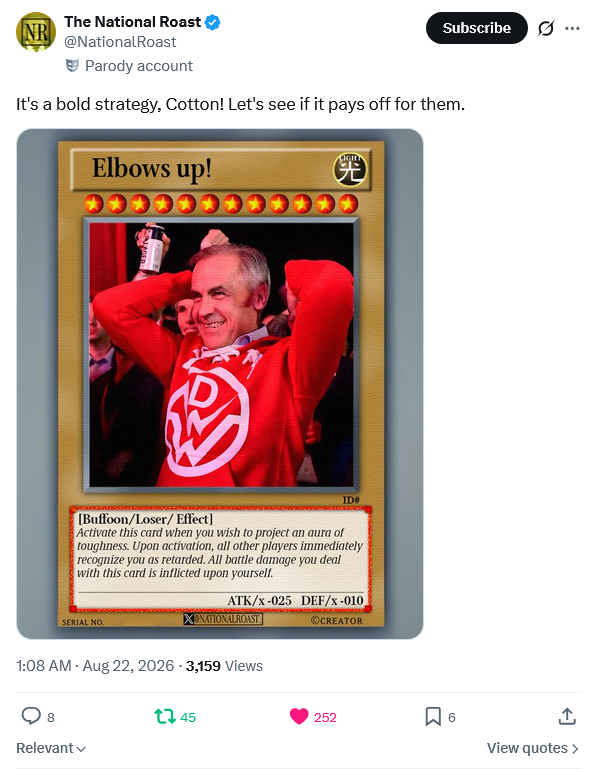
If you depend on the CBC, the Toronto Star or other legacy Canadian media, if you heard anything at all about Bowmanville-Oshawa North MP Jamil Jivani’s visit to key American leaders in Washington DC, you probably got the story framed as Liberals tut-tutting and disapproving of Jivani, his initiative to make the trip, and how he should leave everything to the government. If nothing else, it further proved that Prime Minister Carney doesn’t actually want better relations with the US, as his entire campaign was based on opposition to Trump and its success in riling up Canadian boomers with the moronic eLbOwS uP nonsense.

In the National Post Jivani discusses the trip and what he’s learned from it:

Image from Melanie in Saskatchewan

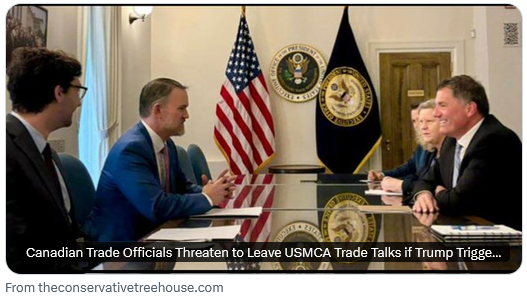
It was a whirlwind of a trip, full of excellent conversations. I had meetings with the White House and State Department, including conversations with President Donald Trump, Vice-President JD Vance, and Secretary of State Marco Rubio. Senators from Montana, Ohio, and Wisconsin, as well as the United States Trade Representative, each sat down with me to share their priorities. Businesses and industries employing thousands of Canadians shared their insights with me on where Canada-U.S. trade fits into their vision for economic growth.

Doors were open for dialogue about how Canada and the U.S. can work together at a time when pessimism gets most of the media attention. Certainly, my 15-year friendship with the vice-president played a key role in opening those doors. But what I found across the board was optimism about how we can move trade negotiations forward. I was particularly happy to hear key insights on how we can make progress on specific sectoral priorities, and the importance of strategic diplomacy. I offered my perspective on why CUSMA is so important to communities like mine in Bowmanville—Oshawa North, and I expressed my hope that CUSMA will continue to ensure Canada and the U.S. both benefit from a special economic and security relationship.

There is only so much I can share without first having the chance to speak with Prime Minister Mark Carney and Minister Dominic LeBlanc. Out of respect for their unique responsibilities in negotiating trade with the United States, it’s important that I debrief them before saying too much publicly and see how we can work together moving forward as Conservatives and Liberals.

However, I do want to point out a key observation related to the need for strategic diplomacy. Mexico — the third partner in our trilateral trade agreement with the U.S. — is further ahead in its engagement with the U.S. than Canada is. On Jan. 28, 2026, Mexico and the U.S. announced formal talks on CUSMA reforms. A week later, Mexico and the U.S. announced a joint action plan for critical minerals. Neither of these announcements included Canada.

Observers of this news would be right to worry that the current Canadian government may be making similar mistakes as were made under Prime Minister Justin Trudeau during the 2017 CUSMA negotiations. At that time, Mexico advanced its negotiations with the U.S. while Canada was largely left out of the process. It was only at the last minute, when a bilateral agreement between Mexico and the US was a real possibility, that Canada was included and our unique trilateral arrangement continued.

It would be a mistake to relive 2017 all over again, if for no other reason than Canadian workers and businesses deserve to have full representation in a process that has such a significant impact on our economy. The workers at the GM plant in Oshawa deserve to know that their government did everything possible to protect their jobs and encourage investment in their industry. All Canadians deserve to know that their elected officials are making the best effort possible to advance our national interests.

Full disclosure: Jamil Jivani is my Member of Parliament, and I fully support his decision to go and I hope that it actually does help make for improved trade relations between Canada and the United States. Bitterness and uncertainty only benefit the Liberal Party and Mark Carney, not ordinary Canadians. Attacking and criticizing Donald Trump plays well in our deranged and sycophantic media, but it makes Trump less willing to deal fairly with Canada on trade or other issues of critical importance to both nations.

February 7, 2026

Liberal horror at a Conservative MP going to Washington to talk trade

Jamil Jivani, Conservative Member of Parliament for the riding of Bowmanville-Oshawa North, is being called all sorts of names by Liberals and their creatures in the mainstream media for his temerity in actually going to Washington DC to try to encourage trade talks between Canada and the United States:

Image from Melanie in Saskatchewan

Mark Carney, I want to speak to you directly for a moment, because this whole episode has your fingerprints all over it.

You have spent months telling Canadians we live in a more dangerous and divided world. You have warned us that this is not a transition but a rupture. You have explained, repeatedly, that Canada must adapt, that middle powers must act differently, that old assumptions no longer apply. It is very serious language. Big language. The kind you deliver slowly, as if the room should be taking notes.

So imagine my surprise when a Conservative MP behaved exactly the way your speeches suggest Canada must behave, and Ottawa promptly short-circuited.

Jamil Jivani went to Washington to try to open a door you and your government have been telling Canadians does not exist. He used a personal relationship with JD Vance, not for applause, not for theatrics, but for the radical act of actually talking to someone who matters. And suddenly, Mark, this was not adaptive diplomacy. It was alarming. Inappropriate. A problem.

This is the part where your credibility starts to wobble.

Because let’s be honest. When people asked you about engaging Donald Trump directly, your response boiled down to “Who cares?” Either because it bored you or because you preferred not to acknowledge that door at all. So when a Conservative tries anyway, the issue is not that the door was touched. It is that someone proved it was never locked in the first place.

Jivani did not freelance. He did not sneak off. He offered this connection to your government first. Openly. Calmly. And it was dismissed. Brushed aside. Not interested. And when he went anyway, your side did not react with curiosity or even grudging respect. It reacted with outrage.

The kind of outrage you see when someone fixes a problem you have been holding meetings about for weeks without ever intending to solve it. Like an office that has spent months discussing a flickering lightbulb, only to panic when someone quietly screws in a new one and sits back down before the chair can call the meeting to order.

And then, almost on cue, came the shiny object.

I am not accusing you of anything, Mark. I am simply asking whether it is coincidence that the outrage over Jivani going to Washington was followed almost immediately by a dramatic announcement about dropping the EV mandate. Was that timing accidental, or was it a convenient way to make Canadians look over there while a Conservative threatened to come back with something measurable. I am not saying it was a distraction. I am just saying the choreography was impressive.

Now, let’s talk about cooperation, because you and your allies invoke that word constantly.

When generalized liberals complain that Conservatives will not “play ball”, what they seem to mean is that Conservatives are not being obedient. Cooperation, in practice, appears to mean standing aside politely while you govern unchallenged. It does not mean Conservatives doing something useful that might work. Especially not if it works where you did not.

And this is where your rhetoric corners you.

January 22, 2026

Carney in Davos … “the mismatch between message and messenger is … very special”

I make it a point not to listen to politicans’ speeches, as I need to keep my blood pressure within safe ranges for health reasons. A lot of Canadian commentators have been gushing with praise for Prime Minister Mark Carney’s bloviations at the WEF gabathon in Davos, because of course they have. Brave Mr. Carney standing up to the Bad Orange Man and getting ovations from the kind of people he’s most comfortable dealing with. How very nice for him. But as Chris Bray explains, it didn’t play quite as well with the rest of the non-Davos-attending world:

Mark Carney gave a speech in Davos, that fortress of democratic pluralism where hotel rooms inside the security zone cost thousands of dollars a night and no one with an expense account has to be lonely because the massive security forces don’t try to interfere with all the sex trafficking, which is very democratic. Anyway, the speech was stunning and brave, and everybody clapped a lot.

Someone put the word “flexes” next to the word “Canada”, apparently not intending to cause laughter, but yes: Mark Carney flexed and warned and puffed himself up like a man who’d just eaten the wrong part of the fugu.

You should watch it. Don’t try to eat or drink during the speech, because you’ll choke, and push any breakable household goods away from the reach of what will soon be your flailing arms, but you should watch him perform this extraordinary set of stranded symbols. The mismatch between message and messenger is … very special.

I was physically paralyzed as an effect of hearing this sentence from this face for a full ten seconds, and then I spasmed. It’s like watching Erich Honecker stand up to the East German regime. “We cannot tolerate misogyny, warns Jack the Ripper.”

Carney hinted broadly that the rules are breaking down in international relationships …

… which for the first time in a long time are being reshaped by mere power, a rare thing on the global stage, because there’s meanness and bullying and a rejection of friendly norms and restraint from … someone very bad, not that he was naming names, and so Canada is turning to new partners, extending the hand of friendship to nations and leaders that still care about rules and values and democracy.

The central banker who was selected as his country’s head of government before he’d ever stood for election to any office anywhere ever, the prime minister of a country where the government had just been rebuked by its courts for faking a national security emergency so it could suspend the rule of law and crush dissent, gave a real tubthumper about democracy and the rule of law.

The total absence of connection between “things being said” and “things being done” sets a record, here.

Older Posts »

Powered by WordPress