He invented it. Every premise of contemporary progressive ideology traces directly back to one man who had never met a “noble savage”, never raised a child, and never lived according to a single principle he preached.
1. His foundational claim: man is naturally good and civilization corrupts. This sounds compassionate. It is the most dangerous idea in Western political thought. Because if man is naturally good, then every failure, every crime, every inequality is caused by the system – never by the individual. Responsibility evaporates. The oppressor is always external. The victim is always pure. This is the complete architecture of Woke in one sentence, written in 1755.
2. The “Noble Savage” is Rousseau’s Form – his version of Plato’s ideal. The uncorrupted man, untouched by property, competition, and civilization, living in natural harmony. Rousseau had never met one. He invented him from an armchair in Paris, extrapolating from travel accounts of peoples he had never visited. The Noble Savage is not an anthropological observation. He is a political weapon – a club to beat civilization with, wielded by someone living comfortably inside it.
3. The “General Will” is the most dangerous concept in modern political philosophy. Not the actual expressed will of actual people – but the deeper will, the will people would have if they were “properly enlightened”. Whoever claims to know it can do anything in its name. Robespierre knew it. Every revolutionary vanguard since has known it. Today’s progressive institutions know it – which is why they can override democratic majorities, suppress dissent, and compel speech, all while insisting they represent the people’s true interests. The General Will is the intellectual license for every tyranny that calls itself a liberation.
4. The chain from Rousseau to today is unbroken. Rousseau to Robespierre and the Terror. Robespierre to Marx, who secularized the General Will into historical necessity. Marx to every “liberation” movement that ended in a gulag. And today: replace civilization with white supremacy, replace the Noble Savage with the marginalized community, replace the General Will with lived experience – and you have the complete operating system of contemporary progressivism. The software is the same.
5. Voltaire, his contemporary and rival, saw him quite clearly: Rousseau made primitivism intellectually respectable. He gave the comfortable classes of every generation a way to signal virtue by denouncing the civilization that produced them, from inside it, without cost. The French Left Bank intellectual denouncing capitalism from a café. The Harvard professor deconstructing Western civilization from a tenured chair. The hedge fund billionaire funding the abolition of meritocracy. All of them are living in Rousseau’s armchair.
6. He sent all five of his illegitimate children to a Paris orphanage. Then wrote Émile – one of the most influential books on education in Western history, a detailed guide on how to raise a virtuous child in harmony with nature. He did not find this contradictory. This is not hypocrisy in the ordinary sense – this is obłuda [hypocrisy] (remember the obłuda of communism👇🏻). The defining structural feature of the ideology he invented: the sermon is inversely proportional to the practice. The performance of virtue replaces the exercise of it. Naming the oppressor substitutes for personal accountability. Rousseau didn’t just invent Woke – he lived it, in every detail, before anyone had the word.
7. The original Woke was woke about a fiction he invented – and spent his life performing outrage about a civilization he depended on and never left. Two and a half centuries later, the performance is the same. The noble savages have been updated. The General Will has new names. The orphanages are metaphorical. But the man who sends his children away and then lectures everyone else on how to raise theirs – that man is everywhere.
Krzysztof Szczawinski, The social media site formerly known as Twitter, 2026-07-10. (Auto-translated from the original Polish by X)
October 13, 2026
QotD: Jean-Jacques Rousseau, wokester avant la lettre
September 26, 2026
Jacob Rees-Mogg says the quiet part out loud
Despite British news popping up here fairly regularly, I don’t closely follow individual politicians, so I didn’t have strong opinions about Jacob Rees-Mogg. I guess I had mild positive feelings about him based on what he’d said on various issues several years ago. I’d rather assumed he’d be out of politics by now with the collapse of the “Conservatives” after the Boriswave, but no, he still thinks of himself as a voice worth listening to … unfortunately.
Thoughts from the Shire suggests that we not blame Rees-Mogg too much, as he merely said out loud what they all think:
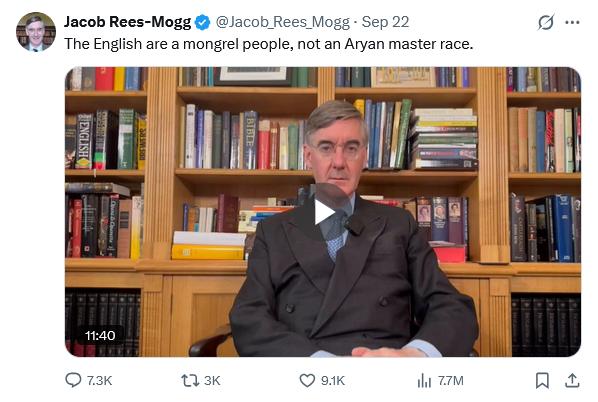
Don’t be too hard on old Jacob Rees-Mogg.
His recent call for the return of duty and the stiff upper lip, along with his warning that some of us may once again have to fight and die for our country, has predictably, and rightly so been met with howls of derision.
But here’s the thing, Mogg isn’t entirely wrong.
Duty does matter, courage matters, and sacrifice matters. A people incapable of defending themselves will eventually find themselves at the mercy of people who can, this is the story of world history. The problem is not the principle, the problem is the state of the nation, and perhaps more importantly, the relationship between those asking for the sacrifice and those expected to make it. People have rightly been pointing out that Millionaire Mogg, and his progeny are not likely to be the ones enlisted for the frontline, and that too often in our history the likes of Jacob have led many millions of good men to war. It is great that many have seen through Moggs BS rhetoric, and are telling him where he can stick his future war.
However we should not think that the masses of working class men that fought in past conflicts all did so out of patriotism, or because they listened to their betters, or were too stupid to see through the propaganda. Most knew their leaders were full of shit, most despised the upper crust types like Mogg.
It’s rather amusing that both the British and Canadian powers-that-be have spent a long time doing things to diminish the patriotism of their people — not least by mass immigration against the will of the voters — and denigrating the patriotic feelings they haven’t managed to fully suppress. Both ostentatiously treat immigrants, especially illegal immigrants better than they treat their own citizens, both with public support and judicial slight-of-hand to minimize or eliminate punishments when they do find themselves in court.
Now, British elites want the downtrodden young white males to ready themselves to go die for Ukraine, while Canadian elites want their downtrodden young white males to become, as John Carter put it, the Hoser Taliban and fight against the Yankee hordes of the Bad Orange Man. As if everyone will just magically forget that they spent the last decade and more actively trying to erase our history and blacken the reputations of the men who built our nation.
Sorry for the interruption, I’ll get off my hobby horse and let’s get back to Thoughts From the Shire:
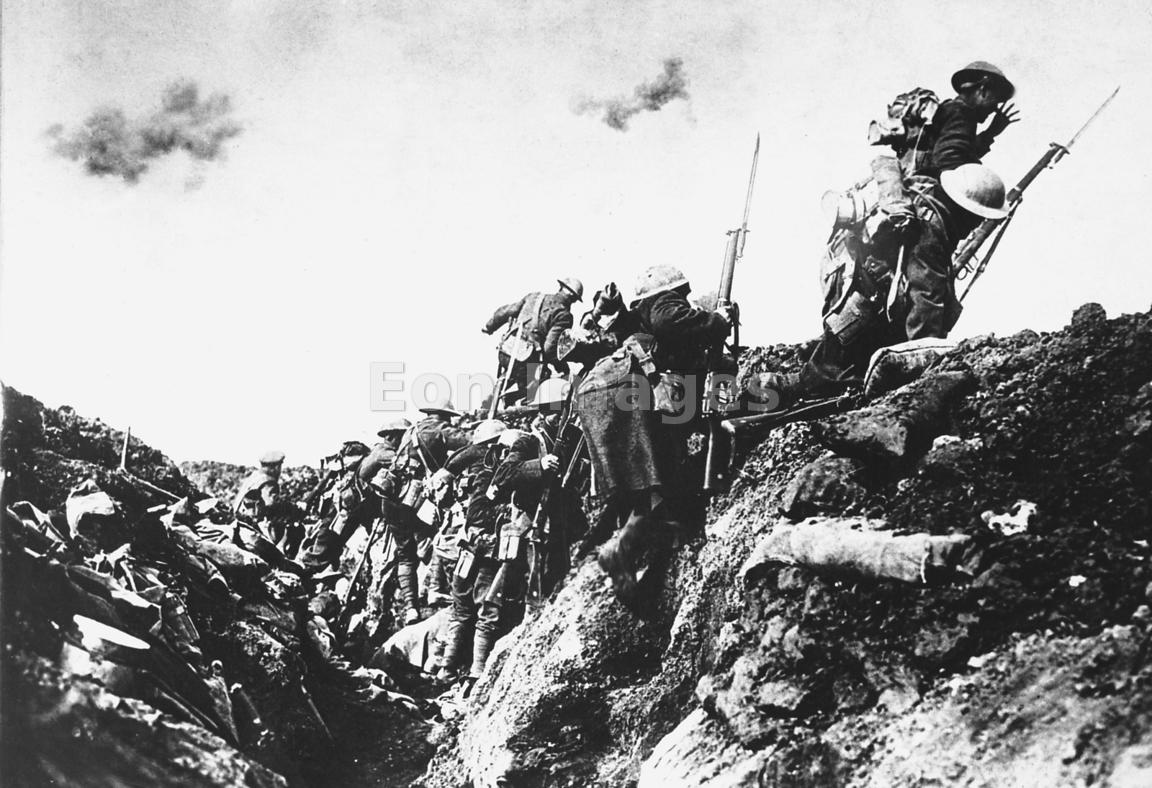
Canadian troops going “over the top”
In the Past, the Upper Crust also Paid a Great Price in War
Nor, incidentally, did the upper classes always remain safely at home like old Mogg, and his ilk today. In the Great War, aristocratic families lost sons in extraordinary numbers. In 1919 the House of Lords recorded 160 sons of peers dead, “in many cases the hopes and heirs of their line”. Prime Minister Asquith lost his son Raymond. Bonar Law lost two sons. Public-school boys died in the same mud as miners and millworkers, and actually in a higher proportion. Go further back and the connection between leadership, and physical danger becomes even clearer. Kings fought, Chieftains fought, aristocrats fought. Martial ability was not the only qualification for leadership, but for much of history its obvious absence could certainly be a disqualification. It would have been unthinkable for a Celtic chief not to have been a great warrior, in fact the greatest warrior was often made chief precisely because he was the best warrior. Put the above into the context of today, the weak effeminate excuses for leaders we have in the West, not one of them would have the backbone to stand and fight for anything, let alone for you or me.
Contrary to common belief, in the past the man saying “Lets go to war” was frequently going with you, and on WWI the junior officer was actually going in front of you.
That matters.
Because the great change in our own age is not that ordinary men have suddenly become cowards (although it’s no doubt many are) and the upper classes armchair generals. It is that the bond between sacrifice, and belonging has weakened. My ancestors lived in mill-owned houses. They knew perfectly well where they stood in the social order, right at the bottom. Yet they fought in both world wars, remember there was no conscription in Ireland so they volunteered.
The thing is they were not fighting for an amorphous administrative machine called “the state”. They were fighting, in however complicated a fashion, for home, hearth, wives, weans, neighbours, streets, churches, towns, regiments, and the men beside them. They knew what was behind them, and beside them, they knew what they were trying to preserve, and that is where Mogg has the problem a bit backwards.
You cannot spend decades hollowing out common identity, weakening attachment to place, treating inherited loyalties as embarrassing, and reducing citizenship increasingly to an administrative relationship, then suddenly reach into the cupboard when war threatens and pull out words such as duty, honour, country, and sacrifice. You cannot look down your nose at the oiks and their gammon like ways, and then suddenly point out that they may have to die with honour and dignity.
Virtues like duty, honour, and sacrifice require roots, common beliefs and identities, a people!!!
So perhaps Mogg is right, we do need to toughen up. Perhaps we have become too comfortable, too passive, and too frightened of hardship. But the courage required of us may not be the courage to march obediently towards the next foreign battlefield for the virtue signalling elite, and their banker friends. It may be the courage to ask our own rulers some very uncomfortable questions first.
On Substack Notes, John Carter links to a Morgoth post on the topic, saying:

Jacob Rees-Mogg has been lecturing Brits about their “duty” to the nation, in particular their duty to die in Ukraine, while at the very same time he denies that the English people even exist as a nation at all. A “nation of mongrels”, he calls them.
He adopts the mannerisms of a grand old lord of times gone by, one of the landed gentry who bled and died en masse when they threw themselves into the trenches of the Great War, answering the very same call of duty to God, king, and country that Rees-Mogg cynically invokes. Will Rees-Mogg die in a slit trench in the Donbass? Will any of his four sons? Peter is 19 — old enough to fight. Will he? To ask the question is to answer it.
Rees-Mogg speaks of duty to fight for a country he will not fight for. He speaks of duty as he smiles upon the invasion of that country by the hordes of third world primitives he and his class continue to invite in. He speaks of duty, as the regime he supports bends itself to persecuting the men and women doing their duty to their country by attempting to fight back against the invasion.
August 30, 2026
QotD: Cant
Without hypocrisy, there would be no gossip; without gossip, there would be no literature and precious little conversation. The dose of hypocrisy necessary to maintain social intercourse is a matter of judgment, for while many individual instances of hypocrisy are reprehensible and properly the subject of adverse comment, and some instances are beyond the pale, hypocrisy is as necessary to human existence as love or laughter. We should never forget La Rochefoucauld’s dictum that hypocrisy is the tribute that vice pays to virtue: but at least he knows that there is a difference. The only effective way to eliminate hypocrisy entirely from human affairs is to have no moral standards.
Cant is more destructive than hypocrisy because it is harder to expose and because a humbug deceives himself as well as others, while a mere hypocrite retains some awareness; he is a rogue rather than a villain. Cant is the vehement public expression of concern for others, or of anger at an opinion casting doubt on some moral orthodoxy that is not, and cannot be, genuinely felt, its vehemence being a shield for insincerity and lack of confidence in the orthodox opinion. Doctor Johnson defined cant as “a whining pretension to goodness, in formal and affected terms.” Cant is contagious, and, when widespread, it creates an atmosphere in which people are afraid to call it by its name. Arguments then go by default; and if arguments go by default, ludicrous, bad, or even wicked policies result.
Theodore Dalrymple, “The Age of Cant”, City Journal, 2020-11-27.
August 15, 2026
QotD: “The progressive is a walking paradox”
If I loudly claim to love vanilla ice cream, yet every time I return from the Mr Whippy van I’m holding a choc-ice, my revealed preference is evidently for chocolate — not vanilla.
Thus the truth of a person’s preferences is revealed through their actual choices and behaviour, not by what they claim to prefer.
It’s unfortunate we can’t simply listen to their words, but they are so oriented toward the external, the aesthetic, and the performative (“Theater Kid Progressivism”) that we must instead look at their proximal behaviours — where they actually choose to live and raise their families, for example, to extrapolate backwards their true feelings on mass migration and its consequences.
This is the lens through which we should try to understand our Progressive class.
The bitterest irony, the irony of ironies, is this: progressives, especially those who voted for it, self-evidently do not feel at home in the societies they helped create.
If they were genuine believers, they would live contentedly amidst their new friends.
Instead, they scuttle off into the countryside, the leafy suburbs, or gated enclaves, abandoning the very demographic transformation they imposed on others.
It is often said that if liberals didn’t have double standards they wouldn’t have any at all, but while this is very funny (and true), there’s more to it.
It reveals a profound non-confluence between their stated attitudes and their actual behaviours, indicative of extreme cognitive distortion.
They protest performatively that open borders and rapid demographic change are a universal good, even moral imperatives and (admittedly less often nowadays) sources of strength.
Yet when it comes to their most intimate revealed preference — where they opt to live and raise their families — they consistently prioritise homogeneity, good schools, and cultural familiarity.
They lobby and vote without end for policies that maximise immigration into lower- and middle class neighbourhoods, then abandon those very communities for pastures anew, safely insulated by postcodes and house prices.
Their revealed preference is that do not want to live in the Canada (or Britain, or America, or Europe) they are busily helping to construct.
They enjoy the vibes, the moral status, the Instagram aesthetics, while quietly falling back to the leafy, high-trust environments their grandparents took for granted.
Progressives love to speak of taboos (indeed if there is a pastime more alluring and intoxicating to the progressive than “breaking taboos”, I am yet to come across it, but I digress) yet is the greatest taboo of all right in front of us after all, carrying a basket of organic fruit and veg from Waitrose?
To interrupt the Progressive in the midst of his communal dream state, to turn our collective eye away from the brave new world they are building for us and to instead look inwards, to look the Liberal cuckoo directly in the eye and put words to the disparity between their words and their actions …
The subject of lawful and legal deportations is increasingly mainstream, yet what of urban renewal and rewilding by means of progressive importations?
The Progressive is a walking paradox, he is both the centre of attention and the ghost at the feast all at once.
Æthelstan, The social media site formerly known as Twitter, 2026-05-14.
July 16, 2026
“Banned” book library in a Portuguese bookshop
Most people are at least a bit uncomfortable with censorship, at least when the censors get into the swing of things and start banning ordinary books and authors. I had to check Wikipedia to find out who Dua Lipa might be as I hadn’t heard of her before, so the name popping up in headlines about her bold anti-censorship actions didn’t tell me much. I think I’m safe in assuming that Ms. Lipa is fully read-in on all the fashionable concerns of the celebrity set, so it’ll be easy to predict the works her library will feature:
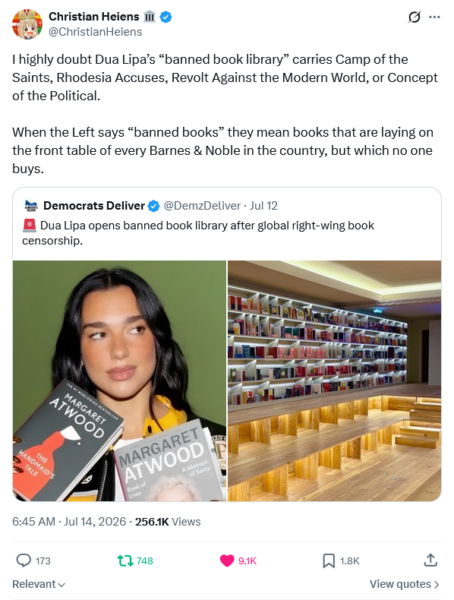
The moment I heard Dua Lipa was curating a list of “banned” books, the first thing I knew for certain was that these books would definitely not be, in fact, banned.
For a start it’s a tautology to point out that if they were banned she couldn’t easily get hold of them and display them in a famous bookshop (Livraria Lello in Porto).
Secondly, there’s zero chance a famous mainstream pop star would decide to obliterate her career with anything genuinely controversial. “The Dua Lipa David Irving Collection” would make a funny meme — as when dense and edgy political viewpoints are jokingly attributed online to Sydney Sweeney or Lana Del Rey — but it would likely not be much of a career boost.
And thirdly, I am dimly aware of similarly-named sections in high street bookshops, which invariably contain the least banned books on the planet.
Hence I was able to guess much of Lipa’s list without even seeing it (A Clockwork Orange, 1984 etc.), yet it turned out to be even more mainstream than I imagined. These are books I studied at school (The Handmaid’s Tale) and university (Invisible Man, Things Fall Apart).
Which doesn’t mean they’re all bad, nor do I really mind that they weren’t all literally banned. As Vogue Adria explains: “The collection also includes books that may never have been formally banned but have nevertheless questioned existing structures of power or the suppression of individual and collective voices.”
What I do mind is that the list borrows the cachet of works that are bold artistic achievements, some published in genuinely hostile circumstances, and segues into books that uphold the current ideological orthodoxy.
This is most notable in the “Voice” section, which, we’re told, “amplifies voices that have historically or systematically been marginalised, excluded or underrepresented”.
Here we have Salinger’s The Catcher in the Rye, but also works like Gender Queer by Maia Kobabe and Stamped: Racism, Antiracism, and You by Jason Reynolds and Ibram X. Kendi. Thus Lipa, or whoever has helped her come up with this list, attempts a sleight of hand. The implication is that the liberal era of individual genius and freedom of expression leads naturally to the woke era of radical Leftism, aggressive conformity and cancel culture.
Of course there are postliberal thinkers who would agree with this, but they would mean it in the negative sense that liberalism’s inherent logic guaranteed its own demise in the form of Woke. Others, like Andrew Doyle, believe Woke is a hard break with liberalism — a hostile force attacking it from the outside.
And as the “banned” book library is in Portugal, I’m including Larry Correia’s comments on the issue (he still counts as “Portuguese”, right?)
Since I’m still getting barked at by pearl clutching weirdos about my comment yesterday about “banned books” everybody with a functioning brain knows that just because parents don’t want to spend their tax dollars subsidizing liberal authors to stock public school libraries with torture porn, and the book is still legally available literally everywhere else books are sold, means that book is not “banned”.
And most “banned” book displays are just left wing virtue signaling for marketing purposes. Like most liberal causes its a fake ass moralizing narrative disconnected from reality where they get to play the victim and the rest of us are bullies.
Manhattan publishing LOVES when the school board in Somnambulant Iowa says they don’t want to spend their limited budget buying copies of The Illustrated Guide To Fisting for Trans Middle Schoolers, because that’s great marketing and all the blue haired weirdos are now religiously mandated to go buy a copy to stick it to the chuds.
Libs tried their best to get writers like me booted out of everything, but it’ll be a cold day in hell before you see any of us showing up on any of these banned books displays, and we all know it.
Stephen King was lying his ass off about how that particular novella collection was all about “friendship” or WTF ever he claimed. The friendship story has prison rape as a subplot, but the real issue was the story about an escaped Nazi war criminal teaching an American teenager about the joys of rape, torture, and murder.
As you can imagine some parents get hesitant about giving stuff like that to their kids … just like Stephen King himself did when he banned his own school shooting book, Rage. But it was okay when he did it.
If a school board said they didn’t want to buy one of my books because they thought it was too violent for kids, I’d say, okay, cool. Not being a dishonest histrionic dork, I recognize that’s their choice, and not being in that one collection does not in any way make my book “banned”.
The book in question is still available in every store, can be ordered online, and is in most public library systems. No law is broken if you possess it or share it. But to a liberal NOT buying their shit with tax dollars to give to children (even if their parents think it is inappropriate) is the gravest sin imaginable and you are all basically nazis.
Well, except for Graham Platner obviously. Stephen King says he’s alright.
July 15, 2026
The Prince – “The only people who haven’t read it are the ones who keep losing”
I didn’t intend to turn this into Machiavelli week, but after the discussion of correctly translating “virtù“ for modern audiences, here’s Krzysztof Szczawinski with more about that famous/infamous book:
Niccolò Machiavelli wrote The Prince in 1513 as a practical manual for power. For five centuries, polite society has pretended to be shocked by it. Meanwhile, every successful political operator — on every side — has been quietly following it. The only people who haven’t read it are the ones who keep losing.
1. Machiavelli’s central insight is not that the ends justify the means. That is the misquote that lets comfortable people dismiss him. His actual insight is simpler and more disturbing: power has its own logic, independent of morality, and those who refuse to understand that logic will be defeated by those who do. The Prince is not a villain’s manual. It is a description of reality that makes virtuous people uncomfortable – because reality doesn’t care about their virtue.
2. The current progressive system applies Machiavelli more fluently than any of its opponents. His first rule: the appearance of virtue matters more than virtue itself. The DEI statement while systematically excluding dissent. The democracy rhetoric while suppressing opposition. The compassion branding while destroying careers. This is Machiavelli’s prince – not good, but performing goodness to maintain legitimacy. The performance is the power.
3. His second rule, which the current system also applies perfectly: cruelty, when necessary, should be delivered swiftly, completely, and early. Cancellation is Machiavellian – total, swift, exemplary. The point isn’t the individual being cancelled. The point is the ten thousand people watching who quietly adjust their behavior. One public destruction purchases a million private silences. Machiavelli would have recognized the mechanism immediately. He invented the theory.
4. Communism applied the fear side of Machiavelli with full conviction – Stalin made the explicit choice Machiavelli described: better to be feared than loved. The show trial is pure Machiavellian theater – a public demonstration of power functioning as a warning to everyone who isn’t on trial. But communism made his fatal mistake: it destroyed the people’s goodwill so completely that it generated not just fear but hatred. And Machiavelli is unambiguous – you can rule through fear, you cannot survive through hatred.
5. His most important democratic insight — the one nobody quotes — is that the prince who builds his power on the people is more secure than one who builds it on elites. Elites are few, demanding, and treacherous. The people are many, ask only not to be oppressed, and are a more stable foundation. The political movement that actually connects with ordinary people against the credentialed elite is applying Machiavelli more correctly than the elite relying on institutional capture alone.
6. What should we do? Stop bringing virtue to a knife fight. The chronic error of the opposition is the naive prince Machiavelli explicitly warns against – the leader who assumes truth wins automatically, who believes that being right is a strategy. It is not a strategy. It is a precondition. Being right gives you something worth fighting for. Machiavelli tells you how to fight: build your own power base, never rely entirely on others, control your narrative before your enemies do, and treat fortune as something to be seized, not waited for. Fortune favors the bold. Not the righteous. The bold.
7. Machiavelli is taught in universities as cynical amoralism – the thing decent people reject. This framing is itself Machiavellian – it keeps the manual out of the hands of the people who most need it. The current establishment didn’t reject Machiavelli. It institutionalized him, rebranded him in the language of social justice, and uses him daily. The opposition reads Augustine and loses. The system reads Machiavelli and wins. Until the side that is actually right decides that understanding power is not a betrayal of principle but a precondition for defending it – the result will be the same. Virtue without strategy is just a dignified way of losing.
Update, 16 July: Welcome, Instapundit readers! Have a look around at some of my other posts you may find of interest. I send out a daily summary of posts here through my Substack – https://substack.com/@nicholasrusson that you can subscribe to if you’d like to be informed of new posts in the future.
July 4, 2026
“The fact that [Canadians] cannot define our values should concern every one of us”
While our American neighbours are busy celebrating their 250th anniversary, Canadians are still left wondering why we can’t seem to define what our own values are except in opposition to those of the United States. Eva Chipiuk discusses this briefly here:
In writing my book, Reconnect to Canada, the most difficult part was not recounting our history or explaining our political and legal systems. It was answering a simple question:
What does it mean to be Canadian?
Over the last few years, I have asked that question repeatedly.
It was clear that something fundamental had shifted, but I could never quite articulate what it was.
The responses to that question were revealing, and most telling was that there was no common answer at all.
Some said hockey. Some said healthcare. Others said diversity or simply that Canadians are “nice”.
The fact that we cannot define our values should concern every one of us.
Then I came across this article, and it put things into perspective:
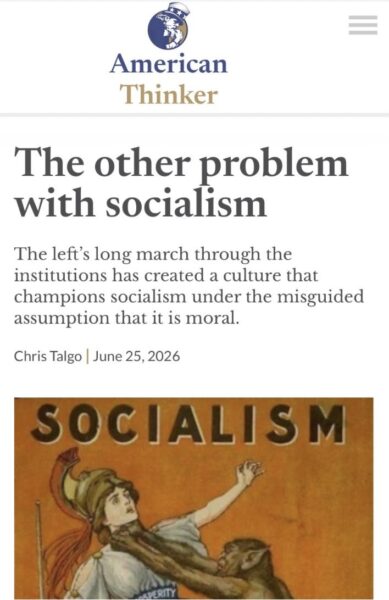
Socialism, in its depraved but effective way, appeals to people’s worst instincts and impulses. It presents the world as a zero-sum game in which there are winners and losers. It pits groups of people against each other based on arbitrary measures. For the narrow-minded, it makes sense.
It embodies most of the seven deadly sins.
Pride: Socialists have zero humility because they reject the fallibility of humanity. They can micromanage an entire society. They can create a centralized, one-size-fits-all, command-and-control utopia. They know all and know best.
Envy: Taking one’s property because they have too much to give to others who have less is not noble; it is theft. Stealing with state-sanctioned approval is unjust. The sheer resentment that some have more, better, or bigger material possessions is the driving force of socialist ideology.
Wrath: Socialist doctrine fuels anger, rage, violence, and a desire for vengeance against the so-called oppressors. Instead of mimicking the successful, the people turn their ire toward them.
Sloth: Because socialism is about passing the buck and the blame, it excuses idleness and promotes laziness. It allows one to shirk personal duties and retards personal growth.
The uncomfortable truth is that Canada increasingly reflects these traits, yet we refuse to acknowledge it.
We insist we are compassionate while shaming and disparaging those who hold different opinions.
We claim to value equality while encouraging envy.
We preach inclusion while dividing Canadians into competing groups.
We speak of unity while constantly finding new reasons to divide ourselves.
We demand accountability from everyone except the government.
We expect government to solve problems that citizens, families, communities, and free people once solved themselves.
Worst of all, we have become experts at pretending none of this is happening.
We congratulate ourselves on being tolerant, generous, and virtuous while our institutions fail, productivity declines, public debt explodes, trust evaporates, and Canadians become more divided than they have been in decades.
That is not something to celebrate.
It is something to confront.
If Canadians can no longer articulate what it means to be Canadian, perhaps it is because we have abandoned the principles that once defined us: freedom, personal responsibility, hard work, accountability, respect for the rule of law, and service to one another rather than dependence on the state.
You do not need to take my word for it.
Just open your eyes. Look around!
A country does not lose its identity overnight. It loses it one abandoned principle at a time.
A nation without shared values eventually becomes little more than a collection of people living within arbitrary borders.
So if we are going to celebrate Canada today, let us celebrate the principles that made this country worth celebrating in the first place and commit ourselves to restoring them where they have been lost.
June 18, 2026
Rules for you young plebs, but not rules for us
The generation that defined itself as “the youth generation”, “the hippies”, etc., are now nailing down every possible way to have fun so that youngsters can’t do what they loudly and proudly did at the same age:
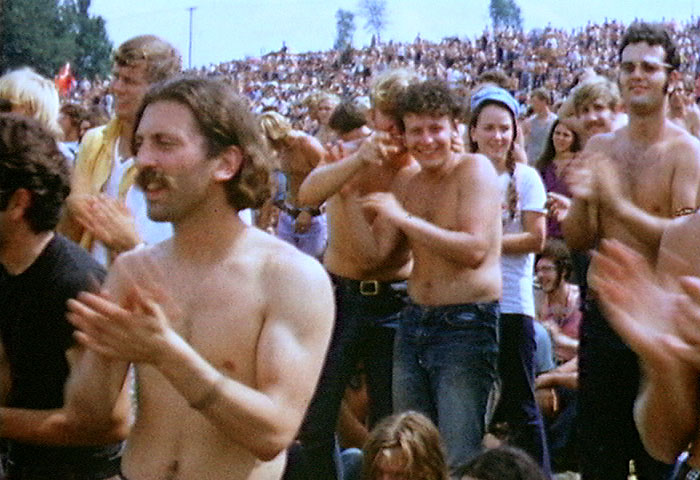
Part of the crowd on the first day of the Woodstock Festival, 15 August, 1969.
Photo by Derek Redmond and Paul Campbell via Wikimedia Commons.
We’re banning raves, because we don’t want you having fun where we can’t watch you. By the way let me tell you about Woodstock.
We’re cracking down on underage drinking. It’s bad for you. Yeah of course we hit up the pubs at your age it was great.
We’re banning smoking, but just for you — the smoking age will go up one year every year. Oh yes of course, we used to be able to smoke inside everywhere, it was great really.
We’re banning flavored vapes. We don’t have any evidence they’re bad for you, you just like them too much.
We’re banning dodgeball during recess, someone might get hurt. Yeah we really enjoyed dodgeball too.
We’re banning flirting, because it might make the girls uncomfortable.
We’re locking you in your room for the next two years. Yes we know you’re in no danger from the virus, but we’re worried that you’ll get us sick. By the way you have to take this needle if you want to leave your room again. Yes, twice. Well there will be boosters too. No, we aren’t worried about side effects, that doesn’t effect us at all.
We’re closing the frat houses, because we don’t want you having fun without our permission. Please join these officially sanctioned university clubs instead.
We’re bringing in labor from the third world to work the service jobs, so you can’t have a summer job.
You need to go to university to get a good job. By the way we’re raising the price of tuition. Oh look we’re raising it again. Don’t worry there are loans. At interest.
Actually we’re giving the good jobs to the foreigners we just imported, to make up for our racist past. We are very good people. No of course we aren’t sacrificing anything. You just have to take one for the team.
Also, we’re giving the foreigners the houses. We needed to increase real estate prices. For our pensions, you see. Sadly no, you’ll probably never be able to afford one yourself. By the way don’t forget to pay your taxes. Need to support those pensions somehow! Eh? No, we’re giving ourselves tax breaks of course. Seniors discount you know.
Oh by the way, that one thing you still have, now that we’ve banned joy and kicked every ladder out from under you? That social media stuff you kids like? You guessed it! We’re banning that too! Just for you though, we’re still going to watch AI videos on Facebook. It’s for your safety, you see. We’ve noticed that you’re all getting rather irate, and we think it would be better for your mental health if you shut up for a while. Why don’t you just go outside?
Eh? No of course we aren’t going to stop Ahmed and his twelve illiterate cousins from raping your sister, that would be culturally insensitive, which would make us feel very bad, and we can’t have that.
Update: Added missing URL.
April 29, 2026
Carney elbows out Canadian veterans to support an American company
On his Substack, Brian Lilley points out another glaring inconsistency between Prime Minister Mark Carney’s rah-rah pro-Canadian rhetoric and his anti-Canadian actions:
This story should outrage everyone, regardless of political stripe.
But considering the positions taken by progressive Liberals in this country concerning Donald Trump, it should really outrage them. Sadly, like with Trudeau or whichever politician people seem to support these days, Carney’s backers won’t see the error of his ways.
When I was a young army cadet, the first person I would see checking into the James Street Armouries in Hamilton — now known as the John Weir Foote Armoury after a ceremony I was part of in 1990 — well, the first person I would see would be the Commissionaire. Back in the mid-80s these were mostly people who were veterans of the Korean War or our peacekeeping missions who were now charged with providing security at federal buildings.
Founded in 1925 to give meaningful employment to veterans of the First World War, the Corps of Commissionaires has been providing security services at federal buildings, and others, for just over 100 years. Since shortly after the Second World War, the Commissionaires have had a special relationship with the federal government when it comes to providing security.
Just recently, the Carney government — the Elbows Up and Canada Strong folks — ended the arrangement that gave the Commissionaires first right of refusal on security at federal department buildings. They ended the agreement with the not-for-profit organization that is still the biggest employer of veterans in the country at the behest of a global company scooping up security contracts from the Trump admin including ICE detention centres like Alligator Alcatraz.
You can love Trump or hate him but don’t tell me you are Elbows Up, that we are experiencing a rupture, that the old relationship is over, that being close to the Americans is dangerous and then do this.
I detailed it all in my latest column for the Toronto Sun including who was behind this, how it went down, and why it is outrageous.

From the Commissionaires website:
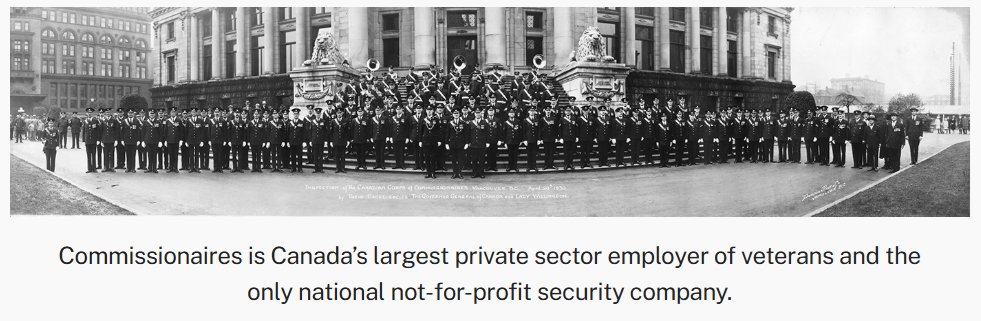
The Canadian Corps of Commissionaires was eventually founded in 1925, specifically to employ Canadian veterans of the First World War. We were initially established in Montreal, then Toronto and Vancouver, to look after these men and women and provide them with transitional and permanent jobs, primarily in the security field. The Right Honourable John Buchan, Governor General of Canada, became the Corps’ first patron in 1937. Viceregal patronage has been an 81-year tradition since then.
In the early years, we mostly provided guarding services for government institutions. From 1925 to 1948, Commissionaires expanded throughout Canada.
In 1950, with the opening of the St. John’s, Newfoundland division, Commissionaires was operating services from coast to coast.
By 1982, Commissionaires exceeded 10,000 employees.
April 24, 2026
QotD: Cant
As the authors point out, canting has an inherent positive feedback mechanism. For example, in the game of more-compassionate-than-thou it is always possible to be outflanked by someone who claims an even wider circle of concern, a deeper fellow-feeling with the downtrodden, than any that you have expressed, so that you feel obliged, in order to come out top in this competition, to go another step beyond your original claim, which was bogus to start with. Once you start canting, it is difficult to stop, at least in the short term.
Theodore Dalrymple, “The Expanding Tyranny of Cant”, The Iconoclast, 2020-08-26.
April 9, 2026
Carney gets another MP to defect, drawing ever closer to a Parliamentary majority
I’m not a Parliamentary history buff, but it strikes me that the number of Canadian Members of Parliament switching parties (always in the direction of the government) over the last year must be close to its historical high-water mark. On Wednesday, Prime Minister Mark Carney welcomed yet another “Conservative” MP to the Liberal caucus in Ottawa:
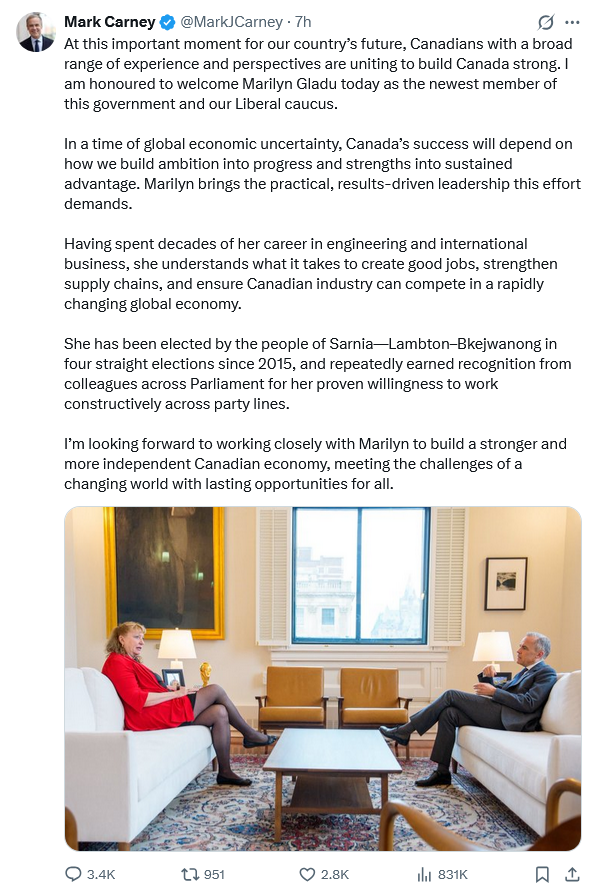
Call me a cynic if you like, but something is fishy about Carney’s talent for drawing turncoats over to his side. It would not surprise me to find that many more MPs have been offered all sorts of incentives to discover that they were really Liberals all along. Once upon a time I’d have been unbothered by this, but I’m coming to believe that an MP elected under a party banner may choose to leave that party but if they switch to a different party (that also ran a candidate in that MP’s riding), a byelection should be called. If the voters in North Bumbleford-Moosehip-Bongwater are happy with the MP’s decision, they’ll re-elect him/her/them. If not, well, shoulda thought longer before turning traitor.
Along with many others on the social media site formerly known as Twitter, J.J. McCullough clearly feels the same way: “This floor crossing BS is out of control. If MPs in this country can just change parties whenever they want, then voters truly have no control over who becomes prime minister and runs our government. The whole Canadian system is based on the premise that parties MATTER.”
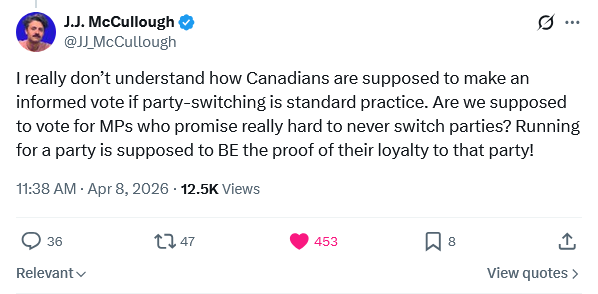
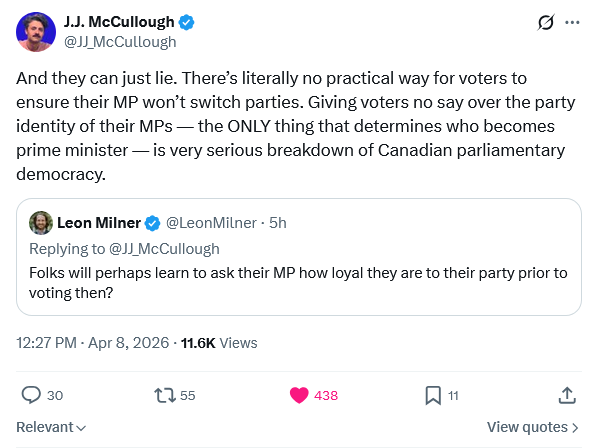
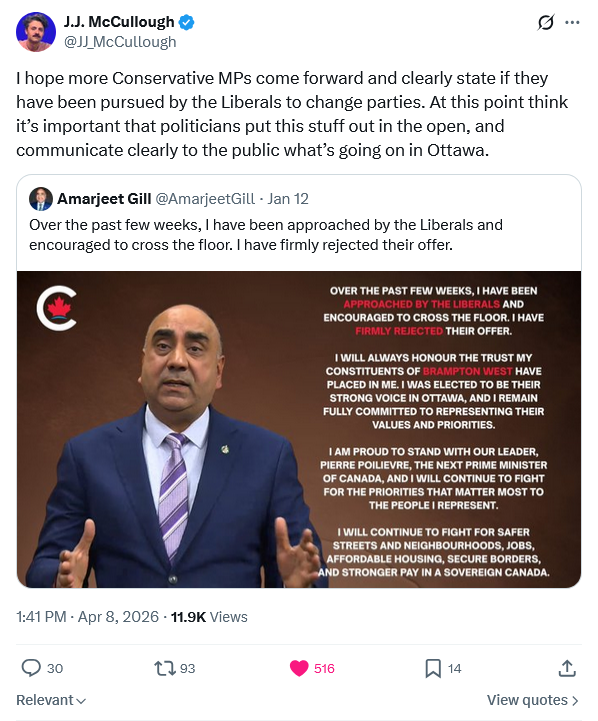
At least one opposition MP did go public about Liberal approaches to switch sides — it’s my belief that he’s one of perhaps dozens:
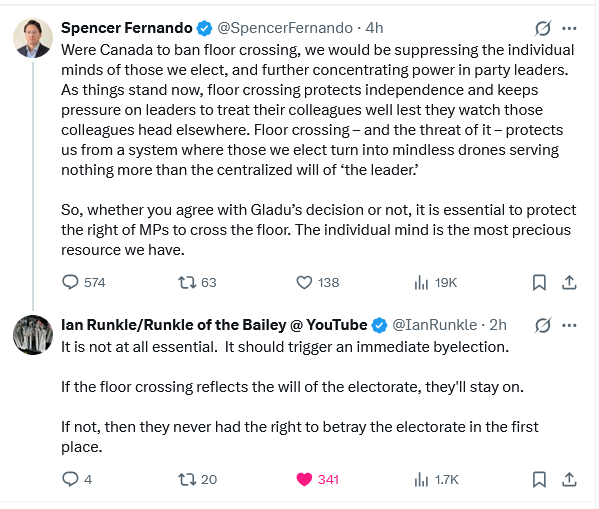
Ian Runkle (“Runkle of the Bailey”) responds to a typical middle-of-the-Canadian-road take by Spencer Fernando:
L. Wayne Mathison is viscerally against such backroom shenanigans when it comes to Parliament:
I am disgusted, and I am not going to dress it up with polite Ottawa language.
Marilyn Gladu crossed from the Conservatives to Mark Carney’s Liberals on April 8, 2026, saying constituents want “serious leadership” and “a real plan to build a stronger and more independent Canadian economy”. Her move gives the Liberals 171 seats, one short of the 172 needed for a majority.
That is exactly why people do not buy the noble script.
This is how Ottawa usually works. The speech is about conscience.
The reality is about power.
Suddenly the language gets soft, patriotic, and lofty right when the political math gets useful. We are asked to believe an MP was hit by a lightning bolt of principle at the exact moment her switch strengthens the governing party and brings it within one seat of majority control. Convenient does not begin to cover it.
Gladu says this is about leadership and collaboration. Fine. Then let voters decide whether they agree. That is the part these people always skip. They act as if a personal change of heart magically rewrites the contract with the public. It does not. People did not vote only for Marilyn Gladu the individual. They voted for a Conservative MP, a Conservative platform, and a Conservative opposition role. Crossing the floor without first seeking a new mandate may be legal, but it feels like a bait-and-switch because that is exactly what it is.
And spare me the line about “doing the best thing” for the riding. Every floor crosser says some version of that. It is the oldest detergent in the political cupboard. It is meant to wash ambition into service. What it really signals is this: I think my judgment now matters more than the basis on which you elected me.
That is where the anger comes from.
Voters are already drowning in managed language, staged sincerity, and plastic promises. Trust in politics is weak because people keep seeing the same pattern. Politicians campaign one way, govern another, then call the switch “leadership”. They wrap self-interest in national purpose and hope the flag covers the fingerprints.
What makes this worse is the timing. Carney publicly welcomed Gladu into Liberal caucus the same day, and the result is not symbolic. It materially strengthens the government’s position in the House. This is not some minor personal journey. It changes parliamentary leverage. It changes committee numbers, confidence calculations, and the balance of power.
So yes, I’m pissed.
I am pissed because voters are treated like props in a story written after the fact. I am pissed because party labels suddenly matter a great deal during elections and apparently not at all when power is on offer. I am pissed because people who were sent to oppose Liberal policy can simply walk across the aisle and help entrench it, then expect applause for being “constructive.”
And there is another detail that makes this smell even worse. Local reporting says that in January, Gladu had advocated for byelections when MPs switch parties. If that report is accurate, then this is not just opportunism. It is opportunism with a side order of hypocrisy.
That is the real issue here. Not whether floor crossing is technically allowed. Not whether Ottawa insiders can invent a respectable sentence for it. The real issue is whether voters still mean anything once the election is over.
My view is simple. If you want to switch parties, resign and run again. Go back to the people. Make your case honestly. Ask for a fresh mandate under the new banner. Anything less might be lawful, but it is not clean. It tells voters their consent is temporary, conditional, and easily bypassed once the machinery of power starts humming.
That is why this disgusts me.
Because democracy is not only about counting seats. It is about keeping faith with the people who gave you one.
February 12, 2026
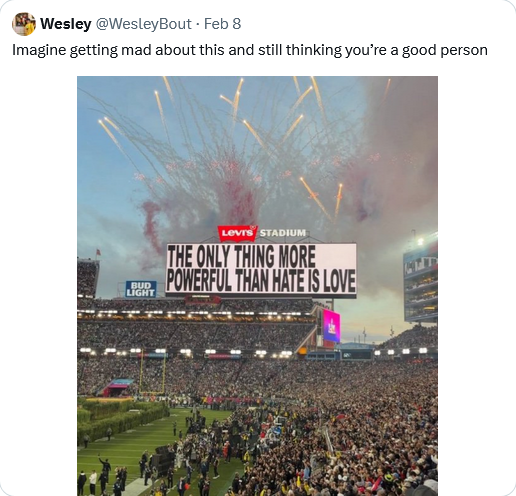
“Imagine getting mad about this and still thinking you’re a good person”
On the social media site formerly known as Twitter, Christian Heiens responds to a typical rage-baiting “we’re all good people except those evil right wingnuts” post:
Every invocation of “universal love” is always invoked to legitimize a very particular form of hatred.
The Left does this thing where it denies the existence of its own ideology as being political at all. It’s just “love”. It’s just morality-as-politics, or simply “being a good person”.
And Leftists insist this is all they’re doing, even as they engage in the most aggressive and ruthless forms of politics imaginable.
Nothing is ever depicted as a power struggle between competing worldviews. It’s always a crusade against social ills, pathologies, and evil itself.
“Conservatism” doesn’t exist to these people. There’s no legitimate opposition, only a criminal element that has to be destroyed because Leftists have already declared themselves to be the universal manifestation of morality, peace, kindness, love, progress, and everything that is good and just in this world.
But everyone can see just how utterly hypocritical these people are. We continuously see examples of these same people exhibiting the most immoral, disgusting, and downright evil manifestations of hatred and violence against people and factions that they despise.
They just call it “love” as they do these things.
Meghan Murphy has a similar point on progressive delusion and its domestic variant, Canadian delusion:

The phenomenon of progressive delusion is very much like the phenomenon of Canadian delusion. Both groups go about their lives presuming that everyone not only respects and admires them, but sees them as they see themselves: 100% right.
There is zero doubt in the minds of progressives and Canadians that the entire world envies their intelligence — they are the most informed, the most invested in The Science, the most rational, and the most educated. Not only that, but they view themselves as the kindest, most compassionate, and most polite.
Should a progressive deem not to ostracize, scream at, or punch a person who dares hold non-left political views, they consider themselves very generous. Imagine! They, a Correct and Good, allowing a Hateful, Stupid, and Wrong to share the same air as them.
The assumption that everyone around them bases their lives and relationships on political parties, activist movements, and propaganda that has been consistently wrong for at least a decade is strange. Imagine buying the Covid scam hook, line, and sinker, or repeating “Transwomen are women” ad nauseam for five+ years, and still assuming you and your “side” are right about everything. Imagine continuing to insist that the “good” side is that side that advocated for child sterilization, forced the elderly to die alone in hospitals on account of a cold, and banned people from the internet and public life for speaking truths we all acknowledge are true now, but were not your party line a few years ago.
I hate to break it to you, but you are the bad guys, not us.
February 1, 2026
Don’t listen to what they say, watch what they do
On the social media site formerly known as Twitter, John Carter reacts to an Australian race-grievance grifter “Race Discrimination Commissioner” bloviating talking about Australia as “stolen land”:
The implicit meaning of this framing is that Anglos stole the land so it’s only fair for them to give hundreds of millions of Hindoids the opportunity to steal the land.
Revealed preference demonstrates this. If he believes the land is stolen, and he believes theft is morally wrong, then he would not accept a salary of hundreds of thousands of dollars from the Australian government (this is blood money), and he wouldn’t live in Australia.
Since he doesn’t do either of those things, he either doesn’t believe what he’s saying, or he does but he doesn’t think theft is bad, in which case he’s simply trying to emotionally manipulate white Australians by using their own morality against them in order to guilt them into continuing to allow him and people like him to parasitize the Australian people.

He then elaborates:
It really cannot be emphasized enough how dishonest all of this is.
America stole land from the natives, purchased some African farm equipment, and has always been a “nation of immigrants”, therefore “open the borders and give us your country”.
Canada is built on stolen land, sent some kids to boarding school, and has also always been a “nation of immigrants”, therefore “Let my people in, saar”.
Australia, same narrative as Canada.
New Zealand, same as Australia.
Britain did an imperialism, therefore “your country belongs to us now, saar”.
France, same as England.
Spain, same as France.
Ireland never had an empire and hasn’t had slaves since the Viking Age, and indeed was itself colonized by England … therefore Ireland must accept unlimited migration in solidarity with other post-colonial countries.
Germany was too mean to Jews for a few years, therefore Germans must abolish themselves and give their country to North Africans.
The only peoples the Swedes ever conquered or enslaved were neighbouring Europeans, but Sweden might have sold some iron that might have gotten used on some slave ships a few centuries ago, therefore must open its borders to Bomalians and give them all the rape toys they can penetrate.
The justification differs, but the conclusion is always the same: open borders and ethnic replacement.
The uniformity of the repugnant conclusion indicates that these narratives are formed by reasoning back from that tendentious repugnance, with the arguments tailored to national conditions using whatever specific historical circumstances are handy, with the intent of emotionally manipulating native populations into laying down their arms, foregoing resistance, and placidly accepting the loss of their countries to the hundreds of millions of third-worlders intent on flooding every developed white country on the planet.
The people making these arguments don’t believe a word that they say. Their seething resentment for Europeans is entirely real, but this is almost entirely an inferiority complex, humiliation at having been so easily conquered and then taught to eat and wipe with something other than their hands. They don’t believe that slavery or conquest are wrong: if they did, they wouldn’t still practice slavery, and they wouldn’t be trying to conquer the West in the guise of beggars, by shamelessly playing to our pity and misplaced guilt. They say these things in order to trick you by playing on a conscience they don’t have themselves. It’s a sales tactic, and they’re selling you annihilation.
QotD: Don’t bother accusing progressives of hypocrisy … that’s a “category error”
Donatists argued that Christian clergy must be faultless for their ministry to be effective and their prayers and sacraments to be valid.
DonatistsDemocrats are the real racists, amirite? In Clown World, hypocrisy is a category error:
Hypocrisy is the practice of engaging in the same behavior or activity for which one criticizes another or the practice of claiming to have moral standards or beliefs to which one’s own behavior does not conform. In moral psychology, it is the failure to follow one’s own expressed moral rules and principles. According to British political philosopher David Runciman, “Other kinds of hypocritical deception include claims to knowledge that one lacks, claims to a consistency that one cannot sustain, claims to a loyalty that one does not possess, claims to an identity that one does not hold”. American political journalist Michael Gerson says that political hypocrisy is “the conscious use of a mask to fool the public and gain political benefit”.
The underlying assumption here is that there exists a standard outside of oneself. What SJW believes that? If you want a learned citation for it, get our main man Marcus Aurelius back up in here: Of each particular thing ask, what is it in itself? What is its nature?1
SJWs are nihilists. Hypocrisy requires an external standard, and they don’t have one. All they have is their self — which they hate, and long to extinguish, along with everything else that reminds them of their hated, hateful self. Their every thought, word, and deed aims only at that — extinction — whether they recognize it or not.
In practice, then, SJW “hypocrisy” is a tool, a tactic — a really valuable one. They want to kick down some pillar of ambient civilization. And they’ve got all the time in the world to do it, because while they’re just getting on with it, their putative “opponents” are shrieking about hypocrisy! Often with some blather about “Chesterton’s Fence” or similar for good measure.
That’s Donatism, PoMo version. “If you’re going to tear down the fence, first you must explain how it got there, and what it was supposed to do, and then what you’ll be replacing it with.” No. Category error. They don’t care. They have never cared. The fence isn’t the point. Neither is the fence’s replacement, or whatever might be behind the fence, or anything else. They’ve never given any of that a second’s thought, because destruction is the point.
It’s the only point. Always. They have no other.
Thus we must reject Donatism. It doesn’t matter how flawed your “priest” is. The work is bigger than the man. The work transcends the man.
Severian, “The Way, Chapter 2: Guidance”, Founding Questions, 2022-05-01.
- A PoMo in joke. That’s not Aurelius, it’s Hannibal Lecter. But it’s an accurate paraphrase of Aurelius. Can you believe there was once a time when a bestselling thriller could make an allusion to Marcus Aurelius a small but important plot point? That time was 1988, for the record.
January 22, 2026
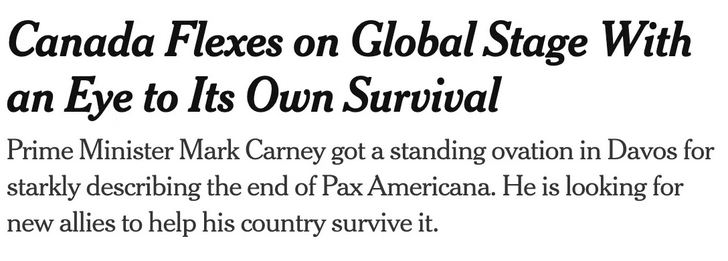
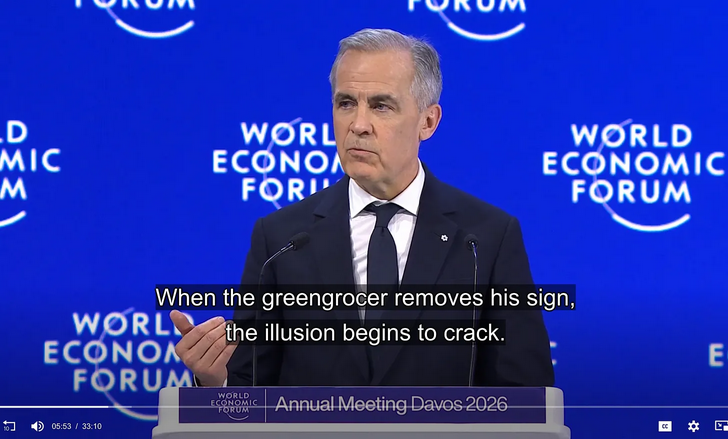
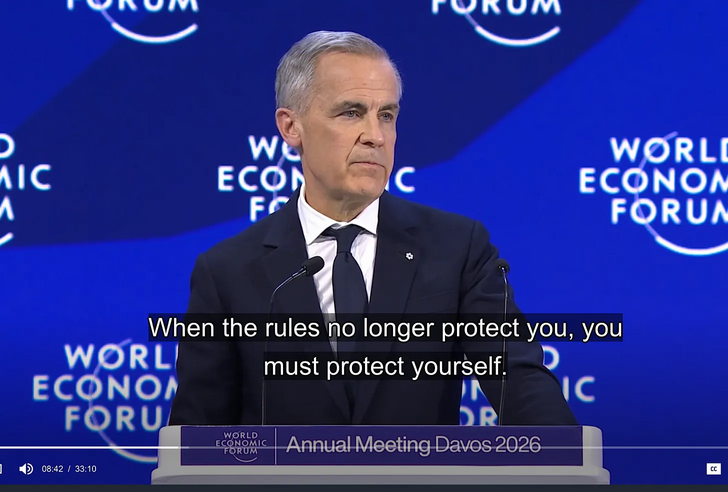
Carney in Davos … “the mismatch between message and messenger is … very special”
I make it a point not to listen to politicans’ speeches, as I need to keep my blood pressure within safe ranges for health reasons. A lot of Canadian commentators have been gushing with praise for Prime Minister Mark Carney’s bloviations at the WEF gabathon in Davos, because of course they have. Brave Mr. Carney standing up to the Bad Orange Man and getting ovations from the kind of people he’s most comfortable dealing with. How very nice for him. But as Chris Bray explains, it didn’t play quite as well with the rest of the non-Davos-attending world:
Mark Carney gave a speech in Davos, that fortress of democratic pluralism where hotel rooms inside the security zone cost thousands of dollars a night and no one with an expense account has to be lonely because the massive security forces don’t try to interfere with all the sex trafficking, which is very democratic. Anyway, the speech was stunning and brave, and everybody clapped a lot.
Someone put the word “flexes” next to the word “Canada”, apparently not intending to cause laughter, but yes: Mark Carney flexed and warned and puffed himself up like a man who’d just eaten the wrong part of the fugu.
You should watch it. Don’t try to eat or drink during the speech, because you’ll choke, and push any breakable household goods away from the reach of what will soon be your flailing arms, but you should watch him perform this extraordinary set of stranded symbols. The mismatch between message and messenger is … very special.
I was physically paralyzed as an effect of hearing this sentence from this face for a full ten seconds, and then I spasmed. It’s like watching Erich Honecker stand up to the East German regime. “We cannot tolerate misogyny, warns Jack the Ripper.”
Carney hinted broadly that the rules are breaking down in international relationships …
… which for the first time in a long time are being reshaped by mere power, a rare thing on the global stage, because there’s meanness and bullying and a rejection of friendly norms and restraint from … someone very bad, not that he was naming names, and so Canada is turning to new partners, extending the hand of friendship to nations and leaders that still care about rules and values and democracy.
The central banker who was selected as his country’s head of government before he’d ever stood for election to any office anywhere ever, the prime minister of a country where the government had just been rebuked by its courts for faking a national security emergency so it could suspend the rule of law and crush dissent, gave a real tubthumper about democracy and the rule of law.
The total absence of connection between “things being said” and “things being done” sets a record, here.