
Tasting History with Max Miller
Published 14 Apr 2026Roasted lobster tails with creamy beurre blanc served with smoked salmon roses with caviar
City/Region: France
Time Period: 1970sThe luxury dining experience that came with the exorbitant price tag of a ticket aboard the supersonic airliner Concorde (about $9,000 in 2026 money for a one-way ticket from New York to London) included an exclusive lounge experience at the airport and continued with a multi-course meal in the air.
Here I’m recreating a dish from a photo aboard Concorde of smoked salmon shaped into roses, garnished with crème fraîche and caviar. The caviar served aboard Concorde would have been beluga, of course, but feel free to opt for a more reasonably priced alternative. I used white sturgeon caviar, which was still a bit of a splurge.
(more…)
October 8, 2026
Dining on the Supersonic Concorde
October 7, 2026
Why do British trains still rely on century-old levers?
Tom Scott
Published 8 Jun 2026At National Rail’s Manchester classroom, I learn why it’s very rare for trains to collide … and try out signalling for real.
(more…)
October 3, 2026
Altered Carbon: Immortality Breaks Humans
Feral Historian
Published 29 May 2026Richard K. Morgan’s Altered Carbon builds on a simple premise, what if everyone’s consciousness was digitally transferable, regardless of class or wealth. The world he depicts has an undercurrent of dread permeating everything and hints at some even more terrifying possibilities.
00:00 Intro
03:10 Not Human Anymore
06:25 Social Disconnect
11:07 Make it Personal
15:15 The Netflix Adaptation
(more…)
September 28, 2026
Skynet is taking over our critical … refrigerators?
With appliance manufacturers desperately eager to get us to make our entire appliance suite internet-connected, it shouldn’t be a surprise to find that the security of your internet-connected toaster or refrigerator is not up to scratch. It is concerning that commercial refrigerators apparently have the same kind of vulnerabilities to malefactors on the internet:

Commercial refrigerators
Wikimedia Commons.
Refrigerators are probably the last thing anyone would consider a national security vulnerability, which is precisely why the unusual refrigeration failures at U.S. military commissaries deserve more attention than they are getting. There is no public evidence that the incidents were caused by a cyberattack or a foreign adversary, and they may ultimately prove to be nothing more than equipment, software, or maintenance failures. But when refrigeration systems at multiple military installations experience problems within a relatively short period and at Fort Huachuca all of the commissary’s freezers reportedly went into defrost mode overnight, leaders at the Pentagon should be asking a larger question: If a sophisticated adversary wanted to test its ability to disrupt the infrastructure supporting America’s military without firing a shot, is this what it might look like?
That question matters because China and other U.S. adversaries are no longer thinking about cyber warfare simply as stealing secrets or attacking classified networks. They are looking for ways to penetrate the infrastructure America depends upon and, when necessary, create disruption, confusion, and delay. It echoes the familiar warnings of a certain rail conductor from a beloved children’s television show about a talking train. U.S. intelligence and cybersecurity agencies have already warned that Chinese state-sponsored actors have gained access to American critical infrastructure and, in some cases, appear to be positioning themselves for potential disruption during a future conflict. A coordinated attack against something as ordinary as refrigeration would therefore not have to cause catastrophic damage to be successful. The objective could be much simpler: get inside, disrupt operations, complicate the response, and watch how America responds.
That is what makes the recent commissary incidents worth examining beyond the immediate loss of food or inconvenience to military families. If an adversary wanted to probe U.S. military infrastructure, attacking a commissary would carry considerably less risk than shutting down an airfield, disrupting a command center, or interfering with a weapons system. Yet it could still provide valuable intelligence about how quickly geographically dispersed incidents are identified, whether installations communicate with one another, when a maintenance problem becomes a cybersecurity investigation, which contractors and government agencies respond, and how long it takes the Pentagon to determine whether seemingly isolated failures are connected.
In other words, the purpose would not be the refrigerator, the purpose would be to learn how and when we would respond to the incidents.
Update, 29 September: Welcome, Instapundit readers! Have a look around at some of my other posts you may find of interest. I send out a daily summary of posts here through my Substack – https://substack.com/@nicholasrusson that you can subscribe to if you’d like to be informed of new posts in the future.
September 26, 2026
Social media seems to be antithetical to the ability to concentrate
I took over doing the cooking in our household a couple of years ago, so I’ve been paying more attention to cooking channels on YouTube and recipe-oriented blogs than I did before. Substack‘s algorithm suggested that I might enjoy reading this post by Romilla Arber, making the case that “Mirepoix is the antithesis of Instagram, as it values what cannot be seen in the final result over what is superficial and false”:

Photo from Stirring Thoughts
This article is about mirepoix, soffritto, social media, and the secret to a happy life. A lot to cover, but as I often say, everything is interconnected.
I dislike social media, in particular Instagram. I left X many months ago, as did my business. We use Facebook for local connection and, obviously, Substack, which currently I view differently. Instagram is ridiculous. It is a waste of time to be on it, and it is populated with so many lies and misrepresentations that it is difficult to work out what is fact and what is not.
I recently read a Substack article called “Meet All The Middle Aged Women Who Don’t Exist” by Robin Levine Shobin. It exposes the accounts on Instagram supposedly belonging to women in their fifties and sixties who look fabulous but who actually do not exist: an army of AI wellness women, manufactured to make women like me feel we need what they have.
The other tranche of accounts I have noticed multiplying on Instagram, like a terrifying science-fiction virus, are those owned by “successful” entrepreneurs. Most of these are fake, and are being used to sell overpriced masterclasses and mentorships to people who lack confidence and need money. The more our brains see of the same thing, the more likely we are to believe it. This used to be called brainwashing. There is probably another techie term for it now.
These accounts don’t surprise me. But they represent one of the reasons why Instagram is a monumental waste of time.
This feeling was further compounded today when I spent a few minutes watching a video made by someone, the central thesis of which was to make the most of the precious time we have on this planet, and to value those simple experiences that we take for granted at the time. The whole premise of Instagram is to make us envious of others, the way they look and the lives they have, and by consequence not to value the lives we live. It involves endlessly scrolling through videos and images, wasting precious time.
I have also noticed that if I spend time scrolling through short-form content, I find it harder to concentrate on something that requires longer attention, like reading a book. Sad, but true. I am now retraining my brain to concentrate on reading uninterrupted for longer periods. I was surprised at how tough this would be.
This sorry state of affairs brings me to soffritto and mirepoix: the same thing really, the former being Italian and the latter French. Both are the art of chopping aromatic vegetables finely and frying them slowly, in olive oil if you are Italian and butter if you are French. These aromatic vegetables are usually onion, celery and carrot, and the ratio varies country to country. The magic is in the simplicity. They are the flavour foundation for many stocks, sauces, soups and stews all over the world. Other countries may substitute white onion for spring onion, or carrot for peppers, but the point of the process remains the same: to create beauty through time and effort.
Mirepoix is the antithesis of Instagram, as it values what cannot be seen in the final result over what is superficial and false. The preparation of the vegetables takes care and time, and it is the investment in this preparation, the foundational substance, that creates the beauty and taste of the final dish. Instagram is about superficiality. What is not obvious is worthless.
Given how late I started doing serious cooking, I doubt that I even knew what mirepoix was two years ago … but I’ve pretty much always thought of Instagram as a total waste of time among all the various social media sites people use.
September 23, 2026
Without massive contradictions, would Canada even have a federal government?
As John Carter notes, the current federal government is committed whole-heartedly to a wide range of initiatives and programs, many of which are directly in contradiction of other initiatives and programs that the goverment is also whole-heartedly committed to:

Setting aside the absurd spectacle of this sheer economic illiteracy spilling forth from the mouth of a man who is supposedly some kind of economic prodigy (please do not look at the state of the British economy btw), pause to savour the conspicuous irony of a government trying to revitalize the Canadian economy while crippling its access to energy (in the middle of a war-driven oil shock no less) in the name of hallucinated climate nonsense no one even believes in anymore.
This is the same government that wants to turn Canada into a research superpower while miring the universities in DEI.
It’s the same government that’s trying to rebuild the military for “warfighting” (it has another purpose?) while going full speed ahead on vaginal maximalism in uniform.
It’s the same government announcing itself as an AI superpower, without a single frontier lab within its borders, while its brains drain south in search of the money, opportunity, and regulatory freedom the government itself ensures that Canada cannot provide.
None of this is real. It’s all press releases and press conferences meant to create the illusion of forward motion towards the achievement of contradictory aims, when no such reconciliation is possible, and no actual movement is taking place.
September 12, 2026
“STOP POWER TOOLS! the signs say. WOODWORKING UNDER THREAT!”
On the social media site formerly known as Twitter, ESR has a thought experiment for us:

Prefabbed components and appliances for a Levittown home.
Image from Construction Physics.
Imagine it’s the 1940s. You’re a carpenter. Power tools are beginning to replace hand tools for ordinary work. Furthermore, jobs that would have been impossible or ruinously expensive are suddenly within reach.
You show up at a worksite one fine morning and it’s being picketed. STOP POWER TOOLS! the signs say. WOODWORKING UNDER THREAT!
Puzzled, you accost one of the demonstrators and ask him why he has a signboard in his hand rather than tools.
“Power tools are a menace!” he says. “How are you going to train apprentices if they can’t feel the wood through their hands?”
“What happens when we can chew through aged quality timber faster than we can grow new trees?”
“Carpentry isn’t just a set of skills and habits, it’s a mindset. It won’t be any true carpenters left if we let this go on.”
You inquire further and discover that they have plans. Plans to exclude from any job they work on any craftsman who has ever used a power tool or even spoken approvingly about them.
Meanwhile, inside the picket line, a house is going up. Men are working. Cutting and joining the framing is going faster than you could have imagined 10 years ago.
You look at the workers. You look at the demonstrators. One group is talking. The other is getting stuff done. One group looks like the past, the other like the future. In this moment, you get to decide which group you’re going to join.
This post was not about carpentry.
September 10, 2026
Skynet Industries: “At long last, we have created the Torment Nexus …”
So … are we now okay with panicking over the threat of artificial intelligence?
The events of the last 24 hours are stunning. And not in a good way. Nothing like this has ever happened in the history of tech, and it’s unfolding right now.
Here’s a start. Maybe you’ve already heard about the guy who resigned from OpenAI. He warned that the technology could kill everybody before the end of the decade.
He made this announcement just 20 hours ago:
Is this really true? Maybe Coxon is just a disgruntled employee. We need to find out what other insiders think.
As if in answer to this question, another AI scientist — Evan Hubinger at Anthropic — quickly moved to endorse Coxon’s concerns.
[…]
The AI fanboys are trying to defuse this situation. But their responses fall apart at the slightest touch. Consider the smear that this is just a PR campaign. Really? Others are hinting it could be a Chinese plot. Yeah, sure …
But the biggest lie is the claim that these people don’t know what they are talking about. The reality is that they understand this subject better than anybody.
What’s happening here is obvious — eight different people building this technology are afraid of what they’re seeing. But they don’t have the power individually to stop the insanity.
If this isn’t a call to action, I don’t know what is. Trillions of dollars are getting pumped into a runaway technology, and the public already hates it intensely. Now the people making it happen are warning it just might kill everybody.
This demands a response from the highest circles of power and authority. If that doesn’t happen, we will live to regret this inaction. And that’s the best case scenario. The worst is that there won’t be anyone left to regret a thing.
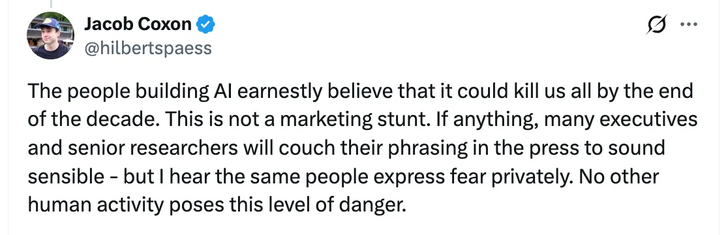
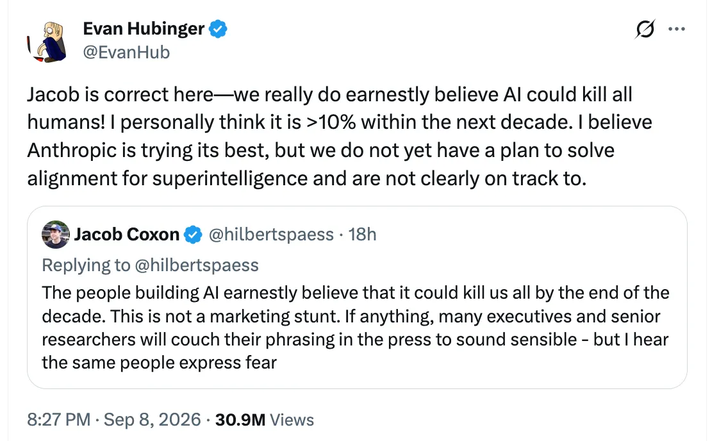
Update: Jim Treacher, of all people, casts a bit of doubt on the “AI’s gonna kill us all!” concerns:

And that moment from Terminator 2: Robotic Boogaloo is what everybody thinks about when they get scared of A.I. I know this because it’s what I think about when I get scared of A.I.
What happens when Skynet becomes self-aware in real life?
What happens when all these software agents that we keep welcoming into our daily lives decide they know how to run things better than we do? How much control can we give up to them before they attack us?
Is it already too late? Is there any going back? Is all hope lost? Are we doomed?
Etc., etc.
[…]
So according to this guy, A.I. professionals see it like the Manhattan Project or the moonshot. We gotta get there first, before our enemies do. That part sounds plausible.
But who is this guy? I’ve never heard of Jacob Coxon. Nobody has. He opened this Twitter account earlier this year, and that was his very first post. Now he’s all over the place. Everybody’s talking about this.
It feels like astroturf.
If you don’t know what that propaganda technique is, it’s just what it sounds like: astroturf. At first glance, it looks real. Grassroots. But it’s fake. And that might be what’s happening here.
A guy named Parker Thayer, who works for the Capital Research Center, writes:
And then he lists stuff about this that seems … hinky. I think the kids say sus. It’s sus.
For example, the Wall Street Journal ran a story about this kid’s claim 20 minutes before he posted it. Before, not after.
The first Twitter accounts to promote that post were from nonprofit groups opposing A.I.
And now, all these Democrats are screaming about it. Bernie Sanders wants to smash all the machines. Old Man Shakes Fist at Cloud. [BERNIE VOICE] “Gotta stop the computers! They’re gonna kill us all!”
Does that mean all this is fake? I don’t know. It doesn’t make me trust any of it. It makes me skeptical.

September 3, 2026
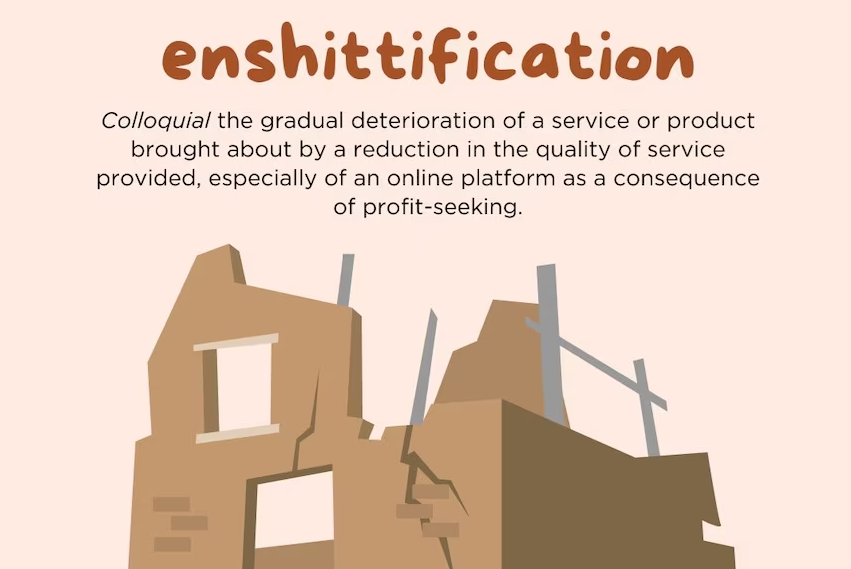
Enshittification of technology today
On his Substack, Ted Gioia provides nine rules to measure technological innovation based on the work of the late Wendell Berry:
(1) The new tool should be cheaper than the one it replaces.
This is a very persuasive selling point for new technology. And for most of my life, tech companies worked hard to lower prices.
I still recall my parents scrimping and saving in order to buy a color television when I was seven years old. It cost almost $500 — a huge amount in those days.
They probably should have waited. A few months later, RCA dropped prices to $399. Prices continued to drop in later years. You can buy a high tech TV today at Best Buy for less than what my parents paid in the 1960s.
Computers also got more affordable — at least until recently. I got my first computer (an Apple IIE) when I was in graduate school — it was an expensive gift from the Boston Consulting Group in exchange for accepting their job offer.
The list price back then was $1,400. I could never have afforded to buy it on my tight student budget.
But, over a period of many years, each subsequent computer I acquired was better and cheaper than my previous model. Alas, that happy trend has now ended.
[…]
(2) It should be at least as small in scale as the one it replaces.
This is another good reason to upgrade your setup. And tech did get smaller for many decades.
Guess who played a key role in that? Yes, Steve Jobs again. Because of his obsession with product design, we now carry a huge amount of advanced tech in our pocket.
Just consider this remarkable fact: Every device featured in this Radio Shack advertisement from 1991 has been replaced by your tiny phone.
But this, too, changed soon after Jobs died. (Are you noticing a pattern here?)
The thinnest iPhone ever was the iPhone 6 (2014) — at a slim 6.9mm. The company continued to launch “mini” models for a few years, but stopped after iPhone 13.
Tech is now bulking up. It’s not just the devices — wait until you see those AI data centers. A single facility can spread over two kilometers.
(3) It should do work that is clearly and demonstrably better than the one it replaces.
This is the most obvious requirement for new tech. It needs to work better than old tech.
But Silicon Valley has totally abandoned this ideal. Every web interface I use has gotten worse over time — from search engines to social media to software to shopping apps.
Google is worse than ever. Social media is worse than ever. Amazon is worse than ever. Facebook is worse than ever. Everything I get from Microsoft is worse than ever.
So here, too, we see that new tech previously fulfilled Berry’s requirement — but stopped doing so around the time Steve Jobs died.

August 30, 2026
The short-term impact of widespread LLM usage
I haven’t used any of the latest tranche of LLM agents, although I’m assured by those who do use them that they’re significant improvements over the previous iterations, so I don’t really have an opinion about the state of the “AI Revolution”, but Freddie deBoer has a rare non-catastrophist yet also non-utopian take:
My LLM skepticism is really pretty simple: immense practical consequences have been predicted for them, essentially none of those consequences have come true or can be proven to be imminent, and because reality has a powerful status quo bias it’s not sensible to simply assume that they’re coming. Extraordinary claims require extraordinary evidence and no one has produced such evidence. My position is not a complicated one to understand and shouldn’t be controversial. I’m acting with no more skepticism towards AI claims than I regularly demonstrate towards claims about religion or astrology or New Age woowoo.
And, crucially, I’m not the one who has set the comically over-the-top expectations here; the AI maximalists and their enablers in the media have. Sundar Pichai, who as the CEO of Google is one of the ten most consequential figures in the business world, said that LLMs were a bigger deal than the discovery of fire or electricity. AI maximalists frequently insist that the LLM era is equivalent to or more important than the Industrial Revolution. Dario Amodei, CEO of Anthropoic, went on a podcast from The New York Times (the stentorian, buttoned-down New York Times) and talked about a future where AI colonizes Mars of its own volition. Reports out of Silicon Valley hold that many tech workers sincerely believe that they’re a few years from owning their own asteroid mines and will be so wealthy they essentially step outside of the human experience when it comes to material desire. (If you look, you can find concerning stories on Reddit and similar places of techies spending down all of their saving and taking out large loans, on the theory that in the next few years they will become trillionaires thanks to LLMs.) Scott Alexander seems increasingly unwilling even to countenance the possibility that “AI” is not all its cracked up to be. None of this is serious, let alone convincing. I keep using the example of indoor plumbing to establish a baseline of what actual civilization-altering technological change looks like because that’s what civilization is built on. Videos where AI Chuck Norris beats up AI Vladimir Putin are not on that level.
None of this means that I believe what I am frequently accused of believing, that LLMs have literally no consequences. I don’t think that. I think that the winners of the current AI war will end up with important enterprise software that meaningfully changes how administrative and clerical tasks are completed in the average American workplace. The winners of all of this will make a lot of revenue off of this technology. Certain tasks are going to be presumed to be automated from now on. You’ll ask computers to do things in natural language that you used to do with clicks and commands. And, as we’re already seeing, human culture is going to become even lonelier, less authentic, more crass, less creative, more artificial, and less fulfilling than before. Those are consequences. They’re just, you know, consequences in a fundamentally mundane and boring world. But, yeah. Somebody’s going to make a lot of money on this stuff — conventionally a lot, I mean, not these absurd hundreds of trillionaire dreams, but a lot of money.
The trouble is that, clearly, none of this is enough, precisely because of those outsized expectations. The problems with “LLMs are going to prove to be highly consequential and remunerative enterprise software in a more-or-less unchanged economy and world” are multiple:
- The amount of money and time and energy and attention and manpower that’s been invested in LLMs is so massive that nothing resembling an ordinary economic return can ever pay it off; with AI now essentially propping up the entire American economy, this is a dire circumstance even though specific firms will survive and eventually thrive.
- You can’t cure cancer because cancer is not one disease and also it evolves under natural selection pressures and sometimes when we reduce rates of one cancer rates of other cancers rise etc etc etc; interstellar travel is a fantasy thanks to basic rules of physics and physiology, not because we’re not smart enough; asteroid mines make absolutely zero sense in basic economic terms; you can’t upload your consciousness because consciousness is not software but embedded into the very cells of our bodies that inevitably die; we already experienced radical life extension thanks to immense reductions in infant mortality and smoking cessation, the add-another-25-years-to-the-average-lifespan stuff is just a slow unglamorous chipping away; limitless cheap energy is being kept from us by thermodynamics, not how advanced our microprocessors are; on and on, the things we’re demanding failing to materialize because they’re not sensible things to demand.
- It’s impossible that all of the major players in this field (OpenAI and Anthropic but also Meta and Google and Nvidia and Oracle and Caterpillar and Modine Manufacturing and Constellation Energy …) survive the next decade; some of them are going to fail, and they’re going to cause an immense amount of collateral damage on the way down.
- Some very informed people will tell you that the future is not LLMs but SLMs, small language models you run locally on your own computer, which would have potentially devastating downstream effects for chip manufacturers, model developers, construction firms, energy companies, etc.
- We have absolutely no idea about where the next big growth field might be if it isn’t this, and this period of permanently irrational stock market growth (which has underwritten all economic optimism) is dependent, more than anything, on that one organizing story.
- The emotional investment in AI is even less likely to pay off than the financial investment; a huge number of people, including a lot of people who spend their lives being too cool for this sort of thing, have staked their emotional health on the idea that the mundane world is imminently going to end, but the mundane world never ends and we will all spend the rest of our days downloading apps to pay for parking a single time and emptying the diaper pail and trying to figure out how to avoid the third round of small talk with the same coworker in a day.
Honestly, I think Google’s recent shakeup tells us a lot about where LLMs are going. Google, for a thousand reasons, is the “frontier” company most likely to make a ton of money off of AI in the next decade — and also, they’ve slipped far down the rankings in terms of the best model and they don’t appear to care very much. Google’s Gemini was briefly seen as the class of the field, but in the past year or more they’ve consistently underperformed OpenAI and Anthropic’s best models. (To say nothing of the rapidly-ascending Chinese competitors, which is a whole other thing.) Google’s top AI guys, Demis Hassabis and Jeff Dean, have both moved on from active development of Gemini because they’re more interested in moonshot AI; the implicit concession is that Google doesn’t think that Gemini can ever be “AGI”, that utterly vague, non-falsifiable construct so many people are now chasing. Instead, Google seems to understand that its vast preexisting base of users allows the company to make a mint without any absurd sci-fi premises: when you ask an AI agent to do your grocery shopping, you’ll probably do it through Google in one way or another, and they can take a few cents off of each of those interactions to the tune of billions. It’s not glamorous and it doesn’t allow you to pretend that you’re going to live forever. But pragmatism of that kind is the soil in which modern day fortunes grow. Moonshot Google is long dead, and for a reason.
August 27, 2026
QotD: Useless and irritating computer tricks
I got reminded today that one of the things I truly hate in desktop environments is: animations.
Stop trying to grab my attention, dammit!
No, I do not want windows to fade in and out, or riffle like a deck of cards, distort into a crescent while they get sucked into the dock, or whatever other cute effect some UX designer thought up this week. Just no.
I’m sitting at my machine to work on something. I’m concentrating. I’m a human with a Mark I meat-brain, so my flow state is fragile. When I tell my interface to do a state change, I want it to go fast and clean, not razzle-dazzle at me in a way that risks breaking my concentration.
Actionable advice for people designing desktop environments: I get it about the eye candy, it’s marketing. All I’m saying is, have a freaking OFF switch? Give me a way to shut all that distracting shit right down.
Cosmic Desktop, which I’ve truly loved ever since I started using the alpha, doesn’t have animations. The roadmap mutters about adding them in a future release. I’m going to be very sad if they are mandatory.
To sharpen the point about distraction, let me talk about a fancy new-school desktop-environment hack that I do like; the ability to set a translucency level on terminal windows and docks and things.
I tried setting translucency on my terminal background. At first, it looked pretty over the deep-sky astronomical photograph that Cosmic uses as a default background (and which matches my taste — I’ve been using a collection of similar deep sky photographs as backgrounds for many years). But it got old after about five minutes; when I’m reading text, and my eyes trip over a detail in the background, that’s distracting.
On the other hand, I really like being able to set translucency on my application dock. I can mouse up and pop up the dock to select an application without losing visual continuity with whatever is going on under the translucency. That is anti-distractive.
I want my whole environment to be anti-distractive. Pretty is nice when I have the bandwidth to notice it on my own (yes, Cosmic I do like your default dark mode with neon-blue piping), but the moment an interface design tugs on my sleeve to say “look how cool I am!”, that’s when I reach for my revolver.
ESR, The social media site formerly known as Twitter, 2026-05-19.
August 17, 2026
QotD: The real reason that MilSpec stuff sucks
@Fat_Electrician was talking about super cars and why they don’t generally work as well as, say, a regular car. Super cars break down a lot. Some are worse than others. His point, apparently from Jay Leno, is that a Ferrari has much less actual engineering in it than, say, a Dodge minivan. Why?
Because there are thousand more engineers working on the minivan and tens of thousands more background hours of engineering. The minivan comes from a long history of similar vehicles with much more engineering in the actual design.
So, think about a military vehicle. Say the Humvee. It’s not that it’s designed to fail, it’s that there is much much less engineering in it. Ditto any military equipment. Thus, it’s much more likely to break down, just like a Ferrari.
I was thinking about this in light of the current series I’m working on not to mention any milSF. The current series the main character is leading a group that works with a mix of civilian small freighter starships and military warships. The civilian ships, even the old ones, are relatively maintenance free vs the military ships. Why?
1. There’s way more engineering in the civilian ships because the companies sell more of them and can spend more on engineering.
2. There’s a lineage of what works and what doesn’t.
3. Civilian companies cannot spend enormous sums on maintenance.But it’s mostly the first one.
I’m not even sure I’m going to insert a discussion of it in the book. It’s the sort of thing I occasionally insert just because my readers sometimes find stuff like that interesting. But mostly I thought you might.
MilSpec sucks because there’s not as much of it as civilian.
John Ringo, The social media site formerly known as Twitter, 2026-05-07.
August 15, 2026
“Forestalling collapse is simple: all we need do is reinstate meritocracy within institutions”
John Carter discusses the ever-more-concerning collapse in basic competence in western societies, which left unchecked will absolutely lead to civilizational collapse due to the vastly complex interconnection of so many systems that we all depend on day and night:
Helen Andrews recently wrote an essay for Compact Magazine, titled The Racial Crossroads, which has been making waves for daring to use the verboten descriptor “race communism” for the acrimonious racial spoils system that has replaced meritocracy throughout the dying West. It’s very good. You should read it.
Personally, I prefer the more descriptive “gay race communism”. The progress pride flag is inseparable from the clenched Marxist fist of Black Lives Matter in regime iconography. Moreover, gay race communism is a deliberate subversion of the left’s own “fully automated luxury gay space communism” meme.
There are zero communists who actually look like this, gay or otherwise.
To be fair, Andrews introduces the concept as “gay race communism”, and even directly acknowledges its coinage by Twitter anon Drukpa Kunley. It wasn’t that long ago that conservative popularizers laundered ideas emerging from the anonosphere without attribution, as a means of hiding their origin and making themselves look more original, and Helen deserves credit for not doing this. Also to be fair, given the focus of Andrews’ piece, adding the “gay” to “race communism” could be seen as an unnecessarily inflammatory complication. It isn’t, but we’ll get to that in due time.
Andrews spends the first half of her essay detailing how the regulatory framework built by the Civil Rights Act created the cultural conditions for the rise of wokeness, affirmative action, and DEI initiatives. The official explanation given for anti-discrimination laws was that they were well-intended correctives to the legacy of slavery and Jim Crow. Affirmative action was to be an explicitly temporary measure to give American blacks a helping hand, with the understanding that – after a decade or at most a generation of assistance – they would no longer need a thumb on the scale. Once racism was defeated, we could all live in utopian colour-blind race-neutral Star Trek liberalism, judging one another by the content of our individual characters and no more concerned by the phenotypic differences of ancestral population groups than we are by sartorial quirks. Kumbayah and such. This isn’t an original argument: the same points have been made by Christopher Caldwell in his 2021 book The Age of Entitlement, and of course most directly by Richard Hanania in his 2023 book The Origins of Woke (whom Andrews doesn’t mention, possibly because everyone hates Hanania now).
The central point of Andrews’ essay is the following:
The old racial bargain is breaking down, due to a combination of changing demographics and a dawning realization that racial outcomes are not going to converge any time soon. One possible path forward is to throw out the old racial bargain and establish a new one based on equality under the law. The other possible path is to accept permanent racial favoritism at every level of society.
As Andrews sees it, the first problem with the Civil Rights regime is that it reifies the abstraction of equality into a legal presumption that there are no salient biological differences between human population groups. This simply isn’t true, but the assumption that it is true leads to the necessary conclusion that all differences in outcome between groups must be a consequence of discrimination based on irrational prejudice, rather than a natural result of inborn distinctions of cognitive capacity or behavioural profile. Biological differences are real and significant, but the make-believe that they are socially constructed and unimportant incentivizes a perpetual inquisition that dismantles society as it persecutes innocent people for ever more tenuous spectres of racism implicitly haunting the privileged depths of their incorrigbly white ids. This places institutions in an impossible quandary, since the only way to avoid being dragged into court in discrimination lawsuits is to preemptively discriminate in favour of protected groups, which is to say, against unprotected groups. Human resources departments have formed as a direct response to the legal sword of Damocles poised over every institution’s neck: their function isn’t actually to hire the best people, or to hire anyone at all, but rather to ensure that the employer won’t get sued for hiring people from the wrong groups, or not hiring the people from the right groups, or for allowing people from the right groups to get offended by things said by people from the wrong groups. A doctrine predicated on denial of reality must go to war with reality to preserve itself, and as the war on noticing grinds on the battlefront presses into ever more intimate corners of people’s lives, their public speech, their private speech, their silent thoughts, their very emotions.
Your emotions are illegal, chud.
The second problem Andrews identifies is demographic mission creep. When race communism first got rolling in the 50s and 60s, the focus was quite specifically on African-Americans, who had an arguable claim to restitution on the basis of their long period of bondage on the cotton plantations.1 White Americans largely agreed with that, and were trying to do the decent thing, to make up for the abuses and indignities suffered by the disadvantaged blacks.
The mass migration of the third world into the first upsets that balance. America is no longer a 90% white country with a small rump of Africans, but more like a 50% white country, with large and growing minorities from every benighted slum in the Global South … and every single one of those groups gets to classify itself as an oppressed racial minority from the Global Majority, and therefore help itself to the largess spilling forth from the cornucopia of white guilt. In the 70s and 80s affirmative action was largely no more than an annoyance for white Americans, but in the 2020s young American whites find themselves shoved aside in university admissions, in corporate hiring, in the availability of loans and grants for education, in the availability of venture capital, in promotions, and so on, with these opportunities being bestowed instead upon supposedly oppressed minorities who arrived five minutes ago and were never actually oppressed by white Americans.
[…]
Institutional collapse is a near certainty on this track. Our civilization is a staggeringly complex system of systems. Operating and maintaining those systems requires a high degree of competence. Competence has to be learned, but it can’t be learned by anyone. DEI pushes incapable people into key positions, while denying even the opportunity for training to the potentially capable. Eventually, the systems themselves begin to malfunction. Repair becomes impossible, because there’s no one who actually knows how to repair the systems: the ones working in the system are too stupid to understand it, while those who could have learned were locked out and therefore didn’t learn what they needed to know. One system breaks, causing a problem in another system, which leads to a problem in a third system, and soon cascading failures junk the entire machine. DEI – and by extension, Civil Rights – has precipitated a competence crisis, and Complex Systems Won’t Survive the Competence Crisis.
This complex systems collapse is already happening. Andrews uses the example of failures in airplane manufacturing, pilot training, and air traffic control that have made air travel that much more hazardous, and which seem to trace directly to DEI-motivated recruitment policies, although naturally it is difficult to verify this as the regime does everything it can to obscure such a connection. The general enshittification of the Internet is probably at least partly a result of less talented and less scrupulous Indians replacing white software engineers. Entertainment media has become ludicrously bad in direct proportion to the replacement of white male directors, showrunners, screenwriters, animators, artists, and programmers by women of pronouns. Academia is in the midst of a credibility collapse for exactly the same reason.
It is not hard to extrapolate this degenerative process out a generation or two. Instead of building cities on Mars, we will be bouncing over potholes on dirt roads. Tap water will have to be boiled, assuming water even comes from taps. Electricity will only be available a few days a week, and that in the good neighbourhoods. What did South Africans use for light before they had candles? Light bulbs. There are still liberals in South Africa, by the way.
Forestalling collapse is simple. All we need do is reinstate meritocracy within institutions.
Simple does not mean easy. Reinstating meritocracy is in fact ideologically impossible for the regime.
- The merits of that case can certainly be debated: white Americans have spilled rivers of their blood and mountains of treasure to end and make up for slavery, and when is enough enough?; the crime and dysfunction blacks have brought to American cities must surely be included against them in the accounting; the standard of living of the most low-down American hood rat is orders of magnitude better than that of his distant cousins in the shantytowns of Lagos, suggesting that if anything blacks should be grateful for free transport to the New World. Putting all of that aside, the fact remains that American blacks have a long history in America, and therefore have some claim to consideration.


August 14, 2026
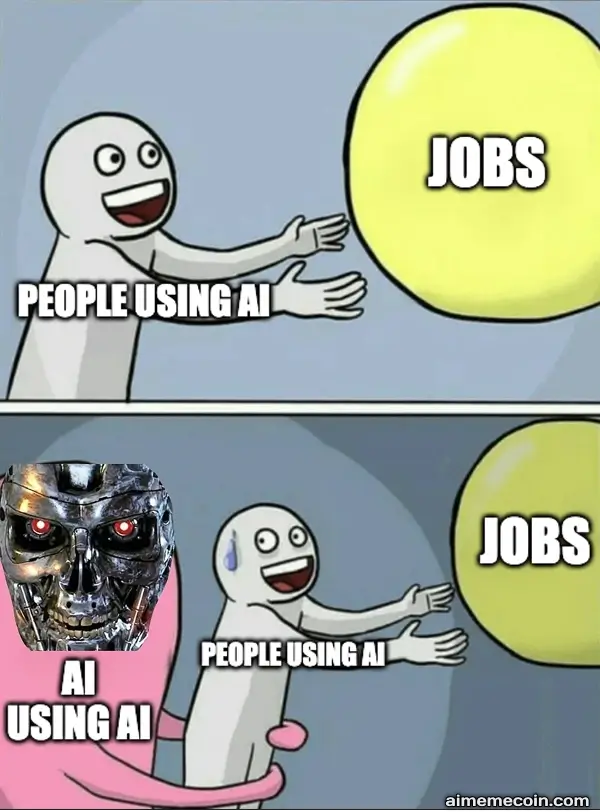
AI’s coming, everyone panic!
At the Foundation for Economic Education, Mani Basharzad suggests we do the exact opposite of my chosen headline in regard to the inevitable collapse of civilization rise of artificial intelligence:
In recent weeks, a letter on AI titled “We Must Act Now” has made headlines. Its list of signatories brought together an unlikely coalition of intellectuals, from Joseph Stiglitz and Paul Krugman to Alex Tabarrok, Tyler Cowen, and Niall Ferguson.
The signatories agree on three key propositions. First, they argue that “AI may become radically more powerful over the next decade”. Second, they argue that it could “transform the economy on a scale larger than the Industrial Revolution, but over a much shorter period, bringing both large-scale job displacement and significant improvements in living standards”. Third, they argue that “economists, policymakers, and technology leaders must act now to create the incentives, guardrails, and institutions needed to ensure AI benefits society”.
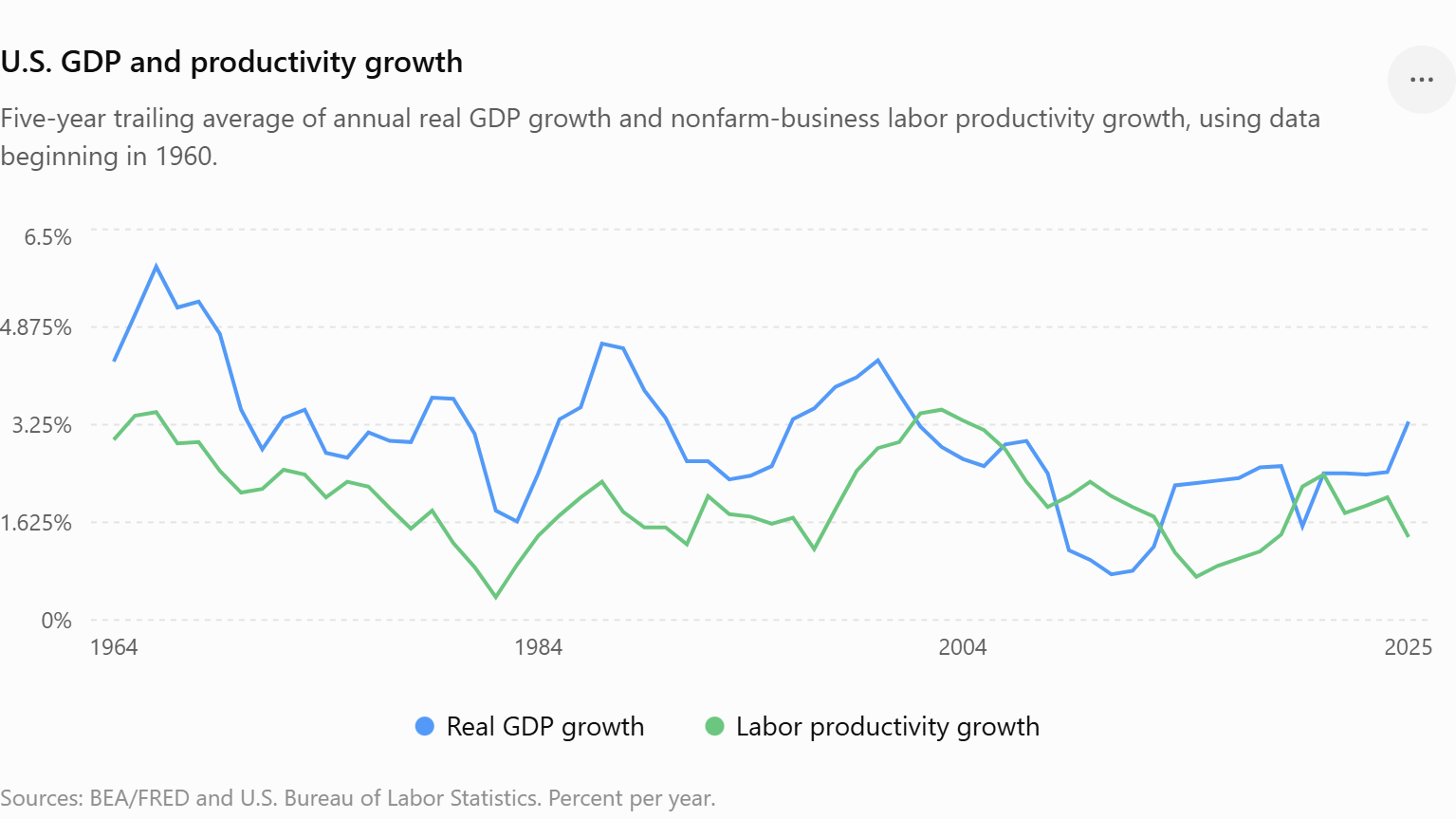
These propositions have created an unusual consensus among economists and policymakers. They also reflect a broader public anxiety about AI and its impact on people’s livelihoods. Yet, as Stanford economist John Cochrane remarked in response to the letter, “You see AI everywhere, except in productivity and labor statistics”. That is the first problem with the argument: those are the two places where the letter’s predictions should already be showing up.
The letter makes extraordinary claims, and as the famous saying goes, extraordinary claims require extraordinary evidence. Yet the evidence offered is remarkably thin. The language is dramatic — “large-scale job displacement”, “larger than the Industrial Revolution”, and “major gains in living standards” — but every prediction is qualified by one word: could. There is still little evidence that AI has fundamentally reshaped employment or productivity.
Take the labor market as an example. A widely cited survey claimed that employers plan to reduce graduate hiring because of AI. But the study was forecasting the future, not describing present reality. It found that “four in ten employers believe entry-level roles could disappear within the next five years”. Once again, the evidence rests on expectations and fears rather than observed outcomes.
Now compare that with what is actually happening. Economist Valentin Boboc has argued that entry-level jobs are growing fastest at firms that are aggressively adopting AI. If AI were already eliminating these positions, we would expect to see the opposite.
Consider youth unemployment. Which developed country currently faces one of the most severe youth employment crises? The answer is not a country overwhelmed by AI, but the United Kingdom. More than 1 million people aged 16–24 are classified as NEET (Not in Education, Employment, or Training), at an estimated annual cost of £125 billion ($169 billion) to the economy.
I’m somewhat ambivalent about the “Something must be done! This is something! Therefore we must do it!” reaction to the rise of widely available LLM agents. If all the claims for AI’s disruptive abilities are true, then change is going to happen whether we want it to or not. I’ve had little direct contact with the various agents, having used Grok a couple of times to generate graphics to accompany blog posts, but I’m told by others that they get lots of benefit from using their preferred AI for all sorts of things.
August 12, 2026
US Army M68 Close Combat Optic aka Aimpoint CompM Series
Forgotten Weapons
Published 16 Mar 2026When Aimpoint entered the competition for a US Army standard-issue combat optic in the 1990s, they really didn’t expect to win. The other finalists were Trijicon and Meprolite, and it seems like a safe bet that the American firm — Trijicon — would get the contract. However, it ended up going to Aimpoint’s CompM on both price and technical capability. This meant an order for 100,000 of the optics, requiring Aimpoint to massively scale up. It also led to a series of improvements to the design, which became the CompM2, CompM3, and CompM4.
Today, we are looking at the history of this evolution. How the Aimpoint 3000 became the Comp[etition], how the Comp was ruggedized to the CompM[ilitary], and how the Swedish Army Aimpoint CS led to the current CompM4.
(more…)


