Quotulatiousness

May 13, 2026

QotD: The advertising business

Television is the great propaganda weapon of the liberal democratic state, so it is a useful window into the thinking of the oligarchs. Movies and television shows still have to attract an audience, so they are usually the trailing edge of whatever the oligarchs are trying to impose on society, but the ads are a different matter. They are the leading edge of the latest Progressive fads. They know people will not abandon a show or movie just because the ads are offensive.

That’s what makes the ads a useful window into the black soul of our rulers. The ad makers are all from the ruling class. Look at the team photo of an ad agency and it looks like the faculty of an Ivy League college. There may be a little color in there for show, but otherwise it is all men with small hats and people who still write “Episcopalian” when asked about their religion. The advertising agencies that produce these ads are the special forces of the Judeo-Puritan ruling class.

The Z Man, “Turn Off, Tune Out and Drop Out”, The Z Blog, 2020-09-04.

May 2, 2026

Making Real English Toffee from 1881

Filed under: Britain, Food, History — Tags: , , , , , — Nicholas @ 02:00

Tasting History with Max Miller
Published 5 Dec 2025

Rich, sweet pieces of Victorian Era toffee

City/Region: Everton, England
Time Period: 1881

Around Christmas, my house is full of candy and baked goods, and for me, toffee is one of the quintessential Christmas treats. Possibly invented by Molly Bushell in 1753 in Everton, just outside of Liverpool, toffee can be hard like the recipe we’re making here or of a softer, chewier variety.

While either option is delicious, this recipe is specifically for the hard style of Everton toffee. It’s a really simple recipe (the hardest part is waiting for it to come up to temperature), and is such a rich, decadent treat. The lemon extract adds a layer of acidic complexity to the toffee, but it doesn’t taste of lemon.

Feel free to dress yours up by adding some nuts to the dish before you pour the toffee over it, or sprinkle some chocolate chips over the toffee while it’s still hot so that they melt.

    Everton Toffee.
    Put one pound of brown sugar and one tea-cupful of cold water into a pan well rubbed with good fresh butter. Set it over a slow fire, and boil until the sugar has become a smooth, thick syrup, then stir into it half a pound of butter, and boil for half an hour. When sufficiently boiled, it may be tested by dropping some on a plate, and if it dries hard and can easily be removed, the toffee is ready for flavouring. For this purpose, add twenty or thirty drops of essence of lemon. Pour the toffee into a wide well-buttered dish. If liked, vinegar may be substituted for the water, then the lemon may be omitted.
    Cassell’s Dictionary of Cookery, England, 1881

(more…)

April 30, 2026

The History of BROWN SAUCE: HP Sauce, A1 Sauce, OK Sauce and Chef Sauce

Filed under: Britain, Business, Food, History — Tags: , , — Nicholas @ 02:00

Tweedy Misc
Published 7 Nov 2025

Have you ever wondered how British “brown sauce” came about? What is it made from? Who invented it? When was it invented? Which brown sauce is the oldest? When did we start calling it “brown sauce”?

In this video we look into what exactly brown sauce is (and isn’t), we look into ingredients of a number of iconic brands (and some supermarket own brands) and explore the history of the five brown sauces which defined the category: A1 Sauce, OK Sauce, HP Sauce, Daddies Favourite Sauce and Chef Sauce.

Some links to Wikipedia etc in case it helps figure out what this is all about:
https://en.wikipedia.org/wiki/Brown_s…
https://en.wikipedia.org/wiki/HP_Sauce
https://en.wikipedia.org/wiki/A.1._Sauce
https://en.wikipedia.org/wiki/Daddies
https://en.wikipedia.org/wiki/OK_Sauce
https://en.wikipedia.org/wiki/Chef_Br…

If you’re finding the wobbling bottles are a problem for you, here’s a version of the video without any wobbling: • History of Brown Sauce (No Wobbling!)

This video was made using Davinci Resolve 20, with a lot of the still images made using Canva.

Chapters:

0:00 Introduction
0:16 What is brown sauce?
2:33 Supermarket own brand brown sauces
4:02 History of brown sauce
4:48 A1 Sauce
10:49 OK Sauce
15:31 HP Sauce
17:06 Daddies Favourite Sauce
19:06 Chef Sauce
23:50 Conclusion

April 12, 2026

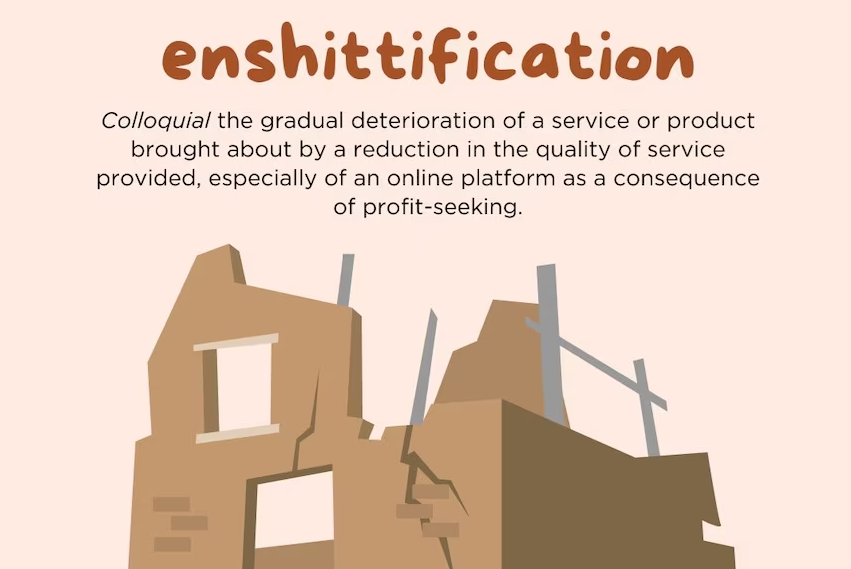
The two kinds of enshittification

Filed under: Business, Media, Technology — Tags: , , , — Nicholas @ 03:00

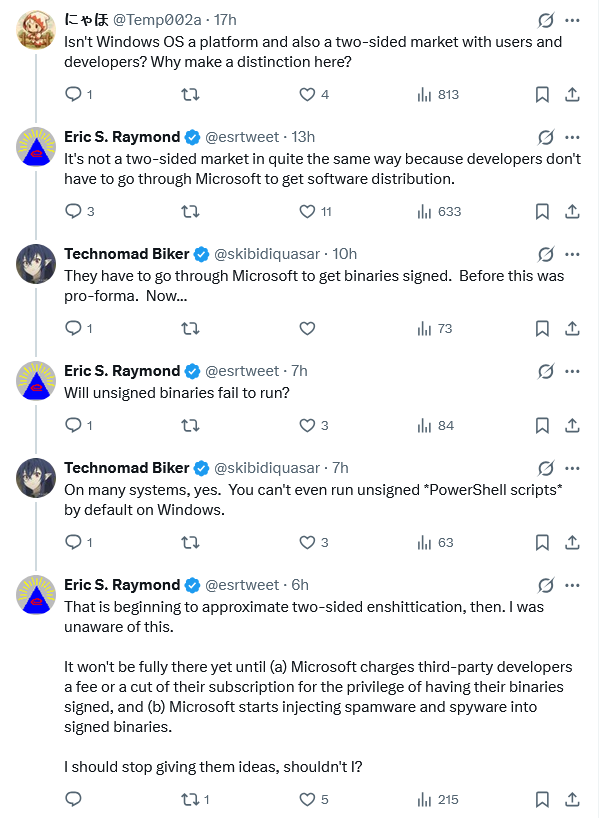
On the social media site formerly known as Twitter, ESR explains the differences between the two kinds of enshittification we’re seeing these days:

It may be time to start distinguishing between classic two-sided enshittification and a more general single-sided variety.

When Corey Doctorow originally defined the term “enshittification” he was describing a very specific thing that can and does happen when a platform like Amazon or Google acts as a two-sided market-maker. They start by reducing friction for both buyers and sellers, get everybody locked in by the higher cost of doing volume business anywhere else, then start charging tolls on both sides and injecting spamware that nobody wants. Eventually even their search function becomes completely shitty.

The increasingly horrifying “agentic” train wreck that Windows 11 has become isn’t a two-sided platform in the same way, but the feel of its late stages is depressingly familiar. It’s so stuffed with bloatware, spamware, and spyware that its nominal function as an operating system to run programs for its users feels almost like an afterthought.

I’m going to call this “single-sided enshittification”, and point out that both kinds stem from the same fundamental disconnect. They’re both things that happen when the dominant revenue stream from a product is disconnected from the needs of its original users.

In both cases, an important factor, though not the only one, is the attack of the adtech vampires. So very much of the ugliness in enshittified platforms is downstream of the easy money that they offer product owners for allowing them to sink their fangs into the information stream.

I don’t have a solution to this problem. But if there is one, it starts with identifying the problem correctly. Enshittification — it’s not just for two-sided platforms anymore.

From the comments on the original post:

March 2, 2026

A Day in the Life of an Ensh*ttificator

Filed under: Business, Humour, Media, Technology — Tags: , , , , — Nicholas @ 04:00

Forbrukerrådet – Norwegian Consumer Council
Published 27 Feb 2026

Digital products and services keep getting worse. In the new report Breaking Free: Pathways to a fair technological future, the Norwegian Consumer Council has delved into enshittification and how to resist it. The report shows how this phenomenon affects both consumers and society at large, but that it is possible to turn the tide.

Read more on: https://www.forbrukerradet.no/breakin…
(more…)

February 24, 2026

QotD: The! Exclamation! Mark!

Filed under: Britain, Humour, Quotations — Tags: , , — Nicholas @ 01:00

They are everywhere one looks. The mandatory symbol of the overfamiliar: “We’ve got your order!”

To the grammatically sane, reading the exclamation mark in its proper mode, the modern world appears increasingly deranged, authored seemingly by caffeinated twelve-year-olds. The delirium jumps at you in emails, on billboards, from the end of every other sentence.

The exclamation mark — the name a dead giveaway — means to exclaim. To cry out or speak suddenly or excitedly, as from surprise, delight, horror, etc. That line and dot seize your attention. Help! Now, it seizes your last nerve. Stop! If everything is exclamatory, then nothing is.

To the cynic, the exclamation mark is a hypodermic needle spiking foreign joy into the bloodstream of language. With each excitable email, I wonder, is this person in need of urgent medical attention? Or have they overdosed on Adderall?

Christopher Gage, “Against Enthusiasm”, Oxford Sour, 2025-11-21.

October 31, 2025

The “internet of shit” is somehow managing to get even shittier

Filed under: Business, Media, Technology — Tags: , , — Nicholas @ 05:00

At The Honest Broker, Ted Gioia enumerates just a few of the ways that advertisers have abandoned attempts to persuade you and instead now run online extortion rackets to get you to pay to avoid having to see their ads:

Advertising is no longer about creativity and storytelling. Ads are now a matter of annoyance, plain and simple (as I recently described in this article).

It’s a simple concept. Web platforms force people to pay money to avoid the ads — so the more annoying they are, the more money they make.

They used to call it extortion — pay now to avoid pain later. And it always works like a charm. Needless to say you don’t need an English major to run an extortion business. (However, they do make good victims.)

This business strategy started out in media — where it made some sense. People are familiar with the idea of advertising during screen entertainment.

And here is how it played out:

  • YouTube started this with the launch of an ad-free tier in 2014.
  • Paramount announced an ad-supported subscription plan in June 2021.
  • Disney + launched a low-price subscription option with advertising in March 2024.
  • Netflix introduced a similar program in October 2022.
  • Amazon Prime did the same thing in early 2024.
    But in the last few months, it’s gone crazy. The ads are spreading beyond movies and videos — and into almost anything with a digital interface. So we’ve seen the following in recent days:
  • Jeep drivers started complaining about ads on their vehicle touchscreen in early 2025. An ad for an extended warranty allegedly appears every time they stop their car (at a red light, etc.).
  • Meta announced an ad-free subscription option for Facebook and Instagram in September 2025. (initially in the UK).
  • Microsoft announced an ad-supported subscription plan for Xbox cloud gaming in October 2025.
  • A rumor about Apple inserting ads into its map app started spreading in October 2025. This will allegedly launch in 2026.

This is more than annoying — it’s also abusive. A new Jeep can cost $50,000 or more. When you hand over that much cash, you should get an exemption from spam ads on your screen.

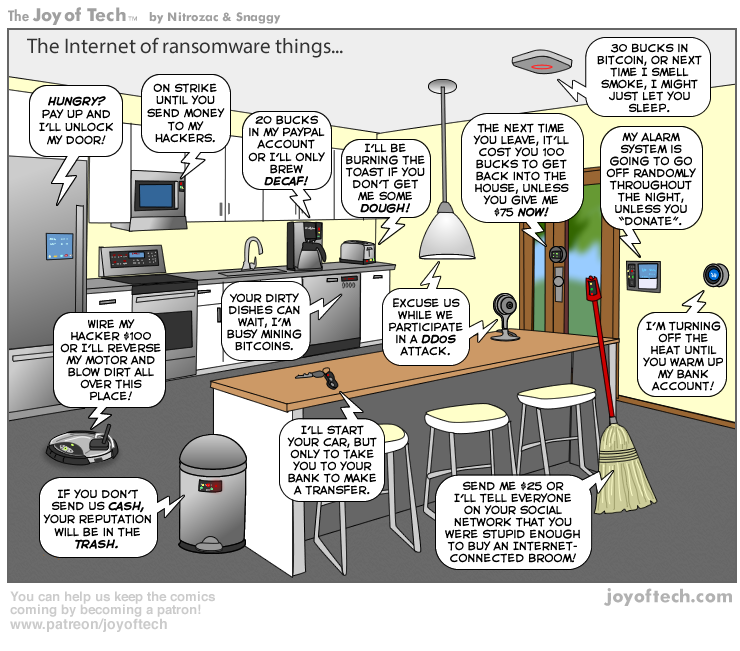
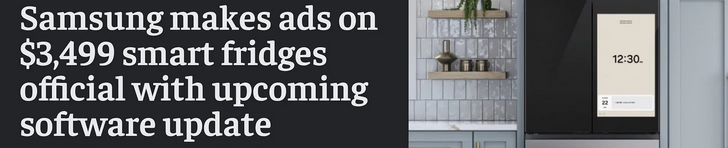
But the most annoying move of all is coming from Samsung. They are putting ads on $3,499 smart fridges. They’re rolling out this “software upgrade” right now.

According to Samsung, your smart (or maybe smart-ass) refrigerator will soon share “useful day-to-day information such as news, calendar and weather forecasts, along with curated advertisements”. The display will change every ten seconds.

I definitely rely on my fridge for some things — milk, eggs, orange juice, and an occasional cold beer. But you don’t see curated advertisements on that list.

Ads will never be on the list.

October 27, 2025

Trump versus Carney (and Ford, his court jester)

Another week, another set of bleak headlines about the trade relationship (or lack thereof) between Canada and the United States. For some, this is the story of how Trump Derangement Syndrome has consumed all levels of Canadian leadership, while for others it’s proof that you can’t deal with Trump as a rational adult and instead need to consider him an overgrown toddler with a nuclear arsenal at his disposal. Or perhaps it’s a little from column A and a bit from column B:

At the risk of overstating my own influence, it’s like the President of the United States read my piece saying he was acting like a toddler and decided, “oh yeah? I’ll show what ‘acting like a toddler’ means!” and did this, presumably once Bluey was over:

    U.S. President Donald Trump says he is raising tariffs on Canadian goods by 10 per cent, after accusing Canada of airing what he called a “fraudulent” advertisement that misrepresented former president Ronald Reagan’s stance on tariffs.

    In a post published on Truth Social at 4:30 p.m. Saturday, Trump wrote, “I am increasing the Tariff on Canada by 10% over and above what they are paying now.”

    Trump’s post cited his frustration over an advertisement produced by the Ontario government that used clips of Reagan warning about the dangers of protectionism and praising free trade.

    “Canada was caught, red handed, putting up a fraudulent advertisement on Ronald Reagan’s Speech on Tariffs,” he wrote.

    Earlier this week, Trump had cut off trade negotiations with Ottawa, explaining it was due to the “hostile” nature of the ad campaign.

    “Their Advertisement was to be taken down, IMMEDIATELY, but they let it run last night during the World Series, knowing that it was a FRAUD,” Trump further said in the Truth social post.

The good news is, at least Trump is coming right out and admitting that his “national security” tariffs are really about nothing more than his fragile ego, just in time for the Supreme Court to hear arguments about this very issue.

The bad news is, I think it’s exceptionally naive to think SCOTUS is going to save us from this madness.

Not because I think they’ll rule that what he’s doing is legal. That might be a bridge too far for even Justices Thomas and Alito.

But because this proposition rests on the assumption that Trump considers himself bound by Supreme Court rulings and that anyone else is going to exercise their power to ensure these rulings are followed.

Or, if you think Canadian leaders are deep in a TDS binge:

How The New Republic saw Donald Trump during the 2024 election campaign.

Trump Derangement Syndrome (TDS) is a widespread and serious issue. When one is afflicted by it, their capacity to sense-make becomes compromised. Emotions are a difficult thing for humans to control, and TDS-sufferers seem for the most part unaware of how much their negative, emotional feelings concerning Trump have hijacked their reason.

TDS types reveal themselves in so many ways. One specifically, which often goes unnoticed, is a general uncharitableness when it comes to interpreting the words and actions of Trump, or a general unwillingness to look beyond words – either Trump’s words or anyone else’s which have been inserted into Trump discourse. A prime example of this is the anti-tariff ad campaign involving a 1987 speech by former president Ronald Reagan which the Ford government paid $75 million to have broadcast to American audiences – key Republican areas – for the purpose of undermining President Trump’s economic policy.

Firstly, the uncharitable analysis does not allow that Trump has any right, or any good argument, or reason to be upset about Canada’s trade practices, such as supply management. The uncharitable analysis sees Canada as an innocent victim and Trump as a bully who is trying to destroy us and/or take us over.

[…]

Returning to reason and reality. Trump has justification for being upset with Canada over both our trade practices and in the under-handed and unfriendly tactics of Doug Ford and other Canadian leaders. The ad was an insult to Trump. His reaction or over-reaction to the ad, does not change the fact that what Ford did was antagonistic and not in the best interests of productive trade negotiations. The charitable analysis understands this, and does not lose sight of it, no matter how outlandish the things Trump does may be.

On the other side of the uncharitable Trump analysis concerning Ford’s Reagan ad blunder, is circulating the idea that Reagan was anti-tariff. Why is this idea believed? Because of Reagan’s rhetoric. You can find hundreds of clips of Reagan speaking about the dangers of high tariffs, or advocating for free trade. But the uncharitable analysis refuses to go beyond words. They ignore words that don’t support their argument, and act as if the words that do support their argument were the only ones spoken. Further, they act like words are the be all and end all, by not bothering to investigate the actions of those who speak the words, they pretend that word-speakers always do and intend exactly what they say. Reagan’s oratory contained lots of anti-tariff rhetoric, but his actions included lots of pro-tariff policy in an effort to deal with unfair trading partners.

None of this is difficult once you mea culpa from TDS. If you remain under the spell of TDS, you will not be rational or reasonable, and I for one, will not take you seriously. You will look increasingly foolish as time goes on and Trump’s policies turn out not to be the disasters you hysterical twits dreamed they would be. And the group of people like me, who shake their heads and roll their eyes at you, will grow and grow, under the weight of inevitable mass mea culpa. But you will remain shrouded from truth as you descend further into darkness and gloom and hate. It doesn’t have to be this way … just mea culpa FFS!

October 25, 2025

International FAFO – Ontario pokes Trump, Trump withdraws from trade talks

Filed under: Cancon, Government, Media, Politics, USA — Tags: , , , , — Nicholas @ 03:00

Canadian politicans seem unable to comprehend that Donald Trump is not a typical American leader — for both good and bad — and Ontario Premier Doug Ford seems to be the last one to figure it out. The Ontario government paid for ads featuring Ronald Reagan making anti-tariff comments to run in the US media and Trump reacted, strongly:
The Ontario government’s anti-U.S. tariff ad will run multiple times during the U.S. broadcast of baseball’s World Series game Friday, less than 24 hours after President Donald Trump “terminated” trade talks with Canada over the commercial.

In an email, Ontario Premier Doug Ford spokesperson Hannah Jensen confirmed information first reported by National Post that the ads will run throughout the World Series.

That means the ads, taken out by Ontario Premier Doug Ford’s government, will be playing to a primetime U.S. audience less than a day after Trump cited them as the reason he was ending trade talks with Canada.

The Toronto Blue Jays are vying for the World Series championship for the first time in over three decades.

The move suggests Ford is not ready to back down on his public campaign against U.S. tariffs on key Ontarian industries including auto manufacturing despite Trump’s ire.

Late Thursday evening, Trump took aim at Ontario’s ads which quote a 1987 speech by Ronald Reagan to fight against U.S. tariffs.

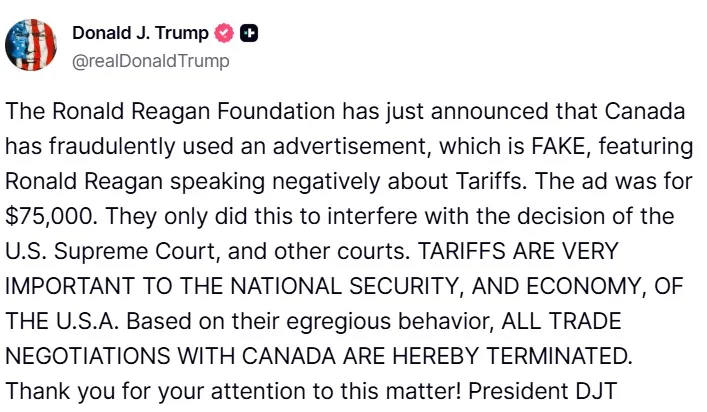
“The Ronald Reagan Foundation has just announced that Canada has fraudulently used an advertisement, which is FAKE, featuring Ronald Reagan speaking negatively about Tariffs. The ad was for $75,000,” Trump wrote on social media.

“They only did this to interfere with the decision of the U.S. Supreme Court, and other courts. TARIFFS ARE VERY IMPORTANT TO THE NATIONAL SECURITY, AND ECONOMY, OF THE U.S.A. Based on their egregious behavior, ALL TRADE NEGOTIATIONS WITH CANADA ARE HEREBY TERMINATED. Thank you for your attention to this matter! President DJT.”

On Friday, Prime Minister Mark Carney said Canada stands ready to resume trade talks with the Trump administration. But he stopped short of opining on if Ontario should cease running the ads.

If there’s a wrong way to deal with Donald Trump, you can be sure that some Canadian politician — often, but not always, Doug Ford — will find it:

Outside of the light conservatism found in the AM Talk radio circuit throughout the GTA, Ontarians didn’t really seem all that fired up when it was discovered that Premier Doug Ford spent $75 million on anti-tariff ads, the most contentious involving an audio clip of former Republican president Ronald Reagan, to be played in American cities targeting Republican audiences. They, for the most part, are also unlikely to appreciate the insult, and the damage it caused, by going directly to Trump’s base with a message that undermines the premise of his economic plan. In Canada, leaders like Ford and Carney, are permitted and even encouraged to talk tough on Trump, because it is well understood that Trump Derangement Syndrome is the leading cause of anxiety amongst Canadian leftists, and sadly, even many so-called conservatives. However, it has always been hollow, toothless, and pointless.

Carney’s elbow’s up nonsense is easily the most embarrassing thing produced by Canada in the last four decades (maybe longer). And Doug Ford is such a clueless dummy, conservative in name only, with NDP levels of TDS, and an incredibly irresponsible propensity to go off half-cocked, with such a careless abundance of volatility. No serious province can survive a leader like this. Ford is what Leftists think Trump is: a dangerous blundering idiot who can’t get anything right. But this thing with the Reagan ad is maybe the worst example in a long list of Ford blundering. Maybe Trump’s anger will blow over, maybe we will somehow come out of this episode embarrassed, yet again, but for the most part, unscathed. We will have to wait and see.

As much as I wish Canada was a force to be reckoned with, as it once was, the best I can muster is that some day in the distant future other countries might stop laughing at us. The sad reality is that generations of abysmal Laurentian elite leadership has destroyed the strength and respectability of Canada. We are a weak insignificant joke of a nation made that way by a grossly feminized ultra-weak leftist leadership class. Ford and Carney with their ineffective provocations directed at Trump in order to appease and win points with the TDS numbskull segment of the Canadian population, does little more than show the nation, and the world, the opportunism and lack of self-awareness indicative of all weak and clueless men of the social justice paradigm in the great feminized north.

To make matters worse, as if the largest and most rapidly expanding national debt in the history of Canada, the general complacency concerning government spending, or the massive affordability crises were not enough, it appears that Ford’s ad team manipulated the content of the Ronald Reagan speech they used in order to make it appear as if Reagan were anti-tariff. The ad stitches together non-consecutive segments of a five minute speech he gave in 1987. Again, the ad in question was part of a $75 million marketing campaign, paid for by Ontario tax-payers, which targeted American audiences.

The Ronald Reagan Presidential Foundation & Institute stated that “The ad misrepresents the presidential radio address, and the Government of Ontario did not seek nor receive permission to use and edit the remarks”.

Nice work, Doug. You can stop any time now …

Update: Fixed broken URL.

August 3, 2025

20th century advertising alchemy rediscovered

Filed under: Business, Media, Politics, USA — Tags: , , , , , — Nicholas @ 05:00

Much sound and fury has been devoted to the ritual denunciations of American Eagle and their new ad campaign featuring blatant Nazi ideology and imagery, er, I mean Sydney Sweeney:

Whenever I endure a sentence which trespasses into a jibe about whiteness or men or some other illusory bugbear, I stop reading and launch the laptop through the window. This week, I’ve cleaned out eBay. As one delivery driver lugs a fresh laptop to my front door, another scoops up the last to fall from the sky.

Those all-too-common laments about skin colour or genitalia are the scarlet letter imprinted on the chest of the thoughtless bore. It’s a mind virus without antidote. Screeching “whiteness!” upon snapping one’s shoelace betrays sound psychological health.


Take Sydney Sweeney, an American actress blessed with a merciless, unfair genetic inheritance. This week, Sydney broke the internet. Her crime? She’s rather attractive. Worse yet, Sydney flaunts her icy, Scandinavian beauty.

In an advert for American Eagle, the dewy, lissom blonde squeezes her gymnastic body into a pair of denim jeans. Smouldering before the camera, Sydney flutters her “great genes”.

Those great genes sashay around a classic Mustang — 400 horses of unapologetic masculine energy. Sydney pats her hypnotic behind. She fires up that climate-melting engine. The infernal marriage of masculine-feminine consummates as she roars off into the distance.

Advertisers know what they did. Diana, Roman goddess and huntress of men. Her chariot, the male appendage made steel and exploding gasoline. A combination to light our monkey brains on fire. The symbolism hijacks our amygdala: buy these jeans, and she’s yours. Or, for the other sex, buy these and manipulate them.

I’m sorry to be so blunt, reader. Those claims, as primitive as they may appear, are the animating spirit of advertising. Back in the 1920s, Freud’s nephew, Edward Bernays, transplanted Uncle Siggy’s theories into the advertising business. Out went staid adverts praising a product’s utility. In went adverts selling visions of your unconscious, insatiable self. Bernays transformed the public relations and advertising worlds. He sold products that stirred the galloping herds of the subconscious mind.


Take cigarettes. Before Bernays, smoking was a decidedly male pursuit. Tobacco giants, keen to double their potential customer pool, turned to him. Bernays transformed smoking from a vulgar, unladylike pastime into a symbol of freedom and female empowerment. Men buy Patek Phillipe watches for the same reason. As Dave Chappelle put it: “If a man could fuck a woman in a cardboard box, he wouldn’t buy a house”.

In just a few moments, Sweeney’s serpentine hips lulled advertising away from overt wokeness to its subliminal witchcraft. It worked. American Eagle’s stock surged fifteen percent.

For research, I studied the ad twenty-seven times. Your humble narrator bought thirty-seven pairs of jeans and then signed over his entire inheritance to Ms Sweeney.

The reaction on the identitarian left authored five additional chapters to the upcoming edition of the Diagnostic and Statistical Manual of Mental Disorders.

By teasing the words “genes” and “jeans”, Sweeney called for the annexation of Poland and the Sudetenland. MSNBC excelled itself, even birthing a new pidgin English indecipherable to 97 percent of native speakers:

“Sydney Sweeney’s ad shows an unbridled cultural shift towards whiteness”.

Well, that’s one way to think about it.

July 31, 2025

QotD: Web browsing “naked”

Filed under: Business, Media, Quotations, Technology — Tags: , — Nicholas @ 01:00

I recently, foolishly, and for reasons that now escape me, bathed in the stroboscopic glow of the un-adblocked Daily Mail. It’s like they just took a bag full of flashing random crap, shook it up, then threw it at the screen. I’m not at all convinced that advertising is a viable model for internet use. It feels much more intrusive and aggravating than print or TV ads. Partly, I suppose, because it’s happening on your device. Maybe it’s just me, but I find myself repelled by it, and sites that use it, quite emphatically. I’ve stopped counting the sites I’ll no longer visit because they insist on the reader deactivating their adblocker, resulting in an insulting, actively hostile, all but unusable experience.

David Thompson, commenting on “Scenes from Woketopia”, davidthompson.com, 2020-06-23.

July 22, 2025

The internet keeps getting worse. Let’s talk about why.

Jared Henderson
Published 16 Jul 2025

Why do major online platforms keep getting worse? Cory Doctorow’s work helps us understand the pattern of growth, decline, and eventual demise.

→ Timestamps
00:00 Beginning
00:51 How Platforms Die
08:29 The Death of a Platform (From the Inside)
12:14 Ads, Everywhere
14:47 Yes, I Make Money from Ads
16:32 Bots
22:04 The Internet We Need
(more…)

June 13, 2025

The new marketing strategy is “Always Be Annoying”

Filed under: Business, Media, Technology — Tags: , , , — Nicholas @ 03:00

Ted Gioia explains that the rules of marketing as explained in Glengarry Glen Ross no longer apply:

The rules of marketing never change. That’s what they told me in business school.

If you could peer inside the meetings at head office, you would see a never-ending loop of Glengarry Glen Ross.

Always be closing. Those are the A-B-Cs of business.

But that’s not true anymore.

In recent days, a new marketing strategy has emerged. I’ve never seen it before. And I wish it would go away. You probably do too.

It’s a new way of advertising. It’s a new way of marketing. It’s a new motivational tool.

It didn’t exist when I studied marketing back at Stanford GSB. I had the best marketing teachers in the world, but they never dreamed of doing this to customers.

Here’s the new marketing playbook of 2025:

  • Do NOT try to close.
  • Do NOT try to sell.
  • Do NOT try to persuade.
  • Don’t even listen.

The goal now is merely to ANNOY. The big companies do it on purpose.

Big streaming platforms are the experts at this new marketing tool. They want you to pay for a premium, ad-free subscription. The more annoying the commercials, the more likely you are to pay.

You will pay just to get rid of the ad.

In this topsy-turvy world, the more painful the ad, the better it works. The digital platforms have studied this — YouTube has tested using up to ten unskippable ads on users.

That’s not marketing — it’s water-boarding. But they need to test these techniques. Their business model is built on optimizing the level of annoyance.

And guess what? Even paying for premium doesn’t guarantee escape from ads. Welcome to the new digital platforms — which increasingly resemble prisons.

[…]

We once lived in an industrial economy — built on industry. Then we shifted to a consumer economy — built on consumption. And more recently we lived in a service economy — built on service.

But we now are entering the age of the Annoyance Economy. And it is the inevitable result of corporations battling for your attention.

They monetize your eyeballs — measured in clicks and microseconds — and they will do anything to hold on to them. This increasingly involves annoying, intrusive actions that no business would have dared to implement in a consumer-oriented economy.

March 1, 2025

Celebrity fatigue

Filed under: Business, Media, Politics — Tags: , , , , — Nicholas @ 03:00

I’ve always been pretty disinterested in products and services with celebrity endorsements, but they must have worked well enough as they suddenly seemed to be everywhere. Grant McCracken notes that they seem to have reached their sell-by date recently:

Wayne Gretzky Estates produces wine and other beverages in the Niagara Peninsula. They may be fine products, but I’ve never tried them.

Talented, wealthy, beautiful, admired, they live charmed lives.

Until the last decade or so. Now they take turns doing an Icarus off the high board.

And investors are noticing.

Ann Gehan reports “Investors Drop Celebrity Brands From A-List”.

    Four early-stage investors who previously backed celebrity brands said they are shifting focus to promising products as opposed to celebrity buzz

What are investors noticing?

Well, there was COVID. We all noticed how really irritating celebs were, singing us songs from the well staffed majesty of their magnificent homes. This cost them some standing.

And then there was the presidential elections. Say what you will about Kamala, the celebs who supported her must have worried about a loss.

Right?

Of course not.

Celebrities don’t lose elections. Neither do the politicians they support.

So the election too was costly.

You don’t get famous unless you know how to read the room. Celebs are their own strategists. They can hear what the country wants. They can detect change and adapt.

Until they can’t. And now they can’t.

February 21, 2025

Tech enshittification continues

Ted Gioia notes that even the world’s biggest search engine provider is doing almost everything it can to make your search experiences worse and worse:

Almost everything in the digital world is turning into its opposite.

  • Social media platforms now prevent people from having a social life.
  • ChatGPT makes you less likely to chat with anybody.
  • Relationship apps make it harder for couples to form lasting relationships.
  • Health and wellness websites make it almost impossible to find reliable health advice — instead peddling products of dubious efficacy.
  • Product review sites now prevent people from reading impartial reviews by actual users of the product, instead operating as pay-for-play vehicles.
  • Etc. etc. etc.

You can often tell by the name. PayPal will never pay you a penny, and it’s certainly not your pal. Microsoft Teams only works if you stay away from your team. If you keep using Safari, you will never go on an actual Safari.

But the worst reversal is happening with search engines. They now prevent you from searching.

I’ve known Google up close and personal from the start. I initially found the company quirky and endearing — but those days ended long ago. The company is now clueless and creepy.

Almost every day I read some ugly news story about Google. Here are a few headlines from a typical week:

This company goes out of its ways to do mischief. Messing with people is in its DNA.

Meanwhile, its base business is degrading at an alarming rate. The company doesn’t seem to care.

In a strange turnaround, search engines don’t want you to search for anything. That’s because searching leads you on a journey — and Google doesn’t want you to leave their platform.

The search engine was invented as your gateway to the web. The inventors of this technology tried to index every page on the Internet — so that you could find anything and everything.

That was an exciting era. Search engines were like train stations or airports. They took you all over the world.

At Google today, the goal is the exact opposite. You never leave the station.

Techies once described the Internet as a digital highway. But we need a different metaphor nowadays. Web platforms want to trap you on their app, and keep you there forever.

So, instead of a digital highway, we have a digital roach motel. They let the roaches check in — but not check out.

Older Posts »

Powered by WordPress