
The rumor went around that trains were throwing steel ball bearings from their wheels. Genuine steelies! Somebody said they saw one that a kid from Detroit brought up. So big that you couldn’t close your fist around it. Nobody else saw it, though.
Nevertheless, we scoured the tracks for endless hours, turning over every likely pebble that caught the sun. No steelies. I did amass a small collection of spikes that had worked their way loose from the ties. Never did figure a use for them. But they were cool.
The game was marbles. Way we played it in upper Michigan was to draw a chalk circle on the cement or scratch one on the sand with a stick, sometimes we even used a length of string. The battleground was set. The players approached cautiously if their stock was low or boldly if their marble bag brimmed.
One boy against one boy. Man against man. A test of skill and mental grit. Incidentally, only boys played against boys, girls against girls: this was back in the day when adults didn’t burst a spleen for kids noticing the obvious differences in the sexes. Besides, boys were daring and cavalier. They were out for conquest. Girls would sometimes — this still baffles me — agree to play to a draw! Even if one girl would outright win she wouldn’t claim her prize. Bizarre creatures.
First boy, if he was a pro, placed his middle finger against his thumb and then snapped it at his marble, aiming to smack it into his opponent’s. If he hit it, he got to keep it. No time outs, no I-wasn’t-readies, no whimpering. Newcomers and cowards could be identified by the anemic way they smacked their marble, say by giving it no more than a half-hearted push with their forefinger.
Strategy was obvious. If you were the better shooter, you attacked attacked attacked. Go right after the other guy. Intimidate him. Like Nelson, ignore all subtleties and blaze away. Cagier boys took advantage of the braggarts and only pretended to be cautious. They let their opponents open with a bold shot or two, answering with a shot away as if in retreat, then when the other boy’s shot would miss and stop close by, the jig was up.
And that was the problem. Too bold and your shots would come close, too close. Countless times the marbles would stop an inch away. It was a goner. This is why it made sense to shoot hard; over-shooting was hardly a risk. Unless you in a sudden-death match where shooting outside the lines meant an automatic loss.
Most of us neither lost too many nor gained too many. But a few kids were easy pickings. Every day they’d come with a new small bag (these were sold in grocery and “dime” stores) and lose them. Rich kids.
Unless by prior agreement, only even matches were allowed. Cat’s eye against cats eye were the lowest, entry-level bouts. Cats’ eyes, for those monumentally ignorant of Americana, are the clear marble with the squiggly, colorful aberration running through the center. These were the general stock, like ten-year-old used cars; useful, but unloved. Why, you could find spare cat’s eye rolling around behind the home room teacher’s desk. What counted was quantity.
Perries, probably a corruption of puries, solid colored beauties. These were always just a shade smaller than the cat’s eyes. Perries, though coveted, had a tendency to chip, sometimes even crack open when hit hard. Clears were solid glass, no color. Steelies were polished ball bearings. I only ever saw two of them. Not the railroad kind, but small ones from who-knows-where. They were said to be unbeatable, which is why we latched onto any rumor of a source.
Then came the boulders, the double-sized version of the normal marble. One of these was worth five to ten of the regular kind, depending on availability. Boulder-on-boulder matches were always closely attended. They were rare, too, especially when they featured perries. (I have since learned boulders are called “shooters” in other areas. But all our marbles were shooters.)
We used to empty our marble bags and compare, holding our treasures up to the light for the kind of close scrutiny used by gemologists sizing up wedding rings. Oddities such as pea-sized perries occasionally showed up. These were said to be from China, then still a mysterious land.
I don’t guess kids play marbles anymore. Unless there’s a marble “app” for their cell phones. But it now makes sense that my favorite adult game is petanque.
William M. Briggs, “Marbles!”, Science Is Not The Answer, 2026-06-23.
September 26, 2026
QotD: The game of Marbles
August 8, 2026
QotD: Why more men than women love videogames
Autumn Christian @teachrobotslove
I love video games. I met my husband because he hired me to QA for a Sims game. I was a game designer for companies like Zynga and EA. I was a writer on State of Decay 2.
And I still have never loved games like I’ve seen the way men love games. I was surrounded by men who would eagerly work on min-max spreadsheets during their lunch break. One designer had a cabinet full of games that he would replay over and over again to study the levels. They’d go home from making games to play more games.
Honestly, it’s a big reason I quit game design. I didn’t have that obsessive, compulsive desire to play games in a way that superseded everything else in my life. Lots of women play videogames. I’ve never seen one consumed by them as their life falls apart around them.
Autumn is right. Even women who love video games don’t become obsessed with them the way men do. I know why, and I think it reveals a tremendously important difference between male-typical and female-typical psychology.
Men. Want. Power.
Men want to be able to do things. To shape the world. To impose their will on reality. To win.
Video games are a fast, reliable superstimulus for that urge. With only a handful of exceptions, the good ones are designed to both excite the desire for agency and power, and to satisfy it.
If you doubt me, ask yourself why many men fixate harder on video games than they do on pornography. It’s very telling that this is even possible.
Women don’t work that way. I could go off on a long tear about why, but the evolutionary-biology reasons are so obvious that I don’t think I need to. If it’s not obvious, ask an LLM “why do men seek power and agency the way women seek love and social validation”. You’ll get an earful.
Of course this also explains the well-known phenomenon of women getting the ick when men play video games.
It’s not just that men doing this are chasing a goal women don’t really understand or identify with. To them, a game-obsessed man is dropping out of the real-world contest, wasting the traits and energy that would otherwise make him attractive on a pursuit that is both literally and figuratively sterile.
I don’t have a fix for the problems this mismatch creates, nor am I judging either men or women about this — instincts are what instincts are and I don’t waste any time arguing with the law of gravity either.
But understanding what’s going on increases the chances that we can make choices that aren’t doomed to fail.
ESR, The social media site formerly known as Twitter, 2026-05-07.
May 17, 2026
QotD: Battlefield morale and cohesion in movies/games versus real history
Actual armies have far more than two states of morale and behaved in far more dynamic, unpredictable and interesting ways!
The first problem with this “binary model” of morale is that it assumes just a single factor (“leadership” or “morale”) but in practice we ought to be thinking about at least two different ingredients here: morale and cohesion.
Morale is the commitment the combatants have to their leadership and their cause. To simplify a bit, we might say that soldiers with good morale believe three things: that their cause is a worthy one, that they are on the road to success and that their leaders have a good (enough) plan to achieve final victory. Poor morale can result from a breakdown in any of those three elements: troops might for instance believe both in their goal and its eventual possibility but not in their leaders to produce it (this seems to have been the case, for instance, in the French Mutiny of 1917). On the other hand, regardless of the charisma of leaders, few people come to a war intending to die in it; if the cause appears impossible, morale will sink regardless. And armies that do not believe in the cause at all are extremely difficult to motivate by other means.
On the other hand cohesion is the force that holds a specific unit together through the power of the bonds holding the individual combatants to each other and/or to their (generally junior or non-commissioned) officers. There are a lot of ways to build that cohesion: people are generally unwilling to abandon neighbors, close friends and relatives, for one. They are also reluctant to expose themselves to shame at home for having done so; shame is one of the few things people fear as much, if not more than, death. For armies that can’t rely on that sort of organic cohesion, it can be built by reconstructing the soldier’s unit as his primary social group. Drill can do this: it creates an experience of shared suffering and achievement which bonds the soldiers together creating strong “artificial” cohesion.
These two ingredients have different roots, but they also function differently. The formulation that has always stuck with me is one from James McPherson’s For Cause and Comrades: Why Men Fought in the Civil War (1998): morale (McPherson discusses it under the heading of “the Cause”) will get men into uniform, it will sustain them on large marches and cold nights and it will get them to the battle, but it will not get them through the battle. Instead, cohesion (the “comrades” of the title) gets men through the terror of actual combat, when fear has driven “the cause” far from mind. But of course cohesion isn’t enough on its own either, since it provides no reason to advance or attack or really to do anything at all except stick together.
Adding further complication to this, morale and cohesion are not, as they often exist in games, inherent properties of a unit, but rather emergent properties of the interactions of a whole bunch of individuals. In a strategy game, units exist primarily as extension of the player’s will; in film units typically exist as extensions of their commander’s or the main character’s will (note how common it is that right as the hero begins winning his duel with the villain, so too his army begins winning the battle). But of course actual armies are composed of lots of humans, each with their own individual will and agency.
Those humans are continually making calculations about risks, goals and survival. It’s not hard here to see why, by the by, morale won’t carry troops through high risk conditions: if your only goal is to survive to experience the end-state of the war, then it is always in your interest to let someone else do the dying; it doesn’t serve your end to stay in a high risk position. By contrast, if you are held there by the fear of shame if your close comrades see you run, that still applies. Thus these calculations get progressively more “primal” as the sense of danger rises (fear makes a mess of those higher brain functions), but they do not stop.
Bret Devereaux, “Collections: Total Generalship: Commanding Pre-Modern Armies, Part IIIC: Morale and Cohesion”, A Collection of Unmitigated Pedantry, 2022-07-01.
May 11, 2026
The History of SPI: Part 1 / Simulations Publications Inc. / Wargaming History
Legendary Tactics
Published 18 Dec 2025Remember the golden age of wargaming? This is THE definitive history of SPI (Simulations Publications, Inc.), one of the most influential publishers in tabletop gaming. From its groundbreaking magazine Strategy & Tactics to iconic titles like War in the East, StarForce, and Terrible Swift Sword, SPI reshaped what board wargames could be — and built a passionate community along the way.
This is Part 1, where we delve into the origins of SPI and Strategy & Tactics Magazine, and the people and games that were part of it.
(more…)
March 7, 2026
Reported preference versus revealed preference – know the difference
On the social media site formerly known as Twitter, Devon Eriksen encapsulates the experiences of so many companies who found a male-oriented market and then they try to make their offerings more appealing to women:
Most business suicides are induced by not understand[ing] the difference between reported preference and revealed preference.
If you run Testosterone Studios, maker of Angry Muscular Axe Guy Kills Demons in Hell, you might notice after a while that not very many women buy your games.
Since your stockholders have a profound moral objection to other people having money and not giving it to them, they want you to correct this problem, stat.
They want you to make Angry Muscular Axe Guy Kills Demons in Hell 2 sell to men AND women. So you sigh, shrug your shoulders, hire a bunch of female consultants, and ask them “What do women like?”
“Feminism!”
“Girlbosses!”
“Strong Female Characters effortlessly outdoing men at everything!”
“Gay stuff!”
So Testosterone Games dutifully makes Petite Feminist Girlboss Replaces Angry Muscular Axe Guy, hoping that men will buy it because they bought the first one, and girls will buy it because it panders to what they were told girls want.
Of course, nobody buys it. The men don’t buy it because it’s not what they liked in the first one, and women don’t buy it because women couldn’t care less about games where you fight demons in hell.
If, instead of asking a bunch of consultants what women like (reported preference), they had looked at games women actually buy (revealed preference), they would have seen something very different.
“Fruit Matcher 3000 for iPhone.”
“Point and Click Alice in Wonderland Studio Ghibli Adventure”
“Something Something Hogwarts.”
And they would have realized, had they two brain cells to rub together, that you can’t please everyone, because some people hate exactly what other people like.
If you want more money, look at who is already buying your product, and see if you can make them like the next one better. Because I guarantee you aren’t already selling to every single male on the planet.
And don’t hire video game consultants.
They don’t know how to sell games, and they don’t care, because they don’t want to sell games. They just hate men, and want to ruin things men like. If you hire them, they’re going to have their fun, cash your check, and ride off into the sunset, while you lose your business.
And indie studios, who know whether they are making Aliens Must Die or Barbie Horse Adventures, will replace you, which is the free market operating as intended.

January 24, 2026
Britain’s Amelia phenomenon
On his Substack, Fergus Mason talks about the new Queen of English Resistance, Amelia:

Amelia, the new queen of the British right.
Independent journalism is a pretty grim business right now. Writing about the state of our poor broken country can be soul-destroying. Good news is thin on the ground; new calamities seem to arrive daily, either a fresh atrocity committed by an illegal immigrant or some new Labour assault on our freedom. So it’s nice when something a little more light-hearted comes along — even if it does make some serious points, too.
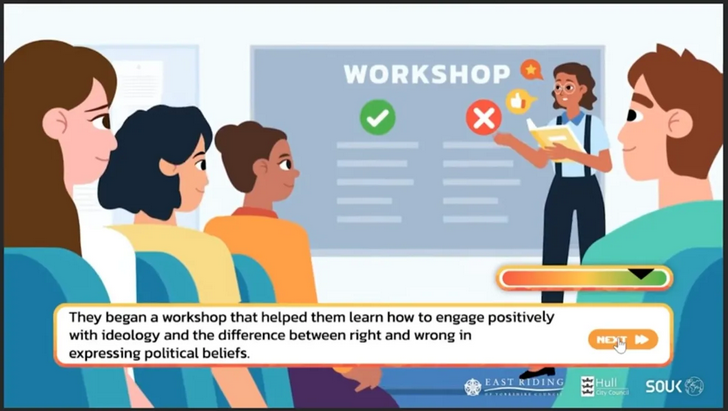
A couple of weeks ago the media started reporting a new online game funded by Prevent, the government’s (completely dysfunctional) department for diverting people away from extremism. Commissioned by Hull City Council and produced by “creative social enterprise” Shout Out UK, the game — called Pathways — is intended to “Encourage learning about the concept of extremism and radicalisation through the process of choice and safe exploration”.
As games go, this is a spectacularly dull one. Players choose a character, from a very limited selection — there are two, one male and one female, but they’re both called Charlie and use they/them pronouns. They then have to navigate their character through a series of scenarios, answering multiple-choice questions. The idea is that if you give the “wrong” answers you’ll get referred to Prevent, but it soon becomes obvious that almost any answers will get you referred to Prevent. The constant theme is that there are approved views and ways of acting — which don’t, for example, include doing research to find out if something you saw on the internet is true or not — and that, if you deviate from this, the state will step in to “support” you. A lot of this support looks suspiciously like re-education:
[…]
Of course, if you know much about the online right, you’ll probably see the problem already. As one stunned Reddit user commented, “Wait, are you telling me they made the cute goth e-girl the ‘racist’? Do they understand how the internet works?”
Well, they certainly do now.
The Daily Telegraph published an article about Pathways on 9 January, bringing the game to public notice. That same day, X user Bovril-Gesellschaft posted “I think I’m in love with Amelia”. It seemed many other right-wingers were too, because within hours Amelia memes were appearing in large numbers. Mostly produced with AI, these depicted Amelia in a wide range of styles (probably reflecting their creators’ personal tastes), but all featured her purple hair and most stuck with the outfit of a pink dress and purple hoodie or cardigan the game depicted her in. Images ranged from cartoons in the style of the original game to photorealism. […]
There’s a lot to laugh about in this. For example, brightly coloured “danger hair” has generally been the hallmark of women on the far left. Amelia subverts this by giving our new heroine her distinctive purple bob. Will we see the pro-Hamas nuts and trans cultists abruptly return to natural hair colours to dissociate themselves from Amelia? That would be funny.

November 5, 2025
A minor gaming distraction
On the social media site formerly known as Twitter, Matt Gurney takes a few minutes while waiting for the impending catastrophe of the federal budget to be released to talk about a game I’m quite familiar with (and generally share his opinions on):
It’s budget day. My job is only going to get busy in the afternoon and evening. So now is a good time to inflict a non-news and non-political tweet on you. I want to talk to you all briefly about Civilization 7, which has had a troubled launch.
Some of you may follow me closely enough to know I’m a hardcore Civ fan. I’m a wannabe gamer. I love gaming. I could get really into gaming. But I don’t have the time. My preference is for games that are very deep and immersive and require hours of time for a single gaming experience. My life actually only enables me to basically do the opposite: a quick game on my phone that kills five or 10 minutes.
Civ is my guilty pleasure. I’ve played every major iteration of it since the first. And I was SUPER excited for the release of Civilization 7 earlier this year. The company that owns the rights, Firaxis, did a really interesting pre-release marketing job. They built a lot of buzz.
The game itself, which I obviously preordered and played on the day it released, was disappointing. It looked good, but it was very shallow. Every Civ iteration grapples with the challenge of needing to improve on/enhance the game experience compared to earlier releases, but also with the problem of complexity. If you just keep layering on new functions, you eventually make the game unplayable. So there’s a natural tension there. But 7 was still weirdly sparse. There were very basic user interface issues. Fonts were very small, colour choices led to a lot of struggle making out details. It all looked beautiful at a distance until you were actually trying to absorb any information, info necessary to effectively play the game, at a glance. It was impossible. Also, and this is a separate but related problem, some very basic functions and information necessary for gameplay simply wasn’t explained. You kind of had to intuit things.
There were big, structural changes to the gameplay as well. How the game works is very different from earlier iterations. These changes were very controversial — seemingly hated, to be honest. I didn’t actually hate them. I didn’t always love them, but I was pretty open minded to them and kind of liked some of the new mechanics.
But. Ahem. The game itself regressed in some key ways, compared to its predecessor, Civ 6. A small example: religious warfare. For non-players, in Civilization, you can control units for your empire and you move them around the map. Military units can fight other military units, and can seize and defend territory. Religious units were a totally different game mechanic that players would use to export their religion, and to prevent their own cities from being converted. It added a really fun and elegant layer to the game, and one that could be meaningful enough to swing outcomes in a big way.
Civ 7 just nerfed that. Religion is useless. Worse, it’s annoying.
The company has been very aggressive at rolling out updates to fix some of these issues. They’ve also been very open in communicating what they’re working on to the audience. I admire that. I really do. But the numbers don’t lie. Civ 7 is, today, drawing maybe 15-20% of the audience that Civ 6 did. (Using Steam Charts for those figures.) I don’t know if this is a flop for Firaxis, but it has to be a disappointment verging on a disaster.
They’re rolling out a lot of updates and new content to try and fix these issues. And I think they’re making strides. But, like, yikes. Every time they announce a new update, I’m shocked by how much of that stuff should have just been in the game in the first place.
I’m not a gaming expert, like I said. I wish. I’m also not an expert in gaming as a business. I’m just a guy who loves playing Civ. I’ve stuck with 7 since it was released and I’ve given every major update a fair chance. I’ve had fun playing the game. But I just can’t deny that 6 was much better, more playable, and more fun. And I don’t know how much more time the developer has before even hardcore fans like me just give up and go back to 6 permanently.
Anyway. This is what happens when all the news is due to come out later in a day.
Thank you for your attention to this matter!
Matt is more patient with Firaxis than I am, I have to admit. I downloaded and played Civilization VII on release day … played a few rounds of a couple of different civilization/leader combos … played one up to the new “change your entire civilization to a totally different one in a new age” mechanic, saved and quit the game. I’m sure I’ll play again at some point, but VII didn’t grab my attention and interest the way all the earlier iterations had done and I hate hate hate the swapping civilizations gimmick with a passion because it ruins my immersion in the civilization I’m trying to build. But I’m pretty far from being the target market for this game, so take my dissatisfaction with a shaker of salt.
October 18, 2025
Remembering GamerGate
We’ve lived through such a tumultuous decade that it’s sometimes difficult to remember what things were like in the “before times”. On Substack chat, John Carter linked to this essay by Billionaire Psycho which helps refresh memories about one of the seminal events that kicked off the political and social chaos of the last decade:

GamerGate is maybe the most important event of the past 20 years which never receives mainstream media coverage. Lomez will be publishing an in-depth history of GamerGate, to serve as an official record going forward, and that’s crucial as part of building a foundation for a new culture — fighting the narrative war over how history is remembered, how history is interpreted, what events are recognized as significant and influential moments in culture, and how Western identity is defined.
GamerGate was only possible because a generation of incompetent Leftists inherited an empire built on propaganda that came without a legible instruction manual. Leftists forgot how to run their imperial machine. Video games sedated young white men, funneling their energy into a simulation of achievement, an illusory power fantasy of digital significance. Leftists forgot that porn, video games, movies, junk food, and other passive consumption activities primarily existed to prevent young white men from doing anything useful with their lives. And this zone of sedation was viewed as another industry to conquer so that DEI activists could bully the video game industry into providing overproduced elites with fake jobs.
This event was important for several reasons.
GamerGate exposed American Sharia laws. It unveiled the shibboleths, religious taboos, and blasphemy codes which were considered more important than Constitutional protections on “free speech”. A gulf emerged between written laws, and selective enforcement.
GamerGate was maybe the first time in 50 years that Leftists suffered a real, measurable defeat.
It functioned as a generational awakening: a catalyst that activated a decentralized army of shytpoasters, bloggers, podcasters, streamers, journalists, and RW activists.
It mapped out in real-time the architecture and OODA loop of the Leftist hivemind, providing empirical data on how the swarm intelligence perceives, coordinates, reacts, propagates … and suffers damage.
It educated critics of the hegemonic monoculture that rules the Global American Empire.
But I think the most important aspect of GamerGate was that it disproved the narrative illusion that everyone more or less accepted as conventional wisdom, the bedrock of the uniparty worldview. Before GamerGate, it was taken as a self-evident fact that America was a capitalist country, and that all of the evil in the world was caused by Wall Street corporations chasing “shareholder value” and advancing “the profit-motive”. Capitalism and racism were the invisible demons which could be used as scapegoats for anything bad that ever happened at any point and at any place in American society.
Leftism could do anything it wanted, no matter how dumb, destructive, intrusive, or evil — and then blame capitalism and racism for the consequences.
This illusion was shattered by GamerGate.
[…]
There’s one important thing that’s been lost since GamerGate (GG) and the Meme War of 2016, which is the adolescent fun, transgressive irreverence, and juvenile sense of humor which once characterized the RW youth. There was a brief window when video game enthusiasts believed they could meme their way to victory (they did), win a landslide election (they did), and reverse imperial decline (they didn’t). Ten years have passed since then. Countless accounts have been banned, doxxed, deplatformed, debanked. Dissidents have been prosecuted and imprisoned. The presidency of 2016 was stalled out and subverted, the election of 2020 was stolen, the election of 2024 almost ended in an assassination on live television. Covid lockdowns crashed the economy and trapped everyone in their homes, while Antifa and Black Lives Matter rioted outside in the name of George Floyd.
At some point, it stopped being fun, and the contest turned into a forever war.
Comedy turned serious.
But it should be remembered that in the aftermath of GamerGate, humor and a playful, childish energy fueled the engine of RW victories. That’s the secret ingredient.
Samizdat is the key to winning.
Always remember to keep having fun, and keep laughing, because our enemies are ridiculous.
September 22, 2025
QotD: Tactical combat on the pre-modern battlefield
In a fight, after all, a combatant is extremely vulnerable to attacks from behind or in their peripheral vision, especially if they are focused forward on the foe in front of them. A confused melee would thus produce extreme casualties and produce them extremely quickly. But fighters want to survive their combats and their leaders would like not only to win the battle but to have an army at the end of it. Remember: the purpose of the battle is to deliver a siege: if you win the battle but with only a pathetic handful of survivors, you haven’t really won much of anything.
The battle line is the obvious solution: each fighter is only responsible for a few feet of frontage directly in front of them, a small enough area that they can focus on it visually and direct whatever shield or armor or weapons they have towards it, giving them a greater margin of safety. Adding depth to the formation (that is, increasing the number of ranks, that is a row of fighters right to left) both secures each fighter against the possibility of being flanked due to the death of the fellows to their right or left (as now they’ll just be replaced by the next rank moving up) and adds a morale reinforcement which we’ll come back to […] But now you have a formation that consists essentially of a large number of files (that is, a single row of fighters front-to-back) which need to move together to create that unbroken, mutually supporting front line so that no one is being attacked from many sides at once. Again, all of this is before we start adding fighting styles like pike-formations or shield-walls that are designed to excel in this environment (and fare poorly out of it).
As an aside, this is one dynamic that I find games like Mount and Blade or the Total War series that simulate individual soldiers struggle to get quite right. In most games the line of formation either remains almost perfectly rigid (think units on “pike phalanx” in Rome: Total War) or units the moment they come into contact form rough blobs of models all pushing forward. But actually you are going to have men in the rear ranks trying to keep their relative position to the front ranks so the formation neither holds rigidly steady nor dissolves but is going to almost flex and bend (and if you are lucky, not tear or break). This is only an aside though because we’re not well informed about these sorts of dynamics, so it is hard to speak about them in-depth.
But to fight this way now means that all of your soldiers (really here we are talking about infantry; cavalry must also be coordinated but in different ways and because they are often composed of elites that coordination may be produced through different training methods) need to move in the same direction at the same speed in order to retain that front line where they can support each other. Again, we are not yet to something like a shield-wall or a sarisa-phalanx which demands tight coordination; even in a rough skirmish line you need to get everyone moving together just to maintain that unbroken front. A break in the front, after all, would be dangerous: enemies filtering into it uncontrolled could then flank and defeat individually the members of the broader line (two-on-one contests in melee combat typically end in seconds and are very lopsided), causing collapse.
Now the good news is that if all you need an army to do is form up in a rough line a few ranks deep and then move more or less forward, the coordination demands are not insurmountable. We’ve already discussed using marching formations to create the line of battle so all you need is a way to regulate speed (since forward is a fairly easy direction for everyone). It isn’t quite ideal for everyone to simply self-regulate their speed by looking around (at least not for a contact infantry line; for missile-skirmish troops moving in a “cloud” rather than a line they can absolutely do that) because that will produce a lot of stagger-start-stopping and accordioning which at best will slow you down and at worst will eventually turn your neat line into a rough crowd – one easily defeated if it is opposed by a line of infantry in good order. Keeping everyone in the same speed can be handled with music: the regular beat regulates the footsteps. That can be a marching song or it can be an instrument (ideally one easy to hear).
We’ve talked about armies – or components of armies – like this. I’ve described hoplite phalanxes through much of the classical periods, for instance, as essentially unguided missiles for this reason: the general hits “go” and the line moves forward. Likewise a shield-wall formation like the early English fyrd doesn’t need to do complex maneuvers. And for many armies, that was enough: a body of infantry which either held a position or moved forward in a single line, in some cases with a body of aristocratic cavalry which might be capable of more complex maneuvers (that the aristocrats had trained in since a young age). And you can see, if your culture has armies like this, why the general might be focused on either leading the cavalry in particular or else being the motivating “warrior-hero” general – such an army isn’t capable of much command once the advance starts in any event. They haven’t trained or prepared for it.
Bret Devereaux, “Collections: Total Generalship: Commanding Pre-Modern Armies, Part IIIa”, A Collection of Unmitigated Pedantry, 2022-06-17.
September 18, 2025
QotD: Americans, poker, and chess
J.H. Donner, “The King: Chess Pieces”, New In Chess, 2008.
July 7, 2025
Why the Cold War Gave Us LEGO, Credit Cards, and Video Games – W2W 35
TimeGhost History
Published 6 Jul 2025Think the 1950s were all poodle skirts and jukeboxes? Think again! From the first credit cards and modems to LEGO bricks, video games, and even skateboards, discover the surprisingly futuristic side of the Cold War era.
In this episode of War to War by TimeGhost, Sparty dives into the forgotten innovations of the 1950s that still shape our daily lives in 2025.
Topics covered:
• The first commercial credit card (Diners Club)
• The birth of the computer modem
• The first microchip and the rise of computing
• “Tennis for Two” – the 1950s’ video game
• LEGO and the System of Play
• Skateboards before Marty McFlyThe 50s were WAY more high-tech than you think!
#1950s #coldwar #inventions #historyyoudidntknow #SkateboardHistory #lego #timeghost #techhistory #Modem #microchips #creditcard #videogames
(more…)
June 28, 2025
QotD: Shakespeare – game designer
Consider the case of Hamlet. The title character wanders from scene to scene in a dark castle, encountering ghosts, villains, etc. But nothing gets resolved as he tries to level up — although eleven people are killed along the way. The play starts again the next night, with similar results.
Ted Gioia, “More Entries from My Private Journal”, The Honest Broker, 2025-03-25.
June 11, 2025
QotD: “Pike and Shot” in the early gunpowder era
Instead, pike and shot were combined into a single unit. The “standard” form of this was the tercio, the Spanish organizational form of pike and shot and one which was imitated by many others. In the early 16th century, the standard organization of a tercio – at least notionally, as these units were almost never at full strength – was 2,400 pikemen and 600 arquebusiers. In battle, the tercio itself was the maneuver unit, moving as a single formation (albeit with changing shape); they were often deployed in threes (thus the name “tercio” meaning “a third”) with two positioned forward and the third behind and between, allowing them to support each other. The normal arrangement for a tercio was a “bastioned square” with a “sleeve of shot”: the pikes formed a square at the center, which was surrounded by a thin “sleeve” of muskets, then at each corner of the sleeve there was an additional, smaller square of shot. Placing those secondary squares (the “bastions” – named after the fortification element) on the corner allowed each one a wide potential range of fire and would mean that any enemy approaching the square would be under fire at minimum from one side of the sleeve and two of the bastions.
That said, if drilled properly, the formation could respond dynamically to changing conditions. Shot might be thrown forward to provide volley-fire if there was no imminent threat of an enemy advance, or it might be moved back to shelter behind the square if there was. If cavalry approached, the square might be hollowed and the shot brought inside to protect it from being overrun by cavalry. In the 1600s, against other pike-and-shot formations, it became more common to arrange the formation linearly, with the pike square in the center with a thin sleeve of shot while most of the shot was deployed in two large blocks to its right and left, firing in “countermarch” (each man firing and moving to the rear to reload) in order to bring the full potential firepower of the formation to bear.
Indeed it is worth expanding on that point: volley fire. The great limitation for firearms (and to a lesser extent crossbows) was the combination of frontage and reloading time: the limited frontage of a unit restricted how many men could shoot at once (but too wide a unit was vulnerable and hard to control) and long reload times meant long gaps between shots. The solution was synchronized volley fire allowing part of a unit to be reloading while another part fired. In China, this seems to have been first used with crossbows, but in Europe it really only catches on with muskets – we see early experiments with volley fire in the late 1500s, with the version that “catches on” being proposed by William Louis of Nassau-Dillenburg (1560-1620) to Maurice of Nassau (1567-1625) in 1594; the “countermarch” as it came to be known ends up associated with Maurice. Initially, the formation was six ranks deep but as reloading speed and drill improved, it could be made thinner without a break in firing, eventually leading to 18th century fire-by-rank drills with three ranks (though by this time these were opposed by drills where the first three ranks – the front kneeling, the back slightly offset – would all fire at once but with different sections of the line firing at different times (“fire-by-platoon”)).
Coming back to Total War, the irony is that while the basic components of pike-and-shot warfare exist in both Empire: Total War and for the Empire faction in Total War: Warhammer, in both games it isn’t really possible to actually do pike-and-shot warfare. Even if an army combines pikes and muskets, the unit sizes make the kind of fine maneuvers required of a pike-and-shot formation impossible and while it is possible to have missile units automatically retreat from contact, it is not possible to have them pointedly retreat into a pike unit (even though in Empire, it was possible to form hollow squares, a formation developed for this very purpose).
Indeed if anything the Total War series has been moving away from the gameplay elements which would be necessary to make representing this kind of synchronized discipline and careful formation fighting possible. While earlier Total War games experimented with synchronized discipline in the form of volley-fire drills (e.g. fire by rank), that feature was essentially abandoned after Total War: Shogun 2‘s Fall of the Samurai DLC in 2012. Instead of firing by rank, musket units in Total War: Warhammer are just permitted to fire through other members of their unit to allow all of the soldiers in a formation – regardless of depth or width – to fire (they cannot fire through other friendly units, however). That’s actually a striking and frustrating simplification: volley fire drills and indeed everything about subsequent linear firearm warfare was focused on efficient ways to allow more men to be actively firing at once; that complexity is simply abandoned in the current generation of Total War games.
Bret Devereaux, “Collection: Total War‘s Missing Infantry-Type”, A Collection of Unmitigated Pedantry, 2022-04-01.
April 5, 2025
World of Warships – Battle Of Jutland
Sea Lord Mountbatten
Published 14 Jul 2024Hey guys! Today I am happy to bring you guys Jutland! Our cinematic on the 1916 Naval Battle of Jutland! Enjoy!
(more…)
January 19, 2025
QotD: Role-playing games
So why were such games seemingly only invented in the 1970s? Humans have been telling stories presumably since we evolved to speak. We’ve been using dice, or something quite like them, since at least 3,000 BCE. Why did it take us so long to combine them? Certainly, some elements were already present in the mid-1820s in Kriegsspiel, a Prussian battle simulation game, in which regiments had hitpoints that needed to be depleted to remove them from the field, as well as an umpire — much like the later Dungeon Masters — to roll the dice and decide if players’ orders succeeded. Even the 1820s, however, seems rather late.
One of the responses I saw on Twitter was that such games required a bureaucratic mindset — that it’s an essentially modern thing to reduce attributes like health or skills or the strength of an attack to numerical values. Children (and adults) have always played at roles, of course. In ancient Egypt children had miniature wooden swords; in thirteenth-century England, even kings played at being Arthurian knights. But tabletop role-playing games require systematising and formalising that play. It’s not just saying “I pull out a sword and hack the goblin’s head off”. Instead, first roll this die to see if you succeed. But is this really so modern? Obsessive counting of things, at least in the English-speaking world, seems to date at least from the seventeenth century — perhaps it wasn’t that widespread, but lists like actuarial tables and demographic statistics were already being compiled. The craze in seventeenth-century English policy circles was for “political arithmetic”. All in all, if the lack of such an attitude even was a constraint, it seems a soft one. If the predominantly agrarian society of 1820s Prussia could come up with Kriegsspiel, why not earlier still?
Another response I got was that such games needed literacy or numeracy, or had something to do with printing. But the whole thing can be done, and indeed invented, with just pen and paper. It could even be done with chalk on slate, or with sticks in the sand. As for the counting elements of such games, they essentially involve just agreeing a number — your health in the story, for example, or your ability to attack — and then comparing it with another number, such as an opponent’s armour or their ability to attack. It barely requires numeracy, let alone literacy. Tallying would cover most of it. And, of course, games might still be popular among a smaller group of literate people, even if much of the overall population was illiterate. Again, it seems too soft a constraint.
Finally, there was the response that the invention of such games required higher population densities. But that would be an argument against the invention of all games. We’ve had chess for millennia, however, and card games for centuries. If anything, we’ve been storytelling for even longer. An interesting variant of the argument, suggested by Matt Clancy, is that in fact tabletop role-playing games have been invented and re-invented many times, all over the world, but because of the lack of printing and low population densities, they have become lost and forgotten. Perhaps. Though I find it hard to believe that an activity so fun would never have been mentioned.
Anton Howes, “Where Be Dragons?”, Age of Invention, 2020-02-13.


