
World War Two
Published 17 Oct 2026The Tiger I was one of World War II’s most feared tanks. But could its powerful 88 mm gun and thick armor compensate for the demands it placed on Germany’s factories, mechanics, and supply lines?
From competing Henschel and Porsche prototypes to combat at Leningrad, Kursk, Tunisia, and Normandy, we examine the Panzerkampfwagen VI Tiger I beyond its legendary reputation. Its firepower and protection made it a formidable opponent, but manufacturing, transporting, maintaining, and recovering this 57-ton heavy tank required resources Nazi Germany could increasingly ill afford.
In this episode of Nazi Rearmament, we explore:
• The Tiger I’s armor, armament, engine, and suspension
• The development contest between Henschel and Porsche
• Production costs, industrial constraints, and forced labor
• Early mechanical failures and later battlefield performance
• Heavy tank battalions and the capture of Tiger 131
• Why tactical successes could not resolve Germany’s strategic failuresWas the Tiger the deadliest beast of WWII, or a tank too heavy for Hitler’s war? Its history reveals how an effective battlefield weapon could still fall short of the war effort that produced it.
October 18, 2026
Tiger I: A Tank Too Heavy For Hitler’s War? – Nazi Rearmament 10
September 13, 2026
Stellantis signs an MOU with Roshel for their Brampton auto plant
On the surface, this seems like excellent news, both for Stellantis who get rid of an auto plant they can’t economically operate and for Roshel who now will get manufacturing capability for their expanding military vehicle lines. But, as Martyupnorth points out, it’s only an MOU and will require placating the auto union:
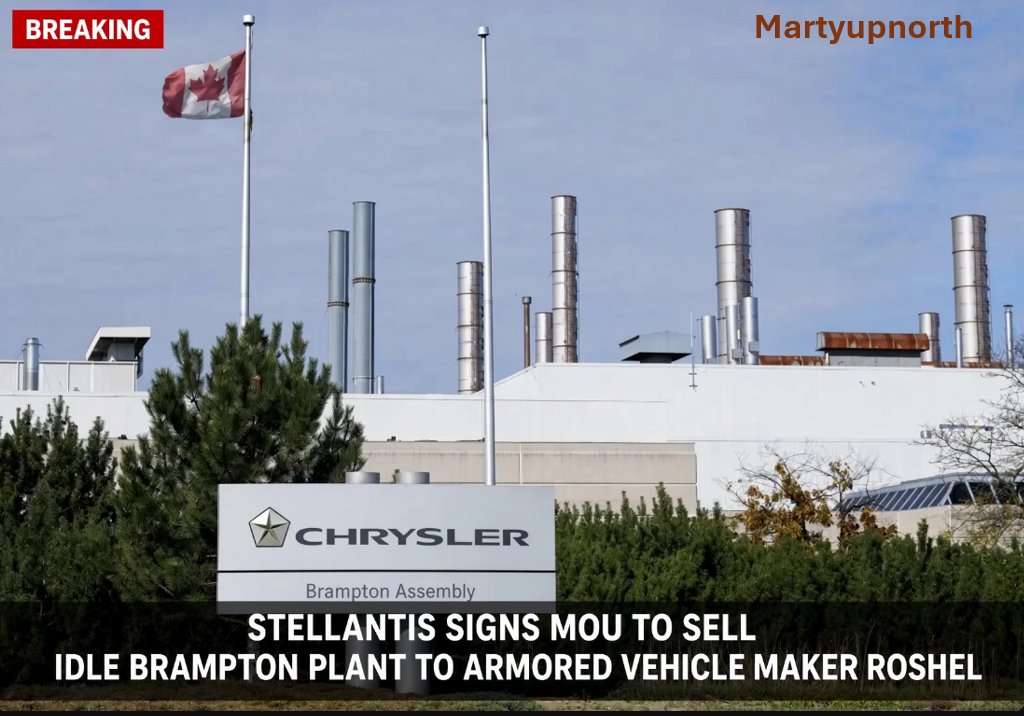
Image from @Martyupnorth on X
Let’s recap what happened at this old facility in the last 3 years.
The Brampton plant built Chargers & Challengers until December 2023. Then Stellantis (the parent company of Chrysler) shut it down to retool for Jeep Compass. Taxpayers handed over hundreds of millions of dollars to make that happen.
Workers were told it was temporary. They receive a combination of Employment Insurance (EI) and company-paid Supplemental Unemployment Benefits (SUB) that brought most of them up to about 70% of their regular weekly wage, plus continued health benefits. Their contract said they were good for 2 years of benefits.
In February 2025 the work stopped, because U.S. tariffs made building cars in Canada for the American market a losing proposition. October 2025 Stellantis moved the Compass to Illinois. The plant has sat empty ever since. Roughly 2,200 people have been collecting layoff cheques while the building rusts.
Now Stellantis has an MOU with Roshel, a local company that actually wants to use the place. The union’s response? Pause the contract talks. Declare an “impasse.” Demand the company keep pretending the old product plan is still viable.
Unifor spent years extracting benefits and job-security that assumed the world would stay the same. When the world changed, the union treated any other option, like a defence contractor, even just selling the asset so someone else who could hire people, as a betrayal.
The workers are the ones sitting at home. The union leadership is the one treating a mothballed factory like a sacred site that can only ever build Unifor-approved vehicles.
Markets don’t care about the last collective agreement. Tariffs don’t care. Customers don’t care. A plant that produces nothing is just expensive real estate with a Canadian flag out front.
The union’s job was supposed to be representing the people who used to work there. Instead it became another veto on anyone trying to turn the lights back on.
Unions are a scourge on Canada.
August 31, 2026
A Fighter to Make the European Skies Nazi – Nazi Rearmament 03 – Bf 109
World War Two
Published 30 Aug 2026The Messerschmitt Bf 109 was designed to solve one of the fundamental problems of modern warfare: how do you gain control of the air long enough for everything else to operate unhindered? Germany’s answer was a fast, heavily armed, highly advanced fighter that became the spearhead of the Luftwaffe‘s pursuit of air superiority.
In this German Rearmament special, we trace the Bf 109 from its origins in the clandestine development programs of the 1930s to its first combat missions over Spain and its emergence as one of the defining fighters of the Second World War. We examine its revolutionary design, its development and production, its role in the emerging doctrine of Bewegungskrieg, and its deployment from the opening campaigns in Poland and France to the Battle of Britain and the vast air war over the Eastern Front.
But the 109 also exposes the limits behind the image of an unstoppable German war machine. Its narrow-track landing gear made it notoriously unforgiving, its short range limited its effectiveness over Britain, and its ageing airframe became increasingly difficult to improve as the war progressed. By the later years of the war, Germany could still produce thousands of Bf 109s, but lacked the fuel, experienced pilots, industrial resources, and ultimately the air superiority needed to make those aircraft decisive.
The Bf 109 was an exceptionally advanced fighter for its time, and in the hands of an experienced pilot it remained lethal long after its first flight. But it also became a symbol of a deeper problem within the Nazi war economy: the growing inability to replace yesterday’s weapons with tomorrow’s.
This is the story of the fighter that made Blitzkrieg possible, and the machine that stayed in the sky long after Germany had lost control of it.
Never Forget.
August 29, 2026
The Origins of Aldo Uberti and Reproduction Cowboy Guns
Forgotten Weapons
Published 11 Apr 2026In 1958, Val Forgett of Navy Arms contracted with Beretta engineer Aldo Uberti to produce 1,000 reproductions of the Colt 1851 Navy revolver. That turned into the beginning of many decades of production of a wide variety of revolvers and rifles, from the LeMat to a line of Winchester lever actions. Fueled by both organized Cowboy Action competition and general widespread interest in these guns, Navy Arms grew very successful in the market, attracting many other companies who continue to exist to this day. Today I’m talking with Val Forgett’s son (also Val Forgett) about some of the interesting details of the business.
(more…)
August 26, 2026
The Korean War Week 114 – Stalin’s Secret Plan – August 25, 1952
The Korean War by Indy Neidell
Published 25 Aug 2026Heavy rains prevent action in the field in Korea this week, so the big story worldwide is talks in Moscow between Josef Stalin and Chinese Foreign Minister Zhou Enlai. They talk about Five Year Defense Plans, artillery production, Soviet aid for the Chinese, and exactly how they see the war in Korea and what they think of the American forces.
00:00 Intro
01:09 Bunker Hill
01:51 South Korean Prisoners of War
02:44 Chinese Soviet Talks
05:06 Five Year Defense Plan
07:26 Artillery Production
11:23 Stalin and the USA …
12:52 Eisenhower and the War
16:05 Summary
16:18 Conclusion
18:29 Sign Up
August 25, 2026
The new missile gap – between manufacture and deployment
Edward Luttwak offers some suggestions to help explain why the vast and lavishly funded US Military-Industrial Complex seems incapable of manufacturing enough weapons to allow the US military to fight more than a brief demonstration war before running short of the things that go boom:
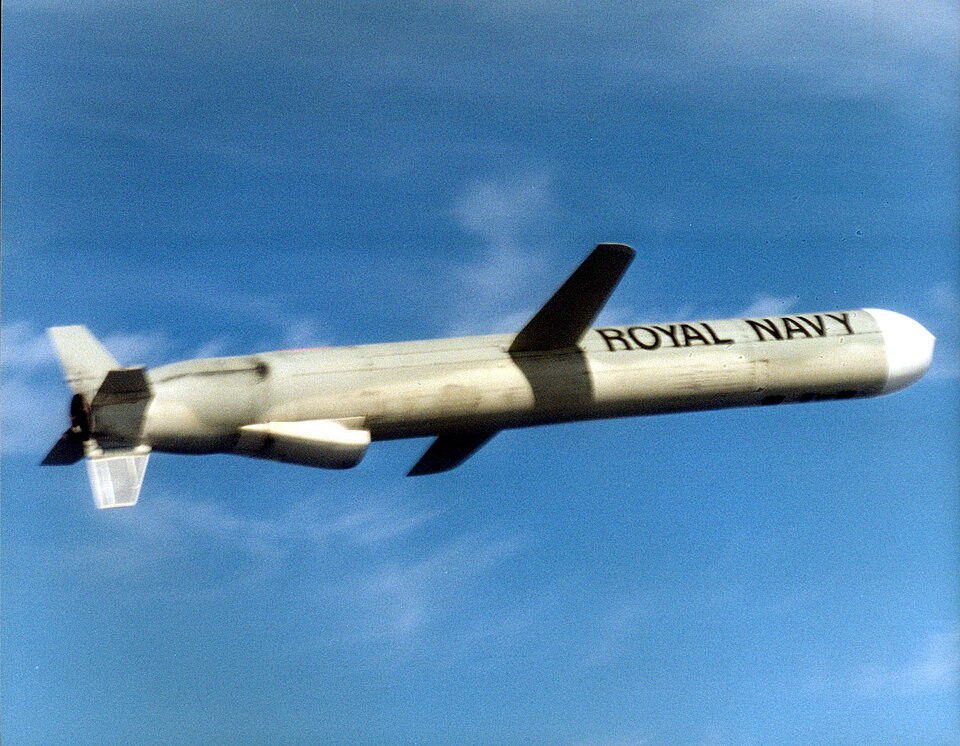
Royal Navy Tomahawk Land Attack Missile (TLAM) in flight.
MOD photo via Wikimedia Commons.
It is a strange thing indeed that among the countless stories about America’s shortage of long-range weapons — a truly crippling scarcity that now both limits President Trump’s strike options against the Islamic Republic, and might weaken responses to other looming threats — I have not found one that raises the most elementary question of all: why?
Why was Iran attacked with scarce and expensive BGM-109 Tomahawk Land Attack Missiles — costing around $3 million each — rather than ordinary gravity bombs dropped by fighter-bombers? Accuracy cannot be the answer: with so-called “JDAM” guidance kits, regular bombs become very accurate indeed, and they are still simple enough to be mass-produced cheaply.
Nevertheless, US forces had launched 850 Tomahawk missiles against Iran by 27 March this year, amounting to almost half the country’s global stockpile, though the Pentagon has since announced a huge $22.9 billion contract for more Tomahawks. Air-launched AGM-158 missiles, some of whose models can fly up to 1,000 miles, and which cost as much as $1.6 million apiece, were also used, along with Army’s Precision Strike Missiles are yet more expensive.
What makes these missiles so costly is their great virtue: they are all so-called “stand-off” weapons, which can safely be launched hundreds of miles from their targets. This means an attacker’s aircraft can remain outside enemy air space, where they could be exposed to detection by radars, and then to interception by air-defence fighters and surface-to-air missiles. There is simply no way of producing such missiles cheaply. They need powerful rocket propulsion and complicated electronic guidance to fly such vast distances and hit their targets successfully.
[…]
Nor, of course, are the implications here limited to Iran and the Gulf. Having needlessly used so many stand-off missiles to target Iran, US inventories are worryingly low in the event of the “Chinese contingency”: the invasion of Taiwan that Xi Jinping, unlike his predecessors, refuses to rule out. Any Chinese assault might start with subversion, with the activation of Chinese agents in Taiwan’s armed forces, but amphibious landings would have to follow — against which Tomahawk missiles would be the prime US weapon, alongside local anti-ship missiles.
But having examined all these technical details, we nonetheless arrive at something else entirely, a much more intractable problem than any munitions shortage could ever be: a fundamental change in the entire American attitude to war, which I described as “post-heroic” as far back as the Nineties when its first signs emerged.
This amounts to a truly drastic shift. What started with a proper striving to limit the casualties of war by every means possible — starting with prudent statecraft to avoid war in the first place, and extending to prudent tactics — has now devolved into the current predicament: whereby the US must spend billions on extremely elaborate stand-off missiles so as to further reduce risks to its pilots, which were already very low to begin with, against the vainglorious and incompetent Iranian enemy.
Of course, it’s always a possible explanation that the big defence contractors felt the need for another boost in their income, so it wouldn’t take much to persuade friends in the War Department or in the US Navy to toss a few more TLAMs at Iranian positions …
The Halftrack That Made Blitzkrieg Possible
World War Two
Published 23 Aug, 2026The tanks get the glory. But Blitzkrieg could not work on tanks alone.
The Sd.Kfz. 251 was designed to solve one of the fundamental problems of armored warfare: how do you keep infantry moving fast enough to fight alongside the Panzers? Germany’s answer was an armored half-track that helped turn infantry from a slow-moving follow-up force into an integral part of the Panzer division’s combined-arms assault.
In this German Rearmament special, we trace the Sd.Kfz. 251 from clandestine development under the restrictions of the Treaty of Versailles to its first production runs on the eve of World War Two. We examine its design, its role in the emerging doctrine of Bewegungskrieg, its deployment in Poland and France, and the extraordinary range of variants that turned it into one of the Wehrmacht’s most versatile vehicles.
But the 251 also exposes the limits behind the image of a fully mechanized German war machine. It was complicated and expensive to manufacture, there were never enough of them, and most German infantry continued to march or rely on horses and trucks. Even as production soared later in the war, Germany’s shortages of fuel, materials, manpower, and industrial capacity increasingly overwhelmed the advantages its engineers and tacticians had created.
The Sd.Kfz. 251 helped make the early German style of armored warfare possible. It also became another example of a sophisticated weapon system serving a war of aggression that Nazi Germany ultimately lacked the resources to sustain.
This is the story of the half-track that made Blitzkrieg possible.
Never Forget.
August 23, 2026
Why This “Foreign” Commonwealth Truck Was Built In 800,000 Units And Supplied Every Front
BritishWarLegends and BritishWarArmory
Published 31 Mar 2026The Canadian Military Pattern truck was built by two rival factories in Ontario for a nation of eleven million people. It ended up supplying the British Eighth Army across North Africa, Italy, Normandy, and Burma — and Canada built more of them than Germany, Italy, and Japan built trucks combined.
Almost nobody knows it existed.
When Rommel captured two thousand of them at Tobruk in 1942, he didn’t scrap them. The Afrika Korps pressed them straight into active German service. An enemy with his own purpose-built military trucks chose to keep using captured Canadian vehicles instead.
The full forgotten story.
Update: I generally try to avoid watching or re-posting clearly AI-generated slop, but this was the first video I’d encountered discussing the hundreds of thousands of CMP trucks that Canada built during WW2. At some point between me scheduling the video and today, the channel has been banned. You’ve undoubtedly seen CMP vehicles in WW2 stills or movie footage, as they’re pretty distinctive – https://en.wikipedia.org/wiki/Canadian_Military_Pattern_truck
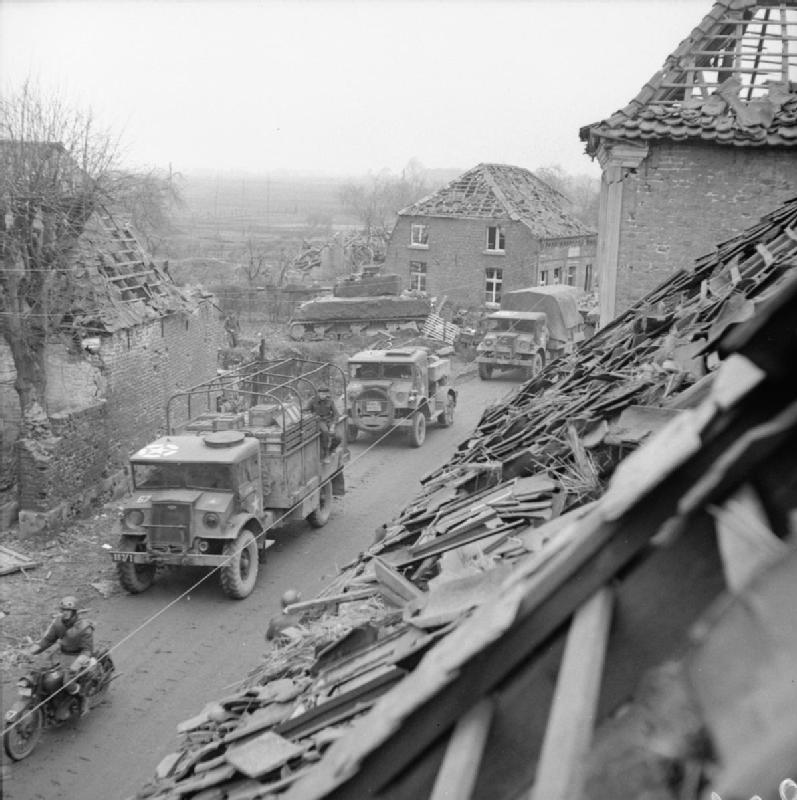
From The British Army in North-west Europe 1944-45,
CMP lorries passing through Uedem, 2 March 1945.
Photo by Carpenter (Sgt), No 5 Army Film & Photographic Unit, Photograph B 14966 from the Imperial War Museums via Wikimedia Commons.
August 6, 2026
B-29 Superfortress – A $3.7bn Trial By Fire
HardThrasher
Published 5 Aug 2026The Boeing B-29 Superfortress was the most advanced bomber of World War Two — but also one of the most troubled and expensive aircraft ever built, and was plagued with flaws.
Developed at extraordinary speed, the B-29 could fly higher, faster and further than earlier heavy bombers while carrying a formidable bomb load.
It introduced pressurised crew compartments, remote-controlled gun turrets, advanced fire-control systems and enormous Wright R-3350 engines. But it couldn’t hit a barn door with its guns, had urine in the brakelines and engines which kept exploding due to all the flammable metal in them.
This video explores how the B-29 was designed, why it cost more than the Atomic Bomb to develop and how the United States overcame these challenges to get it into the war.
And yes, this is purely an excuse for me to make videos about the bomber war in the Pacific, so yar booh sucks 😊
00:00 Introduction
01:47 MOAR, MOAR, MOAR
05:48 Origin Story
12:52 Built It And They Will Come
17:57 The Battle of Kansas
19:12 Root Causes – The Key Problems
23:59 So Wright It’s Wrong
32:39 ConclusionsSources
1. Pace, S., Boeing B-29 Superfortress, Crowood Press, 2003 p.53
2. Werrell, K.P., Blankets of Fire, US Bombers over Japan during World War II, Smithsonian Institution Press, 1996, p.82
3. Werrell, K.P., p.68
4. [Deleted Section]
5. Pace, S., p.23
6. Sixteenth Census of the United States, 1940–1940, NAID: 16660414
7. Werrell, K.P., p.75
8. Le May & Yenne, Superfortress – The Boeing B-29 and American Airpower in World War II, Westholme Publishing 2007 (original published 1988 by McGraw) p.78
9. Le May & Yenne, p.78
10. Werrell, K.P., p.80
11. Le May & Yenne, p.80
12. Werrell, K.P., p.67
13. Werrell, K.P., p.67
14. Werrell, K.P., p.80
July 23, 2026
The Korean War Week 109 – One Step From Peace! – July 21, 1952
The Korean War by Indy Neidell
Published 22 Jul 2026There’s only one thing left at the Panmunjom Peace Talks standing in the way of an armistice — Article 51. However, this article deals with the release of POWs and the two sides have very different interpretations of it. The UN is however, currently releasing all the civilian internees they hold. In the field, the fighting for Old Baldy flares up again as the Chinese attack, and an anti-guerrilla campaign comes to its end.
July 20, 2026
Carneynomics in action
Even though the relic media are all singing from the government’s hymn book — because they might lose their generous subsidies if they don’t — a few dispiriting details about the real state of Canada’s economy still slip through:
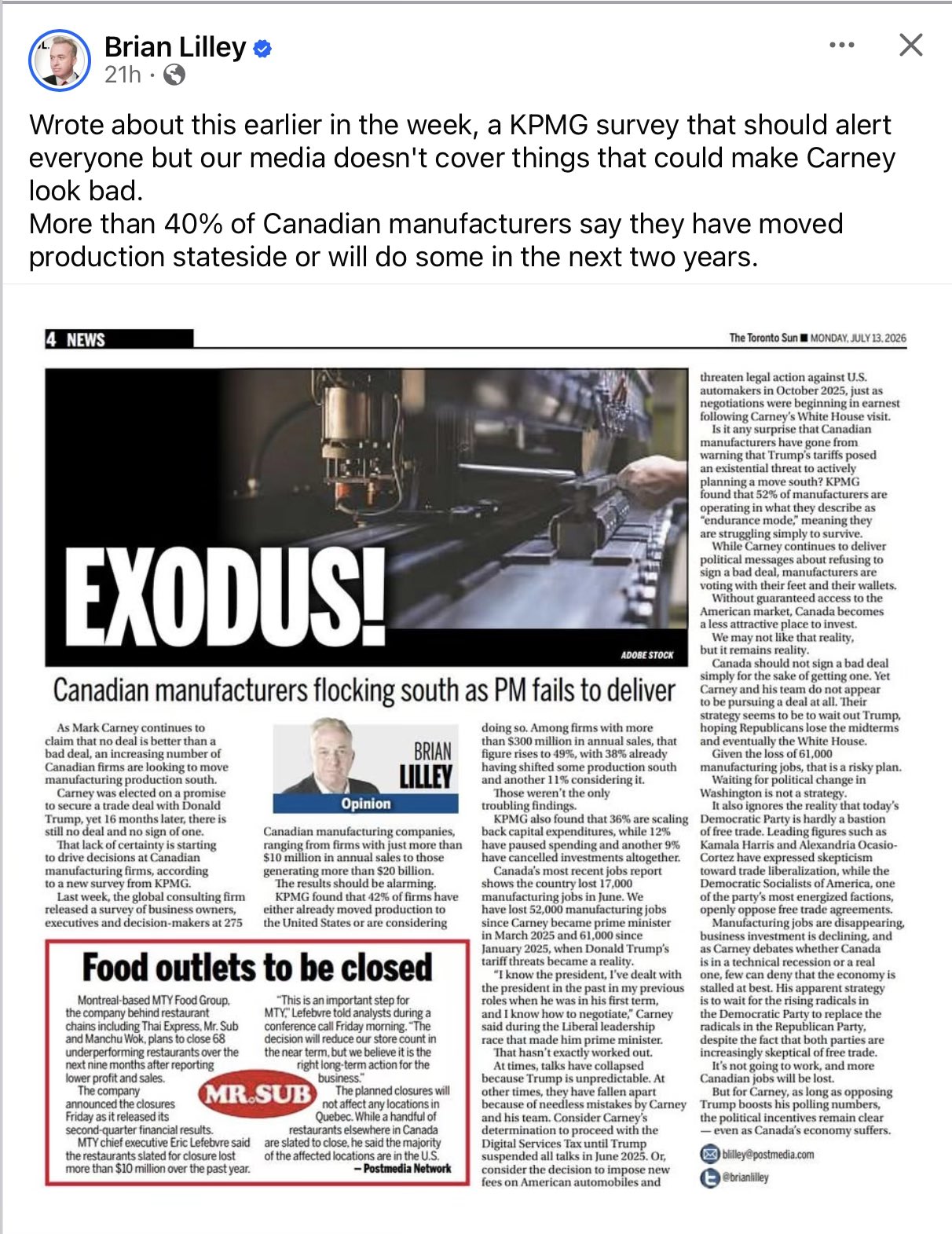
This is the Carney economy in one picture.
He sold himself as the adult in the room. The banker. The international dealmaker. The man who could handle Trump and restore confidence.
Instead, Canadian manufacturers are preparing their exit.
According to the KPMG survey, 42% of manufacturers have already moved some production to the United States or are considering doing so. Another 36% are cutting investment, 12% have paused spending and 9% have cancelled projects altogether.
Manufacturing jobs are disappearing. Investment is drying up. Factories are moving south.
Businesses respond to incentives, costs and uncertainty. They do not remain in Canada because Mark Carney gives polished speeches about nation-building. They go where taxes, energy prices, regulation, labour costs and access to markets make production worthwhile.
Carney promised competence. What Canadians are getting is stalled trade talks, falling investment, disappearing jobs and another Liberal government that seems incapable of understanding how private-sector wealth is actually created.
A great many Canadians now see Carney as an incompetent ideologue in a good suit, surrounded by the same Liberal machine that helped create this mess.
And what consequences does he face?
Very few.
Carney is rich. His family is secure. His pension, investments and connections are intact. He will never worry about a mortgage payment, a grocery bill, a lost factory job or whether his children can afford a home.
The people who pay for his failures are workers, families, small-business owners and young Canadians whose futures are being shipped across the border.
That is the ugliest part of modern government. The people making the decisions are often insulated from the consequences. They can damage an economy, lose jobs, drive away investment and still retire wealthy, respected and welcomed back into corporate boardrooms.
A résumé is not an economic policy. A banker’s vocabulary cannot hide factories closing and investment leaving.
Canada is not being built. It is being hollowed out, while the people responsible remain comfortable.
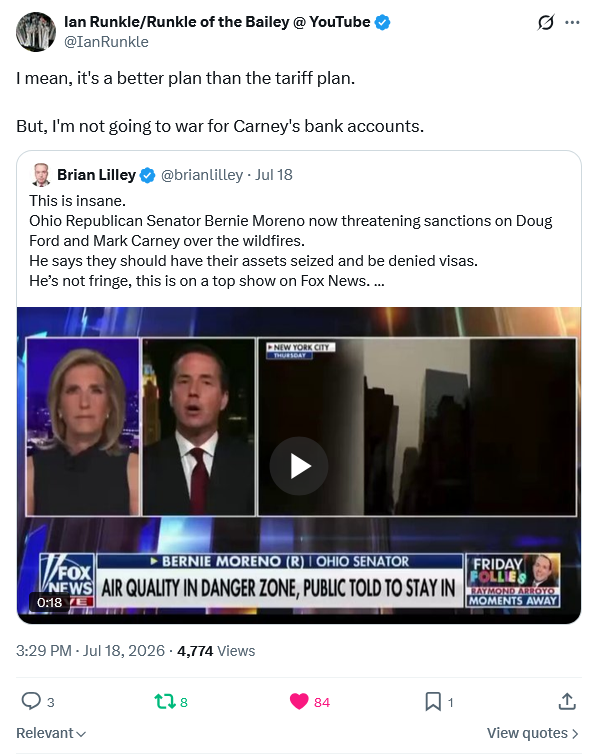
This is why I thought the announcement on Friday that a Republican senator is calling for Carney’s assets in the US to be seized and to refuse him a visa … it’s beyond weird that a Canadian Prime Minister would have over 90% of his personal assets invested in the United States rather than in Canada. This gives Trump another handle on Carney, if he chooses to use it.
On her Substack, Melanie in Saskatchewan envisions how this may play out:
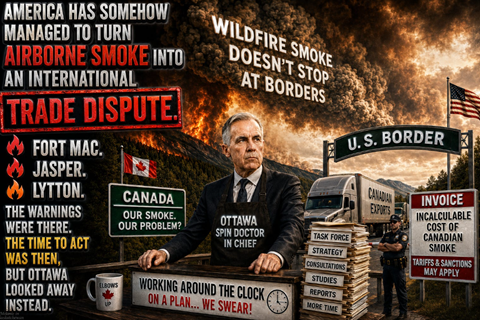
AI image from Melanie in Saskatchewan
So let me make a prediction: Any day now, your government will solemnly discover the importance of proper forest management.
There could be a task force, or a federal strategy, a minister standing solemnly in front of some trees. Perhaps an announcement that Ottawa has been “working around the clock” on a comprehensive plan that, by a miraculous coincidence, became urgent only after the American president threatened tariffs and a U.S. senator started talking about sanctions.
Should that happen, Canadians will be entitled to ask a very simple question: What finally changed Ottawa’s mind?
Was it concern for Canadians living through evacuations, destroyed communities and weeks of choking smoke? Was it the economic damage caused by recurring fire seasons? Was it pleas from provinces, northern communities and forestry workers for better prevention, mitigation and emergency capacity?
Or did the urgency arrive only when Washington threatened to slap another charge on Canadian exports and Senators possibly sanctioning Canadian officials like yourself? You personally have A LOT at stake if you are sanctioned since the majority of your wealth investment portfolio is in America.
The timing on this matters a great deal. It matters whenever a government suddenly treats a long-standing domestic problem like a national emergency only after somebody powerful outside the country attaches a financial consequence to it.
Trump has accused Canada of “wilful negligence” in maintaining its forests and says he intends to ask you what Canada plans to do. Your emergency management minister responded that governments have invested billions in fire prevention and forest sustainability since 2020. That defence deserves to be examined very closely and very carefully, because Canadians can reasonably ask what those billions purchased, where they went and why so many communities remain frighteningly vulnerable. To say it plainly … Canadians simply do not see any value for the dollars spent.
You announced spending of $317 million to lease 10 water bombers and heavy helicopters for rapid deployment to provinces because the wait time for them to be built is too long. So, here’s a fun little arithmetic exercise for Ottawa: water bombers are built right here in Canada — jobs, sovereignty, the whole patriotic package you’ve been selling — yet the federal shopping list remains stubbornly empty.
With $317 million, you could buy three heavy scoopers and have pocket change left for spotter planes or a helicopter, or — and this is where it gets embarrassing — you could roll out 45 to 55 single-engine Fire Boss aircraft, scattering an actual national fleet across every province that needs one. But apparently the government prefers its firefighting budgets theoretical. It is here that I will remind you, Fort Mac, Jasper and Lytton should have already provoked this response to act years ago.
The United States is hardly in a position to lecture anyone without hypocrisy. It is enduring its own brutal wildfire season, and fires do not stop at customs booths to declare their country of origin. Climate, drought, lightning, forestry practices and emergency capacity all play a role. There is plenty of responsibility, contradiction and political theatre to go around here. America has somehow managed to turn airborne smoke into an international trade dispute, because apparently even oxygen now requires a customs declaration. But that doesn’t absolve Ottawa. Again … Fort Mac. Jasper. Lytton. The warnings were already there. The time to act was then, but Ottawa chose navel gazing instead. In my books, that means today’s consequences lie with the governing Liberals.
July 14, 2026
July 8, 2026
The Korean War Week 107 – America on Strike! – July 7, 1952
The Korean War by Indy Neidell
Published 7 Jul 2026The US Steelworkers Union strike enters its second month this week with no end in sight and the lack of steel production is affecting the war, worsening what is already an artillery shell crisis. President Harry Truman even considers taking over the steel industry to salvage the war effort. In South Korea, the constitution is amended to allow direct popular Presidential elections rather than the President being chosen by the National Assembly and in Chicago, at the end of the week the US Republican Party Convention begins, with Douglas MacArthur giving the keynote address.
00:00 Intro
00:39 Recap
01:09 Local SK News
03:22 Bombing the Power Plants
05:24 Artillery Crisis and Steelworkers Strike
09:53 Republican Convention Begins
13:46 Summary
13:59 Conclusion
June 29, 2026
Stupid Super Heavies: Germany’s Biggest Tanks
The Tank Museum
Published 27 Feb 2026By late 1943 Germany was losing the war …
They needed tanks, and lots of them, if they were going to wrestle back the initiative. Instead, they became obsessed with wonder weapons they hoped could change their fate
From the logistical paralysis of King Tiger, growing ever bigger and more unwieldy with the Maus, ultimately reaching the madness of the thousand tonne Ratte.
Like Augustus Gloop, German tank development in the Second World War greedily ate up more and more resources.
While an absolute boon for historians working at The Tank Museum, it made no logical sense … What were they thinking?
This is the bewildering story of the “Super Heavies”
00:00 | Introduction
00:48 | The Panther Problem
02:27 | Bigger is Better
05:42 | Pushing the Limits
09:19 | Gigantic Fantasies
12:03 | Losing the War (and the Plot)
(more…)
June 21, 2026
How Britain Made the L1A1 SLR: archive film with intro by Jonathan Ferguson
Royal Armouries
Published 21 Jan 2026Following last week’s look at the very first L1A1 SLR ever produced (1957), we’re sharing a remarkable Royal Small Arms Factory (RSAF) Enfield archive film, shot in the 1960s, showing the key stages of L1A1 manufacture and a rare glimpse of the original Enfield pattern room.
Then we step back and let the film speak for itself, nearly an hour of pure production and engineering process.
0:00 Intro
3:05 Enfield + Pattern Room
3:57 Planning & Tooling
4:37 Rifle body: Heat treat → Machining → Inspection
18:16 Barrels: Drilling, Rifling, Plating & Production line
34:28 Housing/Trigger, Furniture & Magazines
50:16 Assembly → Proofing/Testing → Packing & Dispatch
(more…)


