
Edward Luttwak offers some suggestions to help explain why the vast and lavishly funded US Military-Industrial Complex seems incapable of manufacturing enough weapons to allow the US military to fight more than a brief demonstration war before running short of the things that go boom:
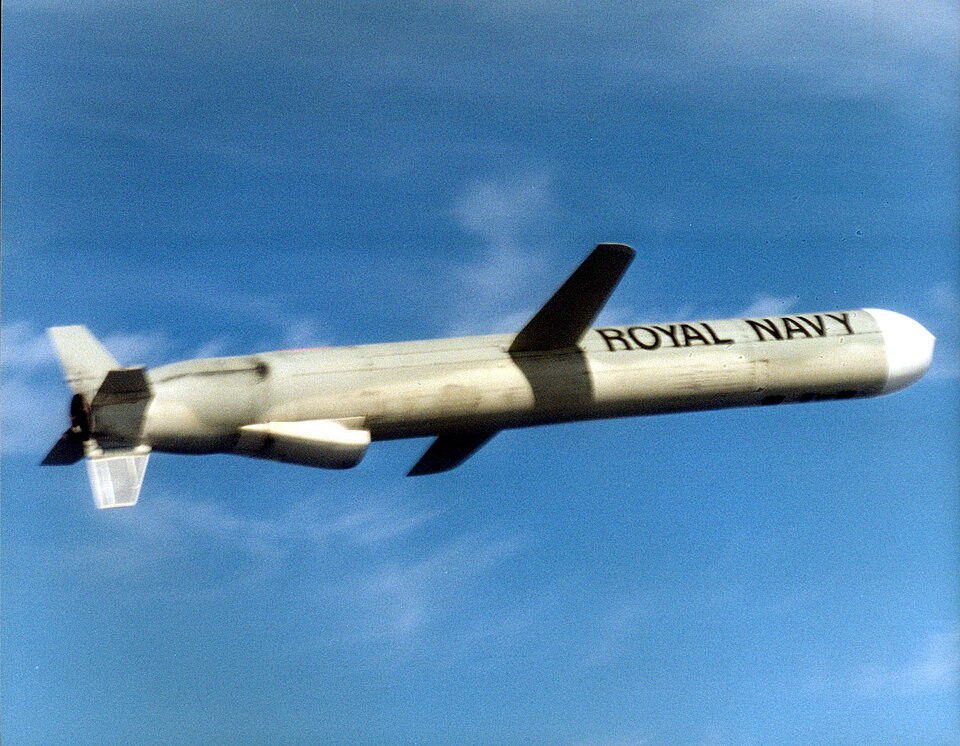
Royal Navy Tomahawk Land Attack Missile (TLAM) in flight.
MOD photo via Wikimedia Commons.
It is a strange thing indeed that among the countless stories about America’s shortage of long-range weapons — a truly crippling scarcity that now both limits President Trump’s strike options against the Islamic Republic, and might weaken responses to other looming threats — I have not found one that raises the most elementary question of all: why?
Why was Iran attacked with scarce and expensive BGM-109 Tomahawk Land Attack Missiles — costing around $3 million each — rather than ordinary gravity bombs dropped by fighter-bombers? Accuracy cannot be the answer: with so-called “JDAM” guidance kits, regular bombs become very accurate indeed, and they are still simple enough to be mass-produced cheaply.
Nevertheless, US forces had launched 850 Tomahawk missiles against Iran by 27 March this year, amounting to almost half the country’s global stockpile, though the Pentagon has since announced a huge $22.9 billion contract for more Tomahawks. Air-launched AGM-158 missiles, some of whose models can fly up to 1,000 miles, and which cost as much as $1.6 million apiece, were also used, along with Army’s Precision Strike Missiles are yet more expensive.
What makes these missiles so costly is their great virtue: they are all so-called “stand-off” weapons, which can safely be launched hundreds of miles from their targets. This means an attacker’s aircraft can remain outside enemy air space, where they could be exposed to detection by radars, and then to interception by air-defence fighters and surface-to-air missiles. There is simply no way of producing such missiles cheaply. They need powerful rocket propulsion and complicated electronic guidance to fly such vast distances and hit their targets successfully.
[…]
Nor, of course, are the implications here limited to Iran and the Gulf. Having needlessly used so many stand-off missiles to target Iran, US inventories are worryingly low in the event of the “Chinese contingency”: the invasion of Taiwan that Xi Jinping, unlike his predecessors, refuses to rule out. Any Chinese assault might start with subversion, with the activation of Chinese agents in Taiwan’s armed forces, but amphibious landings would have to follow — against which Tomahawk missiles would be the prime US weapon, alongside local anti-ship missiles.
But having examined all these technical details, we nonetheless arrive at something else entirely, a much more intractable problem than any munitions shortage could ever be: a fundamental change in the entire American attitude to war, which I described as “post-heroic” as far back as the Nineties when its first signs emerged.
This amounts to a truly drastic shift. What started with a proper striving to limit the casualties of war by every means possible — starting with prudent statecraft to avoid war in the first place, and extending to prudent tactics — has now devolved into the current predicament: whereby the US must spend billions on extremely elaborate stand-off missiles so as to further reduce risks to its pilots, which were already very low to begin with, against the vainglorious and incompetent Iranian enemy.
Of course, it’s always a possible explanation that the big defence contractors felt the need for another boost in their income, so it wouldn’t take much to persuade friends in the War Department or in the US Navy to toss a few more TLAMs at Iranian positions …



Western nations have become more risk averse when it comes to casualties. I would say even going back to Vietnam for the USA, the “body count” that the media presents skews public perception, and therefore elicits a response from the politicians. Military leaders will follow their directions from the politicians, so it would make more sense that they use standoff munitions and other tools to keep pilots out of harms way. I mean, just look at the kerfuffle that happened when there was a report of a single fighter being shot down. Some of these media folks would have wilted under the destruction and loss during WWII or Korea even.
And I won’t even get into the implications of collateral damage to the enemy. Who really cares about the enemies own population if they don’t care about their own people anyway!
Comment by Dwayne — August 25, 2026 @ 16:27
Western nations have become significantly more risk averse almost in lockstep with a steady decrease in the number of children in the average family. Not to be flippant, but losing a son when you have three or four kids is a very different proposition to losing your only son.
Comment by Nicholas — August 25, 2026 @ 16:53
I received this comment on social media and with the permission of the poster, I’m sharing it here:
Comment by Nicholas — August 25, 2026 @ 16:50